


Professional Mobile Step Stools for Retail Stores in Bahrain
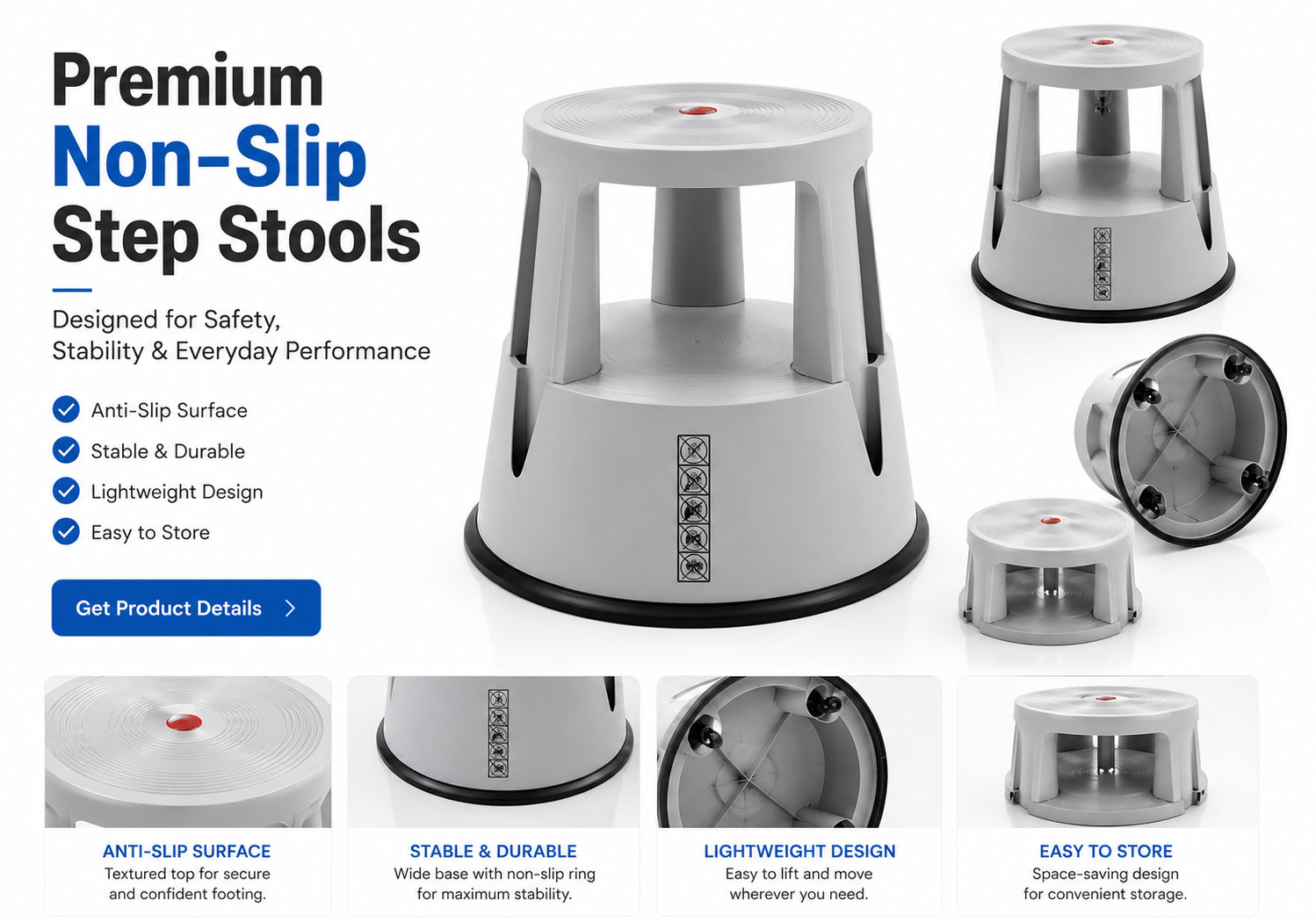
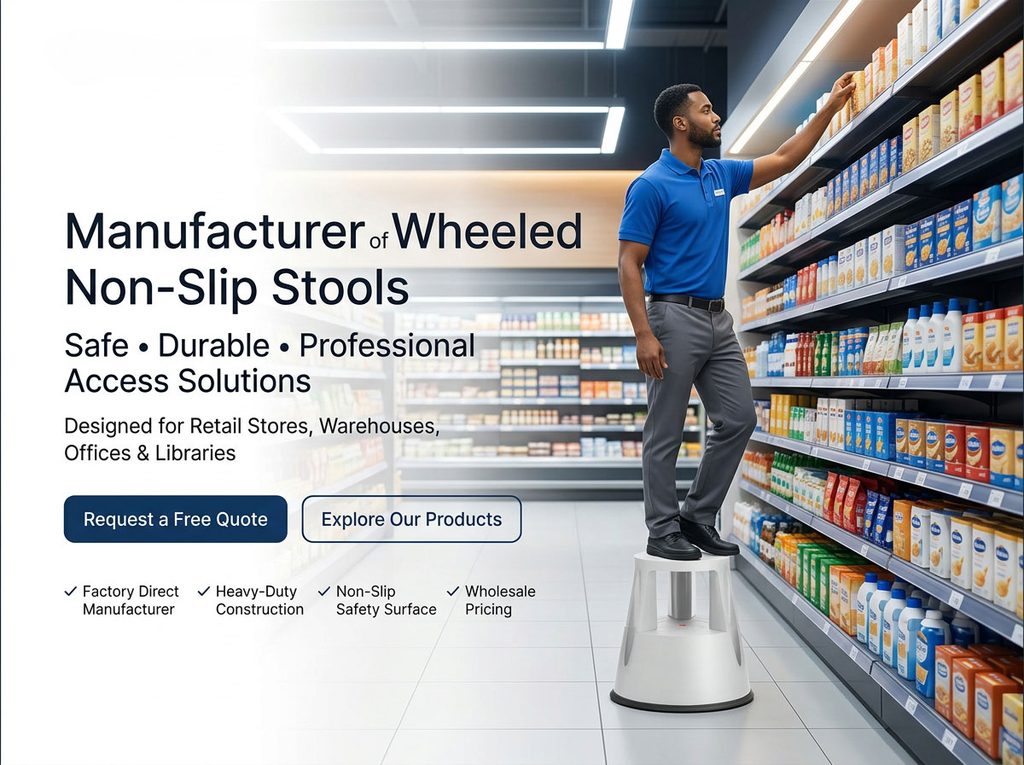
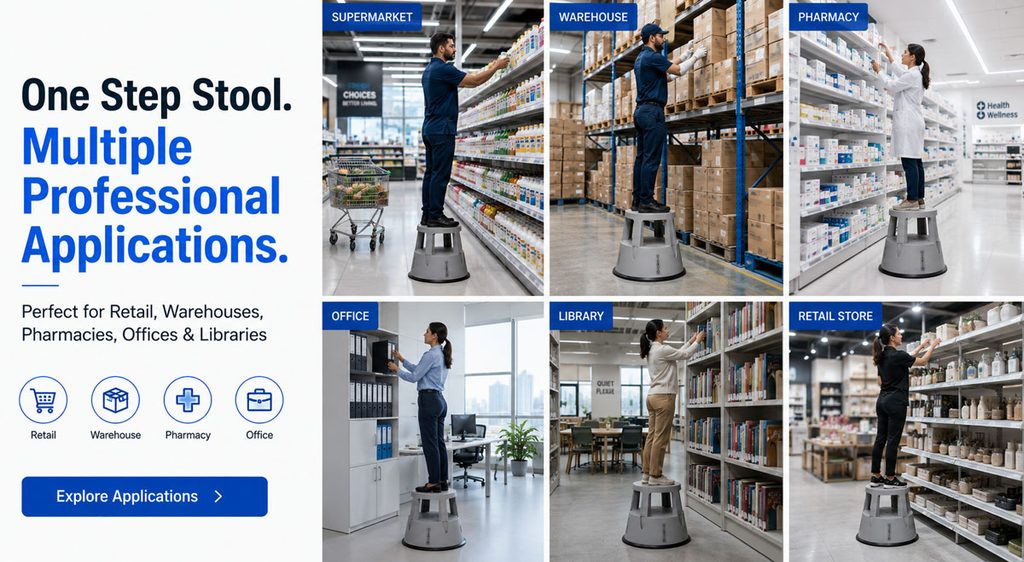
Professional Mobile Step Stools for Retail Stores in Bahrain give retail staff in Bahrain safe, rapid access to elevated shelves, promotional displays, and overhead stock without blocking customer flow. Built for continuous commercial use, these units combine spring-loaded wheels, industrial non-slip platforms, and 150 kg load capacity so that a team member can roll the stool into position, step up securely, complete the task, and move on in seconds. Suitable for both pure retail floors and warehouse-retail hybrid zones that feed supermarket operations, they support bulk orders, OEM customization, and wholesale supply. Firmalazım supplies retail-ready models engineered for the aisle widths, floor finishes, and daily intensity found across Bahrain.



The Invisible Friction That Slows Every Retail Floor
Walk any busy retail store in Bahrain during restocking windows and the pattern repeats. Staff stretch, stack empty cartons, or drag a fixed ladder into an aisle while customers wait or divert. The delay is measured in seconds per task, yet across a full day and multiple locations the total becomes hours of lost productivity and repeated near-miss situations. Professional mobile step stools remove that friction when they are specified for real retail conditions rather than generic light-duty use.
This analysis is written from the viewpoint of a retail operations and procurement lead responsible for store performance across Bahrain. The focus is on how the right mobile step stool changes daily workflow, protects safety, and supports consistent on-shelf availability without creating new obstacles for customers.
Why Conventional Solutions Fail on the Sales Floor
Fixed ladders occupy space and create trip hazards. Lightweight domestic stools flex under commercial loads and slide on polished tile. Improvised platforms made from product crates introduce both safety and product-damage risk. In a retail environment the equipment must be mobile enough to appear only when needed and stable enough that staff trust it completely once it is in place.
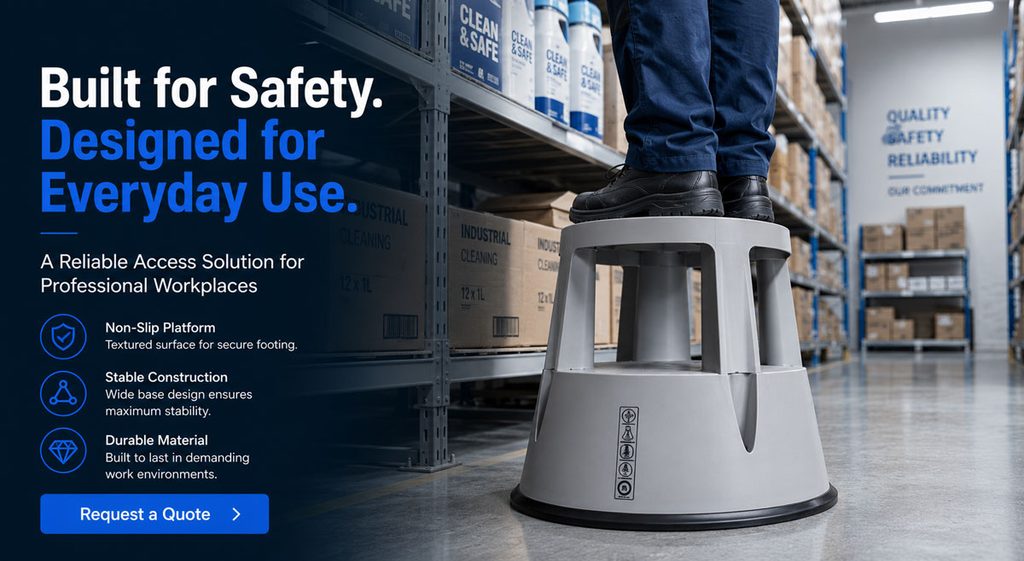
The current generation of professional mobile step stools solves the conflict with spring-loaded wheels that extend for rolling and retract automatically under body weight. The moment the operator steps on, the unit becomes a rigid platform. When the operator steps off, the wheels re-engage and the stool can be moved in one smooth motion. This automatic transition is the single most important usability feature for fast-paced retail floors.
Core Specifications That Matter in Retail
Typical professional units in this category deliver:
- 150 kg load capacity
- Overall height of approximately 410 mm
- Top platform diameter around 283 mm
- Base diameter of 433 mm for inherent stability
- Heavy-duty plastic construction with molded non-slip treads
- Spring-loaded wheels that require no separate locking lever
- Color options (grey, black, blue, red) that support basic zone coding
These dimensions keep the center of gravity low while still providing useful reach for the majority of retail high-bay and promotional tasks. The plastic body resists corrosion in air-conditioned environments, cleans easily, and does not mark polished floors common in modern Bahraini stores.
Retail-Specific Working Conditions in Bahrain
Sales floors range from high-gloss tile in newer developments to more traditional finishes in older buildings. Morning cleaning leaves residual moisture. Customer traffic continues during many restocking windows. Aisles are often narrower than pure warehouse corridors. Any stool that is slow to deploy, difficult to lock, or visually intrusive creates more problems than it solves.
In Manama the intensity of footfall and the speed of restocking cycles favor equipment that moves and settles in seconds. In Riffa stores that combine retail presentation with back-of-house support the same units often travel between the sales floor and the warehouse-retail interface. In Muharraq older layouts with tighter dimensions reward a compact footprint and low overall height. The practical requirements continue through Hamad Town, Isa Town, Sitra, Jidhafs, Budaiya, A’ali, Tubli, Sanabis, Seef, Saar, Janabiya, Karbabad, Barbar, Diraz, Bani Jamra, Al Hidd, Arad, Galali, Diyar Al Muharraq, Amwaj Islands, Maqabah, Abu Saiba, Shakhura, Al Markh, Jasra, Hamala, and Zallaq.
Human-Factors Advantages on the Sales Floor
Because the settling action is automatic, the most common operator error—stepping onto a partially locked unit—is largely eliminated. Gloved or bare hands both work equally well; there is no small lever to manipulate. The wide base and low height reduce the feeling of instability that causes staff to hesitate or over-reach from the floor. Over a full shift these small reductions in hesitation and physical strain compound into higher completed tasks and lower fatigue.
Placement Logic That Protects Customer Flow
The ideal storage points sit close enough to high-bay and promotional zones that retrieval is not a deterrent, yet outside the primary customer circulation paths. End-cap positions, the edge of back-stock doors, and designated spots near seasonal display areas usually satisfy both needs. High-visibility colors or simple floor markers further reduce the chance that a stool is left in an active aisle after use.
Comparative View: Mobile Professional Stools versus Alternatives
| Solution | Speed of Deployment | Stability under Load | Customer Disruption | Suitability for Daily Retail Use |
|---|---|---|---|---|
| Fixed ladder | Slow | High | High | Poor |
| Domestic step stool | Medium | Low–Medium | Medium | Poor |
| Improvised crates | Fast | Very Low | Medium | Unacceptable |
| Professional mobile stool | Very Fast | High | Low | Excellent |
The professional mobile design wins on the combination of speed, stability, and minimal disruption—the three variables that matter most on an active sales floor.
Procurement Framework for Retail Networks
- Map the highest-frequency elevated tasks on the sales floor and in the immediate back-of-house.
- Measure the narrowest working aisles and any floor transitions.
- Confirm that 150 kg capacity provides comfortable margin for operator plus typical retail case weights.
- Trial units on the actual floor finishes present in representative stores.
- Evaluate roll effort and automatic settling with both permanent and temporary staff.
- Decide whether color coding by zone or department adds operational value.
- Structure bulk orders through a manufacturer or wholesale partner capable of consistent quality.
- Consider modest OEM adjustments only after the base design has proven itself in live conditions.
Cost Perspective for the Retail Buyer
Unit price is visible; the cost of delayed restocking, damaged promotional displays, and minor injuries is less visible yet real. A professional mobile stool that is used consistently reduces all three. When bulk orders are placed with a reliable manufacturer the per-unit economics improve while specification consistency across stores is protected. A distributor can supply faster trial quantities and individual replacements; the manufacturer route suits larger wholesale volume and any OEM work.
Safety Integration on the Sales Floor
The equipment must appear in the store’s height-access procedure with clear, simple rules: position the stool, step on so that it settles fully, maintain three points of contact, complete the task, step off, and return the unit to its designated point. Because the mechanism itself enforces the stable state, compliance rates are typically higher than with lever-locked designs.
Maintenance Reality in Retail Environments
Weekly visual checks of the non-slip surface, wheel function, and structural integrity are sufficient. Units that develop uneven spring action, smoothed treads, or visible cracks are removed immediately. The mechanical simplicity of the spring-loaded plastic design keeps maintenance demand low and supports high availability.
Real Operating Scenarios
During a promotional changeover the same stool moves from installing overhead signage to topping up elevated seasonal stock and then to adjusting a high display in the adjacent aisle. In a hybrid warehouse-retail site the unit supports both bulk picking in the back and final presentation on the sales floor. Temporary staff receive a thirty-second demonstration and can use the equipment correctly for the remainder of their shift.
Five Distinct Calls to Action
- Place a small trial set in your highest-intensity stores and measure the change in restocking time and staff feedback within two weeks.
- Share your dominant aisle widths and elevated task profile for a concise model recommendation.
- Move from reactive replacement to planned bulk orders timed ahead of major promotional peaks.
- Standardize on one professional mobile design across the network to simplify training and spare holding.
- Request both standard wholesale pricing and OEM options so the long-term fleet can be optimized for your exact conditions.
Firmalazım supplies professional mobile step stools engineered for the speed, safety, and customer-flow demands of retail stores in Bahrain. Whether the requirement is met through standard wholesale channels or through structured OEM programs, the focus remains on automatic stability, durable non-slip performance, low-effort mobility, and consistent behavior under daily commercial use. Commercial Step Stool Solutions for Facility Management in Bahrain
When the right mobile step stool is correctly specified, placed, and supported by simple procedures, the silent friction that slows every retail floor begins to disappear. The result is faster restocking, fewer improvisations, and a measurably safer working environment for the teams who keep the shelves full.
Frequently Asked Questions
What makes a mobile step stool “professional” rather than domestic? Higher load capacity (typically 150 kg), industrial non-slip surfaces, spring-loaded or positive locking systems designed for repeated daily use, and construction that survives continuous commercial cleaning and traffic.
How do spring-loaded wheels improve safety on a retail floor? They eliminate the need for a separate locking action. The unit becomes stable automatically when weight is applied and mobile again when weight is removed, reducing the most common operator error.
Is 410 mm height sufficient for most retail tasks in Bahrain? Yes for the majority of high-bay restocking, promotional installation, and overhead display work found in supermarket and general retail environments. Very high architectural features may still require other equipment.
Can the same stools be used in both the sales floor and the warehouse-retail back area? Yes. The design performs on both polished retail tile and typical back-of-house surfaces, supporting consistent equipment standards across the boundary.
How important is the non-slip surface when floors are recently cleaned? Critical. Residual moisture is common. Molded industrial textures that retain grip under light moisture keep the platform trustworthy.
What is the practical advantage of a 433 mm base diameter? It lowers the center of gravity and increases inherent stability, which is especially valuable when operators shift weight while handling product at height.
Are color options useful in a retail network? Yes. Simple color coding by zone or department helps staff locate the nearest unit quickly and supports clearer ownership of equipment condition.
How should bulk orders be planned for a multi-store retail group? Complete on-site trials first, confirm the preferred specification, then place volume orders through a manufacturer or wholesale partner that can guarantee consistency across the batch.
Is OEM customization practical for retail step stools? Yes for larger networks that want uniform color, molded identification, or minor dimensional alignment. It is best considered after the base model has proven itself in live stores.
What maintenance is realistically required? Weekly visual inspection of wheels, spring action, non-slip surface, and overall structure. Immediate removal of any unit that shows damage or inconsistent settling.
How do these stools affect customer experience during restocking? When used correctly they appear only for the duration of the task and are removed quickly, minimizing aisle blockage compared with fixed ladders or improvised platforms.
Can temporary or seasonal staff use them safely with minimal training? Yes. The automatic settling action and simple operating sequence allow correct use after a very short practical demonstration.
What is the most common reason retail teams abandon a step stool? Loss of confidence caused by perceived instability, difficult locking, or slippery surfaces. Professional designs that feel solid and settle automatically maintain higher utilization.
How does the product support overall store safety culture? By providing a convenient, reliable alternative to stretching, climbing shelves, or stacking crates. When the correct tool is trusted and easy to use, unsafe improvisation declines.
Should every store carry the same model? Standardization simplifies training and spare parts. Minor variations in height or color coding can still be introduced if layout differences are significant.
What role does a distributor play versus direct manufacturer supply? A distributor often provides faster trial units and individual replacements. Direct manufacturer supply suits larger wholesale volume and OEM programs that require tight specification control.
How long do professional plastic mobile stools typically last under daily retail use? With correct use and basic inspection, well-engineered units commonly deliver several years of service. Actual life depends on intensity, floor conditions, and adherence to load limits.
Is it worth keeping a small buffer stock in the system? Yes. A limited buffer allows immediate replacement of any unit taken out of service and maintains coverage during promotional peaks.
What documentation should be requested before a large order? Load rating, material specification, confirmation of spring-rate consistency across the batch, and any available performance information under repeated load cycles.
How do these stools perform when operators wear standard work gloves? Because there are no small levers to manipulate, gloved operation is straightforward. The platform and any hand contact surfaces remain usable.
Can the stools be cleaned with normal retail floor chemicals? Yes. Heavy-duty plastic constructions tolerate standard cleaning agents when the finish and non-slip surface are appropriately specified.
What is the primary benefit for a supermarket-linked retail network in Bahrain? Consistent, fast, and safe height access that works on both the sales floor and the supporting warehouse-retail zones, reducing friction and risk across the entire operation.
Where should trial units or further technical clarification be requested? Directly from the manufacturer or authorized wholesale and distribution partners that support professional retail equipment requirements in the region.
Professional Mobile Step Stools for Retail Stores in Bahrain
Continuing with Staff Adoption Psychology and Promotional Execution Speed
Equipment that is technically correct can still fail if staff do not prefer it to the previous method. On a retail floor the decision to use or ignore a mobile step stool is made in seconds, often under the pressure of customer presence and time targets. Professional designs that feel immediately stable, require no extra actions, and move out of the way cleanly win that decision more often than units that demand conscious effort or create visible disruption.
When adoption is high, promotional changeovers accelerate. Overhead signage, elevated seasonal displays, and high-bay planogram adjustments that once required coordination of ladders or improvised platforms become single-person tasks completed between customer peaks. The time saving appears both in labor hours and in the speed with which new campaigns reach full visual impact.
Store-by-Store Rollout Scoring System
A lightweight scoring approach helps prioritize where professional mobile stools will deliver the fastest return.
| Factor | Weight | Score 3 | Score 2 | Score 1 |
|---|---|---|---|---|
| Frequency of elevated tasks | High | Multiple times per shift | Several times per day | Occasional |
| Aisle width constraint | High | Narrow, high customer traffic | Medium | Wide, low traffic |
| Current improvisation rate | High | Frequent stretching or crates | Occasional | Rare |
| Promotional intensity | Medium | Frequent campaign changes | Seasonal | Low |
| Back-of-house to sales floor flow | Medium | Regular hybrid movement | Occasional | Separate |
Stores scoring 12 or higher become priority locations for the first wave of units. Lower-scoring stores follow once the preferred specification is confirmed and training materials are refined.
Expert Note on Visual Merchandising Teams
Visual merchandising staff often work under tighter time windows and higher aesthetic standards than routine restocking teams. A mobile stool that settles cleanly and can be removed without leaving scuff marks or residual presence supports both speed and presentation quality. When the same equipment is trusted by both operational and merchandising teams, coordination friction declines.
Short Scenario: Campaign Launch Window
A national promotion requires elevated header boards and high-bay product blocking across multiple stores in a single night. Teams equipped with professional mobile stools complete the elevated elements in parallel rather than waiting for shared ladders. Because the units roll in, settle automatically, and roll out again, the sales floor remains largely open for final cleaning and early customer access. Stores still relying on older methods finish later and with higher visible disruption.
Checklist for First 30 Days After Introduction
- Confirm every new unit has been placed in a designated, high-visibility storage point
- Complete a 60-second practical demonstration with every shift that will use the equipment
- Record any early feedback on roll effort, settling behavior, or platform size
- Remove or relocate any older, less-trusted stools from the same zones
- Re-check utilization after the first major promotional changeover
- Adjust placement points if staff report retrieval friction
This short cycle converts a product delivery into an operational change rather than a simple equipment addition.
Interaction with Warehouse-Retail Hybrid Flows
Many retail sites in Bahrain maintain a direct physical link between back-of-house storage and the sales floor. Professional mobile stools that perform reliably in both environments allow the same tool to support bulk picking, transfer, and final presentation. Consistency of equipment across the boundary removes a small but repeated source of delay and training variation.
Safety as a Daily Operating Condition
On a retail floor the presence of customers raises the consequence of any height-related incident. A stool that is trusted and used correctly reduces the frequency of stretching, climbing on fixtures, or stacking product as improvised platforms. The safety contribution is therefore both protective and cultural: it signals that the store provides proper tools and expects them to be used.
Bulk Order and Supply Considerations for Retail Networks
Once priority stores have validated the design, volume can be scaled through bulk orders placed with a manufacturer capable of consistent spring performance and dimensional accuracy. A wholesale partner or distributor can bridge the period between trial and full rollout by supplying intermediate quantities and rapid replacements. OEM adjustments—common color, discreet branding, or zone identification—become practical once the base model has already proven itself under live retail conditions.
Micro-Friction That Compounds Across a Network
Every time a team member hesitates before using a stool, or chooses an unsafe alternative because the proper unit feels marginal, a small cost is incurred. Across dozens of stores and hundreds of daily elevated tasks those costs accumulate into measurable differences in restocking speed, promotional readiness, and incident rates. Professional mobile stools that remove the hesitation deliver their return through the steady absence of that friction.
In Manama the combination of high footfall and frequent campaign activity makes rapid, low-disruption height access especially valuable. In Riffa stores that balance strong retail presentation with supporting storage the same reliability supports cleaner hand-offs at the warehouse-retail edge. The requirement remains consistent through Muharraq, Hamad Town, Isa Town, Sitra, Jidhafs, Budaiya, A’ali, Tubli, Sanabis, Seef, Saar, Janabiya, Karbabad, Barbar, Diraz, Bani Jamra, Al Hidd, Arad, Galali, Diyar Al Muharraq, Amwaj Islands, Maqabah, Abu Saiba, Shakhura, Al Markh, Jasra, Hamala, and Zallaq.
Longer-Term Fleet Discipline
A simple register of units by store, introduction date, and condition supports planned replacement rather than reactive buying. Tracking which locations generate the highest utilization and the shortest service life allows future bulk orders to be weighted toward real demand. The result is higher average availability and lower emergency procurement cost.
Firmalazım focuses on professional mobile step stools that meet the speed, stability, and customer-flow demands of retail environments in Bahrain. Whether supplied through standard wholesale channels or as part of structured OEM programs, the emphasis stays on automatic settling, durable non-slip performance, low-effort mobility, and consistent behavior under daily commercial use.
When staff prefer the correct tool, promotional teams move faster, restocking friction declines, and the sales floor remains clearer for customers. That combination is the practical definition of success for mobile step stools in retail.
Continuing with After-Hours Windows, Loss-Prevention Visibility, and the True Cost of Friction
Most elevated work in retail does not happen in the middle of peak trading. It happens in the compressed windows before opening, after closing, or during quieter mid-week periods. In those windows every minute of delay compounds because the available labor is limited and the next trading day is fixed. Professional mobile step stools that deploy and clear in seconds protect those scarce minutes. Wheeled Step Stools for Logistics Operations in Bahrain
At the same time, any equipment left on the sales floor after hours becomes part of the loss-prevention picture. A stool that is quick to return to a designated point reduces the number of objects that must be checked or secured. Units that are visually distinctive and stored in consistent locations also make it easier for closing teams to confirm that nothing has been left in customer areas.
Total-Cost-of-Friction Model (Retail View)
The visible price of a mobile step stool is only one line. The larger cost sits in repeated small losses that rarely appear on a single report:
- Extra minutes spent locating or improvising height access
- Delayed promotional readiness that shortens full-price selling time
- Minor product damage from unstable reach
- Near-miss incidents that consume supervisor time
- Gradual staff disengagement when proper tools feel unreliable
- Customer path disruption during open hours restocking
When these elements are acknowledged, the investment case for professional mobile units becomes clearer. The return appears as the steady reduction of those friction points rather than as a single dramatic saving.
After-Hours Execution Protocol
- Pre-position the required number of stools at the edge of the zones scheduled for elevated work.
- Complete all high-bay and overhead tasks first while the floor is clear.
- Return every unit to its designated storage point before final cleaning and security checks.
- Confirm visually that no stools remain in customer circulation areas.
- Note any units that showed reduced performance so they can be audited the next day.
This sequence keeps the equipment productive without creating residual security or presentation issues.
Expert Observation on Closing-Team Behavior
Closing teams are often the most sensitive to equipment that creates extra work. A stool that is difficult to move or that leaves marks on the floor is more likely to be left in place or used only under pressure. Designs that roll freely, settle cleanly, and leave no trace support higher compliance during the final hour of the day.
Loss-Prevention Angle
Consistent storage locations turn the stools into known objects rather than random items that must be investigated. High-visibility colors or simple identification markings further reduce the chance that a unit is mistaken for something that does not belong. In stores where after-hours activity is monitored, predictable equipment placement lowers false alerts and speeds final walkthroughs.
Short Scenario: Multi-Store Campaign Night
A coordinated campaign requires elevated graphics and product blocking across a group of stores on the same night. Teams equipped with professional mobile stools finish the elevated work inside the planned window and still have time for thorough floor clearing. Stores still relying on slower or less trusted methods either run late or leave residual equipment that must be handled by the morning team. The difference is visible both in campaign readiness at opening and in the cleanliness of the morning security report.
Checklist for After-Hours Readiness
- Are storage points still correctly located after any recent planogram or layout changes?
- Do all active units roll and settle without hesitation?
- Is the number of stools in each store matched to the typical after-hours elevated workload?
- Have temporary or seasonal staff received the same short practical demonstration as permanent teams?
- Is there a clear rule that no stool remains on the sales floor once elevated work is complete?
Commercial Use Across Open and Closed Periods
The same professional mobile stool must perform during open-hours top-ups, when customer traffic is present, and during closed-period campaign work, when speed and complete clearance are critical. Units that excel in only one of these conditions create inconsistency. Designs that remain low-effort, automatically stable, and quick to remove satisfy both.
Supply and Standardization Implications
Once a network validates the design under both open and closed conditions, bulk orders can be sized to cover priority stores first and then the wider estate. A manufacturer that maintains tight consistency across those orders protects the performance standard that staff have already accepted. A wholesale or distributor partner can supply the interim quantities and rapid replacements that keep momentum during rollout. Modest OEM options become useful when the network wants uniform appearance or discreet identification that supports both operational and loss-prevention goals.
Safety in the Presence of Customers and in Empty Stores
During open hours the primary safety concern is preventing falls while customers are nearby. During closed hours the concern shifts toward ensuring that elevated work does not leave residual hazards for the next shift. A mobile stool that is trusted in both contexts reduces risk across the full operating cycle.
In Manama the density of stores and the frequency of coordinated campaigns make after-hours efficiency particularly valuable. In Riffa locations that combine strong retail presentation with supporting storage the same speed supports cleaner transitions at the warehouse-retail boundary. The underlying need remains steady through Muharraq, Hamad Town, Isa Town, Sitra, Jidhafs, Budaiya, A’ali, Tubli, Sanabis, Seef, Saar, Janabiya, Karbabad, Barbar, Diraz, Bani Jamra, Al Hidd, Arad, Galali, Diyar Al Muharraq, Amwaj Islands, Maqabah, Abu Saiba, Shakhura, Al Markh, Jasra, Hamala, and Zallaq.
Longer View: From Equipment Purchase to Operating System
The most successful retail networks treat professional mobile step stools as one component of a small operating system that includes placement discipline, short practical training, after-hours clearance rules, and simple condition tracking. When those elements work together, the stools deliver consistent value across open trading, closed execution windows, and the full range of store formats.
Firmalazım supplies professional mobile step stools designed for the dual demands of live retail floors and efficient after-hours execution in Bahrain. Whether the route is standard wholesale supply or structured OEM programs, the focus remains on automatic stability, durable non-slip performance, effortless mobility, and predictable behavior under daily commercial use.
When elevated work becomes fast, low-disruption, and reliably cleared, both the trading day and the hours that prepare it run more cleanly. That is the practical outcome of choosing and supporting the right mobile step stools.
Continuing with Planogram Integrity, High-Bay Shrink Reduction, and the First 90 Days Review
Planograms only deliver their intended sales impact when the elevated elements are executed accurately and maintained. High-bay facings that are left incomplete, promotional headers that sit crooked, or seasonal blocks that are only partially filled create both lost sales and visual inconsistency. Professional mobile step stools turn these elevated tasks from awkward, time-consuming interruptions into routine actions that can be completed to the same standard as floor-level work. Heavy-Duty Step Stools for Warehouses in Bahrain
At the same time, unstable reach is a quiet source of product damage. Cartons that slip, bottles that crack, or packaging that tears while a team member over-reaches from the floor or from an improvised platform contribute to shrink that is rarely attributed to height-access method. When staff have a stable, trusted platform, the frequency of those incidents declines.
First 90 Days Performance Review Framework
A structured review at 30, 60, and 90 days keeps the introduction of professional mobile stools focused on results rather than activity.
30-Day Check
- Utilization rate in priority zones (observed or reported)
- Any early mechanical issues (spring consistency, wheel binding, surface wear)
- Staff feedback on confidence and ease of use
- Placement points still correct after initial layout adjustments
60-Day Check
- Change in time required for typical elevated promotional tasks
- Reduction in visible improvisation (stretching, crate stacking, fixture climbing)
- Condition scores across the introduced fleet
- Any need to adjust quantity per store
90-Day Check
- Comparison of high-bay planogram compliance before and after
- Recorded product damage incidents linked to elevated handling
- Service-life indicators and early replacement needs
- Decision on wider rollout or specification refinement
This framework gives procurement and store operations a shared language for evaluating whether the equipment is delivering the expected operational return.
Expert Note on Shrink That Never Appears on a Damage Report
Not every damaged unit is recorded as height-related. A carton that is dented while being pulled from a high bay or a multipack that splits when a team member loses balance often enters the system as general handling damage. When stable mobile stools become the default method, the volume of these ambiguous incidents tends to fall. The saving is real even if it is not always cleanly attributed.
Short Scenario: Planogram Reset Week
A category reset requires accurate high-bay facings across an entire aisle plus new elevated promotional headers. Teams using professional mobile stools complete the elevated work to planogram standard inside the planned window and still have capacity for final fronting and cleaning. Teams without reliable mobile access either leave elevated sections incomplete or finish late with visible fatigue and higher residual disorder. The difference is measurable both in compliance audits and in the speed with which the aisle returns to full selling condition.
Checklist for Protecting Planogram Accuracy
- Are mobile stools available in every zone that carries elevated facings or headers?
- Do staff treat the stools as the default method rather than a last resort?
- Is the platform size adequate for the largest items regularly handled at height?
- Are storage points close enough that retrieval does not discourage correct use?
- Is there a simple rule that elevated planogram work is not signed off until completed from a stable platform?
Commercial Use Across the Full Retail Cycle
The same professional mobile stool supports routine top-ups during open hours, full planogram resets, seasonal installations, and after-hours campaign work. Units that remain low-effort and automatically stable across all these situations prevent the need for multiple tool types and the training variation that follows.
Supply Discipline Once Value Is Proven
After the first 90 days have confirmed utilization and performance, bulk orders can be sized with greater confidence. A manufacturer that delivers consistent spring behavior and structural quality across volume runs protects the standard that staff have already accepted. A wholesale or distributor channel can continue to supply rapid replacements and smaller top-up quantities while the main fleet is built. OEM options become relevant when the network wants uniform visual identity or discreet identification that supports both operations and loss-prevention routines.
Safety and Presentation as Parallel Outcomes
On a retail floor, safety and visual standards are not separate goals. A team that feels secure at height works more precisely and leaves fewer incomplete or damaged elevated displays. A floor that remains clear of improvised platforms and residual equipment presents better to customers. Professional mobile stools that are trusted and easy to clear support both outcomes simultaneously.
In Manama the density of stores and the frequency of category resets make reliable elevated access a direct contributor to network-wide planogram discipline. In Riffa locations that maintain strong visual standards alongside supporting storage the same equipment reduces friction at the warehouse-retail transition. The requirement holds across Muharraq, Hamad Town, Isa Town, Sitra, Jidhafs, Budaiya, A’ali, Tubli, Sanabis, Seef, Saar, Janabiya, Karbabad, Barbar, Diraz, Bani Jamra, Al Hidd, Arad, Galali, Diyar Al Muharraq, Amwaj Islands, Maqabah, Abu Saiba, Shakhura, Al Markh, Jasra, Hamala, and Zallaq.
Longer-Term View: From Trial to Embedded Practice
The goal is not simply to place stools in stores. The goal is to make correct height access the path of least resistance for every team that works elevated product or displays. When placement, training, condition tracking, and timely replacement operate together, the stools disappear into the normal rhythm of the store. What remains visible is higher planogram compliance, lower avoidable damage, and fewer moments of improvisation.
Firmalazım supplies professional mobile step stools engineered for the combined demands of live retail presentation, planogram accuracy, and efficient execution in Bahrain. Whether the requirement is met through standard wholesale channels or through structured OEM programs, the focus remains on automatic stability, durable non-slip performance, low-effort mobility, and consistent behavior under daily commercial use.
When elevated work becomes precise, rapid, and low-risk, both the sales floor and the teams who maintain it perform at a higher standard. That is the practical measure of success for professional mobile step stools in retail.
Continuing with Live-Aisle Dynamics and Customer Proximity Management
Most restocking in modern retail does not occur behind closed doors. A significant portion happens while customers are present, moving through the same aisles, reaching for the same shelves, and forming impressions of how the store is run. In this environment a mobile step stool is not only a height-access tool; it is a visible piece of working equipment that must support the task without creating obstruction, noise, or a sense of disorder.
Professional mobile step stools that roll in quietly, settle instantly under weight, and roll out again allow staff to complete elevated work in short, controlled bursts. The customer sees a brief, purposeful action rather than prolonged stretching, fixture climbing, or a ladder left standing in the aisle. The difference in perceived professionalism is immediate.
Open-Hours Restocking Protocol That Protects Flow
- Select the stool only when the elevated task cannot be completed safely from the floor.
- Position it so that the operator’s body and the stool occupy the minimum necessary width.
- Complete the task in one continuous sequence without leaving the stool unattended.
- Step down and move the unit out of the primary circulation path before beginning the next location.
- Return the stool to its designated point as soon as the immediate zone is finished.
When this sequence becomes habitual, elevated restocking blends into normal floor activity instead of interrupting it.
Expert Observation on Customer Perception
Customers rarely comment on the presence of a well-used professional stool. They do notice when staff climb on shelves, stack crates unsteadily, or leave equipment blocking an aisle. The absence of those signals contributes to a quieter, more ordered shopping experience. Stores that equip teams with reliable mobile stools and reinforce clean working methods often see the benefit reflected in fewer customer complaints related to aisle obstruction or unsafe staff behavior.
Short Scenario: Mid-Morning Top-Up in a High-Traffic Aisle
A delivery has left gaps in a high-bay grocery section during peak mid-morning trading. Two team members move along the aisle with professional mobile stools. Each stops only long enough to settle the unit, fill the facing, step down, and continue. Customers pass with minimal diversion. The same work performed with fixed ladders or by over-reaching would have required either longer occupation of the aisle or acceptance of incomplete facings until a quieter period. The mobile solution protects both availability and flow.
Checklist for Open-Hours Elevated Work
- Is the stool the smallest effective platform for the task?
- Does the operator fully settle the unit before climbing?
- Is the working position chosen to leave the maximum possible passage width?
- Are multiple stools prevented from clustering in the same narrow section?
- Is every unit cleared from the aisle as soon as the immediate task ends?
Safety When Customers Are Present
The presence of shoppers raises the stakes of any instability. A stool that shifts, tips, or requires awkward locking actions creates risk not only for the operator but for anyone nearby. Spring-loaded designs that become rigid the moment weight is applied remove the most common point of failure. Combined with a wide base and non-slip treads, they give staff the confidence to work deliberately rather than hurriedly.
Commercial Use Across the Trading Day
The same professional mobile stool must perform during quiet early-morning filling, busy open-hours top-ups, and late-evening recovery. Units that remain low-effort and automatically stable across changing traffic levels prevent staff from switching to less safe methods when the floor becomes crowded. Consistency of equipment supports consistency of method.
Link to Warehouse-Retail and Supermarket Replenishment
In stores that receive direct replenishment from linked warehouse-retail areas, the identical stools often travel with the product flow. Staff who use the same trusted platform in both environments carry consistent habits from the back area onto the sales floor. This continuity reduces the training burden and the temptation to improvise once on the shop floor.
Supply Considerations Once Live-Aisle Performance Is Proven
After teams have demonstrated clean open-hours use, bulk orders can be scaled with confidence that the equipment will be utilized rather than avoided. A manufacturer that maintains consistent spring performance and structural quality across volume production protects the standard staff have already accepted. Wholesale and distributor channels remain useful for rapid top-ups and individual replacements while the main fleet is established. OEM adjustments become practical when the network wants uniform color or discreet identification that supports both operational clarity and visual standards.
Micro-Gains That Accumulate Across the Estate
Every time an elevated facing is completed without blocking an aisle, every time a team member chooses the stool instead of stretching or climbing, and every time a unit is cleared promptly, a small increment of operational quality is added. Across a full trading day and a network of stores those increments become visible in higher on-shelf availability, smoother customer movement, and fewer safety observations related to height access.
In Manama the combination of high footfall and continuous replenishment pressure makes clean live-aisle technique especially valuable. In Riffa stores that balance strong retail presentation with frequent top-ups the same discipline protects both sales and flow. The requirement remains consistent through Muharraq, Hamad Town, Isa Town, Sitra, Jidhafs, Budaiya, A’ali, Tubli, Sanabis, Seef, Saar, Janabiya, Karbabad, Barbar, Diraz, Bani Jamra, Al Hidd, Arad, Galali, Diyar Al Muharraq, Amwaj Islands, Maqabah, Abu Saiba, Shakhura, Al Markh, Jasra, Hamala, and Zallaq.
Longer View: Equipment as Part of Service Standard
Professional mobile step stools succeed when they become an invisible support for the store’s service standards rather than a noticeable intervention. When staff use them correctly and clear them promptly, customers experience fuller shelves and clearer aisles without ever focusing on the tool that made it possible. That quiet contribution is the mark of equipment that has been properly specified, placed, and supported. Non-Slip Wheeled Step Stools for Supermarkets in Bahrain
Firmalazım supplies professional mobile step stools designed for the dual reality of live retail floors and efficient back-of-house support in Bahrain. Whether provided through standard wholesale channels or through structured OEM programs, the focus remains on automatic stability, durable non-slip performance, low-effort mobility, and reliable behavior under daily commercial use.
When elevated work can be completed safely and discreetly while customers are present, both availability and shopping experience improve together. That is the practical outcome of equipping retail teams with the right mobile step stools.

Bir yanıt yazın