


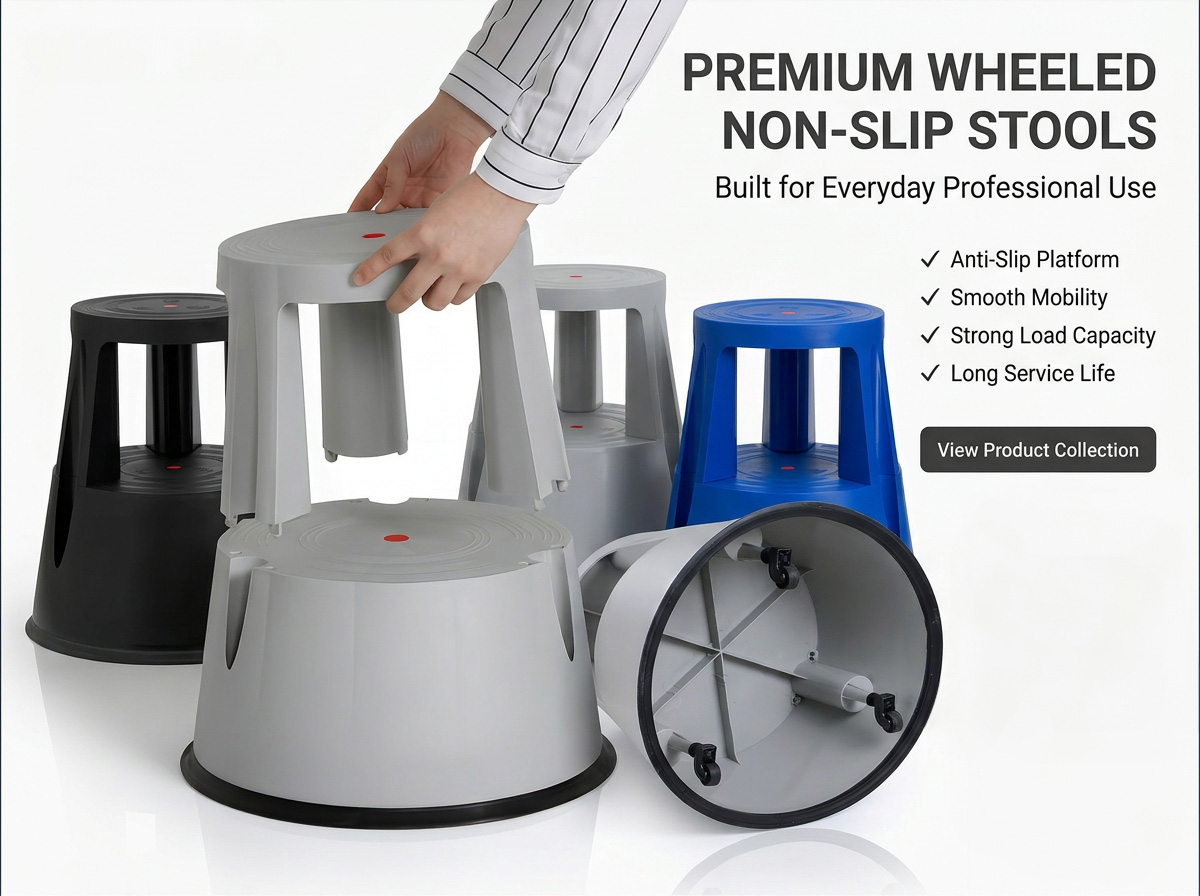
Commercial Step Stool Solutions for Facility Management in Bahrain
Commercial Step Stool Solutions for Facility Management in Bahrain give facility management teams in Bahrain fast, stable access for elevated maintenance, inspection, and minor repair tasks across mixed-use sites. Designed for continuous commercial use, these units feature spring-loaded wheels, industrial non-slip platforms, and 150 kg load capacity so technicians can roll into position, settle automatically, complete the work, and clear the area in seconds. Suitable for facilities that support supermarket operations, warehouse-retail interfaces, and general building services, they enable bulk orders, OEM customization, and wholesale supply. Firmalazım provides facility-grade models engineered for the varied floor surfaces, traffic patterns, and response-time demands found across Bahrain.




The Response-Time Problem That Facility Managers Rarely Measure
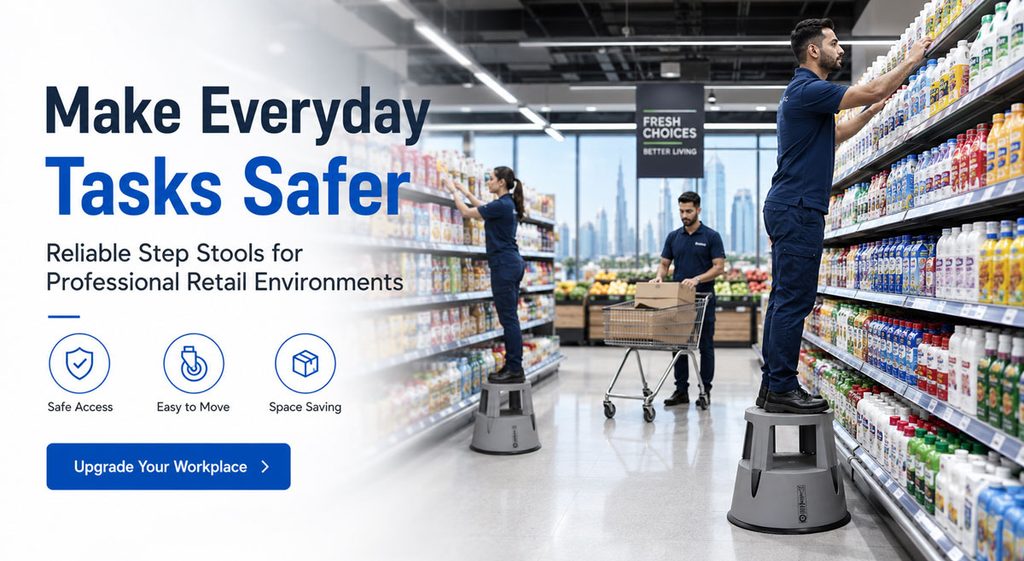
Facility management is judged by how quickly small problems are resolved before they become visible to occupants or customers. A flickering light above a supermarket aisle, a blocked air vent in a warehouse-retail zone, a loose ceiling tile in a back-of-house corridor—each requires elevated access. When the correct step stool is missing, damaged, or slow to deploy, the technician improvises or waits. The delay is measured in minutes, yet across a portfolio of sites those minutes accumulate into longer mean-time-to-repair and higher complaint rates.
Commercial step stools built for facility use remove that delay when they are specified for real mixed-environment conditions rather than light office duty.
Why Generic Stools Fail in Facility Environments
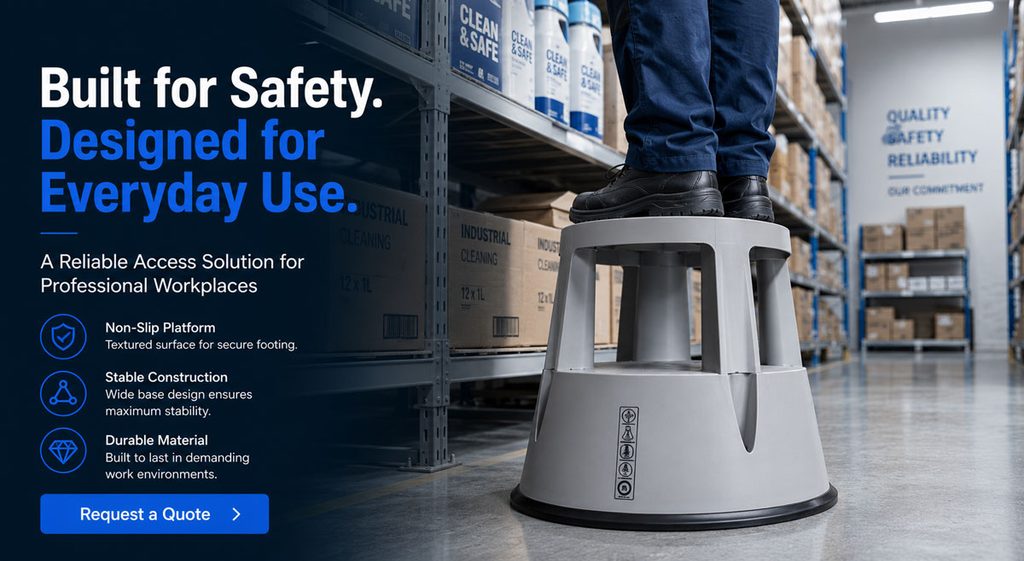
Facility work spans polished retail floors, sealed concrete in back areas, occasional wet surfaces after cleaning, and narrow service corridors. A stool that marks floors, slips under residual moisture, or requires awkward locking actions is quickly abandoned. Spring-loaded designs that settle automatically under weight solve the most common failure point: incomplete securing under time pressure. The technician steps on, the platform becomes rigid, the task is completed, and the unit rolls away—without a separate lever to remember.
Core Specifications That Matter for Facility Teams
Typical professional units deliver:
- 150 kg load capacity
- Height of approximately 410 mm
- Top platform 283 mm diameter
- Base 433 mm diameter for stability
- Heavy-duty plastic with molded non-slip treads
- Spring-loaded wheels that need no manual lock
- Color options for department or site coding
These dimensions keep the center of gravity low while providing useful reach for the majority of facility tasks—lighting, HVAC registers, signage, CCTV adjustments, and minor ceiling work.
Local Conditions Across Bahraini Facilities
Facilities linked to supermarket operations combine public-facing retail areas with supporting back-of-house and logistics spaces. Floors change from high-gloss tile to epoxy-coated concrete. Cleaning regimes leave residual moisture. Traffic includes staff, contractors, and occasional customer overflow.
In Manama high-density commercial sites the speed of response during trading hours is critical. In Riffa mixed-use facilities the same stools often move between retail floors and warehouse-retail support areas. In Muharraq older buildings reward compact footprints and reliable grip on varied surfaces. The same practical needs appear in Hamad Town, Isa Town, Sitra, Jidhafs, Budaiya, A’ali, Tubli, Sanabis, Seef, Saar, Janabiya, Karbabad, Barbar, Diraz, Bani Jamra, Al Hidd, Arad, Galali, Diyar Al Muharraq, Amwaj Islands, Maqabah, Abu Saiba, Shakhura, Al Markh, Jasra, Hamala, and Zallaq.
Human-Factors Advantages for Mobile Technicians
Facility technicians often work alone and carry tools. A stool that rolls easily with one hand, settles without a second action, and remains stable while the technician reaches or uses both hands reduces physical strain and cognitive load. Gloved operation is straightforward because there is no small lever to manipulate. Over a full shift these small reductions compound into higher completed work orders and lower end-of-day fatigue.
Placement Logic That Supports Rapid Response
Storage points must be close enough to common elevated task locations that retrieval does not become a deterrent, yet clear of primary traffic. Service corridors, the edges of plant rooms, and designated spots near high-bay retail sections usually work. Color coding by department or site helps technicians grab the nearest correct unit without searching.
Comparative View: Facility Access Options
| Method | Deployment Speed | Stability | Floor Marking Risk | Suitability for Mixed Facility Use |
|---|---|---|---|---|
| Fixed ladder | Slow | High | Low | Poor |
| Domestic step stool | Medium | Low–Medium | Medium | Poor |
| Improvised platforms | Fast | Very Low | High | Unacceptable |
| Commercial wheeled stool | Very Fast | High | Low | Excellent |
The commercial wheeled design wins on the combination of speed, stability, and minimal disruption—the three variables that determine whether a technician uses the correct method or improvises.
Procurement Framework for Facility Portfolios
- Map the highest-frequency elevated tasks across retail, back-of-house, and support areas.
- Measure the narrowest service routes and any floor transitions.
- Confirm 150 kg capacity provides margin for technician plus tools.
- Trial units on the actual floor finishes present in representative sites.
- Evaluate roll effort and automatic settling with both permanent and contract technicians.
- Decide whether color coding by site or department adds value.
- Structure bulk orders through a manufacturer or wholesale partner capable of consistent quality.
- Consider modest OEM adjustments only after the base design has proven itself in live conditions.
Cost Perspective for Facility Managers
Unit price is visible. The cost of delayed work orders, repeated technician visits, and minor injuries is less visible yet real. A commercial step stool that is used consistently reduces all three. When bulk orders are placed with a reliable manufacturer the per-unit economics improve while specification consistency across the portfolio is protected. A distributor can supply faster trial quantities and individual replacements; the manufacturer route suits larger wholesale volume and any OEM work.
Safety Integration into Facility Procedures
The equipment must appear in the height-access section of the facility safety procedure with clear rules: position the stool, step on so that it settles fully, maintain three points of contact, complete the task, step off, and return the unit to its designated point. Because the mechanism itself enforces the stable state, compliance remains high even when technicians are working alone under time pressure.
Maintenance Reality in Facility Environments
Weekly visual checks of the non-slip surface, spring action, wheel condition, and structural integrity are sufficient. Units that develop uneven settling, smoothed treads, or visible damage are removed immediately. The mechanical simplicity of the spring-loaded design keeps maintenance demand low and supports high availability across a multi-site portfolio.
Real Operating Scenarios
A lighting failure above a busy supermarket aisle is reported. The technician rolls a commercial stool into position, settles it, replaces the fitting, and clears the aisle within minutes. In a warehouse-retail support area the same unit allows safe inspection of high-level sensors without waiting for a shared ladder. Contract cleaners use identical stools for elevated vent cleaning after hours, maintaining consistency of method across different teams.
Five Distinct Calls to Action
- Place a focused trial set in your highest-response-time sites and measure the change in mean-time-to-repair for elevated tasks within two weeks.
- Share your dominant floor types and elevated task profile for a concise model recommendation.
- Move from reactive replacement to planned bulk orders timed with portfolio-wide maintenance cycles.
- Standardize on one commercial design across the network to simplify training and spare holding.
- Request both standard wholesale pricing and OEM options so the long-term fleet can be optimized for your exact conditions.
Firmalazım supplies commercial step stool solutions engineered for the speed, stability, and mixed-environment demands of facility management in Bahrain. Whether the requirement is met through standard wholesale channels or through structured OEM programs, the focus remains on automatic settling, durable non-slip performance, low-effort mobility, and consistent behavior under daily commercial use.
When elevated facility tasks stop creating response-time delays, both operational continuity and occupant satisfaction improve. That is the practical outcome of equipping facility teams with the right commercial step stools.
Frequently Asked Questions
What makes a step stool suitable for facility management rather than light office use? Higher load capacity (typically 150 kg), industrial non-slip surfaces, spring-loaded systems designed for repeated daily cycles, and construction that survives mixed floor types, residual moisture, and continuous traffic.
How do spring-loaded wheels improve safety for lone technicians? They remove the need for a separate locking action. The unit becomes stable automatically when weight is applied, reducing the most common operator error when working alone under time pressure.
Is 410 mm height sufficient for most facility tasks in Bahrain? Yes for the majority of lighting, HVAC, signage, and minor ceiling work found in retail and support facilities. Very high architectural features may still require other equipment.
Can the same stools be used in both public retail areas and back-of-house zones? Yes. The design performs on polished tile, sealed concrete, and typical transition surfaces, supporting consistent equipment standards across both environments.
How important is the non-slip surface after cleaning cycles? Critical. Residual moisture is common. Molded industrial textures that retain grip under light moisture keep the platform trustworthy.
What is the practical advantage of a 433 mm base diameter? It lowers the center of gravity and increases inherent stability when technicians shift weight or use both hands at height.
Are color options useful in multi-site facility portfolios? Yes. Simple color coding by site or department helps technicians locate the nearest unit quickly and supports clearer ownership of equipment condition.
How should bulk orders be planned for a facility management portfolio? Complete on-site trials first, confirm the preferred specification, then place volume orders through a manufacturer or wholesale partner that can guarantee consistency across the batch.
Is OEM customization practical for facility step stools? Yes for larger portfolios that want uniform color, molded identification, or minor dimensional alignment. It is best considered after the base model has proven itself in live conditions.
What maintenance is realistically required? Weekly visual inspection of wheels, spring action, non-slip surface, and overall structure. Immediate removal of any unit that shows damage or inconsistent settling.
How do these stools affect mean-time-to-repair for elevated tasks? When used correctly they eliminate search and deployment delays, allowing technicians to complete elevated work in a single continuous sequence.
Can contract technicians use them safely with minimal training? Yes. The automatic settling action and simple operating sequence allow correct use after a very short practical demonstration.
What is the most common reason facility teams abandon a step stool? Loss of confidence caused by perceived instability, difficult locking, or slippery surfaces. Professional designs that feel solid and settle automatically maintain higher utilization.
How does the product support overall facility safety culture? By providing a convenient, reliable alternative to stretching, climbing fixtures, or using unstable substitutes. When the correct tool is trusted and easy to use, unsafe improvisation declines.
Should every site in a portfolio carry the same model? Standardization simplifies training and spare parts. Minor variations in color coding can still be introduced if site identification adds value.
What role does a distributor play versus direct manufacturer supply? A distributor often provides faster trial units and individual replacements. Direct manufacturer supply suits larger wholesale volume and OEM programs that require tight specification control.
How long do professional plastic wheeled stools typically last under daily facility use? With correct use and basic inspection, well-engineered units commonly deliver several years of service. Actual life depends on intensity, floor conditions, and adherence to load limits.
Is it worth keeping a small buffer stock across the portfolio? Yes. A limited buffer allows immediate replacement of any unit taken out of service and maintains response capability during peak maintenance periods.
What documentation should be requested before a large order? Load rating, material specification, confirmation of spring-rate consistency across the batch, and any available performance information under repeated load cycles.
How do these stools perform when technicians wear standard work gloves? Because there are no small levers to manipulate, gloved operation is straightforward. The platform remains fully usable.
Can the stools be cleaned with normal facility cleaning chemicals? Yes. Heavy-duty plastic constructions tolerate standard cleaning agents when the finish and non-slip surface are appropriately specified.
What is the primary benefit for facility teams that also support supermarket operations in Bahrain? Consistent, fast, and safe height access that works across public retail floors and supporting warehouse-retail zones, reducing response time and risk throughout the portfolio.
Where should trial units or further technical clarification be requested? Directly from the manufacturer or authorized wholesale and distribution partners that support professional facility equipment requirements in the region.
Commercial Step Stool Solutions for Facility Management in Bahrain
Continuing with CMMS Integration, Contractor Standardization, and After-Hours Response Reality
Facility management in Bahrain increasingly runs through digital work-order systems. A technician receives a ticket, travels to the location, completes the elevated task, and closes the ticket with a timestamp. Any friction in deploying the correct access equipment lengthens that timestamp and degrades the performance metrics the CMMS is designed to track. Commercial step stools that are immediately available, automatically stable, and quick to clear protect the integrity of those metrics.
When external contractors are also issued the same work orders, the problem multiplies. Different contractors arrive with different habits and different equipment preferences. A standardized commercial step stool that is already present on site, clearly marked, and simple to use removes the variability. The contractor does not need to bring a personal ladder or improvise; the correct tool is waiting and the expected method is obvious.
After-Hours and Night-Response Protocol
Many elevated facility tasks occur after trading hours or during night shifts when staffing is leaner and supervisory presence is lower. In these windows the cost of an unavailable or untrusted stool is higher because fewer alternative resources exist.
- Confirm that designated storage points remain stocked at the end of the day shift.
- Include a one-line equipment status note in the night-shift handover.
- Ensure buffer units are accessible without requiring a second person.
- Require that every elevated night task is completed from a settled commercial stool rather than from fixtures or improvised platforms.
- Tag any unit that shows degraded performance so it can be removed before the next trading day.
This protocol keeps response capability intact when the building is quiet and the consequences of delay are still real.
Expert Observation on Contractor Behavior
Contract technicians move between multiple clients. When every site provides a different access solution, they default to whatever they carried in the van or to the nearest available object. When a consistent commercial step stool is present, clearly identified, and known to be the expected method, compliance rises sharply. Standardization across a facility portfolio therefore improves safety performance even among teams that are not directly employed by the client.
Portfolio-Level Total Cost of Ownership Model
A simplified three-year view for a facility portfolio supporting multiple supermarket-linked sites:
| Element | Year 1 | Year 2 | Year 3 | Driver |
|---|---|---|---|---|
| Initial fleet acquisition | High | — | — | Volume pricing |
| Annual inspection labor | Low | Low | Low | Routine |
| Replacements and spares | Low | Medium | Medium–High | Utilization intensity |
| Avoided repeat visits | Medium | High | High | Faster first-time fix |
| Reduction in contractor improvisation | Medium | High | High | Standardization |
| Near-miss and minor injury avoidance | Medium | High | High | Consistent method |
| CMMS metric improvement value | Medium | High | High | Response time |
| Net position | Neutral–Positive | Clearly Positive | Strongly Positive | Utilization + consistency |
The dominant variables are utilization rate and consistency of method across both employed and contract teams. Equipment that is trusted and therefore used delivers the return; equipment that is ignored does not.
Training Cascade for Multi-Site Teams
A single practical demonstration is rarely enough when teams rotate across sites. A short cascade works better:
- Site supervisor receives a focused 10-minute practical session.
- Supervisor demonstrates to permanent technicians on the actual floor.
- The same demonstration is given to regular contractors at the start of each new contract period.
- Visual reminders at storage points reinforce the sequence for anyone who missed the live session.
- New starters receive the demonstration as part of site induction.
Because the operating sequence is simple—roll, step on, settle, work, step off, clear—the cascade remains short and repeatable.
Seasonal and Event-Driven Demand Spikes
Retail calendars and national events create predictable peaks in facility work orders—additional lighting checks, temporary signage installation, extra cleaning of high-level surfaces, and rapid response to higher footfall wear. During these windows the number of simultaneous elevated tasks rises. Sites that have already standardized on commercial step stools and maintained buffer stock absorb the spike without a rise in improvisation or delayed tickets. Sites that rely on ad-hoc solutions see both response times and safety observations increase.
Safety Interaction with Emergency and Fire Access Requirements
Facility procedures must ensure that access equipment never obstructs emergency routes. Commercial step stools that are quick to clear and that have designated storage points outside escape paths satisfy this requirement more easily than fixed ladders or larger mobile platforms. The same units can still be used for elevated emergency-related tasks—testing high-level detectors, checking exit signage, or accessing control panels—provided they are removed immediately afterward.
Short Scenario: Multi-Site Lighting Failure After Hours
A power fluctuation affects lighting in the high-bay sections of three supermarket-linked sites on the same night. Facility technicians and a contracted electrical team respond. At each site a commercial step stool is already present at the designated point. The elevated fittings are reached, tested, and restored without waiting for additional equipment or improvising on fixtures. The work orders are closed inside the target window and the stores open with full illumination. On previous occasions when stools were missing or untrusted, the same faults required temporary work-arounds and follow-up visits the next day.
Checklist for Portfolio-Wide Consistency
- Has every site in the portfolio received the same model and the same practical demonstration?
- Are storage points still correctly located after any recent layout or tenancy changes?
- Is buffer stock sized to cover simultaneous peaks across multiple sites?
- Do regular contractors receive the demonstration at the start of each contract period?
- Are tagged units replaced before the next high-demand window?
- Is elevated work order completion time tracked as a visible CMMS metric?
Commercial Use Across the Full Facility Spectrum
The same professional step stool must perform in public retail areas during open hours, in back-of-house corridors, in plant rooms, and in warehouse-retail support zones. Units that remain low-effort and automatically stable across all these environments prevent technicians from changing methods as they move through the building. Consistency of equipment supports consistency of safe practice.
Micro-Gains That Appear in Portfolio Metrics
Every elevated work order completed on the first visit, every contractor who uses the site stool instead of improvising, and every after-hours task closed without residual obstruction adds a small increment of reliability. Across a full month and a multi-site portfolio those increments become visible in lower mean-time-to-repair, fewer repeat tickets, and cleaner safety observation records. Wheeled Step Stools for Logistics Operations in Bahrain
In Manama the density of commercial sites makes portfolio-wide standardization especially powerful. In Riffa mixed-use facilities the same consistency supports cleaner movement between retail floors and warehouse-retail support areas. The requirement remains steady through Muharraq, Hamad Town, Isa Town, Sitra, Jidhafs, Budaiya, A’ali, Tubli, Sanabis, Seef, Saar, Janabiya, Karbabad, Barbar, Diraz, Bani Jamra, Al Hidd, Arad, Galali, Diyar Al Muharraq, Amwaj Islands, Maqabah, Abu Saiba, Shakhura, Al Markh, Jasra, Hamala, and Zallaq.
Longer View: From Individual Tool to Portfolio Standard
Commercial step stools succeed in facility management when they stop being regarded as optional equipment and become an expected part of every elevated work order. When placement, training cascade, contractor alignment, after-hours protocol, and rapid replacement of outliers operate together, the stools disappear into the normal rhythm of the portfolio. What remains visible is faster response, fewer improvisations, and more predictable CMMS performance.
Firmalazım supplies commercial step stool solutions engineered for the mixed-environment, multi-team, and rapid-response demands of facility management in Bahrain. Whether the requirement is met through standard wholesale channels or through structured OEM programs, the focus remains on automatic settling, durable non-slip performance, low-effort mobility, and consistent behavior under daily commercial use.
When elevated facility tasks no longer insert delay into the work-order cycle, both operational continuity and safety performance improve across the entire portfolio. That is the practical standard for commercial step stools in modern facility management.
Continuing with Soft-Services Alignment, Fit-Out Periods, and Liability Reality
Facility management rarely operates in isolation. Soft-services teams—cleaning, security, pest control, and waste—also require occasional elevated access. When these teams are issued different equipment or left to improvise, the safety standard that hard-services technicians follow begins to fragment. A single commercial step stool specification used by every team that works at height keeps the method consistent and the risk profile predictable.
During major fit-outs or refurbishments the problem intensifies. Temporary contractors, new floor finishes, relocated services, and compressed timelines all increase the volume of elevated tasks. Sites that already maintain a reliable fleet of commercial step stools absorb the extra demand more cleanly than sites that must source additional access equipment under time pressure.
Soft-Services Integration Protocol
- Include the same commercial step stool model in the induction for cleaning, security, and pest-control teams.
- Designate shared storage points that remain accessible after trading hours.
- Require that any elevated soft-services task follows the identical settle-and-clear sequence used by hard-services technicians.
- Tag and remove any unit that shows damage after night or early-morning use.
- Review soft-services height-related observations alongside hard-services data so patterns are not missed.
This protocol prevents the common gap in which one group of workers is held to a higher standard than another.
Expert Observation on Fit-Out Risk
Fit-out periods generate the highest concentration of temporary workers and the highest rate of improvisation. When commercial step stools are already present, clearly marked, and known to be the expected method, the majority of elevated tasks stay inside the controlled process. When the equipment is absent or unfamiliar, the rate of fixture climbing and unstable platforms rises sharply. Pre-positioning additional buffer units before a major fit-out is one of the highest-leverage safety actions a facility manager can take.
Liability and Insurance Considerations
Height-access incidents remain one of the more visible categories of workplace injury. Insurers and risk auditors increasingly examine whether suitable equipment was provided and whether its use was enforced. A documented standard commercial step stool, supported by short practical training records and weekly condition checks, strengthens the facility’s position. Conversely, the absence of suitable equipment or the tolerance of improvisation weakens it. The cost of maintaining a consistent fleet is almost always lower than the combined cost of an incident, an investigation, and any subsequent premium adjustment.
Failure-Mode Effects in Facility Environments
| Failure Mode | Immediate Effect | Secondary Effect | Prevention Control |
|---|---|---|---|
| Incomplete settling | Platform movement under load | Loss of confidence, return to improvisation | Automatic spring-loaded design + training |
| Contaminated non-slip surface | Reduced grip | Near-miss or minor slip | Scheduled cleaning of platform with floors |
| Wheel binding after impacts | Higher roll effort | Units left in place, aisle obstruction | Weekly inspection + rapid tagging |
| Structural fatigue after repeated dynamic loads | Flex or permanent set | Sudden instability | Load-rating discipline + condition scoring |
| Missing units at storage points | Search time or improvisation | Delayed work orders, higher risk | Buffer stock + handover checks |
| Inconsistent performance across fleet | Operator uncertainty | Selective use of only “good” units | Tight manufacturer process control |
The table keeps attention on controllable factors rather than generic safety statements.
Cross-Training Between Facility and Supermarket Operations Teams
In sites that combine public retail floors with supporting warehouse-retail areas, facility technicians and supermarket operations staff often share the same physical space and sometimes the same elevated tasks. When both groups are trained on the identical commercial step stool and the identical settle-and-clear sequence, the method remains consistent even when responsibilities overlap. Cross-training also reduces the chance that one team leaves equipment in a condition that creates problems for the other.
Short Scenario: Overnight Deep-Clean and Minor Repairs
A scheduled deep-clean includes high-level vent and light-fitting work across a supermarket sales floor and its back-of-house corridors. Cleaning team members and a facility technician work in parallel. Both use the same commercial step stools already positioned at designated points. Elevated tasks are completed, units are cleared before final floor polishing, and the store opens without residual equipment or incomplete high-level work. On previous occasions when equipment was inconsistent, the cleaning team either skipped elevated sections or left stools in place, creating both presentation and safety issues for the morning shift.
Checklist for Fit-Out and Soft-Services Readiness
- Have additional buffer units been pre-positioned before the fit-out or major clean begins?
- Have all temporary and soft-services teams received the same practical demonstration?
- Are storage points still accessible after temporary hoarding or layout changes?
- Is there a clear rule that no elevated work proceeds from fixtures or improvised platforms?
- Are tagged units replaced before the next high-intensity window?
Commercial Use Across the Full Service Spectrum
The same professional step stool must serve hard-services technicians during the day, soft-services teams at night, and temporary contractors during fit-outs. Units that remain low-effort and automatically stable under all three conditions prevent the method from fragmenting. Consistency of equipment supports consistency of safe practice across every team that works at height. Professional Mobile Step Stools for Retail Stores in Bahrain
Long-Term Obsolescence and Replacement Planning
Even well-engineered commercial step stools reach the end of reliable service life. A simple register that records introduction date, condition scores, and removal reason allows the facility manager to forecast replacement volume rather than react to sudden gaps. Planning bulk orders around known fit-out schedules or annual maintenance cycles further reduces the risk of coverage shortfalls. A manufacturer that can maintain dimensional and performance consistency across successive bulk orders protects the standard that teams have already accepted. Wholesale and distributor channels remain useful for rapid replacement of individual units between major orders. OEM options become relevant when the portfolio wants uniform appearance or discreet identification that supports both operational clarity and audit readiness.
Micro-Gains That Appear in Portfolio Risk Metrics
Every elevated task completed from a settled commercial stool, every soft-services team that follows the same sequence, and every fit-out period that finishes without a height-related observation adds a small increment of control. Across a full year and a multi-site portfolio those increments become visible in lower incident rates, cleaner audit findings, and more predictable insurance discussions.
In Manama the density of commercial and retail sites makes portfolio-wide standardization particularly effective. In Riffa mixed-use facilities the same consistency supports cleaner movement between public floors and warehouse-retail support zones. The requirement remains steady through Muharraq, Hamad Town, Isa Town, Sitra, Jidhafs, Budaiya, A’ali, Tubli, Sanabis, Seef, Saar, Janabiya, Karbabad, Barbar, Diraz, Bani Jamra, Al Hidd, Arad, Galali, Diyar Al Muharraq, Amwaj Islands, Maqabah, Abu Saiba, Shakhura, Al Markh, Jasra, Hamala, and Zallaq.
Longer View: From Reactive Equipment to Controlled System
Commercial step stools succeed in facility management when they are no longer treated as isolated purchases and become part of a small, deliberate system that includes placement discipline, training cascade, contractor alignment, soft-services inclusion, fit-out readiness, and planned replacement. When that system is in place, elevated work stops being a recurring source of delay and risk and becomes a controlled, repeatable activity.
Firmalazım supplies commercial step stool solutions engineered for the multi-team, multi-environment, and rapid-response demands of facility management in Bahrain. Whether the requirement is met through standard wholesale channels or through structured OEM programs, the focus remains on automatic settling, durable non-slip performance, low-effort mobility, and consistent behavior under daily commercial use.
When every team that works at height uses the same trusted method, both operational continuity and safety performance improve across the entire portfolio. That is the practical standard for commercial step stools in modern facility management.
Continuing with Material Behavior Under Local Climate, Chemical Exposure, and Technician Ergonomics
Facility environments in Bahrain expose commercial step stools to a combination of air-conditioning cycles, residual cleaning chemicals, fine dust, and occasional direct sunlight near loading or service doors. Heavy-duty plastic formulations that maintain dimensional stability and surface integrity under these conditions preserve both safety and appearance over years of service. Springs that retain consistent compression force despite temperature swings prevent the gradual drift in settling behavior that causes operators to lose trust.
Non-slip textures must survive repeated exposure to the alkaline and surfactant-based cleaners commonly used on retail and back-of-house floors. Surfaces that polish smooth or become sticky after chemical contact lose effectiveness precisely when residual moisture is present. Material choices that resist both polishing and chemical attack keep the platform trustworthy across the full cleaning cycle.
Ergonomic Fit Across Technician Profiles
Technicians vary in height, reach, and physical strength. A platform height of approximately 410 mm serves the majority of adult users for mid-level tasks without requiring excessive knee bend or over-stretching. The wide base diameter of 433 mm provides a stable stance even when the technician shifts weight to one side while using both hands. Spring-loaded settling removes the need for fine motor control, which benefits users wearing gloves or working in awkward postures.
When the same stool is used by both permanent staff and shorter-term contractors, the absence of adjustment mechanisms becomes an advantage: there is no incorrect setting to create. The design is either suitable or it is not; once validated, it remains consistent for every user.
Permit-to-Work Alignment
Many facilities require a permit-to-work for elevated tasks above a defined height or in sensitive areas. Commercial step stools that are already approved within the permit system reduce administrative friction. The permit can simply reference the standard site stool rather than requiring a separate equipment check for every task. This streamlining is possible only when the fleet is standardized and condition is actively managed.
Utilization Tracking Without Complexity
Sophisticated digital tracking is rarely necessary. A simple laminated zone sheet or a shared digital note that records when a unit is tagged out and when its replacement arrives provides enough visibility for most portfolios. Sites that later wish to quantify utilization can add a basic scan or manual tally at storage points. The key is that the data remains light enough to be maintained rather than becoming another administrative burden.
Single-Site versus Multi-Site Fleet Strategies
A single large site can often maintain a small floating buffer and respond quickly to tagged units. A multi-site portfolio benefits from a slightly larger central buffer plus clear rules for inter-site transfers when one location experiences a temporary spike. Standardization of model and color coding makes transfers seamless. Without standardization, moving a stool from one site to another introduces unfamiliar equipment and defeats the consistency that drives safe use. Heavy-Duty Step Stools for Warehouses in Bahrain
Sustainability and End-of-Life Considerations
Heavy-duty plastic stools that remain structurally sound at the end of primary service life can often be cascaded to lower-intensity sites or to soft-services teams before final retirement. When retirement is required, the material is typically recyclable through industrial plastic streams. Recording condition at removal allows the facility manager to maximize useful life and to demonstrate responsible material management if sustainability reporting is required.
Psychological Safety and Reporting Culture
Technicians are more likely to tag a deteriorating stool when they trust that a replacement will appear quickly and that they will not be blamed for “breaking” equipment. A visible, rapid replacement process reinforces the message that reporting problems is expected and valued. When tagged units sit for weeks, reporting declines and improvisation returns. The speed of the replacement loop is therefore a cultural as well as an operational variable.
Detailed Failure-Mode Expansion for Chemical and Climate Stress
| Stress Factor | Early Indicator | Progressive Effect | Control Action |
|---|---|---|---|
| Repeated chemical exposure | Slight surface gloss or tackiness | Loss of grip under moisture | Platform cleaning protocol + material spec |
| Temperature cycling | Minor change in spring feel | Inconsistent settling | Periodic functional sampling of fleet |
| Fine dust accumulation | Reduced wheel free-roll | Higher effort, units left in place | Scheduled wheel and housing cleaning |
| Impact from carts or doors | Small cracks or deformed wheel housings | Structural weakness under load | Immediate tagging + impact-aware placement |
| UV exposure near service doors | Surface chalking or color fade | Embrittlement over long term | Rotation of units or UV-stable formulation |
The table keeps attention on observable signs that can be caught during routine weekly checks.
Short Scenario: Chemical Clean Followed by Elevated Work
An overnight deep-clean leaves residual moisture and cleaning solution on high-gloss retail floors. Early-morning facility technicians need to reach elevated light fittings and sensors. Units whose non-slip surfaces still shed moisture and retain texture allow the work to proceed safely. Units whose surfaces have polished smooth from repeated chemical exposure create hesitation or force technicians to wait for floors to dry completely. The difference appears in both response time and the number of near-miss notes recorded that morning.
Checklist for Climate and Chemical Resilience
- Has the non-slip surface been observed after a full cleaning cycle?
- Do springs still settle with the same firmness in both early-morning cool conditions and mid-afternoon air-conditioned stability?
- Are units that regularly stand near service doors rotated to reduce continuous UV exposure?
- Is there a simple method for technicians to report early changes in feel or grip?
- Are replacement units drawn from a batch that matches the original performance specification?
Commercial Use Across the Full Daily and Seasonal Cycle
The same professional step stool must perform after chemical cleans, during temperature swings, under gloved hands, and across the full range of technician physiques. Units that remain predictable under all these variables prevent the method from changing with the conditions. Consistency of equipment supports consistency of safe practice.
Micro-Gains That Compound into Portfolio Stability
Every elevated task completed without hesitation after a chemical clean, every technician who tags a changing stool instead of continuing to use it, and every replacement that arrives before improvisation begins adds a small increment of control. Across a full year and a multi-site portfolio those increments become visible in stable response times, lower height-related observations, and cleaner audit outcomes.
In Manama the intensity of commercial activity and frequent cleaning cycles make material and spring resilience especially visible. In Riffa mixed-use facilities the same durability supports reliable movement between public floors and warehouse-retail support zones. The requirement remains steady through Muharraq, Hamad Town, Isa Town, Sitra, Jidhafs, Budaiya, A’ali, Tubli, Sanabis, Seef, Saar, Janabiya, Karbabad, Barbar, Diraz, Bani Jamra, Al Hidd, Arad, Galali, Diyar Al Muharraq, Amwaj Islands, Maqabah, Abu Saiba, Shakhura, Al Markh, Jasra, Hamala, and Zallaq.
Longer View: Equipment That Survives Real Conditions
Commercial step stools succeed in facility management when they continue to feel the same after hundreds of cleaning cycles, temperature swings, and different users. When material choice, spring consistency, placement discipline, rapid tagging, and planned replacement operate together, the stools remain a trusted part of the daily toolkit rather than a source of progressive doubt.
Firmalazım supplies commercial step stool solutions engineered for the chemical, climatic, and multi-user demands of facility management in Bahrain. Whether the requirement is met through standard wholesale channels or through structured OEM programs, the focus remains on automatic settling, durable non-slip performance, low-effort mobility, and consistent behavior under daily commercial use.
When the platform underfoot remains predictable regardless of cleaning schedule, ambient temperature, or technician profile, both safety and operational continuity are protected. That is the practical standard for commercial step stools in real facility environments.
Continuing with Emergency Preparedness, Vertical Transport Constraints, and Restricted-Zone Management
Facility management includes responsibility for emergency preparedness. Fire drills, evacuation exercises, and system tests frequently require elevated access—checking high-level detectors, testing emergency lighting, or verifying signage visibility. Commercial step stools that are already present, trusted, and quick to clear allow these tasks to be completed without introducing additional equipment into escape routes or creating residual obstacles after the drill.
Vertical transportation adds another constraint. Service lifts and passenger elevators have limited floor area and weight capacity. A compact, relatively lightweight commercial step stool can travel with a technician in a service lift more easily than a larger platform or multi-section ladder. Once at the required floor, the same unit provides immediate access without a second trip to retrieve equipment.
Restricted and High-Security Zones
Some areas within supermarket-linked facilities—cash rooms, data closets, pharmaceutical storage, or sensitive plant rooms—operate under restricted access. Bringing external ladders or large platforms into these zones creates both security and logistical friction. A standardized commercial step stool that is already approved for site-wide use and stored inside or immediately adjacent to the restricted area reduces the number of items that must be signed in and out. The simpler the equipment, the lower the procedural overhead.
Emergency-Drill Integration Protocol
- Confirm that commercial step stools required for elevated drill tasks are present at designated points before the exercise begins.
- Assign clear responsibility for clearing every unit immediately after its elevated task is complete.
- Include a rapid visual check of escape routes as part of the post-drill walkthrough.
- Tag any unit that shows damage or degraded performance during the exercise.
- Record any access-related delays so that future drills can be planned with adequate equipment coverage.
This protocol keeps emergency exercises focused on the intended objectives rather than on equipment shortages or residual obstacles.
Expert Observation on Drill Realism
Drills that rely on improvisation or on equipment that is not part of daily operations teach the wrong habits. When technicians use the same commercial step stools during drills that they use for ordinary work orders, the method remains consistent under both normal and elevated stress. The muscle memory developed in daily tasks transfers directly into emergency conditions.
Short Scenario: After-Hours Emergency Lighting Test
A scheduled test of emergency lighting requires verification of high-level fittings across a supermarket sales floor and its supporting corridors. Facility technicians move through the building with commercial step stools already positioned at key points. Each elevated check is completed, the unit is cleared, and the team moves to the next location. Escape routes remain open throughout. When the test is complete, no residual equipment is left in public or circulation areas. Previous tests that depended on shared ladders or improvised access produced both delays and temporary obstructions that had to be corrected before the building could return to normal status.
Checklist for Restricted-Zone and Emergency Readiness
- Are commercial step stools approved for use inside restricted areas, or must they remain outside?
- Is the number of units inside or adjacent to restricted zones matched to the typical elevated task volume?
- Do emergency-drill plans explicitly reference the site-standard stool rather than generic “suitable access equipment”?
- Are storage points for emergency-related elevated tasks clear of escape routes?
- Is there a rapid method to confirm that all units have been cleared after a drill or system test?
Commercial Use Across Normal, Restricted, and Emergency Conditions
The same professional step stool must serve ordinary work orders, restricted-zone tasks, and emergency-drill requirements. Units that remain low-effort, automatically stable, and quick to clear under all three conditions prevent the method from fragmenting. Consistency of equipment supports consistency of safe practice regardless of the operational context.
Micro-Gains That Appear in Preparedness Metrics
Every elevated drill task completed without delay, every restricted-zone entry that does not require additional equipment sign-in, and every post-drill walkthrough that finds clear escape routes adds a small increment of control. Across a full year those increments become visible in smoother exercises, cleaner audit findings, and higher confidence that elevated access will not become a bottleneck under real emergency conditions.
In Manama the density of commercial and retail sites makes standardized emergency and restricted-zone access particularly valuable. In Riffa mixed-use facilities the same consistency supports reliable movement between public floors, warehouse-retail support areas, and controlled zones. The requirement remains steady through Muharraq, Hamad Town, Isa Town, Sitra, Jidhafs, Budaiya, A’ali, Tubli, Sanabis, Seef, Saar, Janabiya, Karbabad, Barbar, Diraz, Bani Jamra, Al Hidd, Arad, Galali, Diyar Al Muharraq, Amwaj Islands, Maqabah, Abu Saiba, Shakhura, Al Markh, Jasra, Hamala, and Zallaq.
Longer View: Equipment That Serves Every Operating Mode
Commercial step stools succeed in facility management when they remain the default, trusted method whether the task is routine, restricted, or part of an emergency exercise. When placement, training, clearance discipline, and rapid replacement operate together across all these modes, the stools become a quiet enabler of both daily continuity and preparedness. Non-Slip Wheeled Step Stools for Supermarkets in Bahrain
Firmalazım supplies commercial step stool solutions engineered for the full range of facility conditions found in Bahrain, including restricted zones and emergency-preparedness requirements. Whether the requirement is met through standard wholesale channels or through structured OEM programs, the focus remains on automatic settling, durable non-slip performance, low-effort mobility, and consistent behavior under daily commercial use.
When elevated access remains controlled and predictable in every operating mode, both routine performance and emergency readiness are strengthened. That is the practical standard for commercial step stools in comprehensive facility management.

Bir yanıt yazın