


Non-Slip Wheeled Step Stools for Supermarkets in Bahrain
Non-Slip Wheeled Step Stools for Supermarkets in Bahrain deliver safe, mobile height access for supermarket staff across Bahrain. Designed for commercial use in high-traffic retail environments, these units combine stable platforms, reliable locking wheels, and durable non-slip surfaces to reduce fall risks while speeding up restocking, inventory checks, and overhead work. Suitable for everything from compact aisles in Manama stores to larger warehouse-retail setups, they support bulk orders, OEM customization, and wholesale distribution. Firmalazım supplies supermarket-ready models that meet the practical demands of Bahrain’s retail sector, helping teams work faster and safer without sacrificing mobility or stability.






The Quiet Efficiency Problem Every Bahraini Supermarket Faces
Walk into any busy supermarket in Bahrain and you will notice the same pattern. Staff reach for high shelves with whatever is closest—stacked crates, folding ladders, or a single-step stool that slides the moment weight shifts. In Manama the pace is relentless; in Riffa stores the ceiling height varies; in Muharraq older buildings create uneven floors. The result is the same: time lost, minor injuries, and inventory that stays out of reach longer than it should.
Non-slip wheeled step stools solve this specific operational friction. They give staff a stable elevated platform that rolls to the exact bay, locks in place, and provides secure footing even when floors are slightly damp from morning cleaning or condensation. For purchasing managers the decision is not about buying another piece of equipment. It is about removing a daily bottleneck that affects labor efficiency, safety compliance, and customer service speed.
This guide examines the product category from the viewpoint of a supermarket operations and procurement professional working in Bahrain. It covers real working conditions, material choices that survive local climate and floor types, selection criteria that matter for commercial use, and practical steps for integrating these stools into daily routines across the kingdom’s retail landscape.
Why Height Access Still Matters in Modern Supermarkets
Even with automated systems and lower shelf designs, a large percentage of supermarket SKUs still sit above comfortable reach. Promotional displays, seasonal stock, and bulk dry goods often occupy the top two or three levels. In Hamad Town hypermarkets the volume of high-bay items is higher; in Isa Town neighborhood stores the same problem appears in tighter spaces. Staff who climb insecurely slow the restocking cycle and increase the chance of dropped product or personal injury.
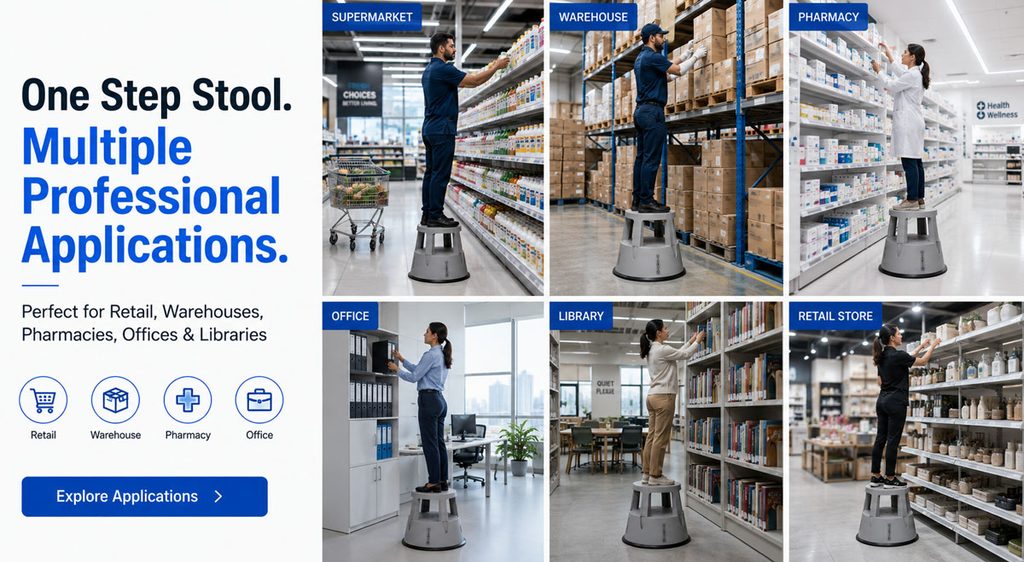
A wheeled step stool with a non-slip platform changes the equation. The operator rolls the unit to the location, engages the lock, steps up, completes the task, unlocks, and moves on. The entire sequence is faster and safer than carrying a fixed ladder or balancing on a plastic crate. For warehouse-retail hybrid formats the same tool serves both the shop floor and the back-of-house storage area.
Local Conditions That Shape the Right Specification
Bahrain’s retail environment imposes specific requirements. Floors range from polished tile in Sitra stores to epoxy-coated concrete in newer Jidhafs developments. Morning cleaning leaves residual moisture. Air-conditioning creates temperature differentials that can produce light condensation. Staff often wear soft-soled shoes for long shifts. Any step stool that fails to grip under these conditions becomes a liability.
Non-slip surfaces—whether textured rubber, industrial-grade grip tape, or molded polymer with aggressive tread—address the primary risk. Wheels must be large enough to roll over minor threshold differences yet lock solidly when the platform is occupied. Frame materials need resistance to the mild humidity and occasional chemical exposure from floor cleaners used across the kingdom.
In Budaiya and A’ali stores that serve residential areas, space between aisles can be limited. Compact footprint models become essential. In larger formats near Tubli or Sanabis the priority shifts toward higher load ratings and dual-sided access so two team members can work simultaneously during peak restocking windows.
Core Design Elements That Separate Functional Units from Decorative Ones
A proper commercial unit is engineered, not merely assembled. The platform must support dynamic loads—staff shifting weight while lifting cases. The non-slip surface must retain grip after thousands of wet and dry cycles. Wheels should be of commercial diameter and material so they do not flatten under constant use. The locking mechanism needs to be intuitive and positive; a half-engaged lock is worse than no lock.
Handrails or side barriers on higher models reduce the risk of lateral falls. Some designs incorporate tool trays or small shelves so the operator does not need to climb down for every item. These features matter more in high-volume supermarket operations than in occasional home use.
Firmalazım focuses on commercial-grade construction suited to supermarket environments. Units intended for bulk orders and wholesale channels are built to withstand daily multi-shift duty rather than intermittent residential use.
Material Choices and What They Mean on the Ground
Steel frames with powder-coat or epoxy finishes resist the minor impacts and cleaning chemicals common in Bahraini stores. Aluminum versions reduce weight for frequent relocation but must be engineered carefully to maintain rigidity. Polymer platforms can offer inherent grip and corrosion resistance; metal platforms usually rely on applied non-slip coatings or inserts.
Wheels are typically polyurethane or rubber compounds chosen for floor protection and quiet rolling. Harder compounds last longer on smooth tile; softer ones handle slight irregularities better. In Seef shopping districts where floors are often high-gloss, quieter wheels also reduce customer disturbance during daytime restocking.
OEM options allow a distributor or large supermarket chain to specify exact platform size, height, color coding by department, or branded marking. This level of customization supports consistent equipment standards across multiple locations.
Practical Working Scenarios Across Bahrain
In Saar a night team restocks dairy coolers. The wheeled stool rolls between cases, locks, and lets the operator reach the top rail without stretching or climbing the unit itself. In Janabiya a smaller store uses a compact model for seasonal display installation above eye level. In Karbabad and Barbar the same tool serves both the sales floor and the adjacent stockroom.
During promotional periods in Diraz and Bani Jamra, staff need rapid access to overhead banners and hanging signs. A stable wheeled platform reduces the time and risk compared with extending poles or temporary scaffolding. In Al Hidd and Arad stores that experience higher foot traffic, the ability to move the stool quickly out of customer paths is valued.
Larger developments in Galali, Diyar Al Muharraq, and Amwaj Islands often feature higher ceilings and more elaborate merchandising. Here the higher-capacity models with dual access and greater load ratings prove useful. In Maqabah, Abu Saiba, Shakhura, Al Markh, Jasra, Hamala, and Zallaq the product still solves the same core problem—safe, mobile height access—scaled to the size of the operation.
Selection Criteria for a Purchasing Manager
Start with maximum working height required for the tallest regular task. Add a safety margin. Confirm platform size is large enough for stable stance plus the product being handled. Verify load rating exceeds the heaviest expected case plus operator weight with a comfortable factor of safety.
Test the locking system under load. Confirm the non-slip surface remains effective when slightly damp. Check that the unit folds or nests if storage space is limited. Evaluate ease of cleaning—supermarkets clean equipment frequently. Confirm the manufacturer can support bulk orders and provide consistent quality across deliveries.
For chains operating in multiple districts, standardize on one or two models so training and spare parts remain simple. Request documentation on materials and any relevant safety testing. A reliable distributor can often arrange local demonstration units so the team can evaluate real-world performance before committing to volume.
Integration into Daily Operations
Successful introduction includes short practical training. Staff learn to position the stool correctly, engage locks fully, maintain three points of contact, and never move the unit while occupied. Placement of stools in logical zones—near high-bay sections, in stockrooms, and at promotional setup areas—reduces the temptation to improvise with unsafe alternatives.
Maintenance is straightforward: inspect wheels and locks weekly, clean the non-slip surface regularly, and retire any unit that shows structural damage. Because the product is simple, downtime is minimal when a small number of spare units are held in the warehouse-retail system.
Cost Perspective Beyond the Unit Price
The purchase price is only one element. Reduced minor injuries lower insurance and lost-time costs. Faster restocking improves on-shelf availability, which directly affects sales. Standardized equipment reduces the variety of ad-hoc solutions that create inconsistency and risk. For larger operators, OEM and wholesale arrangements improve unit economics and ensure long-term supply stability.
When evaluating offers, compare total cost of ownership across expected service life rather than focusing solely on initial outlay. Units built for commercial use typically justify a higher initial investment through durability and lower replacement frequency.
Safety Culture and Equipment as Supporting Tools
Equipment alone does not create safety. Clear procedures, visible leadership commitment, and consistent reinforcement do. Non-slip wheeled step stools remove a common source of improvisation. When the right tool is available and easy to use, staff are far less likely to climb shelves or stack unstable objects. This shift supports a broader safety culture that protects both employees and the business.
Looking Ahead: Incremental Improvements That Matter
Future refinements will likely include lighter high-strength materials, improved wheel compounds that perform across more floor types, and modular designs that allow height or platform adjustments without full replacement. Digital tracking of equipment location within large stores is possible but secondary to core mechanical reliability. For most supermarket operators in Bahrain the priority remains proven, durable, easy-to-use tools that perform every shift.
Firmalazım continues to develop commercial solutions that address the practical realities of supermarket operations. Whether through standard models suited to wholesale channels or customized OEM versions for larger groups, the focus stays on safety, mobility, and daily usability.
Final Operational Recommendation
Map the highest-risk or highest-frequency height-access tasks in each store. Trial a small number of units in the most demanding locations. Collect feedback from the teams who will use them daily. Once the preferred specification is confirmed, move to bulk orders through a reliable manufacturer or distributor pathway. Standardize, train, maintain, and measure the reduction in improvisation and the improvement in restocking speed.
Across Manama, Riffa, Muharraq, Hamad Town, Isa Town, Sitra, Jidhafs, Budaiya, A’ali, Tubli, Sanabis, Seef, Saar, Janabiya, Karbabad, Barbar, Diraz, Bani Jamra, Al Hidd, Arad, Galali, Diyar Al Muharraq, Amwaj Islands, Maqabah, Abu Saiba, Shakhura, Al Markh, Jasra, Hamala, and Zallaq, the same principle applies: give staff a safe, mobile platform and they will use it. The result is fewer risks, faster work, and more consistent shelf presentation—exactly what a modern supermarket needs.
Frequently Asked Questions
What makes a step stool suitable for supermarket commercial use rather than home use? Commercial models feature higher load ratings, more robust locking systems, industrial non-slip surfaces, and frames designed for repeated daily movement and cleaning cycles. Home versions typically lack the durability required for multi-shift retail environments.
How important is the non-slip surface in Bahraini supermarket conditions? Very important. Residual moisture from cleaning, temperature-related condensation, and polished or coated floors reduce friction. A properly engineered non-slip platform maintains grip under these conditions and significantly lowers slip risk.
Can these stools be used on both tiled sales floors and warehouse-retail back areas? Yes, provided the wheels are selected for the floor types present and the unit is rated for the loads and heights required in both zones. Many operators standardize on one model that performs acceptably across both environments.
What load rating should a purchasing manager look for? A practical minimum is the combined weight of the heaviest regular operator plus the heaviest case or item regularly handled, plus a safety margin. Higher ratings provide greater flexibility and longer service life under real working conditions.
Are locking wheels essential? Yes. An unlocked or poorly locked wheeled platform can shift under load. Positive locking mechanisms that engage fully and stay engaged until deliberately released are a core safety feature.
How do OEM options help larger supermarket groups? OEM allows consistent branding, color coding by department or store type, specific height or platform dimensions, and packaging suited to the group’s logistics. This supports standardization across multiple locations.
Is it practical to place bulk orders for multiple districts at once? Yes. Coordinating bulk orders through a manufacturer or wholesale channel often improves unit pricing, ensures consistent specification, and simplifies training and spare-parts management across the network.
What maintenance is typically required? Weekly visual checks of wheels, locks, and platform surface; regular cleaning of the non-slip area; and prompt removal of any unit showing structural damage or excessive wear. The product is mechanically simple, so maintenance demand is low.
Can the stools be stored efficiently when not in use? Many commercial designs fold, nest, or stack. Confirm the storage footprint during evaluation if back-of-house space is limited.
How does the product support safety culture? By providing a convenient, reliable alternative to improvisation. When the correct tool is readily available, staff are less likely to climb shelves or use unstable substitutes.
What floor types are most common in Bahraini supermarkets and how do they affect selection? Polished tile, epoxy-coated concrete, and some vinyl or composite surfaces are typical. Wheel compound and diameter should be chosen to roll smoothly without marking floors while still locking securely.
Should different models be used for high-ceiling versus standard stores? Often yes. Higher platforms or dual-access designs suit larger formats; compact single-platform units suit tighter neighborhood stores. Standardization within each format type keeps operations simple.
How quickly can staff be trained on proper use? Basic safe-use instruction—positioning, locking, three-point contact, never moving while occupied—can be covered in a short practical session and reinforced with visual reminders.
What role does a distributor play compared with direct manufacturer supply? A local or regional distributor can provide faster demonstration units, smaller trial quantities, and after-sales support. Direct manufacturer channels often suit larger wholesale or OEM programs with higher volume.
Are there advantages to color-coding stools by department? Yes. Color coding helps staff locate the nearest unit quickly and can reinforce department ownership of equipment care.
How does climate in Bahrain influence material choice? Mild humidity, air-conditioning differentials, and cleaning chemicals favor corrosion-resistant finishes and non-slip surfaces that do not degrade with temperature cycling or moisture exposure.
Can these stools replace traditional ladders entirely? For most regular restocking and merchandising tasks within typical supermarket heights, yes. Very high or specialized access may still require other equipment, but the majority of daily needs are covered.
What documentation should be requested before placing a large order? Load ratings, material specifications, any available safety or performance test information, and confirmation of consistency across production batches for bulk or wholesale supply.
How do wheeled step stools affect restocking speed? By allowing staff to move the platform to the exact location, lock it, complete the task, and move on without repeated climbing or repositioning of fixed ladders. The cumulative time saving across a shift is measurable.
Is it advisable to keep spare units in the system? Yes. A small buffer of spare stools allows immediate replacement of any unit taken out for maintenance or repair and maintains availability during peak periods.
What is the typical service life under supermarket conditions? With proper use and basic maintenance, commercial-grade units commonly deliver several years of daily service. Actual life depends on intensity of use, floor conditions, and adherence to load limits.
Can the product be used by both full-time staff and temporary promotional teams? Yes, provided the same safety procedures are communicated. Simple, intuitive designs reduce the training burden for short-term workers.
How should a trial be structured before full rollout? Place units in the highest-use or highest-risk locations first. Collect structured feedback on stability, ease of locking, platform size, and any operational friction. Adjust specification if needed before expanding.
Does Firmalazım support both standard wholesale supply and customized OEM projects? Yes. The focus is on commercial solutions that can be supplied as standard models for broad distribution or adapted for specific supermarket group requirements.
What is the most common operational mistake observed with these tools? Failing to fully engage the wheel locks before stepping onto the platform, or attempting to move the unit while it is still occupied. Clear training and visible reminders address both issues.
How does the product fit into warehouse-retail hybrid operations? The same unit can serve the sales floor for merchandising and the back area for high-bay picking or inventory checks, provided the specification covers both environments.
Are quieter wheels worth specifying in customer-facing areas? In high-traffic stores where restocking occurs during open hours, quieter wheel compounds reduce noise and customer disruption. The difference is noticeable on hard floors.
What platform size is generally most practical? Large enough for a stable two-footed stance plus space for the item being handled, yet compact enough to navigate typical aisle widths. Exact dimensions should be confirmed against the tightest regular working spaces.
Can the stools be cleaned with the same chemicals used on store floors? Most commercial units tolerate standard supermarket cleaning agents when the finish and non-slip surface are appropriately specified. Confirm chemical compatibility during selection.
How should damaged units be handled? Remove them from service immediately. Structural damage, severely worn non-slip surfaces, or unreliable locks make the unit unsuitable for continued commercial use.
Is height adjustability a useful feature? For some operators yes, particularly if the same unit must serve different task heights. Fixed-height models are simpler and often more rigid; the choice depends on the range of tasks.
What is the best way to introduce the equipment to existing teams? Demonstrate the correct sequence in the actual work environment, explain the safety reasons, and make the stools easily accessible so the new method is the path of least resistance.
Do these stools help with promotional display installation? Yes. Overhead banners, hanging signs, and elevated display elements are common tasks that benefit from a stable, mobile platform instead of improvised solutions.
How does bulk ordering through a manufacturer improve consistency? Larger production runs under controlled specifications reduce variation between units and simplify long-term maintenance and replacement planning.
What should be checked during weekly inspections? Wheel condition and free rotation, lock engagement and release, platform surface integrity, frame joints and fasteners, and overall stability under light load.
Can the product support two operators at once on larger models? Some dual-access or wider-platform designs are rated for this. Always respect the published load rating and never exceed it.
Is there value in department-level ownership of specific units? Assigning responsibility for care and correct storage to the teams that use the stools most frequently improves accountability and condition over time.
How do these tools interact with existing safety procedures? They should be incorporated into written safe-work procedures for height access, with clear rules on when and how they are to be used and when other equipment is required.
What is the primary benefit for a multi-store operator in Bahrain? Standardized, reliable height-access equipment that performs consistently across different store sizes and locations, reducing both risk and operational friction.
Where should additional information or demonstration units be requested? Directly from the manufacturer or authorized wholesale and distribution channels that support commercial supermarket requirements in the region.
Continuing with the Spring-Loaded Advantage in Real Supermarket Conditions
The product category shown in current commercial offerings centers on a 2-step plastic design with spring-loaded wheels, a 150 kg load capacity, and a molded non-slip platform. Height sits at 410 mm, top platform diameter 283 mm, and base diameter 433 mm. These dimensions create a low, wide stance that feels stable underfoot while remaining compact enough for narrow supermarket aisles.
Spring-loaded wheels are the defining mechanical feature. When the stool is unoccupied the wheels extend, allowing smooth rolling. The moment weight is applied the springs compress, the base settles firmly onto the floor, and the unit becomes a static platform. This automatic transition removes the need for separate locking levers and reduces the most common operator error—stepping onto a unit that is only partially secured. In fast-moving supermarket environments the simplicity of the mechanism supports higher correct-use rates.
Plastic Construction and Daily Commercial Demands
Heavy-duty plastic delivers several practical advantages for supermarket use. The material resists corrosion in air-conditioned interiors, cleans easily with standard floor chemicals, and does not mark polished tile. The molded non-slip texture on both steps maintains grip even when light moisture is present. At 150 kg rated capacity the unit comfortably supports an adult operator plus typical case weights handled during restocking.
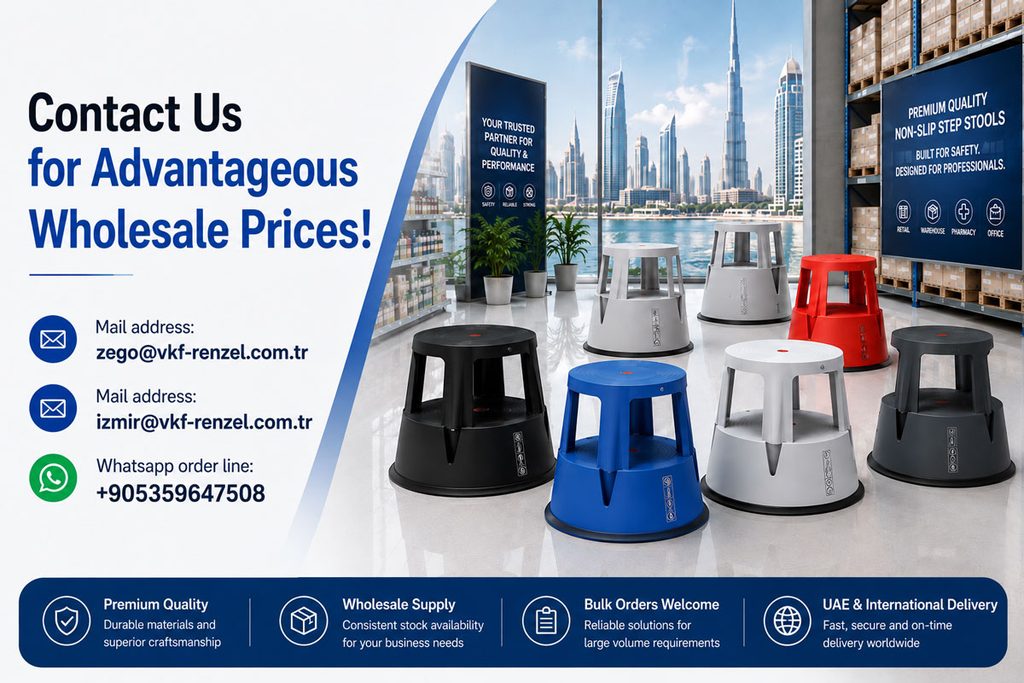
Color options—grey as the core commercial shade, with black and blue variants—allow basic visual coding if a network chooses to assign units by zone or department. The wide base diameter of 433 mm provides a stable footprint while the overall height of 410 mm keeps the center of gravity low, which is especially useful on the slightly uneven transitions sometimes found between sales floor and back-of-house areas.
Matching the Design to Bahraini Store Layouts
In tighter neighborhood formats the compact rolling profile and automatic settling action allow staff to move the stool quickly between short tasks without blocking customer paths. In larger hypermarket settings the same unit serves mid-height promotional work and routine high-bay checks. The 2-step configuration covers the majority of daily reach requirements without the bulk of taller rolling ladders.
Across Manama the pace of restocking favors equipment that transitions from mobile to stable without extra steps. In Riffa stores with varied floor finishes the plastic base and non-slip treads maintain predictable contact. In Muharraq older buildings the low height and wide stance reduce the chance of instability on minor surface irregularities. The same practical fit extends through Hamad Town, Isa Town, Sitra, Jidhafs, Budaiya, A’ali, Tubli, Sanabis, Seef, Saar, Janabiya, Karbabad, Barbar, Diraz, Bani Jamra, Al Hidd, Arad, Galali, Diyar Al Muharraq, Amwaj Islands, Maqabah, Abu Saiba, Shakhura, Al Markh, Jasra, Hamala, and Zallaq.
Operational Sequence That Matches the Mechanism
- Roll the stool to the required bay using light pressure.
- Position it so both feet will land fully on the non-slip steps.
- Step onto the platform; the spring-loaded wheels retract automatically and the base settles.
- Complete the task while maintaining three points of contact.
- Step down; the wheels re-extend and the unit is ready to move again.
This sequence is short enough to become automatic after brief practical training. Because the locking action is weight-activated rather than lever-activated, the most frequent source of incomplete securing is eliminated.
Specification Snapshot for Procurement Reference
| Feature | Typical Value | Commercial Relevance |
|---|---|---|
| Load Capacity | 150 kg | Covers operator + common case weights |
| Height | 410 mm | Mid-reach for most supermarket high-bay tasks |
| Top Platform Diameter | 283 mm | Stable stance without excessive bulk |
| Base Diameter | 433 mm | Wide footprint for inherent stability |
| Material | Heavy-duty plastic | Corrosion resistance, easy cleaning, floor-safe |
| Wheel System | Spring-loaded | Automatic settle under load, free roll when empty |
| Non-Slip Surface | Molded texture | Grip retention under light moisture |
| Primary Colors | Grey, Black, Blue | Optional zone or department coding |
Utilization in Mixed Environments
The same design performs across warehouse-retail interfaces, office stockrooms attached to larger stores, and archive-style storage areas sometimes found in larger supermarket operations. Staff moving between sales floor and back area do not need to change equipment. The plastic construction tolerates the temperature and humidity differentials common when moving between air-conditioned sales space and less-controlled storage zones.
Procurement Considerations Specific to This Design
When evaluating bulk orders, confirm that the spring mechanism maintains consistent compression force across the production batch. Variation in spring rate can produce units that feel either too soft or too stiff underfoot. Request sample units for multi-site trials so that floor managers can assess real rolling resistance and settling behavior on local tile and coated concrete.
OEM adjustments remain possible for larger networks—custom color runs, molded logos, or minor dimensional tweaks—while standard wholesale supply covers immediate requirements. A manufacturer able to maintain dimensional consistency and spring performance across volume orders reduces long-term variation in the fleet.
Maintenance Profile of the Spring-Loaded Plastic Design
Inspection focuses on three points: free extension and retraction of the wheels, integrity of the molded non-slip texture, and absence of cracks in the plastic structure. Because there are no separate locking levers, the mechanical complexity is low. Units that develop uneven spring action or visible structural damage are removed from service. The simplicity of the design keeps maintenance time minimal and supports high fleet availability.
Linking Product Features to Safety Outcomes
The combination of automatic settling, wide base, non-slip treads, and 150 kg capacity directly addresses the most common height-access risks in supermarket settings. When the equipment is placed in high-use zones and supported by brief practical training, the frequency of improvised climbing declines. The safety benefit appears both in reduced incident potential and in greater staff willingness to use the correct tool rather than the nearest unstable alternative.
Firmalazım supplies commercial-grade solutions in this category, supporting both standard wholesale channels and OEM programs for operators who require consistent specification across multiple locations. The focus remains on durable plastic construction, reliable spring-loaded mobility, and non-slip performance suited to daily supermarket conditions in Bahrain.
The design is straightforward. Its value lies in how cleanly it removes friction from routine height work while giving staff a platform they trust. When specification, placement, and basic training align, the result is quieter, faster, and safer restocking across the network.
Non-Slip Wheeled Step Stools for Supermarkets in Bahrain
A purchasing manager evaluating non-slip wheeled step stools is not shopping for convenience. The decision sits at the intersection of labor productivity, injury reduction, and consistent on-shelf availability. In high-turnover supermarket environments the cumulative cost of insecure height access appears in small daily delays that compound across shifts and locations. The right equipment removes that friction without introducing new complexity.
Investment Logic Beyond Unit Price
Consider the total cost of ownership across a three-year horizon. A commercial-grade unit that survives daily multi-shift use in Manama and maintains grip after repeated cleaning cycles delivers measurable returns through reduced lost-time incidents and faster restocking cycles. Lower-priced alternatives that require earlier replacement or create hesitation among staff often erase the initial saving. When bulk orders are structured through a reliable manufacturer the per-unit economics improve further while specification consistency across sites is preserved.
Wholesale channels offer another route for operators managing multiple formats. A distributor familiar with retail equipment can coordinate staged deliveries so that new stores or refitted sections receive equipment in step with opening schedules. OEM programs allow larger groups to lock in platform dimensions, load ratings, and even color systems that match internal equipment standards. Each pathway serves a different scale of commercial use; the common requirement is durability under real supermarket conditions.
Material Performance Under Local Stress
Bahrain’s combination of air-conditioned interiors, occasional residual moisture, and varied floor finishes places specific demands on both the non-slip surface and the frame. Textured polymer platforms or industrial grip inserts retain traction when polished tile in Riffa stores carries light cleaning residue. Steel frames with quality powder-coat finishes resist the minor impacts that occur when units are rolled against gondolas or storage racks. Aluminum constructions reduce weight for frequent relocation yet must be engineered to avoid flex under dynamic loads.
Wheel compounds matter more than many specifications acknowledge. Softer polyurethane rolls quietly across high-gloss floors common in newer developments while harder compounds last longer on epoxy surfaces typical of warehouse-retail back areas. Locking mechanisms that engage positively and remain engaged until deliberately released prevent the subtle shifts that undermine confidence. These details separate tools that staff actually prefer to use from those that sit unused while improvisation continues.
Real Working Patterns Observed Across Formats
In compact neighborhood stores the priority is a narrow footprint that navigates tight aisles without blocking customer flow. Staff in Muharraq locations frequently move between the sales floor and a small rear stock area; a single reliable unit that serves both zones reduces equipment clutter. Larger hypermarket formats generate different pressure. Night teams handling high-bay promotional stock need greater platform space and higher load ratings so that cases can be staged safely at height.
During seasonal peaks the same equipment supports rapid installation of overhead displays. When the alternative is stacked crates or an unstable ladder the wheeled non-slip platform becomes the default safe choice. Operators who place units in logical zones—near high-bay sections, at the entrance to the warehouse-retail interface, and beside promotional prep areas—report higher utilization and fewer instances of staff climbing shelves.
Checklist for Specification Confirmation
Before finalizing any order, confirm the following points against actual store conditions:
- Maximum regular working height required plus a practical safety margin
- Platform size adequate for stable stance and the largest common item handled
- Load rating that comfortably exceeds combined operator and product weight
- Locking system that engages fully under load and releases only by deliberate action
- Non-slip surface performance when slightly damp
- Wheel diameter and compound suited to the dominant floor types
- Ease of cleaning with standard supermarket chemicals
- Storage footprint when not in active use
- Availability of consistent supply through manufacturer or wholesale routes
This checklist keeps evaluation grounded in operational reality rather than brochure claims.
Comparative Perspective: Fixed Ladders versus Mobile Platforms
Fixed or folding ladders still appear in many stores. They offer height but lack mobility and often create trip hazards when left in aisles. A wheeled step stool with positive locks travels to the work point, occupies minimal space while in use, and can be relocated quickly when the task ends. For the majority of supermarket restocking and merchandising tasks within typical ceiling heights the mobile platform is the more efficient and lower-risk tool. Specialized high-access work may still require other equipment; the daily volume of mid-height tasks is where the wheeled solution delivers its strongest return.
Expert Note on Staff Adoption
Equipment succeeds only when teams prefer it to the previous method. Units that feel stable, lock positively, and roll smoothly without excessive effort gain rapid acceptance. Models that wobble, require awkward lock engagement, or leave the platform slippery after cleaning are quietly abandoned. Procurement teams that involve shift supervisors in the final evaluation stage almost always achieve higher long-term utilization.
Integration with Existing Safety Systems
Non-slip wheeled step stools should appear in written safe-work procedures for height access. Clear rules—full lock engagement before stepping up, three points of contact, never moving the unit while occupied, immediate removal of damaged units—reinforce the safety culture the equipment is meant to support. Visual reminders near storage points help temporary or new staff adopt correct habits quickly. When the tool is both available and easy to use correctly, the frequency of improvised climbing declines.
Scaling Across a Multi-Location Network
Operators managing stores of different sizes benefit from a small family of models rather than a single universal unit. Compact versions suit constrained footprints; higher-capacity dual-access versions serve larger formats and warehouse-retail zones. Standardization within each category simplifies training, spare-parts holding, and future bulk orders. A distributor or manufacturer capable of supporting both standard wholesale supply and targeted OEM adjustments can align deliveries with store opening or refit schedules across districts.
In Hamad Town the volume of high-bay dry goods favors robust load ratings. In Isa Town tighter layouts prioritize maneuverability. The same logic extends through Sitra, Jidhafs, Budaiya, A’ali, Tubli, Sanabis, Seef, Saar, Janabiya, Karbabad, Barbar, Diraz, Bani Jamra, Al Hidd, Arad, Galali, Diyar Al Muharraq, Amwaj Islands, Maqabah, Abu Saiba, Shakhura, Al Markh, Jasra, Hamala, and Zallaq. Local floor conditions and aisle dimensions vary, yet the underlying requirement for stable, mobile, non-slip height access remains constant.
Maintenance Rhythm That Protects Investment
Weekly visual inspection of wheels, locks, and platform surface takes only minutes yet prevents progressive deterioration. Immediate removal of any unit showing structural damage, excessive wear on the non-slip surface, or unreliable locking protects both staff and the remaining fleet. Because the product is mechanically simple, most issues are visible and straightforward to address. Holding a small buffer of spare units ensures availability is never interrupted during peak periods.
Forward-Looking Considerations for Smart-Store Evolution
As supermarket layouts continue to evolve, the core need for safe mid-height access is unlikely to disappear. Future refinements may include lighter high-strength materials, modular height options, or improved wheel compounds that perform across an even wider range of floor finishes. Digital location tracking within large stores is possible but secondary to fundamental mechanical reliability and ease of use. Procurement decisions made today should favor proven commercial durability over speculative features that do not yet demonstrate clear operational value.
Practical Next Steps for the Procurement Team
- Map the highest-frequency and highest-risk height-access tasks in representative stores.
- Trial a limited number of candidate units in those locations under normal working conditions.
- Collect structured feedback from the teams who will use the equipment daily.
- Confirm final specification against the checklist above.
- Structure bulk orders or OEM arrangements through a manufacturer or wholesale partner capable of consistent supply.
- Embed the equipment into safety procedures and provide brief practical training.
- Establish a simple inspection and replacement rhythm.
This sequence converts a product decision into a controlled operational improvement. The result is fewer improvisations, faster restocking, and a measurable contribution to the safety environment across the supermarket network.
Firmalazım supplies commercial solutions engineered for the realities of supermarket operations. Whether the requirement is standard models suited to wholesale distribution or customized OEM versions for larger groups, the focus remains on durability, positive locking, reliable non-slip performance, and daily usability under Bahraini retail conditions.
The equipment itself is only one element. When it is correctly specified, readily available, and supported by clear procedures, it becomes a quiet enabler of safer and more efficient work. That is the standard against which any non-slip wheeled step stool should be judged.
Continuing with Failure Modes and Prevention Logic
Even well-designed equipment fails when real operating conditions are ignored. A non-slip wheeled step stool that performs in a controlled demonstration can still create risk if the locking system is only partially engaged, if the non-slip surface is allowed to accumulate residue, or if the unit is overloaded beyond its rated capacity. Understanding the most common failure modes allows a purchasing manager to write clearer specifications and set practical inspection routines.
Partial lock engagement is the most frequent operational error. Staff under time pressure may roll the unit into position and step up before the wheels are fully secured. The result is a subtle shift under load that undermines confidence and can lead to a fall. Positive, clearly indicated locking mechanisms reduce this risk, but only when training reinforces the full-engagement rule. In high-volume supermarket environments the difference between a half-engaged lock and a fully secured platform is the difference between controlled work and an incident.
Surface contamination is the second major factor. Residual floor cleaner, fine dust, or condensation can reduce the effectiveness of any non-slip texture. Regular cleaning of the platform itself—not only the surrounding floor—preserves grip. Units that are easy to wipe down during routine store cleaning cycles maintain performance longer than those with complex textures that trap residue.
Overloading occurs when teams treat the platform as a temporary staging shelf for multiple heavy cases. Commercial load ratings exist for a reason. Exceeding them accelerates wear on frames, wheels, and locking components. Clear communication of rated capacity, combined with platform size that discourages excessive stacking, keeps the equipment within design limits.
Supplier Evaluation Criteria That Matter
Selecting a manufacturer or wholesale partner is not only about unit price. Consistency of production quality across bulk orders, responsiveness on replacement parts, and willingness to support OEM adjustments for larger groups all influence long-term cost and reliability. A distributor that can supply demonstration units for multi-site trials reduces the risk of specifying equipment that looks suitable on paper but performs poorly on local floors.
Request evidence of material specifications, load testing methodology, and quality control processes. Ask how the supplier handles dimensional consistency when producing larger volumes. Confirm lead times for both standard wholesale quantities and any customized OEM runs. These practical points separate suppliers who understand commercial supermarket requirements from those focused primarily on lower-duty markets.
Scenario Planning by Store Format
Compact neighborhood stores generate different demands from large hypermarkets. In smaller footprints the priority is a narrow base that moves cleanly between gondolas without forcing customers to wait. Staff often perform short, frequent height tasks; a lightweight yet rigid unit that locks quickly sees higher utilization. Larger formats generate longer restocking runs and heavier cases. Here platform size, dual-access options, and higher load ratings become more valuable.
Warehouse-retail hybrid sites add a third set of conditions. The same equipment may move from polished sales-floor tile onto coated concrete in the back area. Wheel compounds that handle both surfaces without marking or excessive wear simplify the fleet. Operators who map these three environments before finalizing specifications avoid purchasing multiple incompatible models later.
Training Protocol That Actually Changes Behavior
A five-minute practical demonstration conducted on the sales floor is more effective than a written procedure alone. The sequence is simple: position the unit, engage the locks fully, confirm stability with light pressure, step up using three points of contact, complete the task, step down, release the locks, and move the unit out of the aisle. Reinforcing this sequence during induction and at the start of seasonal peaks reduces the most common errors.
Visual cues help. A small label near the locking mechanism that shows the fully engaged position, combined with a clear load rating sticker, gives temporary staff immediate guidance. When the correct method is both easy and visible, adoption rises.
Cost Modeling Example for a Multi-Store Operator
Assume a mid-sized network operating twenty locations of mixed formats. Replacing ad-hoc height access methods with standardized commercial units reduces average restocking time for high-bay items by a conservative two minutes per task. Across daily cycles the cumulative labor saving becomes measurable. Parallel reduction in minor injuries lowers both direct costs and the softer costs of disrupted shifts. When bulk orders are negotiated through a manufacturer the unit cost declines while specification consistency rises. The net result is a positive contribution to operating margin that appears within the first operating year for most networks of this scale.
Expert Commentary on Utilization Rates
Equipment that is stored out of immediate reach is equipment that is not used. Placement near the highest-frequency high-bay sections, at the warehouse-retail transition point, and in promotional prep zones increases daily utilization. Units that must be retrieved from a distant storeroom are more likely to be bypassed in favor of faster but less safe alternatives. Simple location planning therefore multiplies the return on the original investment.
Inspection Rhythm and Retirement Criteria
Weekly checks should cover four points: free rotation of wheels, positive engagement and release of locks, integrity of the non-slip surface, and absence of frame deformation or cracked welds. Any unit that fails one of these checks is removed from service immediately. Retirement is preferable to repair when structural integrity is in question. Holding a small buffer stock ensures that removal of one unit does not leave a store without coverage.
Adapting to Peak Trading Periods
During major promotional windows the volume of overhead work increases sharply. Additional units staged in promotional prep areas prevent bottlenecks. Temporary staff receive the same short practical demonstration as permanent teams. Because the equipment is intuitive, the training burden remains low even when headcount rises temporarily.
Longer-Term Fleet Management
A simple register of units by location, purchase date, and condition supports planned replacement rather than reactive buying. Tracking average service life under local conditions allows more accurate forecasting of future bulk orders. Operators who treat the fleet as a managed asset rather than a collection of individual purchases maintain higher overall readiness and lower emergency procurement costs.
Connecting Equipment Decisions to Broader Operational Goals
Safe, mobile height access is not an isolated category. It supports on-shelf availability, reduces labor friction during restocking, and contributes to a visible safety culture. When the same commercial standards are applied across formats and locations, training becomes simpler and performance becomes more predictable. The purchasing decision therefore sits inside a larger system of operational consistency.
Firmalazım continues to focus on solutions that meet these practical requirements. Whether the route is standard wholesale supply or tailored OEM programs, the emphasis remains on positive locking, durable non-slip performance, and construction suited to daily supermarket use. The equipment is only as effective as the specification, placement, training, and inspection systems that surround it. When those elements align, the result is quieter, safer, and more efficient work across the network.

Bir yanıt yazın