


Non-Slip Step Stools for Warehouses in Egypt
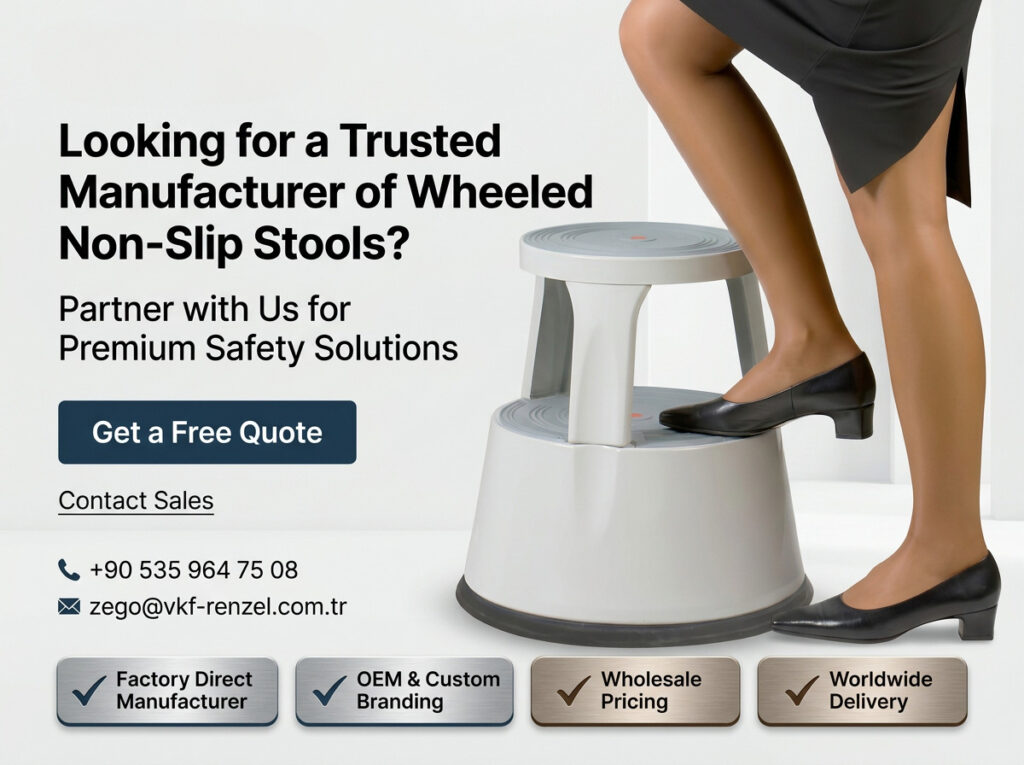
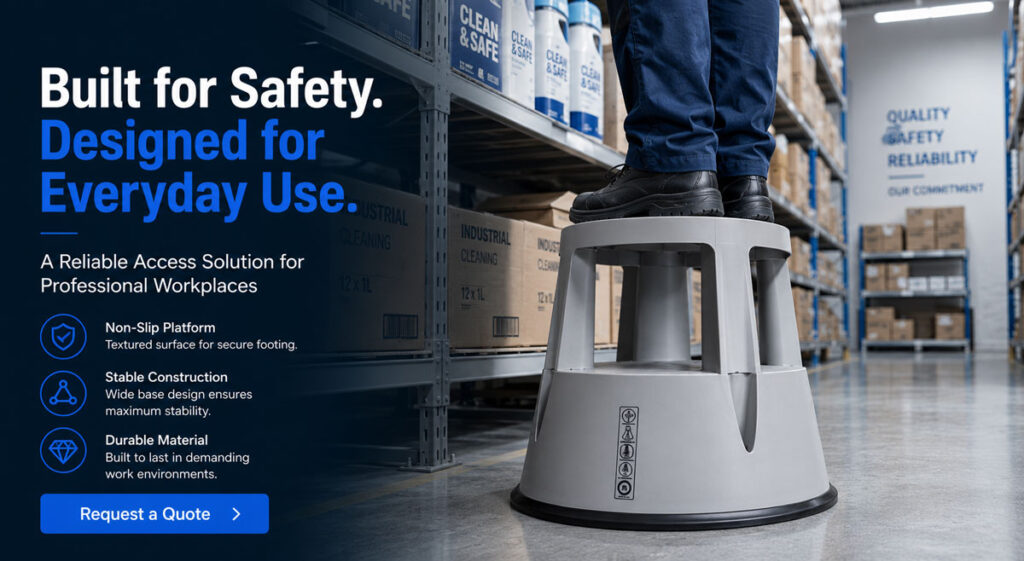
Non-Slip Step Stools for Warehouses in Egypt engineered for warehouse environments give Egyptian supermarket operators a practical way to reach high racks safely and quickly. Firmalazım supplies commercial-grade units with textured surfaces, stable bases and optional mobility features that reduce slip risk on concrete, epoxy and cleaned floors. Designed for continuous warehouse retail use, these stools support bulk stocking, order picking and inventory work while meeting the safety expectations of multi-branch supermarket chains.




Why Warehouse Floors Demand a Different Kind of Step Stool
Warehouse floors inside supermarket distribution areas are rarely dry or perfectly clean. Spills from damaged cartons, condensation near cold rooms, residual cleaning agents and fine dust from cardboard all create low-friction surfaces. A step stool that works adequately on a dry sales-floor tile can become a hazard the moment it is moved into the warehouse retail zone.
Firmalazım approaches the problem from the floor upward. The priority is a non-slip contact surface that maintains grip under the exact conditions found in Egyptian supermarket warehouses. Textured plastic or rubberised treads, a wide stable base and a low centre of gravity combine to keep the platform stationary when a worker is standing on it. When the unit also incorporates spring-loaded wheels, mobility is retained without sacrificing the locked position under load.
This is not a generic household product. It is equipment specified for commercial use inside the warehouse sections of supermarket operations, where load cycles are high, staff turnover is constant and a single slip can stop a picking line.
Technical Features That Translate Into Daily Performance The most effective non-slip step stools for warehouse duty share several measurable characteristics.
- Textured or rubberised step surfaces that retain friction when lightly damp
- Base diameter wide enough to resist tip-over during sideways reach
- Height that places typical racking levels within comfortable arm reach
- Load rating that covers a worker plus a full case or tote
- Optional spring-loaded wheels that retract automatically under weight
Firmalazım’s current 2-step plastic model illustrates these principles in practice: 410 mm overall height, 283 mm top platform, 433 mm base diameter and a verified 150 kg capacity. The grey high-density plastic resists impact and cleans easily after contact with warehouse dust or minor spills. Non-slip texturing covers the standing surfaces so that supermarket footwear maintains contact even when the floor is not perfectly dry.
Material Choices and Why They Matter in Egyptian Warehouses
High-density plastic is selected for several practical reasons. It does not rust in the humid conditions common near coastal cities. It absorbs minor impacts without forming sharp edges. It accepts textured moulding that creates the non-slip pattern without additional coatings that can wear off. Compared with thin domestic plastics, the commercial grade used by a specialised manufacturer maintains structural integrity through thousands of loading cycles.
Metal frames remain an alternative in some environments, yet they introduce corrosion risk and higher weight. For the majority of supermarket warehouse retail applications the plastic construction offers the better balance of grip, durability and ease of movement.
How Non-Slip Performance Is Actually Tested
Laboratory friction coefficients are useful, yet warehouse reality is more demanding. Effective non-slip design must survive repeated wetting and drying, contact with cardboard dust, and the sideways forces generated when a worker reaches for a carton on an adjacent pallet. The combination of surface texture, base geometry and automatic wheel lock addresses these forces simultaneously. When weight is applied the wheels lift and the textured base sits firmly on the floor. When the worker steps off, mobility returns without manual intervention.
Operational Scenarios Inside Supermarket Warehouses
Order-picking teams move continuously between racking aisles. A non-slip stool that can be rolled to the next location and then locked automatically reduces the time spent searching for a stable platform. Inventory counts on upper levels become faster because staff no longer improvise by climbing on lower pallets. Receiving teams use the same units to access high cross-dock shelves after trucks are unloaded.
These patterns appear across the country. In the dense logistics hubs serving Cairo the ability to move and lock a stool quickly keeps picking rates high during peak hours. New distribution centres supporting New Cairo and Nasr City specify non-slip platforms from the opening day so that safety standards are uniform. Established warehouse zones attached to stores in Heliopolis and Maadi replace older smooth-step units after observing reduced near-miss reports.
Large-format operations in 6th of October City and Giza deploy the stools both in the sales-floor backrooms and in dedicated warehouse retail areas. Teams based in Dokki and Mohandessin value the light weight when stools must be carried up short internal ramps. Expanding industrial parks in Obour City, 10th of Ramadan City and Shorouk City include the model in their standard equipment lists because the non-slip specification already matches their internal safety audits.
Coastal humidity adds another variable. Warehouse floors in Alexandria, Borg El Arab, Port Said, Suez and Ismailia experience more frequent moisture. The textured plastic surface continues to provide grip where smoother alternatives become slippery. Delta and Nile cities including Mansoura, Tanta, Zagazig, Mahalla El Kubra, Damietta and New Damietta run high-volume grocery warehouses where speed of replenishment directly affects store availability. Tourist and Upper Egypt locations in Hurghada, Asyut, Sohag, Minya, Beni Suef, Luxor, Qena and Aswan benefit from a single standardised non-slip design that simplifies training across geographically dispersed sites.
Purchasing Logic for Warehouse and Procurement Managers
The decision is rarely about the cheapest unit on the day. It is about total cost across the life of the equipment and the risk that equipment introduces. A stool that loses its non-slip properties after a few months of warehouse dust exposure creates ongoing replacement cost and residual safety risk. A unit supplied by a manufacturer that understands commercial warehouse retail cycles delivers lower long-term cost even if the initial price is higher.
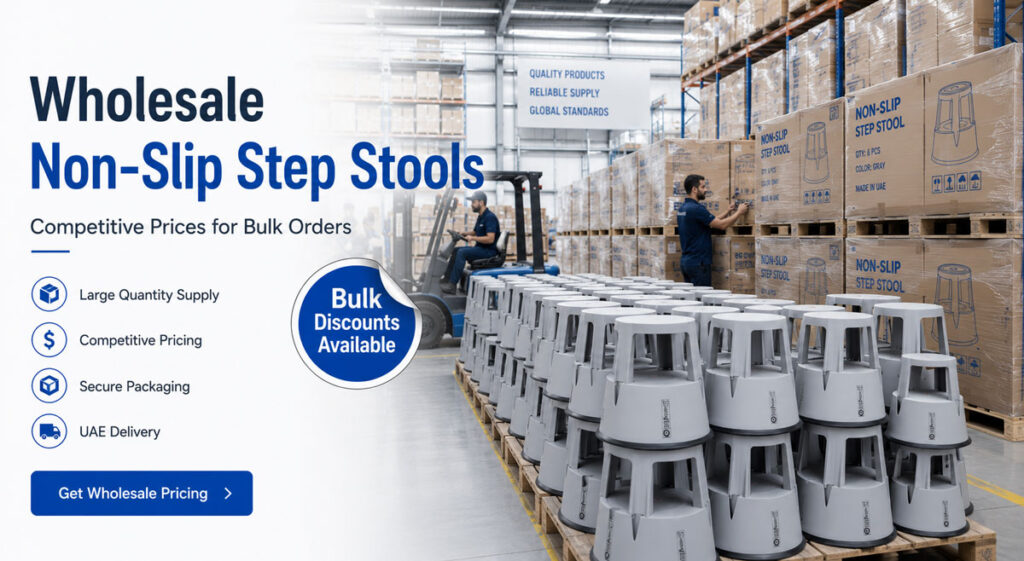
Wholesale pricing becomes attractive once a chain or a regional distributor commits to multi-site volumes. OEM programmes allow private labelling or minor dimensional adjustments while the core non-slip and load-bearing features remain unchanged. Working with a single manufacturer also simplifies documentation for internal safety committees and external auditors.
Comparison Framework for Evaluating Options
| Feature | Domestic / Light-Duty | Commercial Non-Slip Warehouse Grade | Advantage |
|---|---|---|---|
| Surface grip when damp | Often smooth or thin coating | Moulded texture or rubberised | Maintains friction |
| Base stability | Narrower footprint | 400 mm+ diameter typical | Reduces tip risk |
| Load rating | Frequently 100 kg or less | 150 kg and above | Covers worker + case |
| Wheel system | Manual brake or none | Spring-loaded automatic | Removes user error |
| Material durability | Thin plastic, cracks | High-density commercial plastic | Longer service life |
| Consistency across sites | Variable | Uniform specification | Simplifies training |
This table is not theoretical. It reflects the practical differences observed when supermarket groups move from mixed domestic equipment to a single commercial standard.
Implementation Sequence That Avoids Common Failures
- Map the exact racking heights and aisle widths in each warehouse zone.
- Confirm that the chosen stool height and base diameter fit those dimensions.
- Trial a small number of units in the highest-traffic picking aisle for two weeks.
- Collect feedback on grip, ease of movement and any residual slip perception.
- Standardise on the successful model and roll out through bulk orders.
- Include the automatic lock behaviour in every new-hire induction.
- Add a 30-second visual check of steps and wheels to the existing daily safety walk.
Following this sequence converts a simple equipment purchase into a controlled reduction of slip risk.
Maintenance Practices That Preserve Non-Slip Performance Daily cleaning of the textured surfaces removes the thin film of dust that can reduce friction. Supervisors verify that spring-loaded wheels still retract fully under body weight. Any unit showing worn texture, cracked plastic or sticky wheels is removed immediately. Because the design contains few moving parts, long-term maintenance cost remains low when these basic checks are observed. Non-Slip Step Stools for Pharmacy Shelving in Egypt
Expert Perspective on Safety Culture A non-slip step stool is only as effective as the culture that surrounds it. When every warehouse in a supermarket network uses the same model, the safety message becomes consistent: “Use the provided platform; do not climb on pallets.” That consistency is harder to achieve when each site improvises with different equipment. Standardisation therefore supports both the physical safety of the stool and the behavioural safety of the team.
Investment Analysis for Multi-Site Operators Assume a chain operates fifteen warehouse locations and places four stools in each. Replacing light-duty units every nine months generates continuous purchasing and administrative cost. A commercial-grade non-slip model that remains in service for three to four years under the same conditions reduces both the cash outflow and the management attention required. When the reduction in near-miss incidents and the improvement in picking speed are added, the financial case strengthens further.
Five Distinct Calls to Action
- Request a sample unit for a two-week trial in your highest-volume warehouse aisle and measure the change in near-miss reports.
- Ask Firmalazım for a wholesale quotation based on your current number of warehouse locations and projected openings.
- Explore OEM branding options if your supermarket group requires private-label equipment for visual consistency.
- Speak with a regional distributor to confirm local stock availability for urgent replacements.
- Schedule a short technical review with the manufacturer to match stool specifications against your exact racking heights and floor types.
Closing Perspective Warehouse slip risk inside supermarket operations is manageable when the equipment is chosen for the actual floor conditions rather than for appearance or lowest price. Non-slip step stools that combine textured surfaces, stable geometry and automatic locking wheels remove a recurring source of friction and injury. Firmalazım supplies these solutions as a manufacturer focused on commercial warehouse retail environments, supporting bulk orders, OEM requirements and distributor networks across Egypt. Standardising on one reliable design turns a daily operational detail into a measurable improvement in safety and productivity.
Frequently Asked Questions
What makes a step stool genuinely non-slip for warehouse floors? Moulded texture or rubberised surfaces that retain friction when lightly damp or dusty, combined with a wide base that prevents tipping during sideways reach.
Is the 150 kg rating sufficient for typical supermarket warehouse tasks? Yes. It covers the majority of workers plus a full case or tote under normal picking and stocking conditions.
How do spring-loaded wheels improve safety compared with manual brakes? They lock automatically under weight, eliminating the possibility that a worker forgets to engage a lever.
Can the same stool be used in both the warehouse and the sales-floor backroom? Yes. The commercial construction and non-slip surfaces perform in both environments.
Does Firmalazım support bulk orders for multi-site supermarket groups? Yes. Wholesale terms are available once volumes reach the level of several warehouse locations.
Are OEM customisation options available? Yes. Private labelling and limited dimensional adjustments can be discussed for larger programmes.
How should the stools be cleaned to maintain non-slip performance? Wipe the textured surfaces during normal warehouse cleaning routines to remove dust films that can reduce grip.
What floor types are compatible? Concrete, epoxy, sealed and lightly textured warehouse floors commonly found in Egyptian supermarket facilities.
Is the product intended only for dry conditions? No. The non-slip design is specifically intended to retain grip under the light moisture and dust conditions typical of warehouse retail areas.
How does standardisation across warehouses improve safety management? Identical equipment allows uniform training, identical inspection criteria and consistent replacement planning.
What is the typical service life under commercial use? When basic cleaning and inspection are observed, commercial-grade units remain in service for multiple years rather than months.
Can independent supermarket operators obtain the stools through a distributor? Yes. Regional distributors stock the product for smaller volume purchases.
Does the manufacturer provide documentation for internal safety audits? Load capacity statements, material information and care instructions are supplied with commercial orders.
How does the design reduce the temptation to climb on pallets? When a stable, easy-to-move non-slip platform is immediately available, improvised climbing becomes unnecessary.
Are colour options available beyond standard grey? Standard production is grey for practicality. OEM programmes can explore alternatives at sufficient volume.
What is the most common mistake when selecting warehouse step stools? Choosing units whose non-slip properties degrade quickly under dust and light moisture, leading to repeated replacement and residual risk.
How quickly can replacement units be supplied? Lead times depend on whether stock is held by a local distributor or must come from the manufacturer; both pathways are supported.
Is the stool suitable for continuous all-day standing? It is designed for the repeated short-duration use typical of warehouse picking and stocking rather than continuous standing for hours.
What height range is most useful for supermarket warehouse racking? A 410 mm platform height brings the majority of frequently accessed levels into comfortable reach for adult workers.
How does working with a specialised manufacturer differ from buying generic imports? Consistent specifications, technical support, bulk-order reliability and the ability to develop OEM versions create lower long-term risk and cost.
Firmalazım continues to refine non-slip access solutions for the specific demands of Egyptian supermarket warehouses. Whether the requirement is a pilot trial, a full wholesale programme or an OEM-branded rollout, the underlying goal remains the same: safer, faster work at height inside the warehouse retail environment.
Non-Slip Step Stools for Warehouses in Egypt
Non-slip step stools built for warehouse conditions give Egyptian supermarket operators a reliable way to work at height without introducing new slip hazards. Firmalazım’s 2-step plastic model combines a textured standing surface, 150 kg load capacity, spring-loaded locking wheels and a wide stable base. Designed for continuous commercial use inside warehouse retail zones, the unit moves freely when unloaded and locks automatically the moment weight is applied. It supports bulk stocking, order picking and inventory tasks while meeting the safety standards expected by multi-branch supermarket chains.
The Floor-Level Reality That Standard Stools Ignore
Warehouse floors inside supermarket facilities are working surfaces, not showrooms. Cardboard dust, residual cleaning chemicals, condensation near cold rooms and occasional minor spills create low-friction conditions that change throughout the day. A step stool that feels secure on dry sales-floor tile can shift or slide the moment it is moved into the warehouse retail area.
Firmalazım starts from that reality. The design priority is a non-slip interface between the worker’s footwear and the platform, combined with a base geometry that resists tip-over when the user reaches sideways for a carton. Spring-loaded wheels add mobility without requiring the operator to remember a separate locking lever. When weight is applied the wheels retract and the textured plastic sits firmly on the floor. When the worker steps off, the stool rolls again. The entire sequence is automatic.
This approach turns a simple access tool into a controlled element of warehouse safety rather than another variable that staff must manage.
Exact Specifications That Define Performance The current Firmalazım 2-step unit is engineered around measurable dimensions and ratings:
- Material: High-density commercial plastic
- Colour: Grey
- Number of steps: 2
- Overall height: 410 mm
- Top platform diameter: 283 mm
- Base diameter: 433 mm
- Load capacity: 150 kg
- Mobility: Spring-loaded wheels that lock under load
- Surface: Non-slip textured steps
These numbers are not decorative. The 410 mm height places the majority of frequently accessed supermarket warehouse racking levels within comfortable reach. The 433 mm base provides a stable footprint that resists tipping during normal sideways movement. The 150 kg rating covers a worker plus a full case or tote under typical picking conditions. The textured surface maintains friction when the floor is lightly damp or dusty.
Material Science Applied to Warehouse Dust and Moisture
High-density plastic is selected because it accepts deep moulded texture without relying on surface coatings that wear away. It absorbs impact without forming sharp edges. It does not corrode in the humid air common near coastal distribution centres. Compared with thinner domestic plastics, the commercial grade retains structural integrity through repeated loading cycles. Compared with untreated metal, it avoids rust and reduces overall weight so that any team member can reposition the stool without strain.
The grey colour is practical rather than aesthetic. It conceals the fine scuffs that accumulate in warehouse environments and continues to look serviceable after months of daily use.
How Automatic Locking Changes Daily Behaviour
Manual brake systems fail in two ways: the lever is forgotten, or the mechanism itself becomes sticky with dust. Spring-loaded wheels eliminate both failure modes. The act of stepping onto the platform is the only action required to create a stable working surface. This simplicity is especially valuable in high-turnover supermarket warehouses where new staff join frequently and training time is limited. Safety becomes a property of the tool rather than a procedure that must be remembered under time pressure.
Warehouse Scenarios That Reveal the Difference
Order pickers move continuously between racking aisles. A non-slip stool that can be rolled to the next bay and then locked automatically reduces the seconds spent searching for a stable platform. Inventory teams counting upper levels no longer improvise by standing on lower pallets. Receiving staff use the same units to reach high cross-dock shelves after trucks are unloaded. In each case the combination of mobility and automatic stability removes friction from the task.
These patterns appear across Egypt. Dense logistics operations serving Cairo rely on rapid repositioning during peak hours. New distribution centres supporting growth in New Cairo and Nasr City specify non-slip platforms from the first day of operation so that safety standards are uniform. Established warehouse zones attached to stores in Heliopolis and Maadi report fewer near-miss incidents after replacing older smooth-step units. Industrial Step Stools for Logistics Centers in Egypt
Large-format facilities in 6th of October City and Giza deploy the stools in both back-of-house warehouse retail areas and adjacent sales-floor stockrooms. Teams working in Dokki and Mohandessin value the light weight when stools must be moved up short internal ramps. Expanding industrial zones in Obour City, 10th of Ramadan City and Shorouk City include the model in their standard equipment lists because the non-slip specification already satisfies internal audit criteria.
Coastal humidity introduces additional variables. Warehouse floors in Alexandria, Borg El Arab, Port Said, Suez and Ismailia experience more frequent moisture. The textured plastic surface continues to provide grip where smoother alternatives become slippery. High-volume grocery warehouses in Mansoura, Tanta, Zagazig, Mahalla El Kubra, Damietta and New Damietta measure the benefit in faster replenishment cycles. Tourist and Upper Egypt locations in Hurghada, Asyut, Sohag, Minya, Beni Suef, Luxor, Qena and Aswan gain from a single standardised design that simplifies multi-site training and spare-parts planning.
Procurement Perspective: Total Cost Rather Than Unit Price
A warehouse manager or procurement officer who evaluates only the purchase price underestimates the true cost of access equipment. A cheaper stool that loses its non-slip properties after a few months of dust exposure generates repeated replacement orders, staff downtime and residual injury risk. A commercial-grade unit supplied by a specialised manufacturer spreads its cost across years of reliable service and reduces the management attention required for safety compliance.
Wholesale pricing becomes attractive once volumes reach the level of several warehouse locations. OEM programmes allow private labelling or limited dimensional adjustments while the core non-slip and load-bearing features remain unchanged. Regional distributor partners can hold local stock, shortening lead times for urgent replacements. Working directly with the manufacturer also improves the quality of technical documentation available to internal safety committees.
Side-by-Side Evaluation Framework
| Criterion | Light-Duty / Domestic | Commercial Non-Slip Warehouse Grade | Practical Outcome |
|---|---|---|---|
| Grip when damp or dusty | Often degrades quickly | Moulded texture retains friction | Fewer slip incidents |
| Base stability | Narrower footprint | 433 mm typical | Lower tip risk |
| Load capacity | Frequently under 120 kg | 150 kg verified | Covers worker + case |
| Wheel behaviour | Manual brake or none | Automatic spring-loaded | Removes user error |
| Material longevity | Thin plastic cracks | High-density commercial plastic | Multi-year service |
| Specification consistency | Variable by supplier | Uniform from manufacturer | Simplified training |
This comparison is drawn from the actual differences observed when supermarket groups move from mixed equipment to a single commercial standard.
Implementation Sequence That Protects the Investment
- Measure the exact racking heights and aisle clearances in each warehouse zone.
- Confirm that the 410 mm height and 433 mm base fit those dimensions without obstruction.
- Place a small number of units in the highest-traffic picking aisle for a two-week trial.
- Collect structured feedback on grip perception, ease of movement and any residual instability.
- Standardise on the successful model and proceed with bulk orders for the remaining sites.
- Incorporate the automatic locking behaviour into every new-hire induction checklist.
- Add a 30-second visual inspection of steps and wheels to the existing daily safety walk.
Following this sequence converts an equipment purchase into a measurable reduction of slip risk.
Maintenance Practices That Preserve Non-Slip Performance Daily wiping of the textured surfaces removes the thin film of cardboard dust that can reduce friction. Supervisors verify that the spring-loaded wheels still retract fully under body weight. Any unit showing worn texture, cracked plastic or sticky wheels is removed from service immediately. Because the design contains few moving parts, long-term maintenance cost remains low when these basic checks are observed.
Expert View on Safety Culture and Equipment A non-slip step stool is only as effective as the culture that surrounds it. When every warehouse in a supermarket network uses the same model, the behavioural message becomes consistent: use the provided platform; do not climb on pallets. That consistency is harder to achieve when each site improvises with different equipment. Standardisation therefore supports both the physical performance of the stool and the safety habits of the team.
Investment Logic for Growing Chains A supermarket group operating multiple warehouse locations can calculate the difference between repeated replacement of light-duty units and a single purchase of commercial-grade equipment that remains in service for several years. When the reduction in near-miss incidents and the improvement in picking speed are added, the financial case strengthens. The ability to place bulk orders and to develop OEM versions further improves the economics for national operators.
Five Distinct Next Steps
- Request a sample unit for a controlled two-week trial in your busiest warehouse aisle and measure the change in near-miss reports.
- Ask Firmalazım for a wholesale quotation structured around your current number of warehouse sites and planned openings.
- Explore OEM branding if your supermarket group requires private-label equipment for visual and audit consistency.
- Contact a regional distributor to confirm local stock levels for rapid replacement needs.
- Schedule a short technical discussion with the manufacturer to match stool specifications against your exact racking heights and floor types.
Closing Perspective Slip risk on warehouse floors inside supermarket operations is manageable when the equipment is chosen for the actual conditions rather than for appearance or lowest initial price. Non-slip step stools that combine textured surfaces, stable geometry and automatic locking wheels remove a recurring source of friction and injury. Firmalazım supplies these solutions as a manufacturer focused on commercial warehouse retail environments, supporting bulk orders, OEM requirements and distributor networks across Egypt. Standardising on one reliable design turns a daily operational detail into a measurable improvement in both safety and productivity.
Frequently Asked Questions
What specifically makes the surface non-slip under warehouse conditions? Deep moulded texture that retains friction when the platform encounters light moisture or cardboard dust, rather than a thin coating that can wear away.
Is 150 kg a realistic capacity for supermarket warehouse tasks? Yes. It covers the combined weight of a typical worker and a full case or tote under normal picking and stocking loads.
How do the spring-loaded wheels differ from manual brake systems? They lock automatically under weight and re-engage when unloaded, eliminating the possibility that a worker forgets to set a lever.
Can the same stool serve both warehouse and sales-floor stock areas? Yes. The commercial construction and non-slip surfaces perform reliably in both environments.
Does Firmalazım accommodate bulk orders for multi-site operators? Yes. Wholesale terms are structured for volumes that cover several warehouse locations.
Are OEM options available for private labelling? Yes. Limited branding and dimensional adjustments can be discussed for larger programmes.
How should the textured surfaces be cleaned? Wipe them during normal warehouse cleaning routines to remove dust films that can reduce grip.
Which floor types are compatible with the design? Concrete, epoxy, sealed and lightly textured surfaces commonly found in Egyptian supermarket warehouses.
Is the stool intended only for completely dry floors? No. The non-slip design is specifically engineered to retain grip under the light moisture and dust conditions typical of warehouse retail areas.
How does standardisation across warehouses improve safety management? Identical equipment allows uniform training content, identical inspection criteria and predictable replacement planning.
What service life can be expected under commercial use? When basic cleaning and inspection are observed, commercial-grade units remain in service for multiple years rather than months.
Can smaller independent supermarket operators obtain the stools? Yes. Regional distributors stock the product for lower-volume purchases.
What documentation accompanies commercial orders? Load-capacity statements, material information and care instructions suitable for internal safety files.
How does the design discourage climbing on pallets? When a stable, easy-to-move non-slip platform is immediately available, improvised climbing becomes unnecessary.
Are colours other than grey available? Standard production is grey for practicality and scuff resistance. OEM programmes can explore alternatives at sufficient volume.
What is the most frequent purchasing mistake? Selecting units whose non-slip properties degrade quickly under dust and light moisture, leading to repeated replacement and residual risk.
How are urgent replacement units supplied? Through local distributor stock or direct from the manufacturer, depending on the volume and location.
Is the stool suitable for continuous all-day standing? It is designed for the repeated short-duration use typical of warehouse picking and stocking cycles.
What height is most useful for typical supermarket warehouse racking? A 410 mm platform brings the majority of frequently accessed levels into comfortable reach for adult workers.
How does working with a specialised manufacturer differ from generic imports? Consistent specifications, technical support, reliable bulk-order fulfilment and the ability to develop OEM versions reduce long-term risk and cost.
Firmalazım continues to refine non-slip access solutions for the specific demands of Egyptian supermarket warehouses. Whether the requirement is a pilot trial, a full wholesale programme or an OEM-branded rollout, the underlying goal remains safer, faster work at height inside the warehouse retail environment.
Expanding the Operational and Financial Case for Non-Slip Step Stools in Egyptian Supermarket Warehouses
Warehouse productivity inside supermarket networks is measured in picks per hour, replenishment speed and the absence of interruptions caused by injury or equipment failure. A non-slip step stool that performs consistently under the exact floor conditions found in these environments removes one recurring source of both delay and risk. Firmalazım’s 2-step plastic design with automatic spring-loaded wheels, textured surfaces and a verified 150 kg capacity is engineered for that environment rather than adapted from domestic use.
The following sections examine the decision from the viewpoints of warehouse supervisors, safety officers, procurement managers and multi-site operations directors. Each perspective reveals different layers of value that a correctly specified non-slip platform delivers.
Supervisor-Level Reality: Seconds That Accumulate Into Hours
A picking supervisor watches the clock on every aisle. When a worker must leave the pick face to locate a stable platform, or when an unstable stool causes hesitation, the cumulative loss across a shift becomes measurable. A stool that can be rolled into position and then locks automatically under the worker’s weight eliminates those lost seconds. The same unit can travel with the picker from bay to bay without requiring a second person to carry a fixed ladder or a third person to hold a platform steady.
In high-volume grocery warehouses the difference appears most clearly during peak receiving and evening replenishment windows. Staff moving continuously between ambient, chilled and bulk zones benefit from equipment that does not demand extra cognitive load. The automatic lock means the only decision required is “step on.” Everything else is handled by the design.
Safety-Officer Perspective: Removing Variables from the Risk Equation
Safety officers deal in variables that can be controlled and variables that cannot. Floor moisture, cardboard dust and the occasional minor spill cannot be eliminated entirely. What can be controlled is the quality of the interface between the worker and the floor when working at height. A non-slip surface that retains friction under those conditions, combined with a base wide enough to resist tip-over and wheels that lock without human intervention, reduces the number of variables that must be managed through training and supervision alone.
When every warehouse in a supermarket network uses the same model, the safety message becomes uniform. Induction checklists, daily inspection routines and near-miss reporting criteria can all reference the identical piece of equipment. That uniformity simplifies audits and makes trends easier to detect.
Procurement and Total-Cost Modelling
Unit price is only the starting point. A complete cost model includes replacement frequency, administrative time spent on re-ordering, downtime while waiting for replacements, and the residual risk cost of equipment that loses its non-slip properties. Commercial-grade plastic with deep moulded texture and a 150 kg rating typically remains in service for multiple years under normal supermarket warehouse cycles. Light-duty alternatives often require replacement within months once dust and light moisture degrade their surfaces. Professional Wheeled Step Stools for Retail Stores in Egypt
Wholesale pricing structures become relevant once a chain or a regional group commits to volumes covering several sites. OEM programmes allow the same core product to carry private branding or minor dimensional adjustments while retaining the safety and mobility features. Distributor networks provide a second supply path for urgent replacements, reducing the risk of stock-outs at individual warehouses.
Detailed Technical Breakdown of the Current Firmalazım Model
- Overall height 410 mm places typical mid-level racking within comfortable reach for most adult workers.
- Top platform diameter 283 mm offers sufficient standing area without making the unit bulky in narrow aisles.
- Base diameter 433 mm creates a stable footprint that resists tipping during normal sideways reach.
- Load capacity 150 kg covers worker plus full case or tote under standard picking loads.
- High-density plastic accepts deep texture moulding and resists impact cracking.
- Spring-loaded wheels retract under weight and re-engage when unloaded, removing the need for manual brakes.
- Grey colour conceals scuffs and maintains a professional appearance after prolonged warehouse use.
These specifications are not arbitrary. They are the result of matching the physical demands of supermarket warehouse work to a practical, maintainable design.
Comparative Performance Under Real Floor Conditions
| Condition | Smooth Domestic Stool | Textured Commercial Non-Slip Stool | Observed Difference |
|---|---|---|---|
| Dry concrete | Adequate | Excellent | Minimal |
| Light cardboard dust | Grip declines | Grip retained | Clear advantage |
| Residual cleaning moisture | Slip risk rises | Friction maintained | Significant |
| Sideways reach with case | Tip risk higher | Stable base | Measurable |
| Repeated daily cycles | Surface wear accelerates | Texture longevity | Multi-year vs months |
The table reflects patterns reported by warehouse teams that have replaced mixed equipment with a single commercial standard.
Training Integration That Actually Sticks New employees in supermarket warehouses receive large volumes of information in their first days. Equipment that requires multi-step locking procedures competes for attention with more complex systems. An automatic spring-loaded design reduces the training burden to a single sentence: “Step on and it locks; step off and it rolls.” That simplicity improves compliance rates and reduces the likelihood that shortcuts will be taken under time pressure.
Refresher training can focus on inspection rather than operation. Supervisors simply verify that the wheels still retract fully and that the textured surfaces remain free of heavy contamination. The reduced training overhead is a secondary benefit that appears only after standardisation is complete.
Maintenance Protocol Designed for Warehouse Reality Daily: Wipe textured steps during normal cleaning to remove dust films. Shift-end: Quick visual check that wheels move freely when unloaded and retract under body weight. Weekly: Supervisor inspection for cracks, worn texture or sticky springs. Any unit failing these checks is removed immediately and replaced from local stock or through the manufacturer’s supply path.
Because the design contains few moving parts, the protocol remains short enough to be observed consistently. Long-term cost stays low when these basic steps are followed.
Geographic Adaptation Across Egyptian Warehouse Networks Floor conditions and operational intensity vary by region, yet the same non-slip principles apply. Dense urban logistics hubs serving Cairo experience high cycle rates and require rapid repositioning. New facilities supporting expansion in New Cairo and Nasr City can set uniform standards from day one. Established sites in Heliopolis and Maadi often replace older equipment after documenting near-miss reductions.
Large-format operations in 6th of October City and Giza use the stools across both warehouse retail zones and adjacent stockrooms. Teams in Dokki and Mohandessin appreciate the light weight for movement between levels. Industrial growth areas in Obour City, 10th of Ramadan City and Shorouk City include the model in initial fit-out lists because the specification already aligns with safety audit requirements.
Coastal humidity affects Alexandria, Borg El Arab, Port Said, Suez and Ismailia, making textured grip essential. High-volume grocery warehouses in Mansoura, Tanta, Zagazig, Mahalla El Kubra, Damietta and New Damietta measure gains in replenishment speed. Sites in Hurghada, Asyut, Sohag, Minya, Beni Suef, Luxor, Qena and Aswan benefit from a single design that simplifies multi-site management and training consistency.
Error-Prevention Checklist for Warehouse Managers
- Confirm that every stool in use has functional spring-loaded wheels.
- Verify that textured surfaces are not worn smooth or heavily contaminated.
- Ensure base diameter is sufficient for the sideways reaches typical in your racking layout.
- Remove any unit showing cracks or structural damage immediately.
- Include the automatic lock behaviour in every induction and refresher session.
- Maintain a small buffer stock so that damaged units can be replaced the same day.
- Track near-miss reports before and after standardisation to quantify the change.
Following this checklist prevents the gradual degradation that turns a safety tool into a residual risk.
Investment Horizon for Multi-Site Operators A supermarket group with ten warehouse locations placing four stools in each faces a clear choice. Repeated purchase of light-duty units every nine to twelve months generates continuous cash outflow and administrative load. A single investment in commercial-grade non-slip stools that remain serviceable for three to four years under the same conditions reduces both. When the improvement in picking continuity and the reduction in injury-related disruption are added, the return becomes still clearer.
Bulk order volumes improve unit economics further. OEM programmes allow branding consistency across the network. Distributor partnerships provide local resilience. The combination turns an equipment line item into a controlled operational asset.
Five Practical Next Actions
- Run a two-week side-by-side trial in one high-traffic aisle and record near-miss and time-per-pick data.
- Request a wholesale quotation structured around current warehouse count and twelve-month expansion plans.
- Discuss OEM branding options if private-label consistency is required for audit or visual standards.
- Confirm local distributor stock levels for rapid replacement coverage.
- Schedule a short technical review to match the 410 mm height and 433 mm base against your specific racking profiles.
Synthesis for Decision Makers Non-slip performance under real warehouse floor conditions is not a marketing claim; it is a measurable reduction in friction, hesitation and residual risk. The Firmalazım 2-step plastic stool with automatic locking wheels, 150 kg capacity and deep textured surfaces is built for the commercial use patterns found inside Egyptian supermarket warehouse retail environments. Standardising on one reliable design simplifies training, inspection, replacement planning and safety culture across every site.
Whether the immediate need is a pilot programme, a full multi-site rollout through bulk orders, or an OEM-branded version for national consistency, the underlying engineering remains focused on the same goal: safer, faster work at height on the floors that actually exist inside supermarket warehouses.
Additional Frequently Asked Questions
How does cardboard dust specifically affect non-slip performance? Fine dust can create a low-friction film on smooth surfaces. Deep moulded texture retains grip longer because the contact points are not easily filled or polished by dust.
What is the practical difference between 120 kg and 150 kg ratings in daily use? The higher rating provides a clearer safety margin when a worker carries a full heavy case, reducing the chance of approaching the limit during normal tasks.
Can the stools be used on mezzanine levels inside warehouses? Yes, provided the mezzanine flooring is compatible with the base and the height still matches the required reach. Local structural rules should always be checked.
How quickly does the spring mechanism respond under load? Retraction occurs as soon as body weight is applied; there is no perceptible delay in normal use.
Is special footwear required to benefit from the non-slip surface? No. The texture is designed to work with standard supermarket and warehouse footwear under typical conditions.
What happens if a stool is overloaded beyond 150 kg? The unit should never be overloaded. Exceeding the rating increases risk of structural failure and voids normal service expectations.
How are bulk orders typically packaged and delivered? Units are packed to protect the textured surfaces and wheels during transit; delivery schedules can be aligned with warehouse receiving windows.
Does the manufacturer support phased rollouts across multiple regions? Yes. Orders can be staged to match the readiness of individual warehouse sites.
What inspection frequency is recommended after the first three months? Daily visual checks remain the baseline; weekly supervisor inspections are usually sufficient once the equipment has settled into routine use.
Can the stools be stacked for storage when not in use? The design prioritises stability and mobility over nesting. Dedicated storage space near the pick faces is more practical than stacking.
How does humidity in coastal warehouses affect the plastic over time? High-density commercial plastic is selected for resistance to humidity-related degradation; no special coatings are required.
Is there a recommended maximum number of daily cycles? The construction is intended for the repeated short-duration use typical of warehouse picking rather than continuous standing. Normal commercial patterns fall well within design expectations.
What support is available if a wheel fails in service? Damaged units are removed and replaced. Component-level support can be discussed with the manufacturer depending on volume and location.
How does standardisation affect insurance or internal risk scoring? Consistent equipment and documented inspection routines often support more favourable internal risk assessments and clearer audit trails.
Can the same model serve both ambient and chilled warehouse zones? Yes. The non-slip surfaces and plastic construction perform across the temperature ranges typical of supermarket warehouse environments. Heavy-Duty Wheeled Step Stools for Supermarkets in Egypt
Firmalazım remains focused on supplying non-slip access solutions that match the actual working conditions inside Egyptian supermarket warehouses. The combination of automatic locking, durable texture, stable geometry and commercial-grade materials provides a practical foundation for safer and more efficient work at height.

Bir yanıt yazın