


Heavy-Duty Wheeled Step Stools for Supermarkets in Egypt
Heavy-Duty Wheeled Step Stools for Supermarkets in Egypt give supermarket teams in Egypt fast, stable access to high-bay shelves, promotional displays, and overhead stock without disrupting customer flow. Built for continuous commercial use, these units combine spring-loaded wheels, industrial non-slip platforms, and 150 kg load capacity so staff can roll into position, settle automatically under weight, complete the task, and clear the aisle in seconds. Suitable for both pure retail floors and warehouse-retail hybrid zones, they support bulk orders, OEM customization, and wholesale supply. Firmalazım provides supermarket-grade models engineered for the floor conditions, traffic intensity, and operational tempo found across Egypt.





The Quiet Constraint That Limits On-Shelf Availability
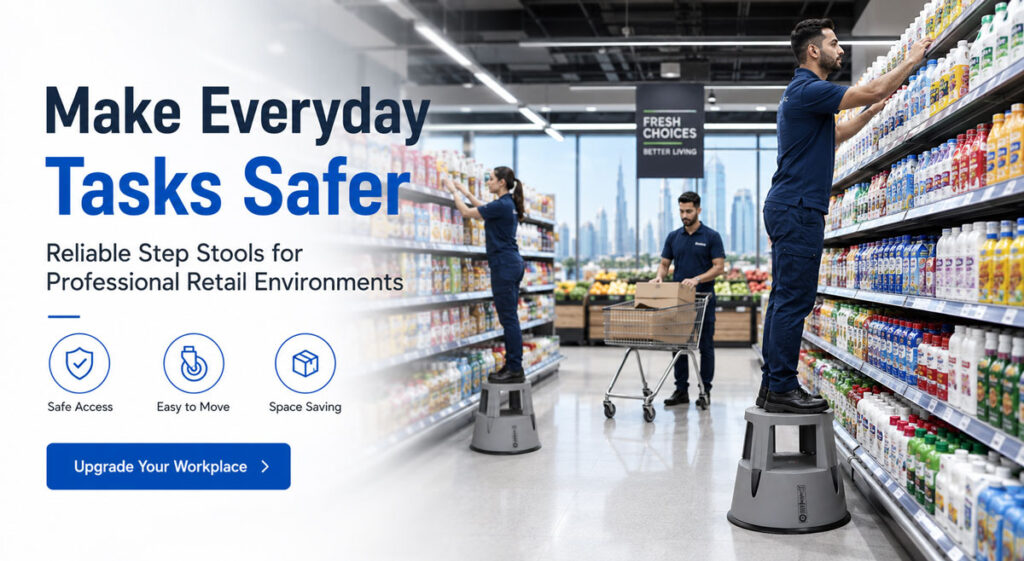
In Egyptian supermarket operations the difference between a full facing and an empty high-bay section is often measured in minutes of access time. When staff must stretch, climb fixtures, or wait for a shared ladder, restocking slows and promotional installations fall behind schedule. Heavy-duty wheeled step stools remove that constraint when they are specified for real supermarket conditions rather than light commercial duty.
This analysis is written from the perspective of a procurement and operations lead responsible for store performance across Egypt. The focus is on how the right wheeled step stool changes daily restocking rhythm, protects safety, and supports consistent presentation without creating new obstacles for customers.
Why Conventional Access Methods Create Drag on the Sales Floor
Fixed ladders occupy space and create trip hazards during open hours. Lightweight domestic stools flex under commercial loads and slide on polished tile. Improvised platforms made from product crates introduce both safety and product-damage risk. In a supermarket environment the equipment must be mobile enough to appear only when needed and stable enough that staff trust it completely once it is in place.
Spring-loaded wheeled designs meet the requirement directly. The wheels extend for free movement when the unit is empty. The moment an operator steps on, the springs compress, the base settles firmly onto the floor, and the stool becomes a rigid platform. When the operator steps off, mobility returns automatically. No separate locking lever is required, eliminating the most common source of incomplete securing under time pressure.
Core Specifications Matched to Supermarket Reality
Typical professional units in this category deliver:
- 150 kg load capacity
- Overall height of approximately 410 mm
- Top platform diameter of 283 mm
- Base diameter of 433 mm for inherent stability
- Heavy-duty plastic construction with molded non-slip treads
- Spring-loaded wheels that require no manual locking action
- Color options that support zone or department identification
These dimensions keep the center of gravity low while still providing useful reach for the majority of supermarket high-bay and promotional tasks. The plastic body resists corrosion in air-conditioned environments, cleans easily, and does not mark polished floors common in modern Egyptian stores.
Local Operating Conditions Across Egyptian Supermarket Networks
Sales floors range from high-gloss tile in newer developments to more traditional finishes in established locations. Morning cleaning leaves residual moisture. Customer traffic continues during many restocking windows. Aisles are often narrower than pure warehouse corridors.
In Cairo the intensity of footfall and the speed of restocking cycles favor equipment that moves and settles in seconds. In New Cairo larger-format stores with higher ceilings place greater value on stable mid-height access. In Nasr City dense urban layouts reward compact footprints. The same practical requirements appear in Heliopolis, Maadi, 6th of October City, Giza, Dokki, Mohandessin, Obour City, 10th of Ramadan City, Shorouk City, Alexandria, Borg El Arab, Port Said, Suez, Ismailia, Mansoura, Tanta, Zagazig, Mahalla El Kubra, Damietta, New Damietta, Hurghada, Asyut, Sohag, Minya, Beni Suef, Luxor, Qena, and Aswan.
Human-Factors Advantages on the Sales Floor
Because settling is automatic, the most common operator error—stepping onto a partially locked unit—is largely eliminated. Gloved or bare hands both work equally well. The wide base and low height reduce the feeling of instability that causes staff to hesitate or over-reach from the floor. Over a full shift these small reductions in hesitation and physical strain compound into higher completed tasks and lower fatigue.
Placement Logic That Protects Customer Flow
The ideal storage points sit close enough to high-bay and promotional zones that retrieval is not a deterrent, yet outside the primary customer circulation paths. End-cap positions, the edge of back-stock doors, and designated spots near seasonal display areas usually satisfy both needs. High-visibility colors or simple floor markers further reduce the chance that a stool is left in an active aisle after use.
Comparative View: Mobile Heavy-Duty Stools versus Alternatives
| Solution | Speed of Deployment | Stability under Load | Customer Disruption | Suitability for Daily Supermarket Use |
|---|---|---|---|---|
| Fixed ladder | Slow | High | High | Poor |
| Domestic step stool | Medium | Low–Medium | Medium | Poor |
| Improvised crates | Fast | Very Low | Medium | Unacceptable |
| Heavy-duty wheeled stool | Very Fast | High | Low | Excellent |
The heavy-duty wheeled design wins on the combination of speed, stability, and minimal disruption—the three variables that matter most on an active supermarket floor.
Procurement Framework for Egyptian Supermarket Networks
- Map the highest-frequency elevated tasks on the sales floor and in the immediate back-of-house.
- Measure the narrowest working aisles and any floor transitions.
- Confirm that 150 kg capacity provides comfortable margin for operator plus typical retail case weights.
- Trial units on the actual floor finishes present in representative stores.
- Evaluate roll effort and automatic settling with both permanent and temporary staff.
- Decide whether color coding by zone or department adds operational value.
- Structure bulk orders through a manufacturer or wholesale partner capable of consistent quality.
- Consider modest OEM adjustments only after the base design has proven itself in live conditions.
Cost Perspective for the Retail Buyer
Unit price is visible; the cost of delayed restocking, incomplete promotional displays, and minor injuries is less visible yet real. A heavy-duty wheeled stool that is used consistently reduces all three. When bulk orders are placed with a reliable manufacturer the per-unit economics improve while specification consistency across stores is protected. A distributor can supply faster trial quantities and individual replacements; the manufacturer route suits larger wholesale volume and any OEM work.
Safety Integration on the Sales Floor
The equipment must appear in the store’s height-access procedure with clear, simple rules: position the stool, step on so that it settles fully, maintain three points of contact, complete the task, step off, and return the unit to its designated point. Because the mechanism itself enforces the stable state, compliance rates are typically higher than with lever-locked designs.
Maintenance Reality in Supermarket Environments
Weekly visual checks of the non-slip surface, spring action, wheel condition, and structural integrity are sufficient. Units that develop uneven settling, smoothed treads, or visible damage are removed immediately. The mechanical simplicity of the spring-loaded plastic design keeps maintenance demand low and supports high availability.
Real Operating Scenarios
During a promotional changeover the same stool moves from installing overhead signage to topping up elevated seasonal stock and then to adjusting a high display in the adjacent aisle. In a hybrid warehouse-retail site the unit supports both bulk picking in the back and final presentation on the sales floor. Temporary staff receive a short practical demonstration and can use the equipment correctly for the remainder of their shift.
Five Distinct Calls to Action
- Place a small trial set in your highest-intensity stores and measure the change in restocking time and staff feedback within two weeks.
- Share your dominant aisle widths and elevated task profile for a concise model recommendation.
- Move from reactive replacement to planned bulk orders timed ahead of major promotional peaks.
- Standardize on one heavy-duty wheeled design across the network to simplify training and spare holding.
- Request both standard wholesale pricing and OEM options so the long-term fleet can be optimized for your exact conditions.
Firmalazım supplies heavy-duty wheeled step stools engineered for the speed, safety, and customer-flow demands of supermarket operations in Egypt. Whether the requirement is met through standard wholesale channels or through structured OEM programs, the focus remains on automatic settling, durable non-slip performance, low-effort mobility, and consistent behavior under daily commercial use.
When elevated work becomes fast, low-disruption, and reliably cleared, both on-shelf availability and shopping experience improve together. That is the practical outcome of equipping supermarket teams with the right heavy-duty wheeled step stools.
Frequently Asked Questions
What makes a wheeled step stool “heavy-duty” for supermarket use? Higher load capacity (typically 150 kg), industrial non-slip surfaces, spring-loaded systems designed for repeated daily cycles, and construction that survives continuous commercial cleaning and traffic.
How do spring-loaded wheels improve safety on a supermarket floor? They eliminate the need for a separate locking action. The unit becomes stable automatically when weight is applied and mobile again when weight is removed, reducing the most common operator error.
Is 410 mm height sufficient for most supermarket tasks in Egypt? Yes for the majority of high-bay restocking, promotional installation, and overhead display work. Very high architectural features may still require other equipment.
Can the same stools be used in both the sales floor and the warehouse-retail back area? Yes. The design performs on both polished retail tile and typical back-of-house surfaces, supporting consistent equipment standards across the boundary.
How important is the non-slip surface when floors are recently cleaned? Critical. Residual moisture is common. Molded industrial textures that retain grip under light moisture keep the platform trustworthy.
What is the practical advantage of a 433 mm base diameter? It lowers the center of gravity and increases inherent stability, which is especially valuable when operators shift weight while handling product at height.
Are color options useful in a supermarket network? Yes. Simple color coding by zone or department helps staff locate the nearest unit quickly and supports clearer ownership of equipment condition.
How should bulk orders be planned for a multi-store supermarket group? Complete on-site trials first, confirm the preferred specification, then place volume orders through a manufacturer or wholesale partner that can guarantee consistency across the batch.
Is OEM customization practical for supermarket step stools? Yes for larger networks that want uniform color, molded identification, or minor dimensional alignment. It is best considered after the base model has proven itself in live stores.
What maintenance is realistically required? Weekly visual inspection of wheels, spring action, non-slip surface, and overall structure. Immediate removal of any unit that shows damage or inconsistent settling.
How do these stools affect customer experience during restocking? When used correctly they appear only for the duration of the task and are removed quickly, minimizing aisle blockage compared with fixed ladders or improvised platforms.
Can temporary or seasonal staff use them safely with minimal training? Yes. The automatic settling action and simple operating sequence allow correct use after a very short practical demonstration.
What is the most common reason supermarket teams abandon a step stool? Loss of confidence caused by perceived instability, difficult locking, or slippery surfaces. Professional designs that feel solid and settle automatically maintain higher utilization.
How does the product support overall store safety culture? By providing a convenient, reliable alternative to stretching, climbing shelves, or stacking crates. When the correct tool is trusted and easy to use, unsafe improvisation declines.
Should every store carry the same model? Standardization simplifies training and spare parts. Minor variations in color coding can still be introduced if layout differences are significant.
What role does a distributor play versus direct manufacturer supply? A distributor often provides faster trial units and individual replacements. Direct manufacturer supply suits larger wholesale volume and OEM programs that require tight specification control.
How long do professional plastic wheeled stools typically last under daily supermarket use? With correct use and basic inspection, well-engineered units commonly deliver several years of service. Actual life depends on intensity, floor conditions, and adherence to load limits.
Is it worth keeping a small buffer stock in the system? Yes. A limited buffer allows immediate replacement of any unit taken out of service and maintains coverage during promotional peaks.
What documentation should be requested before a large order? Load rating, material specification, confirmation of spring-rate consistency across the batch, and any available performance information under repeated load cycles.
How do these stools perform when operators wear standard work gloves? Because there are no small levers to manipulate, gloved operation is straightforward. The platform remains fully usable.
Can the stools be cleaned with normal supermarket floor chemicals? Yes. Heavy-duty plastic constructions tolerate standard cleaning agents when the finish and non-slip surface are appropriately specified.
What is the primary benefit for a supermarket network operating across Egypt? Consistent, fast, and safe height access that works on both the sales floor and supporting warehouse-retail zones, reducing friction and risk across the entire operation.
Where should trial units or further technical clarification be requested? Directly from the manufacturer or authorized wholesale and distribution partners that support professional supermarket equipment requirements in the region.
Heavy-Duty Wheeled Step Stools for Supermarkets in Egypt
Heavy-duty wheeled step stools transform supermarket operations in Egypt by enabling safe, fast access to high shelves while protecting staff and products. Firmalazım supplies commercial-grade units designed for continuous retail use, combining mobility, stability and high load capacity for Egyptian store environments.
Why Egyptian Supermarkets Need Purpose-Built Wheeled Step Stools In busy supermarket aisles, staff must reach top shelves daily without risking falls or product damage. Standard ladders slow movement and create trip hazards. Heavy-duty wheeled step stools solve this with spring-loaded casters that lock when weight is applied, then roll freely when unloaded. This design supports commercial use across high-traffic floors while meeting practical safety expectations for warehouse retail and front-of-house stocking.
A leading manufacturer of industrial access equipment, Firmalazım builds these stools for the demands of Egyptian retail. Units feature wide non-slip steps, robust steel or reinforced frames, and load ratings suitable for staff plus product cases. Safety remains the priority: stable bases, anti-slip treads and automatic wheel retraction reduce the most common workplace incidents.
Local Relevance Across Egypt Supermarket chains operating in Cairo benefit from easy movement between narrow aisles and backrooms. The same performance is valued in New Cairo and Nasr City, where modern hypermarkets stock dense high shelves. Operators in Heliopolis and Maadi report faster replenishment cycles. Facilities in 6th of October City and Giza use the stools for both sales floor and warehouse zones.
Teams in Dokki and Mohandessin appreciate the compact storage footprint. Growing retail hubs in Obour City, 10th of Ramadan City and Shorouk City select them for new store openings. Coastal and delta locations including Alexandria, Borg El Arab, Port Said, Suez, Ismailia, Mansoura, Tanta, Zagazig, Mahalla El Kubra, Damietta and New Damietta rely on corrosion-resistant finishes suited to higher humidity. Tourist and Upper Egypt markets in Hurghada, Asyut, Sohag, Minya, Beni Suef, Luxor, Qena and Aswan deploy the same models for consistent safety standards nationwide.
Practical Advantages for Buyers Wholesale and distributor partners value the ability to place bulk orders with consistent quality. OEM customization is available for chain-specific branding or tray attachments. Units are built for continuous commercial use, reducing replacement frequency compared with lighter domestic stools.
Key features typically include:
- Spring-loaded locking wheels for instant stability
- Wide, textured steps rated for supermarket footwear
- Compact folded or upright storage
- High weight capacity for staff plus cases
Purchasing Considerations Focus on verified load ratings, wheel quality and local service support. Firmalazım offers wholesale pricing for multi-store rollouts and can act as a reliable distributor partner for national chains. Prioritize models engineered specifically for supermarket and warehouse retail environments rather than general-purpose household versions.
FAQ What load capacity is realistic for supermarket use? Most heavy-duty wheeled models support 150–300 kg total, covering staff weight plus product cases.
How do the wheels improve safety? Spring-loaded casters retract under load so the stool sits firmly on the floor; they engage only when unloaded for easy repositioning.
Can these stools be ordered in bulk for multiple branches? Yes. Firmalazım handles bulk orders and provides consistent specifications across locations.
Is OEM branding possible? OEM options exist for private-label or chain-branded units.
Are the stools suitable for both sales floor and warehouse areas? Yes. The same commercial-grade construction works for warehouse retail backrooms and customer-facing aisles.
How should maintenance be handled? Regular inspection of wheels, treads and frame joints keeps the stools in safe working condition.
Why choose a specialist manufacturer over generic imports? Specialist manufacturers design for continuous commercial use and local floor conditions, delivering better long-term safety and durability.
Contact Firmalazım today to discuss wholesale supply, distributor partnerships or customized solutions for your Egyptian supermarket network.
Firmalazım’s heavy-duty 2-step plastic wheeled step stool delivers 150 kg load capacity, spring-loaded locking wheels and non-slip surfaces for safe, fast shelf access in Egyptian supermarkets. Designed for continuous commercial use, it moves effortlessly across warehouse retail floors and sales aisles while locking securely under weight. Ideal for bulk orders, OEM customization and wholesale distribution nationwide.
The Real Cost of Slow Stocking in Egyptian Supermarkets Every minute a team member spends searching for a stable platform or dragging a fixed ladder costs a supermarket chain money. In high-volume stores the daily cycle of opening cases, reaching top shelves, rotating stock and closing gaps never stops. Traditional step stools without wheels create friction. Fixed ladders block aisles. Cheap plastic units crack under repeated loading. The result is slower replenishment, higher injury risk and lost sales when products remain out of reach.
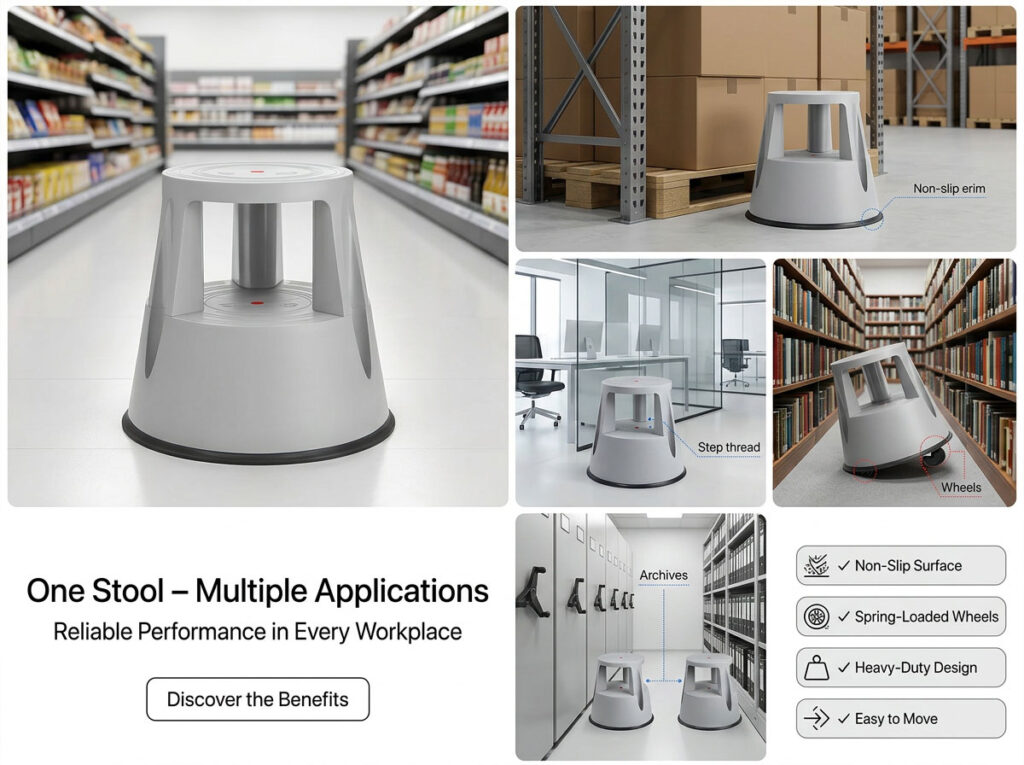
Firmalazım engineered a practical answer: a compact 2-step plastic step stool that combines mobility, stability and durability specifically for supermarket environments. The unit stands 410 mm high, offers a 283 mm top diameter and a 433 mm wide base, and carries a verified 150 kg load capacity. Spring-loaded wheels retract the moment weight is applied, converting the stool into a solid, non-slip platform. When the user steps off, the wheels re-engage for effortless repositioning.
This is not a household product re-badged for retail. It is a commercial tool built for the realities of Egyptian supermarket operations — narrow aisles, mixed flooring, high daily cycles and the need for consistent safety across dozens of branches.
How the Design Solves Daily Operational Problems The core mechanism is simple and reliable. Four spring-loaded wheels sit under the base. When a staff member steps on the top platform the springs compress and the wheels lift clear of the floor. Rubber or textured contact points then sit firmly on the surface, preventing any movement. The moment the user steps off, the springs expand and the stool becomes mobile again. No levers, no brakes to remember, no extra actions required.
Non-slip surfaces cover both steps. The textured plastic grips supermarket footwear even when floors are slightly damp from cleaning or cold-storage condensation. The wide base (433 mm) and low centre of gravity keep the unit stable even when the user reaches sideways for products on adjacent shelves. The overall height of 410 mm brings most standard supermarket shelf levels into comfortable reach without forcing staff onto higher, riskier platforms.
Material choice matters. High-density plastic resists the daily knocks of warehouse retail environments better than thin metal frames that dent or rust. The grey colour hides scuffs and matches most commercial interiors. At only a few kilograms the stool is light enough for any team member to move, yet rigid enough to support the combined weight of a person plus heavy cases.
Technical Specifications That Matter to Procurement Teams
- Material: Heavy-duty plastic
- Colour: Grey
- Number of steps: 2
- Overall height: 410 mm
- Top diameter: 283 mm
- Bottom diameter: 433 mm
- Load capacity: 150 kg
- Mobility: Spring-loaded wheels that lock under load
- Surface: Non-slip textured steps
- Design priority: Safety, stability, everyday convenience
These numbers are not marketing claims. They are the practical dimensions that determine whether a stool fits under a shelf, clears a doorway, or supports a 90 kg employee carrying a 40 kg case of oil or detergent.
Safety as a Commercial Advantage In supermarket operations, safety is not only a compliance issue — it is a cost and productivity issue. A single fall from an unstable platform can trigger lost-time injury, compensation claims, temporary staffing shortages and negative publicity. Firmalazım’s design addresses the three most common failure points: movement under load, slip on the step surface, and tip-over from a narrow base.
The spring-loaded wheel system eliminates the most frequent cause of accidents with wheeled stools — users forgetting to lock the brakes. Because locking is automatic, training is simplified and consistency improves across shifts and branches. The non-slip surface and wide base further reduce risk. When every store in a chain uses the same model, safety procedures become uniform and easier to audit.
Applications Across the Egyptian Retail Landscape The same stool performs reliably in very different store formats. In dense urban hypermarkets the compact footprint allows movement between crowded aisles without blocking customer traffic. In larger warehouse-style formats the 150 kg capacity handles heavier bulk cases. In smaller neighbourhood stores the light weight and easy storage make it practical for limited backroom space.
Operators across Egypt have adopted similar solutions for exactly these reasons. In Cairo the combination of high foot traffic and multi-level shelving makes rapid, safe access essential. New developments in New Cairo and Nasr City equip new stores with wheeled stools from day one to set consistent standards. Established branches in Heliopolis and Maadi replace older fixed platforms with mobile units to reduce aisle congestion.
Large-format stores in 6th of October City and Giza use the stools in both sales floors and back-of-house warehouse retail zones. Teams working in Dokki and Mohandessin value the ability to move the stool quickly between departments. Expanding retail parks in Obour City, 10th of Ramadan City and Shorouk City specify the model for new openings because it meets both safety and operational requirements.
Coastal and industrial cities present additional challenges. Humidity and occasional floor moisture in Alexandria, Borg El Arab, Port Said, Suez and Ismailia demand non-slip surfaces that continue to grip. Delta and Nile cities including Mansoura, Tanta, Zagazig, Mahalla El Kubra, Damietta and New Damietta run high-volume grocery operations where speed of replenishment directly affects sales. Tourist and Upper Egypt markets in Hurghada, Asyut, Sohag, Minya, Beni Suef, Luxor, Qena and Aswan benefit from a single standardised product that simplifies training and spare-parts management across the network.
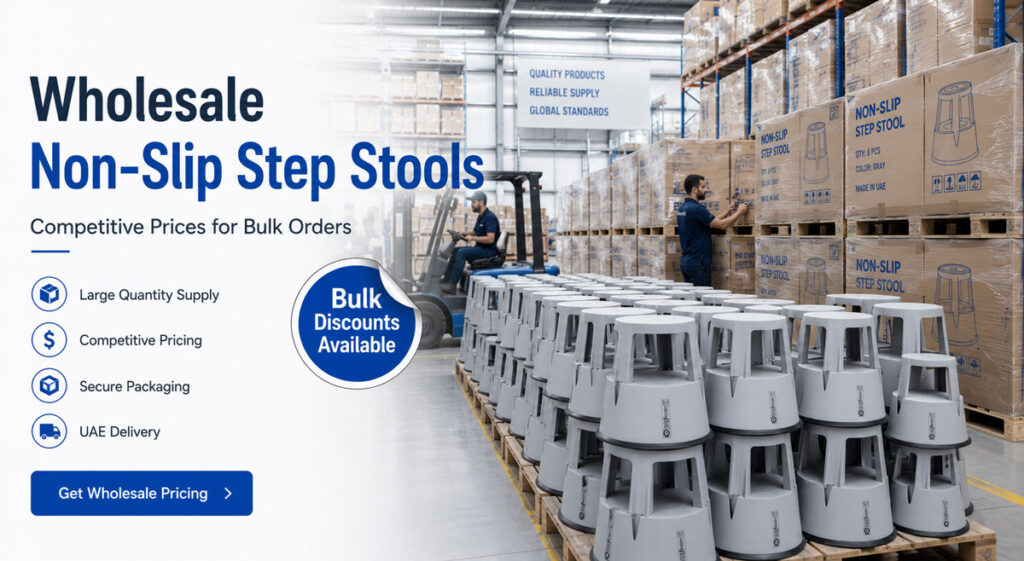
Procurement and Supply-Chain Advantages Retail chains rarely buy one stool at a time. They buy for multiple branches, plan for growth, and prefer consistent specifications. Firmalazım supports bulk orders with reliable lead times and uniform quality. Wholesale pricing becomes attractive once volumes reach multi-branch levels. Distributor partners can stock regional warehouses and supply smaller independent supermarket groups.
OEM options allow chains to add private branding, specific colour accents or small design modifications while retaining the core safety and mobility features. This is valuable for national brands that want visual consistency across all equipment. Because the product is designed for commercial use rather than domestic sale, the manufacturer can maintain tighter quality control and provide technical documentation that procurement and safety teams require.
Comparing Options: Why Specialised Commercial Units Win Generic imported stools often look similar on paper but fail under daily supermarket cycles. Thin plastic cracks. Weak wheels jam. Locking mechanisms break or are ignored. The total cost of ownership rises when units must be replaced every few months or when injuries occur.
A purpose-built commercial stool from a specialist manufacturer delivers lower long-term cost through higher durability, consistent safety performance and the ability to standardise across an entire network. The 150 kg rating provides a realistic safety margin for typical supermarket tasks. The spring-loaded system removes human error from the locking process. The dimensions fit the actual shelf heights and aisle widths found in Egyptian stores.
Implementation and Daily Use Introduction into a store is straightforward. Place units at key replenishment points — near high shelves in ambient grocery, near chilled cases, and in the warehouse retail area. Train staff once on the automatic locking behaviour. Include the stools in daily visual checks for damage or wheel function. Because the design is simple, maintenance is limited to occasional cleaning and inspection of the spring mechanism.
Over time the operational gains become measurable: faster shelf filling, fewer requests for assistance to reach high items, reduced risk of improvised climbing on lower shelves or boxes, and clearer compliance with internal safety standards.
Long-Term Value for Multi-Branch Operators When a supermarket group standardises on one reliable model, several secondary benefits appear. Training becomes simpler. Spare parts and replacement planning become predictable. Safety audits become easier because every branch uses the same equipment. Procurement can negotiate better terms through consolidated bulk orders. The manufacturer relationship develops into a partnership that can support future store openings and product updates.
Firmalazım positions itself as that partner — a manufacturer focused on commercial access solutions, capable of handling wholesale volumes, OEM requirements and ongoing supply for Egyptian supermarket networks.
Conclusion The daily reality of supermarket operations rewards tools that remove friction without creating new risks. A heavy-duty 2-step plastic wheeled step stool with automatic locking wheels, non-slip surfaces and 150 kg capacity is one of those tools. It accelerates replenishment, protects staff and maintains consistent standards across diverse Egyptian locations. For chains that manage multiple stores, the combination of safety, mobility and supply-chain reliability makes it a practical investment rather than a simple equipment purchase.
Frequently Asked Questions
What is the exact load capacity of the Firmalazım 2-step wheeled stool? The rated load capacity is 150 kg. This covers the combined weight of a staff member and typical supermarket product cases under normal use conditions.
How do the spring-loaded wheels improve safety compared with manual brakes? The wheels retract automatically when weight is applied and re-engage when the user steps off. There is no separate brake lever that can be forgotten, reducing the most common user error associated with wheeled platforms.
Is the stool suitable for both sales-floor and warehouse retail areas? Yes. The same commercial-grade construction and mobility features work in customer-facing aisles and back-of-house warehouse retail zones.
Can we place bulk orders for multiple supermarket branches? Yes. Firmalazım supports bulk orders and can coordinate delivery schedules for multi-branch rollouts.
Is OEM branding or customisation available? OEM options are available for chains that require private labelling or minor design adjustments while retaining the core safety and performance specifications.
What material is used and why is it preferred for supermarket environments? High-density plastic provides impact resistance, corrosion resistance and easy cleaning. It performs reliably under the daily knocks and occasional moisture found in supermarket and warehouse retail settings.
How does the stool perform on slightly damp floors? The non-slip textured surfaces maintain grip under light moisture conditions typical after cleaning or near refrigerated cases. Regular inspection remains part of good safety practice.
What are the key dimensions? Overall height 410 mm, top diameter 283 mm, base diameter 433 mm. These proportions balance reach height with stability and aisle compatibility.
Is the product intended only for supermarkets or can it be used in other commercial settings? While optimised for supermarket and warehouse retail use, the same design is suitable for any commercial environment requiring safe, mobile access to moderate heights.
How should the stools be maintained? Daily visual checks for damage, periodic cleaning of steps and wheels, and inspection of the spring mechanism are normally sufficient. No complex servicing is required.
Does Firmalazım act as a manufacturer and also support wholesale and distributor channels? Yes. The company operates as a manufacturer capable of supplying direct bulk orders, wholesale pricing and distributor partnerships across Egypt.
Why choose a specialised commercial stool instead of a cheaper domestic model? Specialised commercial units are engineered for higher cycle rates, consistent safety performance and the ability to standardise across many locations. The total cost of ownership is usually lower despite a higher initial price.
Can the stool be moved while a person is standing on it? No. The design intentionally locks the wheels under load so the platform remains stationary during use. Movement occurs only when the stool is unloaded.
Is the 150 kg capacity realistic for typical supermarket tasks? Yes. It provides a practical margin for staff weight plus the majority of ambient and bulk grocery cases handled during routine replenishment.
How does standardisation across branches improve safety management? When every store uses the same model, training is consistent, inspection criteria are uniform, and replacement planning becomes predictable. This simplifies compliance and reduces variation in risk levels.
Contact Firmalazım to discuss bulk supply, OEM requirements or a pilot programme for your supermarket network.
Continuing the Operational Case for Firmalazım Wheeled Step Stools in Egyptian Supermarkets
Once a supermarket chain commits to mobile access platforms, the next question becomes consistency of performance across every branch. A single model that behaves the same way in every location removes variables that otherwise complicate training, safety audits and replacement planning. Firmalazım’s 2-step plastic design with automatic spring-loaded wheels delivers exactly that consistency. The moment a staff member places weight on the top platform the wheels retract and the unit becomes a solid, non-slip working surface. The moment they step off, the stool is ready to roll again. No levers to remember, no brake mechanisms that can fail or be left unlocked.
This automatic behaviour is especially valuable in high-turnover supermarket environments where new employees join frequently and training time is limited. Safety procedures become simpler to teach and easier to enforce. The same stool can move from ambient grocery aisles to chilled sections to the warehouse retail backroom without any change in handling method.
Cost-of-Ownership Reality for Multi-Branch Operators
Procurement teams often compare only the purchase price. That approach underestimates the true cost of access equipment. A cheaper stool that cracks after three months, or whose wheels jam after six, generates repeated replacement orders, staff downtime and potential injury claims. A commercial-grade unit engineered for continuous use spreads its higher initial cost across years of reliable service.
Consider a mid-sized supermarket chain operating twenty stores. If each store needs four stools and the cheaper alternative must be replaced every eight months, the annual replacement volume quickly exceeds the cost of a more durable model purchased once and kept in service for several years. Add the hidden costs of lost productivity while waiting for replacements and the administrative burden of repeated purchasing, and the specialised commercial solution becomes the lower-cost option.
Firmalazım supports this calculation by offering transparent wholesale pricing for bulk orders and by maintaining consistent specifications so that every unit delivered performs identically. Chains that standardise on one model also reduce the variety of spare parts and inspection criteria that safety managers must track.
Material and Construction Choices That Affect Daily Performance
The choice of high-density plastic is deliberate. Metal frames can dent, rust in humid coastal climates, or develop sharp edges after impacts. Thin domestic plastics crack under repeated loading. The material selected for this stool resists the daily knocks of supermarket life, cleans easily after spills, and maintains structural integrity under the rated 150 kg load. The grey colour hides scuff marks and blends with most commercial interiors, reducing the visual impact of heavy use.
The base diameter of 433 mm provides a stable footprint while still allowing the stool to pass through standard aisle widths and doorways. The top platform diameter of 283 mm offers enough standing space for secure footing without making the unit bulky. At 410 mm overall height the stool brings typical supermarket shelf levels into comfortable reach for most adult staff without encouraging the risky practice of standing on the very top of higher ladders.
Non-slip texturing on both steps is critical. Supermarket floors are cleaned frequently and condensation near refrigerated cases is common. A smooth surface becomes a slip hazard under those conditions. The textured plastic maintains grip even when lightly damp, giving staff confidence when reaching for products.
Real Working Scenarios Across Different Store Formats
In a dense urban hypermarket the stool is moved many times per shift. Staff use it to rotate stock on high shelves, to place promotional displays, and to access backstock in tight warehouse retail areas. Because the wheels lock automatically, the same person can move the stool, step up, complete the task and move on without extra actions.
In a larger format store with wider aisles the same unit supports heavier cases. The 150 kg rating provides a practical margin when an employee carries a full case of bottled water or cooking oil. The wide base keeps the platform stable even when the user reaches slightly sideways.
In smaller neighbourhood stores the light weight and compact size make the stool easy to store between uses. It can live near the stockroom door or under a low shelf and still be available within seconds when needed.
These patterns repeat across Egypt. Store managers in Cairo report faster evening replenishment because staff no longer wait for a fixed ladder to become free. New stores opening in New Cairo and Nasr City equip every department with the same model so that training is identical from day one. Established branches in Heliopolis and Maadi have replaced older fixed platforms and observed a measurable drop in aisle congestion during peak stocking hours.
Large-format operations in 6th of October City and Giza deploy the stools in both sales floors and dedicated warehouse retail zones. Teams in Dokki and Mohandessin value the ability to move the unit quickly between categories. Expanding retail developments in Obour City, 10th of Ramadan City and Shorouk City include the stools in their initial equipment lists because the specifications already match their safety and operational requirements.
Coastal cities present additional environmental factors. Higher humidity and occasional floor moisture in Alexandria, Borg El Arab, Port Said, Suez and Ismailia make non-slip surfaces essential. The plastic construction also resists corrosion better than untreated metal. Delta and Nile cities including Mansoura, Tanta, Zagazig, Mahalla El Kubra, Damietta and New Damietta run high-volume grocery operations where the speed of shelf filling directly influences sales and customer satisfaction. Tourist and Upper Egypt locations in Hurghada, Asyut, Sohag, Minya, Beni Suef, Luxor, Qena and Aswan benefit from a single standardised product that simplifies multi-site management and training.
Procurement Pathways: Wholesale, Distributor and OEM
Most supermarket groups prefer to consolidate purchasing. Firmalazım accommodates this by offering wholesale terms once volumes reach multi-branch levels. Regional distributor partners can hold local stock, reducing lead times for individual stores that need replacements or additional units. For national chains that want visual consistency, OEM options allow private branding or minor colour adjustments while the core safety and mobility features remain unchanged.
Working directly with a manufacturer rather than through multiple importers also improves communication on technical questions, warranty handling and future product updates. Procurement teams receive consistent documentation, load-test information and material specifications that satisfy internal safety committees.
Implementation Checklist for Store Operations Teams
- Identify high-reach zones in ambient, chilled and warehouse retail areas
- Determine the number of stools required per zone based on simultaneous staffing
- Confirm that aisle widths and doorway clearances accept the 433 mm base
- Include the automatic locking behaviour in new-employee induction
- Add daily visual inspection of wheels, steps and base to existing safety routines
- Establish a simple replacement process so damaged units are removed immediately
- Track usage patterns for the first three months to confirm placement is optimal
Following this sequence turns a simple equipment purchase into a controlled operational improvement.
Common Mistakes That Reduce the Value of Mobile Stools
Some operators buy units that look similar but lack the spring-loaded automatic lock. Staff then forget to engage manual brakes and the platform can shift underfoot. Others choose stools with inadequate base width; these feel unstable when the user reaches sideways. A third frequent error is selecting domestic-grade plastic that cracks under commercial cycle rates. Finally, some chains buy different models for different regions, creating training and spare-parts complexity.
Avoiding these mistakes is straightforward when the specification is clear from the beginning: 150 kg capacity, automatic spring-loaded wheels, non-slip textured steps, 410 mm height, wide stable base, and commercial-grade plastic construction.
Maintenance and Longevity in Practice
Daily maintenance is minimal. Staff wipe the steps and base during normal cleaning. Supervisors check that the wheels retract and re-engage smoothly. Any unit showing cracks, damaged texturing or sticky wheels is removed from service. Because the design has few moving parts, long-term reliability is high when basic care is applied. The plastic material does not require painting or rust treatment, further reducing lifecycle cost.
Future-Proofing Access Equipment for Growing Chains
Egyptian supermarket groups continue to open new stores and renovate existing ones. Choosing a model that is already proven across multiple regions simplifies expansion. When the same stool is specified for every new site, the safety and training systems scale without reinvention. The manufacturer relationship also scales: bulk order volumes increase, OEM requirements can be refined, and technical support remains consistent.
Summary of Core Advantages for Decision Makers
- Automatic wheel lock removes the most common user error
- 150 kg capacity covers staff plus typical product loads
- Non-slip surfaces maintain grip on cleaned or lightly damp floors
- Compact dimensions fit supermarket aisles and storage spaces
- Commercial-grade plastic resists daily impacts and humidity
- Uniform specification simplifies training and safety audits
- Wholesale and OEM pathways support multi-branch and national rollouts
- Proven performance across the full range of Egyptian retail environments
Firmalazım supplies this solution as a manufacturer focused on commercial access equipment. Whether the requirement is a pilot order for a single region, a full wholesale programme for an existing chain, or an OEM-branded version for a national brand, the underlying product remains engineered for the realities of supermarket and warehouse retail work.
Expanded Frequently Asked Questions
How quickly can bulk orders be fulfilled for a multi-branch rollout? Lead times depend on volume and current production schedules. Firmalazım works with procurement teams to align deliveries with store opening or renovation timelines.
Can the stools be used on both tiled and epoxy warehouse floors? Yes. The spring-loaded system and non-slip contact points function on the floor surfaces commonly found in Egyptian supermarket sales floors and warehouse retail areas.
What happens if a wheel becomes damaged? The unit should be removed from service immediately. Because the design is modular in concept, replacement of individual components can be discussed with the supplier depending on the nature of the damage.
Is the 410 mm height suitable for all shelf levels? It is optimised for the most frequently accessed mid-to-high supermarket shelves. Extremely high racking may still require taller platforms, but the majority of daily replenishment tasks fall within the comfortable reach of this height.
How does the product support overall store safety programmes? By providing a consistent, automatic-locking platform, the stool reduces variation in how staff access height. This makes safety procedures easier to standardise and audit across every branch.
Are colour options available beyond standard grey? Standard production is grey for practicality and scuff resistance. OEM programmes can explore alternative colours when volumes justify dedicated production runs.
What documentation is supplied with wholesale orders? Typical commercial documentation includes load-capacity statements, material information and basic care instructions that procurement and safety teams can file for compliance records.
Can independent supermarket owners access the same product through a distributor? Yes. Regional distributor partners stock the stools so that smaller operators can purchase without needing full wholesale volumes.
How does the design reduce the temptation for staff to climb on lower shelves or boxes? When a stable, easy-to-move platform is immediately available, improvised climbing becomes unnecessary. Consistent availability is therefore part of the safety benefit.
Is the product intended for continuous all-day use? It is engineered for the repeated short-cycle use typical of supermarket replenishment rather than continuous standing for hours. Under normal commercial patterns the construction provides long service life.
Firmalazım remains ready to support Egyptian supermarket operators with technical clarification, sample units, bulk order planning and OEM discussion. Standardising on a purpose-built wheeled step stool is one of the simpler operational decisions that delivers measurable gains in speed, safety and consistency across every store.

Bir yanıt yazın