


Non-Slip Step Stools for Pharmacy Shelving in Egypt
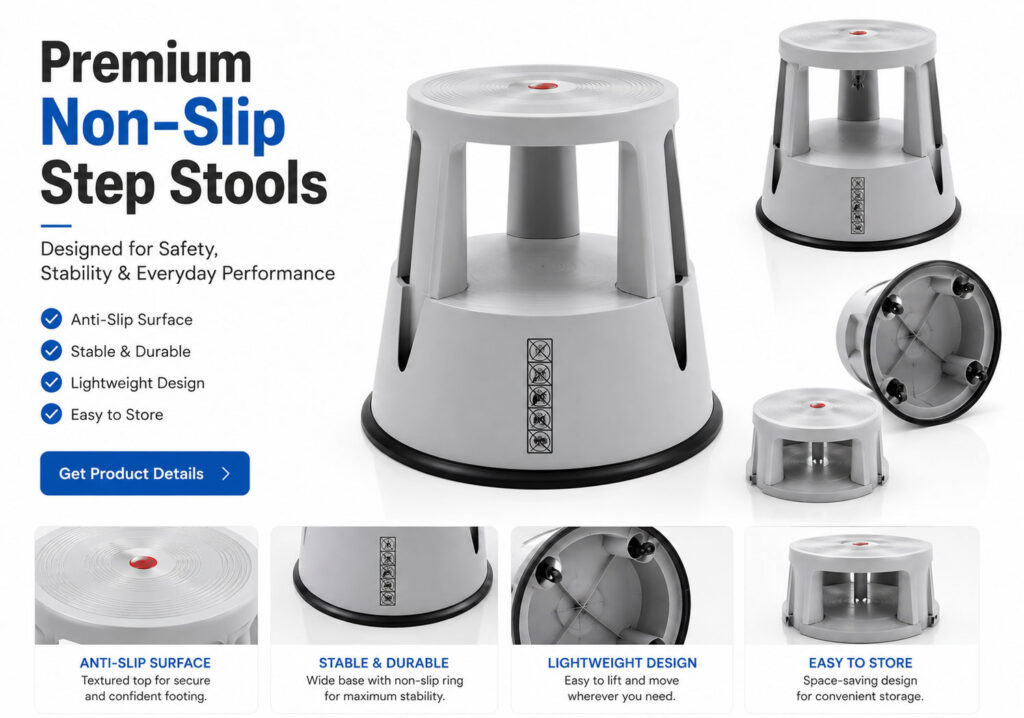
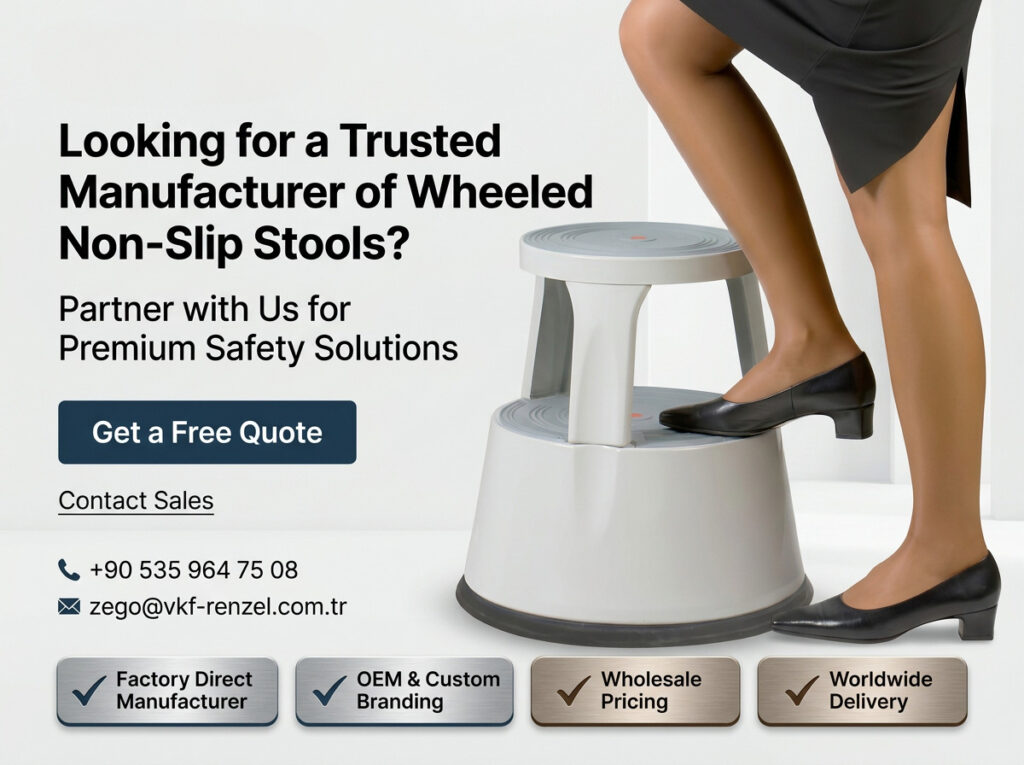
Non-Slip Step Stools for Pharmacy Shelving in Egypt designed for pharmacy shelving give Egyptian supermarket pharmacy sections a safe, precise way to access high medication and supply racks. Firmalazım’s 2-step plastic model features spring-loaded locking wheels, textured non-slip surfaces, 150 kg capacity and compact dimensions suited to narrow pharmacy aisles. Built for continuous commercial use, the stool supports accurate stock rotation, expiry checks and daily replenishment while prioritising staff safety inside supermarket pharmacy environments and linked warehouse retail zones.






Precision Access in the Controlled Environment of Pharmacy Shelving
Pharmacy sections inside Egyptian supermarkets operate under stricter visual and procedural standards than general grocery aisles. High shelves hold medicines, supplements, medical devices and sensitive stock that must remain fully visible, correctly rotated and free from dust or damage. Staff move constantly between dispensing counters, storage bays and back-of-house warehouse retail areas. Any platform that slips, tips or requires complicated locking introduces both safety risk and process delay.
A non-slip step stool engineered for this setting removes those risks. When the unit rolls freely when unloaded and locks automatically the moment weight is applied, the worker can position it exactly where needed, step up with confidence, complete the task and move on. The textured surface maintains grip on floors that may be lightly cleaned or carry residual moisture near refrigerated medicine cabinets. The compact base fits the narrower clearances typical of pharmacy layouts while still providing stability during sideways reach.
Firmalazım supplies the current 2-step plastic model specifically for these commercial pharmacy and supermarket conditions: 410 mm overall height, 283 mm top platform, 433 mm base diameter, 150 kg load capacity, high-density plastic construction and spring-loaded wheels that retract under load.
Why Pharmacy Shelving Demands Different Performance Criteria
General warehouse or retail stools often prioritise speed over precision. Pharmacy work prioritises accuracy, hygiene and residual-risk control. Staff handle products that cannot be dropped or contaminated. Aisles are narrower. Floor surfaces may be smoother or more frequently cleaned. Lighting can be brighter and more revealing of any instability.
The non-slip textured surface addresses grip on cleaned floors. The automatic locking wheels eliminate the most common user error—forgetting to set a manual brake. The 150 kg rating provides a clear margin for staff plus cartons of medicines or bulk supplement cases. The grey high-density plastic resists impact, cleans easily and does not introduce corrosion risk in humid coastal locations.
Technical Specifications Optimised for Pharmacy Use
- Material: High-density commercial plastic
- Colour: Grey
- Number of steps: 2
- Overall height: 410 mm
- Top diameter: 283 mm
- Bottom diameter: 433 mm
- Load capacity: 150 kg
- Mobility: Spring-loaded wheels that lock under load
- Surface: Non-slip textured steps
These dimensions place most standard pharmacy high shelves within comfortable reach while keeping the unit manoeuvrable in tight spaces. The wide base resists tip-over when a worker reaches for a product on an adjacent bay. The automatic lock means the only required action is to step onto the platform.
Material and Hygiene Considerations for Pharmacy Environments
High-density plastic is selected because it accepts deep moulded texture without relying on coatings that can wear or flake. It cleans with standard pharmacy-compatible agents, resists impact from cartons, and does not rust. The grey finish conceals fine scuffs that accumulate during daily commercial use and continues to look professional under the brighter lighting typical of pharmacy sections.
Compared with thinner domestic plastics, the commercial grade maintains structural integrity through repeated daily cycles. Compared with metal frames, it reduces weight and eliminates corrosion concerns near temperature-controlled storage.
Automatic Locking as a Safety and Process Advantage
In pharmacy settings the cost of a slip or tip is higher than in general grocery. Medicines can be damaged, staff can be injured, and customer confidence can be affected. Spring-loaded wheels remove the need for a separate locking action that is easily forgotten under time pressure. The platform becomes stable the moment weight is applied and mobile again the moment the worker steps off. Training is reduced to a single reliable behaviour.
Daily Pharmacy Scenarios Across Egyptian Supermarket Networks
Dispensing teams rotate high-shelf stock to maintain first-expiry-first-out discipline. Inventory staff conduct cycle counts on upper levels without improvising on lower shelves. Receiving teams place newly arrived cartons on high bays in the back-of-house warehouse retail zone. Promotional or seasonal medicine displays are adjusted without blocking customer pathways.
These patterns appear nationwide. Dense urban supermarket pharmacies in Cairo recover time during peak dispensing hours because platforms are immediately available and stable. New stores opening in New Cairo and Nasr City equip pharmacy sections with the same model from day one so that procedures are consistent. Established locations in Heliopolis and Maadi report fewer near-miss incidents after replacing older smooth-step units.
Large-format supermarket pharmacies in 6th of October City and Giza use the stools in both front-of-house shelving and adjacent warehouse retail storage. Teams in Dokki and Mohandessin value the light weight for movement between narrow bays. Expanding retail developments in Obour City, 10th of Ramadan City and Shorouk City include the model in initial pharmacy fit-outs because the specifications already match safety and space requirements.
Coastal humidity affects pharmacies in Alexandria, Borg El Arab, Port Said, Suez and Ismailia. Textured non-slip surfaces continue to provide grip when floors are lightly damp after cleaning. High-volume supermarket pharmacies in Mansoura, Tanta, Zagazig, Mahalla El Kubra, Damietta and New Damietta measure gains in stock accuracy and reduced out-of-stocks. Locations in Hurghada, Asyut, Sohag, Minya, Beni Suef, Luxor, Qena and Aswan benefit from a single standardised design that simplifies multi-site training and replacement planning.
Procurement Perspective for Supermarket Pharmacy Networks
Pharmacy and procurement managers evaluate equipment on residual risk, process consistency and total cost of ownership. A commercial-grade non-slip stool that remains serviceable for several years under daily pharmacy cycles usually delivers lower long-term cost than lighter alternatives that require frequent replacement.
Wholesale pricing becomes relevant once volumes cover multiple supermarket pharmacies. OEM programmes allow private labelling or limited adjustments while the core safety and mobility features remain unchanged. Distributor partners can hold regional stock, shortening lead times for individual stores. Working with a specialised manufacturer improves the consistency of documentation available to pharmacy and safety teams.
Comparative Evaluation for Pharmacy Decision Makers
| Factor | Fixed Ladder or Domestic Stool | Non-Slip Professional Commercial Model | Pharmacy Impact |
|---|---|---|---|
| Grip on cleaned floors | Often declines | Textured surface retains friction | Lower slip risk |
| Stability under load | Variable | Automatic spring-loaded lock | Reduced tip risk |
| Training requirement | Multi-step or none | Single automatic action | Higher compliance |
| Load capacity | Often lower | 150 kg verified | Covers staff + carton |
| Aisle compatibility | Can obstruct | Compact 433 mm base | Clearer customer paths |
| Service life under daily use | Months | Multi-year commercial grade | Lower replacement cost |
Implementation Sequence for Pharmacy Sections
- Map the highest-frequency high-shelf zones and measure actual aisle clearances.
- Confirm that the 410 mm height and 433 mm base fit the physical layout.
- Trial a small number of units in one busy pharmacy section for two weeks.
- Capture baseline data on task time, near-miss frequency and staff feedback.
- Standardise on the successful model and proceed with bulk orders for remaining stores.
- Embed the automatic locking behaviour in every new-employee induction.
- Add a brief visual check of wheels and textured surfaces to existing daily pharmacy routines.
This sequence converts an equipment purchase into a controlled improvement in both safety and stock accuracy.
Maintenance Protocol Suited to Pharmacy Hygiene Standards Daily: Wipe textured steps during normal cleaning with pharmacy-compatible agents. Shift change: Quick visual confirmation that wheels retract under weight and roll freely when unloaded. Weekly: Supervisor inspection for cracks, worn texture or sticky movement. Any unit failing these checks is removed the same day and replaced from local or regional stock.
Because the design contains few moving parts, the protocol remains short enough to be sustained under normal pharmacy operating pressure.
Common Errors That Increase Residual Risk in Pharmacy Settings
Selecting units with manual brakes that staff later ignore. Choosing bases too narrow for sideways reach. Buying domestic-grade plastic that cracks under commercial cycles. Allowing different models across different supermarket pharmacies, which multiplies training and spare-parts complexity. Overlooking the higher consequence of a slip when medicines are involved.
Avoiding these errors begins with a clear specification: automatic locking wheels, non-slip textured surfaces, 150 kg capacity, stable base geometry and commercial-grade construction supplied by a manufacturer experienced in supermarket and warehouse retail environments.
Investment Horizon for Multi-Store Pharmacy Networks
A supermarket group operating multiple pharmacy sections and placing two to four stools in each faces a clear calculation. Continuous replacement of light-duty units generates ongoing purchasing cost and administrative load. A single investment in non-slip professional stools that remain in service for several years under the same conditions reduces both. When improved stock accuracy and fewer safety interruptions are added, the return strengthens further.
Bulk order volumes improve unit economics. OEM options support brand and process consistency. Distributor networks provide local resilience. The combination turns a simple equipment line into a scalable operational asset.
Five Distinct Calls to Action
- Request sample units for a controlled two-week trial in your busiest supermarket pharmacy section and measure the change in task time and near-miss reports.
- Ask Firmalazım for a wholesale quotation structured around current pharmacy count and planned store openings.
- Explore OEM branding if private-label consistency is required across the pharmacy network.
- Confirm regional distributor stock levels so that replacements can be supplied without delay.
- Schedule a short technical review to match the stool dimensions against specific pharmacy shelf heights and aisle widths.
Closing Perspective for Pharmacy and Procurement Leaders
Non-slip step stools remove recurring friction and residual risk from the daily work of supermarket pharmacy teams. Automatic locking, textured grip, adequate load capacity and compact mobility combine to support accurate stock rotation, clearer aisles and more consistent safety behaviour. Firmalazım supplies these solutions as a manufacturer focused on the commercial realities of Egyptian supermarket pharmacy sections and warehouse retail zones. The ability to fulfil bulk orders, support OEM requirements and work through distributor networks allows the same reliable design to scale across an entire national footprint.
Standardising on one purpose-built model simplifies training, inspection and replacement planning while delivering measurable gains in both safety and operational accuracy. The decision concerns the daily reliability of every pharmacy section and the confidence of the staff who work there.
Frequently Asked Questions
What makes a step stool suitable for pharmacy shelving rather than general retail? Higher emphasis on non-slip performance on cleaned floors, automatic locking to remove user error, compact dimensions for narrower aisles, and commercial-grade durability under daily pharmacy cycles.
How do spring-loaded wheels improve safety in pharmacy environments? They lock automatically when weight is applied and re-engage when unloaded, eliminating the possibility that a worker forgets to set a manual brake.
Is the 150 kg capacity realistic for pharmacy tasks? Yes. It covers the majority of staff members plus typical cartons of medicines or bulk supplements.
Can the same stool be used in the pharmacy section and the adjacent warehouse retail storage? Yes. The construction and non-slip surfaces perform in both environments.
Does Firmalazım support bulk orders for multi-store pharmacy networks? Yes. Wholesale terms are available once volumes reach multi-site levels.
Are OEM customisation options available? Yes. Private labelling and limited adjustments can be discussed for larger programmes.
How should the non-slip surfaces be cleaned to meet pharmacy hygiene expectations? Wipe them during normal cleaning with agents compatible with pharmacy environments to remove dust and residue.
What floor types are compatible? Tiled, sealed and lightly textured surfaces commonly found in Egyptian supermarket pharmacy sections.
Is the stool suitable when floors are lightly damp after cleaning? The textured surfaces are designed to retain grip under the light moisture conditions typical after routine cleaning.
How does standardisation across supermarket pharmacies improve operations? Identical equipment allows uniform training, identical inspection criteria and predictable replacement planning.
What service life can be expected under daily pharmacy use? When basic cleaning and inspection are observed, commercial-grade units typically remain in service for multiple years.
Can smaller independent supermarket pharmacies obtain the product? Yes. Regional distributors stock the stools for lower-volume purchases.
What documentation is supplied with commercial orders? Load-capacity information, material details and care instructions suitable for internal pharmacy and safety files.
How does the design reduce improvised climbing on lower shelves? When a stable, easy-to-move platform is immediately available, staff have less reason to climb on product or fixtures.
Are colours other than grey available? Standard production is grey for practicality. OEM programmes can explore alternatives at sufficient volume.
What is the most common purchasing mistake for pharmacy settings? Choosing units with manual brakes or inadequate non-slip surfaces that degrade under daily commercial and cleaning conditions.
How are urgent replacements handled? Through local distributor stock or direct from the manufacturer, depending on location and volume.
Is the stool intended for continuous all-day standing? It is designed for the repeated short-duration use typical of pharmacy stock rotation and replenishment cycles.
What height is most useful for standard pharmacy high shelving? A 410 mm platform brings the majority of frequently accessed levels into comfortable reach.
How does working with a specialised manufacturer differ from generic imports? Consistent specifications, technical support, reliable bulk-order fulfilment and OEM capability reduce long-term risk and cost across a supermarket pharmacy network.
Firmalazım continues to supply non-slip step stools engineered for the daily realities of Egyptian supermarket pharmacy shelving and warehouse retail zones. Whether the need is a pilot trial, a full multi-store programme through bulk orders, or an OEM-branded solution, the focus remains safer, more accurate work at height that supports both staff safety and pharmacy operational standards.
Non-Slip Step Stools for Pharmacy Shelving in Egypt
Precision, Compliance and Network Resilience: Expanding the Case for Non-Slip Step Stools in Egyptian Supermarket Pharmacies
Pharmacy sections inside Egyptian supermarkets operate at the intersection of retail speed and regulated precision. High shelves hold medicines, supplements and medical supplies that must remain correctly rotated, fully visible and free from damage or contamination. Staff move constantly between dispensing points, high-bay storage and back-of-house warehouse retail areas. Any platform that slips, tips or requires extra handling introduces both residual safety risk and process delay.
Non-slip step stools engineered for continuous commercial use remove those points of friction. Firmalazım’s 2-step plastic model—with spring-loaded automatic locking wheels, deep non-slip texturing, 150 kg capacity and compact dimensions—provides a practical platform for the daily realities of supermarket pharmacy shelving. The following sections examine the decision through the lenses of stock integrity, multi-store compliance consistency, workforce precision under time pressure and long-term network value.
Stock Integrity as a Direct Operational Metric
First-expiry-first-out discipline, accurate high-shelf counts and undamaged product presentation are non-negotiable in pharmacy environments. When staff hesitate because a platform feels unstable, or when they improvise by climbing on lower shelves, both accuracy and product condition suffer. A non-slip stool that locks automatically under weight and maintains grip on cleaned floors allows the worker to position precisely, reach confidently and complete the task without secondary risk.
Over repeated daily cycles the cumulative effect appears as fewer damaged cartons, more reliable expiry rotation and cleaner high-shelf facing. These outcomes support both regulatory expectations and customer confidence inside the supermarket pharmacy section.
Technical Foundations Matched to Pharmacy Constraints
The Firmalazım unit is defined by precise specifications: overall height 410 mm, top platform diameter 283 mm, base diameter 433 mm, load capacity 150 kg, high-density plastic construction with deep non-slip texturing, and spring-loaded wheels that retract under load.
These dimensions place most standard pharmacy high shelves within comfortable reach while keeping the unit manoeuvrable in the narrower clearances typical of pharmacy layouts. The wide base resists tip-over during sideways reach. The automatic lock means the only required action is to step onto the platform. The textured surface retains friction on floors that have been recently cleaned or carry residual moisture near temperature-controlled cabinets.
Material Behaviour Under Pharmacy Hygiene Cycles
High-density plastic is selected because it accepts permanent moulded texture, cleans with standard pharmacy-compatible agents, resists impact from cartons, and does not introduce corrosion risk. The grey finish conceals fine scuffs that accumulate during daily commercial use and continues to look professional under the brighter lighting common in pharmacy sections.
Under the repeated short-duration loading cycles of stock rotation, cycle counts and replenishment the material maintains structural integrity for multiple years when basic cleaning and inspection are observed. This longevity is a core component of total-cost calculations for multi-store pharmacy networks.
Automatic Locking as a Compliance and Training Advantage
Pharmacy staff receive extensive procedural training. Equipment that adds another multi-step locking action competes for attention and is easily skipped under time pressure. Spring-loaded wheels remove that action. The platform becomes stable the moment weight is applied and mobile again the moment the worker steps off.
Training reduces to a single reliable behaviour. Compliance rates rise. Residual risk linked to forgotten manual brakes falls. In high-turnover supermarket pharmacy teams this simplicity is especially valuable.
Daily Precision Scenarios Across Egyptian Supermarket Pharmacies Dispensing teams rotate high-shelf stock to maintain strict expiry discipline. Inventory staff conduct cycle counts on upper levels without improvising. Receiving teams place newly arrived cartons on high bays in the adjacent warehouse retail zone. Seasonal or promotional medicine displays are adjusted without blocking customer pathways or creating new hazards.
These patterns appear across the country. Dense urban supermarket pharmacies in Cairo recover time during peak hours because platforms are immediately available and stable. New stores opening in New Cairo and Nasr City equip pharmacy sections with the same model from day one so that procedures remain consistent. Established locations in Heliopolis and Maadi report fewer near-miss incidents after replacing older smooth-step units.
Large-format supermarket pharmacies in 6th of October City and Giza use the stools in both front-of-house shelving and back-of-house warehouse retail storage. Teams in Dokki and Mohandessin value the light weight for movement between narrow bays. Expanding retail developments in Obour City, 10th of Ramadan City and Shorouk City include the model in initial pharmacy fit-outs because the specifications already match space and safety requirements.
Coastal humidity affects pharmacies in Alexandria, Borg El Arab, Port Said, Suez and Ismailia. Textured non-slip surfaces continue to provide grip when floors are lightly damp after cleaning. High-volume supermarket pharmacies in Mansoura, Tanta, Zagazig, Mahalla El Kubra, Damietta and New Damietta measure gains in stock accuracy and reduced out-of-stocks. Locations in Hurghada, Asyut, Sohag, Minya, Beni Suef, Luxor, Qena and Aswan benefit from a single standardised design that simplifies multi-site training and replacement planning.
Procurement Logic for Multi-Store Pharmacy Networks
Pharmacy and procurement managers evaluate equipment on residual risk, process consistency, hygiene compatibility and total cost of ownership. A commercial-grade non-slip stool that remains serviceable for several years under daily pharmacy cycles usually delivers lower long-term cost than lighter alternatives that require frequent replacement.
Wholesale pricing becomes relevant once volumes cover multiple supermarket pharmacies. OEM programmes allow private labelling or limited adjustments while the core safety and mobility features remain unchanged. Distributor partners can hold regional stock, shortening lead times for individual stores. Working with a specialised manufacturer improves the consistency of documentation available to pharmacy and safety teams.
Comparative Decision Matrix for Pharmacy Leaders
| Evaluation Dimension | Fixed or Light-Duty Option | Non-Slip Professional Commercial Model | Pharmacy Network Effect |
|---|---|---|---|
| Grip on cleaned floors | Often declines | Textured surface retains friction | Lower slip risk |
| Stability under load | Variable | Automatic spring-loaded lock | Reduced tip risk |
| Training complexity | Multi-step or none | Single automatic action | Higher compliance |
| Load capacity | Often insufficient | 150 kg verified | Covers staff + carton |
| Aisle impact | Can obstruct | Compact 433 mm base | Clearer customer paths |
| Service life under daily use | Months | Multi-year commercial grade | Lower replacement cost |
| Specification consistency | Variable | Uniform from manufacturer | Simplified multi-site management |
Structured Implementation for Pharmacy Sections
- Map the highest-frequency high-shelf zones and measure actual aisle clearances.
- Confirm that the 410 mm height and 433 mm base fit the physical layout.
- Trial a small number of units in one busy pharmacy section for two to four weeks.
- Capture baseline data on task time, near-miss frequency and staff feedback.
- Standardise on the successful model and proceed with bulk orders for remaining stores.
- Embed the automatic locking behaviour in every new-employee induction.
- Add a brief visual check of wheels and textured surfaces to existing daily pharmacy routines.
This sequence converts an equipment purchase into a controlled improvement in both safety and stock integrity.
Maintenance Protocol Aligned with Pharmacy Hygiene Expectations Daily: Wipe textured steps during normal cleaning with pharmacy-compatible agents. Shift change: Quick visual confirmation that wheels retract under weight and roll freely when unloaded. Weekly: Supervisor inspection for cracks, worn texture or sticky movement. Any unit failing these checks is removed the same day and replaced from local or regional stock.
Because the design contains few moving parts, the protocol remains short enough to be sustained under normal pharmacy operating pressure.
Error-Prevention Checklist for Pharmacy and Regional Managers
- Confirm that every active stool retains fully functional spring-loaded wheels.
- Verify that non-slip texturing has not been polished smooth by prolonged use or cleaning.
- Ensure base geometry continues to match the sideways reaches common in local pharmacy layouts.
- Remove damaged units immediately and log the reason for pattern analysis.
- Keep induction content identical across all supermarket pharmacies.
- Maintain a small regional buffer so that replacements occur without operational delay.
- Review near-miss and stock-accuracy data quarterly to confirm sustained benefit.
Adherence to this checklist prevents the slow erosion of performance that can occur when equipment is treated as a one-time purchase rather than an ongoing operational asset.
Multi-Year Value for Expanding Supermarket Pharmacy Networks A supermarket organisation that continues to open new stores benefits from equipment decisions that scale without reinvention. When every new pharmacy section receives the same non-slip step stool, training, inspection and replacement systems transfer automatically. The manufacturer relationship deepens through repeated bulk orders and potential OEM collaboration. Distributor coverage expands in parallel with the store network.
The cumulative effect is a quieter, more predictable operating environment in which pharmacy teams can focus on accuracy, expiry discipline and customer service rather than on the mechanics of reaching height.
Five Forward-Looking Actions
- Design a four-week pilot in one high-volume supermarket pharmacy section with clear before-and-after metrics on task time, near-miss reports and stock accuracy.
- Request a multi-year wholesale framework quotation based on current pharmacy count and planned store openings.
- Explore OEM branding options that align the equipment with internal visual and audit standards.
- Map regional distributor coverage to ensure rapid replacement capability as the network grows.
- Commission a short technical alignment session to confirm that the 410 mm height and 433 mm base match the dominant pharmacy shelf and aisle profiles across the estate.
Strategic Synthesis for Pharmacy and Procurement Leadership Non-slip step stools are process enablers and residual-risk reducers rather than isolated tools. Automatic locking removes a decision point that is easily skipped under time pressure. Textured surfaces maintain grip under the cleaning and light-moisture conditions of daily pharmacy life. Adequate load capacity and stable geometry reduce tip risk. Compact mobility keeps aisles clear and task cycles short.
Firmalazım supplies these capabilities as a manufacturer focused on the commercial realities of Egyptian supermarket pharmacy sections and warehouse retail zones. The ability to fulfil bulk orders, support OEM requirements and work through distributor networks allows the same reliable design to scale across an entire national footprint. Standardising on one purpose-built model simplifies every supporting process—training, inspection, replacement and safety culture—while delivering measurable gains in stock integrity, residual-risk reduction and operational consistency.
The decision ultimately concerns the daily reliability of every supermarket pharmacy section and the confidence of the staff who maintain its high shelves. Removing friction and residual risk at the point of access to height is one of the more direct routes to both.
Extended Frequently Asked Questions
How does improved high-shelf access typically appear in pharmacy performance metrics? It surfaces as more consistent expiry rotation, fewer damaged cartons, higher stock-count accuracy and reduced time spent on high-level tasks.
What is the most effective way to capture baseline data before a pharmacy pilot? Time a representative sample of high-shelf rotation and count tasks across several shifts, combined with near-miss logs and structured staff feedback for the same period.
Can the stools support both routine daily rotation and larger seasonal medicine displays? Yes. The same mobility and stability characteristics serve continuous daily tasks and lower-frequency but higher-volume display changes.
How does humidity in coastal supermarket pharmacies affect long-term material performance? High-density commercial plastic is selected for resistance to humidity-related degradation; no additional protective coatings are required under normal conditions.
What buffer stock level is practical for a regional cluster of supermarket pharmacies? A small number of spare units per cluster is usually sufficient to cover immediate replacements while new stock is ordered.
How are multi-year supply agreements typically structured? They combine volume commitments with scheduled delivery windows and the option to adjust quantities as the store network evolves.
Does standardisation simplify both internal pharmacy audits and external safety reviews? Yes. Identical equipment and documented inspection routines produce clearer audit trails and more consistent findings.
What is the recommended response if a stool begins to show surface wear or reduced wheel response? Remove it from service at the first sign of compromised performance and replace it from buffer stock.
Can the design support more reliable digital inventory or task systems? While the stool itself is mechanical, its consistent availability and predictable behaviour reduce the variability that often undermines digital task completion tracking.
How does the automatic lock influence near-miss trends related to platform movement? Pharmacy sections that standardise on automatic locking typically observe a clear reduction in reports linked to unexpected movement under load.
Is the product suitable for supermarket pharmacies that operate mixed ambient and temperature-controlled storage? Yes. The construction and non-slip surfaces perform across the temperature ranges common in these environments.
What long-term partnership benefits arise from repeated bulk orders and potential OEM collaboration? Deeper technical alignment, priority production scheduling, refined specifications over successive programmes, and stronger continuity of supply as the pharmacy network expands.
Firmalazım remains focused on supplying non-slip step stools that match the actual working conditions of Egyptian supermarket pharmacy shelving and warehouse retail zones. Whether the requirement is a carefully measured pilot, a multi-year bulk supply programme, or an OEM-branded solution for network-wide consistency, the engineering priority stays the same: safer, more precise, more reliable work at height that supports both daily pharmacy performance and long-term operational resilience.
Non-Slip Step Stools for Pharmacy Shelving Egypt
Non-slip step stools built for pharmacy shelving protect both product integrity and staff safety inside Egyptian supermarket pharmacies. Firmalazım’s 2-step plastic unit delivers automatic spring-loaded locking, textured grip, 150 kg capacity and a compact footprint that fits narrow pharmacy aisles. Designed for continuous commercial use, it supports accurate high-shelf work while reducing residual risk across supermarket pharmacy sections and connected warehouse retail zones.
The Hidden Cost of Unstable Access in Pharmacy Operations
Every time a pharmacy team member hesitates on a high shelf, a carton is at risk of being dropped, an expiry date may be missed, or a near-miss is recorded. In supermarket pharmacy environments the consequences are higher than in general grocery. Medicines cannot be damaged. Controlled items require unbroken traceability. Customer trust is fragile.
A non-slip step stool that locks the moment weight is applied and maintains secure footing on cleaned floors removes the hesitation. The worker positions the unit, steps up with certainty, completes the rotation or count, and returns to the counter. The entire sequence becomes routine rather than a calculated risk.
Firmalazım engineered the current model for exactly these conditions: 410 mm height, 283 mm top platform, 433 mm base, 150 kg rating, high-density plastic with deep non-slip texturing, and spring-loaded wheels that retract under load.
Design Choices That Match Pharmacy Constraints
Pharmacy aisles are narrower than general supermarket aisles. Floor surfaces are cleaned more frequently. Lighting is brighter and more revealing. Staff move between high-intensity dispensing and high-shelf tasks within the same shift.
The compact base diameter allows movement through tight clearances. The textured surface retains friction after routine cleaning. The automatic lock eliminates the most common residual risk—forgotten manual brakes. The load rating provides a clear margin for staff plus typical medicine cartons. The grey high-density plastic cleans easily, resists impact and does not introduce corrosion concerns.
Hygiene and Surface Integrity Under Daily Cleaning Pharmacy floors are wiped repeatedly. Residual moisture and cleaning agents are normal. A surface that becomes slippery after cleaning creates immediate risk. Deep moulded texture on the Firmalazım stool continues to provide grip under these conditions. The plastic itself accepts standard pharmacy-compatible cleaning agents without degradation.
This combination of texture retention and material stability supports both safety and hygiene expectations inside supermarket pharmacy sections.
Automatic Stability as a Training Simplifier Pharmacy teams already carry heavy procedural knowledge. Adding a multi-step locking routine for a platform increases cognitive load. Spring-loaded wheels reduce the required behaviour to one action: step on. The platform locks. Step off and it rolls again.
New staff adopt the correct method faster. Experienced staff maintain compliance under time pressure. Residual risk linked to human error falls.
Real Working Patterns Across Egyptian Supermarket Pharmacies
High-shelf expiry rotation keeps first-expiry-first-out discipline intact. Cycle counts on upper levels are completed without climbing on lower fixtures. Newly received stock is placed on high bays in the back-of-house warehouse retail area. Seasonal displays are adjusted without creating new hazards for customers or staff.
These patterns are visible nationwide. Busy urban pharmacies in Cairo regain minutes during peak periods because platforms are ready and stable. New openings in New Cairo and Nasr City install the same model from day one so that every location follows identical procedures. Established sites in Heliopolis and Maadi record fewer near-miss events after replacing older units.
Large-format supermarket pharmacies in 6th of October City and Giza use the stools across both front-of-house shelving and adjacent warehouse retail storage. Teams working in Dokki and Mohandessin move the light units easily between narrow bays. Expanding developments in Obour City, 10th of Ramadan City and Shorouk City specify the model in initial pharmacy fit-outs because the dimensions already match space and safety needs.
Coastal conditions in Alexandria, Borg El Arab, Port Said, Suez and Ismailia place extra demand on non-slip performance. Textured surfaces continue to grip when floors remain lightly damp. High-volume pharmacies in Mansoura, Tanta, Zagazig, Mahalla El Kubra, Damietta and New Damietta see measurable gains in stock accuracy. Locations in Hurghada, Asyut, Sohag, Minya, Beni Suef, Luxor, Qena and Aswan benefit from one standardised design that simplifies training and spare-parts logistics across distant sites.
Procurement View: Residual Risk Versus Unit Price
Pharmacy managers and procurement teams weigh residual risk, process consistency and total cost of ownership. A commercial-grade non-slip stool that stays in service for several years under daily pharmacy cycles usually costs less over time than lighter units that need frequent replacement.
Wholesale terms become attractive once volumes cover multiple supermarket pharmacies. OEM options allow private labelling while the core safety and mobility features remain unchanged. Distributor partners hold regional stock so that individual stores can replace units quickly. Direct engagement with a manufacturer experienced in commercial use environments improves documentation quality for pharmacy and safety files.
Decision Comparison Table
| Criterion | Light-Duty or Fixed Option | Professional Non-Slip Wheeled Model | Practical Pharmacy Result |
|---|---|---|---|
| Grip after cleaning | Declines quickly | Retained by deep texture | Fewer slip events |
| Locking method | Manual or none | Automatic under weight | Higher compliance |
| Base stability | Narrower | 433 mm footprint | Lower tip risk |
| Load rating | Often marginal | 150 kg verified | Safe staff + carton handling |
| Movement between bays | Slow or awkward | Free-rolling when unloaded | Faster task cycles |
| Longevity | Months | Multi-year commercial grade | Lower lifetime cost |
Practical Roll-Out Sequence
- Identify the highest-frequency high-shelf zones and measure clearances.
- Verify that 410 mm height and 433 mm base fit the layout.
- Place trial units in one busy pharmacy section for two to four weeks.
- Record task times, near-miss counts and staff comments.
- Standardise and expand through bulk orders.
- Include the automatic lock behaviour in every induction.
- Add a short visual check of wheels and texture to daily routines.
This sequence turns a purchase into a controlled operational upgrade.
Maintenance That Fits Pharmacy Schedules Wipe textured surfaces during normal cleaning with compatible agents. Confirm at shift change that wheels retract under weight and roll freely when unloaded. Conduct a weekly supervisor inspection for cracks, worn texture or sticky movement. Remove any failing unit the same day and replace from buffer stock.
The simple design keeps the protocol short enough to survive real operating pressure.
Frequent Mistakes That Increase Residual Risk Choosing units with manual brakes that staff later ignore. Selecting bases too narrow for sideways reach. Buying domestic-grade plastic that cracks under commercial cycles. Allowing different models across different supermarket pharmacies. Ignoring the higher consequence of a slip when medicines are involved.
Clear specification prevents these errors: automatic locking, non-slip texture, 150 kg capacity, stable base and commercial-grade construction from a manufacturer focused on supermarket and warehouse retail environments.
Multi-Year Network Value When every new supermarket pharmacy receives the same non-slip step stool, training, inspection and replacement systems transfer without redesign. Bulk orders improve unit economics. OEM programmes support visual and audit consistency. Distributor coverage grows with the store network.
The long-term result is quieter daily operations, higher stock integrity and lower residual risk across the entire pharmacy footprint.
Five Distinct Next Steps
- Run a four-week trial in one high-volume pharmacy section and measure task time plus near-miss frequency.
- Request a wholesale quotation based on current pharmacy count and planned openings.
- Discuss OEM branding if private-label consistency is required.
- Confirm regional distributor stock for rapid replacements.
- Align stool dimensions with actual shelf heights and aisle widths across the network.
Final Perspective Non-slip step stools protect product integrity and staff safety at the same time. Automatic locking, reliable grip, adequate capacity and compact mobility combine to support accurate high-shelf work inside Egyptian supermarket pharmacies. Firmalazım supplies these units as a manufacturer experienced in commercial use, bulk orders, OEM programmes and distributor networks. Standardising on one reliable design simplifies every supporting process while reducing residual risk and protecting the quality of pharmacy operations.
Frequently Asked Questions
Why is non-slip performance more critical in pharmacy sections than in general grocery? Medicines cannot be dropped or contaminated. Residual slip risk carries higher consequence for both product and customer trust.
How does automatic locking reduce residual risk? It removes the need for a separate brake action that is easily forgotten under time pressure.
Is 150 kg sufficient for typical pharmacy cartons? Yes. It covers staff weight plus the majority of medicine and supplement cases handled daily.
Can the same stool serve the pharmacy floor and the back-of-house warehouse retail area? Yes. Construction and non-slip surfaces perform in both zones.
Does Firmalazım handle bulk orders for multi-store pharmacy networks? Yes. Wholesale terms are structured for multi-site volumes.
Are OEM options available? Yes. Private labelling and limited adjustments can be discussed for larger programmes.
How should surfaces be cleaned to protect both grip and hygiene? Wipe during normal cleaning with pharmacy-compatible agents to remove residue without damaging texture.
What floor types work with the design? Tiled, sealed and lightly textured surfaces common in Egyptian supermarket pharmacies.
Does light residual moisture after cleaning affect performance? The deep texture is designed to retain grip under typical post-cleaning conditions.
How does standardisation help multi-store pharmacy networks? Identical equipment allows uniform training, identical inspection criteria and predictable replacement planning.
What service life is realistic under daily pharmacy use? Commercial-grade units typically remain serviceable for multiple years when basic care is observed.
Can smaller supermarket pharmacies obtain the stools? Yes. Regional distributors stock units for lower-volume needs.
What documentation accompanies commercial orders? Load-capacity statements, material information and care instructions suitable for pharmacy and safety files.
How does the design discourage climbing on lower shelves? When a stable, easy-to-move platform is immediately available, improvisation becomes unnecessary.
Are other colours available? Standard is grey for practicality. OEM programmes can explore alternatives at volume.
What is the most common purchasing error in pharmacy settings? Selecting units with manual brakes or surfaces that lose grip after repeated cleaning.
How are urgent replacements managed? Through local distributor stock or direct manufacturer supply, depending on location and volume.
Is the stool intended for continuous standing? It is designed for repeated short-duration pharmacy tasks rather than prolonged standing.
What height suits most pharmacy high shelving? 410 mm brings the majority of frequently accessed levels into comfortable reach.
How does a specialised manufacturer differ from generic imports? Consistent specifications, technical support, reliable bulk-order fulfilment and OEM capability reduce long-term risk across the pharmacy network.
Firmalazım continues to supply non-slip step stools matched to the real conditions of Egyptian supermarket pharmacy shelving and warehouse retail zones. Whether the need is a focused trial, a multi-store programme through bulk orders, or an OEM solution for network consistency, the priority remains safer, more accurate work at height that protects both staff and product integrity.

Bir yanıt yazın