


Professional Step Stools for Retail Stores in Lebanon
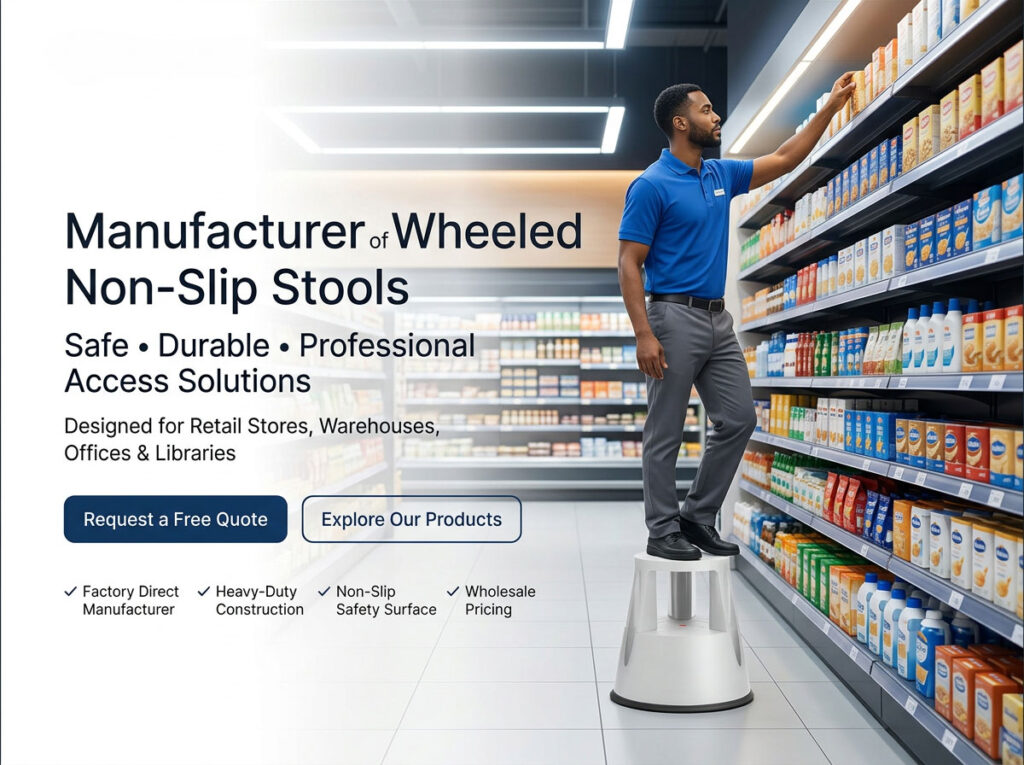
Professional Step Stools for Retail Stores in Lebanon. In a busy supermarket or retail store the difference between a polished operation and a strained one often shows in the smallest moments. A staff member needing to reach a high shelf, a promotional display that must be adjusted during trading hours, or a last-minute gap that requires quick recovery. Professional step stools designed for retail environments solve these moments without creating noise, visual clutter, or Safety risk.

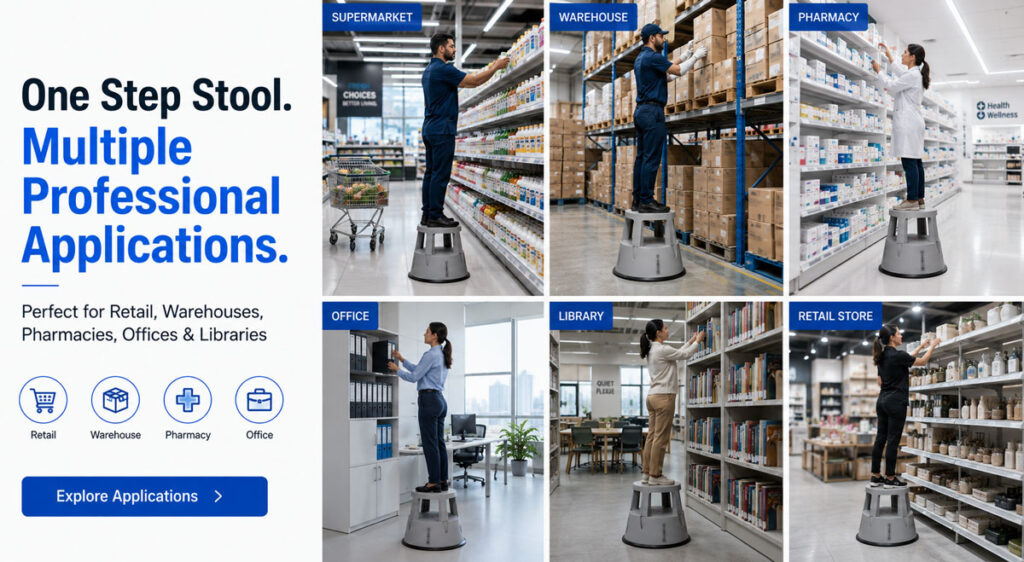
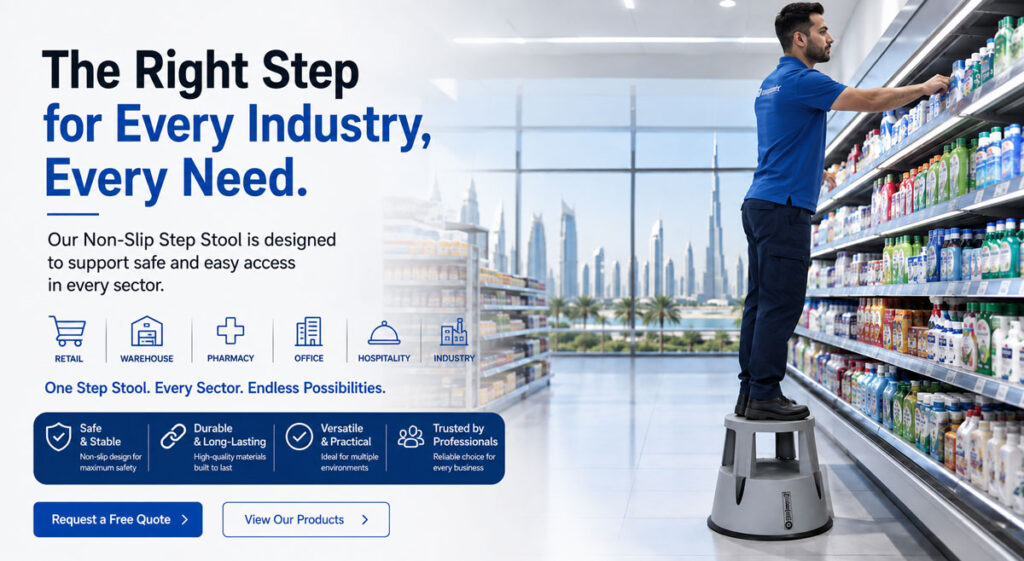


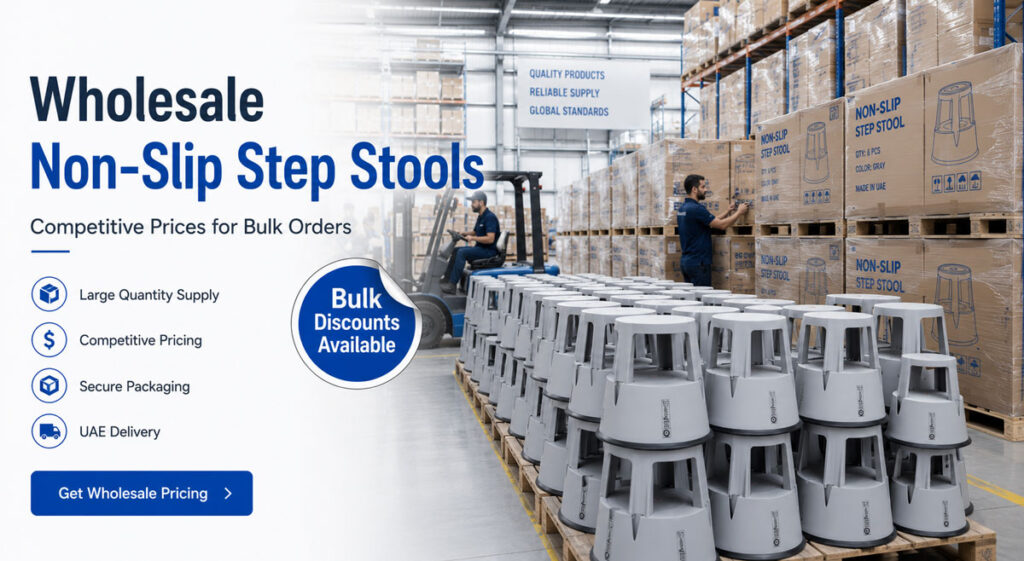

This page is written for purchasing managers, store operations directors, and retail group decision-makers who evaluate equipment by its impact on both staff performance and the customer-facing experience. It focuses on practical realities inside Lebanese retail stores rather than generic product features. Firmalazım supplies professional step stools engineered for Commercial Use in supermarket and retail settings, available through Wholesale channels, Distributor networks, Bulk Orders, and OEM programs.
The Dual Impact: Staff Efficiency and Customer Perception
Most access equipment discussions focus only on the worker. In retail the second audience matters equally: the customer who is shopping a few meters away. A noisy, unstable, or visually industrial stool can subtly damage the sense of order and care that modern supermarket shoppers expect.
Professional retail-oriented step stools address both sides. They move quietly, lock securely, offer non-slip confidence for the user, and present a clean, purposeful appearance that does not clash with merchandised aisles. When staff can resolve high-shelf issues quickly and discreetly, on-shelf availability improves and the sales floor feels calmer. This dual benefit appears consistently in stores operating in Beirut as well as in regional locations such as Tripoli and Sidon.
What “Professional” Actually Means on a Retail Floor
Not every step stool belongs in a customer-facing environment. Professional units for retail typically share these characteristics:
- Quiet-rolling casters that do not announce movement across the store
- Automatic or positive locking under weight
- Clean, non-industrial aesthetics (color options, smooth finishes)
- Reliable non-slip platforms that perform on common retail flooring
- Load ratings suitable for daily staff use (commonly 150–250 kg)
- Compact footprints that do not obstruct aisles when staged or in use
- Easy-clean surfaces compatible with frequent store sanitation
These attributes support both the practical demands of supermarket operations and the quieter expectations of a well-run sales floor. The same criteria apply whether the store is located in Zahle, Jounieh, or Baalbek.
Material and Design Choices That Survive Retail Conditions
Retail floors combine polished tile, occasional moisture from cleaning or produce sections, high foot traffic, and constant visual scrutiny. Materials must therefore balance durability, hygiene, and appearance.
High-density polymers offer light weight, corrosion resistance, and design flexibility for cleaner aesthetics. Hybrid designs with reinforced frames provide additional stability for taller or higher-capacity units. Non-slip surfaces need to retain effective texture after repeated cleaning cycles without looking worn or industrial.
Firmalazım, acting as a Manufacturer focused on commercial retail equipment, engineers units that meet these combined demands. OEM options allow color matching to store branding or zone identification, private labeling, and modest dimensional adjustments when ordered in volume through Bulk Orders.
Real Usage Patterns Across Lebanese Retail Formats
In a high-traffic urban supermarket the most frequent needs are quick recovery of high shelves during trading hours and adjustment of promotional displays. Staff value speed of positioning and confidence that the platform will not shift. Non-Slip Step Stools for Hotels in Lebanon
In larger format or hypermarket-style stores the same tools often serve both sales-floor recovery and adjacent warehouse retail or backroom tasks. The ability of one professional design family to perform acceptably in both zones simplifies training and inventory.
These patterns repeat across diverse locations. Stores in Byblos and Aley face the same core requirements as those in Nabatieh, Batroun, and Tyre, even if customer profiles and peak hours differ. Facilities linked to Zgharta, Jal El Dib, and Hazmieh frequently operate hybrid sales-floor and backroom models that reward versatile, professional-grade equipment.
Cost Perspective Beyond the Initial Purchase
Professional step stools cost more than basic consumer models. The return appears in three areas:
- Faster resolution of high-shelf gaps (improved on-shelf availability)
- Reduced risk of staff strain or minor incidents linked to unstable reaching
- Lower long-term replacement frequency under daily Commercial Use
When these factors are tracked, the higher initial cost is usually recovered inside a normal equipment lifecycle. Groups that standardize across multiple stores gain additional leverage through Wholesale pricing and consolidated Bulk Orders. Local Distributor support further protects uptime by shortening replacement cycles.
Specification Checklist for Retail Decision Makers
| Priority | Recommended Standard | Retail-Specific Reason |
|---|---|---|
| Noise level | Quiet-rolling casters | Customer experience during trading hours |
| Locking | Automatic or clearly positive under weight | Staff confidence and Safety |
| Platform grip | Effective when lightly damp | Cleaning cycles and produce-area proximity |
| Visual appearance | Clean, non-industrial finish | Alignment with merchandised environment |
| Footprint | Compact when staged or in use | Aisle flow and customer movement |
| Load rating | Minimum 150 kg, preferably higher | Daily staff use with occasional extra weight |
| Cleanability | Non-porous, wipe-friendly surfaces | Food-retail hygiene expectations |
Common Procurement and Deployment Mistakes
Teams new to professional retail equipment frequently encounter the same issues:
- Choosing units that perform well in a warehouse test but feel too industrial on the sales floor
- Under-estimating the importance of quiet movement
- Buying only one height when shelf levels and display needs vary
- Failing to stage units at logical points so that retrieval time stays low
- Treating the stools as shared resources without clear ownership for condition checks
A short pilot in one active store quickly surfaces these mismatches before a wider commitment is made.
Implementation Approach That Protects Both Efficiency and Appearance
- Map the most frequent elevated tasks on the sales floor and in adjacent backroom areas.
- Define the minimum professional specification using the checklist above.
- Trial candidate units during live trading hours to evaluate noise, appearance, and staff acceptance.
- Finalize the standard and negotiate volume terms (Wholesale, Bulk Orders, or OEM).
- Stage units at practical intervals rather than concentrating them in one storage point.
- Deliver brief practical training focused on positioning, lock verification, and customer-aware movement.
- Assign light ownership for daily visual checks and prompt removal of any unit that develops issues.
This sequence works for single stores and for groups operating across Sin El Fil, Dbayeh, Broummana, Kaslik, Choueifat, Baabda, Antelias, Bikfaya, Jezzine, and Bint Jbeil.
Safety and Professionalism as Linked Outcomes
In retail environments Safety and presentation are not separate agendas. A staff member who feels unstable on a stool moves more slowly and more cautiously, often creating a more noticeable interruption for nearby customers. A professional unit that locks securely and feels solid encourages quicker, more confident movement that blends into normal store activity.
Clear load labels, consistent non-slip performance, and automatic locking all contribute to both staff Safety and the quieter, more controlled atmosphere that shoppers associate with well-managed stores. The dual benefit is visible in operations from Beirut to Tyre and from coastal to inland locations.
Five Distinct Calls to Action
- Store-operations focus: Share your most common high-shelf recovery situations for a practical specification suggestion.
- Procurement focus: Request current Wholesale pricing and availability for professional retail models in the quantities you need.
- Brand-alignment focus: Explore OEM color and labeling options that match your store environment.
- Pilot focus: Arrange a short live-store trial to evaluate noise, appearance, and staff response under real conditions.
- Network focus: Discuss phased Bulk Orders and staging strategies for multi-store standardization.
Frequently Asked Questions
What makes a step stool “professional” for retail rather than industrial? Quieter movement, cleaner aesthetics, reliable non-slip performance on retail flooring, and a compact presence that does not disrupt the sales floor.
How important is noise level in practice? Very. In customer-facing areas a noisy unit draws attention and can feel unprofessional. Quiet casters are a defining feature of retail-appropriate designs.
Can the same units serve both sales floor and backroom warehouse retail tasks? Yes, when the specification balances appearance, mobility, and durability. Many operators standardize on one professional family for both zones.
What load rating is sufficient for typical supermarket staff use? A continuous rating of 150 kg covers most situations. Higher ratings provide useful margin and longer service life under Commercial Use.
Do professional retail stools require special maintenance? Mainly periodic cleaning of platforms and casters plus prompt attention to any lock or rolling issues. The burden is low when ownership is clear.
How should units be staged in a live store? At logical intervals along main aisles or near high-frequency recovery zones so that retrieval time stays short and units do not create visual clutter.
Is OEM customization useful for retail groups? Yes. Color matching, private labeling, or zone identification helps with brand consistency and equipment discipline when ordered through Bulk Orders.
What is the typical service life under daily retail use? Quality professional units commonly deliver several years of reliable service when basic checks and minor part replacement are performed.
How do these compare with ordinary household step stools? Household models usually lack the durability, quiet casters, automatic locking reliability, and load ratings required for sustained Commercial Use in a supermarket environment.
Can staff be trained quickly? Yes. A short practical demonstration covering positioning, lock verification, centered stance, and customer-aware movement is normally sufficient.
Are these stools suitable for produce or occasionally wet areas? Models with effective wet-grip platform texture perform well. Staff should still wipe visible moisture before ascending.
What role does a local Distributor play? Faster replacement of units or parts, familiarity with domestic logistics, and responsive support after the initial Wholesale or Manufacturer order.
Should every store have the same height mix? Not necessarily. Mapping actual shelf and display heights per format produces a more efficient mix while still allowing standardization of the core model family.
How does the equipment affect customer perception? Indirectly but meaningfully. Faster, quieter, more confident staff movement supports a sense of order and professionalism on the sales floor.
What is the best first step for a purchasing manager? Identify the highest-frequency elevated tasks, observe current work-arounds, and trial professional units during live trading hours.
Does Firmalazım support both standard professional models and customized requirements? As a Manufacturer, Firmalazım offers standard retail-appropriate units, volume options through Wholesale and Bulk Orders, Distributor partnerships, and OEM flexibility for operators who need tailored solutions.
Professional step stools sit at the intersection of staff Safety, operational speed, and the subtle customer experience of a well-run retail store. When specified for real supermarket conditions, staged thoughtfully, and supported by light ownership discipline, they become quiet contributors to both efficiency and store atmosphere.
Firmalazım stands ready to support Lebanese retail operators with equipment designed for Commercial Use, practical procurement pathways, and the flexibility required for multi-store environments. The most useful conversations begin with the specific recovery and display tasks that currently create friction on the sales floor.
Professional Step Stools for Retail Stores in Lebanon
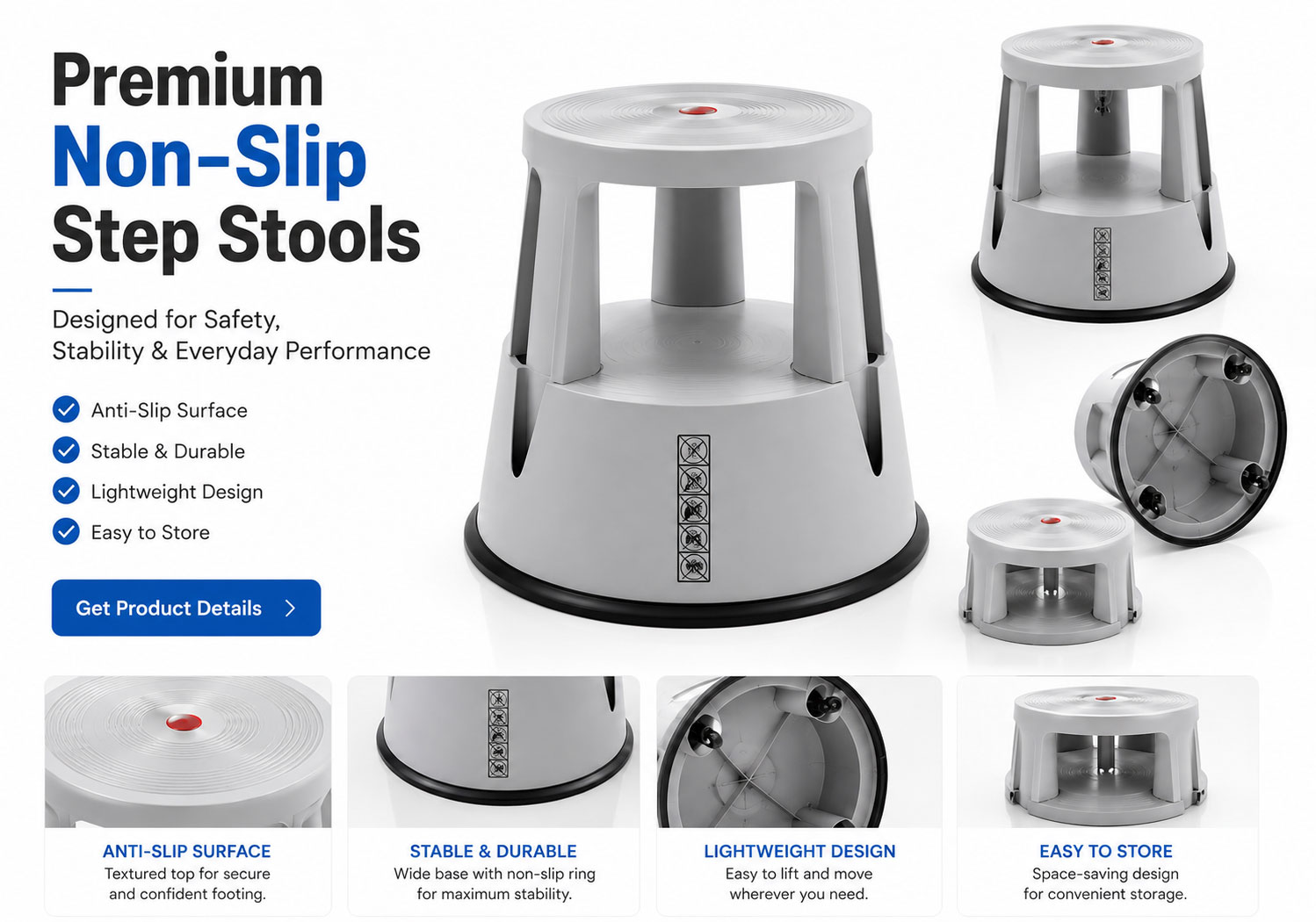
The image above captures one of the most practical and widely adopted designs in professional retail environments: the round, wheeled, non-slip kick-step stool. Unlike multi-step ladders or bulky platforms, this compact form factor combines instant mobility, automatic stability, stackable storage, and a clean visual presence that suits active supermarket and retail floors. Wheeled Step Stools for Logistics Operations in Lebanon
This section examines the specific engineering, workflow, and commercial advantages of this design for Lebanese retail operators, written from the perspective of purchasing and store operations teams who must balance staff Safety, speed, and customer-facing presentation.
Anatomy of a Professional Round Wheeled Step Stool
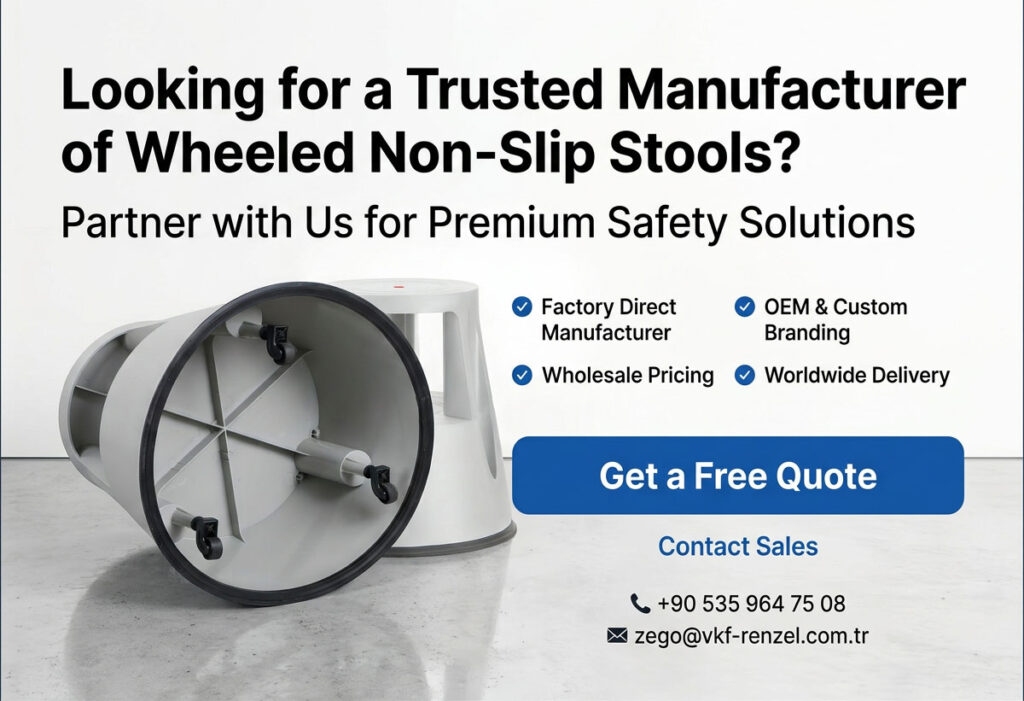
The core mechanism is elegantly simple and highly effective. Three or more spring-loaded or weight-activated casters sit under the base. When the stool is empty, the wheels extend and allow smooth rolling. The moment a user steps onto the platform, body weight compresses the mechanism, retracting the wheels so that a solid, non-slip base ring contacts the floor. The stool becomes stationary and stable.
Key professional-grade features visible in quality versions include:
- Textured anti-slip platform surface (often with a central marker for foot placement)
- Reinforced polymer body capable of repeated impact and daily Commercial Use
- Smooth-rolling, quiet casters that do not mark typical retail flooring
- Wide, stable base geometry that resists tipping during normal reaching
- Stackable design that collapses storage footprint dramatically
These characteristics explain why the round wheeled form remains a default choice for supermarket sales floors, backrooms, and mixed warehouse retail zones.
Workflow Integration on a Live Retail Floor
In a functioning supermarket the value of this design appears in the rhythm of daily work. A staff member spots a high-shelf gap, rolls the nearest stool into position with one hand, steps up, places or retrieves the product, steps down, and rolls the unit a few meters to the next task or back to a staging point. The entire sequence takes seconds and creates minimal disruption for nearby customers.
The same unit often moves between sales-floor recovery and adjacent backroom tasks without requiring a change of equipment. This versatility reduces the total number of access tools a store must manage and simplifies training. Stores operating in Beirut and Tripoli experience the same time-saving pattern as those in Sidon and Zahle, even if peak customer density differs.
Storage and Space Efficiency Advantages
One of the most under-appreciated strengths of the round wheeled design is stackability. Multiple units nest securely, occupying a fraction of the floor space required by non-stackable alternatives. In constrained backrooms or stockrooms this feature frees valuable square meters for product or other equipment.
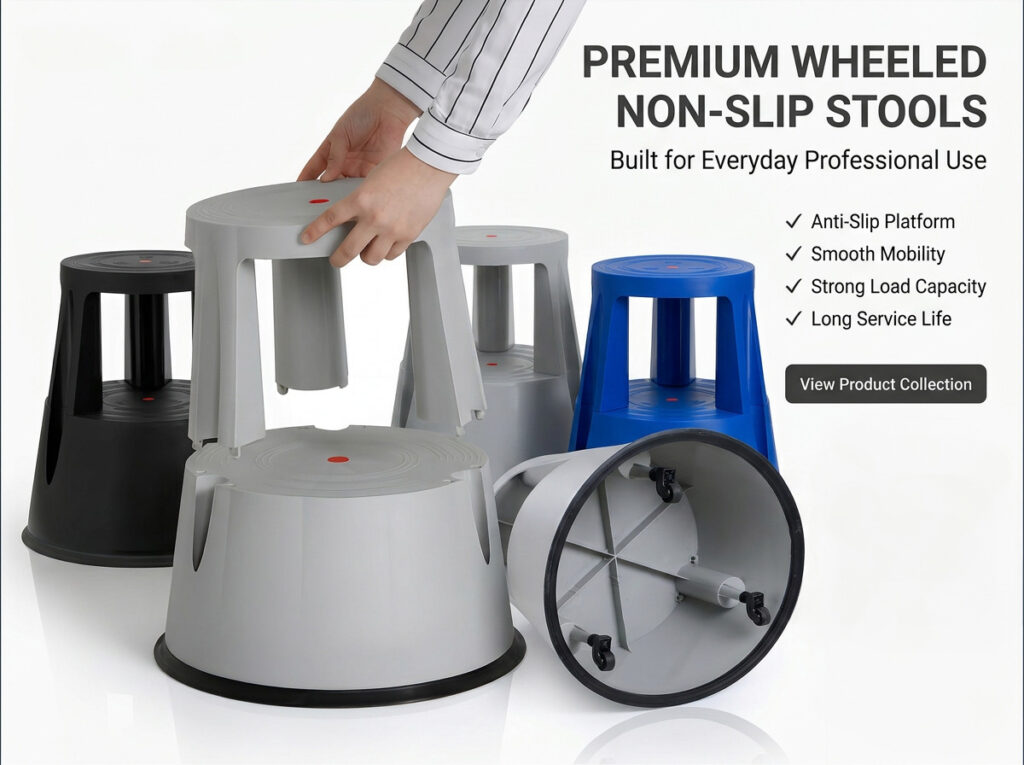
Color variants (black, grey, blue, and others) further support organized staging. Some operators assign colors by zone or function—sales floor versus warehouse retail, dry goods versus produce support—so that the correct unit is visually obvious. OEM programs from a Manufacturer such as Firmalazım make consistent color coding straightforward when ordered through Bulk Orders.
Hygiene and Food-Retail Compatibility
Supermarket environments demand equipment that withstands frequent cleaning and does not harbor residue. High-quality polymer construction with smooth, non-porous surfaces allows rapid wipe-down. The open base design of many round models further reduces places for debris to accumulate.
In produce or occasionally damp areas the non-slip platform texture remains critical. Professional versions maintain effective grip after exposure to light moisture and standard store cleaning agents. This combination of cleanability and reliable traction supports both Safety and food-retail hygiene standards across locations from Jounieh and Baalbek to Byblos and Aley.
Comparative Strengths Against Other Access Options
| Feature | Round Wheeled Kick-Step | Multi-Step Rolling Ladder | Fixed Platform / Stool | Basic Non-Wheeled Step Stool |
|---|---|---|---|---|
| Speed of repositioning | Excellent | Moderate | None | Poor |
| Storage footprint | Excellent (stackable) | Large | Large | Moderate |
| Customer-facing appearance | Clean and discreet | More industrial | Variable | Often domestic-looking |
| Automatic stability | Yes (weight-activated) | Manual brakes common | Permanent | Permanent |
| Typical load rating | 150–250 kg | Higher possible | High | Lower to moderate |
| Noise during movement | Low (quality casters) | Higher | None | None |
| Best use case | High-frequency mid-height tasks | Occasional higher reaches | Permanent high-volume zones | Low-frequency or static |
The round wheeled design wins on the combination of speed, storage efficiency, and suitability for live sales-floor use that dominates most supermarket operations.
Specification Priorities for Lebanese Retail Buyers
When evaluating this specific form factor, experienced purchasing teams focus on:
- Consistency and positivity of the locking mechanism under repeated use
- Caster quality (smooth, quiet, non-marking, durable under daily Commercial Use)
- Platform texture that retains grip after cleaning cycles
- Structural reinforcement at stress points (platform-to-leg junctions)
- Actual measured load rating rather than optimistic claims
- Availability of spare casters and the ease of replacement
- Color and finish options that align with store aesthetics or zone systems
Units that score well on these points deliver years of reliable service. Those that compromise on caster quality or lock consistency generate complaints and eventual abandonment.
Real-World Deployment Patterns
Successful stores rarely leave the stools in a single distant storage area. Instead they stage small numbers at logical intervals along main aisles or near high-frequency recovery zones. This reduces retrieval time and keeps the tools in active circulation.
In larger formats the same units often migrate between the sales floor and adjacent warehouse retail or stock areas during the day. The compact, stackable nature makes this fluid movement practical. Operators in Nabatieh, Batroun, and Tyre report similar staging logic to those managing stores in Zgharta, Jal El Dib, and Hazmieh.
Maintenance Reality for Round Wheeled Models
Daily care is minimal: a quick visual check that the platform is clean and the unit rolls and locks normally. Periodic attention focuses on the casters—removing accumulated debris and replacing wheels when they begin to stiffen or develop flat spots.
Because the design is simple, most minor issues can be resolved quickly when spare parts are available through the original Manufacturer, a Wholesale partner, or a local Distributor. Clear ownership (users tag problems, supervisors ensure prompt action) prevents the slow accumulation of neglected units that eventually damages fleet credibility.
Color Coding and Visual Management
The availability of multiple colors is more than aesthetic. Many professional retail teams use color as a simple visual management tool:
- One color dedicated to sales-floor recovery
- Another for backroom or warehouse retail tasks
- A third for specific departments (for example, produce support)
This low-tech system reduces the chance that the nearest unit is the wrong one for the task and supports faster training of new staff. OEM capability makes consistent color programs feasible even for mid-sized groups when ordered in coordinated Bulk Orders.
Safety Contribution in Customer-Facing Environments
In a live supermarket the Safety benefit is twofold. The automatic lock and non-slip platform protect the staff member. The quiet, controlled movement protects the broader environment by reducing the chance of sudden, attention-drawing incidents that can startle customers or create secondary risks.
Clear load-rating indicators and consistent performance across the fleet further reinforce safe habits. When staff trust the equipment, they use it; when they do not, they revert to stretching or unstable alternatives. The round wheeled design, when properly specified, earns that trust through predictable behavior under daily Commercial Use.
Procurement Pathways for This Product Category
- Direct engagement with a Manufacturer such as Firmalazım offers the greatest control over specification, color programs, and OEM branding.
- Wholesale channels provide competitive pricing and faster availability for standard models.
- Local Distributors add value through rapid replacement, domestic logistics knowledge, and responsive after-sales support.
Many operators combine routes: a core Bulk Order for network standardization, supported by Distributor stock for ongoing needs. This hybrid approach balances cost, control, and uptime across stores in Sin El Fil, Dbayeh, Broummana, Kaslik, Choueifat, Baabda, Antelias, Bikfaya, Jezzine, and Bint Jbeil.
Implementation Checklist Specific to Round Wheeled Stools
- Confirm platform diameter and height match the most common reach requirements
- Test locking consistency and caster smoothness under realistic load
- Evaluate noise level during movement on actual store flooring
- Plan staging points that keep retrieval time low without creating visual clutter
- Decide on color strategy (single color vs zone coding)
- Arrange initial spare-caster stock
- Deliver short practical training focused on the weight-activated lock
- Assign clear ownership for condition checks and minor repairs
- Schedule a 30-day and 90-day utilization review
Why This Design Endures in Professional Retail
The round wheeled non-slip stool has remained a standard for decades because it solves a frequent, practical problem with minimal complexity and maximum reliability. It moves when it should, locks when it must, stores in almost no space, and presents a clean appearance appropriate for customer-facing environments.
When sourced at professional grade and supported by basic management discipline, it becomes one of the highest-return, lowest-drama pieces of equipment on a supermarket floor. The design shown in the image—compact, colorful, clearly engineered for repeated daily use—illustrates the attributes that matter most to operators who measure both staff efficiency and the quiet professionalism of their stores.
Firmalazım continues to supply this category of professional step stools for Lebanese retail environments, supporting Commercial Use requirements through Manufacturer-level quality, flexible Bulk Orders, OEM options, and dependable Wholesale and Distributor pathways. The most productive next step is usually a short conversation about current high-shelf recovery patterns, preferred colors, and the volume needed to move from isolated units to a consistent, well-staged fleet.
Total Cost of Ownership, Adoption Psychology, and Peak-Period Performance of Professional Round Wheeled Step Stools
The true cost of professional round wheeled non-slip step stools is never the unit price alone. It is the sum of acquisition, deployment, daily use friction, maintenance, replacement frequency, and the productivity or Safety consequences of under-performance. This section dissects those layers for Lebanese retail and supermarket operators who must justify equipment decisions to both operations and finance stakeholders.
Breaking Down Total Cost of Ownership
A realistic TCO model for this category includes five components:
- Acquisition cost – unit price influenced by volume (Wholesale or Bulk Orders), specification level, and any OEM customization.
- Deployment cost – staging, initial training, and any minor site adjustments.
- Operating friction cost – time lost when units are hard to find, difficult to roll, or slow to lock.
- Maintenance and spare-parts cost – primarily casters and occasional platform or body attention.
- Consequence cost – residual risk of strain injuries, slower high-shelf recovery, or staff reverting to unsafe methods when trust in the equipment declines.
When quality units from a reputable Manufacturer are chosen and basic ownership discipline is applied, components 3–5 remain low for years. When cheaper or inconsistent units are selected, those same components rise sharply and often erase the initial price advantage within the first 12–18 months.
The Economics of Caster Quality
Casters are the single highest-leverage wear item. Premium sealed, non-marking wheels maintain smooth, quiet movement far longer under the mixed conditions of supermarket floors—polished tile, occasional debris, light moisture, and constant short-distance travel.
Lower-grade casters begin to stiffen or develop flat spots, increasing the physical effort required to move the stool. Staff notice immediately. Retrieval frequency drops, and the productivity benefit shrinks. Replacing casters is inexpensive when parts are readily available through the Manufacturer, a Wholesale channel, or a local Distributor. Ignoring the issue is expensive in lost time and eroded trust.
Adoption Psychology: Why Some Fleets Thrive and Others Fade
Staff do not adopt equipment because a policy says they must. They adopt it when the tool feels easier and safer than the alternative in the exact moment of need.
Critical psychological triggers for round wheeled step stools include:
- Instant, positive lock that the user can feel underfoot
- Quiet movement that does not draw customer attention
- Platform size and texture that feel secure on the first step
- Predictable availability (units staged where they are actually needed)
- Visible maintenance (defective units disappear quickly rather than lingering)
When these triggers are present, usage becomes habitual. When any of them fails, work-arounds reappear. The pattern is consistent across stores in Beirut, Tripoli, Sidon, and Zahle, and it repeats in Jounieh, Baalbek, Byblos, and Aley.
Peak-Period Stress Test
Lebanese retail calendars contain distinct high-pressure windows: Ramadan preparation and trading, holiday seasons, back-to-school, and summer tourism peaks. During these periods the frequency of high-shelf recovery rises sharply while available labor is often stretched. Heavy-Duty Mobile Step Stools for Warehouses in Lebanon
Professional round wheeled stools prove their value most clearly under this stress. Units that continue to roll freely and lock reliably allow staff to maintain recovery speed without increasing physical strain or Safety risk. Units that have already developed stiff casters or inconsistent locks become bottlenecks exactly when they are needed most.
Operators who use quieter periods for caster servicing, fleet inspection, and any necessary Bulk Order replenishment enter peak windows with higher equipment availability. This discipline is equally relevant for stores in Nabatieh, Batroun, Tyre, Zgharta, and Jal El Dib as it is for those in Hazmieh, Sin El Fil, and Dbayeh.
Cross-Functional ROI Narrative
Finance teams respond to numbers. Operations teams respond to daily friction. A complete internal case connects both.
Useful narrative elements include:
- Baseline measurement of average time to resolve a high-shelf gap before introduction
- Post-introduction measurement of the same metric
- Count of residual work-arounds (stretching, unstable alternatives) still observed
- Any change in minor strain or near-miss reports linked to elevated work
- Simple calculation of labor minutes recovered per store per week
- Projection of those minutes across the full network and across a full year
When the story is told with both operational texture and quantified impact, alignment between store teams and central purchasing improves. The equipment moves from “nice to have” to “measured contributor.”
Color Strategy as Low-Cost Visual Management
The availability of multiple colors (black, grey, blue, and others) enables a simple but effective visual system without additional technology.
Common approaches:
- Single corporate color for brand consistency
- Sales-floor color versus backroom / warehouse retail color
- Department-specific colors for high-use zones (for example, a distinct color near produce or promotional areas)
OEM programs make coordinated color fleets feasible. The benefit is faster correct selection by staff and easier visual auditing by supervisors. Stores across Broummana, Kaslik, Choueifat, Baabda, Antelias, Bikfaya, Jezzine, and Bint Jbeil have used variations of this approach successfully.
Staging Science: Placement That Drives Utilization
Even excellent stools under-perform if they are stored far from the work. Effective staging follows a few practical rules:
- Place small clusters at natural transition points along main aisles
- Keep retrieval distance short enough that using the stool is clearly faster than stretching
- Avoid creating visual clutter or obstruction for customers
- Maintain a modest central reserve for peak periods or temporary surges
The goal is that the correct tool is almost always the path of least resistance. When staging achieves this, utilization rises naturally and the return on the original investment improves.
Maintenance Ownership Model That Actually Works
A lightweight, clear model prevents diffusion of responsibility:
- User: ten-second pre-use check; immediate tagging of any problem
- Shift supervisor: daily review of tagged units; decision to remove from service
- Facilities or Safety lead: weekly consolidation, parts ordering, quarterly deep inspection
- Procurement: relationship management with the Manufacturer, Wholesale partner, or Distributor; tracking of spare-parts performance and Bulk Order timing
Documenting these roles on a single page and reviewing them inside existing meetings keeps the system alive without creating new bureaucracy.
Risk of Under-Specification in the Round Wheeled Category
The market contains a wide quality range. Units that look similar in a photograph can differ dramatically in lock consistency, caster durability, platform texture retention, and structural reinforcement.
The cost of under-specification appears as:
- Faster decline in smooth rolling
- Increasing staff complaints and work-arounds
- Higher long-term replacement frequency
- Erosion of the Safety and productivity benefits that justified the purchase
A short live-store pilot with both a budget option and a professional-grade unit makes the difference visible in real conditions before a network commitment is made.
Linking the Tools to Existing Retail KPIs
The strongest sustained attention occurs when the stools are connected to metrics the business already tracks:
- On-shelf availability scores
- Average time to recover high-shelf gaps
- Labor productivity in replenishment tasks
- Near-miss and minor injury trends related to working at height
- Equipment uptime / percentage of fleet in service
When supervisors can see a relationship between reliable professional step stools and these numbers, daily discipline around staging, use, and minor maintenance remains higher.
Practical 90-Day Review Framework
After introduction, a structured review at 30 and 90 days answers critical questions:
- What percentage of elevated tasks are now performed with the proper unit?
- How many units are tagged out of service at any given time, and what is the average return-to-service time?
- What is the dominant complaint (if any)?
- Has the original staging plan proved correct, or does it need adjustment?
- Are spare casters turning over at the expected rate?
The answers guide minor corrections while the equipment is still new and staff habits are still forming. This review discipline is applicable whether the store is in a dense urban setting or a regional location.
Building Resilience into the Fleet
Lebanese retail operations periodically face supply-chain variability. A resilient approach to this equipment category includes:
- Standardization on a limited number of models to simplify spares
- Modest buffer stock of critical casters held locally or with a Distributor
- Preferred Manufacturer or Wholesale relationship that can prioritize replacement needs
- Clear criteria for when a unit should be retired rather than repeatedly repaired
These steps keep the fleet functional even when external conditions temporarily slow new supply.
Closing Perspective: Quiet Infrastructure with Measurable Returns
Professional round wheeled non-slip step stools succeed when three elements align: a robust mechanical design, intelligent staging and color management, and lightweight but consistent ownership of condition and availability.
When those elements are present, the tools deliver daily improvements in speed, Safety, and sales-floor calm that compound across weeks and months. When any element is missing, the same tools gradually drift toward under-use and the expected returns fade.
Firmalazım supports Lebanese supermarket and retail operators with Manufacturer-grade versions of this proven form factor, practical pathways for Bulk Orders and OEM color or branding programs, and reliable supply through Wholesale and Distributor channels. The highest-value conversations begin with current high-shelf recovery patterns, preferred visual management approach, and the simple management habits the team is prepared to maintain after the units arrive.
Treating these stools as managed infrastructure rather than disposable aids is the difference between a one-time purchase and a lasting operational advantage. The design is simple. The returns are real when the surrounding system is deliberate.
Training Design, Behavioral Nudges, and Multi-Store Standardization for Professional Round Wheeled Step Stools
Even the best-designed round wheeled non-slip step stool delivers limited value if staff do not reach for it consistently or if different stores drift into incompatible practices. This section focuses on the practical systems that turn a good product into reliable daily infrastructure across single sites and multi-store networks in Lebanon.
Designing Training That Creates Habit Rather Than Awareness
Traditional equipment training often stops at “this is how it works.” Effective training for high-frequency tools goes further: it builds automatic correct use under time pressure.
A proven short sequence for professional round wheeled stools:
- Demonstration (90 seconds) Supervisor rolls the unit, steps on to show the automatic lock, reaches naturally, steps off, and rolls it away. Emphasis on the feel of the lock engaging.
- Guided practice (2 minutes per person) Each staff member performs the full cycle once while the supervisor watches for centered stance and complete lock engagement.
- Micro-reminder language A single consistent phrase is used across the store: “Roll, lock, center, work.” The phrase is short enough to be repeated in toolbox talks without becoming background noise.
- Spaced reinforcement Daily for the first week, every other day for the next two weeks, then weekly for the remainder of the first month. After that, coaching occurs only when incorrect use is observed.
This approach requires almost no formal classroom time and works equally well in high-turnover environments. Stores in Beirut and Tripoli have used variations of it successfully, as have those in Sidon, Zahle, and Jounieh.
Behavioral Nudges That Increase Correct Usage
People respond more reliably to the environment than to rules. Several low-cost nudges raise the probability that the professional stool is chosen over stretching or improvisation:
- Staging distance Units placed so that retrieval takes fewer steps than the average stretch required for high-shelf work.
- Visual availability Stools kept in clear sightlines rather than behind doors or in distant stockrooms.
- Color contrast Choosing platform or body colors that stand out slightly against the dominant floor and shelving tones makes the tools easier to locate quickly.
- Positive closure Supervisors who occasionally thank staff for using the proper equipment reinforce the behavior more effectively than only correcting non-use.
- Immediate removal of defective units Nothing destroys trust faster than a stool that looks usable but locks poorly or rolls with resistance. Prompt removal signals that the organization takes the tool seriously.
These nudges require no new technology and scale across locations from Baalbek and Byblos to Aley, Nabatieh, and Batroun.
Failure Mode Effects Analysis Specific to Round Wheeled Stools
A lightweight FMEA helps teams anticipate and prevent the most common ways this product category loses effectiveness in supermarket environments.
| Potential Failure Mode | Effect on Operations | Likelihood | Severity | Preventive Control | Detection Method |
|---|---|---|---|---|---|
| Casters stiffen or develop flat spots | Staff stop retrieving the unit | Medium | High | Sealed industrial casters + monthly cleaning | User pre-use check + weekly review |
| Lock engagement becomes inconsistent | Reduced confidence, possible instability | Low–Medium | High | Quality mechanism + never force while rolling | Functional test during checks |
| Platform texture polishes smooth | Lower grip, especially when damp | Medium | Medium | Aggressive non-slip compound from the start | Visual + tactile inspection |
| Units staged too far from work | Stretching and work-arounds increase | High | Medium | Logical interval staging plan | Observation audits |
| Defective units left in circulation | Trust in the entire fleet declines | Medium | High | Clear tagging and removal ownership | Daily supervisor review |
| Inconsistent models across stores | Training and spare-parts complexity rise | Medium | Medium | Deliberate standardization | Network equipment register |
Reviewing this table quarterly keeps attention proportional and prevents slow degradation of the fleet’s credibility.
Multi-Store Standardization Without Rigidity
Large retail groups need consistency for training, spare parts, and purchasing leverage, yet individual stores differ in layout, volume, and peak patterns. An effective standardization approach balances both needs:
- Core model family One primary professional round wheeled design approved network-wide.
- Limited height and color variants Pre-approved options so stores can match local shelf heights and visual management preferences without creating a free-for-all.
- Central specification document A short living document that defines acceptable load rating, caster type, platform texture, and lock performance. Updated only when real field experience justifies change.
- Local staging autonomy Stores decide exact placement points within the agreed principles (short retrieval distance, no customer obstruction).
- Shared spare-parts pool or Distributor agreement Critical casters and minor components held so that any store can restore a unit quickly.
This model delivers the purchasing power of Bulk Orders and OEM consistency while still respecting local operational reality. It has been applied successfully by groups whose stores span Tyre, Zgharta, Jal El Dib, Hazmieh, Sin El Fil, Dbayeh, and Broummana.
Training Content That Travels Across Sites
When staff transfer between stores, inconsistent equipment or inconsistent expectations create friction. A portable training standard solves the problem:
- Same demonstration sequence
- Same micro-reminder phrase
- Same pre-use check points
- Same tagging method for defects
New hires receive the identical short module regardless of which store they join. Supervisors moving between locations can audit and coach without re-learning local variations. The result is faster onboarding and more uniform Safety and productivity outcomes across the network, including sites in Kaslik, Choueifat, Baabda, Antelias, Bikfaya, Jezzine, and Bint Jbeil.
Measuring Adoption Beyond Simple Counts
Counting how many stools are on site is not the same as measuring adoption. More meaningful indicators include:
- Percentage of observed high-shelf tasks performed with the proper unit
- Average retrieval time from the moment of need to the moment of stepping onto the platform
- Number of units tagged out of service and average time to return
- Staff pulse scores on confidence and ease of use (simple three-question check every 60–90 days)
- Trend in elevated-work near misses
These metrics reveal whether the equipment is truly embedded or merely present. They also provide early warning when staging, maintenance, or training needs adjustment.
Role of Supervision in Sustaining Standards
Equipment standards live or die with first-line supervision. Effective supervisors treat professional step stools as part of the daily operating system rather than occasional tools:
- They use the units themselves when performing elevated tasks
- They remove defective units immediately rather than leaving them “for later”
- They reinforce the micro-reminder phrase naturally during floor walks
- They treat repeated non-use as a coaching opportunity rather than a disciplinary issue
When this tone is consistent, correct use becomes social norm rather than enforced rule. The cultural effect is stronger than any written policy.
Integrating with Existing Safety and Productivity Systems
The highest sustainability occurs when the stools are linked to systems the organization already maintains:
- Inclusion in routine Safety walks
- Addition to existing equipment condition checklists
- Connection to on-shelf availability or replenishment productivity metrics
- Mention in toolbox talks during periods of high seasonal demand
By riding inside established rhythms rather than creating new ones, the program avoids the fatigue that causes many equipment initiatives to fade after the first quarter.
Practical Network Rollout Sequence
For groups introducing or upgrading professional round wheeled stools across multiple stores:
- Finalize the core specification and approved variants.
- Run a controlled pilot in two or three representative stores (different formats if possible).
- Refine staging principles and training sequence based on pilot feedback.
- Negotiate the main Bulk Order or Wholesale agreement, including spare-parts provisions.
- Phase deliveries according to store readiness and seasonal calendar.
- Cascade the standard training module through existing store leadership channels.
- Activate the lightweight ownership model (user tagging, supervisor review, facilities support).
- Conduct 30-day and 90-day adoption reviews network-wide.
This sequence reduces the risk of uneven implementation and protects the return on the investment.
Closing Perspective: Systems Turn Products into Infrastructure
Professional round wheeled non-slip step stools are simple, proven tools. Their long-term contribution to Safety, speed, and sales-floor calm depends less on further mechanical innovation and more on the quality of training design, the presence of smart behavioral nudges, the clarity of ownership, and the discipline of multi-store standardization.
Organizations that treat these elements with the same seriousness as load ratings and caster quality extract years of reliable service. Those that focus only on the purchase decision often find themselves re-addressing the same friction points within a short cycle.
Firmalazım supports Lebanese retail and supermarket operators with Manufacturer-grade versions of this form factor, practical options for Bulk Orders and OEM consistency, and dependable supply through Wholesale and Distributor channels. The most useful conversations start with current adoption realities, preferred training approach, and the simple management habits the team is prepared to sustain once the units are on the floor. Wheeled Non-Slip Step Stools for Supermarkets in Lebanon
When product quality and operating systems align, these compact professional stools become quiet, high-return infrastructure. When they do not, even good equipment gradually loses relevance. The difference is organizational, and it is entirely within the control of the teams that choose to manage it deliberately.

Bir yanıt yazın