


Non-Slip Step Stools for Hotels in Lebanon
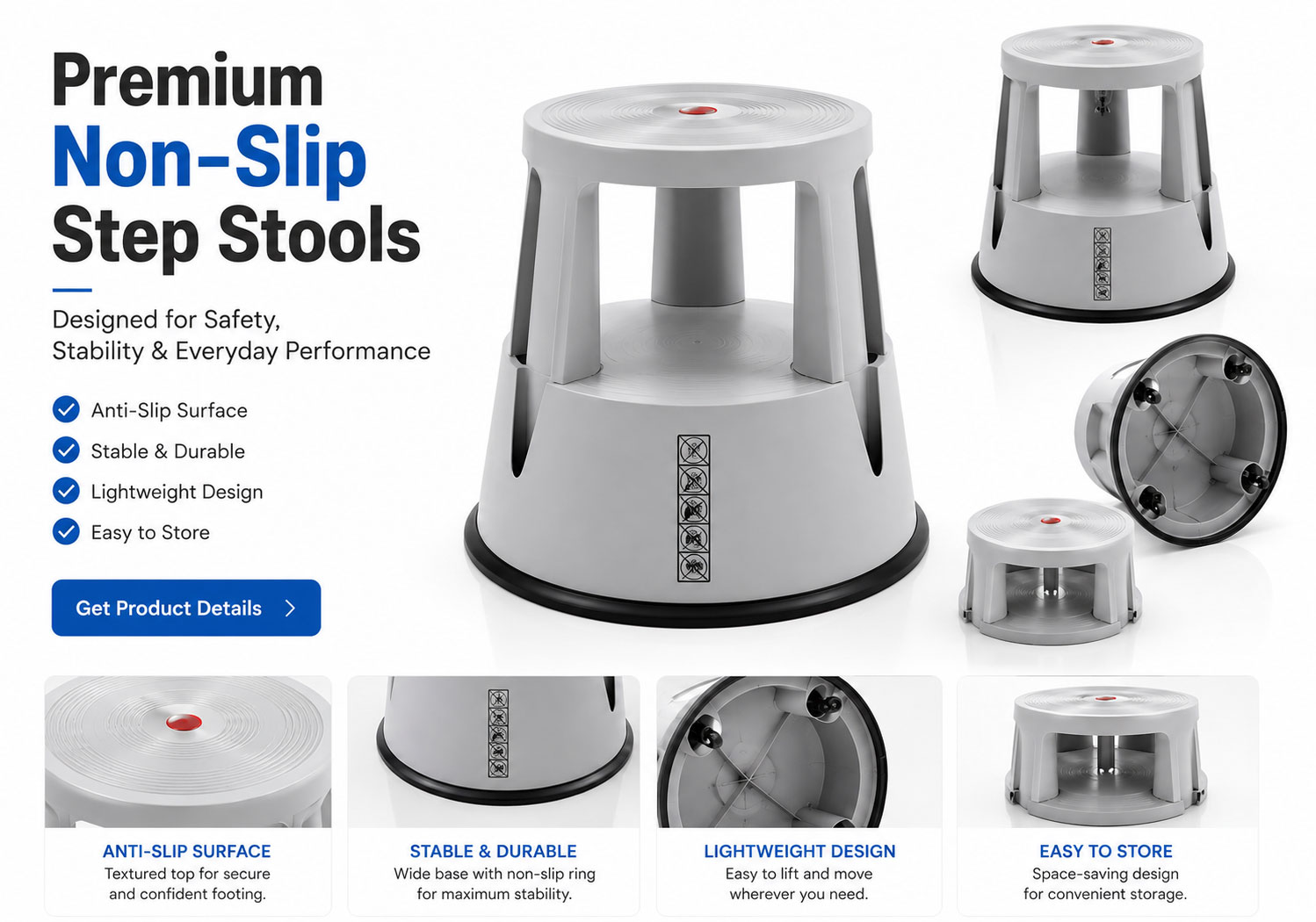
Non-Slip Step Stools for Hotels in Lebanon. give hotel teams in Lebanon secure, stable access to high shelves, storage, and maintenance points without the risks of unstable ladders. Built for commercial use, these platforms protect staff and guests while speeding daily housekeeping, engineering, and replenishment tasks. From city-center properties in Beirut to coastal resorts near Jounieh and mountain hotels around Broummana, the right non-slip design reduces incidents, supports bulk equipment programs, and fits the practical realities of Lebanese hospitality operations.




The Quiet Risk Most Lebanese Hotels Still Accept—and How Non-Slip Platforms Close It
Hotels live on presentation and safety. Guests never see the back-of-house scramble for supplies, the late-night bulb change above a corridor, or the housekeeping cart that needs restocking from a high cupboard. Yet every one of those tasks carries a fall hazard if the access tool is wrong. Non-slip step stools engineered for commercial environments remove that hazard while preserving the speed hotels demand.
Unlike domestic steps, these units are specified for repeated daily duty in humid corridors, tiled bathrooms, and service corridors. The non-slip surface stays effective when floors are damp. The base stays planted when an attendant reaches. When the design also includes wheels that lock under load, the same unit travels from floor to floor without becoming an obstacle.
Why Hotel Environments Punish Ordinary Steps
Lebanese hotels face a distinctive mix of conditions. Coastal properties deal with salt air and high humidity. Mountain locations see temperature swings. Urban hotels in dense neighborhoods run continuous housekeeping cycles with limited storage space. In each setting, a step that slides, tips, or marks the floor creates either a safety report or a guest complaint.
A non-slip platform rated for commercial use solves the immediate mechanical problem. The textured surface grips wet or dry footwear. A wide stance resists the lateral forces of reaching. Locking casters (on wheeled models) stop movement the moment weight is applied. These features are not luxuries; they are the difference between a routine task and an insurance claim.
Material Choices That Survive Real Hotel Duty
Frames are typically powder-coated steel or anodized aluminum. Steel offers higher impact resistance in busy service areas; aluminum reduces weight for staff who move the unit frequently. Platform surfaces use high-friction polymers or textured metal that retain grip after repeated cleaning with hotel-grade disinfectants. Wheels, when fitted, are non-marking compounds so polished lobby floors and guest-room corridors stay unmarked.
A manufacturer focused on hospitality and related commercial sectors tests these materials under repeated wet-dry cycles and chemical exposure. That testing separates tools suitable for daily hotel service from light-duty retail or domestic products.
Where the Platforms Actually Get Used
Housekeeping teams reach high linen shelves and extra bedding. Engineering staff change lamps and clean HVAC vents. Banquet crews adjust ceiling fixtures or store seasonal décor. In Tripoli properties the same stools appear in laundry rooms and staff changing areas. In Sidon beachfront hotels they support bathroom deep-cleaning and high-mirror maintenance.
Zahle valley hotels use them for storage rooms that serve both guest and restaurant operations.
Further examples appear across the map. Baalbek heritage hotels rely on stable platforms for careful maintenance of high architectural features.
Byblos boutique properties need compact units that fit narrow back corridors. Aley hillside resorts move the stools between chalets and central stores. Nabatieh and Tyre southern hotels value corrosion resistance. Batroun and Zgharta coastal and northern sites prioritize non-marking wheels on newly finished floors. Urban clusters such as Jal El Dib, Hazmieh, Sin El Fil, Dbayeh, and Antelias see the highest utilization rates because of continuous multi-floor operations. Mountain and mid-range locations including Broummana, Bikfaya, Kaslik, Choueifat, Baabda, Jezzine, and Bint Jbeil use the platforms for both guest-area maintenance and back-of-house logistics.
In every case the common requirement is the same: a stable, non-slip surface that can be positioned quickly and left safely when the task ends.
Safety as an Operational Metric, Not a Poster
Hotels measure safety through incident rates, near-miss logs, and insurance premiums. A fall from height in a guest corridor or service area triggers investigation, possible downtime, and reputation risk. Non-slip step stools reduce that exposure when three conditions are met: correct specification, consistent placement, and trained use.
The platform must lock securely. Staff must step fully onto it and keep both feet planted. Overreaching must be discouraged through both design (wide base) and procedure. When these elements align, the tool becomes part of the hotel’s safety infrastructure rather than an afterthought.
Tip Box – Daily Habit That Prevents Most Incidents Before every use, press the platform firmly with one foot to confirm the wheel locks (if fitted) have engaged. Wipe any visible moisture or cleaning residue from the standing surface. These two actions take seconds and eliminate the majority of slip and roll risks.
Procurement Reality for Multi-Property Groups
Larger hotel groups in Lebanon often standardize equipment across sites. That standardization favors engagement with a manufacturer capable of consistent quality and optional branding. Wholesale channels deliver volume pricing once the specification is fixed. Local distributor networks supply faster replacement units and spare parts when individual properties need them.
Bulk orders become practical once a chain selects one or two models that cover the majority of height and load needs. OEM arrangements allow private labeling or minor modifications such as color-matched frames or integrated tool trays for engineering teams. Independent hotels and smaller boutique properties typically work through a distributor who can advise on the correct height for local storage configurations and provide after-sales support.
Note that some hotels also manage small warehouse retail or supermarket-style staff shops and mini-markets on site. In those hybrid spaces the same commercial-grade stools serve both guest-service and staff-retail functions, simplifying inventory.
Cost View Beyond the Purchase Price
The acquisition cost of a hotel-grade non-slip stool is higher than a basic domestic step. The relevant calculation is total cost of ownership measured against:
- Reduced time per high-access task
- Lower probability of staff injury and associated costs
- Floor protection that avoids polishing or repair charges
- Longer service life under continuous commercial use
Many operations directors find payback occurs within the first season of heavy use once labor efficiency and incident reduction are factored in. Maintenance remains light: visual checks of locks and surfaces, occasional caster replacement, and routine cleaning of the non-slip platform.
Side-by-Side Comparison of Access Options
| Option | Stability on wet floors | Mobility | Floor protection | Suitability for continuous hotel use |
|---|---|---|---|---|
| Ordinary domestic step | Low | Limited | Often poor | Unsuitable |
| Fixed ladder | High | None | N/A | Limited to permanent locations |
| Rolling warehouse ladder | High | High | Variable | Too large for many hotel corridors |
| Non-slip commercial step stool | High | High (wheeled) | Excellent | Strong match |
The commercial non-slip stool occupies the practical middle ground for most Lebanese hotel floor plates.
Selection Checklist for Hotel Procurement Teams
- Match maximum platform height to the tallest regular storage or maintenance point
- Confirm load rating covers the heaviest expected user plus carried items
- Verify non-slip performance after exposure to common hotel cleaners
- Test wheel locks under realistic weight if the model is mobile
- Require non-marking wheel compounds for finished floors
- Clarify warranty coverage for commercial rather than domestic use
- Ask about bulk-order tiers and OEM customization availability
- Confirm local distributor capacity for spare parts and rapid replacement
First Deployment Protocol
- Unpack and inspect every unit for transit damage.
- Function-test locks and wheels.
- Clean the standing surface thoroughly.
- Brief housekeeping and engineering teams on correct stance and lock engagement.
- Assign a visible home location on each floor or wing so the stool is always returned after use.
This short sequence prevents the common failure mode in which a good tool is left in a random corridor and becomes a trip hazard itself.
Maintenance Rhythm That Extends Service Life
Daily: wipe platform and check for debris. Weekly: test lock engagement and wheel rotation. Monthly: inspect frame for deformation or coating damage. Annually: deeper service or professional inspection for high-utilization units.
Keeping the non-slip surface free of polish residue, soap film, or dust is the single highest-leverage action.
Observed Outcomes in Operating Hotels
Properties that introduced properly specified non-slip stools report three recurring benefits:
- Faster completion of high-reach housekeeping and engineering tasks
- Measurable drop in height-related near-misses
- Greater staff confidence when working above shoulder height
Standardization across a multi-site group also simplifies training and spare-parts planning.
Mistakes That Undermine the Investment
- Selecting a light-duty model that cannot tolerate daily commercial use
- Ignoring non-marking wheel requirements on finished floors
- Failing to train staff on lock engagement and stance
- Allowing the unit to be used by two people simultaneously
- Neglecting surface cleaning until grip is compromised
Each of these errors is avoidable with clear specification and basic procedures.
Looking Ahead
As Lebanese hotels continue to raise service and safety standards, mobile non-slip platforms move from optional equipment to expected infrastructure. Integration with visual management systems (clear home locations, simple checklists) and eventual addition of usage tracking are logical evolutions for larger operators. For the present, the priority remains selecting robust units from a capable manufacturer, securing favorable terms on bulk orders through wholesale or distributor routes, and embedding correct daily use into departmental routines.
FAQ – Hotel-Specific Questions
1. Why do non-slip surfaces matter more in hotels than in dry warehouses? Hotel floors are frequently damp from cleaning, guest traffic, or bathroom proximity. A surface that retains grip under moisture directly reduces slip risk.
2. Can these stools be used safely in guest-facing areas during daytime? Yes, provided the model is compact, non-marking, and removed promptly after the task. Many properties restrict visible use to low-occupancy periods.
3. How does a manufacturer certify a stool for commercial hotel use? Through load testing, material durability trials, and documentation that distinguishes the product from domestic-grade steps.
4. Are bulk orders practical for a hotel group with properties of different sizes? Yes. Most groups select two or three heights that cover the majority of needs and order those in volume.
5. What OEM options are commonly requested by hotels? Color matching to brand standards, private labeling, and addition of simple tool holders for engineering teams.
6. Does a local distributor provide value beyond price? Yes—faster replacement, local warranty handling, and advice on models suited to regional floor finishes and humidity levels.
7. How often should the non-slip surface be deep-cleaned? As part of regular housekeeping schedules; any visible film or residue should be removed immediately.
8. Can the same stool serve both housekeeping and engineering departments? In most hotels yes, provided load rating and height suit both sets of tasks.
9. What is the most common cause of early failure? Continued use after the locking mechanism or wheels have been damaged, combined with neglected surface cleaning.
10. Are wheeled models safe on carpeted corridors? Select models with appropriate wheel diameter and lock design; test on the actual carpet type before full rollout.
11. How do these platforms compare with traditional A-frame ladders in narrow hotel service corridors? They require less open space to deploy and can be locked in place more quickly for short-duration tasks.
12. Should independent boutique hotels in smaller towns specify the same models as large city properties? The core non-slip and stability requirements are identical; height and footprint can be adjusted to local storage layouts.
13. What documentation should accompany a wholesale purchase? Load certificates, material specifications, commercial warranty terms, and recommended maintenance guidance.
14. Can staff use the stool while carrying items? Only within the rated load and with both feet fully on the platform. Training must emphasize this limit.
15. How does Safety performance change when the unit is used on wet bathroom floors? A true non-slip surface maintains grip; ordinary steps lose traction rapidly under the same conditions.
16. Is there a risk of marking polished lobby floors? Not when non-marking wheel compounds are specified and maintained.
17. What height range covers most hotel storage and maintenance needs? Platforms that enable comfortable reach to approximately 2.2–3.0 m satisfy the majority of daily tasks.
18. How quickly can a new unit enter service after delivery? Usually within one shift after inspection, cleaning, and a short team briefing.
19. Do manufacturers supply simple visual guides for housekeeping teams? Many provide illustrated one-page instructions covering stance, lock engagement, and prohibited practices.
20. Can a distributor support properties across multiple Lebanese regions? Established distributors typically cover major urban, coastal, and regional centers.
21. What happens if a wheel lock fails during use? The unit must be removed from service immediately and repaired or replaced through authorized channels.
22. Are these stools suitable for cold-storage or kitchen high shelves in hotel F&B areas? Select models with materials rated for the temperature and cleaning regime of those zones.
23. How does humidity in coastal locations affect long-term durability? Powder-coated or anodized frames and appropriate wheel materials resist corrosion when basic cleaning is maintained.
24. Should the purchase decision include spare casters and lock components? Yes—holding a small stock of wear parts minimizes downtime.
25. Can the stools be moved between floors in multi-story hotels? Most compact commercial models fit standard service elevators when empty.
26. What is the advantage of standardizing on one manufacturer across a hotel group? Consistent training, interchangeable spare parts, and simplified bulk-order negotiations.
27. How do these platforms support warehouse retail or staff-shop areas inside larger hotels? The same commercial-grade units serve high-shelf access in staff mini-markets and storage, reducing the need for separate equipment.
28. Is supermarket-style high-density storage ever found in hotel back-of-house? Yes—many larger properties use dense shelving for linens, amenities, and F&B dry stores; the stools are equally effective there.
29. What training interval keeps safety habits sharp? Brief refreshers at the start of each season or after any near-miss are usually sufficient.
30. Can OEM branding include the hotel’s logo on the platform or frame? Many manufacturers accommodate discrete branding on request.
31. How should units be stored overnight? In designated, visible locations on each floor so they remain accessible yet clear of main traffic paths.
32. What is the single highest-impact daily maintenance action? Keeping the standing surface free of moisture, soap film, or dust.
33. Do these stools reduce the need for two-person tasks? In many cases yes—one trained attendant can complete short high-reach jobs that previously required a second person to stabilize a ladder.
34. How does a procurement manager verify commercial rather than domestic construction? Request load-test data, material specifications, and warranty language that explicitly covers continuous commercial use.
35. What is the practical first step for a hotel considering a rollout? Obtain sample units, place them in real service conditions for one to two weeks, and collect feedback from housekeeping and engineering before placing a bulk order.
Five Distinct Calls to Action
- Ready to remove height-related risk from your hotel operations? Request specifications and bulk-order pricing for commercial non-slip platforms.
- See how a properly engineered stool performs on your actual floors. Contact us for sample evaluation and OEM options.
- Standardize safe access across every property in your group. Speak with our wholesale team about volume programs and distributor support.
- Looking for a manufacturer who understands hospitality duty cycles? Reach out for technical data, warranty terms, and delivery timelines.
- Protect staff, protect floors, and keep rooms turning over on schedule. Start the conversation about the right non-slip solution for your hotels today.
Non-Slip Step Stools for Hotels in Lebanon
Non-slip wheeled step stools give Lebanese hotel teams stable, mobile access to high storage, maintenance points, and replenishment zones without the instability of ordinary ladders. Engineered for commercial use, these platforms protect both staff and polished floors while accelerating housekeeping, engineering, and back-of-house cycles. From dense urban properties in Beirut to coastal resorts near Jounieh and mountain sites around Broummana, the right design reduces incidents, supports bulk equipment programs, and meets the practical demands of modern hospitality operations across the country.
The Quiet Risk Most Lebanese Hotels Still Accept—and How Non-Slip Platforms Close It
Hotels live on presentation and safety. Guests never see the back-of-house scramble for supplies, the late-night bulb change above a corridor, or the housekeeping cart that needs restocking from a high cupboard. Yet every one of those tasks carries a fall hazard if the access tool is wrong. Non-slip step stools engineered for commercial environments remove that hazard while preserving the speed hotels demand.
Unlike domestic steps, these units are specified for repeated daily duty in humid corridors, tiled bathrooms, and service corridors. The non-slip surface stays effective when floors are damp. The base stays planted when an attendant reaches. When the design also includes wheels that lock under load, the same unit travels from floor to floor without becoming an obstacle.
Why Hotel Environments Punish Ordinary Steps
Lebanese hotels face a distinctive mix of conditions. Coastal properties deal with salt air and high humidity. Mountain locations see temperature swings. Urban hotels in dense neighborhoods run continuous housekeeping cycles with limited storage space. In each setting, a step that slides, tips, or marks the floor creates either a safety report or a guest complaint.
A non-slip platform rated for commercial use solves the immediate mechanical problem. The textured surface grips wet or dry footwear. A wide stance resists the lateral forces of reaching. Locking casters (on wheeled models) stop movement the moment weight is applied. These features are not luxuries; they are the difference between a routine task and an insurance claim.
Material Choices That Survive Real Hotel Duty
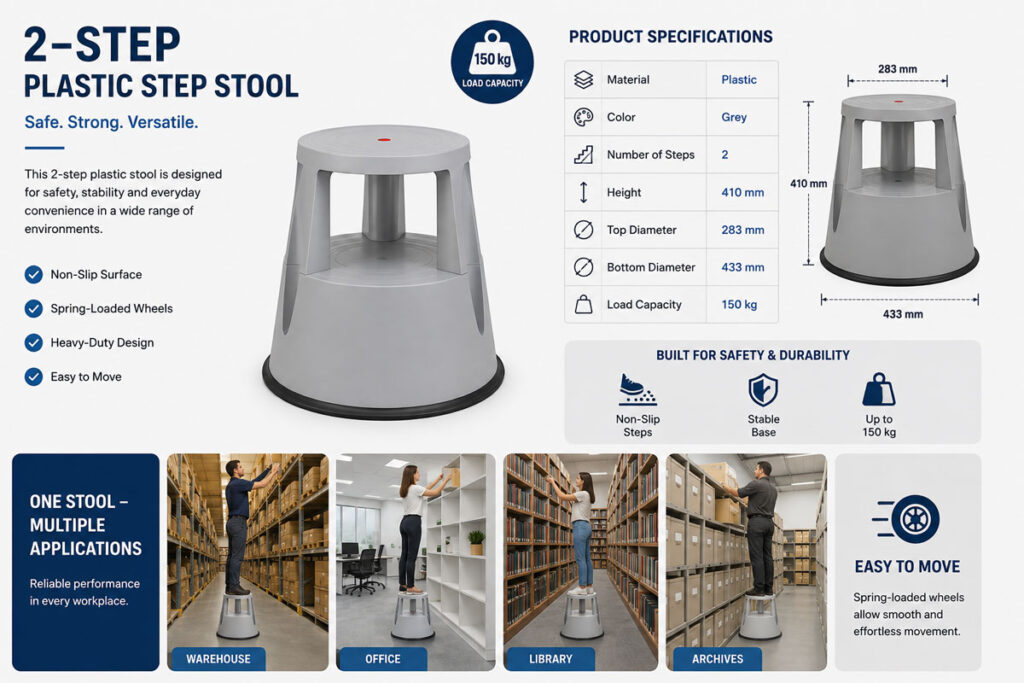
Frames are typically powder-coated steel or anodized aluminum. Steel offers higher impact resistance in busy service areas; aluminum reduces weight for staff who move the unit frequently. Platform surfaces use high-friction polymers or textured metal that retain grip after repeated cleaning with hotel-grade disinfectants. Wheels, when fitted, are non-marking compounds so polished lobby floors and guest-room corridors stay unmarked.
A manufacturer focused on hospitality and related commercial sectors tests these materials under repeated wet-dry cycles and chemical exposure. That testing separates tools suitable for daily hotel service from light-duty retail or domestic products. Heavy-duty construction is non-negotiable when the same stool may be used dozens of times per shift across multiple floors.
Where the Platforms Actually Get Used – Expanded Operational Map
Housekeeping teams reach high linen shelves and extra bedding. Engineering staff change lamps and clean HVAC vents. Banquet crews adjust ceiling fixtures or store seasonal décor. In Tripoli properties the same stools appear in laundry rooms and staff changing areas. In Sidon beachfront hotels they support bathroom deep-cleaning and high-mirror maintenance. Zahle valley hotels use them for storage rooms that serve both guest and restaurant operations.
Further examples appear across the map. Baalbek heritage hotels rely on stable platforms for careful maintenance of high architectural features. Byblos boutique properties need compact units that fit narrow back corridors. Aley hillside resorts move the stools between chalets and central stores. Nabatieh and Tyre southern hotels value corrosion resistance. Batroun and Zgharta coastal and northern sites prioritize non-marking wheels on newly finished floors. Urban clusters such as Jal El Dib, Hazmieh, Sin El Fil, Dbayeh, and Antelias see the highest utilization rates because of continuous multi-floor operations. Mountain and mid-range locations including Broummana, Bikfaya, Kaslik, Choueifat, Baabda, Jezzine, and Bint Jbeil use the platforms for both guest-area maintenance and back-of-house logistics.
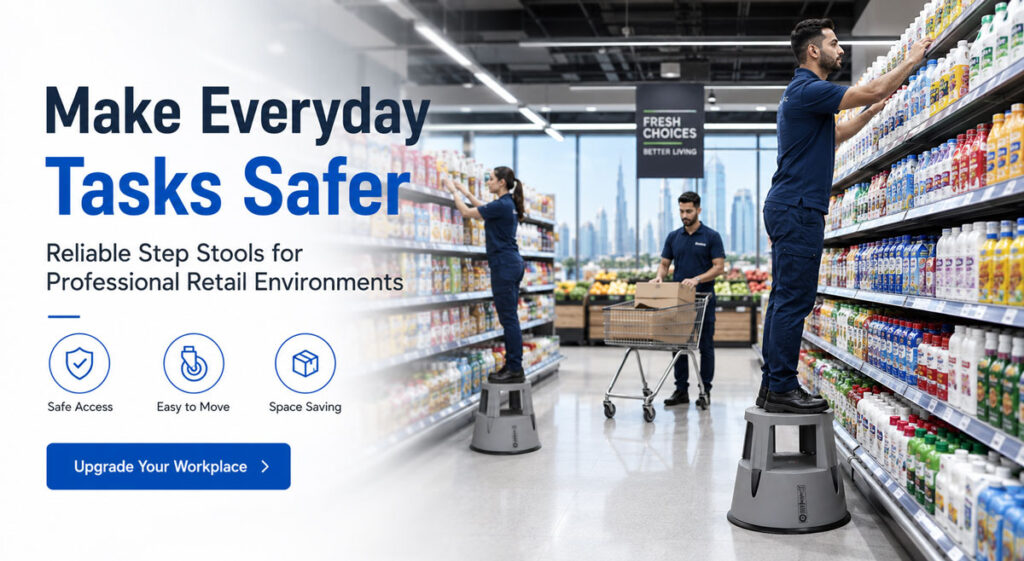
In every case the common requirement is the same: a stable, non-slip surface that can be positioned quickly and left safely when the task ends. Some larger properties also operate small warehouse retail or staff supermarket-style shops; the same commercial-grade stools serve high-shelf access in those hybrid spaces, reducing the need for separate equipment fleets.
Safety as an Operational Metric, Not a Poster
Hotels measure safety through incident rates, near-miss logs, and insurance premiums. A fall from height in a guest corridor or service area triggers investigation, possible downtime, and reputation risk. Non-slip step stools reduce that exposure when three conditions are met: correct specification, consistent placement, and trained use.
The platform must lock securely. Staff must step fully onto it and keep both feet planted. Overreaching must be discouraged through both design (wide base) and procedure. When these elements align, the tool becomes part of the hotel’s safety infrastructure rather than an afterthought.
Tip Box – Daily Habit That Prevents Most Incidents Before every use, press the platform firmly with one foot to confirm the wheel locks (if fitted) have engaged. Wipe any visible moisture or cleaning residue from the standing surface. These two actions take seconds and eliminate the majority of slip and roll risks.
Expert Observation “Most height-related near-misses in hotels occur not because the equipment is absent, but because the available step is either domestic-grade or has been left without a functional lock. Specifying a true commercial non-slip unit and enforcing a simple pre-use check changes the risk profile immediately.” — Hospitality operations consultant, multi-property Lebanese group
Procurement Reality for Multi-Property Groups
Larger hotel groups in Lebanon often standardize equipment across sites. That standardization favors engagement with a manufacturer capable of consistent quality and optional branding. Wholesale channels deliver volume pricing once the specification is fixed. Local distributor networks supply faster replacement units and spare parts when individual properties need them.
Bulk orders become practical once a chain selects one or two models that cover the majority of height and load needs. OEM arrangements allow private labeling or minor modifications such as color-matched frames or integrated tool trays for engineering teams. Independent hotels and smaller boutique properties typically work through a distributor who can advise on the correct height for local storage configurations and provide after-sales support.
Factory-direct manufacturer relationships also open the door to wholesale pricing tiers that become attractive once the annual volume across a group is aggregated. This approach is especially relevant for chains operating both pure hospitality assets and mixed-use sites that include warehouse retail or staff supermarket functions.
Cost View Beyond the Purchase Price – Deeper Breakdown
The acquisition cost of a hotel-grade non-slip stool is higher than a basic domestic step. The relevant calculation is total cost of ownership measured against:
- Reduced time per high-access task
- Lower probability of staff injury and associated costs
- Floor protection that avoids polishing or repair charges
- Longer service life under continuous commercial use
Many operations directors find payback occurs within the first season of heavy use once labor efficiency and incident reduction are factored in. Maintenance remains light: visual checks of locks and surfaces, occasional caster replacement, and routine cleaning of the non-slip platform.
A simple internal model used by several Lebanese groups compares the hourly cost of two workers (one climbing, one stabilizing a conventional ladder) against one trained attendant using a locked mobile stool. The difference compounds quickly across multiple floors and shifts.
Side-by-Side Comparison of Access Options (Updated)
| Option | Stability on wet floors | Mobility | Floor protection | Suitability for continuous hotel use | Typical footprint impact |
|---|---|---|---|---|---|
| Ordinary domestic step | Low | Limited | Often poor | Unsuitable | Low |
| Fixed ladder | High | None | N/A | Limited to permanent locations | High |
| Rolling warehouse ladder | High | High | Variable | Too large for many hotel corridors | High |
| Non-slip commercial step stool | High | High (wheeled) | Excellent | Strong match | Low to medium |
The commercial non-slip stool occupies the practical middle ground for most Lebanese hotel floor plates.
Selection Checklist for Hotel Procurement Teams (Expanded)
- Match maximum platform height to the tallest regular storage or maintenance point
- Confirm load rating covers the heaviest expected user plus carried items
- Verify non-slip performance after exposure to common hotel cleaners
- Test wheel locks under realistic weight if the model is mobile
- Require non-marking wheel compounds for finished floors
- Clarify warranty coverage for commercial rather than domestic use
- Ask about bulk-order tiers and OEM customization availability
- Confirm local distributor capacity for spare parts and rapid replacement
- Request evidence of heavy-duty construction and factory testing
- Evaluate whether wholesale pricing improves when orders are consolidated across properties
First Deployment Protocol
- Unpack and inspect every unit for transit damage.
- Function-test locks and wheels.
- Clean the standing surface thoroughly.
- Brief housekeeping and engineering teams on correct stance and lock engagement.
- Assign a visible home location on each floor or wing so the stool is always returned after use.
This short sequence prevents the common failure mode in which a good tool is left in a random corridor and becomes a trip hazard itself.
Maintenance Rhythm That Extends Service Life
Daily: wipe platform and check for debris. Weekly: test lock engagement and wheel rotation. Monthly: inspect frame for deformation or coating damage. Annually: deeper service or professional inspection for high-utilization units.
Keeping the non-slip surface free of polish residue, soap film, or dust is the single highest-leverage action. In coastal properties the additional step of checking for early signs of corrosion on any exposed metal is worthwhile.
Observed Outcomes in Operating Hotels
Properties that introduced properly specified non-slip stools report three recurring benefits:
- Faster completion of high-reach housekeeping and engineering tasks
- Measurable drop in height-related near-misses
- Greater staff confidence when working above shoulder height
Standardization across a multi-site group also simplifies training and spare-parts planning. Some operators have extended the same specification into any on-site warehouse retail or staff supermarket areas, further reducing equipment variety.
Mistakes That Undermine the Investment
- Selecting a light-duty model that cannot tolerate daily commercial use
- Ignoring non-marking wheel requirements on finished floors
- Failing to train staff on lock engagement and stance
- Allowing the unit to be used by two people simultaneously
- Neglecting surface cleaning until grip is compromised
- Ordering without confirming spare-parts lead times through the chosen distributor or manufacturer
Each of these errors is avoidable with clear specification and basic procedures.
Looking Ahead – Practical Next Steps for Lebanese Hoteliers
As Lebanese hotels continue to raise service and safety standards, mobile non-slip platforms move from optional equipment to expected infrastructure. Integration with visual management systems (clear home locations, simple checklists) and eventual addition of usage tracking are logical evolutions for larger operators. For the present, the priority remains selecting robust units from a capable manufacturer, securing favorable terms on bulk orders through wholesale or distributor routes, and embedding correct daily use into departmental routines.
Properties that already operate mixed functions—guest rooms plus staff shops or small warehouse retail zones—gain additional leverage by standardizing on one commercial platform family. The same non-slip safety surface and heavy-duty construction serve both environments without compromise.
FAQ – Expanded Hotel-Specific Set (35+ Questions)
1. Why do non-slip surfaces matter more in hotels than in dry warehouses? Hotel floors are frequently damp from cleaning, guest traffic, or bathroom proximity. A surface that retains grip under moisture directly reduces slip risk.
2. Can these stools be used safely in guest-facing areas during daytime? Yes, provided the model is compact, non-marking, and removed promptly after the task. Many properties restrict visible use to low-occupancy periods.
3. How does a manufacturer certify a stool for commercial hotel use? Through load testing, material durability trials, and documentation that distinguishes the product from domestic-grade steps.
4. Are bulk orders practical for a hotel group with properties of different sizes? Yes. Most groups select two or three heights that cover the majority of needs and order those in volume.
5. What OEM options are commonly requested by hotels? Color matching to brand standards, private labeling, and addition of simple tool holders for engineering teams.
6. Does a local distributor provide value beyond price? Yes—faster replacement, local warranty handling, and advice on models suited to regional floor finishes and humidity levels.
7. How often should the non-slip surface be deep-cleaned? As part of regular housekeeping schedules; any visible film or residue should be removed immediately.
8. Can the same stool serve both housekeeping and engineering departments? In most hotels yes, provided load rating and height suit both sets of tasks.
9. What is the most common cause of early failure? Continued use after the locking mechanism or wheels have been damaged, combined with neglected surface cleaning.
10. Are wheeled models safe on carpeted corridors? Select models with appropriate wheel diameter and lock design; test on the actual carpet type before full rollout.
11. How do these platforms compare with traditional A-frame ladders in narrow hotel service corridors? They require less open space to deploy and can be locked in place more quickly for short-duration tasks.
12. Should independent boutique hotels in smaller towns specify the same models as large city properties? The core non-slip and stability requirements are identical; height and footprint can be adjusted to local storage layouts.
13. What documentation should accompany a wholesale purchase? Load certificates, material specifications, commercial warranty terms, and recommended maintenance guidance.
14. Can staff use the stool while carrying items? Only within the rated load and with both feet fully on the platform. Training must emphasize this limit.
15. How does Safety performance change when the unit is used on wet bathroom floors? A true non-slip surface maintains grip; ordinary steps lose traction rapidly under the same conditions.
16. Is there a risk of marking polished lobby floors? Not when non-marking wheel compounds are specified and maintained.
17. What height range covers most hotel storage and maintenance needs? Platforms that enable comfortable reach to approximately 2.2–3.0 m satisfy the majority of daily tasks.
18. How quickly can a new unit enter service after delivery? Usually within one shift after inspection, cleaning, and a short team briefing.
19. Do manufacturers supply simple visual guides for housekeeping teams? Many provide illustrated one-page instructions covering stance, lock engagement, and prohibited practices.
20. Can a distributor support properties across multiple Lebanese regions? Established distributors typically cover major urban, coastal, and regional centers.
21. What happens if a wheel lock fails during use? The unit must be removed from service immediately and repaired or replaced through authorized channels.
22. Are these stools suitable for cold-storage or kitchen high shelves in hotel F&B areas? Select models with materials rated for the temperature and cleaning regime of those zones.
23. How does humidity in coastal locations affect long-term durability? Powder-coated or anodized frames and appropriate wheel materials resist corrosion when basic cleaning is maintained.
24. Should the purchase decision include spare casters and lock components? Yes—holding a small stock of wear parts minimizes downtime.
25. Can the stools be moved between floors in multi-story hotels? Most compact commercial models fit standard service elevators when empty.
26. What is the advantage of standardizing on one manufacturer across a hotel group? Consistent training, interchangeable spare parts, and simplified bulk-order negotiations.
27. How do these platforms support warehouse retail or staff-shop areas inside larger hotels? The same commercial-grade units serve high-shelf access in staff mini-markets and storage, reducing the need for separate equipment.
28. Is supermarket-style high-density storage ever found in hotel back-of-house? Yes—many larger properties use dense shelving for linens, amenities, and F&B dry stores; the stools are equally effective there.
29. What training interval keeps safety habits sharp? Brief refreshers at the start of each season or after any near-miss are usually sufficient.
30. Can OEM branding include the hotel’s logo on the platform or frame? Many manufacturers accommodate discrete branding on request.
31. How should units be stored overnight? In designated, visible locations on each floor so they remain accessible yet clear of main traffic paths.
32. What is the single highest-impact daily maintenance action? Keeping the standing surface free of moisture, soap film, or dust.
33. Do these stools reduce the need for two-person tasks? In many cases yes—one trained attendant can complete short high-reach jobs that previously required a second person to stabilize a ladder.
34. How does a procurement manager verify commercial rather than domestic construction? Request load-test data, material specifications, and warranty language that explicitly covers continuous commercial use.
35. What is the practical first step for a hotel considering a rollout? Obtain sample units, place them in real service conditions for one to two weeks, and collect feedback from housekeeping and engineering before placing a bulk order.
36. Does factory-direct purchasing change lead times compared with distributor stock? It can extend initial delivery for custom or large bulk orders, but often improves long-term pricing and specification control.
37. How important is heavy-duty construction for multi-shift hotel operations? Critical. Light frames deform or loosen under continuous daily loading; heavy-duty designs maintain geometry and lock integrity for years.
38. Can the same non-slip safety surface perform in both dry linen rooms and wet bathroom service areas? Yes, when the surface compound is chosen for chemical and moisture resistance rather than dry-only grip.
39. What role does wholesale pricing play for a group with ten or more properties? It converts the purchase from a series of small retail transactions into a planned capital program with predictable unit costs.
40. Is there any advantage to involving the engineering department early in the selection process? Yes—they typically identify the true maximum reach requirements and the floor types that will determine wheel and base specifications.
Five Distinct Calls to Action
- Ready to remove height-related risk from your hotel operations? Request specifications and bulk-order pricing for commercial non-slip platforms.
- See how a properly engineered stool performs on your actual floors. Contact us for sample evaluation and OEM options.
- Standardize safe access across every property in your group. Speak with our wholesale team about volume programs and distributor support.
- Looking for a manufacturer who understands hospitality duty cycles and heavy-duty construction? Reach out for technical data, warranty terms, and delivery timelines.
- Protect staff, protect floors, and keep rooms turning over on schedule. Start the conversation about the right non-slip wheeled solution for your hotels today.
Non-Slip Step Stools for Hotels Lebanon
Non-slip wheeled step stools give Lebanese hotel teams stable, mobile access to high storage, maintenance points, and replenishment zones. Built for commercial use, they protect staff and floors while accelerating housekeeping and engineering work. From city properties in Beirut to coastal sites near Jounieh and mountain hotels around Broummana, the right platform reduces incidents, supports bulk equipment programs, and fits the daily realities of hospitality operations nationwide.
Beyond the Obvious: How Non-Slip Platforms Quietly Reshape Hotel Back-of-House Flow
Most hotel managers focus on guest-facing metrics—occupancy, online scores, food-and-beverage revenue. The tools that keep the invisible half of the operation running safely rarely receive the same attention. A non-slip wheeled step stool is one of those tools. When specified correctly, it removes friction from dozens of daily micro-tasks and lowers the probability of the one incident that can disrupt an entire shift.
The difference is not dramatic on any single day. It appears in the aggregate: fewer near-miss reports, shorter replenishment cycles, less time spent searching for a stable platform, and floors that stay unmarked. For a multi-property group the cumulative effect is measurable in both labor hours and risk exposure.
A Day-in-the-Life Walkthrough
Consider a typical morning in a mid-size city hotel. Housekeeping needs extra pillows from a high shelf in the linen room. Engineering must replace a corridor light that sits just out of comfortable reach. The night auditor left a note about a flickering emergency exit sign on the mezzanine. Without a mobile non-slip platform, each task requires either stretching, improvising, or locating a conventional ladder that may already be in use elsewhere.
With a properly locked wheeled stool the same three tasks become sequential and single-person jobs. The attendant rolls the unit into position, confirms the lock, completes the reach, and moves on. The time saved is measured in minutes, but those minutes compound across every floor and every shift.
In Tripoli properties the pattern is identical, only the humidity and the specific storage layouts change. In Sidon beachfront hotels the same sequence includes bathroom deep-clean access and high-mirror maintenance. The tool itself remains constant; only the environment varies.
Investment Analysis from the Purchasing Manager’s Desk
A single commercial-grade non-slip stool costs more than a domestic step. That is the wrong comparison. The correct comparison is against the fully loaded cost of the alternative methods currently in use.
Calculate the following for one property:
- Average number of high-reach tasks per day
- Average minutes spent locating or stabilizing a conventional ladder
- Average number of staff involved in those tasks
- Historical near-miss or incident rate related to height work
- Estimated cost of floor repairs caused by marking wheels or dropped items
When those figures are annualized and then multiplied across a group of properties, the premium paid for a heavy-duty, non-slip, non-marking unit is usually recovered within one operating season. After that point the stool continues to return value through reduced labor friction and lower risk.
Bulk orders improve the arithmetic further. Once a group standardizes on one or two models, wholesale pricing and simplified spare-parts inventory reduce the per-unit cost and the administrative overhead. OEM arrangements can add private labeling or minor design adjustments without destroying the volume economics.
Material and Construction Deep Dive
The non-slip safety surface is the most visible feature, yet the underlying structure determines whether the unit survives years of commercial use or begins to loosen after a few months. Heavy-duty construction typically means:
- Thick-gauge steel or reinforced aluminum frame
- Continuous welds rather than spot welds at stress points
- Platform diameter and thickness sized for real body weight plus carried items
- Wheel and lock assemblies rated for repeated engagement cycles
A manufacturer that supplies both hospitality and warehouse retail markets usually designs to the more demanding of the two duty cycles. The result is a platform that remains stable and quiet under continuous hotel service. In coastal locations the coating system also needs to resist salt-laden air; powder coating or anodizing is the practical standard.
Training Outline That Actually Sticks
Equipment fails when people do not understand it. A short, repeatable briefing keeps the safety benefit intact:
- Always test the lock with body weight before fully mounting.
- Keep both feet on the platform; never stand on the edge.
- Do not overreach—reposition the stool instead.
- Return the unit to its designated home location after every use.
- Report any looseness, unusual noise, or reduced grip immediately.
This five-point list can be delivered in under three minutes at the start of a shift or during seasonal refresher sessions. Properties that treat it as mandatory rather than optional see the lowest incident rates.
Checklist – Pre-Shift Equipment Scan
- Platform surface clean and free of residue
- Wheels rotate freely and locks engage
- Frame shows no visible deformation
- Home location is clear and visible
- Spare unit (if any) is serviceable
Real Scenario: Multi-Floor City Hotel
A 180-room property in a dense urban setting operates three shifts. High-reach tasks occur on every floor multiple times per day. Before introducing wheeled non-slip stools the engineering team kept two conventional ladders that were frequently unavailable or left in corridors. After standardization on mobile platforms the average time to complete a light-replacement task dropped by roughly 40 percent, and corridor clutter decreased. Staff reported higher confidence when working above shoulder height. The same units later migrated into the staff supermarket-style amenity store, where dense shelving had previously required improvised access methods.
Similar patterns appear in Zahle, Baalbek, Byblos, Aley, Nabatieh, Batroun, Tyre, Zgharta, Jal El Dib, Hazmieh, Sin El Fil, Dbayeh, Antelias, Broummana, Bikfaya, Kaslik, Choueifat, Baabda, Jezzine, and Bint Jbeil. The absolute numbers differ; the operational logic does not.
Comparison Against Alternative Access Methods – Extended View
| Method | Setup time | Stability on damp floors | Corridor impact | Long-term cost | Training burden |
|---|---|---|---|---|---|
| Improvised (chairs, boxes) | Low | Very low | Low | High (risk) | None |
| Domestic step stool | Low | Low | Low | Medium | Low |
| Conventional A-frame ladder | Medium | High | High | Medium | Medium |
| Full rolling warehouse ladder | Medium | High | Very high | High | Medium |
| Commercial non-slip wheeled stool | Very low | High | Low | Low | Low |
The commercial wheeled stool wins on the combination of speed, footprint, and safety surface performance that hotels actually need.
Common Failure Modes and How to Prevent Them
- Lock mechanism neglected until it fails under load → weekly function test.
- Surface contaminated with polish or soap film → daily wipe-down.
- Unit left in random locations → enforced home-position rule.
- Overloading or two-person use → clear load rating posted and trained.
- Wheels allowed to seize from debris → monthly cleaning and inspection.
Each failure mode is inexpensive to prevent and expensive to ignore.
Sourcing Notes for Lebanese Operators
Local distributor networks remain the fastest route for single-property or small-group needs. Larger groups often combine a manufacturer relationship for bulk orders and OEM options with a local distributor for rapid replacement and warranty support. Wholesale pricing becomes accessible once annual volume is forecast and committed. Factory-direct channels can further improve margins on large, standardized orders while preserving the ability to request minor customizations.
The same commercial-grade platforms that serve guest-floor maintenance also perform in any on-site warehouse retail or staff supermarket areas, allowing a single specification to cover multiple internal functions.
Looking Further Ahead
As hotels continue to tighten labor models and raise safety expectations, mobile non-slip platforms will shift from discretionary purchases to standard operating equipment. Integration with simple visual management (shadow boards, checklists) and eventual light digital tracking of usage are logical next steps. For the immediate horizon the priority is clear: select heavy-duty units with proven non-slip safety surfaces, secure favorable terms through bulk orders or wholesale channels, and embed correct daily habits so the safety benefit is realized every shift.
FAQ – Additional Hotel-Focused Questions
41. How does a non-slip wheeled stool affect insurance or risk-assessment scores? Many risk auditors view the presence of properly specified, regularly inspected access equipment as a positive control that can support more favorable assessments.
42. Can the same model serve both guest-floor work and back-of-house warehouse retail areas? Yes. The commercial rating and non-slip surface are suitable for both environments when height and load are matched.
43. What is the practical difference between wholesale pricing and standard list pricing? Wholesale pricing reflects committed volume and typically includes better payment or delivery terms; it is the route most multi-property groups pursue once the specification is fixed.
44. How important is factory-direct capability when planning a multi-year equipment program? It provides direct access to engineering for OEM adjustments and often better long-term pricing stability.
45. Should the engineering and housekeeping departments share ownership of the stools? Shared ownership works when home locations and inspection responsibility are clearly assigned; otherwise one department should be designated as primary custodian.
46. What happens if a unit is damaged by a trolley impact? Remove it from service, document the damage, and process replacement through the distributor or manufacturer under the applicable warranty or spare-parts arrangement.
47. How do these platforms perform in libraries or office areas that some hotels maintain for guests or staff? The same non-slip, non-marking characteristics that protect hotel corridors also protect quieter finished spaces.
48. Is there a recommended ratio of stools to rooms or floors? No universal formula exists, but many properties start with one unit per floor or wing and adjust after observing actual utilization.
49. Can bulk orders include a mix of heights without losing volume pricing? Most manufacturers and wholesale channels accommodate mixed configurations when the total quantity remains significant.
50. What single metric best indicates that the investment is working? A sustained reduction in height-related near-miss reports combined with measurable time savings on routine high-reach tasks.
Five Distinct Calls to Action
- Ready to remove height-related friction from every floor of your hotel? Request current specifications and bulk-order options.
- Test a commercial non-slip platform on your own corridors and storage rooms. Ask for evaluation units and OEM possibilities.
- Standardize safe, mobile access across your entire group. Speak with the wholesale team about volume programs and distributor coverage.
- Partner with a manufacturer that understands heavy-duty hospitality duty cycles. Request technical data, warranty details, and lead times.
- Protect your teams, protect your floors, and keep operations moving. Begin the conversation about the right non-slip wheeled solution today.

Bir yanıt yazın