


Wheeled Non-Slip Step Stools for Supermarkets in Lebanon
Wheeled Non-Slip Step Stools for Supermarkets in Lebanon The Practical Safety Investment Lebanese Supermarkets Need Right Now
In Lebanon’s competitive retail environment, every square meter of shelf space and every minute of staff time carries measurable cost. High shelves demand access. Wet floors, hurried restocking, and tight aisles create risk. Wheeled non-slip step stools solve both problems at once: they move effortlessly between aisles yet lock securely under load, delivering stable, non-slip footing for commercial use.


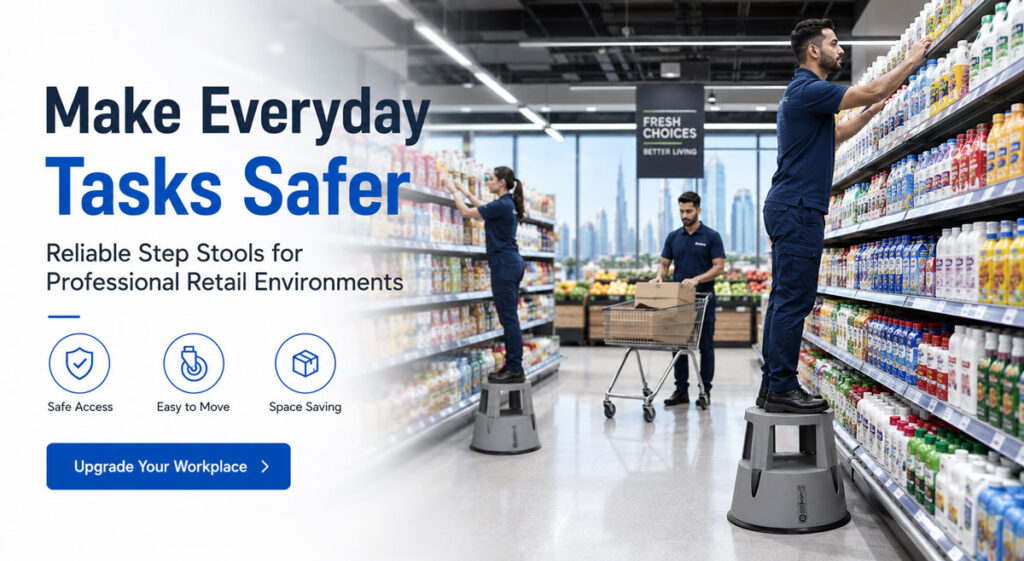


This page is written for purchasing managers, operations directors, and retail owners who evaluate equipment by total cost of ownership, staff safety metrics, and operational uptime—not by brochure claims. It examines why these tools matter across Lebanese supermarket operations, how to specify them correctly, what real-world performance looks like, and how to source them efficiently through Manufacturer, Wholesale, and Distributor channels, including Bulk Orders and OEM options from Firmalazım.
Why Mobile Access Equipment Matters More in Lebanese Retail Than Most Buyers Realize
Supermarket staff in Beirut constantly move between high-volume dry goods, refrigerated sections, and backroom storage. The same pattern repeats in Tripoli hypermarkets and neighborhood stores in Sidon. When workers climb unstable stools or stretch dangerously, two outcomes follow: slower replenishment and higher injury risk.
A properly designed wheeled non-slip step stool changes the equation. Spring-loaded or weight-activated casters allow one-handed repositioning. Non-slip platforms and feet keep the unit planted on tiled, sometimes damp floors common in Lebanese stores. Load ratings of 150–300 kg cover almost every staff member and the occasional heavier load.
For operators running multi-store networks that stretch from Zahle to Jounieh and Baalbek, standardized access equipment reduces training time and replacement costs. The investment is modest compared with the cost of a single lost-time injury or repeated product damage from unstable climbing.
Core Design Features That Separate Professional Tools from Consumer Stools
Not every step stool belongs in a supermarket. Consumer models fail under daily commercial use. Professional units emphasize:
- Retractable or spring-loaded wheels that lock automatically when weight is applied
- Wide, textured non-slip platforms (often rubber or serrated steel/plastic)
- Heavy-duty frames in high-density polypropylene, powder-coated steel, or combinations
- Stable base geometry that resists tipping even when the user reaches slightly off-center
- Quiet casters that do not disturb customers during trading hours
- Easy-clean surfaces suited to food-retail hygiene standards
These features support both front-of-house shelf work and back-of-house warehouse retail tasks. In Byblos coastal stores and Aley mountain locations, the same stool often serves both zones.
Material and Construction Reality Check
Polypropylene models dominate for lighter one- and two-step units because they resist corrosion in humid or frequently cleaned environments and stay light enough for frequent movement. Steel-frame rolling steps handle higher loads and multi-step heights needed for taller warehouse racking.
Firmalazım, as a Manufacturer focused on commercial equipment, offers both categories and supports OEM customization—color coding by store zone, branded labeling, or adjusted platform sizes. For chains placing Bulk Orders, this flexibility reduces the risk of mismatched equipment across sites in Nabatieh, Batroun, and Tyre.
Operational Scenarios Across Lebanese Cities
Consider a typical morning restock in a busy Zgharta supermarket: dairy and produce sections need rapid top-up before peak traffic. Staff roll the stool to the exact bay, step up, place product, step down, and move on. No dragging of fixed stools, no searching for a ladder that blocks an aisle.
In Jal El Dib and Hazmieh stores with high customer density, the low profile and quiet movement keep the sales floor calm. In Sin El Fil and Dbayeh locations that combine supermarket and warehouse functions, the same units serve order-picking and inventory checks.
Broummana, Kaslik, and Choueifat operators report similar patterns: once staff trust the stability and non-slip surface, usage becomes habitual and injury near-misses drop. The pattern holds in Baabda, Antelias, Bikfaya, Jezzine, and Bint Jbeil—different climates and customer profiles, same need for reliable elevated access.
Safety Engineering That Actually Protects Staff
Lebanese retail floors experience frequent cleaning, occasional spills, and temperature swings between refrigerated and ambient zones. Non-slip performance must remain effective under these conditions.
Key safety elements include:
- Platform surface texture that maintains grip when wet
- Automatic wheel lock under body weight
- Wide stance and low center of gravity
- Handholds or rails on multi-step models
- Clear load-rating labels
When these features are present, the tool actively supports Safety culture rather than merely complying with minimum expectations. Purchasing managers who track near-miss reports often see the difference within weeks of introducing quality wheeled units.
Cost and Investment Perspective
A single high-quality wheeled non-slip step stool typically costs more than a basic plastic stool. Over a three-to-five-year horizon the equation reverses.
Factors that improve return:
- Reduced staff time per restock cycle
- Lower product damage from unstable reaching
- Fewer injury-related absences and insurance impacts
- Longer service life under daily commercial use
- Ability to standardize across multiple locations
For multi-branch operators, Wholesale pricing and Distributor logistics become decisive. Firmalazım supports both Bulk Orders for immediate rollout and staged deliveries that match store opening or renovation schedules. OEM versions allow private labeling so equipment aligns with internal asset-management systems.
Specification Checklist for Lebanese Supermarket Buyers
Use this practical filter when evaluating options:
| Criterion | Minimum Recommendation | Why It Matters in Lebanon |
|---|---|---|
| Load capacity | 150 kg (preferably 200–300 kg) | Covers staff + occasional heavier items |
| Platform surface | Textured non-slip rubber or equivalent | Wet floors and cleaning chemicals |
| Wheel system | Auto-lock under weight | Prevents movement while in use |
| Mobility | Easy one-handed push | Narrow aisles and busy trading hours |
| Frame durability | Commercial-grade PP or coated steel | Daily use and occasional rough handling |
| Cleanability | Smooth, non-porous surfaces | Food-retail hygiene standards |
| Height options | 1-step and 2-step primary; 3-step for warehouse | Match shelf heights without excess bulk |
Sourcing Paths: Manufacturer Direct, Wholesale, Distributor, OEM
Direct engagement with a Manufacturer such as Firmalazım often yields the best combination of price, specification control, and after-sales support for larger programs. Wholesale channels suit mid-volume needs. Local Distributors can simplify import clearance, warehousing, and rapid replacement.
OEM arrangements allow Lebanese chains to receive equipment built to their exact color, branding, or dimensional preferences. This is particularly useful for groups that want visual consistency across stores from Beirut to the south and north.
Import considerations remain manageable for this product category. Standard commercial equipment faces routine customs procedures. Working with an experienced Manufacturer or Distributor reduces documentation friction and ensures packaging suitable for regional logistics.
Common Specification Mistakes and How to Avoid Them
Many operators start with consumer-grade stools and later replace them. Typical errors include:
- Choosing units without automatic wheel lock
- Accepting platforms that become slippery when wet
- Under-specifying load capacity
- Buying only one height when multiple shelf levels exist
- Ignoring quiet-operation requirements in customer areas
A short pilot in one high-traffic store quickly reveals which features staff actually value. Expand only after real usage data is collected.
Maintenance Reality
Quality wheeled non-slip step stools require minimal maintenance: periodic cleaning of platforms and casters, visual inspection of locks and frames, and occasional wheel replacement after years of heavy use. Training staff to report damage immediately keeps the fleet reliable. The low upkeep burden is one reason these tools deliver strong total-cost performance in Warehouse Retail and supermarket settings.
Looking Ahead: Equipment That Supports Modern Retail Operations
As Lebanese supermarket operators continue refining labor productivity and Safety performance, mobile access tools become standard infrastructure rather than optional accessories. Units that combine effortless mobility with secure, non-slip standing surfaces align with both daily operational needs and longer-term risk management.
Firmalazım positions itself as a Manufacturer ready to support Lebanese retailers through Wholesale supply, Distributor partnerships, Bulk Orders, and OEM programs tailored to commercial use requirements.
Five Distinct Calls to Action
- Operations-focused: Request a site-specific recommendation and sample unit for one of your high-traffic stores.
- Procurement-focused: Ask for current Wholesale pricing and lead times on Bulk Orders of 1-step and 2-step models.
- Customization-focused: Explore OEM options including private labeling and color matching for multi-branch consistency.
- Safety-driven: Schedule a short consultation on how upgraded access equipment can support your injury-reduction targets.
- Network-wide: Discuss phased rollout logistics across your stores from coastal cities to inland locations.
Frequently Asked Questions
What load capacity is realistic for supermarket staff use? Most adult staff are safely covered by 150–200 kg ratings. Higher ratings provide extra margin and longer service life under commercial use.
Do the wheels mark or damage typical supermarket floors? Quality non-marking casters are standard on professional models and suitable for common tiled and epoxy surfaces.
How do automatic locking wheels actually work? Weight on the platform depresses the casters so the solid feet contact the floor. When the user steps off, the wheels re-engage for movement.
Are these suitable for both sales floor and backroom warehouse retail areas? Yes. The same robust design serves both environments when the correct height and capacity are chosen.
Can we obtain units with our store branding? OEM programs from the Manufacturer make private labeling straightforward for sufficient order quantities.
What is the typical service life under daily supermarket use? With normal care, well-built units commonly last several years even in high-traffic stores.
How important is the non-slip surface in practice? Critical. Lebanese stores experience frequent wet cleaning and occasional product spills. Texture that works when damp is essential.
Do you support staged deliveries for multi-store rollouts? Yes. Wholesale and Distributor arrangements can accommodate phased shipments.
Are spare parts available? Reputable Manufacturers and Distributors maintain stocks of casters, feet, and common wear items.
How do these compare with fixed step stools? Mobility eliminates the need to carry or drag equipment between aisles, saving time and reducing handling injuries.
What heights are most useful? One-step and two-step models cover the majority of supermarket shelf work. Taller units suit warehouse racking.
Can staff with different heights use the same model comfortably? Wide platforms and stable geometry accommodate a range of users. Multiple heights in the fleet provide further flexibility.
Is assembly required? Many commercial models arrive ready to use or require only minimal assembly.
How do we clean them for food-retail standards? Smooth, non-porous surfaces wipe down easily with standard store cleaning agents.
Do quiet wheels matter? Yes, especially during trading hours when customer experience is a priority.
What documentation accompanies commercial shipments? Standard commercial paperwork plus any certificates relevant to materials and load ratings.
Can we trial units before committing to Bulk Orders? Many operators begin with a small pilot order precisely for this reason.
How does local climate affect material choice? Humidity and frequent cleaning favor corrosion-resistant materials such as high-grade polypropylene or properly coated steel.
Are these tools relevant for smaller independent supermarkets as well as large chains? Yes. The productivity and Safety benefits scale to any operation that regularly accesses high shelves.
What is the best first step for a purchasing manager? Define the primary use cases (sales floor vs warehouse), measure typical reach heights, and request specification guidance matched to those needs.
Does Firmalazım handle both standard and customized requirements? As a Manufacturer, Firmalazım supports standard commercial models, Wholesale volumes, Distributor channels, Bulk Orders, and OEM projects.
This equipment category is straightforward yet high-impact. Correctly specified wheeled non-slip step stools reduce friction in daily operations, support staff Safety, and deliver measurable returns across Lebanese supermarket networks. When you are ready to move from evaluation to implementation, the pathways—Manufacturer direct, Wholesale, Distributor, or OEM—are open.
Wheeled Non-Slip Step Stools for Supermarkets in Lebanon
Continuing the Operational Playbook: Turning Access Equipment into a Measurable Advantage
The real difference between a supermarket that merely functions and one that runs with disciplined efficiency often appears in the smallest tools. Wheeled non-slip step stools sit in that category. Once they become part of standard operating procedure rather than occasional equipment, the daily friction of restocking, inventory checks, and high-shelf recovery drops noticeably. This section expands the practical layer for purchasing and operations teams who must justify every capital decision with clear returns.
Mapping Daily Workflow Friction and Removing It
In a typical Lebanese supermarket the average restock cycle involves multiple elevation changes. Staff walk the aisle, identify gaps, locate a climbing aid, position it, climb, place product, descend, and move the aid again. Each of those micro-steps consumes seconds that multiply across dozens of bays and hundreds of shifts. When the aid is a wheeled non-slip unit with automatic lock, the positioning and securing phases shrink dramatically.
Consider the rhythm inside a high-volume store operating in Beirut. Peak morning delivery windows force rapid shelf recovery before customer traffic intensifies. The same pressure appears in Tripoli outlets that serve both residential and wholesale-adjacent demand, and in Sidon stores managing coastal supply patterns. A mobile platform that rolls into place and locks under foot weight removes the need to drag fixed stools or wait for a shared ladder. The result is measurable: fewer minutes per bay and lower cumulative fatigue by the end of the shift.
Operators in Zahle and Jounieh report similar gains once the units become ubiquitous rather than shared. The same logic extends to Baalbek locations where temperature swings between ambient and refrigerated zones make stable footing even more critical. In Byblos and Aley the benefit appears in both front-of-house presentation standards and backroom warehouse retail tasks.
Financial Modeling That Purchasing Managers Actually Use
A simple total-cost model clarifies the investment case. Assume a mid-sized supermarket deploys eight units at an average commercial cost that reflects Wholesale or Manufacturer pricing for quality construction. Expected service life under daily commercial use is four to six years with basic maintenance.
Against that capital outlay sit three recurring savings streams:
- Labor minutes recovered per restock cycle
- Reduction in product damage from unstable reaching or dropped cases
- Lower probability of lost-time injuries linked to falls or over-reaching
Even conservative assumptions—thirty seconds saved per major restock sequence, two fewer damaged cases per week, and a modest decline in near-miss frequency—produce payback inside eighteen months for most multi-store operators. Chains that standardize across Nabatieh, Batroun, and Tyre capture additional purchasing leverage through Bulk Orders and consistent OEM specifications.
The model improves further when the same units serve dual roles: sales-floor recovery during trading hours and warehouse retail order-picking outside peak periods. That dual utilization is common in Zgharta, Jal El Dib, and Hazmieh formats where space is constrained and equipment must earn its footprint.
Safety Integration Beyond the Obvious
Safety performance is not only about preventing dramatic falls. It includes the cumulative effect of micro-instabilities that cause strained backs, twisted ankles, or repeated over-reaching. Non-slip platform texture that remains effective on damp tile, combined with automatic wheel lock, addresses both acute and chronic risk.
A practical Safety protocol that many Lebanese operators adopt includes:
- Mandatory visual check of lock function and platform condition at the start of each shift
- Clear maximum load labeling visible from the approach side
- Training that emphasizes “both feet on the platform, body centered” rather than stretching
- Immediate removal of any unit showing caster wear or frame damage
These simple rules raise the baseline without adding bureaucracy. Stores in Sin El Fil, Dbayeh, and Broummana that implemented structured checks alongside the equipment upgrade recorded fewer near-miss reports within the first quarter. The pattern repeats in Kaslik, Choueifat, and Baabda once supervisors treat the stools as controlled assets rather than disposable aids.
Comparison Against Alternative Access Methods
Fixed step stools remain cheaper at the point of purchase yet carry hidden costs in mobility and storage. Traditional ladders offer greater height but introduce tip risk, aisle blockage, and longer setup time. Mobile order-picking platforms with integrated steps solve some problems for large warehouses but are often oversized and expensive for typical supermarket aisle widths.
Wheeled non-slip step stools occupy the practical middle ground: sufficient height for the majority of supermarket shelving, rapid repositioning, automatic stability under load, and modest capital outlay. For operators managing mixed formats—compact urban stores in Antelias and Bikfaya alongside larger sites in Jezzine and Bint Jbeil—the versatility is decisive.
Procurement Pathways That Reduce Friction
Lebanese retail groups have three primary routes. Direct engagement with a Manufacturer such as Firmalazım allows tight control over specification, color coding, and private labeling through OEM arrangements. Wholesale channels deliver volume pricing for standardized models. Local Distributors simplify logistics, customs clearance, and rapid replacement stock.
The optimal path often combines elements. A core Bulk Order placed with the Manufacturer or through Wholesale pricing establishes the fleet standard. A local Distributor then handles ongoing replenishment and spare parts. This hybrid approach has proven effective for chains that operate from coastal Tyre to inland Baalbek and need both cost discipline and responsive local support.
Detailed Specification Deep Dive
Platform width and depth determine usable standing area and psychological security. Narrow platforms encourage cautious posture; wider ones allow natural foot placement and brief two-handed work. Texture depth and material composition govern wet-grip performance. Rubber compounds or aggressive serrations that resist polishing from repeated cleaning cycles outperform smooth plastics.
Caster quality separates units that roll smoothly for years from those that seize or mark floors. Dual-wheel or soft-compound casters with sealed bearings handle the mix of tile, occasional transition strips, and light debris common in supermarket environments. Frame geometry—particularly the relationship between base width and platform height—governs tip resistance when the user reaches slightly off-center.
These details matter more in daily commercial use than brochure photographs. Operators who request sample units and subject them to real aisle conditions quickly identify which designs survive the first six months of intensive service.
Implementation Sequence That Minimizes Disruption
Successful rollouts follow a consistent sequence:
- Pilot in one high-traffic store for four to six weeks.
- Collect staff feedback on mobility, stability, and preferred heights.
- Refine the specification.
- Place the main Bulk Order with clear delivery phasing.
- Train supervisors first, then cascade to floor staff.
- Integrate the units into existing Safety and asset registers.
- Schedule quarterly condition audits.
Stores that skip the pilot often discover late that a single height does not serve all zones, or that quieter casters are essential in customer-facing areas. The extra weeks of testing repay themselves in higher adoption rates.
Hygiene and Food-Retail Compatibility
Supermarket environments demand equipment that withstands frequent wet cleaning and occasional chemical exposure. Non-porous platforms and frames that do not trap debris or absorb moisture reduce microbial risk. Units designed for commercial use typically meet this threshold when constructed from high-density polypropylene or properly finished steel.
In practice, staff wipe the platform at the same time they clean surrounding floor areas. The process adds negligible time when the surface is smooth and the texture is self-draining. This compatibility supports the broader food-safety systems already operating in modern Lebanese supermarket chains.
Regional Nuances Without Generalization
Climate and building stock vary. Coastal locations experience higher humidity and more aggressive cleaning regimes. Inland and higher-elevation sites may see greater temperature differentials between ambient and cold zones. Older buildings sometimes present uneven floors or tighter aisle transitions. Quality wheeled non-slip designs accommodate these variations when the specification prioritizes robust casters, stable geometry, and corrosion-resistant materials.
Operators running sites in Beirut, Tripoli, Sidon, Zahle, Jounieh, Baalbek, Byblos, Aley, Nabatieh, Batroun, Tyre, Zgharta, Jal El Dib, Hazmieh, Sin El Fil, Dbayeh, Broummana, Kaslik, Choueifat, Baabda, Antelias, Bikfaya, Jezzine, and Bint Jbeil therefore benefit from a common core specification with only minor local adjustments for height mix or color coding.
Risk Register and Failure Modes
The most common failure modes are predictable: caster bearings that seize after prolonged exposure to cleaning chemicals, platform texture that polishes smooth under heavy foot traffic, and lock mechanisms that wear if repeatedly forced while still rolling. Each has a straightforward mitigation—specify sealed or easily replaceable casters, choose aggressive non-slip compounds, and train staff never to force a unit that has not fully locked.
A short risk register kept by the facilities or Safety team turns these known issues into managed items rather than surprises. The register also tracks near-miss data linked to elevated work, creating a feedback loop that justifies further investment or specification refinement.
Training Content That Sticks
Effective training is short and repeated. A five-minute module covering correct positioning, lock verification, centered stance, and descent technique, reinforced at shift briefings for the first month, produces lasting behavior change. Visual reminders placed near equipment storage areas reinforce the message without requiring formal classroom time.
Supervisors who model correct use accelerate adoption. When the unit is treated as a professional tool rather than a disposable aid, staff treat it accordingly.
Scaling Across Multi-Store Networks
For groups operating more than a handful of locations, standardization delivers compounding benefits. Common part numbers simplify spare-parts inventory. Shared training materials reduce onboarding time for transferred staff. Volume commitments unlock better Wholesale or Manufacturer pricing and priority production slots for OEM variants.
Phased delivery aligned with store renovation or seasonal peaks prevents warehouse congestion while ensuring every site reaches the new standard on a predictable timetable. Local Distributors can hold buffer stock so that damaged units are replaced within days rather than weeks.
Looking Beyond Immediate Needs
Retail formats continue to evolve. Higher gondolas, denser planograms, and tighter labor budgets all increase the value of rapid, safe elevated access. Equipment that already performs reliably under current conditions positions the operator for these incremental pressures without requiring another capital cycle.
Some operators are beginning to color-code units by zone or function—sales floor versus warehouse retail, dry goods versus produce—so that the right tool is always visually obvious. OEM programs make such differentiation straightforward at modest additional cost when ordered in Bulk.
Closing the Loop on Value
The wheeled non-slip step stool is not glamorous equipment. It does not appear in customer-facing marketing. Yet it sits at the intersection of labor productivity, product integrity, and staff Safety—three metrics that purchasing managers and operations directors track closely. When specified correctly, sourced efficiently through Manufacturer, Wholesale, or Distributor channels, and supported by simple procedures, it delivers quiet, compounding returns across the entire store network.
Firmalazım stands ready to support Lebanese supermarket operators with commercial-grade solutions, flexible Bulk Orders, OEM customization, and reliable supply pathways. The next practical step is usually a short conversation about current shelf heights, existing pain points, and the volume required to move from pilot to fleet standard.
Extended Practical Checklist for Decision Makers
- Confirm primary use cases (sales floor only, warehouse retail only, or dual).
- Measure actual reach heights in representative stores.
- Request sample units that match the intended specification.
- Run a four-to-six-week pilot with structured feedback collection.
- Calculate internal labor and damage cost baselines before and after.
- Decide on height mix and any zone-specific color coding.
- Choose the primary procurement route (Manufacturer direct, Wholesale, or Distributor).
- Negotiate Bulk Order pricing and phased delivery.
- Prepare short training content and visual reminders.
- Establish a simple condition audit schedule.
- Integrate the new assets into existing Safety and maintenance systems.
- Review performance after ninety days and adjust as needed.
This sequence converts a product purchase into a managed operational improvement. The difference appears in the daily rhythm of the store long after the initial invoice is paid.
Extending the Operational Advantage: Ergonomics, Lifecycle Control, and Multi-Site Execution
Once the basic decision to adopt wheeled non-slip step stools is made, the real performance difference emerges in how the tools are integrated into daily routines, maintained over years, and scaled across a network. This section moves past selection criteria into the practical systems that turn a capital purchase into sustained operational gain for Lebanese supermarket operators.
Ergonomics and the Hidden Cost of Poor Access
Repetitive reaching and unstable footing create cumulative strain that rarely appears as a single dramatic incident. Shelf stockers who repeatedly stretch beyond a comfortable range or compensate for a wobbly platform accumulate micro-injuries in shoulders, lower back, and knees. Over months these translate into higher absenteeism, slower work rates, and increased turnover in roles that already face recruitment pressure.
A stable, properly heighted wheeled unit changes the biomechanics. The user steps onto a wide non-slip platform, centers their weight, and works with both hands free at a natural height. The automatic lock removes the need to brace against movement. In high-volume environments such as those found in Beirut and Tripoli, the reduction in awkward postures is noticeable within the first weeks of consistent use. Similar observations appear in Sidon and Zahle stores where long shifts coincide with intensive replenishment windows.
Quantifying the benefit requires tracking a few simple metrics before and after introduction: average time per high-shelf bay, number of reported discomfort cases, and frequency of product drops linked to unstable positioning. Operators who collect these figures gain a clear internal business case that goes beyond the purchase price.
Lifecycle Management That Protects the Investment
Commercial equipment only delivers its projected return when it remains in reliable service for its full design life. A structured lifecycle approach includes:
- Incoming inspection against the agreed specification
- Clear asset tagging and assignment to specific stores or zones
- Simple daily or shift-start visual checks by users
- Scheduled quarterly reviews by facilities or Safety personnel
- Prompt replacement of wear items such as casters and non-slip pads
- Retirement criteria based on frame integrity rather than arbitrary age
Units operating in Jounieh and Baalbek face different environmental stresses—coastal humidity versus greater temperature variation—yet the same management discipline applies. In Byblos and Aley the combination of tourist-season peaks and routine cleaning chemicals tests surface durability; specifying materials that resist polishing and chemical attack extends service intervals.
When spare parts are readily available through the original Manufacturer or a responsive Distributor, downtime stays minimal. Operators who treat the stools as managed assets rather than disposable items routinely achieve four to six years of effective commercial use.
Integrating the Tools into Existing Supermarket KPIs
The strongest adoption occurs when the equipment is linked to metrics already tracked by the business. Relevant connections include:
- Restock productivity (bays or cases per labor hour)
- On-shelf availability scores
- Near-miss and incident rates under the Safety program
- Product damage recorded in receiving or sales-floor logs
- Labor cost per square meter of selling space
Supervisors in Nabatieh, Batroun, and Tyre who include correct use of the wheeled units in routine floor walks reinforce both productivity and Safety expectations simultaneously. The same linkage works in Zgharta, Jal El Dib, and Hazmieh formats where mixed supermarket and warehouse retail activity places continuous demand on elevated access.
Realistic Multi-Store Rollout Timeline
A disciplined network-wide program typically follows this sequence:
Month 1: Specification finalization and pilot selection Month 2: Pilot operation, feedback collection, and minor refinements Month 3: Negotiation of Bulk Orders, OEM details if required, and logistics planning Months 4–6: Phased delivery and installation aligned with store readiness Months 4–7: Cascaded training and embedding into SOPs Month 9: First formal performance review against baseline metrics Month 12: Full network standardization and spare-parts stocking review
This timeline accommodates the practical realities of Lebanese retail calendars, including seasonal peaks and renovation windows. Stores in Sin El Fil, Dbayeh, and Broummana can receive units in an early wave, while sites in Kaslik, Choueifat, and Baabda follow according to operational priority. Later phases cover Antelias, Bikfaya, Jezzine, and Bint Jbeil without disrupting daily trading.
Material Performance Under Local Conditions
Lebanese supermarket environments combine frequent wet cleaning, occasional aggressive detergents, temperature transitions between ambient and refrigerated zones, and high foot traffic. Platform materials must maintain grip after repeated exposure to moisture and cleaning agents. High-density polypropylene with integrated texture or steel platforms with durable non-slip coatings both perform well when correctly specified.
Caster compounds matter equally. Soft, non-marking wheels that resist embedding of grit and maintain smooth rolling on tile reduce both operator effort and floor damage. Sealed bearings protect against chemical ingress. Frame finishes—whether molded polymer or powder-coated steel—should resist chipping and corrosion in humid coastal conditions found in many locations from Beirut to Tyre.
These material choices are not theoretical. They determine whether a unit still feels trustworthy after eighteen months of daily commercial use or begins to generate complaints and work-arounds.
Supplier Relationship Strategies That Improve Outcomes
Treating the supply relationship as purely transactional often produces average results. Operators who share volume forecasts, provide structured feedback from pilot sites, and discuss longer-term standardization needs typically receive better allocation priority, more responsive technical support, and greater flexibility on OEM adjustments.
A Manufacturer focused on commercial equipment can accommodate color coding, private labeling, and modest dimensional tweaks when volumes justify the setup. Wholesale channels deliver speed and competitive pricing for standard models. Local Distributors add value through faster last-mile delivery and on-the-ground problem solving. The most effective programs often blend all three routes according to need.
Voice-of-User Insights Across Roles
Shelf stockers consistently value ease of movement and confidence that the platform will not shift. Supervisors focus on reduced time spent searching for or arguing over shared equipment. Facilities managers prioritize durability, spare-parts availability, and cleanability. Safety officers look for clear load ratings, effective non-slip performance, and low incident association.
When all four perspectives are considered during specification, the final choice satisfies daily users while meeting the governance requirements of the wider organization. This multi-role input is especially useful for groups operating diverse formats across Beirut, Tripoli, Sidon, Zahle, Jounieh, Baalbek, Byblos, Aley, Nabatieh, Batroun, Tyre, Zgharta, Jal El Dib, Hazmieh, Sin El Fil, Dbayeh, Broummana, Kaslik, Choueifat, Baabda, Antelias, Bikfaya, Jezzine, and Bint Jbeil.
The Real Cost of Under-Specification
Choosing the lowest-priced option frequently produces a false economy. Units that lock inconsistently, lose grip when damp, or develop sticky casters generate work-arounds: staff return to stretching, improvise with unstable alternatives, or simply leave high shelves incomplete. The resulting productivity loss, damage, and elevated Safety risk quickly exceed any initial purchase saving.
A short pilot with both a budget option and a properly specified commercial unit makes the difference visible in real operating conditions. Most teams that complete this comparison select the more robust design even when the unit cost is higher.
Preparing for Incremental Future Needs
Retail continues to densify planograms and raise average gondola heights in pursuit of better space productivity. Labor budgets remain under pressure. Both trends increase the value of fast, reliable elevated access. Equipment that already performs well under current conditions positions the operator to absorb these pressures without a second major capital cycle.
Some operators are beginning to explore modest accessories—clip-on tool trays, zone-color identification, or simple identification tags linked to asset systems. OEM capability makes such adaptations straightforward when planned at the Bulk Order stage.
Practical Next Actions for the Purchasing Team
- Assemble current data on restock times, damage rates, and elevated-work near misses.
- Select one or two representative stores for a structured pilot.
- Define the minimum acceptable specification for platform, lock, casters, and load rating.
- Engage the Manufacturer, Wholesale, or Distributor channel with clear volume indications.
- Build a simple before-and-after measurement plan.
- Align internal stakeholders—operations, Safety, and facilities—on success criteria.
- Prepare training content that can be delivered in under ten minutes.
- Plan spare-parts coverage from day one.
These steps convert a product inquiry into a controlled operational improvement. The wheeled non-slip step stool remains a modest piece of equipment, yet when specified for genuine commercial use and supported by basic management discipline it consistently improves the daily reality of supermarket work across Lebanon.
Firmalazım continues to support operators seeking Manufacturer-level quality, flexible Bulk Orders, OEM options, and reliable pathways through Wholesale and Distributor networks. The conversation that begins with current shelf heights and existing friction points usually ends with a clear, measurable upgrade path.
A Different Lens: Behavior, Ownership, and the Quiet Systems That Make Equipment Actually Work
Most capital decisions end at the moment of purchase. The equipment arrives, is placed on the floor, and is expected to deliver value by its mere presence. In practice the opposite is true. Value appears only when daily behavior changes and when clear ownership keeps the tools reliable year after year. This section examines the human and organizational layer that determines whether wheeled non-slip step stools become a genuine operational asset or simply another item that eventually gathers dust.
How Staff Actually Decide Whether to Use the Tool
On a busy morning in a supermarket the decision to reach for a wheeled unit or to stretch from the floor is made in seconds. Factors that influence the choice include: how close the nearest unit is, how easily it rolls, how confidently it locks, and whether previous experience with similar equipment was positive or frustrating.
When the platform feels stable underfoot and the non-slip surface grips even on damp tile, confidence rises. When the casters stick or the lock is inconsistent, staff quietly revert to old habits. This behavioral reality is visible across stores in Beirut and Tripoli just as it is in Sidon and Zahle. The physical design therefore has to remove friction at the exact moment of use, not merely meet a specification sheet.
Designing Training That Changes Habit Rather Than Checking a Box
Effective training for this category of equipment is short, repeated, and embedded in the flow of work rather than delivered as a one-time classroom event. A practical sequence that has worked in multiple Lebanese retail environments looks like this:
- Supervisor demonstrates correct positioning, lock verification, centered stance, and controlled descent in under three minutes.
- Each team member practices once under observation.
- Visual reminder cards are placed near storage points.
- For the first two weeks the supervisor includes a quick verbal check during floor walks.
- After thirty days the topic shifts from “how to use” to “report any issue immediately.”
The goal is automatic correct use rather than perfect recall of a manual. Stores operating in Jounieh and Baalbek that followed this lightweight approach saw faster and more consistent adoption than those that relied on a single formal session. The same pattern holds in Byblos, Aley, and Nabatieh.
Clear Ownership Prevents the “Everyone’s Equipment, No One’s Responsibility” Trap
Once the units are distributed, ambiguity about who maintains them quickly erodes performance. A simple ownership model resolves the issue:
- Daily users perform a ten-second visual check at the start of the shift.
- The department supervisor owns condition reporting and temporary removal of damaged units.
- Facilities or the designated Safety lead owns the quarterly audit and spare-parts ordering.
- Procurement owns the relationship with the Manufacturer, Wholesale channel, or Distributor for replacements and Bulk Orders.
When these roles are written into existing checklists rather than creating new bureaucracy, the system runs with minimal overhead. Operators in Batroun, Tyre, and Zgharta who assigned ownership explicitly recorded fewer units sitting unused because of minor unresolved defects.
Zone-Specific Protocols That Match Real Store Conditions
Different areas of a supermarket impose different demands. A single generic instruction is less effective than short, zone-aware guidance.
Dry-goods and general merchandise aisles Priority is speed of repositioning and quiet movement during trading hours. Units should be staged at logical intervals so that no staff member walks more than a few bays to reach one.
Produce and wet areas Non-slip performance under frequent moisture is critical. Staff are reminded to wipe the platform if visible water is present and to verify the lock more deliberately.
Cold-chain and refrigerated zones Temperature differentials can affect grip and material feel. Units assigned here benefit from slightly more frequent caster inspection because condensation increases the chance of grit accumulation.
Backroom and warehouse retail spaces Higher load expectations and occasional rough handling justify the more robust models. Height selection often shifts toward two-step or three-step configurations.
These distinctions are practical rather than theoretical. They appear in daily work across Jal El Dib, Hazmieh, Sin El Fil, Dbayeh, and Broummana just as they do in Kaslik, Choueifat, and Baabda.
Failure Modes and the Preventive Habits That Neutralize Them
Even well-designed equipment eventually shows wear. The most common issues and their simple countermeasures are:
- Casters that begin to stick → scheduled cleaning of wheel tracks and prompt replacement of sealed-bearing units.
- Platform texture that gradually polishes → selection of aggressive non-slip compounds at the purchase stage and avoidance of overly abrasive cleaning pads.
- Lock mechanisms that feel less positive → training never to force a unit that has not fully settled, plus periodic functional testing.
- Frame scuffs that look worse than they are → clear criteria distinguishing cosmetic wear from structural concern.
When these points are known in advance, they become routine maintenance items rather than sources of frustration. The approach works equally in Antelias, Bikfaya, Jezzine, and Bint Jbeil.
Cross-Functional Alignment That Protects the Investment
Purchasing can select an excellent specification. Operations can train staff thoroughly. Safety can write clear protocols. Yet if facilities cannot obtain spare casters quickly, or if finance treats every replacement as a new capital request, the system degrades.
A short cross-functional agreement—often no more than a one-page internal note—clarifies:
- Expected service life and replacement philosophy
- Budget line for wear parts
- Escalation path when a unit is removed from service
- Review cadence for the overall program
This light governance layer has proven more effective than elaborate new procedures. It keeps the focus on commercial use performance rather than internal process.
Measuring What Actually Matters After the Honeymoon Period
The first month after introduction often shows enthusiastic use. The real test arrives at month six and month twelve. Useful continuing metrics include:
- Percentage of high-shelf tasks completed with the proper unit rather than improvised methods
- Number of units removed from service for repair and average time to return
- Staff feedback scores on confidence and ease of use
- Any change in elevated-work near-miss reports
When these indicators remain positive, the original investment thesis is confirmed. When they drift, the data points to specific corrective actions rather than vague dissatisfaction.
Sustainability and End-of-Life Considerations
Although this category of equipment is not the largest environmental factor in a supermarket, responsible operators still consider material longevity and eventual disposal. Units built for genuine commercial use last longer, reducing replacement frequency. At end of life, the combination of polymer platforms and metal frames is typically separable for recycling streams available in Lebanon. Choosing a Manufacturer that designs for durability therefore aligns operational and environmental interests without requiring special programs.
The Quiet Competitive Advantage
None of the elements described above—behavior design, clear ownership, zone protocols, preventive habits, light governance—is dramatic. Collectively they determine whether wheeled non-slip step stools remain productive assets five years after purchase or become neglected equipment that staff no longer trust.
The stores and networks that treat the tools as part of a managed system rather than a one-time buy consistently extract more value. That discipline is available to operators of every size, from compact urban formats to larger sites, and it travels well across the varied conditions found in Beirut, Tripoli, Sidon, Zahle, Jounieh, Baalbek, Byblos, Aley, Nabatieh, Batroun, Tyre, Zgharta, Jal El Dib, Hazmieh, Sin El Fil, Dbayeh, Broummana, Kaslik, Choueifat, Baabda, Antelias, Bikfaya, Jezzine, and Bint Jbeil.
Firmalazım continues to support Lebanese supermarket teams that want Manufacturer-grade equipment, practical Bulk Orders, OEM flexibility, and dependable supply through Wholesale and Distributor routes. The most useful conversations begin with current daily friction points and the simple systems needed to keep new tools working at full potential for years.

Bir yanıt yazın