


Heavy-Duty Mobile Step Stools for Warehouses in Lebanon
Heavy-Duty Mobile Step Stools for Warehouses in Lebanon. In Lebanese warehouse and back-of-house environments, elevated access is not occasional—it is continuous. High racking, mixed pallet and case handling, narrow aisles, and time pressure combine to make ordinary step stools inadequate. Heavy-duty mobile step stools with robust frames, high load ratings, automatic locking systems, and industrial non-slip platforms address the gap between unsafe improvisation and slow, bulky alternatives.
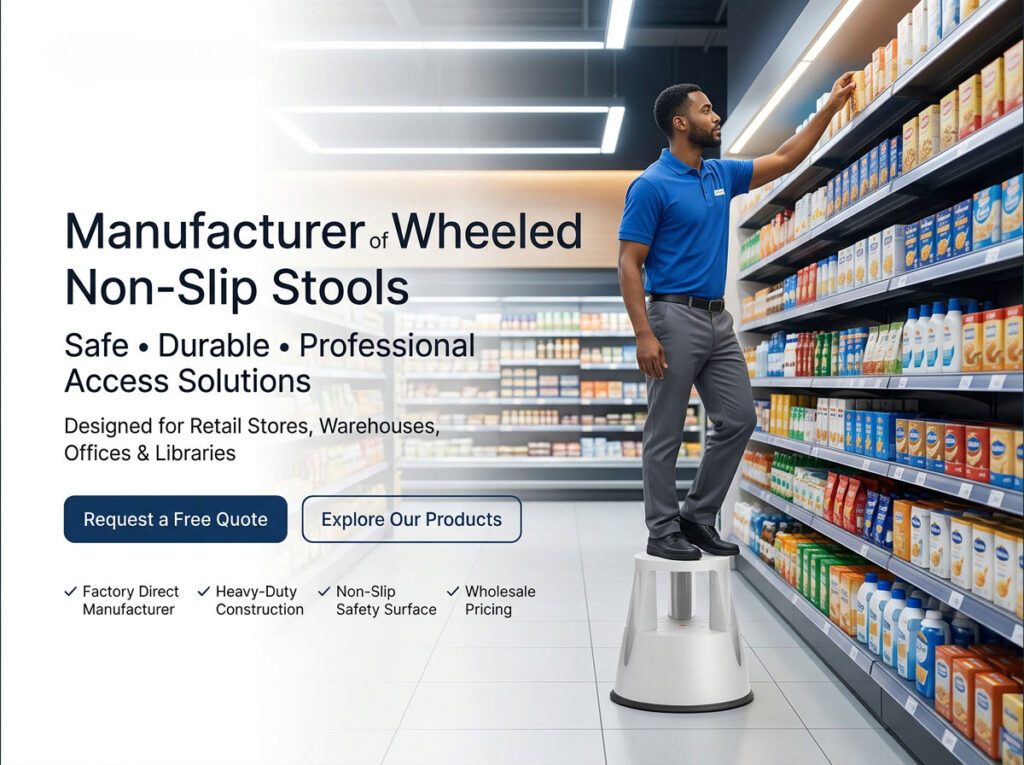


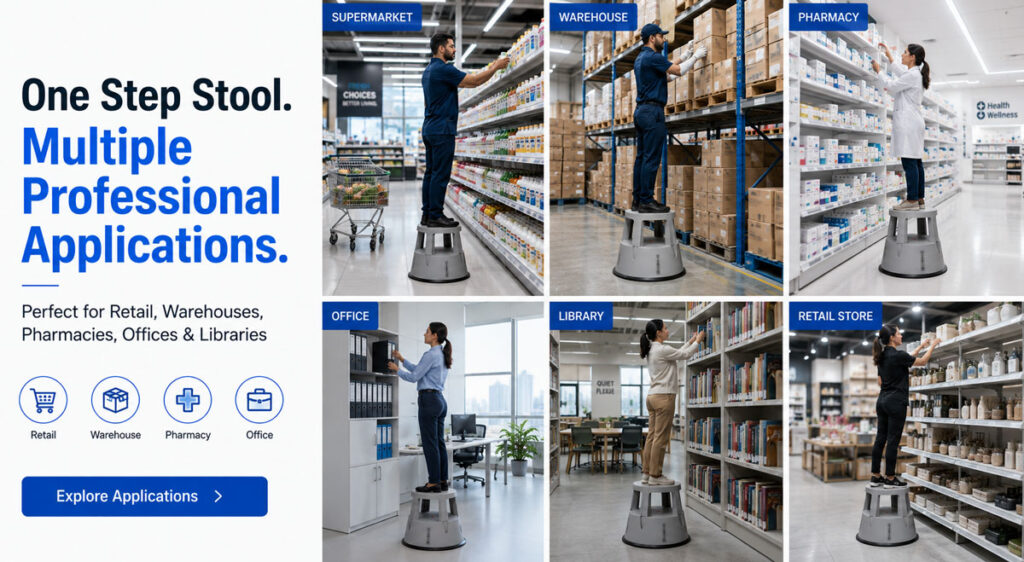


This page is written for purchasing managers, warehouse supervisors, and operations directors who evaluate equipment by uptime, injury risk, and total cost of ownership. It focuses on real performance under Lebanese conditions rather than generic product claims. Firmalazım supplies these tools as a Manufacturer supporting Commercial Use, Warehouse Retail, and supermarket backroom operations through Wholesale channels, Distributor networks, Bulk Orders, and OEM programs.
Why Standard Stools Fail in Warehouse Settings
Warehouse floors in Lebanon experience heavier traffic, occasional debris, temperature variation, and more aggressive cleaning than pure sales-floor environments. Staff frequently move between ground-level picking and elevated locations while carrying or positioning product. A light consumer-grade stool that rolls easily on a supermarket tile often becomes unstable, noisy, or quick to wear under these loads.
Heavy-duty mobile designs change the equation. Higher capacity frames (commonly 150 kg and above), wider bases, industrial casters, and platforms engineered for repeated impact deliver the stability required for commercial use. When the unit locks automatically under weight and maintains grip on imperfect surfaces, both speed and Safety improve.
Operators managing facilities that serve stores in Beirut and Tripoli face the same core requirements as those supporting Sidon and Zahle distribution points: reliable elevation without constant repositioning effort or tip risk.
Core Performance Requirements for Lebanese Warehouse Conditions
Not every mobile step stool qualifies as heavy-duty. The practical filters used by experienced buyers include:
| Requirement | Minimum Practical Standard | Why It Matters Locally |
|---|---|---|
| Load rating | 150 kg continuous, preferably higher | Covers staff + occasional case or tool weight |
| Platform surface | Aggressive non-slip, impact-resistant | Debris, moisture, and cleaning chemicals |
| Locking system | Automatic under body weight | Prevents movement during elevated work |
| Caster quality | Industrial, non-marking, sealed | Mixed floor conditions and frequent movement |
| Frame construction | Reinforced steel or high-grade composite | Daily impact and long service life |
| Base geometry | Wide stance relative to height | Tip resistance when reaching off-center |
| Serviceability | Replaceable casters and pads | Minimizes downtime |
These criteria separate tools that survive years of warehouse retail and supermarket backroom duty from those that degrade within months.
Material and Construction Choices That Survive Real Use
Steel-frame models with powder-coated or treated finishes handle the highest loads and impact. High-density polymer platforms or hybrid designs reduce weight while resisting corrosion in humid coastal conditions. The non-slip surface must retain texture after repeated exposure to cleaning agents common in food-related warehouses.
Firmalazım, operating as a Manufacturer focused on industrial access equipment, engineers units specifically for these demands. OEM options allow adjustments in height, platform size, color coding for zone identification, or private labeling—valuable when a single network standardizes equipment across multiple sites.
Operational Scenarios Across Lebanese Locations
In a distribution center feeding Jounieh and Baalbek stores, staff move rapidly between receiving, put-away, and order assembly. A heavy-duty mobile stool that rolls freely yet locks securely cuts the time spent searching for or dragging fixed access equipment.
The same advantage appears in Byblos and Aley facilities where space is constrained and every piece of equipment must earn its footprint. In Nabatieh, Batroun, and Tyre the combination of higher ambient temperatures and intensive daily cycles tests both material durability and caster performance. Units that continue to roll smoothly and lock positively after months of service become trusted tools rather than sources of complaint.
Facilities linked to Zgharta, Jal El Dib, and Hazmieh operations often combine warehouse and supermarket backroom functions. Here the ability of one robust design to serve both environments simplifies training and spare-parts management. Parallel needs exist in Sin El Fil, Dbayeh, Broummana, Kaslik, Choueifat, Baabda, Antelias, Bikfaya, Jezzine, and Bint Jbeil.
Total Cost of Ownership: Looking Past the Unit Price
The purchase price of a heavy-duty mobile step stool is only the entry point. The full calculation includes:
- Expected service life under daily commercial use
- Frequency and cost of caster or platform replacement
- Labor time recovered through faster, safer access
- Reduction in product damage from unstable reaching
- Impact on Safety metrics and potential insurance or lost-time costs
When these factors are modeled over three to five years, properly specified units consistently outperform cheaper alternatives that require earlier replacement or generate work-arounds. Bulk Orders placed with a Manufacturer or through Wholesale channels further improve the capital side of the equation, while a responsive Distributor network protects uptime.
Common Specification and Deployment Mistakes
Experienced warehouse teams repeatedly encounter the same errors:
- Selecting units with inadequate load ratings for actual mixed use
- Accepting platforms that lose grip when damp or dusty
- Ignoring caster quality until units become difficult to move
- Buying a single height when racking levels vary
- Failing to assign clear ownership for inspection and repair
- Treating the equipment as disposable rather than managed assets
A short pilot in one active zone quickly surfaces these issues before a network-wide commitment is made.
Implementation Sequence That Protects Uptime
- Map primary elevated tasks and measure typical reach heights.
- Define the minimum specification using the table above.
- Trial two or three candidate units under real load and floor conditions.
- Finalize the standard and negotiate Bulk Orders or OEM details.
- Phase delivery to avoid storage congestion.
- Train supervisors first, then cascade short practical sessions to users.
- Embed simple daily checks and quarterly audits into existing routines.
- Stock critical spares from day one.
This sequence works whether the warehouse supports a single large site or a network feeding stores across Lebanon.
Safety Integration That Fits Existing Programs
Heavy-duty mobile step stools support Safety objectives when they are specified for the real environment and backed by basic discipline. Automatic locking, high-visibility load labels, and non-slip surfaces that remain effective under local conditions reduce both acute fall risk and cumulative strain.
Supervisors who treat correct use as a non-negotiable standard—and who remove defective units immediately—protect both people and productivity. The approach is identical in urban facilities serving Beirut and in regional centers supporting Tripoli, Sidon, Zahle, and beyond.
Procurement Routes That Match Different Needs
- Direct Manufacturer engagement suits operators seeking tight specification control, OEM customization, and volume pricing on Bulk Orders.
- Wholesale channels deliver speed and competitive cost for standard heavy-duty models.
- Local Distributors add value through faster delivery, customs familiarity, and on-the-ground support.
Many successful programs combine routes: a core Bulk Order with the Manufacturer or Wholesale partner, supported by a Distributor for ongoing replenishment and spares.
Five Distinct Calls to Action
- Operations-focused: Share your primary racking heights and daily elevated tasks for a tailored specification recommendation.
- Procurement-focused: Request current Wholesale pricing and lead times for heavy-duty models in the quantities you need.
- Customization-focused: Explore OEM options including zone color coding and private labeling for network standardization.
- Risk-focused: Discuss how upgraded mobile access equipment can support your current Safety and uptime targets.
- Network-focused: Plan a phased Bulk Order and delivery schedule that matches your warehouse and store priorities.
Frequently Asked Questions
What load rating is realistic for mixed warehouse and supermarket backroom use? A continuous rating of 200 kg or higher covers most staff plus occasional additional weight. Higher ratings provide useful margin.
How do automatic locking systems perform on imperfect warehouse floors? Quality systems engage reliably when weight is applied, provided the unit is placed on a reasonably level surface. Extreme irregularities still require care.
Are industrial casters necessary or will lighter wheels suffice? Industrial, sealed, non-marking casters maintain mobility and reduce maintenance under real warehouse conditions. Lighter wheels often degrade faster.
Can the same units serve both warehouse racking and supermarket sales-floor needs? Yes, when the specification prioritizes durability and the height mix matches both environments. Many operators standardize on one robust family.
How important is platform texture in dusty or occasionally wet conditions? Critical. Texture that retains grip after exposure to dust, moisture, and cleaning agents prevents the gradual loss of confidence that leads to unsafe work-arounds.
What is a realistic service life under daily commercial use? Properly specified heavy-duty units commonly deliver four to six years or more when basic inspection and caster replacement are performed.
Do these stools require special training? Short, practical instruction on positioning, lock verification, and centered stance is sufficient. The emphasis is on habit, not lengthy theory.
How should spare parts be managed? Stock common wear items (casters, non-slip pads) from the beginning. A responsive Manufacturer or Distributor relationship keeps downtime low.
Is OEM customization worth considering? For networks seeking visual consistency, zone identification, or private labeling, OEM options delivered through Bulk Orders are often cost-effective.
What floor types are suitable? Quality units perform on typical warehouse concrete, coated floors, and the tiled or mixed surfaces found in supermarket backrooms. Extremely uneven surfaces still demand caution.
How do heavy-duty mobile stools compare with rolling ladders? They are faster to deploy and less obstructive in narrower aisles, while still providing secure elevated access for the majority of warehouse and backroom tasks.
Can units be color-coded by zone or function? Yes. OEM programs make this straightforward and improve equipment discipline.
What maintenance is actually required? Periodic cleaning of platforms and casters, visual inspection of locks and frames, and timely replacement of wear parts. The burden is low when ownership is clear.
How does local climate affect material choice? Humidity and cleaning regimes favor corrosion-resistant finishes and non-absorbent platforms. Specifying these from the start extends service life.
Are these tools relevant for smaller independent operations as well as large networks? Yes. The productivity and Safety benefits scale. Smaller sites often see faster relative gains because equipment is shared less and used more intensively.
What documentation should accompany a commercial shipment? Standard commercial documents plus any material or load-rating information relevant to the specification.
How quickly can replacement units or parts be obtained? This depends on the chosen channel. Manufacturer direct, Wholesale, and local Distributor routes each offer different speed-versus-cost balances.
Should every elevated task use a mobile step stool? No. Tasks requiring significant height or prolonged work at elevation may still need ladders or platforms. The mobile stool covers the high-frequency middle range most efficiently.
What is the best first step for a purchasing manager? Document the most common elevated tasks, measure the required reach, and trial units that meet a clear minimum specification under real conditions.
Does Firmalazım support both standard heavy-duty models and customized requirements? As a Manufacturer, Firmalazım provides standard commercial units, volume pricing through Wholesale and Bulk Orders, Distributor partnerships, and OEM flexibility for operators who need tailored solutions.
Heavy-duty mobile step stools are unglamorous tools. Yet when specified for genuine warehouse and supermarket backroom conditions, supported by simple ownership and maintenance discipline, and sourced through efficient Manufacturer, Wholesale, or Distributor channels, they deliver measurable improvements in speed, Safety, and cost control across Lebanese operations. The most effective programs begin with a clear-eyed view of current friction points and a willingness to treat access equipment as managed infrastructure rather than disposable aids.
Heavy-Duty Mobile Step Stools for Warehouses in Lebanon
Deep Operational Forensics: Why Heavy-Duty Mobile Step Stools Succeed or Fail in Lebanese Warehouses
The difference between equipment that remains in daily service for years and equipment that quietly falls out of use is rarely the brochure specification. It is the accumulation of small frictions, unowned defects, and eroded trust. This section examines the operational realities that determine long-term performance of heavy-duty mobile step stools in warehouse and supermarket backroom environments across Lebanon.
The Psychology of Trust and the Speed of Abandonment
Warehouse staff make rapid, subconscious judgments about tools. If a mobile step stool locks inconsistently, rolls with resistance, or feels unstable under load even once, confidence drops. The next time the same worker faces an elevated task, the probability of stretching from the floor or improvising with an unstable alternative rises sharply.
This behavioral pattern appears in high-velocity facilities serving Beirut just as it does in regional hubs supporting Tripoli and Sidon. Once trust is damaged, restoring it requires more than a new unit; it requires visible, consistent reliability over weeks. Specifying robust automatic locking systems, high-quality industrial casters, and platforms that maintain grip under real conditions is therefore not a comfort feature—it is the foundation of sustained commercial use.
Failure Forensics: The Most Common Degradation Paths
Heavy-duty mobile step stools fail in predictable ways when placed under continuous warehouse demand. Understanding these paths allows preventive action rather than reactive replacement.
Caster degradation The most frequent issue. Dust, cleaning residue, and occasional impact cause bearings to stiffen or wheels to develop flat spots. When movement requires extra force, staff stop retrieving the unit. Sealed industrial casters and a simple monthly cleaning routine dramatically slow this process.
Platform texture polishing Aggressive non-slip surfaces gradually lose bite under repeated foot traffic and wet cleaning. Once grip feels marginal, users become cautious or avoid the tool. Selecting compounds engineered for industrial rather than light commercial duty extends the usable life of the surface.
Lock mechanism wear Systems that require precise alignment or that are forced while still rolling develop play. Training that emphasizes “place, settle, then step” plus periodic functional testing keeps the lock positive.
Frame and joint fatigue Less common on quality units but visible on under-specified frames subjected to off-center loading or impact. Wide-stance geometry and reinforced construction are the primary defenses.
These degradation modes are observed in facilities linked to Zahle, Jounieh, and Baalbek as well as those supporting Byblos, Aley, and Nabatieh. The environments differ, yet the mechanical stresses share common patterns.
Building a Lightweight Predictive Maintenance Culture
Elaborate computer systems are unnecessary. A practical approach that works in lean Lebanese warehouse teams includes:
- A ten-second visual and functional check at the start of each shift by the first user
- A simple tag or digital note when a unit is removed for attention
- Weekly review by the supervisor of any tagged units
- Monthly caster cleaning and lubrication as needed
- Quarterly formal inspection covering lock function, platform condition, frame integrity, and load-label clarity
When this rhythm is embedded into existing Safety or facilities routines rather than added as new bureaucracy, compliance remains high. Stores and warehouses operating in Batroun, Tyre, and Zgharta that adopted similar light systems reported fewer units sitting idle because of unresolved minor defects.
High-Velocity and Cross-Dock Environments
Some Lebanese facilities function closer to cross-dock or high-velocity distribution than classic storage warehouses. Product dwell time is short, order cycles are tight, and elevated access occurs in short, frequent bursts rather than prolonged work at height.
In these settings the mobility and rapid lock-unlock cycle of a heavy-duty mobile step stool become especially valuable. The unit must roll freely into position, lock instantly under weight, and release cleanly when the task ends. Any hesitation in the mechanism multiplies across dozens of daily uses. Facilities feeding Jal El Dib, Hazmieh, and Sin El Fil supermarket networks often operate in this high-frequency mode, as do those supporting Dbayeh, Broummana, and Kaslik.
Standardization Economics Across Multi-Site Networks
When a group operates warehouses or backrooms serving multiple retail locations, the cost of non-standard equipment compounds. Different models require different spare parts, different training points, and different inspection criteria. Staff transferred between sites need re-orientation.
Standardizing on one or two carefully chosen heavy-duty mobile step stool models produces savings that extend far beyond the initial Bulk Order discount. Spare-parts inventory shrinks, training becomes portable, and the Manufacturer or Distributor relationship deepens, often unlocking better technical support and priority allocation.
Networks that have standardized equipment across sites linked to Choueifat, Baabda, Antelias, Bikfaya, Jezzine, and Bint Jbeil report simpler management and higher average utilization rates than those running mixed fleets of varying quality.
Zone and Task Differentiation Without Complexity
Not every elevated task is identical. A practical differentiation that avoids over-engineering includes:
- Lower-height, highly mobile units for frequent case-level work
- Higher-capacity or multi-step units for less frequent but heavier or taller access
- Color or label coding so the correct tool is obvious at a glance
OEM capability from a Manufacturer such as Firmalazım makes modest visual differentiation straightforward when ordered in volume. The result is better tool discipline without requiring staff to memorize complex rules.
The Role of Supervision in Sustained Performance
Equipment does not enforce its own correct use. Supervisors who treat proper deployment of heavy-duty mobile step stools as a visible standard—and who remove defective units from service immediately—protect both Safety outcomes and the return on the original investment.
Conversely, when defective units remain on the floor “until we get around to it,” the entire fleet’s credibility suffers. The cultural signal is more powerful than any written procedure. This dynamic is consistent whether the warehouse supports dense urban supermarket operations in Beirut or regional distribution for Tripoli, Sidon, and beyond.
Integrating Access Equipment into Broader Warehouse KPIs
The most durable programs link the tools to metrics the business already values:
- Order-picking or put-away productivity
- On-time completion of elevated tasks
- Near-miss and incident rates associated with working at height
- Equipment uptime percentage
- Labor hours spent on non-value-added movement or searching for access tools
When supervisors can see a connection between reliable mobile step stools and these numbers, attention remains high long after the novelty of new equipment has faded.
End-of-Life and Replacement Philosophy
Even well-maintained units eventually reach the end of economical service. A clear replacement philosophy prevents both premature disposal and unsafe prolonged use. Criteria typically include:
- Structural deformation or cracking
- Lock mechanism that can no longer be restored to positive engagement
- Platform surface that cannot maintain adequate grip
- Caster system requiring uneconomical repeated repair
Having these criteria agreed in advance turns replacement into a routine operational decision rather than a debated capital request. Planning Bulk Orders or staged replacements with the Manufacturer, Wholesale partner, or Distributor keeps the fleet current without crisis purchasing.
Practical Observations from Mixed Supermarket-Warehouse Operations
Many Lebanese facilities blur the line between pure warehouse and supermarket backroom. The same heavy-duty mobile step stools often serve both racking access and occasional sales-floor support during peak periods. In these hybrid environments the ability of one robust design family to perform acceptably across both settings simplifies everything from training to spare parts.
Operators who recognized this hybrid reality early and specified accordingly avoided the cost and complexity of maintaining separate equipment fleets. The pattern is visible in operations connected to Beirut, Tripoli, Sidon, Zahle, Jounieh, Baalbek, Byblos, Aley, Nabatieh, Batroun, Tyre, Zgharta, Jal El Dib, Hazmieh, Sin El Fil, Dbayeh, Broummana, Kaslik, Choueifat, Baabda, Antelias, Bikfaya, Jezzine, and Bint Jbeil.
Closing the Loop: From Purchase to Enduring Asset
Heavy-duty mobile step stools deliver their full value only when the organization treats them as managed infrastructure. That requires:
- Specification matched to real loads, floors, and frequencies
- Clear ownership of inspection and minor maintenance
- Supervisory standards that keep defective units out of service
- Linkage to existing productivity and Safety metrics
- A planned approach to spares and eventual replacement
- Standardization where multi-site operations exist
None of these elements is expensive. Collectively they determine whether the equipment remains a daily contributor to efficient, safer warehouse and supermarket backroom work or slowly drifts into neglected status.
Firmalazım supports Lebanese operators seeking Manufacturer-level durability, practical pathways for Bulk Orders, OEM flexibility for standardization or zone identification, and reliable supply through Wholesale and Distributor channels. The most productive conversations start with current elevated-task friction points and the simple systems needed to keep new tools trustworthy for years rather than months.
The warehouses and hybrid facilities that master these fundamentals quietly outperform those that focus only on the initial purchase decision. The tools are the same; the operating discipline makes the difference.
Logistics, Negotiation, and System Integration: Turning Heavy-Duty Mobile Step Stools into Reliable Infrastructure
Purchasing a capable heavy-duty mobile step stool is only the visible part of the decision. The invisible work—navigating import realities, structuring supplier agreements, embedding the tools into daily warehouse systems, and preparing for seasonal swings—determines whether the investment compounds or slowly erodes. This section examines those downstream realities from the perspective of a purchasing and operations team responsible for warehouse and supermarket backroom performance in Lebanon.
Import and Supply-Chain Realities Specific to Lebanon
Heavy-duty mobile step stools fall into the category of commercial industrial equipment. Import pathways are generally straightforward compared with regulated categories, yet several practical considerations still shape cost and lead time.
Clear product descriptions, accurate HS classification, and complete commercial documentation reduce clearance friction at the Port of Beirut or airport cargo facilities. Units shipped fully assembled or in minimal-assembly form lower the risk of damage and speed deployment once they clear customs. Packaging that protects casters and locking mechanisms during regional road transport is equally important for deliveries moving inland.
Operators who work with an experienced Manufacturer or established Distributor typically encounter fewer surprises. Those placing Bulk Orders can often negotiate consolidated shipments that improve freight efficiency. Facilities supporting supermarket networks in Beirut and distribution points linked to Tripoli benefit from the denser logistics infrastructure, while sites serving Sidon, Zahle, and Jounieh require realistic buffer times for inland movement.
Structuring Supplier Relationships for Long-Term Performance
Transactional purchasing produces average results. Relationships structured around volume visibility, technical feedback, and multi-year intent tend to deliver better allocation priority, faster response on spare parts, and greater flexibility on OEM adjustments.
Useful elements in a working agreement include:
- Forecast sharing for anticipated Bulk Orders over a twelve-month horizon
- Clear definition of what constitutes an acceptable quality deviation
- Agreed response times for technical queries and replacement parts
- Options for staged deliveries that match warehouse capacity and seasonal peaks
- Provisions for modest customization (color, labeling, height mix) when volumes justify OEM setup
A Manufacturer focused on commercial access equipment can usually accommodate these points. Wholesale channels excel at speed and competitive unit cost for standard models. Local Distributors add value through proximity, faster last-mile delivery, and familiarity with domestic transport conditions. Many effective programs blend the three routes according to the specific need.
Embedding the Tools into Warehouse SOPs and Daily Rhythm
Equipment that remains outside standard operating procedures eventually becomes optional in the eyes of users. Integration that works in practice is light and visual rather than heavily documented.
Effective tactics include:
- Designated storage or staging points at logical intervals along main picking and put-away routes
- Simple pictorial reminders of correct lock verification and stance near those points
- Inclusion of the mobile step stools in existing start-of-shift equipment checks
- Clear rule that any unit failing the check is tagged and removed immediately
- Supervisor floor-walk habit of noting both correct use and any units out of service
When these elements sit inside routines already followed for Safety or house-keeping, adoption remains high without creating new administrative load. The approach scales from compact backrooms supporting Baalbek and Byblos stores to larger facilities feeding Aley, Nabatieh, and Batroun networks.
Seasonal and Demand-Fluctuation Planning
Lebanese retail and distribution activity is not uniform across the year. Ramadan, holiday periods, back-to-school, and summer tourism create distinct peaks in volume and therefore in elevated access demand. Warehouses that support supermarket chains feel these swings directly.
Planning implications include:
- Ensuring sufficient units are available before known peak windows rather than reacting during them
- Using quieter periods for deep cleaning, caster servicing, and any necessary replacements
- Holding a modest buffer stock of critical wear parts so that a sudden increase in usage does not create downtime
- Reviewing height mix if seasonal product profiles change the dominant reach requirements
Operators who align Bulk Orders and Distributor replenishment with these calendar realities maintain higher equipment availability precisely when it is most needed. The same logic applies to facilities linked to Tyre, Zgharta, and Jal El Dib as well as those serving Hazmieh, Sin El Fil, and Dbayeh.
Comparative Analysis: Mobile Step Stools Versus Alternative Access Methods
No single solution covers every elevated task. A clear-eyed comparison helps purchasing teams allocate capital correctly.
| Access Method | Strengths | Limitations in Warehouse Settings | Best Fit |
|---|---|---|---|
| Heavy-duty mobile step stool | Fast deployment, automatic lock, low obstruction, good for frequent short tasks | Limited maximum height | High-frequency mid-height work |
| Rolling warehouse ladder | Greater height, often higher load rating | Larger footprint, slower to move, more obstructive | Less frequent high reaches |
| Fixed platform or mezzanine | Permanent stability, high capacity | Zero mobility, high capital, space consumption | Permanent high-volume zones |
| Manual step stool (non-mobile) | Low cost, simple | Slow repositioning, higher handling strain | Very low-frequency or static use |
| Order-picker truck / powered | Height + load capacity + travel | High capital, training, aisle-width requirements | Large-scale, high-throughput sites |
Heavy-duty mobile step stools occupy the high-frequency middle ground that dominates most supermarket-related warehouse and backroom work. They complement rather than replace the other methods. Facilities that map task frequency against height and then equip accordingly avoid both under- and over-investment.
Space-Constrained Aisle Realities
Many Lebanese warehouses and supermarket backrooms operate with narrower aisle widths than large modern distribution centers. In these environments the compact footprint and rapid maneuverability of a well-designed mobile step stool become decisive advantages. Units that require wide turning radii or that leave residual obstruction after use create secondary inefficiencies.
Specification attention to overall width, caster arrangement, and ease of one-handed positioning pays measurable dividends in constrained layouts common in older buildings and urban sites serving Broummana, Kaslik, Choueifat, and Baabda.
Staff Feedback Loops That Actually Improve the Fleet
Formal suggestion schemes often atrophy. A lighter, more effective loop includes:
- Short structured questions during the first thirty days after introduction
- Ongoing open invitation for users to tag units with specific complaints (stiff caster, weak lock feel, etc.)
- Monthly five-minute review by the supervisor of any recurring comments
- Visible action—repair, adjustment, or replacement—so staff see that feedback produces results
When users observe that their experience influences maintenance priority, reporting remains honest and timely. This cultural element is as important as the mechanical specification in sustaining long-term commercial use.
Risk Register Specific to Elevated Access Equipment
A concise risk register focused on mobile step stools helps keep attention proportional. Typical entries include:
- Loss of non-slip performance → mitigation: specified texture + periodic inspection
- Caster failure leading to abandonment → mitigation: sealed industrial wheels + spare stock
- Inconsistent locking → mitigation: training + functional test cadence
- Off-center loading damage → mitigation: wide-stance geometry + user guidance
- Spare-parts delay → mitigation: local Distributor relationship or Manufacturer buffer
Reviewing the register quarterly alongside Safety metrics keeps the topic alive without consuming excessive management time. The discipline is equally relevant for operations connected to Antelias, Bikfaya, Jezzine, and Bint Jbeil.
Negotiation Levers That Matter More Than Unit Price Alone
Experienced purchasing managers look beyond the headline price. Meaningful levers include:
- Payment terms aligned with delivery and acceptance
- Inclusion of a starter spare-parts kit in the initial Bulk Order
- Commitment to hold critical spares for an agreed period
- Flexibility on delivery phasing without heavy penalties
- Technical support responsiveness metrics
- Options for future OEM adjustments at pre-agreed conditions
A Manufacturer or Wholesale partner that engages constructively on these points often delivers lower total cost of ownership than the lowest initial bidder who cannot support the fleet after arrival.
Measuring Success Beyond the First Ninety Days
Early enthusiasm is common. Durable value appears in the data collected at six and twelve months:
- Percentage of elevated tasks performed with the proper unit
- Average time to return a tagged unit to service
- User confidence scores (simple periodic pulse checks)
- Trend in height-related near misses
- Spare-parts consumption versus plan
When these indicators remain favorable, the original investment thesis is validated. When they weaken, the data points to specific corrective actions—additional training, caster upgrades, or height-mix adjustment—rather than vague dissatisfaction.
Closing Perspective: Infrastructure, Not Equipment
Heavy-duty mobile step stools become true infrastructure when the organization surrounds them with clear ownership, light but consistent maintenance discipline, integration into existing SOPs, and a supplier relationship built for continuity rather than one-off transactions.
The mechanical product is necessary but not sufficient. The operating system around it determines whether the tools remain trusted assets supporting Safety and productivity in warehouse and supermarket backroom settings, or gradually drift into under-use.
Firmalazım continues to work with Lebanese operators who want Manufacturer-grade construction, practical Bulk Orders, OEM options for standardization, and dependable supply routes through Wholesale and Distributor channels. The most useful starting point remains a clear description of current elevated-task friction, floor conditions, and the simple management habits the team is prepared to sustain.
Warehouses and hybrid facilities that master both the product specification and the surrounding operating discipline extract years of reliable service. Those that focus only on the purchase decision often find themselves re-addressing the same problems within a short cycle. The difference is organizational, not merely technical.
Human Factors, Change Discipline, and Operational Resilience: The Layer That Determines Real Returns
Technical specification and supplier selection establish the foundation. What ultimately decides whether heavy-duty mobile step stools deliver sustained value is the interaction between the equipment, the people who use it, and the management systems that surround it. This section examines that human and organizational layer in depth, focusing on practical methods that work inside Lebanese warehouse and supermarket backroom environments.
Human Factors: Designing for Real Behavior Under Time Pressure
Warehouse work is characterized by time pressure, physical fatigue, and frequent task switching. Under these conditions people default to the path of least immediate resistance. If retrieving and positioning a mobile step stool feels even slightly slower or less certain than stretching or improvising, the safer method loses.
Effective design therefore prioritizes instantaneous usability:
- One-handed rolling and positioning
- Immediate, positive lock engagement that the user can feel and hear
- Platform size and texture that inspire confidence at the first step
- Release that requires no awkward manipulation
When these elements are present, the correct method becomes the easy method. Facilities that have observed this principle in action—whether supporting dense operations in Beirut or regional flows through Tripoli and Sidon—report higher spontaneous adoption and fewer work-arounds.
Change Management That Survives Contact with Daily Reality
Introducing new access equipment is a change project, even when the tools appear simple. Resistance rarely appears as open objection; it appears as quiet non-use.
A change approach that has proven durable includes four parallel tracks:
- Visible sponsorship – Supervisors and team leads use the units themselves and comment positively in real time.
- Immediate usability – Units are placed in high-traffic zones from day one so that the first experience is convenient.
- Rapid response to friction – Any complaint about rolling resistance, lock feel, or stability is investigated within 48 hours.
- Social proof – Early positive comments from respected operators are amplified informally.
This combination works across different scales—from compact backrooms linked to Zahle and Jounieh stores to larger facilities feeding Baalbek, Byblos, and Aley networks. The common success factor is speed of response to early friction points.
Post-Implementation Auditing: Measuring What Actually Happens
Assumed usage and actual usage frequently diverge. A light auditing rhythm reveals the gap before it becomes entrenched.
Practical audit elements:
- Random observation of elevated tasks during peak windows (does the correct unit get used?)
- Simple count of units actively in circulation versus tagged out of service
- Short pulse questions to users every 30–45 days during the first six months
- Tracking of near-miss reports that mention height or reaching
- Comparison of task completion times before and after introduction on a sample of high-frequency activities
The goal is not punitive oversight. It is early detection of emerging problems—stiff casters, polished platforms, unclear ownership—so they can be corrected while the equipment is still new enough for the correction to restore confidence. Operations connected to Nabatieh, Batroun, and Tyre that instituted such light audits maintained higher utilization rates than those that relied solely on initial training.
Resilience Under Variable Supply and Operating Conditions
Lebanese supply chains periodically experience disruption. Fuel availability, road conditions, and import timing can all affect the ability to obtain replacement parts or additional units quickly. Equipment strategies that ignore this reality create hidden vulnerability.
Resilience tactics include:
- Holding a calculated buffer of critical wear items (casters, non-slip pads, lock components) at the primary warehouse or with a local Distributor
- Preferring designs whose common parts remain available through more than one channel
- Standardizing on a limited number of models so that the spare-parts inventory stays manageable
- Building modest redundancy into the fleet size so that temporary removal of units for service does not create immediate shortages
These measures are especially relevant for sites supporting continuous supermarket replenishment cycles in Zgharta, Jal El Dib, Hazmieh, and Sin El Fil, where even short equipment shortages can cascade into on-shelf availability issues.
Linking Access Equipment to Broader Workforce Productivity
Heavy-duty mobile step stools influence productivity through several channels:
- Reduced time spent searching for or improvising access
- Lower physical fatigue from repeated stretching or unstable positioning
- Fewer micro-interruptions caused by hesitation or re-positioning
- Decreased risk of minor injuries that remove experienced workers from the floor
When these effects are acknowledged and measured, the equipment moves from the category of “facilities expense” to “productivity enabler.” Supervisors who can point to concrete improvements in task cycle time or reduced discomfort reports find it easier to maintain attention on correct use and timely maintenance.
The linkage is observable in both high-intensity urban facilities serving Dbayeh and Broummana and in more distributed operations supporting Kaslik, Choueifat, and Baabda.
Scenario-Based Protocol Design
Generic instructions lose force. Short, scenario-specific protocols stay relevant.
Scenario 1: High-frequency case picking at mid-height Unit is staged within a few bays. Operator rolls, locks by stepping, works with both hands, descends, releases, and moves. Emphasis on rhythm and minimal handling time.
Scenario 2: Occasional heavier or higher access Higher-capacity or multi-step unit is retrieved from a central point. Extra attention to base stability and centered stance. Second person may assist with load positioning if required.
Scenario 3: Wet or debris-prone zones Visual check of platform and casters before ascending. Wipe if necessary. Slightly slower, more deliberate lock verification.
Scenario 4: End-of-shift or low-activity periods Units returned to designated staging points, quick visual inspection, any defects tagged for the next maintenance window.
These protocols remain short enough to be reinforced in toolbox talks and visual reminders. They adapt naturally to the mixed warehouse and supermarket backroom conditions found across Antelias, Bikfaya, Jezzine, and Bint Jbeil.
Ownership Models That Prevent Diffusion of Responsibility
When everyone is responsible, no one is responsible. Clear, lightweight ownership prevents the slow accumulation of minor defects that eventually destroy fleet credibility.
A working model used successfully by several operators:
- Users: ten-second pre-use check; immediate tagging of problems
- Shift supervisor: daily review of tagged units; decision to remove or continue
- Facilities / Safety lead: weekly consolidation of issues; ordering of parts; quarterly deep inspection
- Procurement: relationship with Manufacturer, Wholesale, or Distributor; tracking of Bulk Order and spare-parts performance
Documenting these roles on a single page and reviewing them during existing meetings keeps the system alive without creating new committees.
Training Reinforcement Over Time
Initial training creates awareness. Reinforcement creates habit. Effective reinforcement is brief and spaced:
- Week 1–2: daily verbal reminder during shift start
- Week 3–6: every other day
- Month 2–3: twice weekly
- Thereafter: inclusion in periodic Safety shares and immediate coaching when incorrect use is observed
The content stays almost identical—position, lock, center, work, descend—so that the message remains sharp. New hires receive the same short practical module, keeping the standard consistent as teams turn over.
Economic Resilience Through Standardization
Every additional model in the fleet multiplies spare-parts complexity, training variants, and inspection criteria. In an environment where management attention is scarce, this multiplication is costly.
Standardizing on one primary heavy-duty mobile step stool family (with limited height variants) produces compounding advantages:
- Smaller, more predictable spare-parts inventory
- Portable training across sites
- Stronger negotiating position for Bulk Orders and OEM adjustments
- Faster diagnosis when problems appear
- Easier benchmarking of utilization and maintenance cost
Networks that have pursued deliberate standardization across sites linked to the full range of locations—Beirut, Tripoli, Sidon, Zahle, Jounieh, Baalbek, Byblos, Aley, Nabatieh, Batroun, Tyre, Zgharta, Jal El Dib, Hazmieh, Sin El Fil, Dbayeh, Broummana, Kaslik, Choueifat, Baabda, Antelias, Bikfaya, Jezzine, and Bint Jbeil—report simpler governance and higher average equipment availability.
Closing the Human Systems Loop
Heavy-duty mobile step stools are mechanical tools. Their performance in practice is governed by human perception of reliability, the speed with which friction is removed, the clarity of ownership, and the consistency of reinforcement.
Organizations that treat these human and managerial factors with the same seriousness as load ratings and caster quality extract years of productive, safer service. Those that focus exclusively on the initial purchase often find themselves re-buying or re-training within a short cycle.
Firmalazım supports operators who want Manufacturer-level durability, flexible pathways for Bulk Orders and OEM standardization, and dependable supply through Wholesale and Distributor channels. The highest-leverage conversations begin with current elevated-task realities and the management habits the team is prepared to sustain after the equipment arrives.
When both the product and the surrounding human systems are addressed, heavy-duty mobile step stools become quiet, reliable contributors to warehouse and supermarket backroom performance rather than another item that requires periodic justification. The difference is visible in daily rhythm, in Safety metrics, and in the absence of repeated complaints about access. That outcome is available to any operation willing to manage the tools as infrastructure rather than as disposable aids.

Bir yanıt yazın