


Wheeled Step Stools for Logistics Operations in Bahrain
Wheeled Step Stools for Logistics Operations in Bahrain designed for logistics operations give teams in Bahrain fast, stable access to elevated racking, bulk picking locations, and overhead storage without slowing the flow of goods. Built for continuous commercial use, these units feature spring-loaded wheels, industrial non-slip platforms, and 150 kg load capacity so operators can roll into position, settle automatically under weight, complete the task, and move on in seconds. Ideal for pure logistics sites and warehouse-retail facilities that support supermarket replenishment, they enable bulk orders, OEM customization, and wholesale supply. Firmalazım provides logistics-grade models engineered for the floor conditions, traffic patterns, and throughput demands found across Bahrain.




The Bottleneck That Rarely Appears on a KPI Dashboard
In logistics operations the largest delays are often the smallest ones. A picker who must stretch, climb racking, or wait for a shared ladder loses seconds that multiply across hundreds of lines per shift. When those seconds occur at the exact moment a supermarket replenishment wave is due, the effect ripples outward into late dispatches and incomplete store deliveries. Wheeled step stools remove that hidden bottleneck when they are specified for real logistics intensity rather than light commercial duty.
This analysis is written from the perspective of a logistics and procurement lead responsible for throughput and safety performance in Bahrain. The focus is on how the right wheeled step stool changes the rhythm of elevated work inside high-volume flows that ultimately serve supermarket networks.
Why Conventional Access Methods Create Drag
Fixed platforms serve only one location. Lightweight domestic stools flex and slide under repeated dynamic loads. Improvised solutions using pallets or crates introduce both safety exposure and product damage risk. In a logistics environment the equipment must travel with the work, settle securely the moment it is needed, and clear the aisle the moment the task ends.Commercial Step Stool Solutions for Facility Management in Bahrain
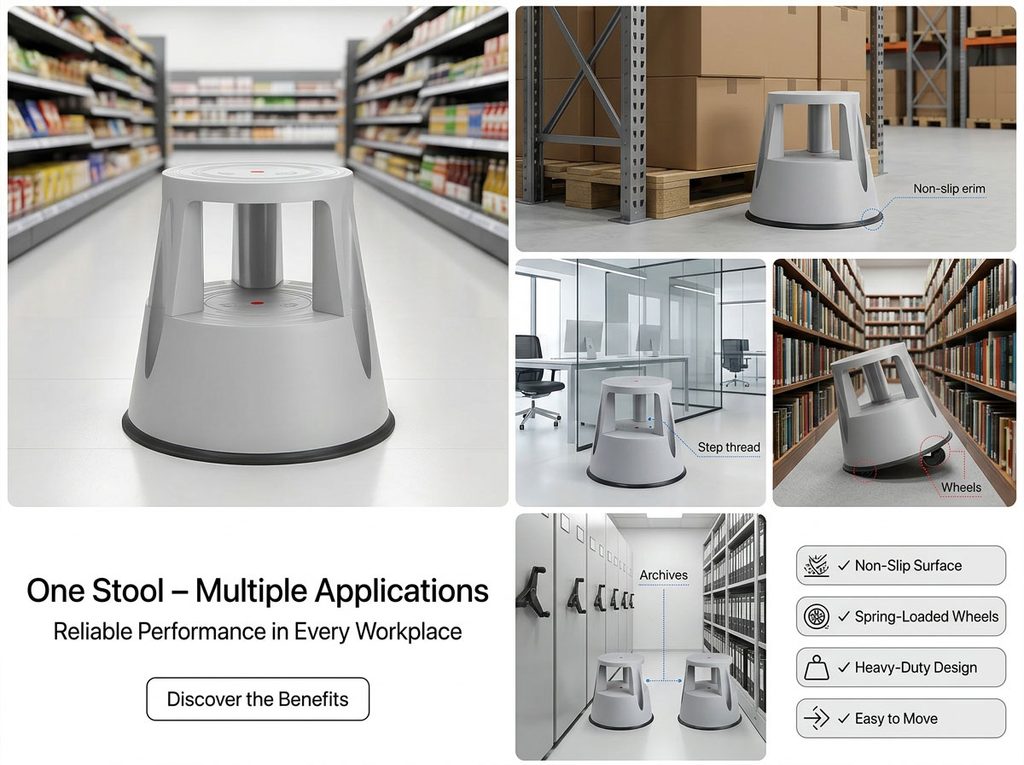
Spring-loaded wheeled designs meet the requirement directly. The wheels extend for free movement when the unit is empty. The moment an operator steps on, the springs compress, the base settles firmly onto the floor, and the stool becomes a rigid platform. When the operator steps off, mobility returns automatically. No separate locking lever is required, eliminating the most common source of incomplete securing under time pressure.
Core Specifications Matched to Logistics Reality
Current professional units in this category typically deliver:
- 150 kg load capacity
- Overall height of 410 mm
- Top platform diameter of 283 mm
- Base diameter of 433 mm for inherent stability
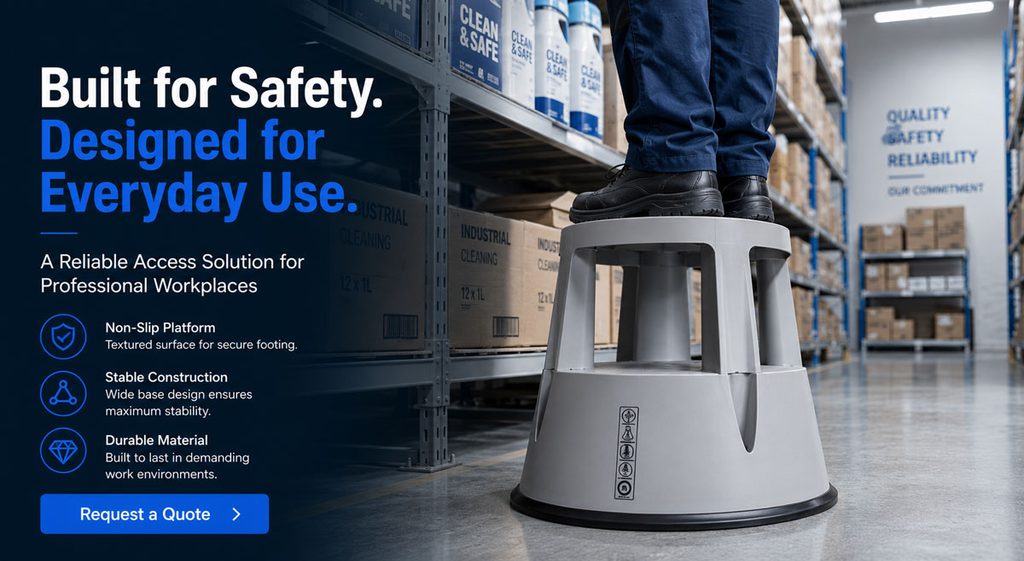
- Heavy-duty plastic construction with molded non-slip treads
- Spring-loaded wheels that require no manual locking action
- Color options that support zone or shift identification
These dimensions keep the center of gravity low while still providing useful reach for the majority of mid-level logistics tasks. The plastic body resists the dust, minor impacts, and cleaning regimes common in Bahraini logistics facilities and does not mark sealed or coated floors.
Local Operating Conditions That Shape the Specification
Logistics sites in Bahrain range from pure distribution centers to hybrid warehouse-retail facilities that feed supermarket networks. Floors vary from sealed concrete to epoxy coatings. Traffic includes pallet jacks, forklifts, and continuous foot movement in the same corridors. Temperature differentials between ambient and temperature-controlled zones can produce light surface moisture.
In Manama high-intensity hubs the speed of multi-shift picking favors equipment that deploys and clears in seconds. In Riffa facilities that balance bulk storage with outbound retail support the same units often move between pure logistics zones and the warehouse-retail interface. In Muharraq older sites with tighter dimensions reward a compact footprint and low overall height. The practical requirements continue through Hamad Town, Isa Town, Sitra, Jidhafs, Budaiya, A’ali, Tubli, Sanabis, Seef, Saar, Janabiya, Karbabad, Barbar, Diraz, Bani Jamra, Al Hidd, Arad, Galali, Diyar Al Muharraq, Amwaj Islands, Maqabah, Abu Saiba, Shakhura, Al Markh, Jasra, Hamala, and Zallaq.
Human-Factors Advantages Under Throughput Pressure
Because settling is automatic, operators under time pressure do not skip a locking step. Gloved hands work as easily as bare hands. The wide base and low height reduce the micro-hesitations that appear when a platform feels marginal. Over a full shift these small reductions in effort and uncertainty compound into higher completed lines and lower end-of-shift fatigue.
Placement Logic That Protects Flow
Designated storage points must sit close enough to high-bay and mid-level picking zones that retrieval is not a deterrent, yet outside the primary travel paths of pallet jacks and forklifts. End-of-aisle positions, the edges of staging areas, and the warehouse-retail transition points usually satisfy both needs. High-visibility colors or simple floor markings further reduce impact risk.
Comparative View: Wheeled Professional Stools versus Alternatives
| Access Method | Deployment Speed | Stability under Dynamic Load | Aisle Clearance Time | Suitability for Continuous Logistics Use |
|---|---|---|---|---|
| Fixed ladder / platform | Slow | High | Slow | Poor |
| Domestic step stool | Medium | Low–Medium | Medium | Poor |
| Improvised pallets / crates | Fast | Very Low | Medium | Unacceptable |
| Professional wheeled stool | Very Fast | High | Very Fast | Excellent |
The professional wheeled design wins on the combination of speed, stability, and rapid clearance—the three variables that matter most inside active logistics flows.
Procurement Framework for Logistics Operations
- Map the highest-frequency elevated tasks and the actual weights handled at height.
- Measure the narrowest working aisles and any floor transitions.
- Confirm that 150 kg capacity provides comfortable margin for operator plus typical logistics carton weights.
- Trial units on the actual floor finishes and traffic patterns of representative sites.
- Evaluate roll effort and automatic settling with both permanent and temporary staff.
- Decide whether color coding by zone or shift adds operational value.
- Structure bulk orders through a manufacturer or wholesale partner capable of consistent quality.
- Consider modest OEM adjustments only after the base design has proven itself under live conditions.
Cost Perspective Beyond Unit Price
The purchase price is visible. The cost of delayed lines, incomplete supermarket replenishment waves, and minor injuries is less visible yet real. A wheeled step stool that is used consistently reduces all three. When bulk orders are placed with a reliable manufacturer the per-unit economics improve while specification consistency across sites is protected. A distributor can supply faster trial quantities and individual replacements; the manufacturer route suits larger wholesale volume and any OEM work.
Safety Integration Inside Live Logistics Flows
The equipment must appear in the site’s height-access procedure with clear rules: position the stool, step on so that it settles fully, maintain three points of contact, complete the task, step off, and clear the unit from the travel path. Because the mechanism itself enforces the stable state, compliance rates remain high even under throughput pressure.
Maintenance Reality in Logistics Environments
Weekly visual checks of the non-slip surface, spring action, wheel condition, and structural integrity are sufficient. Units that develop uneven settling, smoothed treads, or visible damage are removed immediately. The mechanical simplicity of the spring-loaded design keeps maintenance demand low and supports high availability.
Real Operating Scenarios
During a supermarket replenishment wave the same stools move with the pickers from bulk racking to consolidation areas. In a hybrid warehouse-retail site they support both pure logistics picking and the final staging before transfer to retail. Temporary staff receive a short practical demonstration and can use the equipment correctly for the remainder of their shift.
Five Distinct Calls to Action
- Place a focused trial set in your highest-throughput zones and measure the change in elevated pick time and staff feedback within two weeks.
- Share your dominant aisle widths and elevated task profile for a concise model recommendation.
- Move from reactive replacement to planned bulk orders timed ahead of known volume peaks.
- Standardize on one professional wheeled design across the network to simplify training and spare holding.
- Request both standard wholesale pricing and OEM options so the long-term fleet can be optimized for your exact conditions.
Firmalazım supplies wheeled step stools engineered for the speed, stability, and flow demands of logistics operations in Bahrain. Whether the requirement is met through standard wholesale channels or through structured OEM programs, the focus remains on automatic settling, durable non-slip performance, low-effort mobility, and consistent behavior under daily commercial use.
When elevated work stops creating micro-delays inside the main flow, both throughput and safety improve together. That is the practical outcome of equipping logistics teams with the right wheeled step stools.
Frequently Asked Questions
What makes a wheeled step stool suitable for logistics rather than light commercial use? Higher load capacity (typically 150 kg), industrial non-slip surfaces, spring-loaded systems designed for repeated daily cycles, and construction that survives continuous traffic, dust, and cleaning regimes.
How do spring-loaded wheels improve safety under time pressure? They remove the need for a separate locking action. The unit becomes stable automatically when weight is applied, reducing the most common operator error in fast-paced environments.
Is 410 mm height sufficient for most logistics tasks in Bahrain? Yes for the majority of mid-level racking and overhead storage work found in distribution and warehouse-retail facilities. Very high bays may still require other equipment.
Can the same stools serve both pure logistics zones and warehouse-retail interfaces? Yes. The design performs on sealed concrete, epoxy, and typical transition surfaces, supporting consistent equipment standards across both areas.
How important is the non-slip surface when floors carry dust or light moisture? Critical. Molded industrial textures that retain grip under these conditions keep the platform trustworthy during continuous use.
What is the practical advantage of a 433 mm base diameter? It lowers the center of gravity and increases inherent stability when operators shift weight while handling cartons at height.
Are color options useful in logistics operations? Yes. Simple color coding by zone or shift helps staff locate the nearest unit quickly and supports clearer ownership of equipment condition.
How should bulk orders be planned for a multi-site logistics network? Complete on-site trials first, confirm the preferred specification, then place volume orders through a manufacturer or wholesale partner that can guarantee consistency across the batch.
Is OEM customization practical for logistics step stools? Yes for larger networks that want uniform color, molded identification, or minor dimensional alignment. It is best considered after the base model has proven itself in live operations.
What maintenance is realistically required? Weekly visual inspection of wheels, spring action, non-slip surface, and overall structure. Immediate removal of any unit that shows damage or inconsistent settling.
How do these stools affect overall flow during peak replenishment waves? When used correctly they appear only for the duration of the elevated task and are cleared quickly, minimizing obstruction compared with fixed ladders or improvised platforms.
Can temporary or agency staff use them safely with minimal training? Yes. The automatic settling action and simple operating sequence allow correct use after a very short practical demonstration.
What is the most common reason logistics teams abandon a step stool? Loss of confidence caused by perceived instability, difficult locking, or slippery surfaces. Professional designs that feel solid and settle automatically maintain higher utilization.
How does the product support overall site safety culture? By providing a convenient, reliable alternative to stretching, climbing racking, or stacking pallets. When the correct tool is trusted and easy to use, unsafe improvisation declines.
Should every site carry the same model? Standardization simplifies training and spare parts. Minor variations in color coding can still be introduced if zone identification adds value.
What role does a distributor play versus direct manufacturer supply? A distributor often provides faster trial units and individual replacements. Direct manufacturer supply suits larger wholesale volume and OEM programs that require tight specification control.
How long do professional plastic wheeled stools typically last under daily logistics use? With correct use and basic inspection, well-engineered units commonly deliver several years of service. Actual life depends on intensity, floor conditions, and adherence to load limits.
Is it worth keeping a small buffer stock in the system? Yes. A limited buffer allows immediate replacement of any unit taken out of service and maintains coverage during volume peaks.
What documentation should be requested before a large order? Load rating, material specification, confirmation of spring-rate consistency across the batch, and any available performance information under repeated load cycles.
How do these stools perform when operators wear standard work gloves? Because there are no small levers to manipulate, gloved operation is straightforward. The platform remains fully usable.
Can the stools be cleaned with normal logistics facility chemicals? Yes. Heavy-duty plastic constructions tolerate standard cleaning agents when the finish and non-slip surface are appropriately specified.
What is the primary benefit for a logistics operation that also supports supermarket replenishment in Bahrain? Consistent, fast, and safe height access that works across pure logistics zones and warehouse-retail interfaces, reducing friction and risk throughout the supply flow.
Where should trial units or further technical clarification be requested? Directly from the manufacturer or authorized wholesale and distribution partners that support professional logistics equipment requirements in the region.
Wheeled Step Stools for Logistics Operations in Bahrain
In high-volume logistics the pick path is a carefully timed sequence. Any tool that forces an operator to break rhythm—searching for a ladder, waiting for a shared platform, or hesitating on an unstable surface—inserts micro-stops that accumulate into measurable lost lines by the end of the shift. Wheeled step stools that travel with the picker, settle in one motion, and clear just as quickly protect that rhythm. Professional Mobile Step Stools for Retail Stores in Bahrain
When the same units remain reliable from the first hour to the last, pick-rate consistency across the shift improves. The drop-off that often appears in the final two hours, when fatigue and equipment distrust combine, becomes less pronounced. The result is smoother output and fewer incomplete supermarket replenishment waves at the end of the day.
Shift-Handover Equipment Status Protocol
A simple status check at every shift change keeps the fleet visible and prevents the gradual drift of damaged or missing units.
- Outgoing team confirms every active stool is at its designated point and free of obvious damage.
- Any unit showing uneven settling, wheel resistance, or surface wear is tagged and moved to the quarantine location.
- Incoming team verifies the count against the zone list and notes any gaps.
- Supervisors review tags at the start of the next planning window and arrange replacement or repair.
- Buffer stock is checked so that tagged units can be swapped without leaving a zone uncovered.
This five-step routine takes minutes yet prevents the common pattern in which problems are discovered only when an operator needs the equipment under pressure.
Expert Observation on Residual Aisle Risk
Even a correctly used stool creates temporary risk if it is left in a travel lane after the task. In mixed traffic environments the residual presence of a single unit can force a pallet jack to stop or divert. Designs that roll with minimal effort and that staff are trained to clear immediately reduce the frequency of these secondary interruptions. Placement discipline and rapid clearance are therefore as important as the mechanical performance of the stool itself.
Short Scenario: End-of-Wave Consolidation
A supermarket replenishment wave is closing. Pickers move from bulk racking into consolidation lanes where elevated locations still need final checks. Teams using wheeled step stools complete the elevated work without breaking the flow of cartons into staging. Units are cleared as each short section finishes, leaving the lanes open for the final pallet movements. Operations still relying on slower or less trusted access methods either leave elevated locations incomplete or create temporary blockages that delay the wave.
Checklist for Protecting Pick-Path Continuity
- Are stools pre-positioned at the start of high-intensity zones rather than stored far from the work?
- Do operators treat clearance as part of the task rather than an optional extra?
- Is the number of units matched to the number of simultaneous elevated tasks expected in the zone?
- Are temporary staff given the same short practical demonstration as permanent teams?
- Is there a visible rule that no stool remains in a primary travel path once the immediate task ends?
Commercial Use Across Changing Shift Profiles
Day shifts often combine routine picking with higher supervisory presence. Night shifts frequently run with leaner teams and greater time pressure. The same professional wheeled stool must remain low-effort and automatically stable under both conditions. Units that perform consistently prevent night teams from reverting to improvisation when fewer eyes are present.
Safety as a Throughput Enabler
In logistics, safety and speed are not opposing forces. A platform that feels secure allows the operator to work at a steady pace rather than with repeated micro-corrections. When that confidence extends into the final hours of a long shift, both incident potential and output variability decline together.
Supply and Fleet Implications Once Rhythm Is Protected
After teams experience the difference in pick-path continuity, bulk orders can be sized to eliminate coverage gaps rather than simply to replace failed units. A manufacturer that delivers consistent spring behavior and structural quality across volume runs protects the performance standard that has already improved shift results. Wholesale and distributor channels remain useful for rapid replacement of tagged units while the main fleet is built or refreshed. OEM options become practical when zone or shift color coding further reduces retrieval time.
Micro-Gains That Appear in the Data
Every time an elevated location is completed without a search for equipment, every time a stool is cleared before the next pallet movement, and every time an operator finishes a long shift still willing to use the correct tool, a small increment of stability is added to the operation. Across a full week and multiple sites those increments become visible in higher average pick rates, fewer late replenishment waves, and lower height-related observations.
In Manama the intensity of multi-shift logistics makes the protection of pick-path rhythm especially valuable. In Riffa facilities that feed both bulk customers and supermarket networks the same reliability supports cleaner hand-offs at the warehouse-retail boundary. The underlying need remains steady through Muharraq, Hamad Town, Isa Town, Sitra, Jidhafs, Budaiya, A’ali, Tubli, Sanabis, Seef, Saar, Janabiya, Karbabad, Barbar, Diraz, Bani Jamra, Al Hidd, Arad, Galali, Diyar Al Muharraq, Amwaj Islands, Maqabah, Abu Saiba, Shakhura, Al Markh, Jasra, Hamala, and Zallaq.
Longer View: From Tool to Flow Component
Wheeled step stools succeed in logistics when they stop being regarded as occasional equipment and become an expected part of the pick path. When placement, clearance discipline, shift-handover checks, and timely replacement operate together, the stools disappear into the normal rhythm of the operation. What remains visible is steadier output, cleaner aisles, and fewer moments of improvisation under pressure.
Firmalazım supplies wheeled step stools engineered for the continuous, high-pressure demands of logistics operations in Bahrain. Whether provided through standard wholesale channels or through structured OEM programs, the focus remains on automatic settling, durable non-slip performance, low-effort mobility, and reliable behavior under daily commercial use.
When elevated work no longer inserts friction into the main flow, both throughput and safety move in the same direction. That is the practical measure of success for wheeled step stools in logistics.
Continuing with Bulk Inbound Reality and Spring-Performance Consistency
When a logistics operation moves from trial quantities to full fleet coverage, the conversation shifts from individual unit behavior to the consistency of an entire delivery. A single stool that settles cleanly is useful. A bulk delivery in which every unit settles with the same firmness, rolls with the same effort, and presents the same non-slip texture is what actually protects pick-path rhythm across multiple zones and shifts.
Variation in spring rate is the silent problem that appears only after volume arrives. Units that feel too soft allow slight movement under load; units that feel too stiff make the transition from mobile to stable abrupt and less predictable. Both extremes reduce operator confidence. A manufacturer that controls spring compression force within a tight band across large production runs removes this variable before the equipment ever reaches the floor.
Receiving-and-Inspection Protocol for Incoming Bulk Orders
- Verify the count against the packing list before any unit is released to the floor.
- Select a random sample (minimum 10 % or ten units, whichever is greater) for functional testing.
- Test each sampled unit for free roll, automatic settling under body weight, and clean re-extension of the wheels.
- Inspect the non-slip surface for consistent texture and absence of molding defects.
- Check base and platform for structural uniformity and correct labeling.
- Quarantine the entire batch if more than two sampled units fall outside accepted performance.
- Only after the sample passes are units released to designated storage points.
This protocol converts a delivery into a controlled intake rather than an assumption of quality.
Expert Observation on Packaging as a Performance Factor
Heavy-duty plastic stools are robust, yet poor inbound packaging can still introduce hidden damage—scuffed non-slip surfaces, deformed wheel housings, or stressed spring assemblies. Secure, consistent packaging that prevents movement inside the carton or on the pallet protects the performance standard the operation has already validated in trials. When bulk orders arrive with uniform, protective packaging, the receiving team spends less time sorting defects and more time placing serviceable units into the flow.
Short Scenario: Scaling from Trial to Network Coverage
A logistics network validates the wheeled stool in three high-intensity zones. Performance is strong. The decision is made to equip the remaining sites. The first bulk delivery arrives with noticeable variation in settling firmness. Some units are accepted; others are returned. The second delivery, sourced from a manufacturer with tighter process control, shows consistent behavior across the entire sample. Only then does the rollout proceed without introducing new sources of operator hesitation.
Checklist for Protecting Fleet Consistency at Scale
- Has the accepted spring-performance range been documented from the successful trial units?
- Does the purchase order explicitly reference that performance range?
- Is a random-sample functional test required before any bulk delivery is released?
- Are quarantine and return procedures clear and rapid?
- Is buffer stock sized to cover the period between tagging a defective unit and receiving its replacement?
Commercial Use Under Volume Pressure
Once the fleet is fully deployed, the same consistency that mattered at intake continues to matter every shift. Operators move between zones and expect the next stool to behave exactly like the last one. When that expectation is met, the micro-stops caused by distrust disappear. When it is not met, improvisation returns even if the majority of units are still serviceable.
Safety Implication of Inconsistent Settling
A stool that settles differently from the one used earlier in the shift creates a moment of uncertainty. Under time pressure that uncertainty is often resolved by over-reaching from the floor or by using an adjacent fixture. Consistent automatic settling removes the uncertainty and keeps the correct method as the path of least resistance.
Supply Partnership Implications
A manufacturer capable of holding spring rate, dimensional accuracy, and surface quality across bulk orders becomes a strategic partner rather than a transactional supplier. Wholesale and distributor channels remain valuable for rapid replacement of individual tagged units and for bridging gaps during phased rollouts. OEM programs become relevant when the network wants uniform color, molded zone identification, or discreet branding that further reduces retrieval time and supports loss-prevention routines.
Micro-Gains That Appear Only After Scale
The full value of wheeled step stools in logistics is realized only when every zone, every shift, and every operator encounters the same reliable behavior. That uniformity is not accidental. It is the result of controlled manufacturing, disciplined receiving, and ongoing condition tracking. When those elements are present, elevated work stops inserting friction into the main flow and the entire replenishment chain that serves supermarket networks becomes more predictable.
In Manama the density of high-volume sites makes consistency across bulk deliveries especially critical. In Riffa facilities that serve both bulk and supermarket channels the same uniformity supports cleaner hand-offs at the warehouse-retail interface. The requirement holds through Muharraq, Hamad Town, Isa Town, Sitra, Jidhafs, Budaiya, A’ali, Tubli, Sanabis, Seef, Saar, Janabiya, Karbabad, Barbar, Diraz, Bani Jamra, Al Hidd, Arad, Galali, Diyar Al Muharraq, Amwaj Islands, Maqabah, Abu Saiba, Shakhura, Al Markh, Jasra, Hamala, and Zallaq.
Longer View: From Validated Trial to Controlled Fleet
The journey from a successful trial to a reliable network-wide fleet is not automatic. It requires deliberate control of the variables that appear only at volume—spring consistency, packaging integrity, receiving discipline, and rapid replacement of outliers. When those controls are in place, wheeled step stools become a stable component of the pick path rather than a recurring source of variation.
Firmalazım supplies wheeled step stools engineered for the continuous demands of logistics operations in Bahrain. Whether the requirement is met through standard wholesale channels or through structured OEM programs, the focus remains on automatic settling, durable non-slip performance, low-effort mobility, and repeatable behavior across large commercial deliveries.
When every unit in the fleet performs like the trial units that first earned operator trust, both throughput and safety move forward together. That is the practical standard for wheeled step stools at logistics scale.
Continuing with Multi-Shift Fatigue Dynamics and the Hidden Economics of Avoided Stock-Outs
Logistics operations that feed supermarket networks operate on thin time margins. A delay of twenty minutes in a replenishment wave can translate into empty facings on the sales floor the following morning. When elevated picks form part of that wave, the reliability of the access method becomes a direct contributor to on-shelf availability. Wheeled step stools that remain trustworthy from the first hour of a shift to the last protect both the internal flow and the downstream retail outcome.
Fatigue changes the risk profile of height access. In the early hours of a shift operators move with precision and patience. By the final two hours the same operators are more likely to stretch, to accept a marginal platform, or to skip a clearance step. Equipment that continues to feel solid and automatic under fatigue prevents the late-shift drift toward improvisation. The safety benefit and the throughput benefit appear together.
Lifecycle Cost Model with Sensitivity to Utilization
A practical three-year view for a mid-sized logistics site operating two main shifts:
| Cost / Benefit Element | Low Utilization (40 %) | Medium Utilization (70 %) | High Utilization (90 %) | Notes |
|---|---|---|---|---|
| Initial acquisition (fleet of 40 units) | Baseline | Baseline | Baseline | Volume pricing applies |
| Annual inspection & minor upkeep | Low | Low–Medium | Medium | Mostly labor |
| Expected replacements over 3 years | 8–10 units | 12–15 units | 18–22 units | Higher use shortens life |
| Avoided elevated-pick delay minutes per day | 15–20 | 35–45 | 55–70 | Cumulative |
| Estimated supermarket stock-out risk reduction | Modest | Material | Significant | Downstream effect |
| Near-miss and minor injury cost avoidance | Low–Medium | Medium–High | High | Safety + disruption |
| Net position after 3 years | Neutral to positive | Clearly positive | Strongly positive | Driven by utilization |
The model is illustrative. Its purpose is to show that utilization rate is the dominant variable. Equipment that is trusted and therefore used delivers far higher return than equipment that sits unused while improvisation continues.
Expert Observation on Late-Shift Behavior
Supervisors who walk the floor in the final hours of a long shift consistently report the same pattern: when the wheeled stools still feel solid, operators continue to use them. When any unit has developed uneven settling or higher rolling resistance, operators begin to bypass it. The difference in elevated pick completion between the first and last hours of the shift narrows measurably when the fleet remains consistent.
Lean Logistics Alignment
Lean principles emphasize the removal of unnecessary motion and waiting. Searching for a ladder, waiting for a shared platform, or correcting balance on an unstable surface are all forms of waste. A wheeled step stool that travels with the picker, settles in one movement, and clears in one movement eliminates those wastes at the point of occurrence. When the same standard is applied across every zone, the pick path becomes smoother without requiring changes to the layout or the WMS logic.
Protocol for Maintaining Late-Shift Reliability
- Schedule a focused condition check of high-use units during the mid-shift window.
- Tag and replace any unit showing early signs of spring fatigue or surface wear before the final hours.
- Ensure buffer stock is physically accessible to the outgoing and incoming teams.
- Include a one-line equipment status note in the shift handover.
- Review tagged units the following morning and adjust inspection frequency if patterns appear.
This protocol keeps the fleet at the performance level that operators have already accepted.
Short Scenario: The Final Replenishment Wave
A major supermarket replenishment wave is scheduled to close at the end of the night shift. Elevated locations remain in several bulk zones. Teams using a consistent, well-maintained fleet of wheeled step stools complete the elevated work without breaking the flow of cartons into staging. Units are cleared as each section finishes. The wave closes on time and the downstream stores open with complete facings. On nights when several stools have drifted out of specification, the same elevated work either runs late or is left incomplete, creating the exact stock-out risk the wave was intended to prevent. Heavy-Duty Step Stools for Warehouses in Bahrain
Checklist for Protecting Downstream Retail Availability
- Are the highest-volume elevated locations covered by stools that still meet the original trial performance standard?
- Is buffer stock sufficient to replace any unit tagged during the shift without leaving a gap?
- Do night-shift teams receive the same practical demonstration and clearance expectations as day teams?
- Is there a visible link between elevated pick completion and the on-time status of the supermarket wave?
- Are late-shift near-misses or improvisation incidents reviewed specifically for equipment contribution?
Commercial Use Across the Full 24-Hour Cycle
Logistics sites that support supermarket networks rarely sleep. The same professional wheeled stool must perform under day-shift supervision, night-shift time pressure, and the transitional periods when both teams overlap. Units that remain low-effort and automatically stable across all three conditions prevent the method from changing with the clock.
Safety as a Continuous Variable Across Shifts
The absolute number of height-related incidents is usually low. The near-miss frequency, however, often rises in the final hours. Equipment that continues to feel predictable under fatigue keeps the correct method available even when concentration is lower. The safety contribution is therefore greatest precisely when it is most needed.
Supply Implications for Continuous Operations
Once a site has validated that consistent wheeled stools protect both internal flow and downstream retail availability, bulk orders can be sized to eliminate coverage gaps rather than merely to replace failures. A manufacturer that holds spring rate and structural quality across large deliveries becomes essential. Wholesale and distributor partners remain critical for rapid replacement of tagged units so that no zone is left exposed during the next wave. OEM options become useful when color coding by shift or zone further reduces retrieval time under pressure.
Micro-Gains That Compound into Retail Outcomes
Every elevated location completed without delay, every stool cleared before the next pallet movement, and every late-shift operator who still chooses the correct tool adds a small increment of reliability to the replenishment chain. Across a full week those increments appear as higher on-time wave completion and fewer emergency store transfers. The link between a wheeled step stool in a bulk aisle and a full facing in a supermarket is indirect yet real.
In Manama the concentration of high-volume logistics sites makes late-shift reliability especially visible in downstream retail performance. In Riffa facilities that serve both bulk and supermarket channels the same consistency supports cleaner hand-offs at the warehouse-retail boundary. The requirement remains steady through Muharraq, Hamad Town, Isa Town, Sitra, Jidhafs, Budaiya, A’ali, Tubli, Sanabis, Seef, Saar, Janabiya, Karbabad, Barbar, Diraz, Bani Jamra, Al Hidd, Arad, Galali, Diyar Al Muharraq, Amwaj Islands, Maqabah, Abu Saiba, Shakhura, Al Markh, Jasra, Hamala, and Zallaq.
Longer View: Equipment as Part of the Replenishment Promise
Wheeled step stools in logistics succeed when they are no longer regarded as optional accessories and become an expected component of every elevated pick. When placement, clearance discipline, mid-shift condition checks, and rapid replacement of outliers operate together, the stools disappear into the normal rhythm of the operation. What remains visible is steadier wave completion, fewer downstream stock-outs, and a measurable reduction in late-shift improvisation.
Firmalazım supplies wheeled step stools engineered for the continuous, multi-shift demands of logistics operations that support supermarket networks in Bahrain. Whether the requirement is met through standard wholesale channels or through structured OEM programs, the focus remains on automatic settling, durable non-slip performance, low-effort mobility, and repeatable behavior across large commercial fleets.
When elevated work stops inserting friction into the final hours of the shift, both the logistics operation and the retail shelves it serves become more reliable. That is the practical standard for wheeled step stools in modern logistics.
Continuing with Temperature-Controlled Zones and Condensation Reality
Logistics sites that support supermarket networks almost always contain temperature-controlled areas. Chilled and frozen zones introduce a different set of physical conditions: colder surfaces, higher likelihood of condensation, and operators wearing bulkier clothing and gloves. A wheeled step stool that performs reliably in ambient bulk storage can still create problems if it becomes slippery, difficult to move, or unstable once it enters a cold environment.
Condensation is the primary hidden variable. When a stool moves from a warm aisle into a chilled zone, or when cold air meets warmer flooring at the zone entrance, thin moisture films can form. Non-slip surfaces that rely only on aggressive texture can lose effectiveness if the texture fills with water or ice crystals. Designs that combine texture with material properties that shed moisture maintain grip more consistently.
Cold-Zone Performance Checklist
- Does the non-slip surface retain effective grip after exposure to light condensation?
- Do the wheels continue to roll freely when the unit is cold, or does the compound harden noticeably?
- Does the spring mechanism maintain consistent compression force at lower temperatures?
- Can operators wearing insulated gloves settle and clear the unit without fine motor difficulty?
- Is the base stable on the slightly different floor coatings common in chilled areas?
Units that pass these checks can move freely between ambient and controlled environments without forcing operators to change methods.
Expert Observation on Gloved Operation in Cold Zones
Insulated gloves reduce tactile feedback. Lever-style locks become harder to confirm by feel. Spring-loaded designs that settle automatically under body weight remove the need for that confirmation. The operator simply steps on and the platform becomes rigid. This advantage grows more pronounced as glove thickness increases.
Short Scenario: Chilled Replenishment Wave
A supermarket cold-chain wave requires elevated picks inside a chilled bulk zone. Operators move stools from the ambient staging area into the controlled space. Units that retain grip and settling behavior allow the work to continue at normal pace. Units that become marginal under condensation force operators either to slow down for extra caution or to stretch from the floor. The difference appears both in wave completion time and in the number of near-miss observations recorded during the shift.
Comparative Behavior Across Temperature Zones
| Condition | Ambient Bulk Zone | Chilled Zone (0–5 °C) | Frozen Interface |
|---|---|---|---|
| Non-slip grip | High | Medium–High (if moisture-shedding) | Medium (risk of ice film) |
| Wheel roll effort | Low | Low–Medium | Medium (compound stiffening) |
| Spring settling consistency | High | High | Medium–High |
| Gloved operability | High | High (automatic settle preferred) | High (automatic settle critical) |
| Clearance speed | Very High | High | Medium–High |
The table shows why a single specification must be validated in the actual cold environments present on site rather than assumed from ambient performance alone.
Safety Implications Specific to Cold Environments
Falls in chilled or frozen zones carry higher consequences because of harder flooring, reduced reaction speed in bulky clothing, and the difficulty of moving an injured person out of a controlled space. A platform that remains trustworthy under condensation and low temperature directly reduces that exposure. The same automatic settling that helps in ambient areas becomes even more valuable when operators cannot easily feel a manual lock through thick gloves.
Commercial Use Across the Cold Chain Interface
Many logistics sites maintain a continuous flow between ambient storage, chilled bulk, and the final staging that feeds supermarket cold rooms. Wheeled step stools that can travel with that flow without performance degradation prevent operators from leaving the correct tool behind and improvising once inside the controlled zone. Consistency of method across the temperature boundary supports both safety and speed.
Maintenance Adjustments for Mixed-Temperature Fleets
Weekly inspections in sites with significant cold-chain activity should include a deliberate check of units that regularly enter chilled areas. Look for early signs of wheel compound hardening, moisture trapped in textured surfaces, or changes in spring feel. Units that show these changes are rotated into ambient-only service or replaced before they affect cold-zone work.
Supply Considerations for Cold-Chain Reliability
Once a site confirms that a particular wheeled stool design maintains performance across temperature zones, bulk orders can be placed with confidence that the same units will serve the full range of environments. A manufacturer that controls material formulation and spring characteristics across large deliveries protects that cross-zone consistency. Wholesale and distributor channels remain useful for rapid replacement so that cold-zone coverage is never left thin. OEM options become relevant when color coding helps teams quickly identify units rated or preferred for controlled-temperature work.
Micro-Gains That Protect the Cold Chain
Every elevated pick completed inside a chilled zone without hesitation, every stool that retains grip under light condensation, and every operator who continues to use the correct tool while wearing insulated gloves adds a small increment of reliability to the cold-chain replenishment flow. Across a full week those increments appear as higher on-time supermarket cold-room deliveries and fewer temperature-related handling incidents.
In Manama the concentration of temperature-controlled logistics capacity makes cross-zone reliability especially visible. In Riffa facilities that balance ambient bulk with significant chilled volume the same consistency supports cleaner transitions at the warehouse-retail cold interface. The requirement holds through Muharraq, Hamad Town, Isa Town, Sitra, Jidhafs, Budaiya, A’ali, Tubli, Sanabis, Seef, Saar, Janabiya, Karbabad, Barbar, Diraz, Bani Jamra, Al Hidd, Arad, Galali, Diyar Al Muharraq, Amwaj Islands, Maqabah, Abu Saiba, Shakhura, Al Markh, Jasra, Hamala, and Zallaq.
Longer View: One Tool Across the Temperature Gradient
The most effective logistics fleets are those in which the same wheeled step stool can move from ambient racking into chilled bulk and back again without forcing a change in method or a drop in confidence. When material choice, spring performance, and surface design support that continuity, elevated work inside the cold chain stops being a special risk category and becomes simply another part of the normal flow. Non-Slip Wheeled Step Stools for Supermarkets in Bahrain
Firmalazım supplies wheeled step stools engineered for the full range of logistics environments found in Bahrain, including the temperature-controlled zones that protect supermarket cold chains. Whether the requirement is met through standard wholesale channels or through structured OEM programs, the focus remains on automatic settling, moisture-tolerant non-slip performance, low-effort mobility, and reliable behavior under continuous commercial use.
When operators can trust the same platform on both sides of the temperature boundary, both safety and replenishment reliability improve together. That is the practical standard for wheeled step stools in modern temperature-controlled logistics.

Bir yanıt yazın