


Wheeled Step Stools for Logistics Operations in Iraq
Wheeled Step Stools for Logistics Operations in Iraq keep Iraqi logistics operations moving when high-level access is required. Firmalazım’s 2-step plastic model features spring-loaded automatic locking wheels, deep non-slip texturing, 150 kg capacity and a compact stable base. Designed for continuous commercial use, it supports faster pick-face cycles, clearer travel paths and lower residual risk inside warehouses that serve supermarket networks across Iraq.




The Bottleneck That Quietly Delays Outbound Waves In logistics centers that supply supermarket chains, the difference between an on-time wave and a delayed departure is often measured in minutes at the pick face. When a worker must search for a stable platform, hesitate because the surface feels uncertain under dust, or wait for a shared ladder, those minutes accumulate. Outbound schedules slip. Stores receive incomplete orders. On-shelf availability suffers.
A wheeled step stool that rolls freely when unloaded and locks the moment weight is applied removes the bottleneck. The picker positions the unit, steps up with confidence, completes the line, steps down and continues. No search, no extra locking action, no second person. The wave stays closer to schedule.
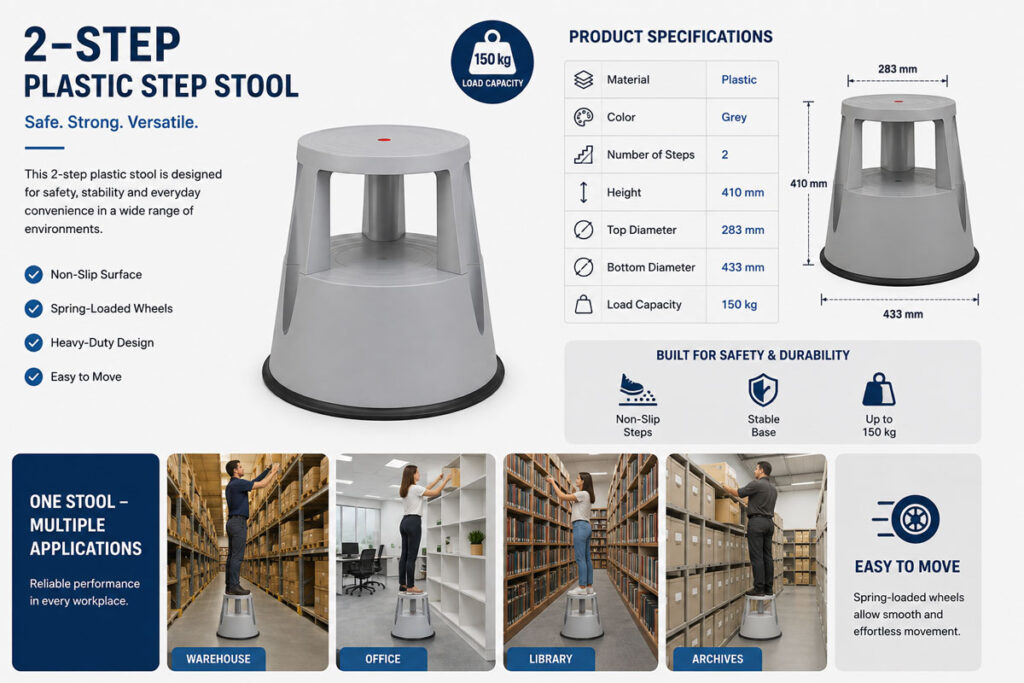
Firmalazım’s current model is built for this exact logistics sequence under Iraqi conditions: 410 mm height, 283 mm top platform, 433 mm base, 150 kg rating, high-density plastic with permanent non-slip texture, and spring-loaded wheels that retract under load.
Dust, Temperature and the Daily Reality of Iraqi Logistics Floors Fine dust settles throughout the shift. Cleaning leaves light residual moisture. Temperature differences between climate-controlled zones and open warehouse areas create further variables. Platforms that perform in clean, stable environments can lose grip or become awkward under these conditions.
Deep moulded texture continues to provide contact points even when a light dust film is present. High-density plastic stays dimensionally stable across temperature ranges, resists impact and does not corrode. The automatic lock removes the most common residual risk with wheeled platforms—forgotten manual brakes—under the time pressure of outbound waves. The compact base fits typical aisle clearances while still resisting tip-over during sideways reach with a tote or case.
How Access Speed Protects the Entire Supply Chain Every second saved on a mid-level pick is a second that keeps the wave on schedule. When the stool is light enough for one person to move, locks without a lever, and stays stable under a full case, the cumulative gain across hundreds of lines becomes measurable. Incomplete orders decline. Expedited transport costs fall. Supermarket stores receive the stock they need to maintain on-shelf availability.
The same unit works for put-away and inventory counts, so the entire warehouse flow remains consistent.
Operational Patterns Across Iraqi Logistics Locations Dense hubs serving Baghdad recover time during peak outbound waves because platforms can be positioned and locked in one continuous motion. Southern facilities in Basrah face higher humidity and dust loads; the textured surface continues to grip. Operations in Mosul and Karbala run multiple shifts; the automatic lock keeps behaviour consistent regardless of which team is on duty.
Warehouses supporting stores in Kirkuk and Najaf report fewer delayed lines after replacing older platforms. Large-format sites in Erbil and Nasiriyah use the same stools across ambient and temperature-variable zones. Teams in Al Diwaniyah and Kut move the light units between levels without accumulating extra fatigue. Expanding locations in Amarah, Hillah and Baqubah specify the model because the dimensions already match their racking and aisle profiles.
Southern and coastal sites in Ramadi, Kufa, Az Zubayr and Duhok place extra demand on grip under residual moisture. High-volume centers in Sulaymaniyah, Samawah, Abu Al-Khaseeb and Fallujah track measurable gains in wave completion. Locations in Samarra, Zakho, Shatrah, Al Hartha, Al Qurnah, Mahmudiyah, Jisr Diyala, Taji, Nahrawan, Abu Ghraib, Musayib, Hindiyah, Al Hashimiyah, Miqdadiyah, Rifai, Suq Al-Shuyukh, Al-Suwaira, Al-Fallujah and Al Shirqat benefit from one standardised platform that removes the need for different training or spare parts in each city.
Procurement Reality for Multi-Site Logistics Networks Unit price is only the entry figure. The real cost includes replacement frequency under dust and heat, time lost to unstable platforms, residual risk events, and the administrative burden of managing different models across sites. A commercial-grade wheeled step stool that stays in service for years under local conditions usually costs less over the full life cycle.
Wholesale volumes reduce the unit cost further. OEM options allow private labelling while the core locking and grip features stay identical. Distributor partners hold stock in key regions so that a damaged unit can be replaced the same day. Working with a manufacturer that understands commercial warehouse retail use keeps specifications consistent and documentation ready for internal audits.
Side-by-Side Reality Check
| Situation | Older Fixed or Light Platform | Firmalazım Wheeled Step Stool | Result on Logistics Flow |
|---|---|---|---|
| Dust film present | Grip falls | Texture still grips | Fewer slips |
| Light moisture after cleaning | Surface becomes risky | Texture holds | Continued confidence |
| Peak outbound wave | Ladder or unstable platform slows lines | Rolls in, locks, rolls out | Wave stays on schedule |
| End-of-shift fatigue | Heavy or awkward unit | Light, automatic lock | Higher remaining output |
| Multi-site training | Different models | One model everywhere | Uniform behaviour |
Practical Steps That Deliver Results Start with one high-volume aisle. Place several units in the zones that generate the most delayed lines. Time the mid-level picks for two weeks before and two weeks after. Record near-misses and staff comments on effort. Once the numbers confirm the gain, expand through bulk orders. Keep the induction message identical in every site: step on and it locks, step off and it rolls. Add a ten-second visual check of wheels and texture to the existing daily routine.
Maintenance That Survives Real Shifts Wipe the textured steps during normal cleaning to remove dust. At shift change confirm the wheels still retract under weight. Once a week a supervisor checks for cracks or sticky movement. Any unit that fails is removed the same day and replaced from the nearest buffer stock. The design has so few moving parts that the routine stays short.
Mistakes That Quietly Destroy the Benefit Buying units with manual brakes that staff later ignore under wave pressure. Choosing narrow bases that feel tippy when reaching sideways with a tote. Accepting domestic-grade plastic that cracks after a few months of dust and temperature cycles. Allowing each warehouse to select its own model. Ignoring the cumulative time cost of platforms that are slow to position.
Clear specification prevents all of them: automatic locking, deep non-slip texture, 150 kg capacity, stable 433 mm base, commercial-grade plastic, supplied by a manufacturer that supports bulk orders, OEM programmes and distributor networks.
Five Different Ways to Move Forward
- Run a controlled four-week test in one busy warehouse aisle and measure line completion speed plus near-miss count.
- Ask for a wholesale price structure based on the number of warehouses you plan to equip this year.
- Discuss OEM branding if you need the stools to match your internal visual or process standards.
- Confirm which regions already have distributor stock for same-day replacement.
- Match the 410 mm height and 433 mm base against the actual racking and aisle measurements in your current sites.
Closing View Delayed outbound waves are rarely a labour problem alone. They are often an access problem. A wheeled step stool that locks automatically, grips under dust and residual moisture, carries 150 kg and moves easily between bays removes that access problem. Firmalazım builds the unit for continuous commercial use in warehouse retail environments across Iraq. Standardising on one reliable model simplifies training, inspection and replacement while protecting outbound reliability and supermarket on-shelf availability in every city from Baghdad to Al Shirqat.
Frequently Asked Questions
How quickly does the stool improve wave completion times? Most warehouses see measurable gains in line completion speed within the first two weeks of consistent use.
Does fine dust really reduce grip on ordinary platforms? Yes. Smooth or thinly coated surfaces lose friction rapidly once a dust film forms. Deep moulded texture continues to grip.
Is the automatic lock reliable after months of dusty conditions? When the wheels are kept free of heavy build-up through normal cleaning, the spring mechanism continues to retract and re-engage consistently.
Can one model serve both climate-controlled and open warehouse zones? Yes. The same construction and non-slip surfaces perform across temperature and dust conditions.
What volume makes wholesale pricing available? Once the order covers multiple warehouses or a planned multi-site roll-out, wholesale terms become available.
Is OEM branding possible for a national supply-chain group? Yes. Private labelling and limited visual adjustments can be discussed for larger programmes.
How often should the textured surface be cleaned under dusty conditions? Wiping during the normal daily cleaning cycle is normally sufficient to maintain grip performance.
What happens if a wheel becomes sticky with dust? Remove the unit from service, clean the mechanism if possible, or replace it from buffer stock.
Does the 150 kg rating cover typical warehouse cases in Iraq? Yes. It provides a clear margin for worker weight plus full cases or totes of common supermarket products.
How does standardisation across warehouses reduce cost? One model means one training programme, one inspection checklist, one spare-parts plan and simpler bulk purchasing.
Can smaller regional operators buy through a distributor? Yes. Regional distributors stock units for lower-volume requirements.
What documentation is provided with commercial orders? Load-capacity statements, material information and basic care instructions suitable for internal records.
Is the stool suitable when floors are still slightly damp after cleaning? The deep texture is designed to retain grip under the light residual moisture typical after routine cleaning.
How long do commercial-grade units typically last under local warehouse conditions? With basic daily cleaning and weekly inspection, multiple years of service is realistic.
What is the single biggest residual risk the design removes? The forgotten manual brake that leaves a wheeled platform free to move under load.
Firmalazım continues to supply wheeled step stools built for the actual dust, temperature and cycle conditions of Iraqi logistics operations that serve supermarket networks. Whether you need a single-aisle trial, a multi-site programme through bulk orders, or an OEM solution for network-wide consistency, the goal remains the same: keep outbound waves on schedule, residual risk low and supermarket shelves full across Iraq.
Wheeled Step Stools for Logistics Operations in Iraq
Wheeled step stools deliver measurable gains in speed, safety, and shelf-access efficiency for supermarket logistics teams across Iraq. In an expanding retail market driven by modern hypermarkets and high-volume warehouses, these mobile platforms cut time spent retrieving high-placed stock, reduce fall-related downtime, and support consistent order fulfilment. Firmalazım designs and supplies commercial-grade units engineered for the realities of Iraqi supermarket backrooms and distribution points—durable frames, lockable casters, non-slip treads, and capacities suited to daily commercial use. This guide examines practical deployment, cost impact, selection criteria, and location-specific considerations so procurement and operations managers can evaluate the equipment as a targeted operational investment rather than a generic accessory.
Why Mobile Access Platforms Matter in Iraq’s Growing Supermarket Logistics
Iraq’s retail sector continues to expand through supermarket and hypermarket formats in major urban centres. Operators face the dual pressure of rising consumer demand and the need for faster, safer restocking of high shelves and bulk storage areas. Fixed ladders or improvised stools create bottlenecks and elevate risk. Wheeled step stools solve both problems by combining mobility with stable working platforms.
In Baghdad, large supermarket warehouses process high volumes of dry goods and ambient products that must move quickly from receiving docks to sales-floor shelving. Teams that can roll a stable platform to the exact aisle and lock the casters complete picks faster while maintaining three points of contact. Similar patterns appear in Basrah, where port-linked distribution centres feed southern retail networks and humidity plus dusty floors demand non-slip surfaces and corrosion-resistant finishes.
The same logic applies in Mosul, where post-reconstruction retail growth has increased the density of multi-level storage. In Karbala and Najaf, seasonal pilgrim-related demand spikes require rapid replenishment cycles; wheeled units allow staff to reposition quickly between peak periods without carrying separate ladders. Kirkuk and Erbil host a mix of modern supermarket chains and wholesale-retail hybrids; here the equipment supports both warehouse retail operations and direct-to-shelf restocking.
Further south and west, Nasiriyah, Al Diwaniyah, Kut, and Amarah rely on regional distribution hubs that serve multiple smaller stores. A single robust wheeled step stool shared across a hub reduces capital outlay while improving consistency. In Hillah, Baqubah, and Ramadi, space-constrained backrooms benefit from compact designs that still offer secure height. Kufa, Az Zubayr, and Duhok present varied floor conditions—concrete, tiled, or occasionally uneven—so units with spring-loaded or lockable casters maintain stability. Sulaymaniyah and Samawah continue to see new supermarket openings; early adoption of proper access equipment establishes safer working norms from the start.
Even in secondary logistics nodes such as Abu Al-Khaseeb, Fallujah, Samarra, Zakho, Shatrah, Al Hartha, Al Qurnah, Mahmudiyah, Jisr Diyala, Taji, Nahrawan, Abu Ghraib, Musayib, Hindiyah, Al Hashimiyah, Miqdadiyah, Rifai, Suq Al-Shuyukh, Al-Suwaira, Al-Fallujah, and Al Shirqat, the core requirement remains identical: reach elevated stock safely and move the platform without interrupting flow. Across these locations the equipment supports commercial use inside supermarket premises and associated warehouse retail facilities.
Operational Scenarios That Reveal Real Value
Consider a typical morning restock cycle in a mid-sized supermarket. Staff must pull cases from the top two or three levels of racking, open them, and face the product on the sales floor. Without a wheeled platform they either stretch from the floor (unsafe and slow) or fetch a fixed ladder that must later be returned. With a wheeled step stool the operator rolls the unit into position, steps up, locks the casters if required, completes the pick, unlocks, and moves to the next bay. Cycle time drops. The same platform later serves for light-bulb changes, high cleaning, or seasonal display installation.
In larger distribution points feeding multiple stores, the stools become shared assets. One unit can support order-picking for several supermarket branches before returning to the hub. Bulk orders of identical models simplify training and spare-parts management. When a manufacturer such as Firmalazım offers OEM options—custom colours, branding plates, or adjusted tread heights—chains can standardise appearance and ergonomics across sites.
Safety remains non-negotiable. Falls from height, even modest ones, generate lost-time incidents, compensation claims, and temporary staffing gaps. Non-slip treads, dual handrails on higher models, and positive locking casters address the primary failure modes observed in warehouse and supermarket environments. Proper training reinforces the engineering controls.
Technical and Material Considerations for Iraqi Conditions
Most commercial wheeled step stools use cold-rolled or powder-coated steel frames for strength and durability. Load ratings commonly range from 150 kg to over 300 kg, sufficient for a worker plus product. Steps feature ribbed or textured surfaces; some incorporate rubber or vinyl edge protectors. Casters are typically polyurethane or rubber, sized to roll over warehouse floors yet lock firmly under load. Spring-loaded designs retract when weight is applied, providing automatic stability.
In hotter southern cities the powder-coat finish resists fading and minor corrosion. In northern locations with cooler winters the same coating prevents surface degradation. Dusty environments common across much of Iraq favour designs that shed debris rather than trap it in perforated treads. Handrail height and step spacing should align with recognised industrial guidelines so that users maintain balance without overreaching.
Firmalazım, acting as both manufacturer and wholesale supplier, can configure units for specific supermarket aisle widths or shelf heights. OEM collaboration allows incorporation of local branding or slight dimensional adjustments that improve fit within existing racking systems. Distributor networks then place stock closer to end users, shortening lead times for replacements or expansions.
Cost and Return Perspective for Procurement Teams
Purchase price is only the starting figure. Calculate total cost of ownership by including reduced picking time, lower incident rates, and extended equipment life. A single wheeled step stool that saves ten minutes per restock cycle across multiple shifts recovers its cost within months in a busy supermarket. When bulk orders secure volume pricing, the payback accelerates further.
Compare against alternatives: fixed ladders consume floor space and require extra handling; rolling scaffolds are over-specified and more expensive for routine shelf work; unsecured stools introduce unacceptable risk. The wheeled step stool occupies the practical middle ground—mobile enough for daily use, stable enough for safety, and priced for commercial budgets.
Maintenance is straightforward. Periodic inspection of casters, locking mechanisms, and tread surfaces, plus occasional cleaning, keeps units serviceable for years. Spare wheels and rubber feet are inexpensive and readily available through established wholesale channels.
Selection Checklist for Supermarket Operations Managers
- Confirm maximum intended load including worker and typical case weight.
- Verify caster type and locking reliability on the actual floor surface.
- Check step width and spacing against local ergonomic preferences.
- Evaluate handrail presence for models above two or three steps.
- Assess overall footprint relative to narrowest aisle.
- Request powder-coat or equivalent finish suited to ambient conditions.
- Confirm availability of bulk-order pricing and spare parts.
- Review manufacturer documentation for commercial-use ratings.
- Plan staff familiarisation before full deployment.
- Document inspection intervals as part of site safety procedures.
Practical Deployment Tips
Position units near high-turnover high-shelf zones rather than central storage. Colour-code or label stools by department so staff return them after use. Integrate a quick visual check into shift-start routines. For multi-site chains, standardise on one or two models to simplify training and inventory. When expanding into new locations, include the stools in the initial fit-out package so safe access is available from day one.
Firmalazım Role in the Supply Chain
As a manufacturer focused on industrial access equipment, Firmalazım supplies both standard commercial models and OEM-configured versions. Wholesale and distributor partners across Iraq can hold inventory for rapid fulfilment. Buyers placing bulk orders benefit from consistent specification and volume pricing. The equipment is intended for commercial use inside supermarket warehouses and retail backrooms, supporting safety while accelerating logistics tasks. Industrial Step Stool Solutions for Commercial Facilities in Iraq
Closing Perspective
Wheeled step stools are not glamorous assets, yet they remove a recurring friction point in supermarket logistics. In an Iraqi retail market that continues to modernise and expand, the combination of mobility, stability, and durability translates directly into faster replenishment, fewer incidents, and more predictable operations. Selecting the right units—and sourcing them from a manufacturer capable of supporting bulk and OEM requirements—turns a simple piece of equipment into a quiet contributor to daily performance across the country’s supermarket network.
Frequently Asked Questions
What load capacity is typically required for supermarket restocking? Most operations find 150–300 kg sufficient to cover a worker plus cases or cartons. Higher ratings provide extra margin for heavier bulk items.
How do lockable casters improve safety compared with free-rolling wheels? Once locked, the platform remains stationary under the user’s weight, eliminating the risk of unexpected movement while climbing or standing.
Can the same wheeled step stool serve both warehouse and sales-floor areas? Yes, provided the unit is compact enough for narrower retail aisles and the finish resists visible wear in customer-facing zones.
What maintenance schedule keeps the equipment reliable? Visual inspection of casters, locks, and treads at the start of each shift, plus a more thorough monthly check of frame integrity and fasteners, is usually adequate.
Are spring-loaded casters preferable to manual locks? Spring-loaded designs automatically stabilise under weight and free-roll when unloaded, reducing the chance that staff forget to lock or unlock.
How does dust common in many Iraqi locations affect performance? Choose treads and casters that shed rather than trap dust. Periodic sweeping of the contact surfaces maintains grip and rolling ease.
What is the advantage of ordering through a wholesale channel rather than single-unit retail? Wholesale pricing, consistent batch specification, and faster availability of replacements or additional units for multi-site roll-outs.
Can Firmalazım supply units with custom branding or colours? As a manufacturer offering OEM services, Firmalazım can incorporate logos, colour schemes, or minor dimensional adjustments to match chain standards.
How many units does a typical mid-sized supermarket need? Two to four units usually cover daily restocking and occasional high-reach tasks, depending on store size and shelf density.
Do these stools meet general industrial safety expectations? Commercial models designed for warehouse and supermarket use incorporate non-slip surfaces, stable bases, and load ratings aligned with common workplace requirements. Always verify the specific model documentation.
Is training necessary before staff use the equipment? A short familiarisation covering correct locking procedure, three-point contact, and inspection points significantly reduces misuse risk.
What happens if a caster fails in service? Most manufacturers stock replacement wheels. Keeping a small spare-parts kit on site minimises downtime.
Can the stools be used on slightly uneven floors? Units with larger casters and a stable frame tolerate minor irregularities better than narrow-footed designs, but extreme unevenness still requires caution.
How does bulk ordering affect lead times? Larger orders often receive priority production and consolidated shipping, improving predictability for multi-location deployments.
Are aluminium versions preferable to steel in certain climates? Steel with quality powder coating generally offers better durability and lower cost for heavy commercial use; aluminium can reduce weight where frequent long-distance movement is required.
What role does a local distributor play? A distributor shortens delivery times, provides after-sales support, and can hold buffer stock for urgent replacements.
How do wheeled step stools compare with mobile ladder stands for supermarket work? Step stools are lighter and faster to reposition for moderate heights; ladder stands suit higher or more prolonged work but occupy more space and cost more.
Should the equipment be included in new-store fit-out budgets? Yes. Providing safe access from opening day establishes correct working habits and avoids later retrofits.
What is the typical service life under daily supermarket use? With routine inspection and occasional part replacement, well-built commercial units commonly remain in service for several years.
How can operations measure the return on these platforms? Track average time per high-shelf pick before and after introduction, plus any reduction in height-related incidents. The time savings alone usually justify the investment within a short period.
Wheeled Step Stools for Logistics Operations Iraq
Wheeled step stools represent a practical operational upgrade for supermarket logistics teams operating across Iraq. In a retail environment where modern supermarket formats continue to expand and high-shelf storage remains standard, these mobile platforms reduce the time required for restocking, improve worker safety during elevated tasks, and support consistent product availability on the sales floor. Firmalazım supplies commercial-grade wheeled step stools engineered for the demands of warehouse retail and supermarket backrooms, offering durable construction, reliable mobility, and configurations suitable for bulk orders and OEM requirements. This extended guide examines real-world deployment patterns, technical selection criteria, cost dynamics, location-specific considerations, and practical implementation steps so that procurement managers, operations directors, and safety officers can evaluate the equipment as a targeted efficiency investment rather than a generic accessory.
The Logistics Reality Facing Iraqi Supermarkets Today
Iraq’s supermarket sector has evolved from traditional open markets toward structured hypermarkets and multi-store chains that rely on organised warehousing and rapid replenishment cycles. Rising consumer demand in urban centres creates pressure on backroom teams to keep high shelves fully stocked while maintaining safe working conditions. Fixed ladders consume valuable floor space and slow movement between aisles. Improvised stools introduce unacceptable risk. Wheeled step stools occupy the practical middle ground: they travel with the worker, lock securely under load, and free up capacity for higher-value tasks.
In Baghdad, the density of large supermarket warehouses and central distribution points means teams frequently move between receiving docks, bulk storage, and sales-floor interfaces. A wheeled platform allows a single operator to complete multiple high-reach picks without repeatedly returning a fixed ladder to a central storage point. The same pattern appears in Basrah, where port-linked supply chains feed southern retail networks and dusty or occasionally damp floors demand non-slip treads and robust caster performance. In Mosul, reconstruction-driven retail growth has increased the number of multi-level storage areas; mobile access equipment helps new facilities establish safer working norms from the outset.
Seasonal demand fluctuations further highlight the value of mobility. In Karbala and Najaf, pilgrim-related peaks require rapid restocking of dry goods, beverages, and household items. Teams that can reposition a stable platform quickly between high-turnover zones maintain product availability without expanding headcount. Kirkuk and Erbil host a mix of modern supermarket chains and hybrid wholesale-retail operations; here the stools support both internal warehouse retail flows and direct replenishment onto sales-floor fixtures. Further south, Nasiriyah, Al Diwaniyah, Kut, and Amarah rely on regional hubs that supply multiple smaller stores. A limited number of shared wheeled units can serve an entire hub, reducing capital outlay while standardising safety practices.
In Hillah, Baqubah, and Ramadi, space-constrained backrooms benefit from compact footprints that still provide secure standing platforms. Kufa, Az Zubayr, and Duhok present varied floor surfaces—smooth concrete, tiled, or occasionally uneven—so units with quality casters and positive locking mechanisms maintain stability. Sulaymaniyah and Samawah continue to see new supermarket openings; early inclusion of proper access equipment in the fit-out package prevents later retrofits. Even in secondary logistics nodes such as Abu Al-Khaseeb, Fallujah, Samarra, Zakho, Shatrah, Al Hartha, Al Qurnah, Mahmudiyah, Jisr Diyala, Taji, Nahrawan, Abu Ghraib, Musayib, Hindiyah, Al Hashimiyah, Miqdadiyah, Rifai, Suq Al-Shuyukh, Al-Suwaira, Al-Fallujah, and Al Shirqat, the fundamental requirement remains consistent: reach elevated stock safely, move the platform without disrupting flow, and return it ready for the next task.
Across all these locations the equipment supports commercial use inside supermarket premises and associated warehouse retail facilities. When sourced through a manufacturer capable of fulfilling bulk orders and OEM configurations, chains can standardise models, simplify training, and manage spare parts more efficiently.
Operational Scenarios That Demonstrate Measurable Impact
Consider a typical morning restock cycle in a mid-sized supermarket. Dry goods and ambient products arrive in cases that must be moved from receiving to high-level racking or directly to sales-floor shelves. Without a wheeled step stool, an operator either stretches from the floor (increasing strain and fall risk) or retrieves a fixed ladder, climbs, completes the pick, descends, returns the ladder, and repeats the sequence for the next bay. Cycle time accumulates. With a wheeled unit the operator rolls the platform into position, steps up while maintaining three points of contact, locks the casters if required, completes the retrieval, unlocks, and moves to the next location. The cumulative time saving across a full shift becomes significant.
In larger distribution centres that supply multiple supermarket branches, the same stools become shared assets. One well-specified unit can support order-picking for several stores before returning to the hub. When a manufacturer such as Firmalazım offers consistent models, training becomes uniform and spare-part inventories remain simple. OEM options—custom colour coding by department, branded identification plates, or slight adjustments to tread height—further align the equipment with internal operational standards. Professional Mobile Step Stools for Retail Stores in Iraq
Safety performance forms the second major benefit. Even modest falls from height generate lost-time incidents, temporary staffing gaps, and potential compensation claims. Non-slip ribbed or textured treads, dual handrails on higher models, and reliable locking casters address the primary failure modes observed in warehouse and supermarket environments. When combined with brief familiarisation training, the engineering controls reduce both the probability and severity of incidents.
A third scenario involves light facility maintenance. Changing high-level lighting, cleaning upper fixtures, or installing seasonal displays requires stable elevated access. A wheeled step stool that already exists for restocking duties can serve these secondary tasks without the need for separate specialised equipment, improving overall asset utilisation.
Technical Characteristics Suited to Iraqi Supermarket Conditions
Commercial wheeled step stools intended for daily warehouse and supermarket use typically employ cold-rolled steel frames finished with durable powder coating. Load capacities commonly range from 150 kg to more than 300 kg, providing a comfortable margin for a worker plus typical case weights. Steps feature ribbed, serrated, or rubberised surfaces that maintain grip even when dust or minor moisture is present. Casters are usually polyurethane or rubber, sized to roll smoothly over concrete and tiled floors yet lock firmly under load. Some designs incorporate spring-loaded casters that retract automatically when weight is applied, offering inherent stability without requiring the operator to remember a separate locking action.
In hotter southern cities the powder-coat finish resists fading and surface degradation. In northern locations that experience cooler winters the same coating protects against minor corrosion. Dusty conditions prevalent across much of Iraq favour open tread designs that shed debris rather than trap it. Handrail height and step spacing should allow users to maintain balance without overreaching; models intended for commercial use generally follow recognised industrial guidelines for these dimensions.
Firmalazım, operating as a manufacturer with wholesale and distributor channels, can supply both standard commercial models and OEM-configured versions. Buyers placing bulk orders benefit from consistent specification across sites and volume-based pricing. Local distributors then hold buffer stock closer to end users, shortening replacement lead times when a unit requires service or when a new store opens.
Cost Structure and Return Calculation for Procurement Teams
Purchase price represents only the initial figure. Total cost of ownership includes reduced labour time per high-shelf pick, lower incidence of height-related injuries, extended equipment life through durable construction, and simplified spare-parts management. A single wheeled step stool that saves even eight to ten minutes per restock cycle across multiple daily shifts recovers its acquisition cost within a few months in a busy supermarket. When bulk orders secure volume discounts, the payback period shortens further.
Compare the wheeled step stool against common alternatives. Fixed ladders require dedicated floor space and extra handling time each time they are moved. Rolling scaffolds provide greater height and platform area but are over-specified and more expensive for routine shelf work. Unsecured plastic or wooden stools introduce unacceptable safety risk and fail quickly under commercial use. The wheeled step stool occupies the practical middle ground—mobile enough for frequent repositioning, stable enough for safe standing, and priced for supermarket budgets.
Maintenance costs remain low. Periodic visual inspection of casters, locking mechanisms, and tread surfaces, combined with occasional cleaning and replacement of wear items such as rubber feet or wheels, keeps units serviceable for years. Keeping a small kit of common spare parts on site minimises downtime.
Expanded Selection Framework for Operations and Safety Managers
When evaluating models, begin with the maximum intended load. Include the weight of a typical worker plus the heaviest case or carton that will be handled from the platform. Next examine caster design: spring-loaded units offer automatic stabilisation, while manual locks provide positive mechanical security. Step width and spacing should feel comfortable for the local workforce; excessively narrow or widely spaced steps reduce confidence and slow movement. Handrails become increasingly important as platform height rises above two or three steps.
Footprint matters in narrow supermarket aisles and crowded backrooms. Measure the tightest working corridor and confirm the fully extended or locked stance of the stool will still allow safe passage of other staff or trolleys. Finish quality affects longevity in dusty or occasionally humid conditions; powder-coated steel generally outperforms lighter alternatives for heavy commercial use. Finally, confirm that the manufacturer or distributor can support bulk orders, provide technical documentation, and supply spare parts on reasonable lead times.
A practical checklist for site evaluation includes:
- Confirm load rating exceeds expected combined weight.
- Test caster locking or spring retraction on the actual floor surface.
- Verify step tread grip under dusty or slightly damp conditions.
- Check overall height and handrail presence against typical shelf levels.
- Measure footprint against the narrowest aisle.
- Review powder-coat or equivalent finish for local climate.
- Confirm availability of bulk-order pricing and spare-part stock.
- Request manufacturer documentation covering commercial-use ratings.
- Plan a short staff familiarisation session before full deployment.
- Incorporate routine inspection into existing safety procedures.
Implementation Guidance Across Different Store Formats
In larger hypermarkets the recommended approach is to position two or more units near high-turnover high-shelf zones rather than storing them in a central equipment room. Colour-coding or clear labelling by department encourages staff to return units after use. Integrating a quick visual check into shift-start routines catches worn casters or loose components early. For multi-site chains, standardising on one or two models simplifies training materials, reduces spare-part variety, and enables volume purchasing.
When opening a new store, include the wheeled step stools in the initial fit-out package. Providing safe elevated access from day one establishes correct working habits and avoids the cost and disruption of later retrofits. In regional distribution hubs that serve multiple smaller outlets, a shared pool of units can be scheduled across sites according to delivery and restock calendars, maximising utilisation while controlling capital expenditure.
Material and Construction Insights for Long-Term Performance
Cold-rolled steel frames offer the best combination of strength, cost, and durability for commercial supermarket environments. Powder coating provides a resilient barrier against surface corrosion and everyday abrasion. Weld quality at critical joints determines long-term structural integrity; reputable manufacturers reinforce these points and subject finished units to load testing. Tread surfaces that incorporate ribbing, perforation, or bonded rubber maintain grip even when fine dust is present. Casters should be sized appropriately for the expected floor type and fitted with reliable locking or spring mechanisms.
OEM collaboration allows chains to specify minor dimensional adjustments, colour schemes that match corporate identity, or identification plates that support asset tracking. When these customisations are ordered in bulk, the incremental cost remains modest relative to the operational consistency gained across multiple locations.
Safety Integration and Training Considerations
Engineering controls form the foundation, yet consistent safe use depends on brief, practical training. Staff should understand correct positioning of the unit, the importance of locking casters or relying on spring retraction, the need to maintain three points of contact while climbing, and the prohibition on overreaching. A short demonstration during induction or periodic safety briefings is usually sufficient. Incorporating a visual inspection of the stools into daily or weekly safety checklists keeps the equipment in reliable condition and reinforces its status as a controlled work tool rather than an informal aid. Wheeled Non-Slip Step Stools for Supermarkets in Iraq
In locations where floor conditions vary, additional guidance on assessing surface stability before use further reduces residual risk. Documenting these procedures supports both internal safety culture and external audit requirements.
Comparative Perspective: Positioning Within the Broader Access-Equipment Range
Wheeled step stools sit between simple stationary stools and more complex mobile ladder stands or scaffolds. Stationary stools lack mobility and therefore force workers to carry product farther or make multiple trips. Full ladder stands offer greater height and platform area but occupy more space, cost more, and are slower to reposition for routine restocking. Rolling scaffolds provide extensive working platforms yet are rarely justified for everyday supermarket shelf work. The wheeled step stool delivers the mobility and moderate height required for the majority of high-reach tasks while remaining compact, affordable, and quick to deploy.
This positioning makes the equipment particularly suitable for supermarket and warehouse retail environments where the dominant need is frequent, short-duration elevated access rather than prolonged high-level work.
Supply-Chain and Procurement Advantages
Working with a manufacturer that also supports wholesale and distributor channels simplifies the purchasing process. Bulk orders secure consistent specification and volume pricing. Local distributors reduce lead times for both initial supply and subsequent replacements. OEM capability allows chains to align the equipment with internal standards without sacrificing commercial load ratings or safety features. When these elements combine, procurement teams can treat the wheeled step stool as a standardised asset rather than a series of ad-hoc purchases.
Long-Term Operational Outlook
As supermarket formats continue to expand and consumer expectations for product availability remain high, the efficiency of backroom and warehouse processes becomes increasingly visible in overall store performance. Equipment that reduces restocking time, lowers incident risk, and requires minimal ongoing maintenance contributes quietly but consistently to these outcomes. Wheeled step stools, when correctly specified and sourced from a capable manufacturer, form one of the simpler yet higher-impact investments available to supermarket logistics teams operating across Iraq.
By evaluating the equipment through the dual lenses of operational speed and worker safety, decision-makers can move beyond generic product descriptions and focus on measurable contribution to daily performance. Standardisation across sites, support for bulk and OEM requirements, and attention to local floor and climate conditions further strengthen the case for systematic adoption.
Frequently Asked Questions (Expanded Set)
What load capacity should a supermarket typically specify? A rating of 150–300 kg covers most restocking scenarios involving a worker plus cases or cartons. Higher ratings provide additional margin for heavier bulk items without significantly increasing cost or weight.
How do spring-loaded casters differ from manual locking systems in daily use? Spring-loaded designs automatically stabilise under the user’s weight and free-roll when unloaded, reducing the chance that staff forget to lock or unlock. Manual locks provide positive mechanical security and are preferred by some safety teams.
Can one model serve both warehouse and sales-floor environments? Yes, provided the footprint fits the narrowest aisle and the finish resists visible wear in customer-visible areas. Many commercial units meet both requirements.
What routine maintenance keeps the equipment reliable over years of commercial use? A visual check of casters, locks, and treads at the start of each shift, combined with a more thorough monthly inspection of frame integrity and fasteners, is generally sufficient. Occasional cleaning removes accumulated dust.
How does dust common in many Iraqi locations affect grip and rolling performance? Open or ribbed tread designs that shed debris perform better than tightly perforated surfaces that can trap fine particles. Periodic sweeping of contact surfaces maintains both grip and smooth rolling.
What commercial advantages come from placing bulk orders rather than single-unit purchases? Volume pricing, consistent batch specification across sites, simplified training, and improved availability of matching spare parts.
Does Firmalazım offer OEM customisation for supermarket chains? As a manufacturer, Firmalazım can incorporate colour schemes, branding plates, or minor dimensional adjustments while retaining commercial load ratings and safety features.
How many units does a typical mid-sized supermarket require? Two to four units usually cover daily restocking and occasional maintenance tasks, depending on store size, shelf density, and number of concurrent high-reach activities.
Are these stools suitable for slightly uneven warehouse floors? Units with appropriately sized casters and a stable base tolerate minor irregularities better than narrow-footed designs, but extreme unevenness still requires caution and alternative access methods.
What is the typical service life under daily supermarket conditions? With routine inspection and timely replacement of wear items such as wheels or rubber feet, well-built commercial units commonly remain in reliable service for several years.
Should wheeled step stools be included in new-store opening budgets? Yes. Providing safe elevated access from the first day of operation establishes correct working habits and avoids the disruption and cost of later equipment introductions.
How can operations teams quantify the return on investment? Track average time required for high-shelf picks before and after introduction, together with any reduction in height-related incidents. Time savings alone usually justify the expenditure within a short period in high-volume stores.
What role does a local distributor play in ongoing support? A distributor shortens delivery times for both initial supply and replacements, holds buffer stock, and provides a practical point of contact for technical queries or spare-part orders.
How do wheeled step stools compare with mobile ladder stands for routine supermarket work? Step stools are lighter, faster to reposition, and more economical for moderate heights and short-duration tasks. Ladder stands suit higher or more prolonged work but occupy more space and cost more.
Is formal training required before staff begin using the equipment? A short practical familiarisation covering correct positioning, locking procedure, three-point contact, and basic inspection points significantly reduces the risk of misuse and reinforces safe habits.
Can the same units be shared across a regional distribution hub and multiple smaller stores? Yes. Scheduling shared assets according to delivery and restock calendars maximises utilisation while controlling overall capital expenditure.
What finish is most appropriate for the range of climates found across Iraq? A quality powder-coated steel finish generally provides the best combination of durability, corrosion resistance, and cost for commercial supermarket environments in both hotter southern and cooler northern locations.
How should worn or damaged units be handled? Remove them from service immediately, tag them as unsafe, and either repair using manufacturer-approved parts or replace them. Keeping a small stock of common wear items minimises downtime.
Does the equipment support both warehouse retail flows and direct sales-floor replenishment? When correctly specified for footprint and finish, the same commercial units can serve both environments, improving asset utilisation across the operation.
What documentation should procurement request from the manufacturer or distributor? Load rating confirmation, material and finish specifications, assembly or inspection guidance, and any commercial-use statements that support internal safety and compliance records. Heavy-Duty Step Stools for Warehouses in Iraq
This extended examination positions wheeled step stools as a focused operational tool rather than a generic accessory. When selected with attention to local conditions, sourced through channels that support bulk orders and OEM needs, and integrated into daily routines with basic training and inspection, the equipment contributes measurable improvements in restocking speed, worker safety, and overall supermarket logistics performance across Iraq.

Bir yanıt yazın