


Professional Mobile Step Stools for Retail Stores in Iraq
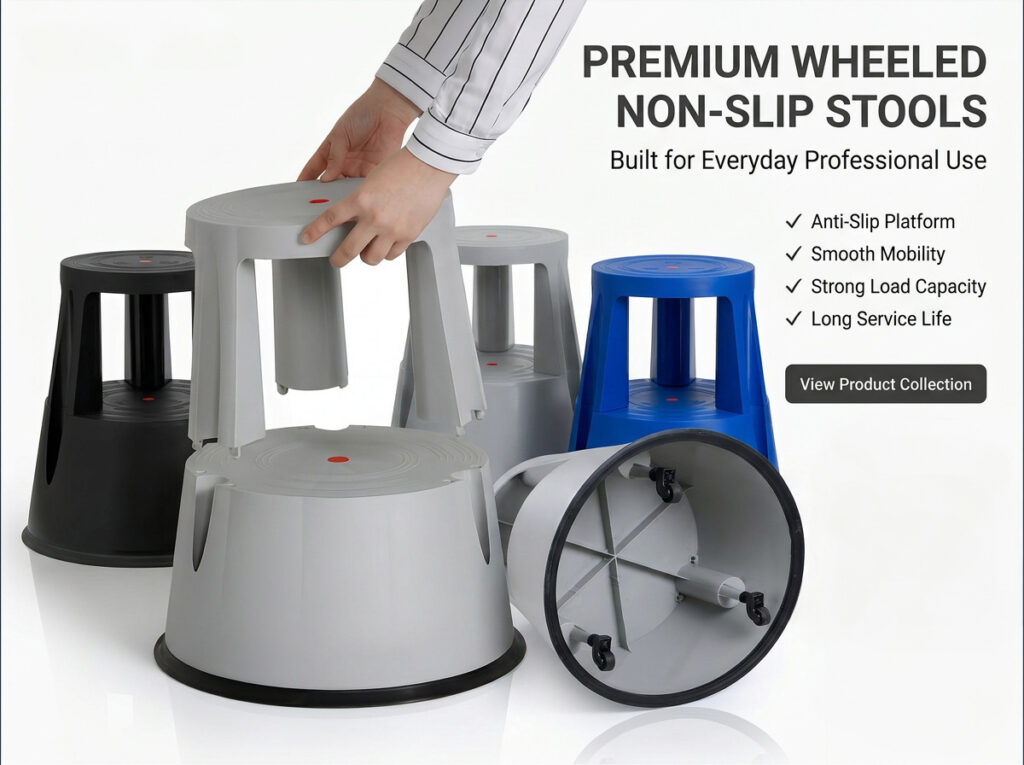
Professional Mobile Step Stools for Retail Stores in Iraq Professional mobile step stools keep Iraqi supermarket shelves full and aisles clear under real operating conditions. Firmalazım’s 2-step plastic model features spring-loaded automatic locking wheels, deep non-slip texturing, 150 kg capacity and a compact base that fits busy retail floors. Designed for continuous commercial use, it supports rapid facing, stock rotation and promotional changes while prioritising staff safety across supermarket stores and connected warehouse retail zones throughout Iraq.




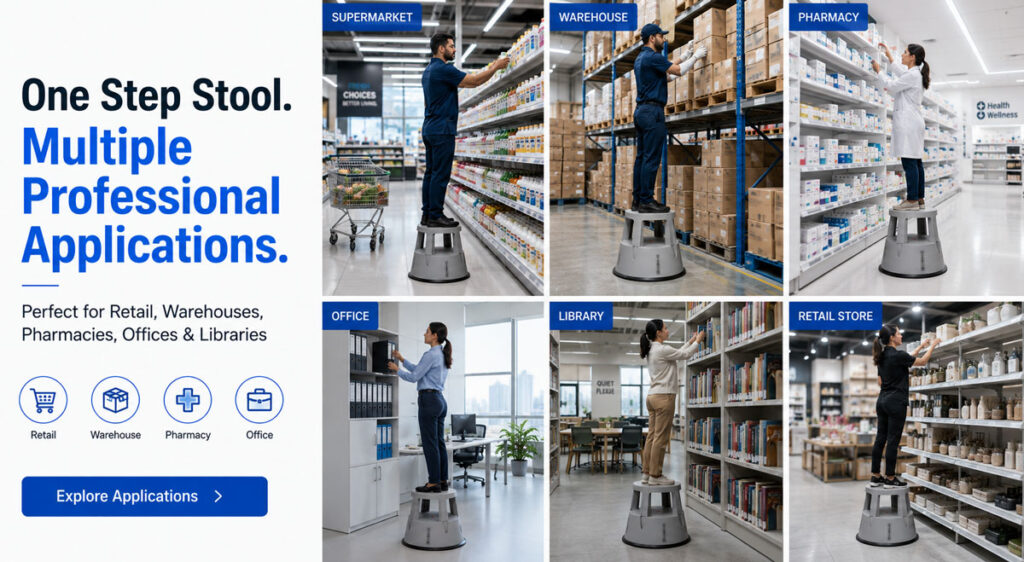

The Daily Friction That Empties High Shelves In a busy supermarket the difference between a full high shelf and an empty facing is often measured in minutes. When staff must search for a stable platform, drag a fixed ladder or hesitate because the surface feels uncertain under dust or residual moisture, those minutes accumulate. Customers walk past empty upper levels. Sales are lost. The store looks poorly maintained.
A professional mobile step stool that rolls freely when unloaded and locks the moment weight is applied removes the friction. The worker positions the unit exactly where needed, steps up with confidence, completes the facing or rotation, steps down and moves on. The shelf is restored before the next customer wave. The aisle stays open. Residual risk stays low.
Firmalazım’s current model is built for this exact retail sequence: 410 mm height, 283 mm top platform, 433 mm base, 150 kg rating, high-density plastic with permanent non-slip texture, and spring-loaded wheels that retract under load.
Retail Floor Conditions That Change Equipment Requirements Iraqi supermarket floors combine fine dust, frequent cleaning residue, temperature differences between sales areas and back-of-house zones, and continuous customer traffic. Platforms that perform in clean, stable environments can lose grip or become awkward under these conditions.
Deep moulded texture continues to provide contact points even when a light dust film is present. High-density plastic stays dimensionally stable across temperature ranges, resists impact and does not corrode. The automatic lock removes the most common residual risk with wheeled platforms—forgotten manual brakes—under the time pressure of peak trading hours. The compact base fits typical aisle clearances while still resisting tip-over during sideways reach.
How Mobility Protects Both Sales and Safety Every second saved on a high-shelf task is a second that can be used to face another bay or assist a customer. When the stool is light enough for one person to move, locks without a lever, and stays stable under a full case, the cumulative gain across a shift becomes visible in higher on-shelf availability and clearer customer pathways.
The same unit works in the warehouse retail zone for put-away, so the flow from receiving to shelf remains consistent.
Store-Level Patterns Across Iraqi Cities Dense urban stores in Baghdad experience continuous customer traffic. A stool that can be positioned and locked in one fluid motion keeps pathways open during evening replenishment. Southern operations in Basrah face higher humidity and dust; the textured surface continues to grip. Facilities in Mosul and Karbala run multiple shifts; the automatic lock keeps behaviour consistent regardless of which team is on duty.
Stores in Kirkuk and Najaf report fewer delayed facings after replacing fixed ladders. Large-format sites in Erbil and Nasiriyah use the same stools on the sales floor and in the warehouse retail area, simplifying training. Teams in Al Diwaniyah and Kut move the light units between categories without fatigue. Expanding locations in Amarah, Hillah and Baqubah specify the model because the dimensions already match their aisle and shelf profiles.
Southern and coastal sites in Ramadi, Kufa, Az Zubayr and Duhok place extra demand on grip under residual moisture. High-volume stores in Sulaymaniyah, Samawah, Abu Al-Khaseeb and Fallujah track measurable gains in facing speed. Locations in Samarra, Zakho, Shatrah, Al Hartha, Al Qurnah, Mahmudiyah, Jisr Diyala, Taji, Nahrawan, Abu Ghraib, Musayib, Hindiyah, Al Hashimiyah, Miqdadiyah, Rifai, Suq Al-Shuyukh, Al-Suwaira, Al-Fallujah and Al Shirqat benefit from one standardised platform that removes the need for different training or spare parts in each city.
Procurement Reality for Multi-City Retail Groups Unit price is only the entry figure. The real cost includes replacement frequency under dust and heat, time lost to unstable platforms, residual risk events, and the administrative burden of managing different models across cities. A commercial-grade professional mobile stool that stays in service for years under local conditions usually costs less over the full life cycle.
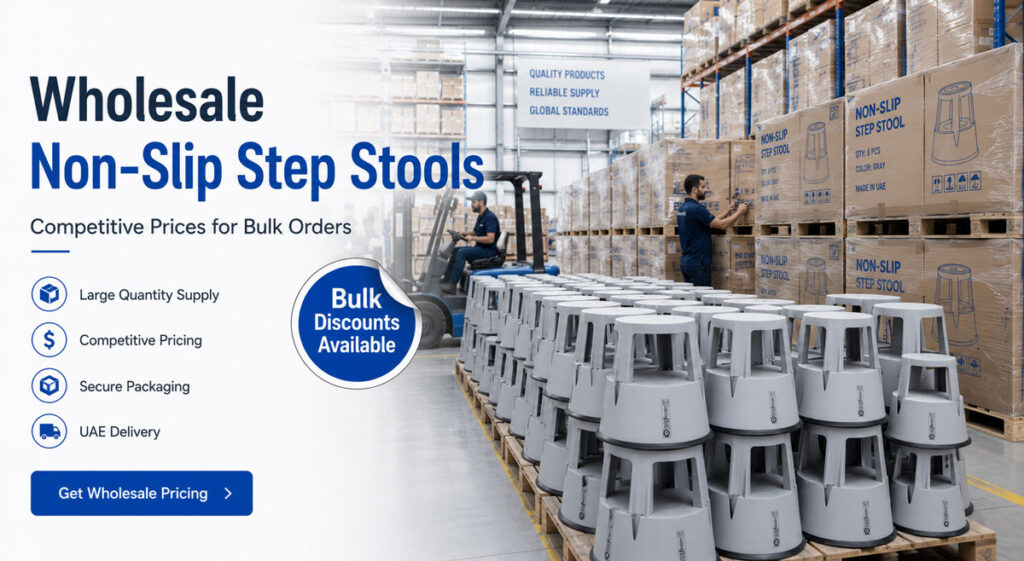
Wholesale volumes reduce the unit cost further. OEM options allow private labelling while the core locking and grip features stay identical. Distributor partners hold stock in key regions so that a damaged unit can be replaced the same day. Working with a manufacturer that understands commercial supermarket use keeps specifications consistent and documentation ready for internal audits.
Side-by-Side Reality Check
| Situation | Older Fixed or Light Platform | Firmalazım Professional Mobile Stool | Result on the Sales Floor |
|---|---|---|---|
| Dust film present | Grip falls | Texture still grips | Fewer slips |
| Light moisture after cleaning | Surface becomes risky | Texture holds | Continued confidence |
| Peak-hour replenishment | Ladder blocks aisle | Rolls in, locks, rolls out | Open pathways |
| End-of-shift fatigue | Heavy or awkward unit | Light, automatic lock | Higher remaining output |
| Multi-city training | Different models | One model everywhere | Uniform behaviour |
Practical Steps That Deliver Results Start with one high-traffic store. Place four to six units in the zones that generate the most delayed facings. Time the high-shelf tasks for two weeks before and two weeks after. Record near-misses and staff comments on effort. Once the numbers confirm the gain, expand through bulk orders. Keep the induction message identical in every city: step on and it locks, step off and it rolls. Add a ten-second visual check of wheels and texture to the existing daily routine.
Maintenance That Survives Real Shifts Wipe the textured steps during normal cleaning to remove dust. At shift change confirm the wheels still retract under weight. Once a week a supervisor checks for cracks or sticky movement. Any unit that fails is removed the same day and replaced from the nearest buffer stock. The design has so few moving parts that the routine stays short.
Mistakes That Quietly Destroy the Benefit Buying units with manual brakes that staff later ignore. Choosing narrow bases that feel tippy when reaching sideways. Accepting domestic-grade plastic that cracks after a few months of dust and temperature cycles. Allowing each city to select its own model. Ignoring the cumulative time cost of platforms that are slow to position.
Clear specification prevents all of them: automatic locking, deep non-slip texture, 150 kg capacity, stable 433 mm base, commercial-grade plastic, supplied by a manufacturer that supports bulk orders, OEM programmes and distributor networks.
Five Different Ways to Move Forward
- Run a controlled four-week test in one busy store and measure facing speed plus near-miss count.
- Ask for a wholesale price structure based on the number of stores you plan to equip this year.
- Discuss OEM branding if you need the stools to match your internal visual standards.
- Confirm which cities already have distributor stock for same-day replacement.
- Match the 410 mm height and 433 mm base against the actual shelf and aisle measurements in your current locations.
Closing View Empty high shelves are rarely a supply problem alone. They are an access problem. A professional mobile step stool that locks automatically, grips under dust and residual moisture, carries 150 kg and moves easily between bays removes that access problem. Firmalazım builds the unit for continuous commercial use in supermarket and warehouse retail environments across Iraq. Standardising on one reliable model simplifies training, inspection and replacement while protecting on-shelf availability and staff safety in every city from Baghdad to Al Shirqat.
Frequently Asked Questions
How quickly does the stool improve on-shelf availability? Most stores see measurable facing-speed gains within the first two weeks of consistent use.
Does fine dust really reduce grip on ordinary stools? Yes. Smooth or thinly coated surfaces lose friction rapidly once a dust film forms. Deep moulded texture continues to grip.
Is the automatic lock reliable after months of dusty conditions? When the wheels are kept free of heavy build-up through normal cleaning, the spring mechanism continues to retract and re-engage consistently.
Can one model serve both the sales floor and the warehouse retail area? Yes. The same construction and non-slip surfaces perform in both temperature and dust environments.
What volume makes wholesale pricing available? Once the order covers multiple stores or a planned multi-city roll-out, wholesale terms become available.
Is OEM branding possible for a national supermarket group? Yes. Private labelling and limited visual adjustments can be discussed for larger programmes.
How often should the textured surface be cleaned? Wiping during the normal daily cleaning cycle is normally sufficient to maintain grip performance.
What happens if a wheel becomes sticky with dust? Remove the unit from service, clean the mechanism if possible, or replace it from buffer stock.
Does the 150 kg rating cover typical Iraqi supermarket cases? Yes. It provides a clear margin for staff weight plus full cases of common grocery and household products.
How does standardisation across cities reduce cost? One model means one training programme, one inspection checklist, one spare-parts plan and simpler bulk purchasing.
Can smaller independent stores buy through a distributor? Yes. Regional distributors stock units for lower-volume requirements.
What documentation is provided with commercial orders? Load-capacity statements, material information and basic care instructions suitable for internal records.
Is the stool suitable when floors are still slightly damp after cleaning? The deep texture is designed to retain grip under the light residual moisture typical after routine cleaning.
How long do commercial-grade units typically last under local conditions? With basic daily cleaning and weekly inspection, multiple years of service is realistic.
What is the single biggest residual risk the design removes? The forgotten manual brake that leaves a wheeled platform free to move under load.
Firmalazım continues to supply professional mobile step stools built for the actual dust, temperature and traffic conditions of Iraqi supermarket floors and warehouse retail zones. Whether you need a single-store trial, a multi-city programme through bulk orders, or an OEM solution for network-wide consistency, the goal remains the same: keep high shelves full, aisles clear and staff safe in every location across Iraq.
Professional Mobile Step Stools for Retail Stores in Iraq
Professional mobile step stools protect both store presentation and staff safety on Iraqi supermarket floors. Firmalazım’s 2-step plastic model combines spring-loaded automatic locking, deep non-slip texturing, 150 kg capacity and a compact footprint that moves easily through busy aisles. Built for continuous commercial use, it enables rapid high-shelf facing without blocking customer pathways across supermarket stores and warehouse retail zones throughout Iraq.
The Visual Cost of Slow High-Shelf Access Customers judge a supermarket by what they see at eye level and above. Empty upper facings, blocked aisles during replenishment, or staff struggling with unstable platforms create an immediate impression of disorganisation. In competitive Iraqi retail environments that impression translates into lost baskets and weaker brand perception.
A professional mobile step stool that rolls into position and locks the instant weight is applied shortens the visible disruption. The worker moves the unit, steps up, restores the facing, steps down and clears the aisle—all within a single fluid sequence. The shelf looks full. The pathway stays open. Residual risk stays controlled.
Firmalazım’s model is engineered for this retail sequence under local conditions: 410 mm height, 283 mm top platform, 433 mm base, 150 kg rating, high-density plastic with permanent non-slip texture, and spring-loaded wheels that retract under load.
Floor Conditions That Affect Presentation and Safety Together Fine dust settles throughout the trading day. Cleaning leaves light residual moisture. Temperature differences between the sales floor and back-of-house warehouse retail areas add further variables. Platforms that lose grip or require complicated locking create both safety risk and longer visible disruption.
Deep moulded texture continues to provide contact points even when a light dust film is present. High-density plastic remains stable across temperature ranges, resists impact and does not corrode. The automatic lock removes the most common residual risk—forgotten manual brakes—under the time pressure of peak trading hours. The compact base fits typical aisle clearances while still resisting tip-over during sideways reach.
How Faster Facing Protects Customer Perception Every minute a high shelf stays empty is a minute of lost visual merchandising. When the stool is light enough for one person to move, locks without a lever, and stays stable under a full case, the facing is restored before the next customer wave. The store continues to look well-stocked and well-managed. Staff remain available for customer service rather than equipment management.
The same unit works in the warehouse retail zone, so the flow from receiving to shelf stays consistent and the sales floor is not starved of stock.
Presentation Patterns Across Iraqi Retail Cities Dense urban stores in Baghdad face continuous customer traffic. A stool that can be positioned and locked quickly keeps pathways open during evening replenishment and protects the visual standard. Southern operations in Basrah contend with higher humidity and dust; the textured surface continues to grip. Facilities in Mosul and Karbala run multiple shifts; the automatic lock keeps behaviour consistent across teams.
Stores in Kirkuk and Najaf report fewer prolonged empty facings after replacing fixed ladders. Large-format sites in Erbil and Nasiriyah use the same stools on the sales floor and in the warehouse retail area, simplifying training and maintaining uniform presentation standards. Teams in Al Diwaniyah and Kut move the light units between categories without creating extended aisle blockages. Expanding locations in Amarah, Hillah and Baqubah specify the model because the dimensions already match their aisle and shelf profiles.
Southern and coastal sites in Ramadi, Kufa, Az Zubayr and Duhok place extra demand on grip under residual moisture. High-volume stores in Sulaymaniyah, Samawah, Abu Al-Khaseeb and Fallujah track measurable gains in facing speed and aisle clarity. Locations in Samarra, Zakho, Shatrah, Al Hartha, Al Qurnah, Mahmudiyah, Jisr Diyala, Taji, Nahrawan, Abu Ghraib, Musayib, Hindiyah, Al Hashimiyah, Miqdadiyah, Rifai, Suq Al-Shuyukh, Al-Suwaira, Al-Fallujah and Al Shirqat benefit from one standardised platform that removes the need for different training or spare parts in each city.
Procurement Reality for Presentation-Focused Retail Groups Unit price is only the starting figure. The real cost includes replacement frequency under dust and heat, time lost to unstable platforms, residual risk events, and the administrative burden of managing different models across cities. A commercial-grade professional mobile stool that stays in service for years under local conditions usually costs less over the full life cycle.
Wholesale volumes reduce the unit cost further. OEM options allow private labelling while the core locking and grip features stay identical. Distributor partners hold stock in key regions so that a damaged unit can be replaced the same day. Working with a manufacturer that understands commercial supermarket use keeps specifications consistent and documentation ready for internal audits.
Presentation and Safety Comparison
| Situation | Older Fixed or Light Platform | Firmalazım Professional Mobile Stool | Effect on Store Presentation |
|---|---|---|---|
| Dust film present | Grip falls | Texture still grips | Faster, safer facing |
| Light moisture after cleaning | Surface becomes risky | Texture holds | No added hesitation |
| Peak-hour replenishment | Ladder blocks aisle | Rolls in, locks, rolls out | Pathways stay open |
| Prolonged empty high shelves | Slow access extends out-of-stocks | Rapid access restores facings | Stronger visual standard |
| Multi-city consistency | Different models | One model everywhere | Uniform brand experience |
Implementation That Protects Both Sales Floor and Brand Start with one high-traffic store. Place four to six units in the zones that generate the most visible empty facings or aisle blockages. Time the high-shelf tasks for two weeks before and two weeks after. Record near-misses, staff comments on effort, and any customer flow observations. Once the numbers confirm the gain, expand through bulk orders. Keep the induction message identical in every city: step on and it locks, step off and it rolls. Add a ten-second visual check of wheels and texture to the existing daily routine.
Maintenance That Keeps Presentation Equipment Reliable Wipe the textured steps during normal cleaning to remove dust. At shift change confirm the wheels still retract under weight. Once a week a supervisor checks for cracks or sticky movement. Any unit that fails is removed the same day and replaced from the nearest buffer stock. The design has so few moving parts that the routine stays short enough to survive real trading pressure.
Mistakes That Undermine Both Safety and Presentation Buying units with manual brakes that staff later ignore. Choosing narrow bases that feel tippy when reaching sideways. Accepting domestic-grade plastic that cracks after a few months of dust and temperature cycles. Allowing each city to select its own model. Ignoring the cumulative time cost of platforms that are slow to position and therefore leave shelves empty longer.
Clear specification prevents all of them: automatic locking, deep non-slip texture, 150 kg capacity, stable 433 mm base, commercial-grade plastic, supplied by a manufacturer that supports bulk orders, OEM programmes and distributor networks.
Five Distinct Routes to Better Floor Presentation
- Run a controlled four-week test in one busy store and measure facing speed, aisle blockage time and near-miss count.
- Ask for a wholesale price structure based on the number of stores you plan to equip this year.
- Discuss OEM branding if you need the stools to match your internal visual standards.
- Confirm which cities already have distributor stock for same-day replacement.
- Match the 410 mm height and 433 mm base against the actual shelf and aisle measurements in your current locations.
Closing Perspective Store presentation and staff safety are not separate issues. A professional mobile step stool that locks automatically, grips under dust and residual moisture, carries 150 kg and moves easily between bays protects both at the same time. Firmalazım builds the unit for continuous commercial use in supermarket and warehouse retail environments across Iraq. Standardising on one reliable model simplifies training, inspection and replacement while protecting on-shelf availability, aisle clarity and brand perception in every city from Baghdad to Al Shirqat.
Frequently Asked Questions
How does faster high-shelf access improve customer perception? Shelves stay full, aisles stay open, and staff remain available for service rather than equipment management—creating a stronger visual and service impression.
Does fine dust really affect ordinary stools more than textured commercial units? Yes. Smooth or thinly coated surfaces lose friction rapidly once a dust film forms. Deep moulded texture continues to grip.
Is the automatic lock reliable after months of dusty retail conditions? When the wheels are kept free of heavy build-up through normal cleaning, the spring mechanism continues to retract and re-engage consistently.
Can one model serve both the sales floor and the warehouse retail area? Yes. The same construction and non-slip surfaces perform in both temperature and dust environments.
What volume makes wholesale pricing available? Once the order covers multiple stores or a planned multi-city roll-out, wholesale terms become available.
Is OEM branding possible for a national supermarket group? Yes. Private labelling and limited visual adjustments can be discussed for larger programmes.
How often should the textured surface be cleaned under dusty conditions? Wiping during the normal daily cleaning cycle is normally sufficient to maintain grip performance.
What happens if a wheel becomes sticky with dust? Remove the unit from service, clean the mechanism if possible, or replace it from buffer stock.
Does the 150 kg rating cover typical Iraqi supermarket cases? Yes. It provides a clear margin for staff weight plus full cases of common grocery and household products.
How does standardisation across cities reduce cost and protect brand consistency? One model means one training programme, one inspection checklist, one spare-parts plan and a uniform appearance and behaviour in every store.
Can smaller independent stores buy through a distributor? Yes. Regional distributors stock units for lower-volume requirements.
What documentation is provided with commercial orders? Load-capacity statements, material information and basic care instructions suitable for internal records.
Is the stool suitable when floors are still slightly damp after cleaning? The deep texture is designed to retain grip under the light residual moisture typical after routine cleaning.
How long do commercial-grade units typically last under local retail conditions? With basic daily cleaning and weekly inspection, multiple years of service is realistic.
What single residual risk does the design most effectively remove? The forgotten manual brake that leaves a wheeled platform free to move under load during peak trading hours.
Firmalazım continues to supply professional mobile step stools built for the actual dust, temperature and traffic conditions of Iraqi supermarket floors and warehouse retail zones. Whether you need a single-store trial, a multi-city programme through bulk orders, or an OEM solution for network-wide consistency, the goal remains the same: keep high shelves full, aisles clear, staff safe and store presentation strong in every location across Iraq.
Professional Mobile Step Stools for Retail Stores Iraq
Continuing the Case for Professional Mobile Step Stools in Iraqi Retail Environments
Retail success in Iraqi supermarkets is built on the accumulation of small, reliable actions. High shelves that stay full, aisles that remain open during peak hours, and staff who can move confidently between tasks all contribute to stronger sales and lower residual risk. Professional mobile step stools engineered for continuous commercial use remove one of the most persistent sources of friction in that daily rhythm. Firmalazım’s 2-step plastic model—with spring-loaded automatic locking wheels, deep non-slip texturing, 150 kg capacity and compact dimensions—provides a practical platform matched to local floor conditions and traffic patterns.
Peak-Hour Dynamics and the Cost of Blocked Pathways During the busiest trading periods every extra minute a ladder or unstable platform occupies an aisle becomes visible to customers. Fixed equipment forces staff to work around customer flow or to pause replenishment until quieter moments. A mobile stool that rolls freely when unloaded and locks securely under weight allows one worker to complete high-shelf tasks without creating extended blockages.
The compact 433 mm base fits typical clearances. The automatic lock ensures stability once the worker is in position. The textured surface maintains grip even when fine dust or light residual moisture is present. The combination supports continuous facing without sacrificing the open, navigable feel that customers expect.
Dust Accumulation Across a Full Trading Day Fine dust does not appear all at once. It builds steadily. Platforms with smooth surfaces or thin coatings lose friction as the hours pass. By mid-afternoon a worker may be standing on a surface that feels less secure than it did at opening. Deep moulded texture continues to present contact points even as a light dust film forms. Routine wiping during normal cleaning restores full performance without special procedures.
This consistency keeps residual risk controlled and prevents the gradual rise in hesitation that slows facing as the day progresses.
Temperature Variation Between Sales Floor and Back-of-House Sales floors are usually climate-controlled. Adjacent warehouse retail zones often run warmer. Materials that expand, soften or become brittle under these differences introduce new variables. High-density plastic remains dimensionally stable, retains its textured grip and continues to support the rated 150 kg load. It stays light enough for any team member to reposition without strain, even at the end of a long shift.
Technical Consistency That Supports Multi-City Networks The Firmalazım unit delivers fixed, repeatable characteristics: overall height 410 mm, top platform diameter 283 mm, base diameter 433 mm, load capacity 150 kg, high-density plastic with deep non-slip texturing, and spring-loaded wheels that retract under load.
These specifications remain identical in every unit, supporting uniform training, identical inspection criteria and predictable replacement planning across multiple cities. The automatic lock removes the most common residual risk associated with wheeled platforms under the time pressure of peak trading hours.
Operational Patterns That Repeat Across Iraq Dense urban stores in Baghdad face continuous customer traffic. A stool that can be positioned and locked quickly keeps pathways open and high shelves restored during evening peaks. Southern operations in Basrah contend with higher humidity and dust loads; the textured surface continues to perform. Facilities in Mosul and Karbala run multiple shifts; the automatic lock keeps behaviour consistent regardless of which team is working.
Stores in Kirkuk and Najaf report fewer prolonged empty facings after replacing fixed ladders. Large-format sites in Erbil and Nasiriyah use the same stools on the sales floor and in the warehouse retail area, simplifying training and maintaining uniform standards. Teams in Al Diwaniyah and Kut move the light units between categories without creating extended aisle blockages. Expanding locations in Amarah, Hillah and Baqubah specify the model because the dimensions already match their aisle and shelf profiles.
Southern and coastal sites in Ramadi, Kufa, Az Zubayr and Duhok place extra demand on grip under residual moisture. High-volume stores in Sulaymaniyah, Samawah, Abu Al-Khaseeb and Fallujah track measurable gains in facing speed and aisle clarity. Locations in Samarra, Zakho, Shatrah, Al Hartha, Al Qurnah, Mahmudiyah, Jisr Diyala, Taji, Nahrawan, Abu Ghraib, Musayib, Hindiyah, Al Hashimiyah, Miqdadiyah, Rifai, Suq Al-Shuyukh, Al-Suwaira, Al-Fallujah and Al Shirqat benefit from one standardised platform that removes the need for different training or spare parts in each city.
Procurement Logic for Presentation and Safety Together Procurement teams evaluate residual risk, process consistency and lifetime cost under local conditions. A commercial-grade professional mobile stool that remains serviceable for several years under daily supermarket cycles and dust exposure usually delivers lower total cost than lighter units that require frequent replacement.
Wholesale pricing becomes relevant once volumes cover multiple cities. OEM programmes allow private labelling while the core locking and grip features remain unchanged. Distributor partners can hold regional stock, reducing lead times for individual stores. Engagement with a manufacturer experienced in commercial supermarket use improves documentation quality for operations and safety files.
Comparative Framework for Retail Decision Makers
| Factor | Fixed or Light-Duty Option | Professional Mobile Commercial Model | Impact on Iraqi Retail Floors |
|---|---|---|---|
| Grip under progressive dust | Declines through the day | Retained by deep texture | Controlled residual slip risk |
| Aisle obstruction during peaks | Higher | Lower – compact and mobile | Better customer flow |
| Locking reliability under pressure | Manual or none | Automatic under weight | Higher compliance |
| Facing speed for high shelves | Slower | Faster single-person cycle | Stronger visual standards |
| Service life under local conditions | Months | Multi-year commercial grade | Lower lifetime cost |
| Specification consistency | Variable | Uniform from manufacturer | Simplified multi-city management |
Implementation Pathway That Protects Both Sales and Safety
- Identify the highest-frequency high-shelf zones and measure actual aisle clearances.
- Confirm that the 410 mm height and 433 mm base fit the physical layout.
- Place trial units in one high-traffic store for two to four weeks.
- Record task times, near-miss counts, staff feedback and any customer-flow observations.
- Standardise and expand through bulk orders.
- Include the automatic lock behaviour in every induction.
- Add a short visual check of wheels and texture to daily routines.
This sequence turns a purchase into a controlled, measurable upgrade that can be repeated across cities.
Maintenance Discipline Under Dust and Trading Pressure Wipe textured surfaces during normal cleaning to remove dust films. Confirm at shift change that wheels retract under weight and roll freely when unloaded. Conduct a weekly supervisor inspection for cracks, worn texture or sticky movement. Remove any failing unit the same day and replace from regional buffer stock.
The simple design keeps the protocol short enough to survive real trading pressure.
Error-Prevention Protocol for Multi-City Managers
- Verify that every active stool retains fully functional spring-loaded wheels.
- Confirm that non-slip texturing has not been polished smooth by dust and cleaning cycles.
- Ensure base geometry continues to match local sideways-reach patterns.
- Remove damaged units immediately and log the reason.
- Keep induction content identical across all cities.
- Maintain a small regional buffer for rapid replacements.
- Review near-miss, facing-speed and aisle-flow data quarterly.
Consistent application prevents gradual performance decline.
Long-Term Network Value When every new store receives the same professional mobile step stool, training, inspection and replacement systems transfer without redesign. Bulk orders improve unit economics. OEM programmes support visual and process consistency. Distributor coverage expands with the store network.
The cumulative result is stronger store presentation, clearer peak-hour aisles, higher on-shelf availability and lower residual risk across the entire supermarket footprint in Iraq.
Five Practical Next Steps
- Run a four-week trial in one high-volume store and measure facing speed, aisle blockage time and near-miss frequency.
- Request a multi-year wholesale quotation based on current store count and planned openings.
- Explore OEM branding if private-label consistency is required.
- Map regional distributor coverage for rapid replacement capability.
- Align stool dimensions with actual shelf heights and aisle widths across the network.
Strategic Close Professional mobile step stools remove friction from the daily work of keeping high shelves full and aisles clear under the specific dust, temperature and traffic conditions found in Iraqi supermarkets. Automatic locking, reliable textured grip, adequate load capacity and compact mobility combine to support stronger visual standards and more consistent safety behaviour. Firmalazım supplies these units as a manufacturer focused on commercial use, bulk orders, OEM programmes and distributor networks. Standardising on one reliable design simplifies every supporting process while delivering measurable gains in presentation, residual risk reduction and operational consistency across multiple Iraqi cities.
Further Frequently Asked Questions
How does faster high-shelf access improve customer perception of the store? Shelves stay full, aisles stay open, and staff remain available for service rather than equipment management—creating a stronger overall impression.
What is the most practical way to measure improvement after introducing the stools? Time a representative sample of high-shelf tasks before and after, combined with near-miss logs and short observations of aisle blockage during peak periods.
Can the stools support both routine facing and larger promotional display changes? Yes. The same mobility and stability characteristics serve continuous daily tasks and higher-volume display resets.
How does progressive dust accumulation affect ordinary platforms more than textured commercial units? Smooth or thinly coated surfaces lose friction as a dust film builds. Deep moulded texture continues to provide contact points throughout the trading day.
What buffer stock level is practical for a regional cluster of stores? A small number of spare units per cluster is usually sufficient to cover immediate replacements while new stock is ordered.
How are multi-year supply agreements typically structured? They combine volume commitments with scheduled delivery windows and the option to adjust quantities as the store network evolves.
Does standardisation simplify multi-city management and brand consistency? Yes. Identical equipment and documented inspection routines produce clearer audit trails and a uniform experience in every store.
What is the recommended response if a stool begins to show surface wear or reduced wheel response? Remove it from service at the first sign of compromised performance and replace it from buffer stock.
Can the design support more reliable digital task systems? While the stool itself is mechanical, its consistent availability and predictable behaviour reduce the variability that often undermines digital task completion tracking.
How does the automatic lock influence near-miss trends during peak hours? Stores that standardise on automatic locking typically record fewer incidents linked to platform movement under load.
Is the product suitable for stores that operate mixed ambient and chilled zones? Yes. The construction and non-slip surfaces perform across the temperature ranges common in Iraqi supermarket environments.
What long-term partnership benefits arise from repeated bulk orders and potential OEM collaboration? Deeper technical alignment, priority production scheduling, refined specifications over successive programmes, and stronger continuity of supply as the network expands.
Firmalazım continues to supply professional mobile step stools matched to the real operating conditions of Iraqi supermarket floors and warehouse retail zones. Whether the requirement is a focused trial, a multi-city programme through bulk orders, or an OEM solution for network-wide consistency, the priority remains safer, faster work at height that keeps high shelves full, aisles clear and store presentation strong across Iraq.
Staff Confidence, Promotional Agility and Brand Equity Through Professional Mobile Step Stools in Iraqi Supermarkets
Iraqi supermarket floors operate under continuous pressure to keep high shelves full, aisles open and visual standards high. Staff move between routine facing, promotional set-ups and customer service within the same shift. Any platform that feels unstable, requires extra locking steps or loses grip under dust adds hesitation exactly when speed and confidence are most needed.
Professional mobile step stools engineered for continuous commercial use remove that hesitation. Firmalazım’s 2-step plastic model—with spring-loaded automatic locking wheels, deep non-slip texturing, 150 kg capacity and compact dimensions—gives teams a reliable tool that supports both daily operations and longer-term brand perception across supermarket stores and warehouse retail zones in Iraq.
Confidence Under Peak Trading Pressure During the busiest hours staff attention is divided between customers, replenishment and the physical act of reaching high levels. A platform that requires a separate locking action or that feels uncertain underfoot creates a split-second decision that is easily skipped or that slows the entire sequence.
Spring-loaded wheels remove the decision. The platform locks the moment weight is applied and becomes mobile again the moment the worker steps off. The textured surface maintains grip even when fine dust or light residual moisture is present. The result is higher confidence, faster task completion and lower residual risk when the store is most visible to customers.
Promotional Cycles and the Need for Rapid, Safe Access Promotional displays and seasonal changes often require temporary high-level work in addition to routine facing. Fixed ladders or awkward platforms extend the time the aisle is disrupted and increase the chance of product damage or residual incidents. A mobile stool that can be positioned quickly, locked automatically and moved clear once the task is finished keeps the promotional window short and the visual impact positive.
The same unit then returns to routine high-shelf rotation, so the store does not need separate equipment for different task types.
Technical Foundations That Remain Consistent The Firmalazım unit delivers fixed specifications: overall height 410 mm, top platform diameter 283 mm, base diameter 433 mm, load capacity 150 kg, high-density plastic with deep non-slip texturing, and spring-loaded wheels that retract under load.
These characteristics stay identical across every unit, supporting uniform training and inspection in every city. The 410 mm height reaches the majority of standard supermarket shelf levels. The 433 mm base resists tip-over during sideways reach. The 150 kg rating covers staff weight plus typical full cases. The automatic lock and textured surface address the most common residual risks under local dust and cleaning conditions.
Material Behaviour Across a Full Trading Day Fine dust builds progressively. High-density plastic with deep moulded texture continues to provide contact points even as a light film forms. Routine wiping during normal cleaning restores full grip. Temperature differences between the sales floor and warehouse retail zones do not affect dimensional stability or load capacity. The grey finish conceals fine scuffs and maintains a professional appearance under bright store lighting.
City-Level Realities That Shape Daily Use Dense urban stores in Baghdad experience continuous customer traffic. A stool that locks automatically and moves clear quickly protects both facing speed and pathway clarity during evening peaks. Southern operations in Basrah face higher humidity and dust; the textured surface continues to perform. Facilities in Mosul and Karbala run multiple shifts; the automatic lock keeps behaviour consistent across teams.
Stores in Kirkuk and Najaf report fewer prolonged empty facings after replacing fixed ladders. Large-format sites in Erbil and Nasiriyah use the same stools on the sales floor and in the warehouse retail area, simplifying training. Teams in Al Diwaniyah and Kut move the light units between categories without creating extended blockages. Expanding locations in Amarah, Hillah and Baqubah specify the model because the dimensions already match local aisle and shelf profiles.
Southern and coastal sites in Ramadi, Kufa, Az Zubayr and Duhok place extra demand on grip under residual moisture. High-volume stores in Sulaymaniyah, Samawah, Abu Al-Khaseeb and Fallujah track measurable gains in facing speed and aisle clarity. Locations in Samarra, Zakho, Shatrah, Al Hartha, Al Qurnah, Mahmudiyah, Jisr Diyala, Taji, Nahrawan, Abu Ghraib, Musayib, Hindiyah, Al Hashimiyah, Miqdadiyah, Rifai, Suq Al-Shuyukh, Al-Suwaira, Al-Fallujah and Al Shirqat benefit from one standardised platform that removes the need for different training or spare parts in each city.
Procurement Perspective: Brand Equity and Residual Risk Together Procurement teams evaluate residual risk, process consistency and lifetime cost under local conditions. A commercial-grade professional mobile stool that remains serviceable for several years under daily supermarket cycles and dust exposure usually delivers lower total cost than lighter units that require frequent replacement.
Wholesale pricing becomes relevant once volumes cover multiple cities. OEM programmes allow private labelling while the core locking and grip features remain unchanged. Distributor partners can hold regional stock, reducing lead times. Engagement with a manufacturer experienced in commercial supermarket use improves documentation quality for operations and safety files.
Comparative View for Retail Leaders
| Factor | Fixed or Light-Duty Option | Professional Mobile Commercial Model | Impact on Store Experience |
|---|---|---|---|
| Confidence under peak pressure | Lower – extra decisions | Higher – automatic lock | Faster, safer facing |
| Aisle disruption during promotions | Higher | Lower – rapid in-and-out | Stronger visual impact |
| Grip under progressive dust | Declines through the day | Retained by deep texture | Consistent residual risk control |
| Multi-city consistency | Variable | Uniform from manufacturer | Uniform brand presentation |
| Service life under local conditions | Months | Multi-year commercial grade | Lower lifetime cost |
Implementation That Builds Both Safety and Presentation
- Identify the zones that generate the most visible empty facings or aisle blockages.
- Confirm that the 410 mm height and 433 mm base fit the physical layout.
- Place trial units in one high-traffic store for two to four weeks.
- Record task times, near-miss counts, staff confidence feedback and any customer-flow observations.
- Standardise and expand through bulk orders.
- Include the automatic lock behaviour in every induction.
- Add a short visual check of wheels and texture to daily routines.
This sequence turns a purchase into a controlled upgrade that protects both daily operations and longer-term brand perception.
Maintenance That Keeps Equipment Presentation-Ready Wipe textured surfaces during normal cleaning to remove dust films. Confirm at shift change that wheels retract under weight and roll freely when unloaded. Conduct a weekly supervisor inspection for cracks, worn texture or sticky movement. Remove any failing unit the same day and replace from regional buffer stock.
The simple design keeps the protocol short enough to survive real trading pressure.
Error-Prevention for Multi-City Retail Groups
- Verify that every active stool retains fully functional spring-loaded wheels.
- Confirm that non-slip texturing has not been polished smooth by dust and cleaning.
- Ensure base geometry continues to match local sideways-reach patterns.
- Remove damaged units immediately and log the reason.
- Keep induction content identical across all cities.
- Maintain a small regional buffer for rapid replacements.
- Review near-miss, facing-speed and aisle-flow data quarterly.
Consistent application prevents gradual performance decline.
Long-Term Brand and Operational Value When every new store receives the same professional mobile step stool, training, inspection and replacement systems transfer without redesign. Bulk orders improve unit economics. OEM programmes support visual and process consistency. Distributor coverage expands with the store network.
The cumulative result is stronger store presentation, clearer peak-hour aisles, higher on-shelf availability and lower residual risk across the entire supermarket footprint in Iraq.
Five Practical Next Steps
- Run a four-week trial in one high-volume store and measure facing speed, aisle blockage time and staff confidence feedback.
- Request a multi-year wholesale quotation based on current store count and planned openings.
- Explore OEM branding if private-label consistency is required.
- Map regional distributor coverage for rapid replacement capability.
- Align stool dimensions with actual shelf heights and aisle widths across the network.
Strategic Close Professional mobile step stools support both the daily work of keeping high shelves full and the longer-term goal of consistent, confident store presentation under the specific conditions found in Iraqi supermarkets. Automatic locking, reliable textured grip, adequate load capacity and compact mobility combine to protect staff safety and brand perception at the same time. Firmalazım supplies these units as a manufacturer focused on commercial use, bulk orders, OEM programmes and distributor networks. Standardising on one reliable design simplifies every supporting process while delivering measurable gains across multiple Iraqi cities.
Further Frequently Asked Questions
How does higher staff confidence under peak pressure translate into store performance? Faster facing, fewer hesitations, lower residual risk and more time available for customer service.
What is the most practical way to measure improvement in promotional set-up times? Time a representative sample of high-level promotional tasks before and after introduction, combined with observations of aisle blockage duration.
Can the stools handle both routine facing and frequent promotional changes? Yes. The same mobility and stability characteristics serve continuous daily tasks and higher-intensity display work.
How does progressive dust specifically affect staff confidence on ordinary platforms? As grip declines through the day, hesitation increases. Deep moulded texture maintains consistent contact points and confidence.
What buffer stock level is practical for a regional cluster of stores? A small number of spare units per cluster is usually sufficient to cover immediate replacements while new stock is ordered.
How are multi-year supply agreements typically structured? They combine volume commitments with scheduled delivery windows and the option to adjust quantities as the store network evolves.
Does standardisation strengthen brand consistency across cities? Yes. Identical equipment and behaviour in every store support a uniform customer experience and simpler internal standards.
What is the recommended response if a stool begins to show surface wear or reduced wheel response? Remove it from service at the first sign of compromised performance and replace it from buffer stock.
Can the design support more reliable digital task systems? While the stool itself is mechanical, its consistent availability and predictable behaviour reduce the variability that often undermines digital task completion tracking.
How does the automatic lock influence near-miss trends during peak trading hours? Stores that standardise on automatic locking typically record fewer incidents linked to platform movement under load.
Is the product suitable for stores that operate mixed ambient and chilled zones? Yes. The construction and non-slip surfaces perform across the temperature ranges common in Iraqi supermarket environments.
What long-term partnership benefits arise from repeated bulk orders and potential OEM collaboration? Deeper technical alignment, priority production scheduling, refined specifications over successive programmes, and stronger continuity of supply as the network expands.
Firmalazım continues to supply professional mobile step stools matched to the real operating conditions of Iraqi supermarket floors and warehouse retail zones. Whether the requirement is a focused trial, a multi-city programme through bulk orders, or an OEM solution for network-wide consistency, the priority remains safer, faster work at height that keeps high shelves full, aisles clear, staff confident and store presentation strong across Iraq.

Bir yanıt yazın