


Professional Wheeled Step Stools for Retail Stores in UAE
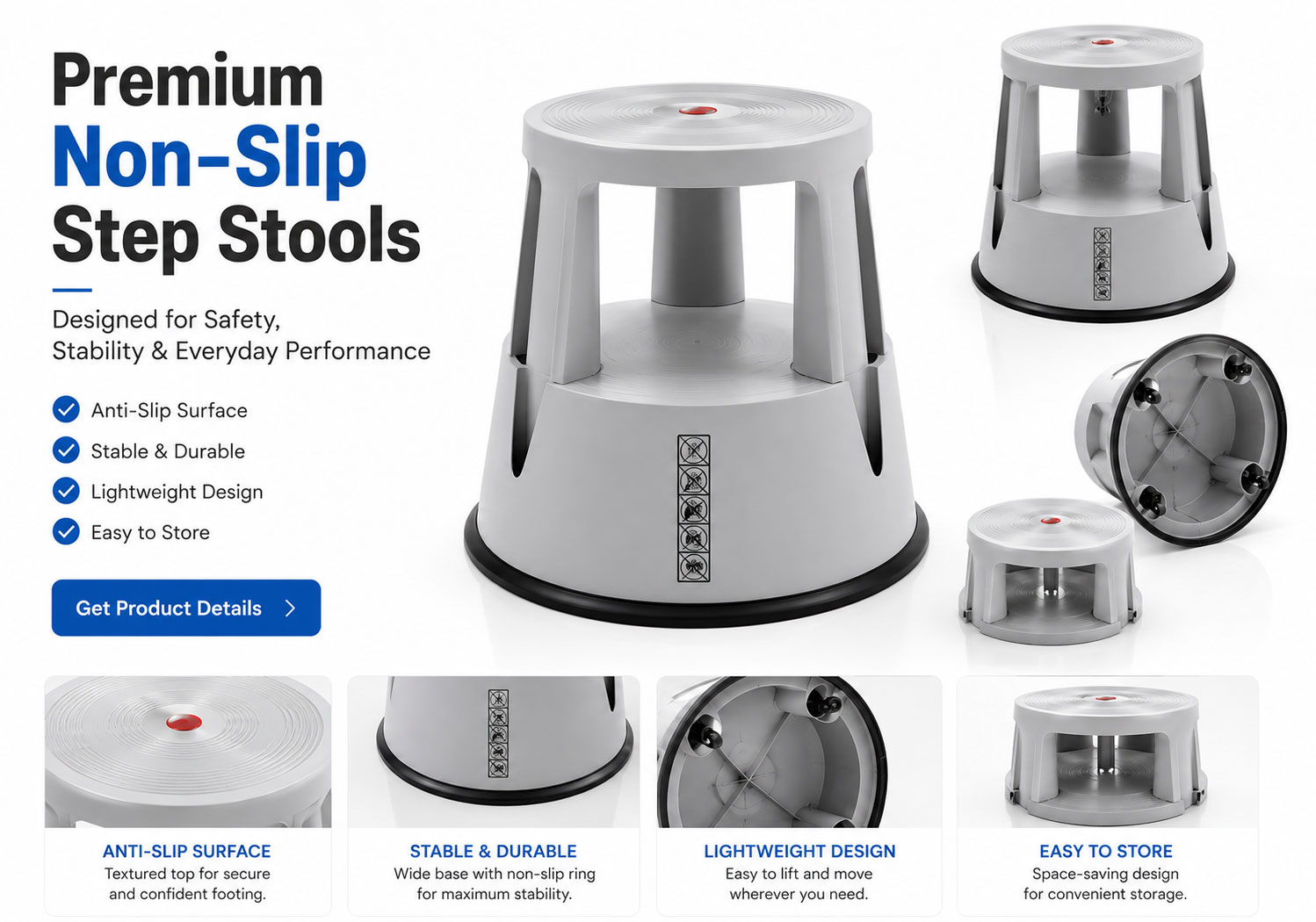
Professional Wheeled Step Stools for Retail Stores in UAE give retail store teams in the UAE fast, stable access to upper shelves during daily restocking and merchandising. A proven 2-step design delivers 150 kg load capacity, spring-loaded non-marking wheels that lock under weight, a textured non-slip surface, 410 mm height, 283 mm top diameter and 433 mm base diameter. Firmalazım supplies these units for commercial use across supermarket and retail environments, with logistics reach into facilities linked to Jebel Ali, JAFZA, Dubai Industrial City, Al Quoz, Ras Al Khor, Al Qusais, Umm Ramool, Dubai South, Deira, Al Warsan and Dubai Investment Park (DIP).







Professional Wheeled Access Designed for UAE Retail Floors
Retail stores and supermarkets in the UAE operate under constant visual and operational pressure. Shelves must look full. Aisles must stay clear. Floors must remain unmarked. Staff move quickly between planograms, promotional displays and back-stock locations. A static stool slows the team. A light domestic stool slides or leaves black marks on polished tile. The equipment that solves the daily problem is a professional wheeled step stool built for continuous commercial use.
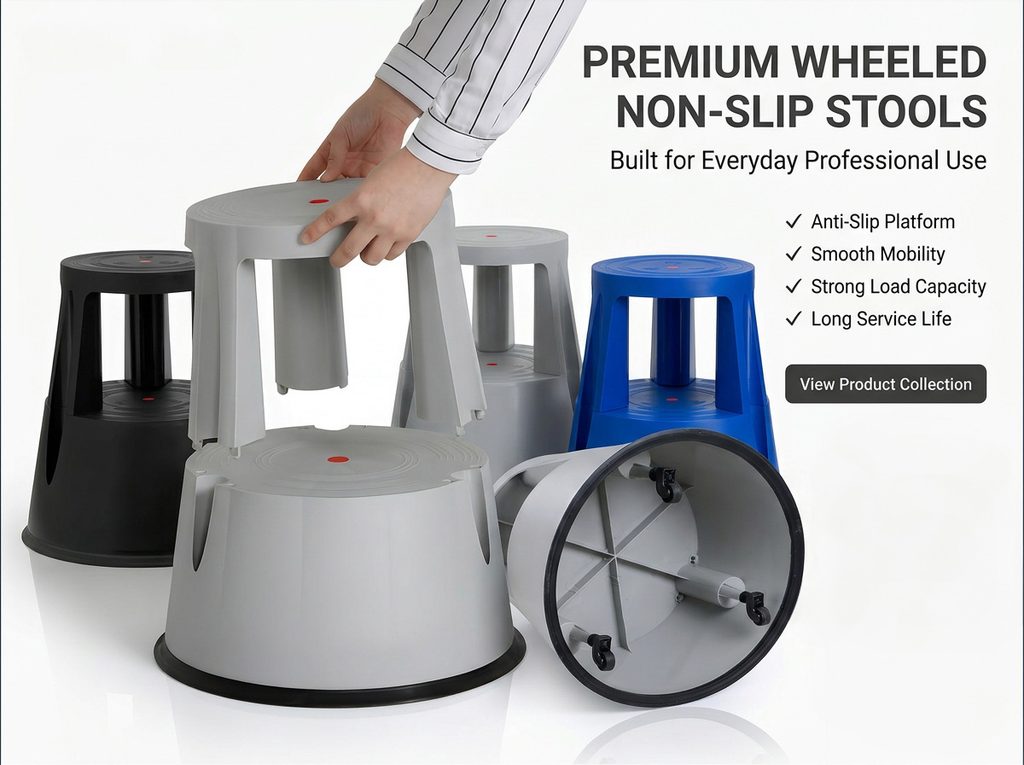
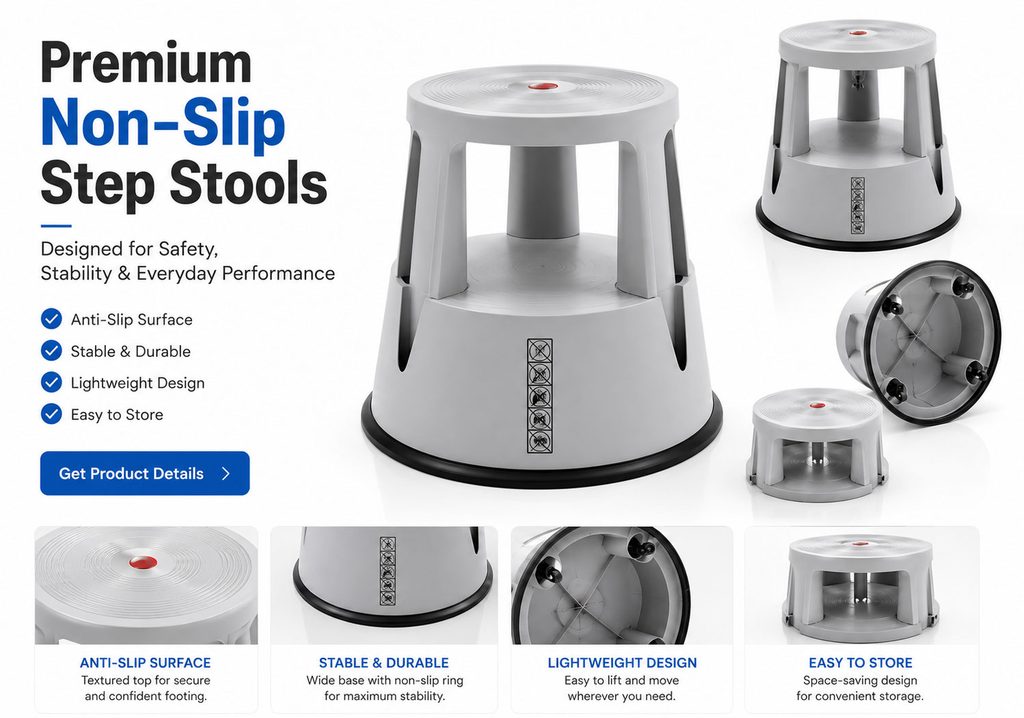
The reference 2-step plastic model illustrates the required performance: spring-loaded wheels, non-slip textured platform, 150 kg capacity, overall height of 410 mm, top diameter 283 mm and base diameter 433 mm. These dimensions provide a practical boost for typical retail shelving while keeping the unit compact enough for narrow aisles and stable enough for safe standing work.
Why Professional Specification Matters on the Sales Floor
A professional wheeled step stool is defined by three behaviours that lighter alternatives rarely combine:
- Free rolling when empty so staff can move it in seconds
- Automatic lock or retraction under body weight so the platform cannot roll while in use
- Non-marking contact surfaces that protect polished retail floors
When these three elements are present, restocking and merchandising become faster and cleaner. When any element is missing, the stools are either avoided or create secondary problems that store managers notice immediately.
Technical Profile for Retail Environments
| Attribute | Professional Target | Retail Benefit |
|---|---|---|
| Load capacity | 150 kg continuous | Covers staff + product under normal dynamic load |
| Steps | 2 | Matches common upper-shelf reaches |
| Height | 410 mm | Practical boost without excess bulk |
| Top / base diameter | 283 mm / 433 mm | Secure footing + wide stable footprint |
| Mobility | Spring-loaded non-marking wheels | Rapid movement + automatic stability |
| Surface | Textured non-slip | Grip retained after cleaning |
| Material | Heavy-duty plastic | Lightweight, cleanable, durable under daily use |
A manufacturer that produces to this profile enables retailers to standardise across multiple stores. Bulk Orders become straightforward once the specification is locked. OEM options allow private labelling or minor dimensional adjustments when required. Wholesale pricing rewards volume commitments, while a reliable distributor network ensures units and spare parts reach stores and supporting locations across the listed Dubai zones.
Material Behaviour on UAE Retail Floors
Polished tile and epoxy finishes common in UAE supermarkets show marks quickly. Non-marking wheel compounds are therefore essential. The textured platform must continue to grip after night cleaning leaves residual moisture. Heavy-duty plastic constructions resist many cleaning chemicals, remain light enough for frequent movement, and maintain rigidity under the 150 kg rating. These material choices determine whether the stool remains an asset for years or becomes a source of floor complaints and early replacement.
Daily Use Cases in Retail and Supermarket Settings
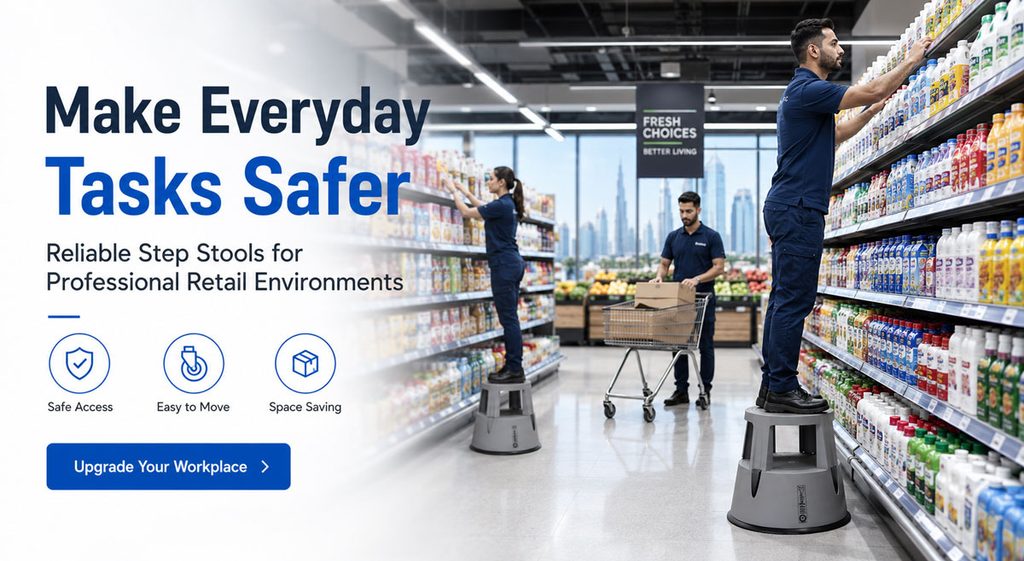
Sales-floor restocking Staff roll the stool along the aisle, step on for upper shelves, place product, step off and continue. The automatic lock frees both hands. The non-marking wheels leave no trail.
Promotional display building Temporary end-of-aisle or island displays often require repeated access to higher levels. A wheeled unit moves with the team and keeps the work area clear.
Back-of-house to sales-floor transition Units used in stockrooms can travel with the replenishment trolley onto the sales floor, reducing the need for separate equipment sets.
Multi-store consistency Retail groups operating across Deira, Al Warsan and stores fed by warehouses in Al Quoz, DIP or Dubai South gain the greatest benefit from a single professional model. Training, spare parts and safety expectations remain uniform.
Safety as an Everyday Retail Requirement
Safety on the retail floor is both a legal expectation and a brand requirement. Customers notice disorder. Staff notice unstable equipment. A professional wheeled step stool with documented 150 kg capacity, automatic stability under weight and a textured non-slip surface reduces the likelihood of slips and tip-related incidents during routine restocking. When the supply approach treats Safety as a continuous requirement rather than an afterthought, the stools become part of the store’s standard operating equipment.
Cost Perspective for Retail Procurement
Unit price is only the visible cost. A complete view includes:
- Service life under daily retail cycling
- Replacement frequency across a multi-store network
- Time saved in restocking and merchandising
- Floor-protection value of non-marking wheels
- Reduction in near-miss reports
Retailers who evaluate these factors typically find that professional wheeled units supplied through structured Wholesale and Distributor channels deliver lower total cost than repeated purchases of lighter alternatives.
Common Errors in Retail Equipment Selection
- Choosing the lowest-priced stool without verifying lock-up behaviour
- Ignoring non-marking performance on polished floors
- Overlooking wet-grip performance after cleaning
- Operating different models in different stores
- Neglecting spare-parts availability
- Treating the purchase as a one-time event rather than a fleet decision
A clear specification and a supply partner capable of supporting Commercial Use at scale prevent these errors.
Practical Selection Checklist for Retail Buyers
- Confirm maximum staff-plus-product load and retain margin
- Require spring-loaded or equivalent automatic stability
- Specify textured non-slip surface and non-marking wheels
- Match height and platform size to dominant shelf intervals
- Evaluate cleanability for hygiene-sensitive categories
- Confirm spare-parts lead times
- Pilot in a high-traffic store before network rollout
- Standardise across the retail estate
- Align volume with Manufacturer capacity, Bulk Orders potential, OEM flexibility, Wholesale pricing and Distributor logistics so that Commercial Use in Warehouse, Retail and Supermarket environments remains consistent and Safety is protected
Expert Note on Adoption
Store managers repeatedly observe the same pattern. Once staff confirm that the stool locks securely under their weight and does not mark the floor, utilisation rises quickly. The equipment stops being “something we have to use” and becomes “the normal way we reach the top shelf.” That shift is the practical definition of successful professional specification.
Maintenance for Continuous Retail Duty
Daily visual checks of tread and wheels take seconds. Regular cleaning removes cleaning residue. Periodic functional tests confirm that the spring-loaded mechanism still locks under weight. Timely replacement of wear parts keeps performance consistent across every store.
Firmalazım Role in Retail Supply
Firmalazım focuses on professional wheeled step stools suited to UAE retail and supermarket floors. The emphasis is practical performance — 150 kg class capacity, spring-loaded non-marking mobility, textured non-slip surfaces and stable geometry — supported by Manufacturer quality, Bulk Orders capability, OEM flexibility, Wholesale structures and Distributor reach that together enable reliable Commercial Use in Warehouse, Retail and Supermarket settings while prioritising Safety.
Frequently Asked Questions (FAQ)
1. What makes a wheeled step stool “professional” for UAE retail stores? Automatic lock under weight, non-marking wheels, textured non-slip surface, industrial load capacity and construction designed for daily commercial cycling rather than occasional use.
2. How does the spring-loaded system help on the sales floor? The unit rolls freely when empty for rapid movement, then locks automatically so staff can work with both hands free.
3. Is 150 kg capacity sufficient for typical retail restocking? It covers most staff plus product. Stores with heavier loads may specify higher ratings.
4. Why are non-marking wheels essential in UAE retail? Polished tile and epoxy show marks quickly. Non-marking compounds protect floor appearance and reduce complaints.
5. How do these stools perform after night cleaning? Textured non-slip surfaces retain grip better than smooth platforms when residual moisture is present.
6. Can the same model be used in stockrooms and on the sales floor? Yes, when the specification meets the duty requirements of both areas.
7. How does a Manufacturer support consistent quality across large retail orders? Through controlled production processes and batch consistency that keep dimensions, wheel behaviour and tread texture uniform.
8. What role do Bulk Orders play for multi-store retailers? They improve unit economics and secure supply continuity across the network.
9. Can OEM adjustments be made for specific retail requirements? Yes. Minor dimensional or branding changes are often possible once volume is clear.
10. How does Wholesale pricing benefit retail groups? Volume commitments unlock better commercial terms while still allowing phased delivery to individual stores.
11. Why is a reliable Distributor important for UAE retail networks? Because stores and supporting locations are spread across zones such as Deira, Al Warsan, Al Quoz and DIP; local or regional logistics keep lead times short.
12. What does Commercial Use require that domestic stools lack? Higher cycle durability, reliable lock-up, non-marking performance and cleanability under daily retail conditions.
13. How do these stools perform in Warehouse areas that feed Retail stores? The same professional specification supports mid-level access in both environments, simplifying equipment standardisation.
14. Why is standardisation valuable across a Supermarket estate? One model means uniform training, one spare-parts list and consistent Safety expectations in every store.
15. How do professional wheeled stools contribute to Safety on the retail floor? By providing automatic stability, non-slip surfaces and documented load capacity that reduce slip and tip risks during routine work.
16. What documentation should retailers request? Load-rating information, material specifications and any batch or performance statements needed for internal audits.
17. Should store operations and HSE teams both be involved in selection? Yes. Their combined input improves both daily usability and formal Safety compliance.
18. How should a pilot be structured in a retail environment? Deploy units in one high-traffic store, gather staff feedback on mobility, lock-up and floor condition, then measure any change in restocking speed.
19. What is the most common procurement mistake? Focusing only on unit price while under-specifying lock-up behaviour and non-marking performance.
20. How long should a professional unit last under daily retail use? Several years with basic maintenance is realistic when the specification is industrial rather than domestic.
21. Can colour or asset tagging be added for store-level control? Many supply arrangements support these options for visual management and inventory tracking.
22. How should spare parts be managed across multiple retail locations? Centralise on one wheel and tread specification and maintain buffer stock through the Distributor layer.
23. Are these stools suitable for promotional display work? Yes. Their mobility and automatic stability make them practical for temporary high-level merchandising tasks.
24. What maintenance keeps performance consistent? Regular cleaning of treads and wheels, visual checks, and functional verification of the lock-up mechanism.
25. How does the 433 mm base improve daily Safety? The wider footprint increases resistance to tip-over when staff reach sideways or upward.
26. Can the stools be used in both dry grocery and wetter produce areas? Yes, provided the tread and wheel compounds have been validated for residual moisture; enhanced options exist for persistently wet zones.
27. What is the practical next step after a successful store pilot? Lock the specification, aggregate volume across the estate, and formalise supply and spare-parts arrangements.
28. How transparent should lead times and stock levels be? High transparency allows accurate planning for new store openings, refits and peak trading periods.
29. Does the same professional model work for convenience stores and hypermarkets? In most cases yes; height and capacity can be adjusted if shelf profiles differ significantly.
30. Why choose Firmalazım for professional wheeled step stools in UAE retail? Because the focus is practical performance for local retail floors, supported by Manufacturer quality, Bulk Orders capability, OEM flexibility, Wholesale structures and Distributor reach that together enable reliable Commercial Use in Warehouse, Retail and Supermarket settings while protecting Safety.
Five Distinct Calls to Action
- Store-level specification request Share your typical shelf heights, floor finishes and number of locations. Firmalazım will return a professional wheeled step stool recommendation matched to UAE retail conditions.
- High-traffic store pilot Request a controlled pilot quantity for one busy location. Validate mobility, automatic lock-up, non-slip grip and staff feedback before wider rollout.
- Multi-store volume discussion Planning to standardise across several sites linked to Deira, Al Warsan, Al Quoz or DIP? Begin the conversation with your store count and preferred delivery model.
- Total-cost and floor-protection review Ask for a comparison that includes service life, restocking time and non-marking performance so the business case is complete.
- Retail supply partnership enquiry Engage Firmalazım to structure ongoing supply that supports Manufacturer consistency, Bulk Orders efficiency, OEM options where needed, Wholesale pricing and Distributor logistics for reliable Commercial Use across your Warehouse, Retail and Supermarket network while prioritising Safety.
Firmalazım supplies professional wheeled step stools engineered for the daily realities of UAE retail and supermarket floors. Reliable spring-loaded mobility, textured non-slip surfaces, non-marking protection and practical 150 kg capacity are combined with supply structures that keep quality and availability consistent across the key industrial and retail zones of Dubai.
Professional Wheeled Step Stools for Retail Stores UAE
UAE retail floors present a unique combination of demands. Polished tile must stay unmarked. Aisles must remain open for customers. Restocking windows are short. Night cleaning often leaves residual moisture that is still present when the early shift begins. A professional wheeled step stool must satisfy all of these constraints at once.
The 2-step design with 410 mm height, 283 mm top platform and 433 mm base provides a practical working height for the majority of supermarket and retail shelving while remaining compact enough to move between narrow gondolas. Spring-loaded wheels allow the unit to travel with the restocking trolley and then lock automatically when the operator steps on. The textured non-slip surface maintains grip even when the floor is not completely dry. Non-marking compounds protect the expensive floor finish that store managers are measured on.
When these elements work together, the stool becomes invisible infrastructure. Staff stop thinking about access equipment and simply use it. That is the practical definition of professional specification in a retail environment.
Linking Retail Floors to Supporting Logistics Zones
Many UAE supermarket and retail groups maintain stockrooms, cross-docks or regional distribution points in or near Jebel Ali, JAFZA, Dubai Industrial City, Al Quoz, Ras Al Khor, Al Qusais, Umm Ramool, Dubai South, Deira, Al Warsan and Dubai Investment Park. Equipment decisions made for the sales floor should ideally align with equipment used in these supporting locations. A single professional wheeled step stool model that performs in both the Warehouse and the Retail environment simplifies training, spare-parts management and Safety expectations across the entire chain.
A Manufacturer that can deliver consistent batches enables this alignment. Bulk Orders across multiple sites improve commercial terms. OEM flexibility allows minor adjustments when a particular store format requires it. Wholesale structures reward volume while a capable Distributor ensures units and wear parts reach both the industrial zones and the individual retail locations.
Human Factors on the Sales Floor
Retail staff develop strong preferences within days. A stool that feels solid, locks decisively and leaves no marks is adopted. A stool that flexes, hesitates or scuffs the floor is quietly avoided. The result is that investment in under-specified equipment is often wasted because utilisation remains low. Heavy-Duty Wheeled Step Stools for Warehouses in UAE
Professional wheeled step stools address the human factor directly. Once operators confirm the automatic lock under their own weight and see that the floor remains clean, daily use becomes normal. Restocking speed improves. Merchandising tasks that previously required two people or a fixed ladder become single-person jobs. The equipment disappears into the workflow.
Safety Integration in Customer-Facing Environments
Safety in a retail store is visible. Customers notice disorder or unsafe practices. Staff notice unstable equipment. A professional wheeled step stool with documented 150 kg capacity, automatic stability and a textured non-slip surface reduces the risk of slips and tip-related incidents during routine work. When Safety is treated as a continuous requirement rather than a checklist item, the stools become part of the store’s standard operating procedure rather than optional equipment.
Store managers who track near-miss reports related to access equipment typically see a clear reduction once professional units replace lighter alternatives.
Cost Structure for Multi-Store Retail Networks
The visible cost is the unit price. The real cost includes:
- Frequency of replacement under daily retail cycling
- Time spent searching for or carrying alternative access
- Floor cleaning or repair after marking
- Training time when models differ between stores
- Near-miss investigation time
Retailers who model these factors across an estate of stores find that professional wheeled units supplied through structured Wholesale and Distributor channels deliver lower total cost of ownership. The ability to place Bulk Orders and, where required, request OEM adjustments further improves the economics once the specification is locked.
Error Patterns That Appear in Retail Procurement
- Selecting the lowest unit price without testing lock-up under real weight
- Ignoring non-marking performance on the exact floor finish used in the stores
- Overlooking residual moisture grip after cleaning
- Allowing different models to proliferate across the estate
- Failing to secure spare-parts availability for wheels and contact surfaces
- Treating the purchase as a one-off rather than a fleet decision
A clear professional specification and a supply approach that connects Manufacturer consistency with Bulk Orders, OEM options, Wholesale pricing and Distributor logistics prevent these patterns from becoming systemic.
Practical Roll-Out Sequence for Retail Groups
- Pilot in one high-traffic store under real restocking and merchandising conditions.
- Collect staff feedback on mobility, lock-up feel, grip and floor condition.
- Lock the specification.
- Aggregate volume across the estate to improve commercial terms.
- Phase delivery to individual stores while maintaining buffer stock for urgent needs.
- Standardise training and spare-parts lists.
- Review Safety and productivity indicators after 30–60 days.
This sequence minimises risk while still capturing the benefits of standardisation and volume.
Maintenance Discipline That Protects the Investment
Daily visual checks of tread and wheels take seconds. Weekly cleaning removes residue that can reduce grip or free rolling. Monthly functional tests confirm that the spring-loaded mechanism still locks under weight. Replacement of wear parts at the first sign of hardening or cracking keeps every unit performing to the original standard. When spare parts are available through the same Distributor network that supplies the original stools, downtime remains minimal even across a dispersed retail estate.
Closing Perspective for the Retail Purchasing Manager
Professional wheeled step stools are a small asset with outsized daily impact on UAE retail floors. Their value appears when three conditions are met:
- The mechanical design (automatic lock, non-slip surface, non-marking wheels, 150 kg class capacity, stable geometry) matches real store conditions.
- The supply approach connects Manufacturer quality, Bulk Orders efficiency, OEM flexibility, Wholesale structures and Distributor reach so that Commercial Use remains consistent in both Warehouse and Retail / Supermarket environments.
- Safety is treated as a continuous operating requirement rather than an afterthought.
Firmalazım focuses on satisfying all three conditions for retailers whose stores and supporting locations sit across the key zones of Dubai and the wider UAE.
Additional Frequently Asked Questions
31. How quickly do retail staff typically adopt professional wheeled stools? Most teams adapt within a few shifts once they personally confirm the automatic lock and see that the floor remains unmarked.
32. Can the stools be colour-coded by department or store? Yes. Colour variants support visual management and make the correct equipment immediately identifiable.
33. What is the impact of residual cleaning moisture on daily use? Quality textured surfaces retain grip; the key is to specify and pilot under the actual cleaning regime used in the stores.
34. How should a multi-store retailer handle urgent replacements? Maintain a small buffer stock at store or regional level and ensure the Distributor can replenish quickly.
35. Does the same professional model work for both hypermarkets and smaller convenience formats? In most cases yes. Height and capacity can be reviewed if shelf profiles differ significantly.
36. What single metric best demonstrates success after rollout? Restocking time per bay or per planogram section, tracked before and after introduction in the pilot store.
37. How does standardisation simplify onboarding of new or temporary staff? One model means one short instruction that remains valid in every store.
38. Can the stools be used safely during trading hours? Yes, provided staff follow basic safe-use rules and do not leave units unattended in customer traffic lanes.
39. What is the practical trigger for reviewing the specification again? Significant changes in shelf height, product weight profile, floor finish or store format should prompt a short re-validation.
40. How transparent should the supply partner be about lead times? High transparency allows accurate planning for new store openings, refits and seasonal peaks.
Extended Calls to Action
- Pilot design for a high-traffic store Request a structured pilot that includes simple before/after observation of restocking speed, staff feedback and floor condition.
- Estate-wide specification lock Share your current store count, floor types and shelf profiles. Firmalazım will help finalise one professional model suitable for standardisation.
- Volume and logistics planning Discuss how Bulk Orders, Wholesale terms and Distributor coverage can be aligned with your store opening and replenishment calendar across the listed Dubai zones.
- Safety and productivity review Invite a short workshop to examine how professional wheeled step stools can reduce near-miss exposure and improve daily restocking efficiency.
- Long-term retail supply framework Define a multi-year arrangement that keeps Manufacturer consistency, OEM flexibility where needed, Wholesale pricing and Distributor reliability connected to daily Commercial Use in your Warehouse, Retail and Supermarket operations while protecting Safety.
Firmalazım continues to equip UAE retail and supermarket floors with professional wheeled step stools that prioritise automatic stability, non-slip grip, non-marking performance and practical 150 kg capacity. The supply approach connects Manufacturer quality with Bulk Orders efficiency, OEM options, Wholesale structures and Distributor reach so that Commercial Use remains consistent and Safety stays protected across every store and supporting location from Jebel Ali to Dubai Investment Park.
Professional Wheeled Step Stools for Retail Stores in UAE
Peak Trading and Seasonal Pressure on Retail Floors
UAE retail calendars contain sharp peaks — Ramadan, National Day, back-to-school, major promotions and holiday periods. During these windows restocking intensity rises while customer traffic remains high. Equipment that is merely adequate under normal conditions becomes a constraint when every minute counts and every aisle must stay presentable. Non-Slip Step Stool Supplier in UAE
Professional wheeled step stools with reliable spring-loaded lock-up and non-marking performance absorb these peaks without progressive failure. Staff continue to move the units quickly, lock automatically under weight, and keep floors clean even when the volume of upper-shelf work doubles. Retailers who have already standardised on a professional model before the peak enter the high-pressure period with one less operational variable to manage.
Visual Standards and Brand Presentation
In modern UAE retail the floor is part of the brand. Black scuff marks, abandoned stools in aisles, or staff struggling with unstable platforms all register with customers and with mystery-shopper or internal audit programmes. A professional wheeled step stool that leaves no marks and moves cleanly with the restocking team supports visual standards rather than undermining them.
Store managers measured on presentation scores repeatedly note that non-marking wheels and compact, stable geometry remove a recurring source of minor but visible defects.
Integration with Planogram and Merchandising Workflows
Planogram changes, promotional displays and seasonal resets require repeated access to higher shelves and display tops. A wheeled unit that travels with the merchandising trolley and locks under weight turns these tasks into single-person or small-team jobs. The same stool used for routine replenishment becomes the tool for display building, reducing the need for separate ladders or platforms that clutter the back-of-house.
When the model is standardised across the estate, merchandising teams moving between stores encounter identical equipment and identical safe-use expectations.
Spare-Parts Logic for Dispersed Retail Estates
Wheels and contact surfaces are wear items under daily retail cycling. The difference between a resilient fleet and a fragmented one lies in parts planning:
- One approved wheel specification across all stores
- Buffer stock held at regional or Distributor level
- Clear visual triggers for replacement
- Lead times measured in days
When spare parts move through the same channels that supply the original units, individual store downtime remains minimal even when the estate stretches from Deira and Al Warsan to stores fed by Al Quoz, DIP or Dubai South.
Decision Framework for Retail Procurement Teams
- Map the dominant shelf heights and floor finishes across the estate.
- Confirm maximum staff-plus-product load and required safety margin.
- Require automatic lock-up under weight and non-marking performance on the actual floor type.
- Pilot in a high-traffic store under real restocking and merchandising conditions.
- Lock one professional specification.
- Aggregate volume to improve terms while still allowing phased store delivery.
- Formalise spare-parts and replenishment arrangements.
- Track simple indicators — restocking time, floor condition, near-miss reports — after rollout.
This sequence keeps risk low and makes the commercial conversation with a Manufacturer, Wholesale partner or Distributor concrete rather than speculative.
Indicators That Confirm Successful Deployment
Retail operations teams that track the following after introduction typically confirm the specification is correct:
- Reduction in time spent locating or carrying access equipment
- Measurable improvement in upper-shelf restocking speed
- Decline in floor-marking observations during store walks
- Lower frequency of near-miss reports related to unstable platforms
- Consistent staff preference for the professional units over previous alternatives
When these indicators move positively, the wheeled step stools have transitioned from new equipment to normal infrastructure.
Closing View for the Retail Decision Maker
Professional wheeled step stools succeed on UAE retail floors when three conditions are present at the same time:
- Mechanical design matched to real store conditions (automatic stability, non-slip grip, non-marking wheels, practical 150 kg capacity, stable geometry).
- Supply approach that connects Manufacturer consistency, Bulk Orders efficiency, OEM flexibility where needed, Wholesale structures and Distributor reliability so that Commercial Use remains uniform in Warehouse, Retail and Supermarket environments.
- Operational discipline that treats the stools as a managed fleet — standardised, maintained and measured — while keeping Safety visible and continuous.
Firmalazım focuses on enabling that convergence for retailers whose stores and supporting locations operate across the key industrial and commercial zones of Dubai and the wider UAE.
Additional FAQ Set
41. How should seasonal peaks influence the timing of a rollout? Complete the pilot and core rollout before the next major peak so that the new equipment is already familiar when intensity rises.
42. Can professional wheeled stools reduce the need for taller ladders on the sales floor? For the majority of routine upper-shelf work, yes. Taller ladders remain relevant for occasional high reaches or maintenance tasks.
43. What is the most useful staff-feedback question after the first two weeks? “Do you trust the stool to stay locked when you are standing on it with product in your hands?”
44. How does standardisation affect internal audit scores? Uniform equipment and clear safe-use expectations typically improve consistency scores related to house-keeping and Safety.
45. Should back-of-house and sales-floor teams use the identical model? Yes, wherever duty cycles allow. Identical models simplify training and parts while still supporting both environments.
46. What is the practical limit to how many different wheeled stool models a retail estate should operate? Experience shows that one primary professional model, with at most one variant for specialised wet or high-load zones, covers the large majority of needs.
47. How can a retailer protect floor warranties or maintenance contracts? Specify and document non-marking performance so that any residual marking can be traced to other causes.
48. What role does the Distributor play after the initial rollout? Ongoing replenishment of complete units and wear parts, plus rapid response when individual stores require urgent replacements.
49. How should damaged units be removed from service? Immediately quarantine, replace from buffer stock, and record the reason so that patterns can be identified if they appear.
50. What is the recommended review interval after full estate deployment? A light review at 90 days and a fuller review at 12 months, focused on utilisation, parts consumption and any emerging floor or Safety observations.
Final Calls to Action
- Pre-peak readiness check Map your next high-intensity trading period and current access equipment status. Firmalazım will help identify gaps in professional wheeled capacity and parts cover.
- Metrics-based pilot Request a pilot framework that includes simple before/after observation so the case for estate-wide standardisation is evidence-based.
- Estate standardisation session Bring together operations and procurement stakeholders to lock one professional specification and the supporting supply arrangements.
- Floor-protection and Safety alignment Review how professional wheeled step stools can support both presentation standards and formal Safety requirements across your stores.
- Multi-year retail supply framework Define an ongoing arrangement that keeps Manufacturer quality, Bulk Orders efficiency, OEM options, Wholesale terms and Distributor reliability connected to daily Commercial Use in your Warehouse, Retail and Supermarket operations while protecting Safety.
Firmalazım continues to support UAE retail and supermarket operators with professional wheeled step stools engineered for real sales-floor conditions. Automatic stability, non-slip grip, non-marking performance and practical industrial capacity are delivered through supply structures that maintain consistency from the Manufacturer through to daily use on the retail floor, across every relevant zone from Jebel Ali to Dubai Investment Park.
Aligning Equipment Decisions with Store Format Evolution
UAE retail formats continue to evolve. Hypermarkets expand high-bay sections. Convenience stores tighten footprints. Premium formats raise visual standards. Each change alters the practical requirements placed on access equipment. A professional wheeled step stool specification that already contains margin on capacity, a proven automatic lock, non-marking performance and stable geometry is more likely to remain relevant through these shifts than a minimal domestic design.
Retail groups that treat the stools as long-term infrastructure rather than disposable items find that the same model continues to serve new store openings and refits with only minor adjustments. This continuity reduces the training and parts burden that appears when every new format introduces a different stool.
The Quiet Cost of Inconsistent Equipment
When different stores operate different step stools, several hidden costs accumulate:
- Training content must be rewritten or delivered in multiple versions
- Spare parts multiply
- Staff transferring between locations encounter unfamiliar equipment
- Safety messaging becomes fragmented
- Procurement loses volume leverage
A single professional model eliminates most of these frictions. The commercial conversation with a Manufacturer becomes clearer, Bulk Orders can be aggregated with confidence, OEM requests stay limited and purposeful, Wholesale terms improve, and the Distributor can focus on reliable delivery rather than managing dozens of variants. Commercial Use across the estate becomes uniform, and Safety expectations remain consistent from the stockroom to the sales floor.
Operator Confidence as a Leading Indicator
In retail environments the fastest signal that a wheeled step stool is correctly specified is operator confidence. Within a few shifts staff either trust the automatic lock and use the unit freely, or they continue to look for alternatives. Confidence is built by three tangible experiences:
- The unit does not move once weight is applied
- The platform feels solid underfoot
- The floor remains clean after repeated passes
When these three experiences are present, utilisation rises and the productivity and Safety benefits follow. When any is absent, the investment under-performs regardless of the data sheet.
Linking Retail Floors Back to Industrial Supply Points
Many of the warehouses and distribution points that feed UAE supermarket and retail stores sit in Jebel Ali, JAFZA, Dubai Industrial City, Al Quoz, Ras Al Khor, Al Qusais, Umm Ramool, Dubai South, Deira, Al Warsan or Dubai Investment Park. Decisions made for the sales floor should ideally be compatible with equipment used in these supporting locations. A professional wheeled step stool that performs in both environments allows the same training, the same parts list and the same Safety messaging to travel with the product flow from Warehouse into Retail.
This alignment is easier to achieve when the supply approach already connects Manufacturer consistency with the ability to place Bulk Orders, request OEM adjustments where needed, secure Wholesale pricing and rely on Distributor logistics.
Practical Governance for a Multi-Store Fleet
Once a professional model is selected, light governance keeps performance consistent:
- Clear ownership of the specification (usually operations or procurement with HSE input)
- Simple visual standards for when a unit should be removed from service
- Central visibility of parts consumption so that wear patterns can be spotted early
- Periodic sampling of lock-up behaviour and tread condition across a sample of stores
These practices require little ongoing effort yet protect the original investment and keep Safety performance visible.
Synthesis for the Retail Leadership Team
Professional wheeled step stools deliver daily value on UAE retail floors when three elements are held together:
- Mechanical design matched to real store conditions — automatic stability, non-slip grip, non-marking wheels, practical capacity and stable geometry.
- Supply architecture that links Manufacturer quality, Bulk Orders efficiency, OEM flexibility, Wholesale structures and Distributor reliability so that Commercial Use remains consistent in Warehouse, Retail and Supermarket settings.
- Operational discipline that standardises the model, maintains it as a fleet, and treats Safety as a continuous requirement rather than a periodic check.
Firmalazım focuses on enabling that combination for retailers whose stores and supporting locations operate across Dubai’s key commercial and industrial zones.
Further FAQ Entries
51. How should a retailer handle the transition from mixed legacy stools to a single professional model? Phase the change store by store or region by region, retiring older units as they reach end of life while introducing the new standard with clear communication.
52. What is the most effective way to communicate the change to store teams? Short, practical demonstrations that let staff feel the automatic lock and see the non-marking performance on their own floor.
53. Can professional wheeled stools support both grocery and non-food categories? Yes. The same core specification serves both; only extreme weight or height requirements occasionally justify a variant.
54. How does the 150 kg rating interact with two-person handling of larger items? The rating is intended for a single operator plus product. Two-person lifts should still follow normal manual-handling guidance.
55. What documentation is most useful for internal retail audit teams? A one-page specification summary, load-rating confirmation, and a short safe-use guide that matches the training given to staff.
56. Should the same model be used in customer-facing areas and purely back-of-house zones? Wherever duty cycles allow, yes. Identical models reduce complexity; specialised wet-area variants can be introduced only where truly necessary.
57. How can a retailer quantify the floor-protection benefit? Track the frequency of floor-marking observations or cleaning interventions before and after the change to non-marking wheeled units.
58. What is a reasonable buffer-stock level for a multi-store estate? Enough complete units and wear parts to cover expected weekly consumption plus a modest emergency reserve; exact numbers depend on store count and cycle intensity.
59. How often should lock-up behaviour be formally checked across the estate? A light functional check during routine store walks is usually sufficient; more formal sampling can be scheduled quarterly or after any change in cleaning regime.
60. What signal indicates that the professional specification needs review? Persistent operator work-arounds, rising parts consumption, or a change in shelf height or product weight profile that exceeds the original design assumptions.
Closing Calls to Action
- Specification alignment session Bring current shelf profiles, floor finishes and store count. Firmalazım will help confirm one professional wheeled step stool model suitable for standardisation across your estate.
- Transition planning support Request a practical roadmap for moving from mixed legacy equipment to a single professional standard while maintaining daily operations.
- Supply continuity review Examine how Manufacturer capacity, Bulk Orders, OEM options, Wholesale terms and Distributor coverage can be structured to keep Commercial Use reliable in every Warehouse, Retail and Supermarket location.
- Safety and presentation joint review Explore how professional wheeled step stools can support both formal Safety requirements and the visual standards expected on UAE retail floors.
- Long-term fleet partnership Define an ongoing relationship that treats professional wheeled step stools as managed retail infrastructure, with clear volume expectations, parts availability and performance standards.
Firmalazım remains focused on providing professional wheeled step stools that meet the real conditions of UAE retail and supermarket floors. Automatic stability, non-slip performance, non-marking protection and practical industrial capacity are supplied through an approach that keeps Manufacturer quality, volume efficiency and daily operational reliability aligned across the full range of locations from Jebel Ali to Dubai Investment Park.
The Hidden Friction of Inadequate Access Equipment
In a busy UAE supermarket the cost of poor access equipment rarely appears as a single line item. It appears as accumulated minutes. A staff member walks twenty metres to collect a static stool, carries it back, positions it, climbs, places two cases, descends, and repeats the cycle at the next bay. Over a four-hour restocking window the lost time becomes measurable. When the stool is light and unstable, the same staff member hesitates, repositions, or calls a colleague for support. When the stool marks the floor, the night team receives an extra cleaning task and the store manager receives another observation on the daily walk.
Professional wheeled step stools remove these layers of friction. The unit travels with the restocking trolley. The operator steps on, the spring-loaded mechanism locks, both hands remain free, and the floor stays clean. The difference is not dramatic in a single movement. It becomes dramatic across hundreds of movements per day across an entire estate.
Matching Geometry to Real Retail Shelving
The 410 mm overall height and 283 mm top platform of a typical professional 2-step design are not arbitrary. They correspond to the most common upper-shelf reaches in UAE supermarket and retail formats. The 433 mm base diameter supplies the stability needed when an operator reaches sideways or slightly upward while holding product. A narrower base would feel tippy. A significantly taller unit would become cumbersome in narrow aisles and harder to store when not in use.
Retailers who measure their dominant shelf heights before specifying equipment avoid the common mismatch in which stools are either too short (forcing over-reaching) or too tall (creating unnecessary bulk and tip risk). The correct geometry turns the stool into a natural extension of the restocking motion rather than an awkward tool that must be managed.
Non-Marking Performance as a Brand Requirement
In contemporary UAE retail the floor is part of the customer experience. Black wheel marks on light-coloured tile or epoxy are immediately visible under bright store lighting. They appear in photographs, in mystery-shopper reports, and in internal presentation scores. Non-marking wheel compounds are therefore not a minor technical detail. They are a brand-protection feature.
Professional wheeled step stools that use appropriate polyurethane or rubber formulations leave no trail even after weeks of daily movement. The absence of marks removes a recurring source of minor but visible defects and eliminates the secondary cleaning time that marked floors previously required. Store managers who have switched to non-marking units frequently report that floor presentation scores become easier to maintain.
Automatic Lock-Up and the Psychology of Use
Staff will only use equipment they trust. If a wheeled stool rolls even slightly while they are standing on it with product in their hands, confidence collapses and utilisation falls. Spring-loaded systems that engage decisively under body weight solve this psychological barrier. Once an operator has tested the lock with their own weight and felt the platform become solid, the hesitation disappears. Wheeled Non-Slip Step Stools for Supermarkets in UAE
This trust effect is observable within the first two or three shifts of a pilot. Teams that previously avoided wheeled stools begin to move them as a normal part of the restocking sequence. The change in behaviour is the clearest early indicator that the professional specification is correct.
Standardisation Across an Estate of Stores
When a retail group operates ten, twenty or fifty locations, the cost of non-standard equipment multiplies. Different stools require different training messages, different spare parts, and different Safety briefings. Staff who transfer between stores encounter unfamiliar equipment. Procurement loses the ability to aggregate volume effectively.
A single professional model eliminates most of these costs. Training becomes one short, repeatable message. Parts inventory collapses to one wheel type and one set of contact surfaces. Safety expectations remain identical from the smallest convenience format to the largest hypermarket. Volume can be aggregated with confidence, improving commercial terms with the Manufacturer and through Wholesale channels, while a capable Distributor still delivers to individual store addresses.
Linking the Sales Floor to Supporting Warehouse Locations
Many of the warehouses and distribution points that supply UAE retail stores are concentrated in Jebel Ali, JAFZA, Dubai Industrial City, Al Quoz, Ras Al Khor, Al Qusais, Umm Ramool, Dubai South, Deira, Al Warsan and Dubai Investment Park. Equipment decisions made purely for the sales floor sometimes ignore this supporting layer. The result is two different populations of step stools, two sets of parts, and two sets of training requirements.
A professional wheeled step stool that performs reliably in both the Warehouse and the Retail environment allows the same standard to travel with the product flow. Staff who move between warehouse and store encounter identical equipment. Spare-parts planning becomes simpler. Safety messaging remains consistent. The commercial pathway that supports this alignment — from Manufacturer capacity through Bulk Orders, possible OEM adjustments, Wholesale pricing and Distributor logistics — keeps Commercial Use uniform while protecting Safety across both environments.
Measuring What Matters After Deployment
Retail operations teams that want clear evidence of success track a short list of indicators:
- Average time to complete upper-shelf restocking on a defined set of bays
- Frequency of floor-marking observations during store walks
- Number of near-miss reports related to access equipment
- Staff preference expressed in simple post-pilot feedback
- Consumption rate of wear parts (an indirect measure of utilisation and durability)
When these indicators move in the expected direction, the professional wheeled step stools have transitioned from a procurement project into normal store infrastructure. When any indicator stagnates or worsens, the specification or the implementation needs attention.
Maintenance as a Light but Non-Negotiable Discipline
Professional wheeled step stools are robust, yet they are not maintenance-free. Tread surfaces accumulate cleaning residue. Wheels pick up fine dust. Spring mechanisms benefit from occasional verification. A light routine protects the original performance:
- Daily visual glance at tread and wheels during opening checks
- Weekly wipe-down of the platform and wheel area
- Monthly functional test of the automatic lock under weight
- Prompt replacement of any wheel or contact surface that shows hardening, cracking or reduced grip
These steps require minutes per store per week. They extend service life and keep every unit performing to the standard that justified the original investment. When spare parts are available through the same Distributor network that supplies complete units, the routine remains practical even across a dispersed estate.
The Procurement Conversation That Produces Results
The most effective retail procurement conversations begin with operational reality rather than catalogue pages. Key questions include:
- What are the dominant shelf heights and floor finishes across the estate?
- What is the maximum staff-plus-product load that must be supported?
- How important is non-marking performance to presentation scores?
- How will the same equipment perform in supporting Warehouse locations?
- What volume can be aggregated to improve terms while still allowing phased store delivery?
Answers to these questions allow a Manufacturer to confirm capacity, enable meaningful Bulk Orders, keep OEM requests focused, support clear Wholesale pricing, and allow a Distributor to plan reliable logistics. The result is Commercial Use that remains consistent and Safety that remains protected.
Final Perspective for Retail Decision Makers
Professional wheeled step stools are a high-leverage, relatively low-cost intervention on UAE retail floors. Their daily value appears only when mechanical design, supply architecture and operational discipline are held together. The design must deliver automatic stability, non-slip grip, non-marking performance and practical capacity. The supply approach must connect Manufacturer quality with volume efficiency and reliable delivery. The operational approach must standardise the model, maintain it as a fleet, and treat Safety as continuous rather than periodic. Non-Slip Step Stool Solutions for Facility Management in UAE
Firmalazım focuses on making that combination practical for retailers whose stores and supporting locations operate across the key zones of Dubai and the wider UAE supermarket and retail landscape. The goal is simple: equipment that staff trust, floors that stay clean, restocking that moves faster, and a Safety standard that remains visible every day.

Bir yanıt yazın