


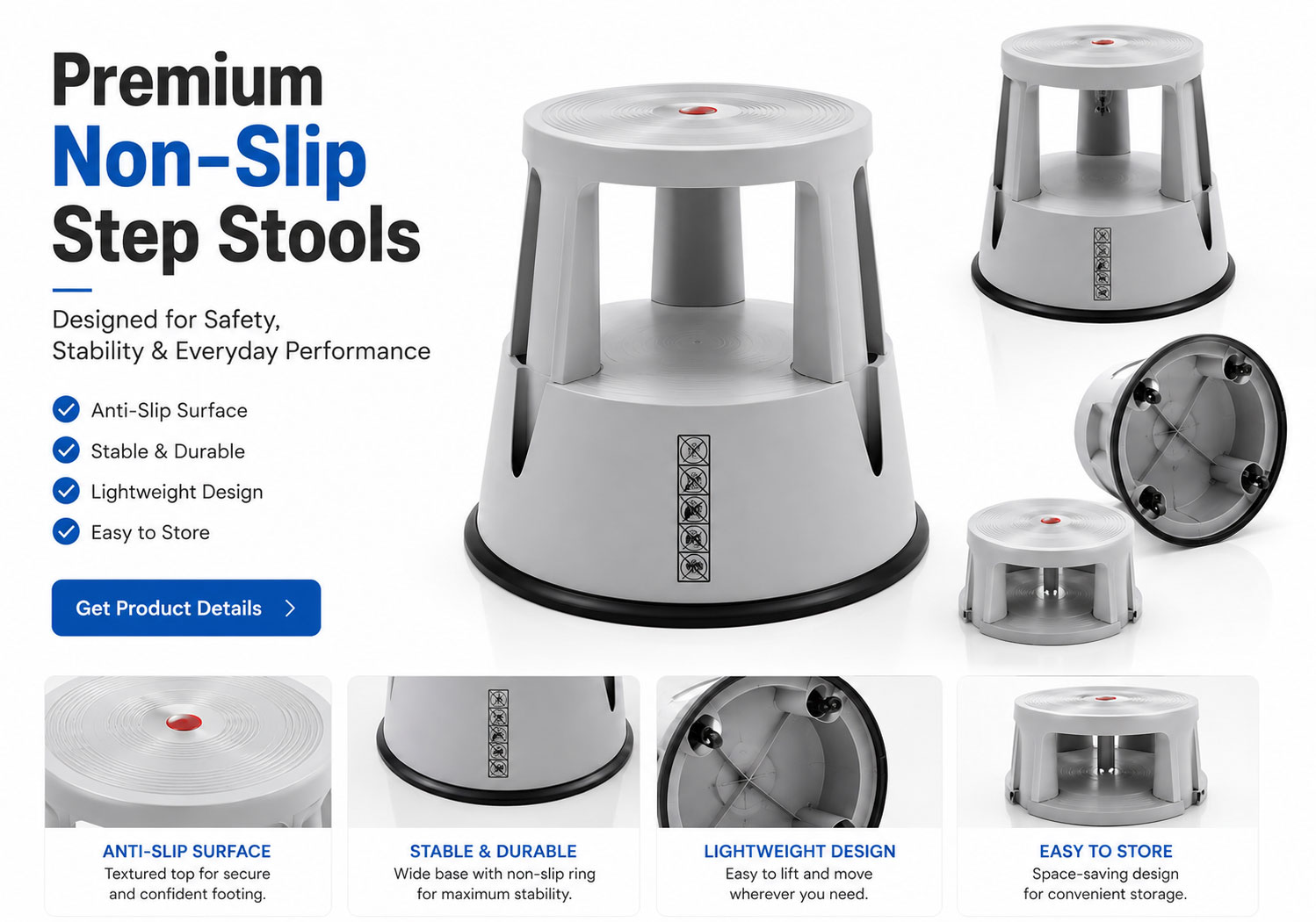
Non-Slip Step Stool Solutions for Facility Management in UAE
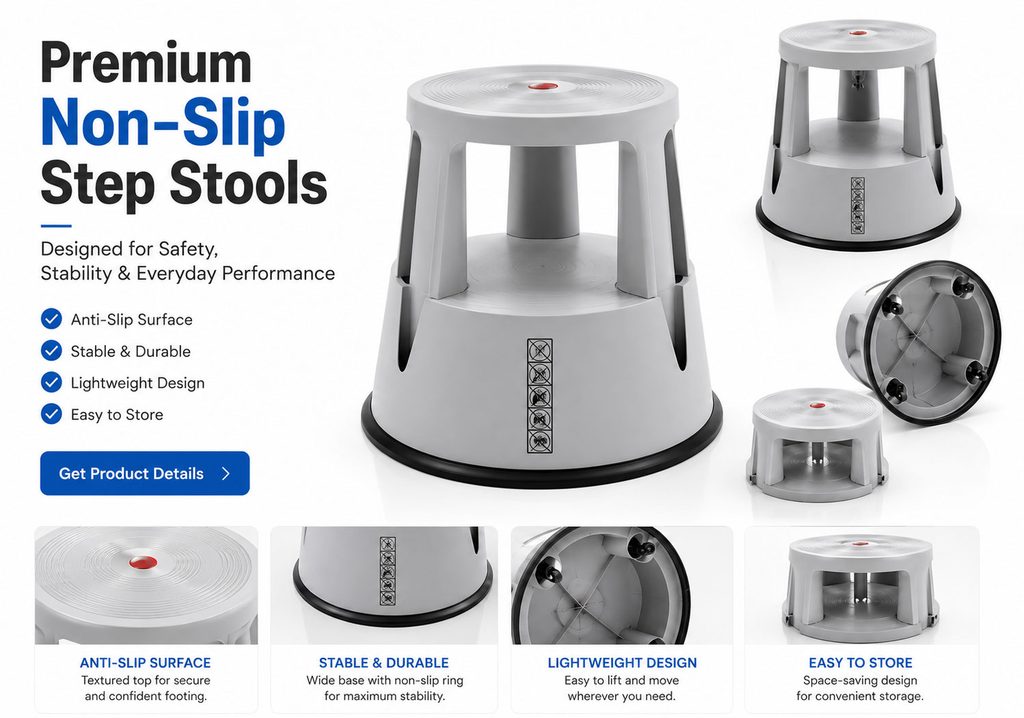
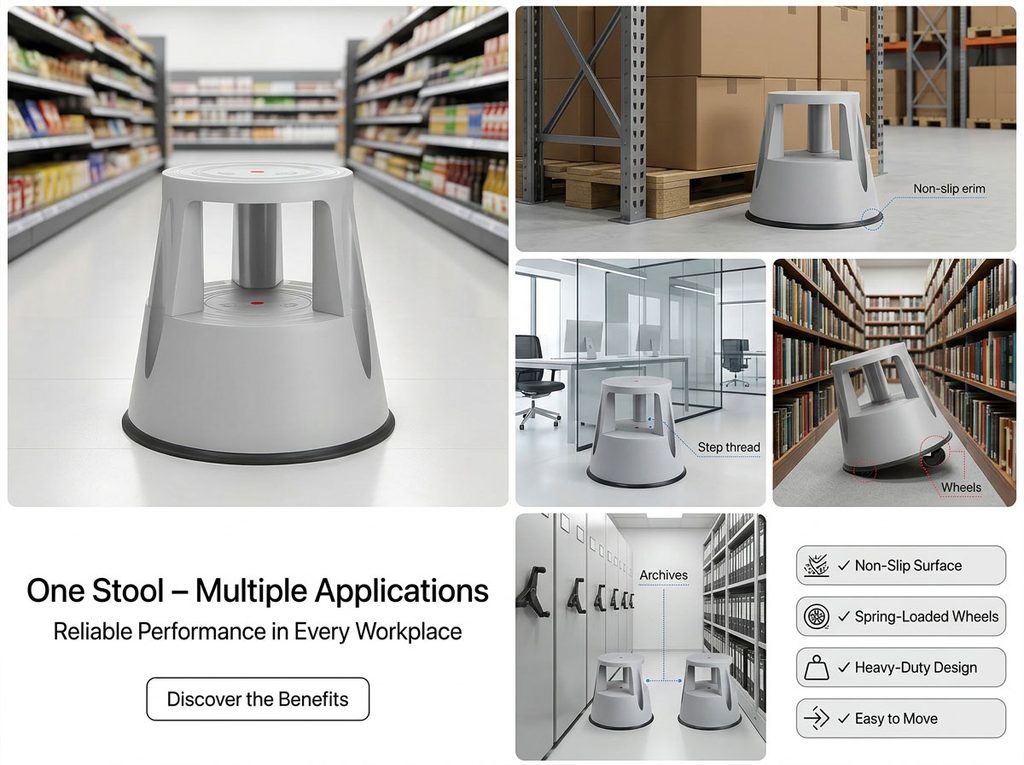
Non-Slip Step Stool Solutions for Facility Management in UAE give facility management teams in the UAE reliable, low-risk access for routine maintenance, restocking support and inspection tasks across supermarket and retail sites. Professional units typically feature textured non-slip platforms, stable wide bases, optional spring-loaded wheeled mobility and industrial load ratings around 150 kg. Firmalazım supplies these solutions for commercial use, supporting facility teams whose sites and supporting locations connect to Jebel Ali, JAFZA, Dubai Industrial City, Al Quoz, Ras Al Khor, Al Qusais, Umm Ramool, Dubai South, Deira, Al Warsan and Dubai Investment Park (DIP).
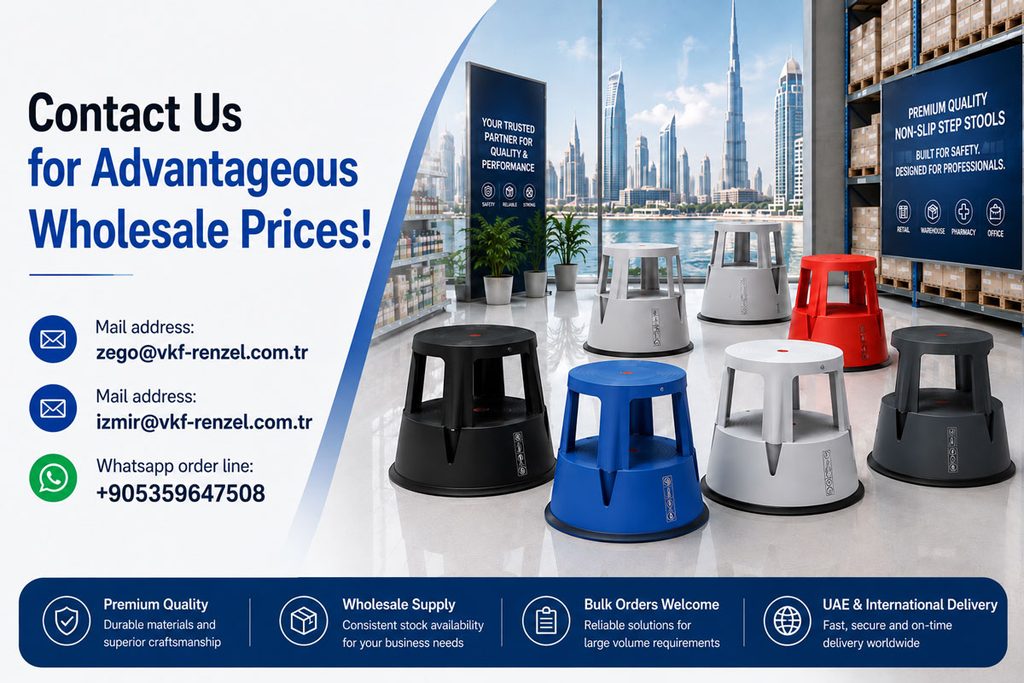
Detailed Article: Non-Slip Step Stool Solutions Designed for UAE Facility Management
Facility management in UAE supermarket and retail environments operates under continuous constraints. Floors must stay presentable. Access equipment must not create new hazards. Maintenance windows are short. Teams move between stockrooms, sales floors, plant rooms and external areas. A step stool that slips, tips or marks the floor creates immediate problems for both Safety and presentation scores. The practical solution is a non-slip step stool specified for professional commercial use rather than occasional domestic duty.
A well-designed unit combines a textured standing surface that retains grip on residual moisture, a wide stable base that resists tip-over, and, where mobility is required, spring-loaded or locking wheels that stabilise under load. Load ratings in the 150 kg class cover typical facility and restocking tasks. Geometry is kept compact enough for narrow plant-room doors and retail aisles yet stable enough for safe working.
Why Facility Management Needs a Different Specification
Domestic stools fail quickly under facility management duty cycles. They flex, lose grip after cleaning, or leave marks on polished tile. Professional non-slip step stools address the real conditions found in UAE supermarket and retail sites:
- Residual moisture after night cleaning or spill response
- Polished tile and epoxy floors that show every mark
- Mixed indoor environments from air-conditioned sales floors to warmer plant rooms
- Frequent short-duration access rather than prolonged standing
- The need to move equipment quickly between locations
When these conditions are met, the stools become reliable tools rather than sources of secondary complaints.
Technical Priorities for Facility Teams
| Requirement | Professional Target | Facility Management Benefit |
|---|---|---|
| Standing surface | Textured non-slip with drainage or grip pattern | Secure footing on damp or cleaned floors |
| Base geometry | Wide, low centre of gravity | Reduced tip risk during reaching or leaning |
| Load capacity | 150 kg continuous class | Covers staff + light tools or product |
| Mobility (where required) | Spring-loaded or locking non-marking wheels | Rapid repositioning + automatic stability |
| Floor protection | Non-marking contact surfaces | Protects polished retail and common-area floors |
| Cleanability | Smooth, wipe-down surfaces | Compatible with facility hygiene regimes |
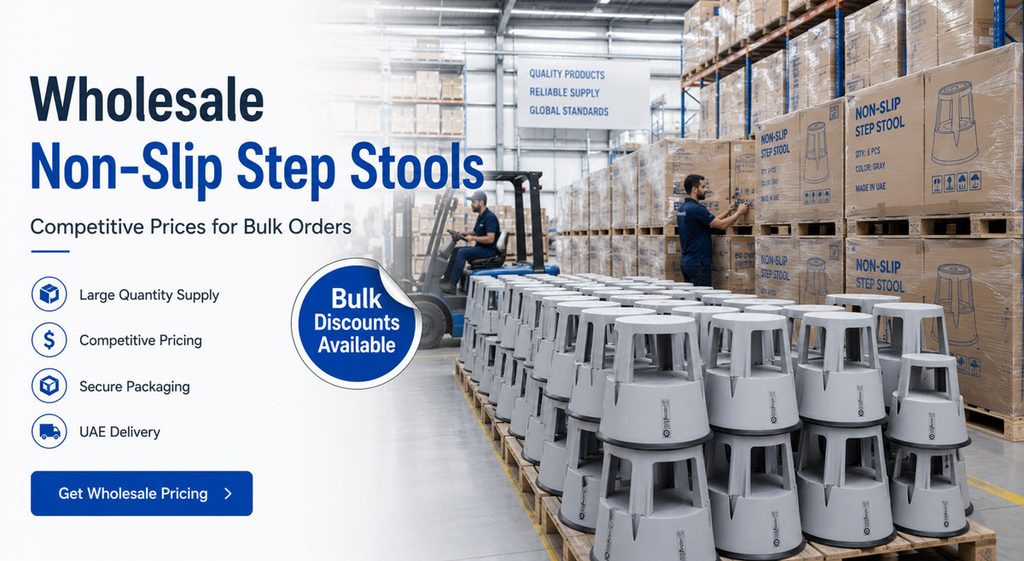
A Manufacturer that produces to these priorities enables facility managers to standardise across multiple sites. Bulk Orders become feasible once the specification is locked. OEM adjustments can address site-specific height or branding needs. Wholesale arrangements reward volume, while a reliable Distributor ensures units and wear parts reach both central stores and individual locations across the listed Dubai zones.
Material Choices Under UAE Facility Conditions
Facility environments combine humidity, cleaning chemicals and temperature differentials. Heavy-duty plastic constructions offer low weight, chemical resistance and easy cleaning for most indoor applications. Textured platforms must maintain grip after exposure to common floor detergents. Non-marking wheel or foot compounds protect the high-visibility floors found in supermarket and retail common areas. These material decisions determine whether the stools remain serviceable for years or require frequent replacement.
Typical Facility Management Use Cases
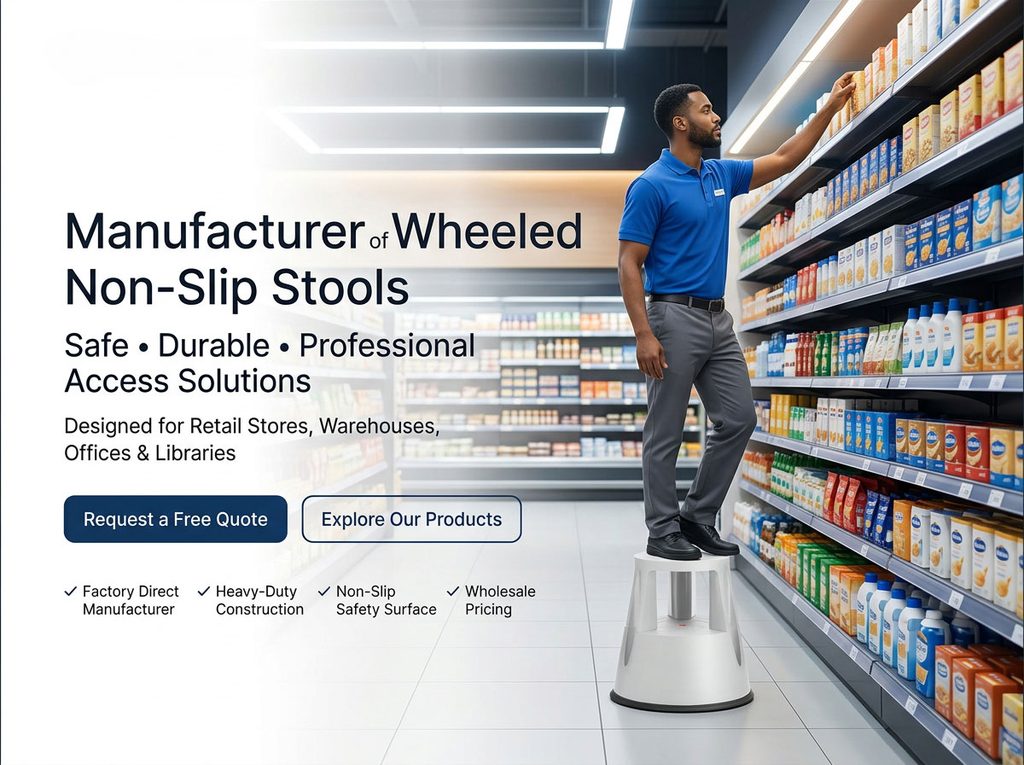
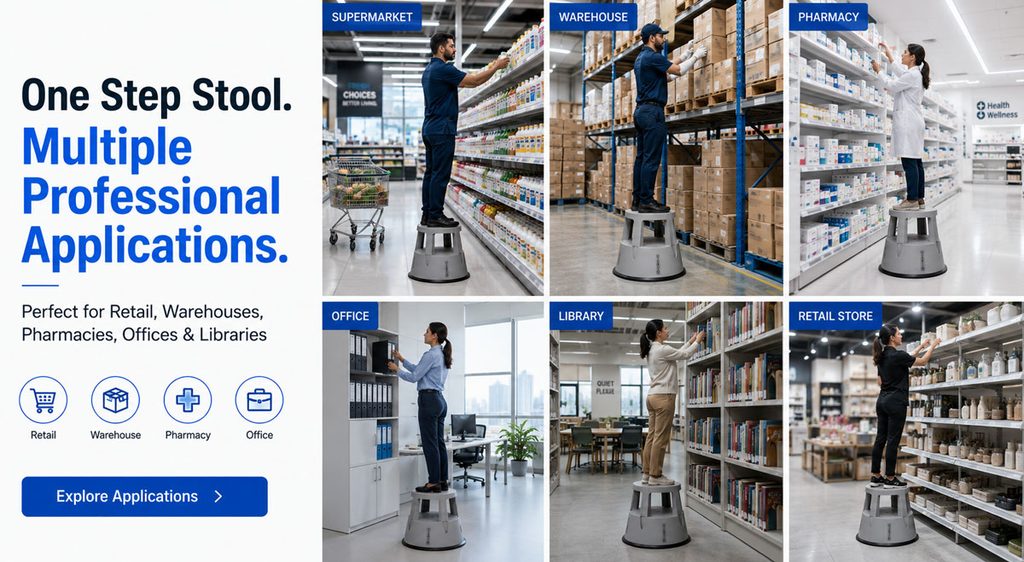
Routine restocking support Facility or store teams use the stools for upper-shelf work during overnight or early-morning windows. Non-slip surfaces and stable bases reduce risk when floors are still damp.
Light maintenance and inspection Access to high-level fixtures, signage, sensors or storage in plant rooms and back-of-house areas. Compact geometry allows movement through standard doorways.
Spill response and cleaning support Quick access for temporary high-level tasks during or after cleaning cycles. Non-marking surfaces avoid adding new marks while resolving the original issue.
Multi-site consistency Facility management companies or in-house teams responsible for several supermarket and retail locations gain efficiency from a single approved model. Training, spare parts and Safety messaging remain uniform whether the site is in Deira, Al Warsan or supported by warehouses in Al Quoz, DIP or Dubai South.
Safety as a Core Facility Responsibility
Safety is both a regulatory expectation and a contractual requirement for many facility management providers. Non-slip step stools with documented load capacity, stable geometry and textured surfaces support safe systems of work for low-level access tasks. When Safety is treated as a continuous operating standard rather than a periodic audit item, the stools become part of the controlled equipment list rather than ad-hoc purchases.
Facility managers who track near-miss reports related to access equipment typically see reductions once professional non-slip units replace lighter or unmarked alternatives.
Cost Perspective for Facility Procurement
The purchase price is visible. The full cost includes replacement frequency, time lost to unstable or missing equipment, floor-marking remediation, and any incident investigation time. Facility teams that evaluate these factors across multiple supermarket and retail sites usually find that professional non-slip step stools supplied through structured Wholesale and Distributor channels deliver lower total cost of ownership. The ability to place Bulk Orders and, where needed, request OEM modifications further improves economics once the specification is agreed.
Common Specification Errors in Facility Management
- Purchasing domestic stools for continuous commercial use
- Ignoring residual-moisture grip performance
- Overlooking non-marking requirements on polished floors
- Allowing multiple different models across the managed estate
- Neglecting spare-parts availability
- Treating the stools as disposable rather than managed assets
A clear professional specification and a supply approach that links Manufacturer consistency with volume capability and reliable logistics prevent these errors from becoming systemic.
Practical Selection Checklist for Facility Managers
- Confirm maximum staff-plus-tool load and required reach height
- Require textured non-slip surface validated under residual moisture
- Specify non-marking feet or wheels on the actual floor finishes used
- Match overall geometry to doorways, aisles and storage constraints
- Evaluate cleanability against the site cleaning regime
- Confirm spare-parts lead times
- Pilot on representative supermarket or retail sites before estate-wide adoption
- Standardise across the managed portfolio
- Align volume with Manufacturer capacity, Bulk Orders potential, OEM flexibility, Wholesale terms and Distributor coverage so that Commercial Use remains consistent in Warehouse, Retail and Supermarket environments while Safety stays protected
Expert Observation from Facility Operations
Experienced facility managers in the UAE repeatedly note the same adoption pattern. Once teams confirm that the platform stays secure underfoot and the floor remains unmarked, the stools move from “equipment we have to remember” to “equipment we simply use.” Utilisation rises, minor access-related delays fall, and presentation scores become easier to protect. That shift is the practical measure of successful specification.
Maintenance Discipline for Continuous Availability
Daily visual checks of the standing surface and contact points take seconds. Regular cleaning removes detergent residue that can reduce grip. Periodic functional verification of any wheeled locking mechanism confirms ongoing reliability. Timely replacement of wear parts keeps every unit performing to the original standard. When spare parts are available through the same Distributor network that supplies complete units, maintenance remains practical even across a dispersed portfolio of supermarket and retail sites.
Firmalazım Approach for Facility Management Solutions
Firmalazım focuses on non-slip step stool solutions suited to the real conditions of UAE facility management in supermarket and retail environments. The emphasis is practical performance — textured non-slip surfaces, stable geometry, optional professional mobility, and industrial load capacity — supported by Manufacturer quality, Bulk Orders capability, OEM flexibility, Wholesale structures and Distributor reach that together enable reliable Commercial Use across Warehouse, Retail and Supermarket settings while prioritising Safety.
Frequently Asked Questions (FAQ)
1. What defines a professional non-slip step stool for UAE facility management? Textured non-slip platform, wide stable base, industrial load rating, cleanable construction and, where required, non-marking wheeled mobility with automatic stability.
2. Why do domestic stools fail under facility management duty cycles? They lack the grip retention, rigidity and floor-protection features needed for repeated commercial use on cleaned and polished surfaces.
3. Is 150 kg capacity adequate for typical facility tasks? It covers most staff plus light tools or product. Higher ratings can be specified for heavier requirements.
4. How important is residual-moisture grip for facility teams? Critical. Many tasks occur shortly after cleaning when floors are not fully dry.
5. Why are non-marking surfaces essential in supermarket and retail sites? Polished floors show marks immediately and affect presentation scores that facility teams are often measured on.
6. Can the same model serve both sales-floor support and plant-room access? Yes, when geometry and capacity meet the constraints of both environments.
7. How does a Manufacturer support consistent quality for multi-site facility contracts? Through controlled production and batch consistency that keep performance uniform across deliveries.
8. What advantage do Bulk Orders offer facility management providers? Improved unit economics and supply continuity across the managed estate.
9. Can OEM adjustments address site-specific needs? Yes. Minor height, branding or colour changes are often possible once volume is clear.
10. How does Wholesale pricing benefit multi-site facility operations? Volume commitments unlock better commercial terms while still allowing delivery to individual locations.
11. Why is a reliable Distributor important for UAE facility portfolios? Sites and supporting locations are spread across zones such as Deira, Al Warsan, Al Quoz and DIP; responsive logistics keep equipment available.
12. What does Commercial Use require that lighter stools cannot deliver? Durability under daily cycling, reliable non-slip performance and floor protection.
13. How do these stools perform in Warehouse areas that support Retail sites? The same professional specification can serve both, simplifying standardisation across the chain.
14. Why is standardisation valuable across a Supermarket facility portfolio? One model means uniform training, one parts list and consistent Safety expectations at every site.
15. How do non-slip step stools contribute to Safety in facility management? By providing secure footing, stable geometry and documented capacity that reduce slip and tip risks during routine access tasks.
16. What documentation should facility managers request? Load-rating information, material specifications and any statements needed for internal or client audits.
17. Should both operations and Safety teams participate in selection? Yes. Combined input improves daily usability and formal compliance.
18. How should a pilot be structured for facility management? Deploy units on representative supermarket or retail sites, gather team feedback on grip, stability and floor condition, then review any change in access-related delays.
19. What is the most common procurement error? Selecting the lowest-priced stool without validating grip and non-marking performance under real site conditions.
20. How long should a professional unit last under facility duty cycles? Several years with basic maintenance is realistic when the specification is industrial.
21. Can colour or asset tagging support facility control systems? Yes. Many arrangements support visual identification and inventory tracking.
22. How should spare parts be managed across multiple sites? Standardise on one specification and maintain buffer stock through the Distributor layer.
23. Are wheeled versions suitable for facility teams that move frequently between areas? Yes, provided the mobility system locks reliably under weight and uses non-marking compounds.
24. What maintenance keeps performance consistent? Regular cleaning of the standing surface, visual checks, and functional verification of any locking mechanism.
25. How does base width improve daily Safety? A wider footprint increases resistance to tip-over when reaching or working with light tools.
26. Can the stools be used in both dry and occasionally wet facility zones? Yes, when the tread and contact materials have been validated for residual moisture.
27. What is the practical next step after a successful pilot? Lock the specification, aggregate volume, and formalise supply and parts arrangements.
28. How transparent should lead times be for facility contracts? High transparency supports planning for new sites, refits and planned maintenance windows.
29. Does one professional model work across convenience and hypermarket formats? In most cases yes; geometry can be reviewed if access constraints differ significantly.
30. Why choose Firmalazım for non-slip step stool solutions in UAE facility management? Because the focus is practical performance for local supermarket and retail conditions, supported by Manufacturer quality, Bulk Orders capability, OEM flexibility, Wholesale structures and Distributor reach that enable reliable Commercial Use in Warehouse, Retail and Supermarket environments while protecting Safety.
Five Distinct Calls to Action
- Facility specification request Share the typical access tasks, floor finishes and number of sites under management. Firmalazım will return a non-slip step stool recommendation matched to UAE facility conditions.
- Multi-site pilot Request a controlled pilot across representative supermarket or retail locations. Validate grip, stability, floor protection and team feedback before wider adoption.
- Portfolio standardisation discussion Managing multiple sites linked to Deira, Al Warsan, Al Quoz or DIP? Begin the conversation on locking one professional model and the supporting supply arrangements.
- Total-cost and Safety review Ask for a comparison that includes service life, access efficiency and floor-protection value so the business case is complete.
- Facility supply partnership enquiry Engage Firmalazım to structure ongoing supply that connects Manufacturer consistency, Bulk Orders efficiency, OEM options, Wholesale terms and Distributor logistics for reliable Commercial Use across your Warehouse, Retail and Supermarket portfolio while prioritising Safety.
Firmalazım supplies non-slip step stool solutions engineered for the real demands of UAE facility management in supermarket and retail environments. Secure grip, stable geometry, optional professional mobility and practical industrial capacity are delivered through supply structures that keep quality and availability consistent across the key zones from Jebel Ali to Dubai Investment Park.
Non-Slip Step Stool Solutions for Facility Management in UAE
For supermarket facility managers and procurement teams in the UAE, non-slip step stool solutions directly affect daily safety scores, restocking speed, and total cost of ownership. A well-specified 2-step plastic stool with spring-loaded wheels, 150 kg capacity, non-slip surfaces, and a stable wide base removes a recurring source of height-related risk while supporting efficient movement across sales floors and back rooms.
This guide is written from the purchasing manager’s perspective. It focuses on investment logic, risk reduction, common specification errors, total cost modelling, supplier evaluation for bulk and OEM supply, and practical deployment across Dubai’s commercial and industrial zones. The goal is to give decision-makers a clear framework for selecting, ordering, and managing these tools so that safety and operational performance improve without unnecessary complexity or cost.
Detailed Article
The Procurement Reality Behind a Simple Stool
Most supermarket equipment lists treat step stools as low-value consumables. That approach is expensive. When a staff member uses an unstable or poorly gripping platform to reach upper shelves, the potential cost is not the price of the stool—it is the lost-time injury, the insurance claim, the temporary labour cover, and the disruption to planogram execution.
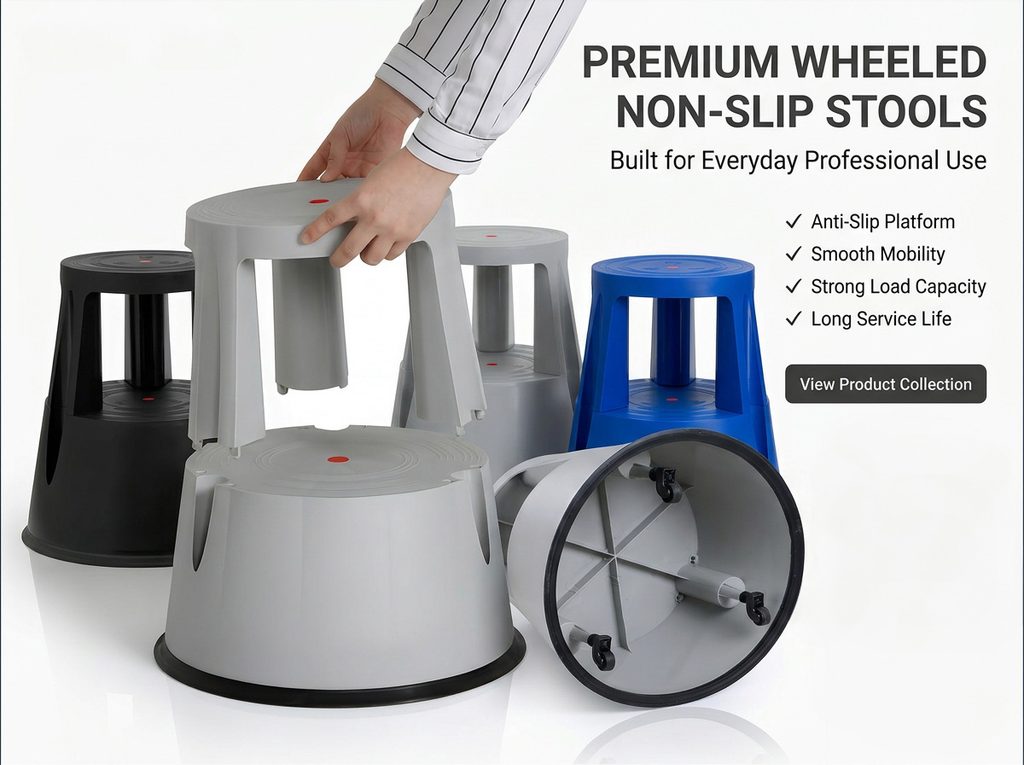
A purpose-built 2-step plastic non-slip stool with spring-loaded wheels changes the equation. Under no load the unit rolls easily between aisles. The moment body weight is applied, the wheels retract and the stool becomes a fixed, stable platform. The top surface is textured for grip, the base diameter is significantly wider than the top, and the load rating of 150 kg covers typical staff plus product weight in commercial use.
From a purchasing standpoint the questions are straightforward: Does this design reduce measurable risk? Does it survive daily supermarket conditions? Can it be supplied consistently in bulk orders? Can the manufacturer support OEM or private-label requirements? And what is the true cost over three to five years of multi-store operation?
Investment Logic: Safety as a Cost-Control Lever
Every fall from height or near-miss involving improvised climbing (chairs, lower shelves, cardboard boxes) carries direct and indirect costs. In a high-volume supermarket the cumulative minutes spent searching for a ladder or waiting for a fixed platform also add up. A mobile stool that locks under weight shortens those intervals and removes a common failure mode.
When evaluating return, procurement teams should model three numbers:
- Reduction in height-related incidents or near-misses
- Time saved per restocking cycle on upper shelves
- Replacement frequency compared with cheaper alternatives
A unit that lasts three to five years under daily use and requires only occasional wheel or spring attention will almost always outperform a lower-priced stool that cracks, loses grip, or develops wheel problems within twelve months. The safety benefit is the primary justification; the operational efficiency is the secondary return.
Technical Specifications That Matter to Buyers
Key measurable attributes for the reference 2-step design include:
| Attribute | Typical Value | Why It Matters for Supermarket Use |
|---|---|---|
| Overall height | 410 mm | Useful reach without excessive climb |
| Top diameter | 283 mm | Stable standing surface |
| Bottom diameter | 433 mm | Low centre of gravity, tip resistance |
| Load capacity | 150 kg | Covers staff + product in commercial use |
| Material | Heavy-duty plastic | Impact resistance, cleanability, no rust |
| Colour | Grey | Practical for retail environments |
| Wheel system | Spring-loaded | Locks under weight, rolls when unloaded |
| Surface | Non-slip textured | Grip on tiled or epoxy floors |
These dimensions and ratings should appear consistently in manufacturer documentation. Variation between production batches is a red flag for bulk buyers.
Material and Durability Under UAE Retail Conditions
Plastic construction is preferred for supermarket environments because it resists corrosion, is lighter than metal equivalents, and can be moulded with integral texture. In the UAE the material must also tolerate temperature differences between air-conditioned sales floors and hot receiving docks, plus repeated exposure to cleaning chemicals. Heavy-Duty Wheeled Step Stools for Warehouses in UAE
High-quality formulations maintain structural integrity and surface grip over time. Inferior plastics develop stress cracks around the step junctions or wheel housings after repeated loading cycles. When assessing a manufacturer, request information on wall thickness, internal ribbing, and any cycle testing performed on the spring-and-wheel assembly.
The black non-slip base ring adds friction on smooth floors and protects the plastic edge from abrasion. This detail is often missing on low-cost imports and becomes noticeable after a few months of commercial use.
Common Specification and Purchasing Errors
Procurement teams repeatedly encounter the same mistakes:
- Selecting by lowest unit price without checking dynamic load behaviour or wheel reliability
- Ignoring the difference between static load rating and real-world side-loading when a worker reaches sideways
- Ordering without confirming dimensional consistency across a bulk order
- Failing to secure spare wheel assemblies or clear warranty terms
- Treating the stool as a one-time purchase rather than part of a multi-year safety equipment programme
An additional frequent error is assuming that any wheeled stool is equivalent. Free-rolling designs without a reliable retraction mechanism introduce rolling risk while the user is climbing—the exact opposite of the intended safety improvement.
Checklist for Avoiding These Errors
- Confirm spring-loaded retraction under realistic body weight
- Verify actual measured base and top diameters
- Request batch consistency data for large orders
- Include spare parts availability in the supplier evaluation
- Align the purchase with the store’s existing safety audit framework
Supplier Evaluation: Manufacturer, Wholesale and Distributor Channels
A capable manufacturer will provide clear technical data, consistent production quality, and the ability to handle bulk orders. Many supermarket groups also require OEM options—private labelling, colour matching, or minor dimensional adjustments—so that equipment carries the retailer’s identity.
Wholesale and distributor partners that hold regional stock reduce lead times and allow smaller top-up orders between major replenishments. For UAE operations, the ability to deliver reliably into free zones and industrial areas is a practical advantage.
When scoring suppliers, weight the following:
- Documented load and cycle performance
- Track record with commercial and warehouse retail clients
- Flexibility on OEM and private-label work
- Clarity of warranty and parts supply
- Logistics capability for multi-store roll-outs
Firmalazım positions itself as a manufacturer focused on these commercial requirements, supporting both direct bulk supply and structured distributor relationships.
Deployment Across Dubai’s Commercial and Industrial Zones
Operational patterns are similar, yet each zone has distinct logistics and store formats.
In Jebel Ali, large-format stores and distribution-linked supermarkets handle high volumes of imported goods; mobile non-slip stools reduce time spent moving fixed platforms between receiving and sales areas.
Within the Jebel Ali Free Zone (JAFZA), facilities supporting supermarket supply chains use the same equipment for quality checks and packing-line access where temporary elevation is required.
Dubai Industrial City contains manufacturing and logistics operations that feed retail; step stools with reliable wheel-lock systems support both maintenance tasks and warehouse picking.
Al Quoz mixes warehouses, showrooms and smaller supermarket formats where compact dimensions and easy movement through tighter spaces are valued.
Ras Al Khor’s industrial and logistics clusters see intensive use of wheeled stools for racking access in support of retail distribution.
Al Qusais commercial and retail buildings rely on them for daily merchandising and cleaning of higher fixtures.
Umm Ramool industrial estates and adjacent retail outlets apply the stools to both sales-floor and storage duties.
Dubai South’s expanding logistics and retail infrastructure incorporates them into new supermarket fit-outs from the opening phase.
Deira’s dense retail environment benefits from the stool’s ability to move quickly through narrower aisles without obstructing customers.
Al Warsan industrial and mixed-use zones require durable units that tolerate varied floor conditions.
Dubai Investment Park (DIP) hosts larger distribution and retail-support operations where bulk orders of safety equipment, including non-slip step stools, are routinely placed.
Across all these locations the procurement logic remains the same: specify once, supply consistently, and maintain simply.
Total Cost of Ownership Model
A realistic three-year model for a multi-store operator includes:
- Initial acquisition cost (influenced by volume and OEM requirements)
- Shipping and handling into UAE free zones or industrial parks
- Expected replacement rate based on daily use intensity
- Spare parts and maintenance labour
- Avoided incident and downtime costs (the largest potential saving)
When the stool is treated as a safety asset rather than a disposable item, the higher-quality unit almost always delivers lower total cost. The manufacturer that can demonstrate durability data and parts availability strengthens this calculation.
Maintenance Protocol That Protects the Investment
Daily: visual confirmation that wheels roll freely when unloaded and retract under light pressure; quick wipe of the standing surface. Weekly: thorough cleaning with standard floor detergents to remove residues that reduce grip. Monthly: inspection of spring tension and wheel condition; removal of any unit showing damage.
Because the design is mechanical and the structure is plastic, most potential failures are visible. A small pool of spare units at high-volume stores prevents operational gaps.
Comparison Framework for Decision Makers
| Factor | Basic Free-Rolling Stool | Spring-Loaded Non-Slip 2-Step | Fixed Platform |
|---|---|---|---|
| Mobility | High | High when unloaded | None |
| Stability under load | Variable / risk of roll | High (wheels retract) | High |
| Floor-space impact | Low | Low | Higher |
| Cleaning effort | Moderate | Low–moderate | Higher |
| Typical commercial life | 12–24 months | 36–60 months | Long but inflexible |
| Suitability for open sales floor | Limited | Strong | Poor |
The spring-loaded non-slip design occupies the practical middle ground required by supermarket operations.
Expert Notes for Safety and Facility Teams
Safety officers value equipment that can be referenced in risk assessments with clear load ratings and a defined locking mechanism. Facility managers value equipment that staff actually use because it is easy to move and does not create new trip hazards. The combination of non-slip texture, automatic wheel retraction, and a wide base satisfies both groups when the product is correctly specified and maintained.
Implementation Sequence for Multi-Store Roll-Out
- Pilot in one or two high-volume stores for 30–60 days.
- Collect data on usage frequency, staff feedback, and any near-miss reduction.
- Finalise specification and negotiate bulk or OEM terms with the manufacturer or appointed distributor.
- Schedule delivery aligned with store maintenance windows.
- Conduct brief practical training on the locking behaviour.
- Establish designated storage points and a simple inspection routine.
- Review performance at six months and adjust quantities if needed.
This sequence keeps risk low and ensures the investment delivers measurable results.
Closing Perspective
A non-slip 2-step plastic step stool with spring-loaded wheels is a small item on a supermarket capital or operational expenditure list. Its impact on daily safety and restocking efficiency is outsized. When procurement teams evaluate it through the lens of total cost, risk reduction, and supplier reliability—rather than unit price alone—they consistently select designs that lock under weight, grip reliably, and survive commercial use.
Firmalazım, as a manufacturer serving commercial and wholesale channels, focuses on exactly these requirements: consistent quality for bulk orders, OEM flexibility, and products engineered for supermarket and warehouse retail environments where safety and uptime matter.
FAQ – Frequently Asked Questions
1. How should a purchasing manager calculate the real cost of a step stool beyond the unit price? Include expected service life, spare-parts cost, replacement frequency, and the avoided cost of height-related incidents or restocking delays. A higher-quality unit with proven durability usually shows lower total cost over three to five years.
2. What is the most important mechanical feature for supermarket safety? Reliable spring-loaded wheel retraction that locks the stool under body weight. This prevents rolling while the user is climbing or standing.
3. Can these stools be specified for both sales-floor and back-of-house warehouse retail areas? Yes. The same non-slip, wheeled design is used for merchandising on the sales floor and for racking access in storage areas.
4. What documentation should be requested from a manufacturer before placing a bulk order? Dimensional drawings, load-capacity confirmation, material data, and any available cycle-test results for the wheel mechanism.
5. How does OEM supply work for supermarket groups that want branded equipment? Many manufacturers offer private labelling, colour matching, or logo moulding. Confirm minimum order quantities and lead times early in the process.
6. Are there specific logistics advantages when sourcing for free-zone or industrial locations? Suppliers experienced with UAE free zones and industrial parks can often provide more reliable delivery schedules and clearer customs handling for commercial volumes.
7. What is a realistic replacement cycle under daily supermarket use? Quality units typically last several years when inspected and cleaned regularly. Intensity of use and floor conditions influence the exact interval.
8. How can facility teams prevent stools from becoming trip hazards themselves? Designate fixed storage locations at the end of each shift and train staff to return units after use.
9. Is grey the only practical colour for retail environments? Grey is common because it hides minor marks and remains neutral. OEM programmes can sometimes accommodate other colours if volume justifies it.
10. What happens if one wheel fails during use? Because the wheels retract under load, the stool remains stable on its base. The unit should still be removed from service until repaired or replaced.
11. How many units does a typical supermarket require? It depends on store size and restocking intensity. A pilot period provides the most accurate number for each location.
12. Can wholesale distributors hold buffer stock for rapid top-up orders? Yes. This is a practical advantage for multi-store operators that need occasional replacements between major bulk deliveries.
13. What cleaning agents are safe for the non-slip plastic surface? Standard supermarket floor detergents are normally suitable. Avoid aggressive solvents that could degrade the texture or plastic over time.
14. How does the 150 kg rating translate to real supermarket tasks? It comfortably covers a staff member plus a carton or cleaning tool under normal commercial use conditions.
15. Should step stools be included in new-store fit-out schedules? Yes. Including them from the opening phase ensures correct quantities are available and avoids later ad-hoc purchases.
16. What is the main difference between a spring-loaded design and a simple wheeled stool? The spring-loaded system actively locks under weight; a simple wheeled stool can continue to roll while the user is on it.
17. How important is base diameter relative to top diameter? A significantly wider base lowers the centre of gravity and improves resistance to tipping when the user reaches sideways.
18. Can the same specification be used across all listed Dubai zones? Yes. The operational requirements are consistent; only logistics and store format details differ by location.
19. What training is required for staff? A short demonstration of the locking behaviour is usually sufficient so that everyone understands the wheels will retract under weight.
20. How should spare parts be managed? Maintain a small stock of wheel assemblies at high-volume sites or through the distributor so that individual units can be returned to service quickly.
21. Is plastic preferable to metal for supermarket step stools? In most cases yes—lighter, non-corroding, easier to clean, and capable of integral non-slip texture.
22. What risk does a purchasing manager take by choosing the lowest-priced option? Higher replacement frequency, potential safety incidents, and greater long-term cost. Durability and locking reliability are the higher-value attributes.
23. How can performance be measured after roll-out? Track near-miss reports related to height access, restocking time for upper shelves, and staff feedback on ease of use.
24. Does the stool require any assembly? Most commercial 2-step plastic models are delivered fully assembled and ready for immediate use.
25. What role does a distributor play versus direct manufacturer supply? Distributors often provide local stock, faster small-quantity fulfilment, and regional logistics support, while the manufacturer controls quality and OEM capability.
26. Can these stools be used on both tiled sales floors and concrete warehouse areas? Yes, provided the base has adequate non-slip contact. The wide locked base performs on both surfaces.
27. How does temperature variation in the UAE affect the product? Quality plastic formulations are selected to maintain integrity between cold interiors and hot docks. Avoid prolonged outdoor storage in direct sun.
28. What is the best way to start a multi-store programme? Begin with a controlled pilot, collect data, then standardise the specification and negotiate volume terms.
29. Are there any special considerations for high-traffic Deira or dense urban stores? Manoeuvrability in narrower aisles becomes more important; the compact rolling design is well suited to these environments.
30. How does Firmalazım support commercial buyers? As a manufacturer focused on commercial use, the company works with bulk orders, OEM requirements, and distributor channels to supply consistent non-slip step stool solutions for supermarket and warehouse retail operations across the UAE.
Five Distinct Calls to Action
- Request a detailed cost-of-ownership comparison and sample unit so your procurement and safety teams can evaluate the spring-loaded design under real supermarket conditions.
- Speak directly with the commercial team about volume pricing, OEM options, and structured supply for multi-store roll-outs.
- Obtain current technical data sheets, load documentation, and lead-time information for bulk orders destined for free zones and industrial locations.
- Schedule a short consultation focused on standardising non-slip step stools across your network and reducing height-access risk.
- Contact us to discuss distributor partnership or direct wholesale supply of safety-focused 2-step stools engineered for daily commercial use in UAE supermarket environments.
Non-Slip Step Stool Solutions for Facility Management in UAE
From a purchasing manager’s viewpoint, non-slip step stool solutions are not low-value accessories. They are controllable risk and cost variables that affect safety metrics, restocking labour, and multi-year operating expense in UAE supermarkets. A correctly specified 2-step plastic stool with spring-loaded wheels, non-slip surface, 150 kg capacity and stable base geometry reduces height-related incidents while improving movement efficiency across sales floors and back rooms. Wheeled Non-Slip Step Stools for Supermarkets in UAE
This extended guide examines investment logic, total cost of ownership, specification errors, supplier evaluation for manufacturer, bulk orders, OEM, wholesale and distributor channels, real deployment patterns, maintenance economics, and practical decision frameworks. It is written for facility, safety and procurement teams who must justify every commercial purchase and protect both people and budget.
Detailed Article
Why Procurement Owns the Step-Stool Decision
In most supermarket organisations the step stool sits at the intersection of three budgets: safety, operations and facilities. When the wrong unit is chosen, the safety budget absorbs claims or near-miss investigations, the operations budget absorbs slower restocking cycles, and the facilities budget absorbs premature replacements. When the right unit is chosen, all three improve simultaneously.
The product under discussion is a 2-step plastic design approximately 410 mm high, with a 283 mm top platform, 433 mm base, textured non-slip surface and spring-loaded wheels that retract under load. Rated at 150 kg, it is intended for commercial use. The mechanical principle is simple and robust: unloaded, the stool rolls; loaded, the wheels disappear and the unit becomes a fixed platform. That single behaviour removes the most common failure mode of ordinary wheeled stools.
Investment Framing: Safety Cost Versus Acquisition Cost
A single lost-time injury linked to height access can exceed the purchase price of dozens of quality stools. Even without a formal claim, repeated near-misses consume supervisor time, generate internal reports and erode staff confidence. Restocking upper shelves with an unstable or hard-to-move platform adds cumulative labour minutes that never appear as a line item yet steadily inflate payroll cost per square metre.
Therefore the correct financial question is not “What is the cheapest stool?” but “Which specification delivers the lowest total cost of ownership while measurably reducing height-access risk?” The answer almost always favours a durable, spring-loaded, non-slip design supplied consistently by a manufacturer capable of supporting bulk orders and, where required, OEM programmes.
Total Cost of Ownership Model in Detail
A practical three-to-five-year model for a multi-store operator includes the following elements:
- Unit acquisition price (volume-dependent)
- Inbound logistics into UAE free zones or industrial parks
- Expected service life under daily supermarket intensity
- Spare-parts consumption (primarily wheels and springs)
- Inspection and cleaning labour
- Cost of premature replacement
- Monetised value of reduced near-misses and faster restocking cycles
When these factors are modelled, the higher-specification unit frequently shows a lower net cost even if its initial price is 30–60 % higher. The manufacturer that can supply consistent quality across bulk orders and offer clear parts availability strengthens the model further. Wholesale and distributor partners that hold regional stock reduce the working-capital cost of safety stock at each store.
Specification Errors That Quietly Destroy Value
Purchasing teams repeatedly encounter the same avoidable mistakes:
- Selecting solely on unit price without verifying dynamic stability.
- Accepting free-rolling designs that do not lock under weight.
- Ignoring dimensional consistency across a bulk order.
- Omitting spare-parts clauses from the supply agreement.
- Failing to align the purchase with the company’s existing safety-audit language.
- Treating the stool as a one-off expense rather than a multi-year programme.
- Assuming that any plastic stool will survive UAE temperature swings and cleaning chemicals equally well.
Each of these errors converts a modest capital outlay into recurring operational friction. The corrective discipline is simple: require measurable performance data, demand batch consistency, and write spare-parts and warranty terms into the commercial agreement.
Procurement Control Checklist
- Confirm spring-loaded retraction under realistic body weight
- Verify actual top and base diameters against stated specifications
- Request material data and any available cycle-test summaries
- Include OEM or private-label capability if branding is required
- Establish clear lead times for both initial bulk orders and subsequent top-ups
- Nominate a single internal owner for ongoing inspection standards
Supplier Evaluation Framework
A capable manufacturer differentiates itself through consistent production quality, transparent technical documentation and the ability to scale. For supermarket groups the additional requirements are often OEM flexibility and reliable logistics into free zones.
Wholesale channels and appointed distributors add value by holding buffer stock, simplifying smaller replenishment orders and providing local technical support. The ideal arrangement frequently combines direct manufacturer engagement for large initial programmes with distributor support for ongoing maintenance quantities.
Evaluation criteria that matter in practice:
- Documented load capacity and stability behaviour
- Evidence of supply to other commercial or warehouse retail clients
- Willingness and capability to execute OEM work
- Clarity of warranty and parts supply
- Proven delivery performance into UAE industrial and free-zone locations
Firmalazım operates as a manufacturer oriented toward these commercial requirements, supporting both volume supply and structured distributor relationships.
Material Performance Under UAE Conditions
Plastic is the dominant material for this category because it is light, non-corrosive and capable of integral non-slip texture. In the UAE the same material must also tolerate rapid temperature changes between cold sales floors and hot receiving docks, plus repeated contact with detergents and occasional food residues. Professional Wheeled Step Stools for Retail Stores in UAE
High-quality formulations maintain structural integrity and surface grip. Lower-grade plastics develop stress cracks at step junctions or wheel housings after repeated loading. When assessing a supplier, wall thickness, internal ribbing and the design of the spring-and-wheel housing are more predictive of longevity than marketing claims. The black non-slip base ring is a small but useful detail that improves friction on smooth tiles and protects the plastic edge from abrasion.
Operational Patterns Across Key Dubai Zones
Although the core task is identical, logistics and store formats differ by location, and procurement planning must reflect those differences.
In Jebel Ali, large-format stores linked to major distribution flows move high volumes of imported goods; mobile stools reduce the time staff spend transporting fixed platforms between receiving and sales areas.
Inside the Jebel Ali Free Zone (JAFZA), facilities that support supermarket supply chains use the same equipment for temporary elevated access during quality checks and packing operations.
Dubai Industrial City contains manufacturing and logistics operations that feed retail networks; spring-loaded stools support both line-side maintenance and warehouse picking tasks.
Al Quoz hosts a mixture of warehouses, showrooms and smaller supermarket formats where compact dimensions and easy movement through constrained spaces are especially valued.
Ras Al Khor’s industrial and logistics clusters generate intensive racking-access demand; reliable wheel-lock behaviour is essential.
Al Qusais commercial and retail buildings rely on the stools for daily merchandising and higher-level cleaning.
Umm Ramool industrial estates and neighbouring retail outlets apply the units to both sales-floor and storage duties.
Dubai South’s expanding logistics and retail infrastructure incorporates the stools into new supermarket fit-outs from day one.
Deira’s dense urban retail environment rewards the stool’s ability to move quickly through narrower aisles without obstructing customers.
Al Warsan mixed industrial and commercial zones require durable construction that tolerates varied floor surfaces.
Dubai Investment Park (DIP) accommodates larger distribution and retail-support operations where bulk orders of safety equipment are routinely placed.
Across every one of these zones the purchasing logic remains constant: specify a stable, non-slip, spring-loaded design once, then supply it consistently.
Maintenance Economics
Daily visual checks take less than a minute per unit. Weekly cleaning with ordinary floor detergent removes residues that would otherwise reduce grip. Monthly inspection of springs and wheels prevents progressive failure.
Because the mechanism is mechanical and the structure is plastic, most potential problems are visible before they become safety issues. Maintaining a small pool of spare units at high-volume stores eliminates downtime. The cost of this simple regime is negligible compared with the cost of an unexpected failure during peak trading.
Comparison Table for Decision Support
| Decision Factor | Low-Cost Free-Rolling Stool | Spring-Loaded Non-Slip 2-Step | Fixed Platform |
|---|---|---|---|
| Mobility when unloaded | High | High | None |
| Stability under load | Variable / rolling risk | High (wheels retract) | High |
| Suitability for open sales floor | Limited | Strong | Poor |
| Typical commercial service life | 12–24 months | 36–60 months | Long but inflexible |
| Cleaning and hygiene effort | Moderate | Low to moderate | Higher |
| Spare-parts practicality | Often limited | Generally available | Minimal |
| Total cost over 3–5 years | Frequently higher | Usually lower | High opportunity cost |
The spring-loaded non-slip design occupies the practical centre that supermarket operations require.
Implementation Sequence That Protects Budget and Safety
- Select two pilot stores with different formats and traffic levels.
- Deploy a controlled quantity of the candidate specification for 30–60 days.
- Collect usage frequency, staff feedback and any change in height-related near-miss reports.
- Finalise the technical specification and commercial terms (including bulk pricing, OEM options and parts supply).
- Negotiate delivery schedules that align with store maintenance windows.
- Conduct brief practical training focused solely on the locking behaviour.
- Establish designated storage points and a simple inspection standard.
- Review quantitative and qualitative results at six months and adjust quantities.
This sequence keeps financial and operational risk low while generating the internal evidence needed for wider roll-out.
Expert Perspective on Risk Transfer
Every time a supermarket relies on chairs, lower shelves or improvised platforms for height access, it transfers risk from equipment to people. A correctly specified non-slip step stool reverses that transfer. The purchasing decision therefore functions as a risk-management control as much as a facilities purchase. Safety officers value clear load ratings and a defined locking mechanism that can be referenced in risk assessments. Facility managers value equipment that staff actually prefer to use because it moves easily and does not create new obstacles. When both groups are satisfied, compliance and daily performance improve together.
Closing Investment View
A 2-step plastic non-slip step stool with spring-loaded wheels is a modest line item. Its influence on daily safety scores, restocking labour and multi-year replacement cost is disproportionate. Purchasing managers who evaluate the product through total cost of ownership, specification discipline and supplier reliability—rather than unit price alone—consistently select designs that lock under weight, grip reliably and survive commercial use.
Firmalazım, operating as a manufacturer serving commercial channels, focuses on exactly these requirements: consistent quality for bulk orders, OEM capability, and products engineered for the safety and durability demands of supermarket and warehouse retail environments across the UAE. Non-Slip Step Stool Supplier in UAE
FAQ – Extended Set
1. How should total cost of ownership be calculated for step stools across a multi-store network? Sum acquisition cost, logistics, expected service life, spare parts, inspection labour and the monetised value of reduced incidents and faster restocking. Compare that figure against lower-priced alternatives over a three-to-five-year horizon.
2. What is the single most important mechanical feature from a risk perspective? Reliable spring-loaded wheel retraction that converts the stool into a fixed platform the moment weight is applied.
3. Why do many low-cost stools fail earlier than expected in supermarket use? Insufficient wall thickness, weak wheel housings, and free-rolling designs that introduce instability under load.
4. How can a purchasing manager verify batch consistency before a large bulk order? Request dimensional and load-test data from multiple production batches and, where possible, inspect sample units drawn from different lots.
5. What role does OEM capability play for large supermarket groups? It allows private labelling, colour matching or minor customisation so that equipment carries the retailer’s identity and supports brand standards.
6. How do wholesale and distributor channels complement direct manufacturer supply? They provide buffer stock, faster small-quantity fulfilment and local logistics support between major bulk deliveries.
7. Is 150 kg capacity adequate for typical supermarket tasks? Yes. It covers a staff member plus normal product or tool loads under commercial use conditions.
8. What maintenance regime protects the investment most cost-effectively? Daily visual checks, weekly cleaning with standard detergents, and monthly inspection of springs and wheels.
9. How should pilot programmes be structured to generate usable data? Choose contrasting store formats, define clear metrics in advance (usage frequency, near-miss reports, staff feedback), and run for at least 30–60 days.
10. Can the same specification serve both sales-floor and warehouse retail areas? Yes. The non-slip surface and locking wheels perform in both environments.
11. What documentation should be mandatory in any commercial agreement? Dimensional drawings, load-capacity confirmation, material data, warranty terms and spare-parts availability.
12. How does temperature variation between sales floor and receiving dock affect plastic stools? Quality formulations are selected to retain integrity across that range. Inferior plastics can become brittle or lose dimensional stability.
13. What is the practical advantage of a wider base diameter? It lowers the centre of gravity and increases resistance to tipping when the user reaches sideways with a load.
14. Should step stools be included in new-store capital schedules? Yes. Including them from the fit-out stage ensures correct quantities are present on opening day and avoids later emergency purchases.
15. How can near-miss data be used to justify the investment? Track height-access near-misses before and after deployment. A measurable reduction provides internal evidence for wider roll-out and supports safety-audit discussions.
16. What is the main operational difference between a spring-loaded stool and a fixed platform? The spring-loaded unit moves freely when unloaded, allowing rapid relocation between tasks; a fixed platform cannot.
17. How important is non-slip surface texture in a supermarket environment? Critical. Dust, residual detergent and occasional food particles reduce friction on smooth surfaces; texture maintains grip.
18. Can spare wheel assemblies be stocked at store level? Yes. A small number of spare assemblies at high-volume sites returns individual units to service quickly and minimises downtime.
19. What training content is actually required? A short practical demonstration that the wheels retract under weight is normally sufficient.
20. How does the product support formal safety-audit language? Clear load ratings and a defined mechanical locking behaviour can be referenced directly in risk assessments and safe-work procedures.
21. Are there logistics considerations unique to free-zone deliveries? Suppliers experienced with free-zone procedures can often provide more predictable lead times and clearer documentation for commercial volumes.
22. What is the typical service life under intensive daily use? Quality units commonly remain in service for three to five years when basic inspection and cleaning routines are followed.
23. How should storage locations be chosen inside the store? Select points that are convenient for staff yet do not obstruct aisles, emergency routes or customer flow.
24. Can colour be customised under an OEM programme? Often yes, subject to minimum order quantities and lead-time implications.
25. What is the risk of relying on improvised platforms (chairs, lower shelves)? It transfers height-access risk from controlled equipment to people and creates inconsistent, unauditable practice.
26. How does Firmalazım position itself for commercial buyers? As a manufacturer focused on commercial use, supporting bulk orders, OEM requirements and distributor channels for supermarket and warehouse retail safety equipment.
27. Should replacement frequency be tracked as a key performance indicator? Yes. Unexpected early replacements signal either specification problems or inadequate maintenance and should trigger review.
28. Is plastic preferable to metal for this application in UAE supermarkets? In most cases yes—lighter, non-corrosive, easier to clean and capable of integral non-slip texture.
29. How can procurement protect against future supply disruption? Establish dual channels (manufacturer plus distributor), maintain modest safety stock, and include clear lead-time commitments in agreements.
30. What final question should a purchasing manager ask before signing? “Does this specification, at this total cost of ownership, measurably reduce height-access risk while surviving daily commercial use across our store network?”
Five Distinct Calls to Action
- Request a tailored total-cost-of-ownership model and sample units so your procurement and safety teams can quantify the difference under real supermarket conditions.
- Engage the commercial team to discuss volume pricing, OEM options and structured supply programmes for multi-store networks.
- Obtain current technical data, load documentation and logistics parameters for bulk orders destined for free zones and industrial locations.
- Arrange a focused consultation on standardising non-slip step stools and converting height-access risk into a controlled, auditable process.
- Contact us to explore manufacturer-direct or distributor-supported supply of spring-loaded, non-slip stools engineered for the safety and durability demands of UAE supermarket and warehouse retail operations.

Bir yanıt yazın