


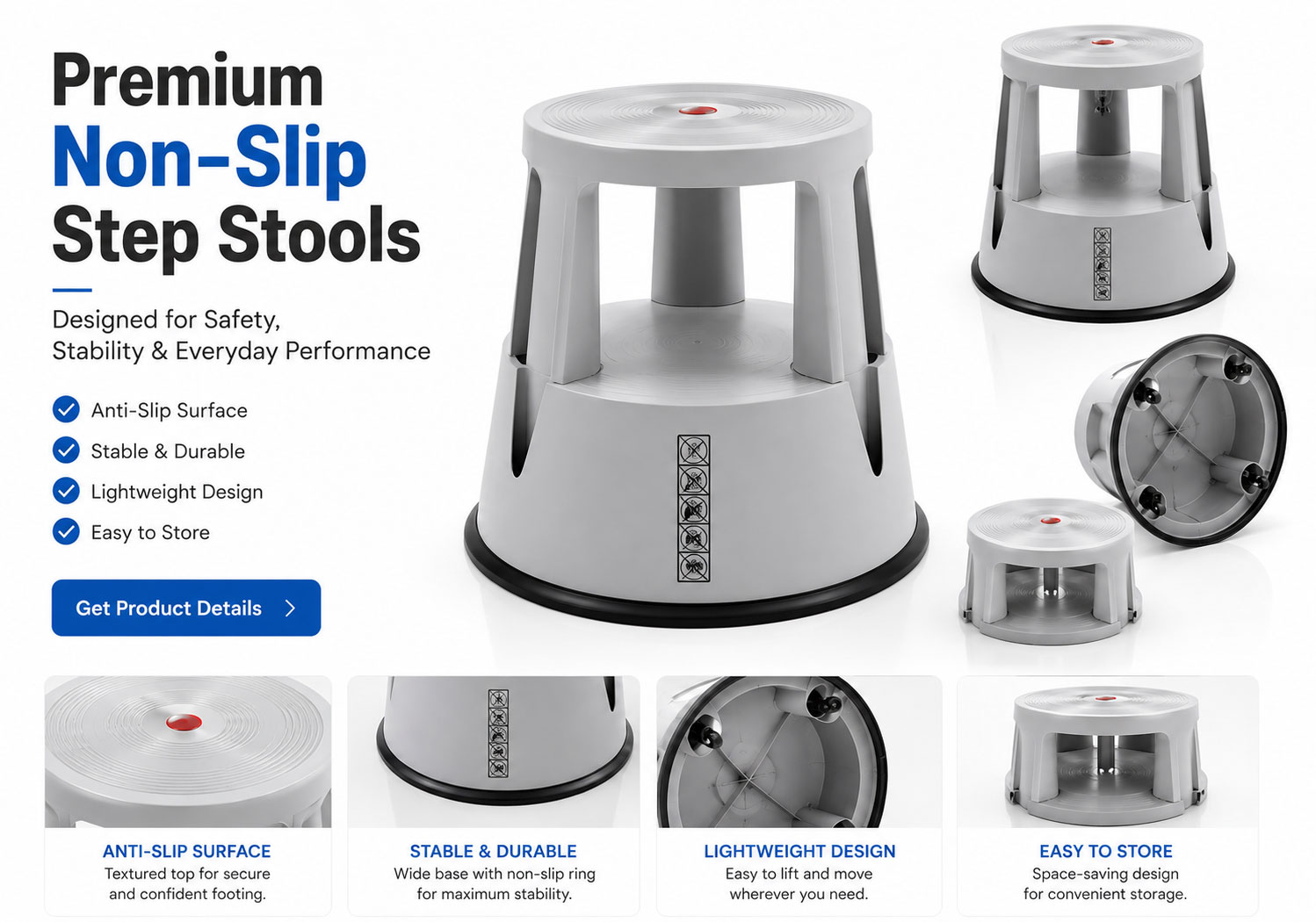
Non-Slip Wheeled Step Stools for Supermarkets in Morocco
Non-Slip Wheeled Step Stools for Supermarkets in Morocco give supermarket teams fast, stable access to high shelves, promotional displays, and backroom racking while maintaining grip on floors that are frequently cleaned, occasionally wet, or lightly dusty. Spring-loaded or auto-locking casters allow the unit to roll freely when unloaded and become fixed the moment weight is applied. In high-traffic supermarket environments that also interface with warehouse retail functions, these stools reduce slip-related incidents, speed restocking, and support consistent safety practice. Firmalazım supplies configurations suited to continuous commercial use, available through bulk orders, OEM adaptation, and wholesale distribution.


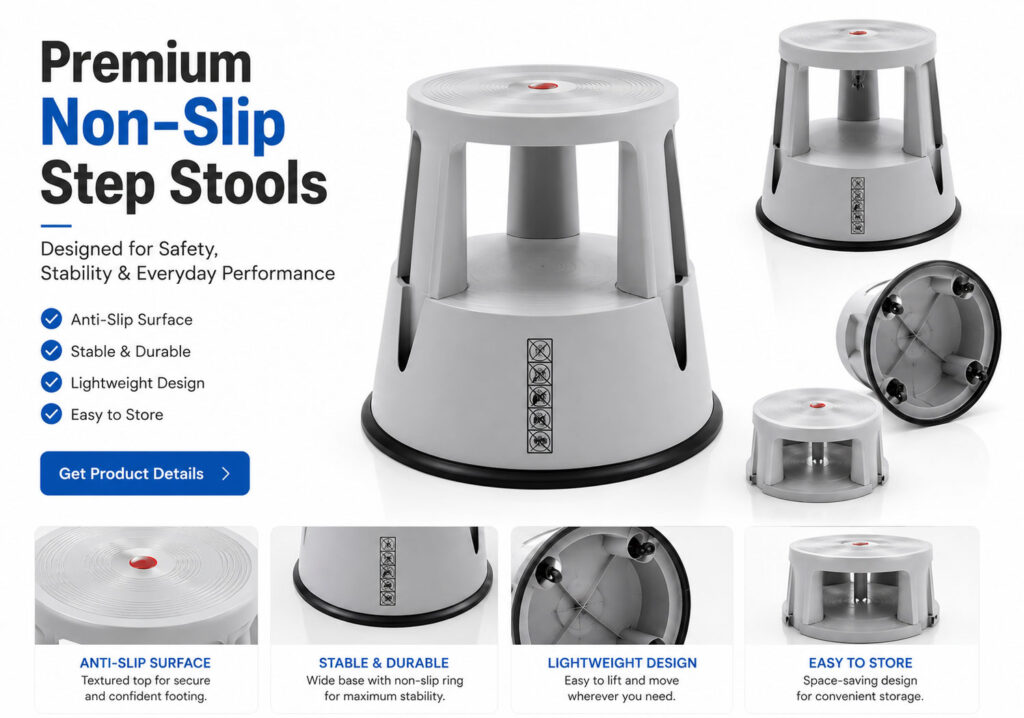

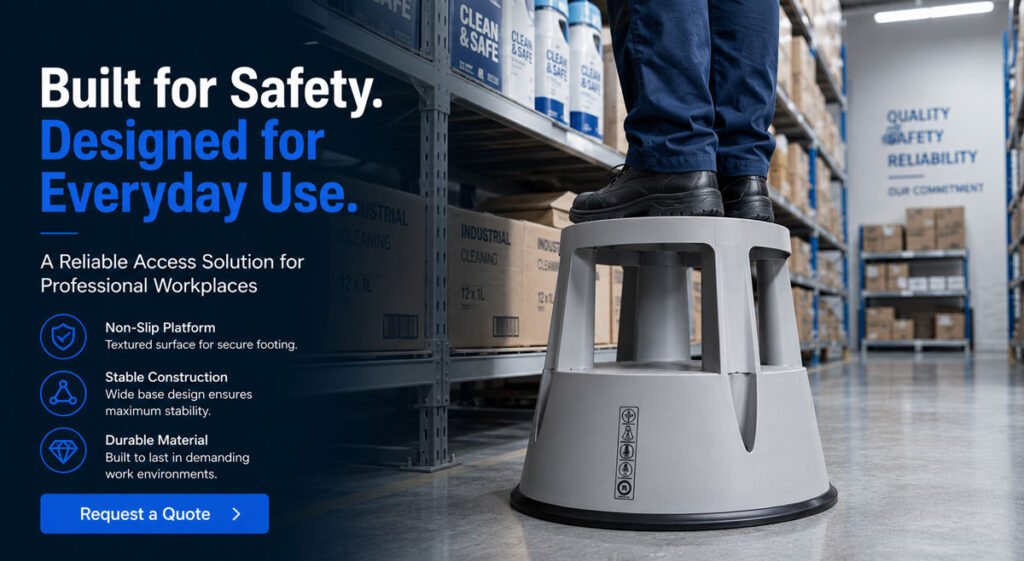
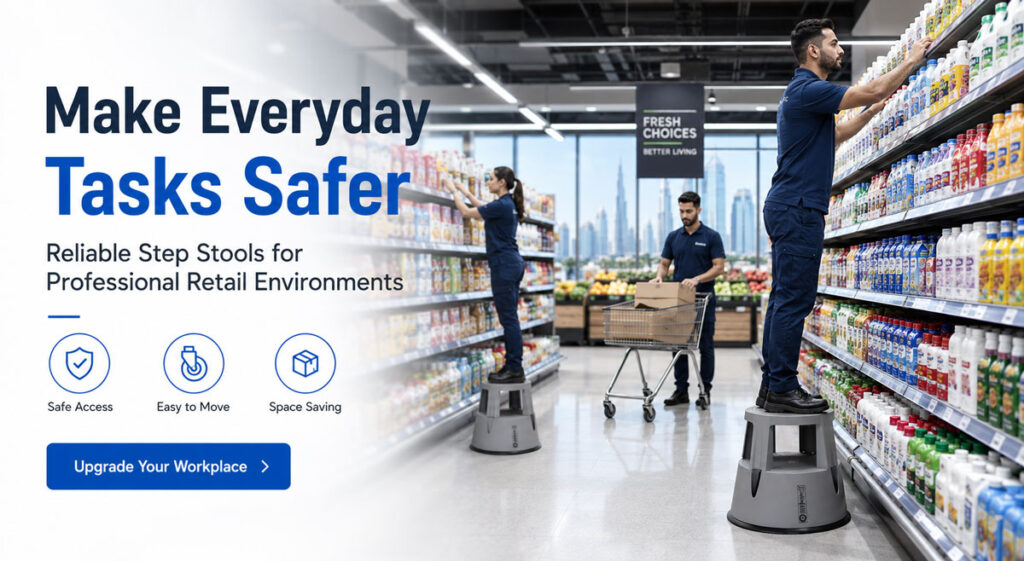


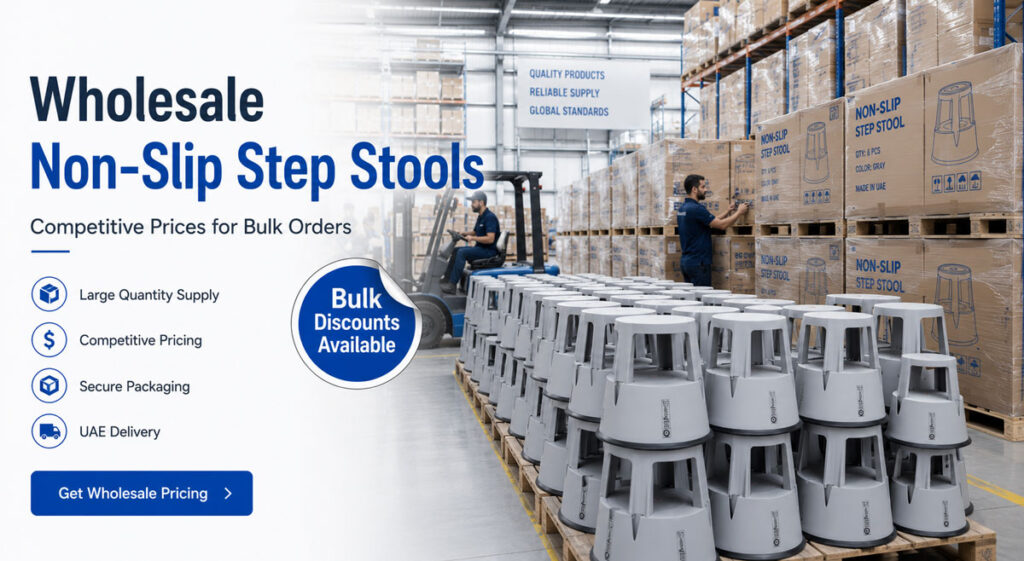
Supermarket floors are rarely dry for long. Spillages, routine mopping, condensation from refrigeration, and fine dust tracked in from receiving areas create a constantly changing surface underfoot. Ordinary step stools lose grip or become unstable precisely when staff need them most—during peak restocking windows or rapid promotional changes. Non-slip wheeled step stools are engineered to keep working under these conditions. Their defining features are a high-friction tread system that retains purchase on damp or lightly contaminated floors and a mobility system that locks automatically under load.
The operational purpose is simple: eliminate the need for staff to climb on lower shelves, stack crates, or stretch from unstable positions. When the correct stool is within a few metres and can be positioned in seconds, the unsafe alternatives disappear. In stores that also manage warehouse retail zones for bulk or online-order fulfilment, the same units often move between the sales floor and the back area, demanding durability across both environments.
How Non-Slip Performance Is Actually Achieved
Grip is not a single material property; it is the result of surface geometry, material choice, and drainage. Industrial-grade supermarket stools typically use one of three tread approaches:
- Deeply textured or serrated steel that bites into shoe soles even when a thin film of water is present
- Perforated platforms that allow liquids to drain rather than pool
- Replaceable high-friction composite or rubber overlays bonded to a rigid base
The best-performing designs often combine drainage with a renewable friction layer so that grip can be restored without replacing the entire unit. Feet and caster contact points receive equal attention; non-marking compounds that still provide lateral resistance prevent the stool from sliding while protecting polished or coated retail floors.
Mobility Systems Matched to Supermarket Traffic
Wheeled models dominate because supermarket work is rarely static. Spring-loaded casters remain the most common professional solution: body weight compresses the springs, the wheels retract, and solid feet or pads take the load. Alternative systems use automatic brakes that engage under weight. Both remove the failure mode of wheels left unlocked during use—an especially important safety feature when staff are working under time pressure in customer-facing aisles.
Frame construction is normally all-welded steel with a powder-coated or industrial finish capable of withstanding frequent cleaning chemicals. Load ratings for continuous commercial use typically start at 150 kg and rise to 300 kg or higher for units expected to support both the worker and a carried case.
Production and Supply Pathways for Multi-Store Operators
A manufacturer focused on supermarket and warehouse retail applications frequently supports OEM programmes. Colour coding to match store branding, custom platform heights, or additional handrail options become feasible once volumes reach bulk-order levels. Wholesale channels then move the standardised units to individual stores or central distribution points, while a regional distributor maintains stocks of wear items such as treads, feet, and caster assemblies. This structure keeps specification consistent across a network and simplifies long-term maintenance.
Typical High-Value Usage Moments Inside a Supermarket
Three situations account for the majority of elevated access needs:
- Rapid restocking of high-turnover top shelves during or just before peak trading
- Building or dismantling promotional end-of-aisle displays that exceed normal reach
- Retrieving or placing bulk cases in the warehouse retail or backroom area
In each case the ability to roll the stool into position, step on with confidence, complete the task, and clear the aisle quickly determines whether the equipment is used or bypassed. Units that feel stable underfoot and lock without conscious effort win consistent adoption.
Decision Matrix for Supermarket Environments
| Feature | Non-Slip Wheeled Step Stool | Standard Mobile Stool | Fixed Platform | Lightweight Folding Stool |
|---|---|---|---|---|
| Grip on damp or cleaned floors | Excellent | Moderate | Good | Poor to moderate |
| Speed of repositioning | Very high | High | None | High |
| Automatic locking under load | Yes (professional models) | Variable | N/A | Rarely |
| Suitability for customer aisles | High | Moderate | Low | Moderate |
| Durability under continuous commercial use | High | Variable | High | Low |
| Floor protection | Non-marking options | Variable | Good | Variable |
The matrix explains why many supermarket operators standardise on genuine non-slip wheeled models rather than lighter or less specialised alternatives.
Total Cost Perspective for Procurement
Purchase price is only the first number. A lower-cost stool that loses grip or structural integrity under daily supermarket conditions generates replacement cost, lost time, and elevated risk. Units ordered in bulk, supported by a local distributor, and designed for continuous commercial use typically show a lower whole-life cost. OEM customisation can further reduce later adaptation expense when branding or specific dimensional needs exist.
A practical internal model used by multi-store operators includes acquisition cost, expected tread and caster replacement, inspection labour, and a risk adjustment based on historical elevated-access incidents. When professional non-slip wheeled stools replace mixed or inadequate equipment, the risk component usually declines enough to produce a clear net positive within the first year.
Expert View on Specification Priorities
Procurement and safety leads who have standardised elevated access across supermarket networks consistently rank three criteria above price. First, the tread system must retain measurable grip after exposure to cleaning agents and light soiling—not merely look textured when new. Second, any wheeled system must lock automatically under load; manual locks fail under real operating pressure. Third, genuine spare parts must be available through a regional distributor on short lead times. Applying these filters early removes the majority of unsuitable products.
Frequent Errors and Their Prevention
Common mistakes include:
- Choosing stools rated only for dry commercial floors and then deploying them in frequently cleaned supermarket aisles
- Underestimating the combined weight of worker plus product case
- Allowing different models across stores, which complicates training and parts
- Neglecting marked parking positions so that stools obstruct customer flow
- Treating inspection as optional rather than scheduled
Each is avoidable with a short written specification and clear ownership of daily and weekly checks.
Operating Realities Across Diverse Locations
Supermarket formats and supporting warehouse retail functions operate under varying conditions. In the high-density trading environment of Nairobi the priority is rapid repositioning through crowded aisles and reliable grip after frequent cleaning. Coastal stores and distribution points linked to Mombasa and extending toward Malindi, Kilifi, Ukunda, and Diani Beach face higher humidity and occasional salt exposure, favouring robust finishes and sealed components.
Inland centres such as Nakuru, Eldoret, Kisumu, Kitale, and Kakamega experience wider temperature ranges and seasonal dust; both tread compounds and frame protection must accommodate these cycles. Growth corridors around Thika, Kiambu, Ruiru, Athi River, Kitengela, and Machakos often combine large-format supermarket trading with significant warehouse retail activity, rewarding dual-capable units.
Further locations including Nyeri, Meru, Naivasha, Nanyuki, Kericho, Kisii, Homa Bay, Migori, Bungoma, Busia, Garissa, Isiolo, Lodwar, Voi, Murang’a, Embu, Nyahururu, Limuru, Ngong, Ongata Rongai, Kajiado, and Narok each present distinct combinations of climate, floor-cleaning regimes, and customer density. Across all of them the core requirements remain identical: dependable non-slip performance under real supermarket conditions, immediate stability once loaded, and construction rated for continuous commercial use.
Practical Maintenance Rhythm
Daily (any user) Visual check of tread cleanliness and obvious damage; confirmation that casters roll when unloaded.
Weekly (supervisor) Body-weight test of locking function; cleaning of tread and wheel mechanisms; inspection of feet.
Monthly (facilities or safety lead) Frame integrity review, label legibility check, and coordination of any parts replacement through the distributor.
Units that fail are tagged and removed until restored with genuine components.
Deployment Checklist for New or Upgraded Fleets
- Map the most frequent elevated tasks and floor conditions
- Select tread system matched to cleaning chemicals and moisture levels
- Confirm automatic locking under load
- Standardise on one or two models across the network
- Mark clear parking positions that protect customer flow
- Assign inspection ownership
- Conduct short hands-on familiarisation for all relevant staff
- Schedule the first monthly performance review
Stores that complete this sequence before the stools enter service achieve faster adoption and fewer early issues.
Looking Ahead
Supermarket formats continue to densify promotional space and tighten labour models. Short-duration elevated work will remain frequent. Non-slip wheeled step stools that can be deployed in seconds, maintain grip on real floors, and survive continuous commercial use will stay relevant. Operators who work with a manufacturer capable of OEM support and a distributor that maintains local parts availability will be able to absorb incremental improvements without fleet disruption.
Firmalazım focuses on non-slip wheeled step stools engineered for the daily realities of supermarket and warehouse retail environments. Through bulk orders, OEM collaboration, wholesale distribution, and sustained local support, the objective is equipment that performs reliably under continuous commercial use while contributing to the safety standards expected in modern retail operations.
Five Distinct Calls to Action
- Request tread-performance data under wet and cleaned-floor conditions relevant to supermarket environments.
- Arrange a short in-store trial with sample non-slip wheeled units during a live restocking window.
- Submit current store count and elevated-access challenges for a volume pricing proposal under bulk orders.
- Explore OEM colour or branding options that align the stools with existing store visual standards.
- Contact the regional distributor network to confirm spare-parts lead times and technical support coverage.
FAQ – Non-Slip Wheeled Step Stools for Supermarkets
What distinguishes a genuine non-slip supermarket stool from a standard wheeled model? Retained grip after exposure to cleaning agents and light moisture, combined with automatic locking under load and construction rated for continuous commercial use.
How do spring-loaded casters improve safety compared with manual locks? They remove the possibility that wheels are left unlocked under time pressure—the most common human-error pathway in busy supermarket aisles.
What load rating is appropriate when staff carry product cases? Choose a rating that covers the heaviest expected combination of worker plus case. Many professional supermarket units start at 150–200 kg and go higher.
Can the same stools serve both the sales floor and the warehouse retail back area? Yes, provided the tread system and load rating meet the more demanding conditions of the two environments.
How often should treads be inspected in a high-cleaning-frequency store? Daily visual checks by users and weekly functional reviews form a practical minimum.
Is OEM colour coding useful in a multi-store network? Yes. It improves visual management and makes it immediately obvious when a unit has been moved to an unsuitable zone.
What is the most common reason these stools are removed from service early? Loss of tread grip through wear or contamination, followed by damaged feet or incomplete caster locking—both largely preventable with disciplined inspection.
How does bulk ordering affect total cost? Unit price declines, production scheduling becomes more predictable, and logistics costs per unit usually fall when coordinated through wholesale and distributor channels.
Should parking positions be marked on the sales floor? Yes. Clear, durable markings keep units accessible yet out of customer flow and reinforce correct storage habits.
What training produces the fastest safe adoption? A short hands-on demonstration on the actual floor covering positioning, locking behaviour, and correct ascent technique.
Can non-slip wheeled stools reduce reliance on larger ladders? For the majority of routine supermarket elevated tasks they can, improving both speed and safety.
How do frequent floor-cleaning chemicals affect tread life? Quality industrial compounds are selected for resistance to common retail cleaning agents; still, regular cleaning of the tread itself prevents residue build-up that can reduce friction.
What documentation should accompany a multi-store purchase? Load-test evidence, tread and material specifications, inspection guidance, and confirmation of spare-parts availability through a designated distributor.
Is it acceptable to add aftermarket non-slip mats to standard stools? No. Ad-hoc additions rarely achieve the mechanical security or durability of purpose-designed industrial treads and can create new failure points.
How should a near-miss involving a step stool be handled? Immediate removal of the unit, formal documentation, thorough inspection, and a brief team review focused on systemic learning.
Do these stools require special floor protection? Professional models are available with non-marking feet and casters specifically to protect supermarket flooring.
What early sign indicates that a tread system is losing effectiveness? Operators reporting reduced confidence underfoot or visible polishing of the friction surface.
Can the same specification be used for both new-store openings and existing-store upgrades? Yes. Maintaining one approved specification simplifies procurement, training, and parts management across the entire network.
How does temperature and humidity variation across locations affect performance? Quality commercial designs remain functional across the ranges typical of supermarket environments, but elastomeric components should be inspected after extreme conditions.
What role does the distributor play after initial delivery? Ongoing supply of genuine wear components, technical advice for site-specific floor conditions, and coordination of replacements.
Should contractors working in the store be required to use the site’s approved stools? Yes, to maintain specification control and consistent safety standards.
How can leadership keep the stools from becoming “optional” during peak trading periods? By referencing them in standard operating procedures, including them in routine checks, and treating missing or defective units with the same seriousness as other process tools.
Is a small buffer stock of units useful? Yes. A modest reserve allows rapid replacement of units removed for repair and supports temporary volume spikes.
What is the recommended policy for stools involved in an impact? Immediate removal, structural inspection, and either certified repair with genuine parts or permanent retirement.
How does Firmalazım support supermarket operators seeking both standard and customised solutions? By supplying non-slip wheeled step stools engineered for continuous commercial use, available through bulk orders, OEM collaboration, wholesale channels, and local distributor support.
These elements form a complete operating system. Non-slip wheeled step stools deliver lasting reductions in both risk and task friction only when technical suitability for real supermarket floors, disciplined procurement, procedural integration, and daily ownership work together. When that system is in place, the equipment becomes a quiet but effective contributor to safer, faster elevated access across supermarket and warehouse retail environments.
Non-Slip Wheeled Step Stools for Supermarkets in Morocco
The difference between a stool that sits unused and one that becomes part of the daily rhythm is decided in the first three weeks after arrival. Technical suitability is the entry ticket; consistent use is the result of positioning, familiarisation, and visible ownership. Mobile Step Stools for Logistics Centers in Morocco
Live Workflow Example – Peak Restock Window
A typical large-format supermarket faces a compressed restock period between 06:30 and 08:30. High-turnover categories on the top shelf must be replenished before doors open. In stores still relying on mixed or inadequate access equipment, staff either stretch, climb on lower shelves, or spend time locating a suitable platform. With non-slip wheeled step stools stationed at predetermined points along the main aisles, the sequence changes. An operator rolls the nearest unit two or three metres, steps on, the casters lock automatically, the case is placed, and the stool is returned to its marked position. The entire cycle adds minimal time yet removes the previous unsafe options. When this pattern is repeated across multiple aisles and multiple staff, the cumulative effect on both speed and risk becomes measurable.
Operator Adoption Patterns Observed Across Sites
Feedback collected after structured introductions shows a consistent sequence. In the first days operators test the automatic locking action and comment on the confidence the non-slip tread provides on recently cleaned floors. Within ten to fourteen days the stools begin to move without prompting. By the end of the third week most relevant staff treat the correct unit as the default tool. Sites that skip the short hands-on familiarisation or leave parking positions unmarked experience slower uptake and a higher residual rate of improvisation. The equipment itself does not create the habit; the surrounding process does.
Simple Measurement Framework for Store Managers
Three indicators are sufficient for most supermarket operations:
- Number of elevated-access near-miss reports per month
- Average time required for a standard top-shelf restock task (sampled weekly)
- Percentage of scheduled stool inspections completed
A basic tally sheet maintained by the shift supervisor captures the data. When near-misses decline and task times stabilise at the lower figure, the business case becomes visible without complex analysis. Adding a fourth informal measure—operator comments on grip confidence after wet cleaning—often provides early qualitative confirmation that the tread system is performing as intended.
Integration with Existing Store Processes
Non-slip wheeled step stools deliver maximum value when they are referenced inside normal operating routines rather than treated as a separate safety project. Practical linkage points include:
- Opening and closing checklists that verify the nearest units are present and serviceable
- Restock standard operating procedures that specify use of the approved wheeled stool for any work above shoulder height
- Near-miss investigation forms that ask whether the correct access equipment was available and used
- Contractor induction materials that show the approved stools and the prohibition on improvisation
When these connections exist, the stools reinforce the wider safety and operational system and are in turn protected by it.
Expanded Maintenance Discipline for High-Cleaning Environments
Supermarket floors are cleaned frequently, often with chemical agents that can leave residues. A practical rhythm that survives trading pressure is:
Every shift (user level) Quick visual of the tread surface and confirmation that casters roll freely when unloaded.
Twice weekly (supervisor) Full body-weight locking test, thorough cleaning of tread perforations or friction surface, and check of non-marking feet.
Monthly (facilities or safety lead) Frame and weld inspection, verification of load-rating label condition, review of parts usage, and ordering of replacements through the distributor.
Any unit that fails is tagged and removed until restored with genuine components. Keeping the protocol short is essential; elaborate systems collapse under peak trading pressure.
Regional Operating Notes – Additional Detail
Conditions continue to vary. In the dense urban trading environment of Nairobi the combination of high customer density and frequent floor cleaning places maximum demand on rapid repositioning and reliable wet-grip performance. Coastal supermarket and supporting warehouse retail operations linked to Mombasa and the areas toward Malindi, Kilifi, Ukunda, and Diani Beach introduce higher humidity and occasional salt exposure, making coating quality and sealed caster mechanisms more significant.
Inland centres such as Nakuru, Eldoret, Kisumu, Kitale, and Kakamega experience wider temperature swings and seasonal dust loads; both tread compounds and frame finishes must retain performance across these cycles. Growth corridors around Thika, Kiambu, Ruiru, Athi River, Kitengela, and Machakos frequently combine large-format supermarket trading with substantial warehouse retail activity, rewarding units that move comfortably between the two environments. Industrial Non-Slip Step Stools for Factories in Morocco
Further locations including Nyeri, Meru, Naivasha, Nanyuki, Kericho, Kisii, Homa Bay, Migori, Bungoma, Busia, Garissa, Isiolo, Lodwar, Voi, Murang’a, Embu, Nyahururu, Limuru, Ngong, Ongata Rongai, Kajiado, and Narok each add their own balance of climate, cleaning regime, and trading intensity. Across the full set the fundamental requirements stay constant: dependable non-slip behaviour under real supermarket floor conditions, immediate stability once loaded, and construction rated for continuous commercial use.
Preventing Regression After Initial Success
The most common long-term failure mode is gradual erosion of the supporting disciplines. Parking markings fade, inspection boards become outdated, and new staff receive only brief verbal instruction. Counter-measures that have proven effective include:
- Quarterly five-minute refresher demonstrations built into existing team meetings
- Inclusion of stool condition and positioning in routine leadership walks
- Simple trend visibility of near-miss rates posted in staff areas
- Explicit handover of inspection ownership whenever supervisors change
These actions require little time yet protect the performance gains already achieved.
Worked Illustration of Time Recovery
A store sampling twenty top-shelf restock tasks before and after full deployment of non-slip wheeled stools recorded an average reduction of eighteen seconds per task. At 90 such tasks per trading day the daily recovery exceeded 25 minutes. Across a year the cumulative figure became material. When the parallel drop in near-miss reports was added, the combined operational and risk benefit clearly exceeded the annualised cost of the fleet, including expected tread and caster replacement supplied through the distributor.
Procurement Continuity Across Store Openings and Upgrades
Multi-store operators that maintain consistent elevated-access standards share three practices. They freeze a short performance specification (wet-grip tread system, automatic locking under load, appropriate load rating, non-marking contact surfaces, documented spare-parts availability) before commercial discussions. They route volume requirements through bulk-order and wholesale channels that feed a capable distributor network. And they embed the equipment in store-opening and refurbishment checklists so that the same standard appears in every location from day one.
Closing Operational Perspective
Non-slip wheeled step stools contribute measurable value inside supermarket and warehouse retail environments only when four elements operate together:
- Technical suitability for real floor conditions and continuous commercial use
- Procurement that leverages bulk orders, OEM options where useful, and reliable wholesale-to-distributor supply
- Procedural integration that makes correct use the easiest path
- Daily ownership that keeps inspection, positioning, and familiarisation alive over time
When these elements are present, the stools become an unremarkable but highly effective part of normal store operations—reducing risk, recovering small amounts of time that compound across shifts, and supporting the consistent safety standards expected in modern supermarket environments.
Firmalazım continues to focus on non-slip wheeled step stools engineered for these exact conditions. Support extends from specification guidance through volume supply under bulk orders, OEM collaboration, and sustained local availability via distributor channels, so that the equipment can perform reliably under continuous commercial use.
Additional FAQ – Adoption, Measurement and Continuity
How long does it usually take for staff to treat the stools as the default tool? In most stores that combine correct equipment with hands-on familiarisation and marked parking positions, the transition occurs within two to three weeks.
What is the simplest useful metric for a busy store manager? Monthly count of elevated-access near-miss reports. A sustained decline confirms that both the equipment and the surrounding process are working.
Should the same stools be used by night-fill teams and day staff? Yes. A single specification simplifies training, inspection, and parts management across all shifts.
How can a store prevent stools from gradually migrating to inconvenient locations? Durable floor markings plus a quick visual check of positioning included in the supervisor’s twice-weekly routine.
Is it worth tracking operator comments on grip confidence? Yes. Qualitative feedback after wet cleaning often provides the earliest signal that the tread system is performing or beginning to degrade.
What is the recommended response when a new staff member is observed improvising? Immediate coaching, verification that the nearest correct unit is serviceable, and inclusion of the correct method in the next short refresher.
Can the stools be referenced in formal restock standard operating procedures? Yes. Explicitly requiring the approved non-slip wheeled stool for any work above a defined height reinforces both safety and consistency.
How should layout changes or seasonal display resets be handled? Re-mark parking positions as part of the change and conduct a brief re-familiarisation for affected teams. The stools themselves remain the same.
What early cultural signal shows that adoption is succeeding? Staff begin moving a stool into position automatically and express mild frustration if the nearest unit is missing or defective.
Does Firmalazım assist with the non-product elements of a successful rollout? Support typically includes guidance on specification, volume pricing under bulk orders, OEM coordination where required, and introduction to the relevant distributor for ongoing parts and technical coverage. Heavy-Duty Step Stools for Warehouses in Morocco
These additional layers close the operational loop. Non-slip wheeled step stools deliver lasting reductions in both risk and task friction only when they are treated as an integrated system rather than a one-time equipment purchase. When technical performance, disciplined supply, procedural reinforcement, and sustained ownership work together, the result is quieter, safer, and more efficient elevated access across supermarket and warehouse retail environments.
Non-Slip Wheeled Step Stools for Supermarkets Morocco
Once the stools are on the floor and initial adoption has begun, the next determinant of lasting performance is the quality of the familiarisation process and the robustness of the cost and risk model that justifies ongoing investment.
Structured Familiarisation Module Used by High-Performing Stores
A concise, repeatable module lasting approximately twenty-five minutes has proven effective across multiple supermarket formats:
- Brief explanation of why non-slip performance and automatic locking matter on frequently cleaned floors (4 minutes)
- Live demonstration of the full sequence: roll, position, step on (lock), work, step off, return to marked position (6 minutes)
- Hands-on practice by each participant with immediate coaching on stance and load awareness (10 minutes)
- Review of the simple daily and weekly inspection points plus the rule for removing a defective unit (5 minutes)
New starters receive the module during induction. Existing teams receive a short refresher at six- to twelve-month intervals or after major layout changes. The same content is used across every store so that staff transferring between locations encounter identical expectations. Recording a single high-quality demonstration video further supports consistency when live trainers are not available.
Deeper Cost and Risk Model for Multi-Store Decision Makers
A more complete whole-life view includes five layers:
- Acquisition cost under bulk orders or OEM arrangements
- Logistics and deployment cost through wholesale and distributor channels
- Scheduled maintenance and consumable replacement (treads, feet, casters)
- Familiarisation and supervision labour
- Risk adjustment based on historical elevated-access incidents and near-miss trends
Stores that have moved from mixed or light-duty equipment to standardised non-slip wheeled stools typically observe a clear reduction in the risk layer. When this reduction is combined with modest daily time recovery across restock and display tasks, the model returns a net positive well inside the first twelve to eighteen months. The calculation becomes still more favourable when the same specification is applied across an entire network, because training materials, spare-parts inventories, and audit processes scale efficiently.
Realistic Recovery Case After Process Drift
A regional supermarket cluster introduced non-slip wheeled stools successfully but allowed inspection ownership to become unclear during a period of high staff turnover. Within four months several units developed polished tread surfaces and two showed incomplete caster locking. Near-miss reports began to reappear. Recovery required three decisive actions: immediate removal of all sub-standard units, re-assignment of named inspection ownership on every shift, and a short refresher demonstration for all relevant teams. Within five weeks the near-miss rate returned to the improved baseline and grip-confidence comments from staff became positive again. The episode confirmed that the equipment’s technical capability is only one component; sustained process ownership is the other.
Sustainability Through Serviceability
A stool that remains in service for many years under continuous commercial use generates less waste than lighter units that require frequent replacement. Replaceable tread systems allow the high-wear friction surface to be renewed while the structural platform continues in service. Local availability of genuine parts through a distributor shortens transport distances for maintenance items and reduces the likelihood that entire units will be discarded because a single component has failed. Some operators also record a secondary benefit: fewer damaged products or packaging materials when staff can reach elevated points securely and without haste. That reduction appears both in waste metrics and in the presentation quality of goods on supermarket shelves.
Regional Condition Notes – Final Layer of Detail
Operating realities remain location-specific. In the high-intensity trading environment of Nairobi the combination of dense customer flow and frequent floor cleaning continues to reward rapid repositioning and reliable wet-grip performance. Coastal supermarket and warehouse retail operations connected to Mombasa and extending toward Malindi, Kilifi, Ukunda, and Diani Beach add humidity and occasional salt exposure, placing greater emphasis on coating integrity and sealed moving parts.
Inland centres such as Nakuru, Eldoret, Kisumu, Kitale, and Kakamega face wider temperature variation and seasonal dust; tread compounds and frame finishes must be selected with these cycles in mind. Mixed large-format supermarket and warehouse retail zones around Thika, Kiambu, Ruiru, Athi River, Kitengela, and Machakos require units that transition comfortably between sales floor and backroom conditions.
Additional locations including Nyeri, Meru, Naivasha, Nanyuki, Kericho, Kisii, Homa Bay, Migori, Bungoma, Busia, Garissa, Isiolo, Lodwar, Voi, Murang’a, Embu, Nyahururu, Limuru, Ngong, Ongata Rongai, Kajiado, and Narok each contribute distinct profiles of climate, cleaning intensity, and trading density. Across the entire network the non-negotiable requirements stay identical: dependable non-slip behaviour under real supermarket floor conditions, immediate stability once loaded, and construction rated for continuous commercial use.
Maintaining Specification Integrity During Network Growth
Organisations that open new stores or acquire existing ones while preserving elevated-access standards share three practical disciplines. They keep a single, short performance specification frozen and visible. They route all volume requirements through established bulk-order and wholesale channels that feed a capable distributor network. And they include the approved non-slip wheeled stools in every store-opening and refurbishment checklist so that the same standard appears from the first day of trading.
Closing System View
Non-slip wheeled step stools deliver lasting operational and safety value inside supermarket and warehouse retail environments only when four elements function as a single system:
- Technical suitability for actual floor conditions and continuous commercial use
- Procurement that leverages bulk orders, OEM flexibility where needed, and reliable wholesale-to-distributor supply
- Procedural integration that makes correct use the path of least resistance
- Sustained ownership of inspection, positioning, and familiarisation over time
When these elements are present, the stools become an unremarkable yet highly effective part of normal store operations—quietly reducing risk, recovering small increments of time that compound across shifts, and supporting the consistent safety standards expected in modern supermarket environments.
Firmalazım remains focused on non-slip wheeled step stools engineered for these exact conditions. Support covers specification guidance, volume supply under bulk orders, OEM collaboration, and ongoing local availability through distributor channels, enabling the equipment to perform reliably under continuous commercial use.
Further FAQ – Training, Cost and Network Continuity
How often should the familiarisation module be repeated for existing staff? A short refresher every six to twelve months, or after significant layout or process changes, is usually sufficient to maintain standards.
What is the most useful single cost metric for finance discussions? Annualised whole-life cost per store, including acquisition, expected consumables, and a risk adjustment based on near-miss and incident trends.
Should inspection ownership be assigned to a specific role or rotated? Named ownership on every shift produces higher compliance than rotation. The role can be a supervisor, team leader, or designated safety champion.
How can a multi-store organisation quickly bring a newly acquired store up to the same standard? Apply the existing performance specification, supply the approved units through the established distributor channel, and run the standard familiarisation module for all relevant staff.
Is it beneficial to involve experienced operators in the final selection of a new model? Yes. A short practical trial with shortlisted units often surfaces usability details that pure technical specifications miss.
What early warning sign indicates that process discipline is slipping? An increase in units found outside marked parking positions, incomplete inspection logs, or a rise in minor tread complaints.
Can the same non-slip wheeled stools be specified for both small-format and large-format stores? Yes, provided the load rating and tread system meet the more demanding environment. Standardisation simplifies everything else.
How should seasonal promotional peaks be managed without permanently expanding the fleet? Maintain a modest central buffer of additional units that can be deployed to high-activity stores, or establish temporary reallocation between nearby locations.
What is the recommended action when a stool is involved in any impact or tip event? Immediate removal from service, structural inspection, and either certified repair with genuine parts or permanent retirement.
Does Firmalazım support both pilot deployments and full network standardisation? Yes. Assistance typically includes specification development, volume pricing under bulk orders, OEM coordination where required, and linkage to the distributor network for sustained parts and technical support. Professional Wheeled Step Stools for Retail Stores in Morocco
These final elements complete the operational picture. Non-slip wheeled step stools become a durable source of both productivity and safety advantage only when technical performance, disciplined supply, procedural reinforcement, and sustained ownership are treated as interdependent. When that integrated system is in place, the equipment performs quietly and reliably across the full range of supermarket and warehouse retail environments.

Bir yanıt yazın