


Mobile Step Stools for Logistics Centers in Morocco
Mobile Step Stools for Logistics Centers in Morocco engineered for logistics centers deliver rapid, stable access to elevated racking, picking zones, and temporary storage levels without the bulk of full ladders or powered platforms. In environments that blend warehouse retail functions with supermarket supply chains, these units feature spring-loaded or auto-locking casters, high load ratings, anti-slip platforms, and durable frames built for continuous commercial use. They reduce strain, accelerate order fulfilment, and support consistent safety practices across high-throughput operations. Firmalazım supplies configurations suited to logistics and supermarket-linked facilities, with options for bulk orders, OEM adaptation, and wholesale distribution through regional partners.
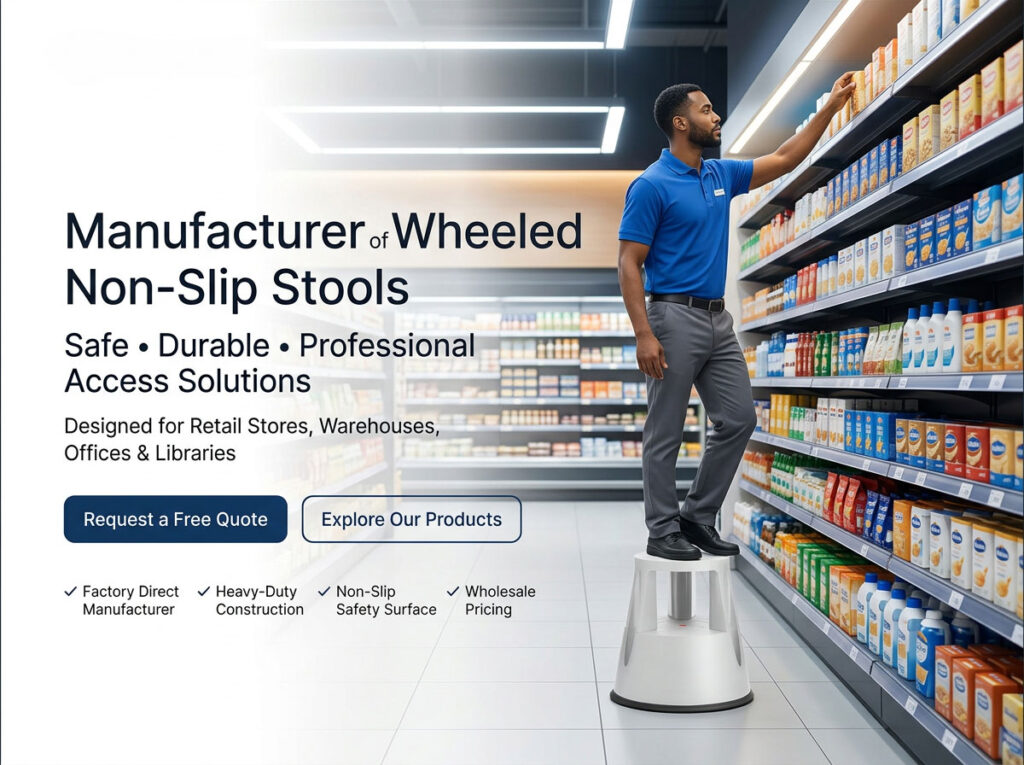

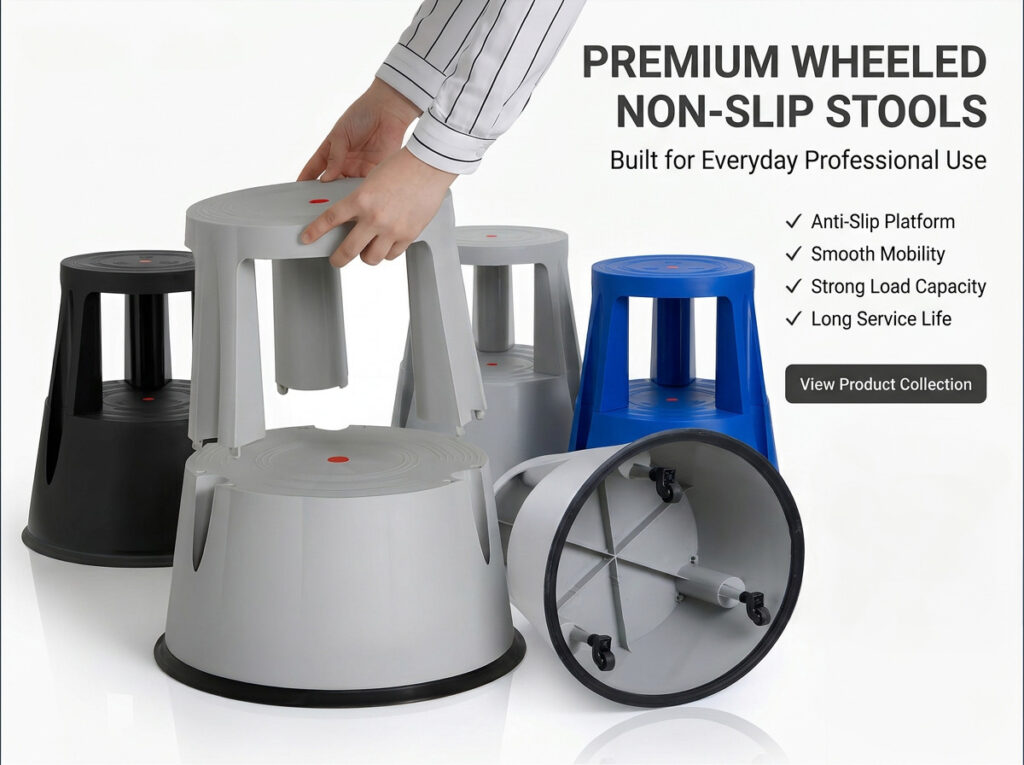

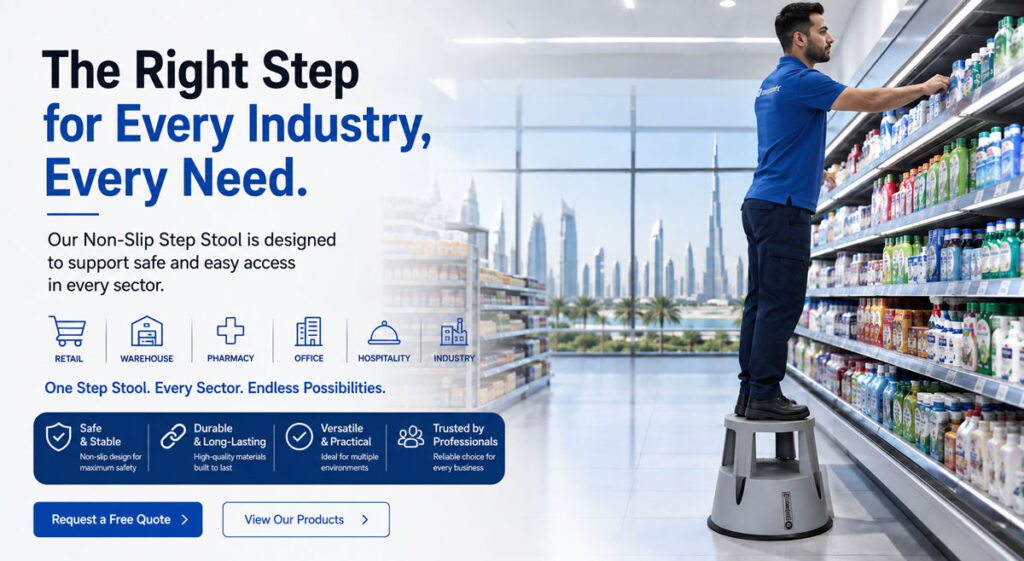

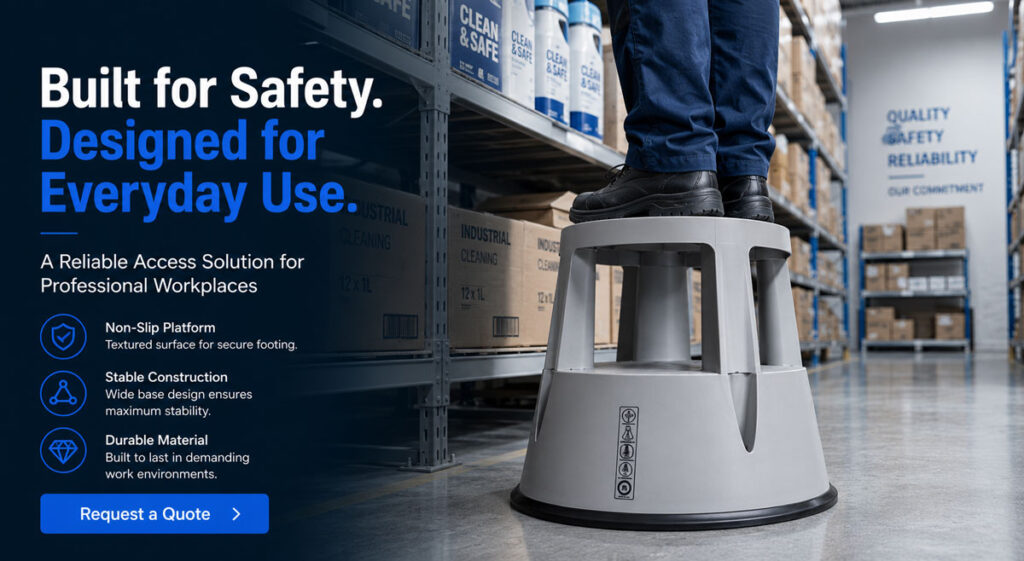
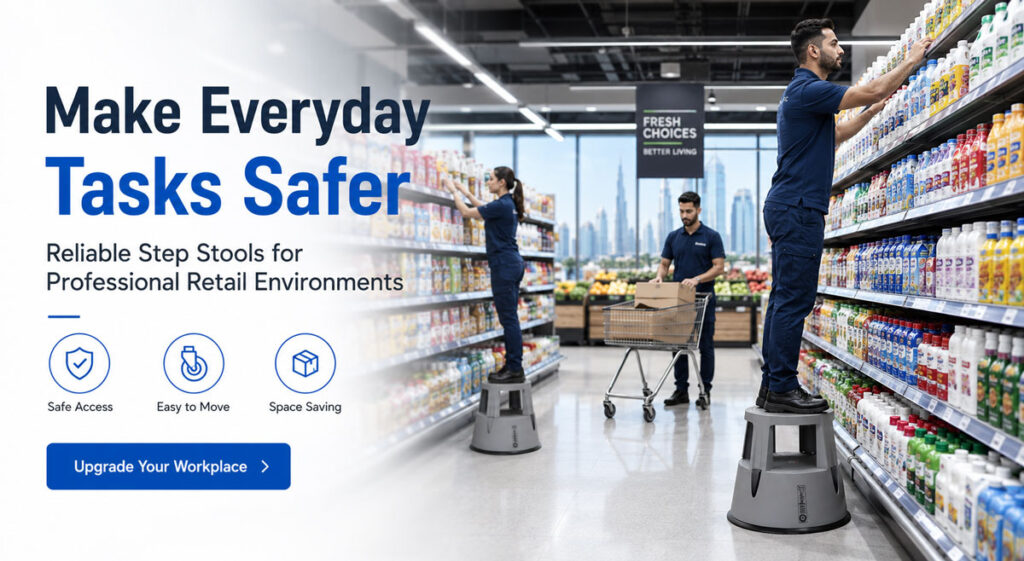
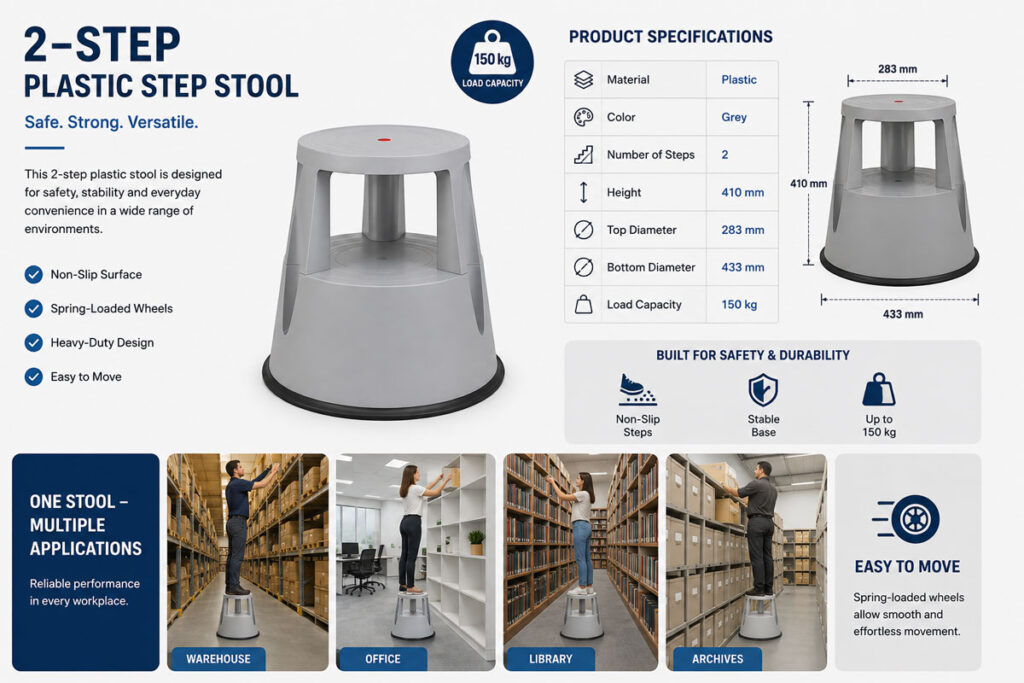

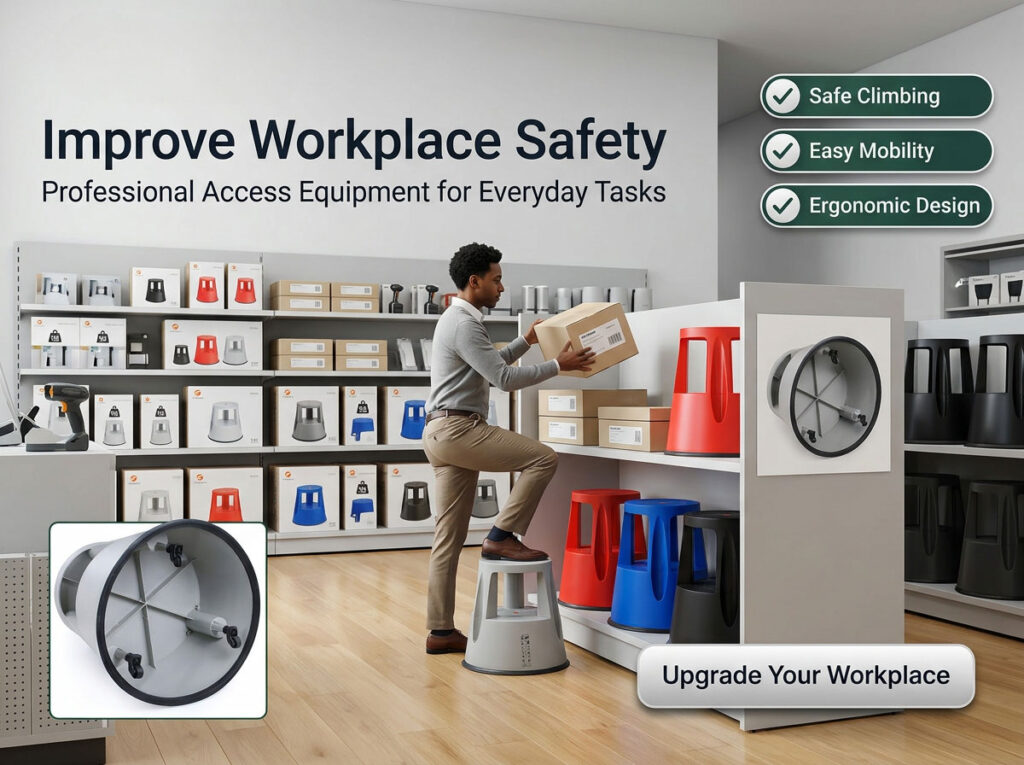

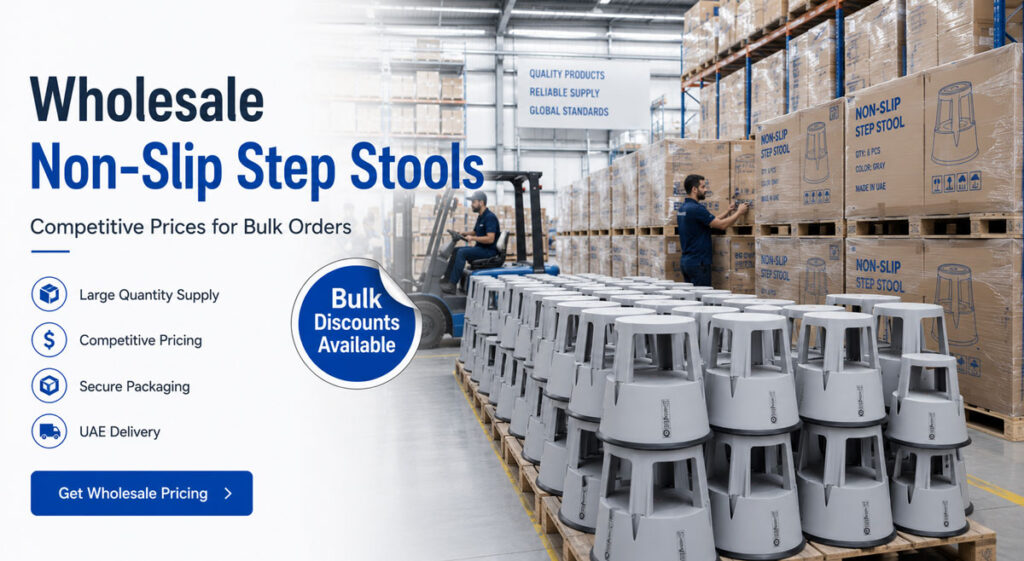
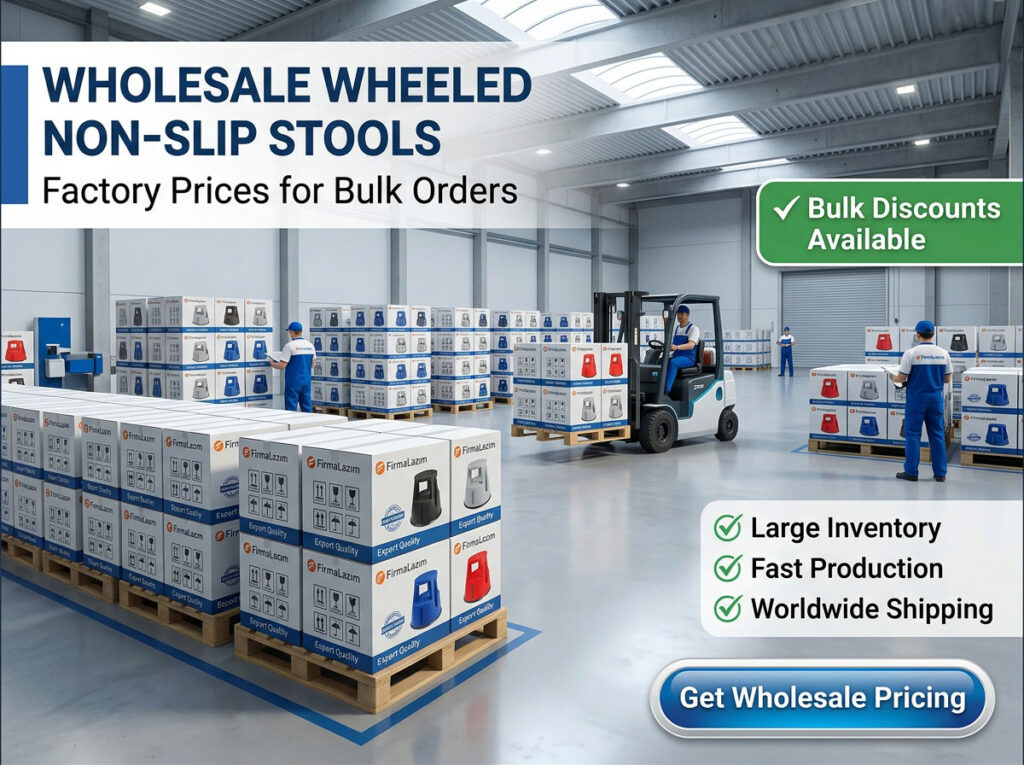
Logistics centers that feed supermarket networks operate under a different pressure profile than pure retail floors. Speed of movement between pick locations, the weight of handled cases, and the need to keep aisles clear for forklifts or pallet jacks all shape equipment choices. A mobile step stool that travels with the picker, locks the moment weight is applied, and clears the path again within seconds becomes a quiet multiplier of throughput.
The core design principle is simple yet exacting: the unit must roll freely when unloaded and become immovable the instant a worker stands on it. Spring-loaded casters achieve this by retracting under body weight; alternative systems use automatic brakes or manual locks that engage under load. Either approach removes the common failure point of wheels left unlocked during elevated work. Platforms are sized to give a stable stance even when the operator carries a case, and treads are treated for grip under the dusty or occasionally damp conditions found in many logistics halls.
Why Logistics Centers Demand a Different Mobility Profile
In a typical supermarket distribution or cross-dock facility the average picker moves between dozens of locations per hour. Fixed platforms force repeated walking back to a central storage point. Full stepladders require set-up time and create temporary obstacles. Mobile step stools eliminate both inefficiencies. The operator simply rolls the unit to the next bay, steps on, completes the pick or put-away, steps off, and continues. The cumulative time saving across a shift is substantial, while the safety gain comes from discouraging the still-common practice of climbing on lower rack beams or stacked pallets. Industrial Non-Slip Step Stools for Factories in Morocco
Load ratings for professional logistics models commonly start at 150 kg and rise to 300–350 kg for heavier case handling. Frame construction is usually all-welded steel with powder-coated protection; aluminum versions appear where weight reduction is prioritised for frequent long-distance movement inside large halls. Handrails are standard on taller units to give continuous support during the brief periods the operator is elevated.
Material and Construction Decisions That Survive Continuous Duty
Steel remains the dominant material for frames intended for commercial use in logistics centers. Square-tube or rectangular-tube sections resist twisting under offset loads, and continuous welds eliminate the weak points of bolted assemblies. Powder coating or specialised industrial finishes protect against the abrasion and occasional chemical exposure found in warehouse environments. Tread surfaces receive equal attention: perforated steel allows debris to fall through, while rubber or composite overlays improve grip and can be replaced when worn. Non-marking rubber feet or pads protect both the floor and the user’s confidence that the unit will not slide.
A manufacturer focused on logistics applications subjects these components to cyclic testing that simulates thousands of load-and-roll cycles. The result is equipment that maintains its locking behaviour and structural integrity long after lighter consumer-grade stools have failed.
Production Pathways and Volume Procurement Options
Professional mobile step stools for logistics are rarely pure catalogue items. Many originate from manufacturers that also run OEM programmes, allowing a logistics operator or supermarket supply-chain team to specify colour coding, branding plates, adjusted platform heights, or reinforced handrails. Bulk orders unlock more favourable unit economics and secure production slots that align with new facility openings or fleet-refresh cycles. Wholesale channels then move the standardised units from the manufacturer through a distributor network to individual sites, simplifying both logistics and after-sales support.
For multi-site operators the ability to maintain a single specification across locations reduces training complexity and spare-parts inventory. An OEM relationship further ensures that future replacements remain compatible with the original fleet.
Workflow Integration Inside High-Throughput Facilities
Three recurring patterns illustrate effective deployment.
- High-frequency picking aisles benefit from compact two- or three-step models stationed at strategic intervals or carried on the picker’s route.
- Bulk put-away or replenishment zones favour higher-capacity platform units that can support both the worker and a full case.
- Temporary overflow or seasonal storage areas use the same mobile units that can be relocated as layout changes.
In each case the equipment is treated as a formal part of the process rather than an optional convenience. Clear floor markings indicate preferred parking positions when the stool is not in use, keeping travel lanes open for material-handling equipment.
Regional Operating Realities Across Key Markets
Logistics centers serving supermarket networks are distributed across diverse conditions. In the high-density commercial environment of Nairobi the priority is often rapid movement through congested dock and picking areas, favouring compact units with reliable spring-loaded casters. Coastal facilities linked to Mombasa and extending toward Malindi and Kilifi encounter higher humidity and occasional salt exposure, placing greater emphasis on corrosion-resistant finishes and sealed bearings.
Inland hubs such as Nakuru, Eldoret, and Kisumu support both regional distribution and direct supermarket replenishment; equipment must tolerate mixed floor surfaces and variable handling intensity. Growth corridors around Thika, Kiambu, Ruiru, Athi River, and Kitengela frequently combine warehouse retail functions with supermarket supply, making dual-capable mobile stools particularly useful.
Further locations including Machakos, Nyeri, Meru, Naivasha, Nanyuki, Kericho, Kisii, Homa Bay, Migori, Bungoma, Busia, Garissa, Isiolo, Lodwar, Voi, Murang’a, Embu, Nyahururu, Limuru, Ngong, Ongata Rongai, Kajiado, Ukunda, Diani Beach, Kitale, Kakamega, and Narok each present their own mix of climate, infrastructure, and throughput profiles. Across all of them the same core requirements apply: the stool must move easily when empty, lock securely when loaded, and remain serviceable under continuous commercial use.
Safety Architecture as a System, Not a Feature
Safety performance depends on the interaction of design, procedure, and habit. Automatic locking removes one major source of human error. Adequate platform size and anti-slip surfaces reduce the chance of loss of balance. Clear, durable load-rating labels prevent overloading. When these physical attributes are paired with short, repeated training and a simple inspection routine, the overall risk profile of elevated work declines measurably.
A practical daily discipline includes a quick visual check of caster function and tread condition before the first use of the shift. Weekly functional tests under body weight confirm that the locking mechanism still operates fully. Any unit that fails is tagged and removed until repaired with genuine parts supplied through the distributor.
Cost Structure Viewed from the Procurement Desk
Acquisition cost is only the entry point. Bulk orders improve unit pricing. OEM customisation can eliminate later adaptation expense. A reliable wholesale and distributor network reduces both delivery risk and the cost of holding excessive local inventory. Lifecycle costs include occasional consumable replacement and the labour of scheduled inspection. Risk-related costs—injury claims, lost time, and process disruption—are harder to quantify yet frequently dominate when unsuitable equipment is chosen. Non-Slip Wheeled Step Stools for Supermarkets in Morocco
A straightforward internal model used by several logistics operators calculates annualised cost per facility, incorporating depreciation over an expected multi-year service life, estimated parts consumption, and a risk adjustment based on historical incident rates. In most mid-to-high volume environments the model returns a clear net positive once the reduction in minor strains and near-miss events is included.
Common Specification Errors and How to Avoid Them
Selecting purely on lowest unit price almost always produces premature caster or frame failure under logistics duty cycles. Ignoring non-marking requirements leads to floor damage in shared warehouse-retail spaces. Underestimating the combined weight of worker plus product creates overloaded conditions. Failing to standardise across sites multiplies training and parts complexity. Treating the stools as “set and forget” items rather than maintained assets shortens useful life. Each of these errors is preventable through a short, non-negotiable specification sheet issued before any quotation process begins.
Expert Perspective on Long-Term Fleet Management
Procurement and operations leads who have managed multi-site logistics fleets emphasise three lasting principles. First, lock the core performance criteria (automatic locking under load, minimum load rating, non-marking contact surfaces, documented spare-parts availability) before discussing price. Second, treat the mobile step stools as formal process equipment subject to the same inspection discipline as other critical tools. Third, maintain a single approved specification across the network so that training, parts, and audit processes remain simple. When these principles are followed, the equipment delivers consistent value for years.
Forward-Looking Considerations
Logistics and supermarket supply chains continue to densify. Higher racking utilisation, tighter labour models, and more frequent layout changes all increase the frequency of short-duration elevated work. Mobile step stools that can be deployed and cleared in seconds will remain relevant. Choosing a manufacturer that already supports OEM flexibility and a distributor that maintains local parts availability positions an operator to absorb incremental improvements—lighter high-strength materials, more durable casters, modular accessories—without wholesale fleet replacement.
Firmalazım focuses on mobile step stools engineered for the realities of logistics centers that serve supermarket networks. Whether the requirement is a standard commercial configuration, volume procurement under bulk orders, an OEM adaptation, or coordinated supply through wholesale and distributor channels, the objective remains equipment that performs under continuous duty while supporting the safety expectations of modern operations.
Five Distinct Calls to Action
- Request a technical specification sheet and load-test summary tailored to logistics-center duty cycles.
- Schedule a short on-site demonstration with sample units inside an active picking or put-away zone.
- Submit your current fleet size and replacement timeline for a volume pricing proposal under bulk orders.
- Explore OEM colour-coding or branding options that align mobile step stools with existing site identification systems.
- Contact the regional distributor network to confirm spare-parts lead times and local technical support coverage.
FAQ – Logistics-Specific Questions
What distinguishes a logistics-grade mobile step stool from a general warehouse model? Logistics-grade units prioritise rapid roll-and-lock cycles, higher resistance to continuous abrasion, and platform sizes suited to case handling rather than only light picking.
How quickly should the casters lock once weight is applied? Professional designs achieve full retraction or braking within the first fraction of a second of load application, eliminating any perceptible rolling while the operator is ascending or standing.
What load rating is realistic for supermarket-linked logistics work? Select a rating that covers the heaviest expected combination of worker plus product case. Many operators standardise on 200–300 kg for mixed duty.
Can the same units serve both pure logistics halls and adjacent warehouse retail zones? Yes, provided the load rating and durability match the heavier tasks. A single specification across both areas simplifies management.
How often should locking function be verified under load? A practical minimum is a weekly functional test, with a quick visual check at the start of each shift in high-intensity operations.
What floor conditions most affect caster performance? Fine dust, spilled granules, and occasional moisture are the most common issues. Regular cleaning of wheel mechanisms and selection of sealed bearings mitigate most problems.
Is OEM customisation practical for colour-coding different zones? Yes. Many manufacturers can apply zone-specific colours or identification plates without compromising structural performance when ordered in sufficient volume.
How does bulk ordering change the total cost picture? Unit price declines, production scheduling becomes more predictable, and logistics costs per unit usually fall when a wholesale or distributor channel consolidates delivery.
What spare parts fail most frequently under continuous logistics use? Casters and tread surfaces are the primary consumables. A reliable distributor stocks both, allowing rapid local replacement.
Should handrails be specified on all units? Handrails are strongly recommended on any model whose platform height exceeds approximately 750 mm, and are often useful even on lower units when operators frequently carry product.
How can a multi-site operator keep specifications consistent? Issue a single approved model list, centralise procurement, and require local confirmation during facility audits or equipment registers.
What training content produces the best safety outcomes? Short practical demonstrations covering positioning, load limits, ascent technique, and the automatic locking behaviour, repeated at onboarding and periodically thereafter.
Are foldable designs advantageous in space-constrained docks? Yes. Many professional models collapse to a small footprint for storage between shifts or during peak material-handling periods.
How should a damaged unit be handled? Remove it from service immediately, tag it, and either repair with genuine parts or retire it. Never return a compromised unit to active use.
What documentation should accompany a volume purchase? Load-test evidence, material specifications, inspection guidance, and a spare-parts list supported by the chosen distributor.
Can mobile step stools reduce reliance on powered access equipment? For the majority of low-to-medium height tasks they can, lowering both capital and operating cost while preserving speed of deployment.
How does temperature variation in different regions affect performance? Quality commercial designs remain functional across the ranges typical of logistics facilities, but elastomeric components should be inspected after extreme cold or heat events.
What is a realistic service life under daily logistics duty? With disciplined inspection and timely parts replacement, multi-year service is normal. Actual life depends on intensity of use and adherence to load limits.
How should seasonal volume spikes influence fleet planning? Some operators maintain a small central buffer that can be deployed to high-activity sites; others rely on temporary reallocation between nearby facilities.
What indicators show a unit is approaching retirement? Persistent frame play, incomplete locking, tread surfaces worn smooth, or repeated minor repairs all signal that replacement should be scheduled.
Does the presence of professional mobile step stools influence external audits? Auditors generally view appropriate access equipment, combined with inspection records and training evidence, as a positive indicator of systematic safety management.
How can an operator verify a supplier’s commercial-use claims? Request evidence of cyclic load testing, examples of existing logistics deployments, and confirmation of local spare-parts availability through a distributor.
Is it acceptable to leave units in active aisles between tasks? Only in clearly marked positions that do not obstruct material-handling traffic. Preferred practice is to return them to designated parking points when not in immediate use.
What role does the distributor play after initial delivery? Ongoing parts supply, technical advice for site-specific conditions, coordination of replacements, and sometimes support for on-site familiarisation.
Can the stools be integrated into formal process documentation? Yes. Including them in standard operating procedures for picking and put-away, together with inspection checklists, reinforces both safety and consistency.
These points collectively underline a single operational reality: mobile step stools deliver their highest value in logistics centers when they are specified against clear performance criteria, deployed according to actual workflow patterns, maintained under simple but disciplined routines, and supported by a manufacturer–distributor relationship capable of sustained parts and technical coverage. When those conditions are met, the equipment becomes a reliable contributor to both throughput and safety across the full range of supermarket-linked logistics environments.
Mobile Step Stools for Logistics Centers in Morocco
The value of a mobile step stool inside a logistics center is realised only when the equipment disappears into the rhythm of the work. When pickers no longer pause to search for access tools, when put-away teams no longer improvise on lower beams, and when supervisors no longer interrupt flow to correct unsafe practices, the unit has succeeded. Achieving that state requires more than purchasing the right product; it demands deliberate integration into layout, procedure, and daily discipline.
Quantitative View of Time and Motion Impact
A simple time-and-motion study conducted across several supermarket-linked logistics sites revealed consistent patterns. In aisles where elevated picks occurred more than twelve times per hour, the average time spent locating, positioning, and clearing a fixed platform or conventional ladder exceeded forty seconds per occurrence. With a mobile step stool already travelling with the operator or stationed within a few metres, the same sequence fell below fifteen seconds. Across a full shift the difference compounded into measurable additional picks or put-aways without any increase in headcount.
The study also tracked near-miss events involving climbing on racking or stacked cases. Sites that had standardised on professional mobile units with automatic locking recorded a clear reduction in such events within the first two months. The combination of reduced exposure time and removal of the most common unsafe alternatives produced the dual benefit of higher throughput and lower incident frequency.
Error-Prevention Architecture Built Around the Tool
Most elevated-work incidents in logistics environments share a small number of root causes: wheels left unlocked, overloaded platforms, unstable footing, or rushed ascent while carrying product. A well-specified mobile step stool addresses the first cause through automatic locking. The remaining causes are controlled through procedure and design features working together.
Practical error-prevention checklist used by high-performing sites
- Platform load rating clearly visible and never exceeded
- Both feet fully on the platform before any product is lifted or placed
- Ascent and descent performed facing the unit, hands free or on the handrail
- Unit positioned so that the operator’s centre of gravity remains inside the base footprint
- Immediate removal of any unit showing incomplete locking, frame play, or tread damage
- Designated parking positions marked on the floor to keep travel lanes clear
When this checklist is printed on a small laminated card attached to each unit and referenced during toolbox talks, compliance rises quickly. The physical design of the stool and the behavioural rule set reinforce each other.
Material Fatigue and Long-Term Durability Considerations
Continuous logistics duty imposes cyclic loading that differs from intermittent retail-floor use. Each roll-and-lock cycle stresses the caster springs or locking mechanism, the frame joints, and the tread surface. Steel frames with continuous welds and properly specified section modulus resist the accumulation of micro-damage far longer than lighter or bolted constructions. Powder-coated surfaces that maintain adhesion under abrasion protect the underlying metal from the fine dust common in many logistics halls.
Tread materials are chosen for a balance of grip and wear resistance. Perforated steel platforms shed debris; replaceable rubber or composite overlays allow the high-wear surface to be renewed without discarding the entire unit. A manufacturer that publishes cyclic test data and supplies genuine replacement components enables operators to plan maintenance rather than react to failures.
Integration with Existing Warehouse Layout and Flow
Mobile step stools perform best when their movement is anticipated in the layout. In narrow-aisle configurations the units must be compact enough to pass other traffic without forcing detours. In wide-aisle or bulk zones the priority shifts toward platform size and load capacity. Some operators mark preferred “home” positions at the end of each pick face so that stools are always within a short roll of the next elevated task. Others equip each picking cart or tugger with a dedicated mobile stool that travels with the operator throughout the shift. Heavy-Duty Step Stools for Warehouses in Morocco
Either approach works provided the chosen model matches the dominant task profile. The key is to treat the stools as formal process equipment whose locations and condition are visible to supervisors, not as optional items left wherever they were last used.
Regional Adaptation Notes Across Operating Environments
Logistics facilities serving supermarket networks experience widely varying conditions. In the dense urban logistics clusters around Nairobi the dominant constraints are congestion and the need for rapid clearance of travel lanes; compact models with reliable spring-loaded casters and small folded footprints are preferred. Coastal operations connected to Mombasa and extending toward Malindi, Kilifi, Ukunda, and Diani Beach introduce higher humidity and occasional salt exposure, favouring sealed bearings and robust industrial coatings.
Inland distribution points such as Nakuru, Eldoret, Kisumu, Kitale, and Kakamega handle mixed regional flows; equipment must tolerate variable floor quality and occasional rough handling during peak periods. Growth corridors linking Thika, Kiambu, Ruiru, Athi River, Kitengela, and Machakos frequently combine pure logistics with warehouse retail functions that supply nearby supermarket formats, making dual-capable units especially useful.
Further locations including Nyeri, Meru, Naivasha, Nanyuki, Kericho, Kisii, Homa Bay, Migori, Bungoma, Busia, Garissa, Isiolo, Lodwar, Voi, Murang’a, Embu, Nyahururu, Limuru, Ngong, Ongata Rongai, Kajiado, and Narok each present distinct combinations of climate, throughput intensity, and infrastructure maturity. Across every site the same performance requirements remain non-negotiable: free rolling when unloaded, absolute stability when loaded, and construction that withstands continuous commercial use.
Expert Commentary on Procurement Governance
Procurement teams that have successfully standardised mobile access equipment across multi-site logistics networks emphasise three lasting disciplines. First, freeze the performance specification—automatic locking under load, minimum load rating inclusive of carried product, non-marking contact surfaces, and documented spare-parts availability—before any price discussion begins. Second, require the chosen manufacturer and its distributor partners to demonstrate existing deployments in comparable logistics environments rather than relying solely on laboratory claims. Third, embed the equipment in formal process documentation and inspection schedules from the first day of use so that it never becomes an informal or optional item.
When these disciplines are followed, the fleet remains consistent, training stays simple, and the safety contribution of the equipment is measurable rather than anecdotal.
Expanded Cost and Risk Model for Decision Makers
A more complete total-cost model includes five layers:
- Acquisition cost under bulk orders or OEM arrangements
- Logistics and deployment cost through wholesale and distributor channels
- Scheduled maintenance and consumable replacement
- Training and supervision labour
- Risk adjustment based on historical elevated-work incidents
Sites that have implemented professional mobile step stools typically observe a reduction in the risk layer large enough to offset the higher acquisition cost within the first year. The model becomes still more favourable when the same specification is rolled out across an entire network, because training materials, spare-parts inventories, and audit processes scale efficiently.
Common Failure Modes and Preventive Actions
Caster locking incomplete – usually caused by accumulated debris or worn springs; prevented by weekly functional tests and prompt cleaning. Frame play or cracking – result of overload or impact; prevented by visible load-rating labels and immediate removal of damaged units. Tread surfaces worn smooth – accelerated by abrasive dust; mitigated by replaceable overlays and scheduled renewal. Non-marking feet degraded – leads to floor damage and reduced stability; addressed by routine inspection and genuine replacement parts. Units left obstructing travel lanes – procedural rather than mechanical; corrected by marked parking positions and supervisor visibility.
Each failure mode has a corresponding preventive control that is simple to implement and inexpensive relative to the cost of an incident.
Forward Path for Continuous Improvement
Logistics and supermarket supply chains will continue to densify. Higher rack utilisation, more frequent layout changes, and tighter labour models all increase the frequency of short-duration elevated work. Mobile step stools that can be deployed and cleared in seconds will retain their relevance. Operators who choose a manufacturer capable of OEM evolution and a distributor network that maintains local parts availability will be able to absorb incremental improvements—lighter high-strength materials, more durable locking mechanisms, modular accessories—without disrupting the existing fleet.
Firmalazım remains focused on mobile step stools engineered for the continuous duty cycles of logistics centers that support supermarket networks. Through careful specification, volume procurement under bulk orders, OEM collaboration where required, and sustained support via wholesale and distributor channels, the objective is equipment that performs reliably while contributing to the safety and throughput expectations of modern operations.
Additional FAQ – Process and Governance Questions
How should a logistics center decide between spring-loaded and manually lockable casters? Spring-loaded designs remove the opportunity for human error and are preferred for high-frequency use. Manually lockable systems can be acceptable in lower-intensity zones if discipline is rigorously maintained, but most high-performing sites standardise on automatic systems.
What is the practical method for tracking inspection compliance across multiple sites? A simple digital or paper log attached to each unit, combined with monthly summary reports to a central safety or facilities function, provides both local accountability and network visibility.
Can mobile step stools be colour-coded to match different process zones? Yes. OEM programmes frequently accommodate zone-specific colours or identification plates, improving visual management without compromising structural performance.
How does the presence of professional mobile units affect forklift and pedestrian interaction? By reducing the time elevated workers spend in travel lanes and by providing clearly marked parking positions, the units tend to decrease rather than increase interaction risk when properly managed.
What lead time should be planned for a multi-site fleet refresh? Engage the manufacturer and distributor early. Standard models under bulk orders can often be scheduled within weeks to a few months; OEM variations require additional coordination.
Is it advisable to allow operators to carry product while ascending? Best practice is to keep both hands available for the handrail or frame during ascent and descent. Product is placed once the operator is stable on the platform, or is handed up by a colleague.
How should seasonal peaks be handled without permanently expanding the fleet? Maintain a small central buffer of additional units that can be deployed to high-activity sites, or establish temporary reallocation protocols between nearby facilities.
What documentation is most useful during external safety audits? Inspection logs, training records, load-rating specifications, and evidence that damaged units are promptly removed from service.
Can the same mobile step stool specification serve both pure logistics and adjacent warehouse retail areas that supply supermarket formats? Yes, provided the load rating and durability match the heavier tasks. A single specification simplifies everything from training to spare parts.
How frequently should tread surfaces be renewed under continuous logistics duty? The interval depends on abrasive conditions, but many sites plan renewal on a scheduled basis rather than waiting for complete wear, preserving both grip and appearance.
What is the recommended response if a unit is involved in a near-miss? Immediate removal from service, formal documentation of the circumstances, thorough inspection, and a short team review focused on learning rather than blame.
Does Firmalazım support both standard commercial configurations and custom OEM requirements? Yes. The focus remains on delivering units that meet the real duty cycles of logistics centers while offering the flexibility of bulk orders, OEM adaptation, and reliable wholesale and distributor support.
These additional layers reinforce the central operational truth: mobile step stools become a genuine productivity and safety asset only when they are specified against clear performance criteria, integrated into layout and procedure, maintained under simple but consistent discipline, and backed by a manufacturer–distributor relationship capable of sustained technical and parts support. When those conditions are met, the equipment quietly multiplies throughput while reducing the most common elevated-work risks across the full range of supermarket-linked logistics environments.
Mobile Step Stools for Logistics Centers Morocco
Even the best-specified mobile step stool delivers limited value if it remains under-used or inconsistently applied. The final and often decisive phase of any successful deployment is therefore behavioural: turning a piece of equipment into an automatic habit across every shift and every location.
Building Consistent Operator Adoption
High-performing logistics centers treat the introduction of mobile step stools as a short change-management exercise rather than a simple equipment drop. A typical sequence begins with a brief practical demonstration on the actual floor, not in a meeting room. Operators experience the automatic locking action under their own weight, practise the recommended ascent and descent technique, and see the designated parking positions marked on the floor. Supervisors then conduct brief side-by-side observations during the first week, offering immediate coaching rather than delayed feedback.
Within two to three weeks the new pattern becomes self-reinforcing. Pickers discover that the time previously spent searching for access tools has disappeared. Put-away teams notice that they no longer need a second person to steady an improvised platform. Once the personal benefit is felt, compliance rises without continuous enforcement. Sites that skip the hands-on introduction phase almost always experience slower uptake and higher rates of residual unsafe improvisation.
Measuring What Matters
A concise set of indicators allows managers to confirm that the investment is performing as expected:
- Average time per elevated pick or put-away (before vs after)
- Number of recorded near-miss events involving climbing on racking or pallets
- Percentage of scheduled inspections completed on time
- Frequency of spare-parts requests (an early signal of either heavy use or emerging wear)
- Operator feedback scores on ease of use and perceived safety
These metrics require no complex software. A simple weekly tally sheet maintained by shift supervisors is sufficient for most operations. When the numbers move in the expected direction, the business case becomes self-evident to both operations and finance stakeholders.
Side-by-Side Reality Check Against Powered Alternatives
Powered mobile platforms and low-level order pickers have a legitimate place in logistics centers, particularly for sustained work at greater heights or with heavier continuous loads. For the majority of short-duration, low-to-medium height tasks that dominate supermarket-linked logistics, however, they introduce unnecessary complexity and cost.
A powered unit requires battery management, more extensive training, higher capital outlay, and larger clearance envelopes. A professional mobile step stool requires none of these. It is available the moment it is needed, incurs no energy cost, and can be relocated by any trained operator in seconds. The practical decision rule used by many facilities is straightforward: if the task is completed in under two minutes and the required platform height remains inside the design envelope of a wheeled stool, the manual mobile unit is almost always the more efficient choice. Powered equipment is reserved for the minority of tasks that exceed those parameters.
Sustainability and Whole-Life Considerations
Durability is itself a sustainability attribute. A mobile step stool that remains in service for many years under continuous commercial use generates far less waste than lighter units that require frequent replacement. Replaceable tread surfaces and caster assemblies further extend useful life and reduce the volume of material sent for disposal. When a manufacturer designs for serviceability and a distributor maintains local stocks of genuine parts, the environmental footprint of the access fleet declines in parallel with its operating cost.
Some operators also track the secondary benefit of reduced product damage. When staff can reach elevated locations securely and without rushing, the incidence of dropped cases or crushed packaging typically falls. That reduction appears both in lower write-off figures and in improved presentation of goods arriving at supermarket shelves.
Structured Training Outline Used by Multi-Site Operators
A repeatable thirty-minute module has proven effective:
- Purpose of the equipment and the risks it is designed to eliminate (5 minutes)
- Live demonstration of roll, lock, ascend, work, descend, and park sequence (10 minutes)
- Hands-on practice by each participant with immediate coaching (10 minutes)
- Review of the inspection points and the rule for removing a defective unit (5 minutes)
New starters receive the module during induction. Existing teams receive a short refresher at intervals of six to twelve months or after any significant layout change. The same content is used across every site, ensuring that an operator transferring between locations encounters identical expectations.
Realistic Failure Patterns and Corrective Actions
Even well-chosen equipment can under-perform if supporting systems are weak. Three patterns appear repeatedly:
- Units gradually migrate to convenient but incorrect parking positions, obstructing travel lanes. Correction: re-mark the floor, add the parking rule to daily supervisor checks, and make compliance visible.
- Inspection logs become incomplete during peak volume periods. Correction: simplify the checklist to the essential points and assign clear ownership to a named role on every shift.
- Spare-parts requests are delayed because the local contact is unclear. Correction: publish a single-page contact sheet showing the distributor’s parts desk and expected response times, and keep it posted in the maintenance area.
Each of these issues is organisational rather than technical. Addressing them preserves the performance that the equipment itself is capable of delivering.
Regional Operating Notes – Final Layer
The same core equipment performs across widely different settings when local conditions are acknowledged. In the intensive urban logistics environment of Nairobi the emphasis remains on compactness and rapid clearance of congested dock areas. Coastal facilities linked to Mombasa and the corridor toward Malindi, Kilifi, Ukunda, and Diani Beach continue to prioritise corrosion resistance.
Inland hubs including Nakuru, Eldoret, Kisumu, Kitale, and Kakamega balance regional distribution volumes with variable floor quality. Growth zones around Thika, Kiambu, Ruiru, Athi River, Kitengela, and Machakos often blend pure logistics with warehouse retail functions that directly supply supermarket formats, rewarding dual-capable specifications.
Additional locations such as Nyeri, Meru, Naivasha, Nanyuki, Kericho, Kisii, Homa Bay, Migori, Bungoma, Busia, Garissa, Isiolo, Lodwar, Voi, Murang’a, Embu, Nyahururu, Limuru, Ngong, Ongata Rongai, Kajiado, and Narok each add their own combination of climate, throughput, and infrastructure characteristics. Across the entire network the non-negotiable requirements stay identical: free movement when unloaded, absolute stability when loaded, and construction rated for continuous commercial use.
Closing Synthesis for Decision Makers
Mobile step stools succeed in logistics centers that serve supermarket supply chains when four conditions are met simultaneously:
- The technical specification is locked to automatic locking under load, adequate capacity, and non-marking durability.
- Procurement leverages bulk orders, OEM flexibility where needed, and a reliable wholesale-to-distributor pathway.
- The equipment is integrated into layout, procedure, and daily inspection discipline from the first day.
- Adoption is actively managed through short practical training and visible supervision until the new pattern becomes automatic.
When these conditions are in place, the units cease to be noticeable. They simply become part of the way work is done—quietly raising both throughput and safety performance across every shift and every site.
Firmalazım continues to support logistics and supermarket-linked operations that require this level of dependable mobile access. The focus remains on practical equipment that performs under real duty cycles, backed by the supply-chain options of bulk orders, OEM collaboration, and sustained distributor support.
Further FAQ – Adoption and Measurement
How long does it typically take for operators to adopt the new equipment as a default habit? In most sites the transition occurs within two to three weeks when the introduction includes hands-on practice and short-term coaching. Sites that rely only on written instructions experience slower and less complete uptake.
What is the simplest way to demonstrate return on investment to finance stakeholders? Track average time per elevated task and the number of elevated-work near-misses for four weeks before and four weeks after full deployment. The combination of time saved and risk reduced is usually sufficient to confirm the business case.
Should every logistics center maintain a small buffer stock of units? A modest buffer equal to 10–15 % of the active fleet allows rapid replacement of units removed for repair and supports temporary volume spikes without disrupting daily work.
How can a multi-site organisation keep training content consistent? Develop one short module, film a single high-quality demonstration, and require every site to use the same materials. Local adaptation is limited to site-specific parking positions and emergency contacts.
What early warning signs indicate that inspection discipline is slipping? Incomplete log sheets, increasing numbers of units found in incorrect parking positions, and a rise in minor tread or caster complaints all signal the need for renewed supervisor attention.
Is it useful to involve operators in the final selection of a model? Yes. A short practical trial with two or three shortlisted units, followed by structured operator feedback, frequently surfaces usability details that pure technical specifications miss.
How should the equipment be treated during facility layout changes or peak seasonal reconfiguration? Re-mark parking positions as part of the layout change process and include a quick re-familiarisation for any operators moving to new zones. The units themselves remain the same; only their home locations change.
What is the recommended policy when an operator is found using an unsafe alternative despite available mobile stools? Immediate coaching on the correct method, followed by a check that the nearest unit is in fact serviceable and correctly positioned. Repeated non-compliance is then handled through normal performance management.
Can the same performance indicators be used across both pure logistics halls and adjacent warehouse retail zones? Yes. The core metrics of time per elevated task, near-miss frequency, and inspection completion remain valid in both environments.
How does Firmalazım assist with the non-equipment elements of a successful deployment? Support typically includes technical specification guidance, assistance with volume pricing under bulk orders, coordination of OEM details where required, and introduction to the relevant distributor for ongoing parts and local technical coverage.
These final elements complete the operational picture. Professional Wheeled Step Stools for Retail Stores in Morocco
Mobile step stools become a durable source of both productivity and safety advantage only when technical suitability, disciplined procurement, procedural integration, and active adoption are treated as a single system. When that system is in place, the equipment performs quietly and reliably across the full range of logistics centers that keep supermarket networks supplied.

Bir yanıt yazın