


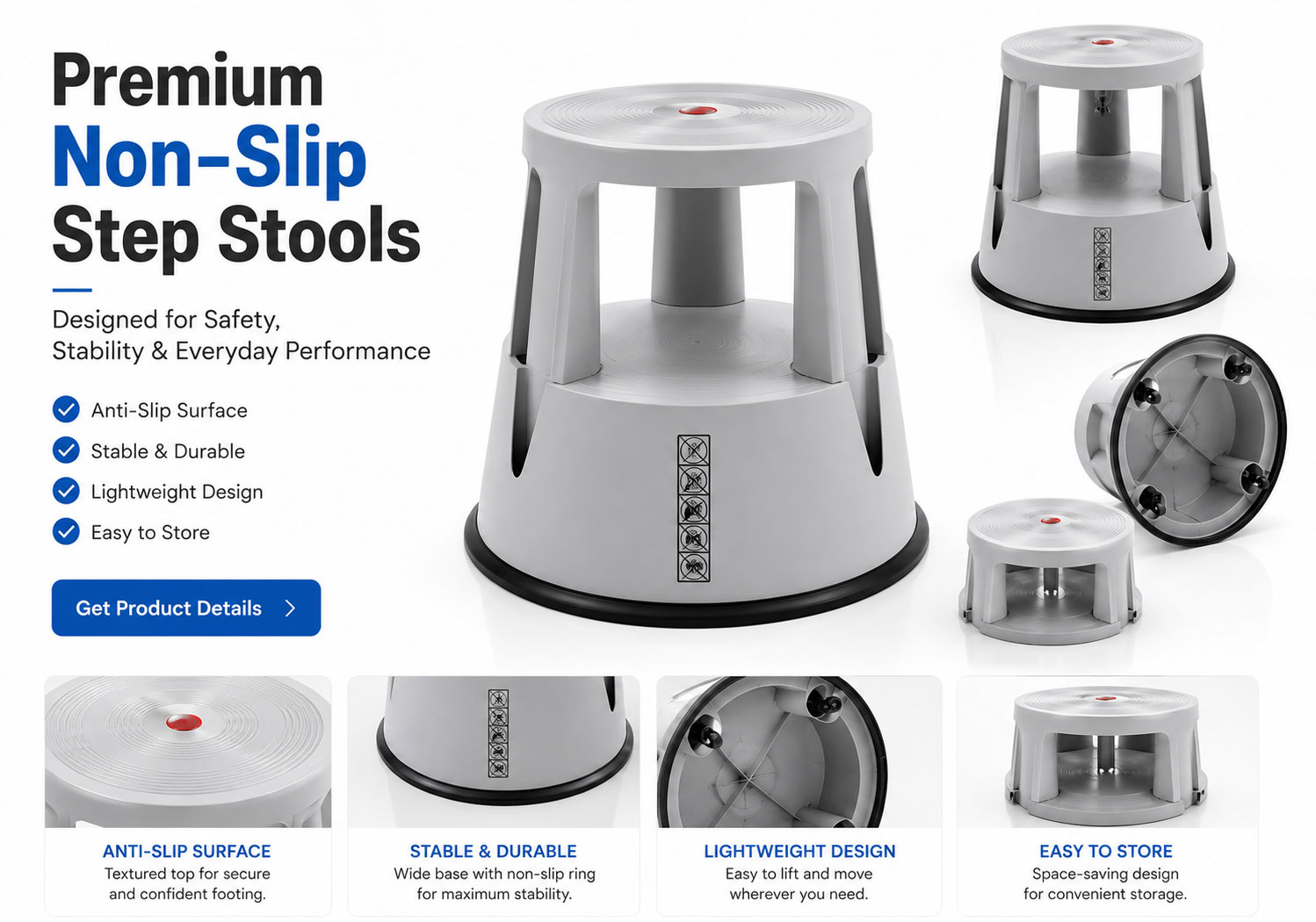
Mobile Step Stools for Distribution Centers in Jordan
Mobile Step Stools for Distribution Centers in Jordan influence the velocity of high-level picking and staging inside supermarket distribution centers, particularly where cross-dock and rapid-replenishment flows leave little margin for interruption. When the platform is immediately available, stable under load, and quick to reposition, elevated retrievals stay inside the designed cycle time rather than generating search delays or residual movement that slows the entire path.
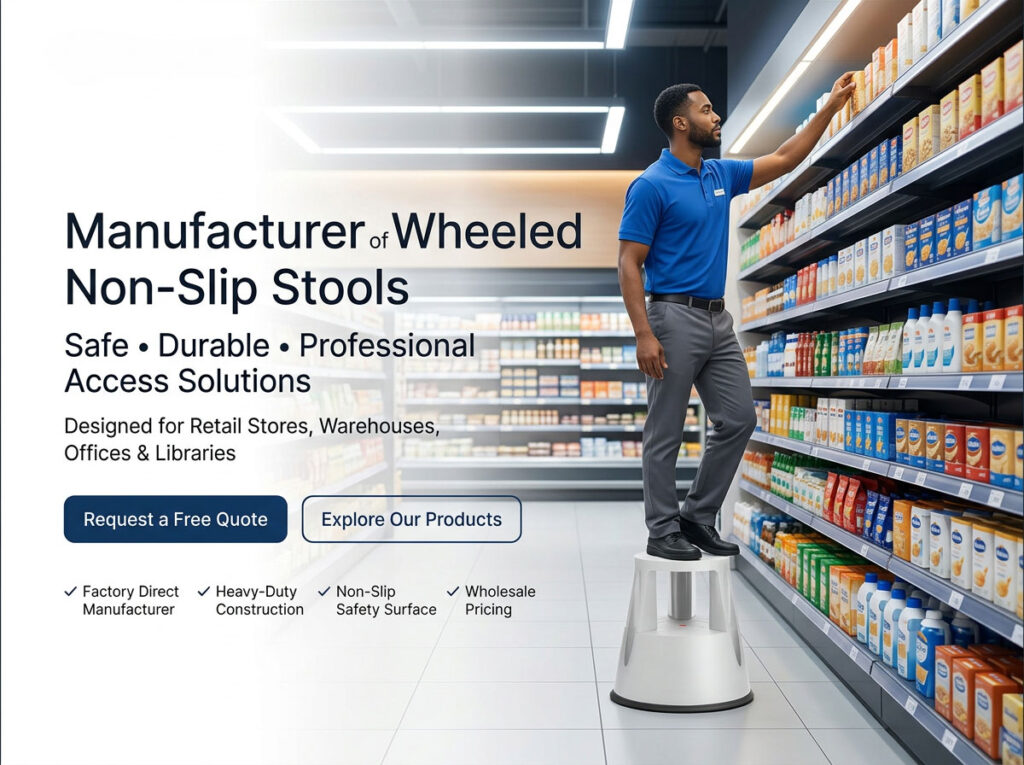

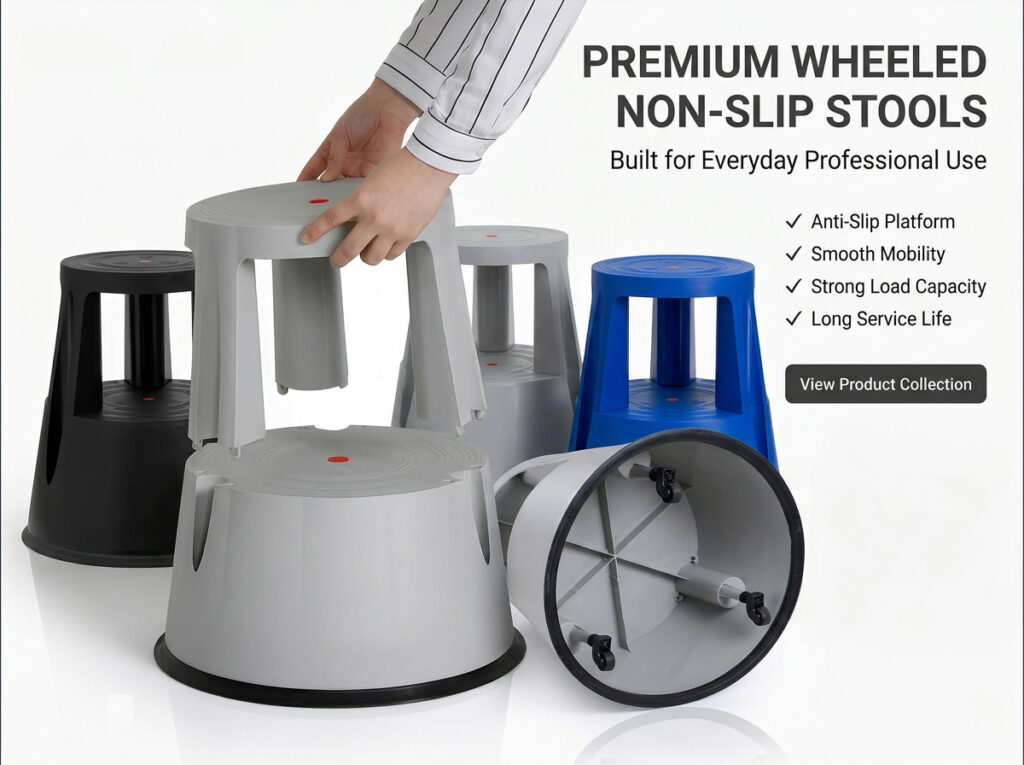
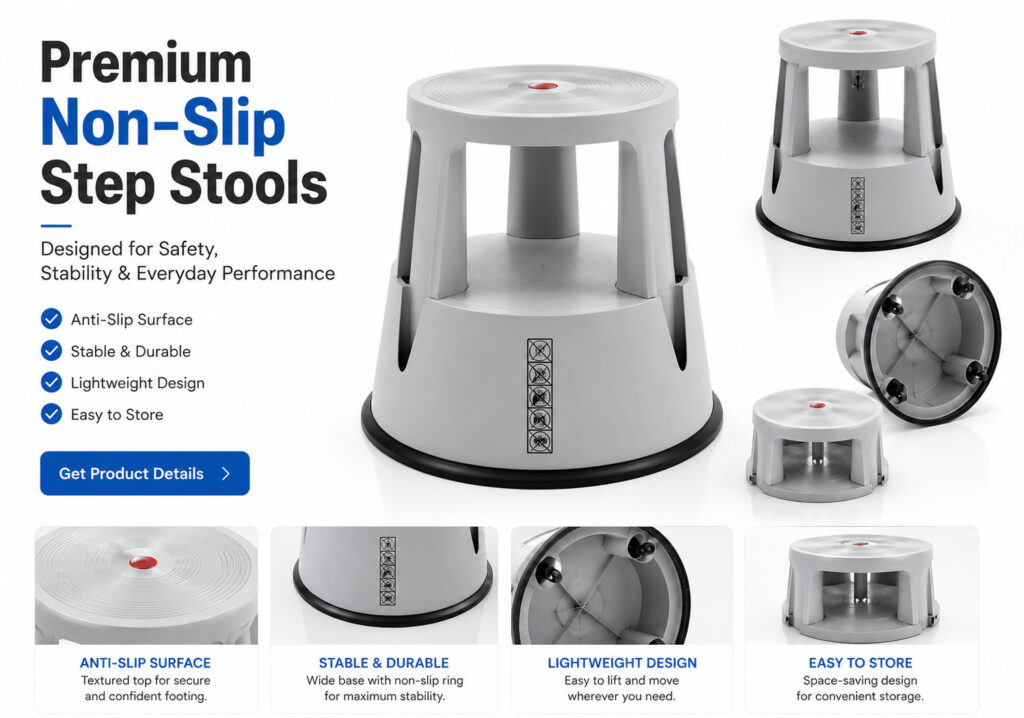

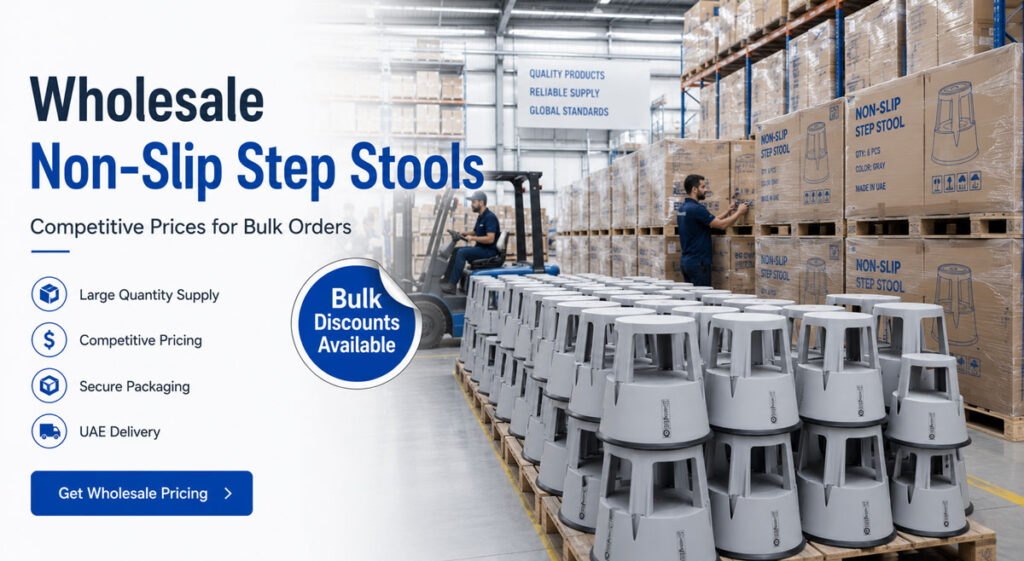
Firmalazım manufactures mobile step stools engineered for commercial use and supports bulk orders, OEM identification, and supply through wholesale and distributor channels. This guide examines the subject from a cross-dock and rapid-replenishment flow perspective, giving purchasing and operations managers a practical method for protecting fulfilment velocity across distribution centers serving supermarket networks in Jordan.
The Flow Cost of Interrupted Elevated Retrievals
Distribution centers that feed supermarket networks operate under tight time windows. Product arrives, is sorted or cross-docked, staged at height when necessary, and dispatched to stores on compressed schedules. Any tool that forces an operator to search, to climb with exaggerated caution, or to make multiple repositioning moves inserts non-value seconds into a sequence that is already measured in minutes. Across hundreds of elevated picks per shift those seconds become late dispatches, overtime, or incomplete store orders.
In Amman, the concentration of large supermarket distribution facilities generates the highest density of rapid-replenishment and cross-dock activity. Mobile platforms that remain in known locations and provide immediate secure footing keep elevated retrievals inside the planned path. The same pressure appears in Zarqa, where industrial adjacency and dust loads increase the chance that marginal equipment forces extra caution or corrective moves. Irbid serves both modern distribution nodes and denser urban store networks; flow efficiency depends on elevated-access equipment that does not itself become a bottleneck.
Coastal humidity and temperature variation in Aqaba affect material behaviour and the need for reliable non-slip performance when high-level staging coincides with incoming container or truck flows. Inland centres such as Salt and Madaba experience clearer seasonal swings in volume; consistent platform stability across those swings protects both pace and safety. Jerash and Mafraq continue to expand distribution capacity linked to growing retail demand; introducing flow-protective mobile step stools at the outset prevents later velocity loss. Southern locations including Karak, Tafilah, and Ma’an may operate lower absolute volume, yet each interrupted elevated pick still lengthens the cycle for the outbound wave it serves.
Northern and satellite sites follow identical flow logic. Ajloun and Ramtha support regional supermarket replenishment with compact footprints where a missing or awkward platform immediately disrupts short travel distances. Sahab, Wadi Al-Seer, Sweileh, Marka, and Al-Jubeiha form part of the greater commercial distribution orbit; standardised mobile platforms allow path designs and operator methods to remain consistent when staff or volume shift between nodes. When every facility uses the same professional specification, non-value time associated with elevated access becomes both measurable and controllable.
Where Non-Value Time Accumulates in Distribution Paths
Four interruptions dominate high-level work inside supermarket distribution centers:
- Searching for a mobile platform that is not in a predictable location along the pick or staging path
- Multiple repositioning moves caused by instability or a footprint that forces awkward placement relative to racking or staging faces
- Slowed ascent or descent caused by uncertain grip or residual movement under load
- Extra travel or stretching caused by platform height or step geometry that does not match the dominant retrieval levels
A professional mobile step stool addresses each point when its design, placement rules, and condition are aligned with the actual cross-dock and replenishment sequences.
Flow-Efficiency Selection Criteria
- Platform height and step geometry matched to the most frequent high-level retrieval and staging faces so that the majority of work occurs from a stable standing position
- Non-slip tread and positive stabilisation that remove hesitation during the dynamic phases of the cycle
- Footprint that allows placement close to the rack or staging face without blocking the main travel aisle or cross-dock lane
- Frame rigidity that eliminates flex under commercial load and the resulting micro-balancing
- Immediate availability through designated locations so that search time approaches zero
- Network consistency via bulk orders and OEM identification so that path methods remain identical across facilities
- Genuine wear-item support through a distributor or wholesale channel so that grip and stabilisation never degrade into new sources of delay
- Commercial-use documentation confirming the design is intended for repeated daily distribution cycles
Measuring the Velocity Contribution
Simple before-and-after sampling is sufficient. Time a representative set of high-level picks or staging tasks under current equipment conditions, capturing search, positioning, climb, retrieve or place, descend, and return-to-path. Repeat the sample after introduction of the controlled mobile standard and designated locations. The difference in average non-value seconds per elevated task, multiplied by daily volume and number of operating days, produces a clear throughput and labour-equivalent figure. Most supermarket distribution operations discover that the cumulative saving exceeds the annualised equipment cost within the first year.
Layout Interactions That Amplify or Reduce the Benefit
Aisle width, rack depth, cross-dock lane geometry, and the balance between bulk reserve and forward staging faces all influence how a mobile step stool is used. In narrow-aisle or high-density configurations the footprint and turning behaviour become critical. In wider cross-dock areas the priority shifts to rapid travel between distant high-level locations. In both cases the same professional mobile model can serve, provided its dimensions have been validated against the actual geometry.
Common Flow-Efficiency Errors
Placing home positions far from the dominant high-level zones recreates search time. Choosing a platform whose height forces frequent over-reaching reintroduces strain and caution. Allowing mixed models across the network prevents standard path methods. Neglecting tread and caster condition allows progressive hesitation to return. Each error is visible in the time samples and is correctable by specification discipline and simple location rules.
Implementation Sequence Focused on Fulfilment Velocity
- Map the highest-frequency high-level locations and the current travel paths that serve cross-dock and rapid-replenishment flows.
- Time a baseline sample of elevated tasks, separating value and non-value elements.
- Draft a mobile specification that prioritises height match, stability under dynamic load, and footprint compatibility with existing aisles and lanes.
- Obtain samples from a manufacturer able to fulfil bulk orders and OEM identification.
- Trial the preferred model on the actual paths, measuring both time and operator feedback under live volume.
- Approve the standard, mark practical home positions, and convert existing equipment on a controlled schedule.
- Embed a rapid condition check into shift-start routines so that grip and stabilisation remain at design level.
- Re-sample elevated-task times after stabilisation and quantify the reduction in non-value seconds.
- Lock the approved model and location rules into all future distribution layout and fit-out standards.
- Review path performance periodically; adjust only when layout or product-profile changes require it.
Scenario: Cross-Dock Wave Under Controlled Conditions
The operator travels the defined path, finds the mobile step stool in its marked location, positions it once against the staging face, locks or confirms stabilisation, completes the high-level placement or retrieval from a comfortable standing height, descends, returns the platform to the home position, and continues. Search time is zero, repositioning moves are minimal, and hesitation during climb or descent is absent. The sequence remains inside the designed wave timing rather than generating side excursions or corrective actions that threaten outbound departure.
Scenario: Network-Level Path Standardisation Across Distribution Nodes
After conversion to a single professional mobile model, every supermarket distribution center in the network uses identical platform geometry and identical location rules. Operators who transfer between nodes require no re-learning of elevated-access technique. Central teams can compare non-value time samples across facilities and identify outliers that are now attributable to layout or process rather than to equipment variation.
Expert Observation on Fulfilment Velocity
The largest gains rarely come from spectacular features. They come from the elimination of hundreds of small interruptions that never appear on a conventional productivity dashboard until they are deliberately measured. Professional mobile step stools, when placed and maintained as part of the path design, remove those interruptions at low capital cost and with high reliability inside the compressed windows of supermarket distribution.
Comparison: Flow-Integrated Mobile Fleet versus Ad-Hoc Elevated Access
| Factor | Flow-Integrated Mobile Approach | Ad-Hoc Elevated Access |
|---|---|---|
| Search time per elevated task | Near zero | Variable and often significant |
| Repositioning moves | Minimal | Frequent |
| Hesitation during climb/descent | Low | Higher under dust or fatigue |
| Consistency of method across nodes | High | Low |
| Ability to measure non-value time | Straightforward | Obscured by equipment variation |
| Contribution to wave or order cycle time | Positive and quantifiable | Neutral or negative |
| Residual safety exposure | Controlled | Higher |
| Fit with future layout changes | Predictable | Requires repeated local adaptation |
Closing Perspective
Mobile step stools contribute to supermarket distribution velocity when they are specified, located, and maintained as integral elements of the cross-dock and rapid-replenishment path rather than as background tools. Height match, dynamic stability, immediate availability, and network consistency remove repeated non-value seconds from every elevated retrieval or staging task. When a manufacturer supplies units designed for commercial use and supports bulk orders, OEM identification, and wholesale or distributor fulfilment, the equipment can be standardised and sustained across the entire distribution footprint. The result is measurable flow improvement, lower residual risk, and clearer operational control from the largest urban nodes to secondary facilities throughout Jordan.
Frequently Asked Questions
What is the most common source of non-value time related to elevated access in distribution centers? Searching for a platform that is not in a predictable location, followed by multiple repositioning moves caused by instability or poor footprint match.
How can non-value seconds per elevated task be measured without complex systems? Time a representative sample of high-level picks or staging tasks with a simple breakdown of travel, search, position, climb, retrieve or place, descend, and return; repeat after changes and compare averages.
Why does platform height matching matter more than maximum load rating for flow efficiency? Correct height keeps the majority of retrievals and placements inside a stable standing envelope, eliminating the extra time and caution associated with over-reaching or repeated climbing.
Can a single mobile model serve both narrow-aisle and wide cross-dock areas? Yes, when its footprint and turning behaviour have been validated against the tightest aisles and its stability remains adequate for longer travel distances.
How do designated home positions reduce non-value time? They drive search time toward zero and make the correct return behaviour the path of least resistance for the operator.
What role does OEM identification play in flow-efficiency programmes? It allows correlation of any residual delays or incidents with specific units and their condition, separating equipment issues from layout or process issues.
How quickly do tread or caster wear begin to re-introduce hesitation? Under dusty commercial conditions the effect can appear within weeks if cleaning and genuine-part replacement are neglected; daily visual checks catch the decline early.
Should flow-efficiency sampling include both early-shift and late-shift periods? Yes. Fatigue amplifies the time cost of any instability or poor grip; measuring both periods reveals the full contribution of a stable platform.
What is the practical first step for a distribution center already experiencing flow friction? Map the highest-frequency high-level locations and time a baseline sample of elevated tasks; the data usually make the case for controlled equipment self-evident.
How does bulk ordering support path consistency across multiple distribution nodes? Identical platform geometry and stabilisation method allow the same path rules and operator technique to be used network-wide without local variation.
Can secondary lower-volume facilities justify the same flow-integrated standard? Yes. Absolute task volume may be lower, yet each elevated retrieval still benefits from zero search time and secure footing; consistency also supports shared staff and volume swings.
What layout change most frequently requires a review of the mobile step-stool specification? Significant alteration of aisle width, rack height profile, cross-dock lane geometry, or the balance between bulk-reserve and forward-staging faces.
How should new distribution center openings be treated under a flow-efficiency approach? The approved mobile model, calculated quantity, and marked home-position rules form part of the layout and fit-out package so that velocity protection exists from the first operational wave.
Is handrail provision relevant to path speed on lower platforms? On models above two or three steps, appropriate handrails support confident three-point contact and reduce the cautious phase of ascent and descent.
What maintenance failure most quickly erodes flow-efficiency gains? Loss of non-slip performance or locking reliability, which re-introduces operator hesitation and extra positioning moves.
How can residual safety exposure be linked to path performance? The same factors that slow the elevated task (uncertain grip, residual movement, over-reaching) also elevate incident probability; improving one metric usually improves the other.
What is the recommended frequency for re-sampling elevated-task times? After initial stabilisation of the new standard, and then annually or whenever major layout or product-profile changes occur.
Does commercial-use design intent affect flow efficiency? Yes. Equipment engineered for repeated daily distribution cycles maintains its stability and grip characteristics longer under real intensity, preserving the time gains.
How does a distributor relationship protect the efficiency investment? Rapid supply of genuine casters, feet, and tread components keeps every unit at design performance so that non-value time does not creep back through progressive wear.
What single change typically produces the largest reduction in elevated-access non-value time? Combining a correctly height-matched mobile platform with designated home positions that eliminate search.
Should operators be involved in the trial of candidate platforms? Yes. Direct feedback on positioning effort, climb confidence, and reach comfort often reveals differences that pure time samples miss.
How are mixed fleets harmful to path standardisation? Different geometries and stabilisation methods force operators to adapt technique at each node or even within the same facility, destroying the possibility of a single efficient method.
What documentation supports the flow-efficiency case for capital approval? Baseline and post-implementation time samples, calculated labour-equivalent savings, and the commercial-use specification of the chosen mobile model.
Can the same mobile step stool support both order-picking and cross-dock staging paths? Yes, provided its height and footprint have been validated against the shelf and staging levels present in both activities.
How does Firmalazım’s offering align with a flow-efficiency programme? As a manufacturer focused on commercial use, it can supply consistent mobile step stools in bulk quantities, apply OEM identification for tracking, and work with wholesale or distributor channels that maintain part availability over the full service life required to protect the velocity investment. Wheeled Step Stools for Retail Stores in Jordan
This cross-dock and rapid-replenishment examination positions mobile step stools as active elements of distribution flow design rather than passive accessories. When height, stability, availability, and network consistency are deliberately matched to the actual travel and elevated-retrieval sequence, interruptions shrink and overall fulfilment velocity rises. Supported by bulk orders, OEM identification, and reliable wholesale or distributor fulfilment from a manufacturer oriented toward commercial use, the approach delivers measurable efficiency and controlled residual risk across supermarket distribution centers throughout Jordan.
Mobile Step Stools for Distribution Centers in Jordan
Mobile step stools determine how safely and consistently supermarket distribution centers maintain elevated access across multi-shift and overnight operations. When the platform remains stable, high-grip, and immediately available under thinner supervision and higher fatigue, high-level put-away and retrieval stay inside designed cycle times rather than generating progressive hesitation or residual movement. Firmalazım manufactures mobile step stools engineered for commercial use and supports bulk orders, OEM identification, and supply through wholesale and distributor channels. This guide examines the subject from a multi-shift fatigue-resistance and continuous-operations perspective, giving purchasing and operations managers a practical method for protecting both safety and velocity during the hours when supervisory density is lowest across distribution centers in Jordan.
The Compounding Effect of Fatigue on Elevated Access
Distribution centers that feed supermarket networks rarely stop. Night and early-morning shifts handle cross-dock waves, high-level put-away, and rapid replenishment under lower lighting, thinner supervision, and rising operator fatigue. Any platform that requires extra caution, multiple repositioning moves, or continuous micro-balancing amplifies that fatigue. What begins as a small hesitation in the first hours becomes measurable slowdown and elevated residual risk by the final hours of the shift. Across continuous operations the cumulative effect appears in incomplete waves, overtime, and higher near-miss frequency during the periods least able to absorb them.
In Amman, large supermarket distribution facilities run multi-shift schedules with the highest absolute volume of overnight elevated work. Mobile platforms that retain secure footing and positive stabilisation keep late-shift performance closer to early-shift levels. The same pressure appears in Zarqa, where dust loads and industrial adjacency already challenge grip; adding fatigue multiplies the cost of any marginal equipment. Irbid supports both modern distribution nodes and denser store networks; continuous-operations efficiency depends on elevated-access equipment that does not itself become a progressive bottleneck as the shift advances.
Coastal humidity and temperature variation in Aqaba affect material behaviour and operator comfort during overnight windows; consistent non-slip performance and frame rigidity become more critical when ambient conditions fluctuate. Inland centres such as Salt and Madaba experience clearer seasonal volume swings that often concentrate in night or early-morning waves; platforms that maintain stability across those conditions protect both pace and safety when supervision is lightest. Jerash and Mafraq continue to expand distribution capacity; introducing fatigue-resistant mobile step stools at the outset prevents later late-shift velocity loss. Southern locations including Karak, Tafilah, and Ma’an may operate leaner night teams, yet each interrupted elevated task still lengthens the cycle for the outbound wave it serves.
Northern and satellite sites follow identical continuous-operations logic. Ajloun and Ramtha support regional supermarket replenishment with compact footprints where a missing or awkward platform immediately disrupts short travel distances during low-supervision hours. Sahab, Wadi Al-Seer, Sweileh, Marka, and Al-Jubeiha form part of the greater commercial distribution orbit; standardised mobile platforms allow path methods to remain consistent when volume or staff shift between nodes across the 24-hour cycle. When every facility uses the same professional specification, the compounding effect of fatigue on elevated access becomes both measurable and controllable.
Where Fatigue Amplifies Non-Value Time and Residual Risk
Four interruptions grow more costly as the shift advances:
- Searching for a mobile platform that is not in a predictable location, now performed under higher fatigue and lower ambient light
- Multiple repositioning moves caused by instability or footprint mismatch, each requiring extra physical and cognitive effort
- Slowed ascent or descent caused by uncertain grip or residual movement, now compounded by reduced balance confidence
- Extra travel or stretching caused by platform height that does not match dominant retrieval levels, increasing cumulative strain
A professional mobile step stool addresses each point when its design, placement rules, and condition are aligned with the realities of multi-shift distribution work.
Fatigue-Resistant Selection Criteria
- Platform height and step geometry matched to the most frequent high-level faces so that the majority of work occurs from a stable standing position even under fatigue
- Non-slip tread and positive stabilisation that remain unambiguous when operator attention is lower
- Footprint that allows placement close to the rack or staging face without forcing awkward manoeuvres in lower light
- Frame rigidity that eliminates flex under commercial load and the continuous micro-balancing that accelerates fatigue
- Immediate availability through designated locations so that search time does not compound with tiredness
- Network consistency via bulk orders and OEM identification so that late-shift methods remain identical across facilities
- Genuine wear-item support through a distributor or wholesale channel so that grip and stabilisation never degrade into new sources of late-shift hesitation
- Commercial-use documentation confirming the design is intended for repeated daily and overnight distribution cycles
Measuring the Late-Shift Contribution
Simple segmented sampling is effective. Time a representative set of high-level tasks in the first two hours and the final two hours of both day and night shifts under current equipment conditions. Repeat after introduction of the controlled mobile standard and designated locations. The widening or narrowing of the performance gap between early and late periods quantifies the fatigue-resistance contribution. Most supermarket distribution operations discover that closing even a modest late-shift gap produces labour-equivalent savings that exceed the annualised equipment cost within the first year of continuous operations.
Layout and Lighting Interactions
Lower ambient light and the geometry of overnight cross-dock or put-away paths amplify any platform that requires precise positioning or continuous balance correction. In narrow-aisle configurations the footprint and turning behaviour become more critical under fatigue. In wider staging areas the priority shifts to rapid, low-effort travel between distant high-level locations. In both cases the same professional mobile model can serve, provided its dimensions and stabilisation feedback have been validated under realistic overnight conditions.
Common Continuous-Operations Errors
Placing home positions far from dominant overnight high-level zones recreates search time precisely when operators are least able to absorb it. Choosing a platform whose height forces frequent over-reaching accelerates cumulative strain across the shift. Allowing mixed models across the network prevents standard late-shift methods. Neglecting tread and caster condition allows progressive hesitation to return and widen the early-to-late performance gap. Each error is visible in segmented time samples and is correctable by specification discipline and simple location rules.
Implementation Sequence Focused on Multi-Shift Resilience
- Map the highest-frequency high-level locations used during night and early-morning waves.
- Time segmented samples of elevated tasks in early and late periods of both day and night shifts.
- Draft a mobile specification that prioritises height match, unambiguous stabilisation feedback, and verified non-slip performance under realistic lighting and fatigue conditions.
- Obtain samples from a manufacturer able to fulfil bulk orders and OEM identification.
- Trial the preferred model during live overnight waves, measuring both time and operator feedback in late-shift periods.
- Approve the standard, mark practical home positions visible under lower light, and convert existing equipment on a controlled schedule.
- Embed a rapid condition check into every shift-start routine so that grip and stabilisation remain at design level before fatigue accumulates.
- Re-sample early-to-late gaps after stabilisation and quantify the reduction in non-value seconds and residual risk.
- Lock the approved model and location rules into all future distribution layout and multi-shift standards.
- Review late-shift performance periodically; adjust only when layout, lighting, or product-profile changes require it.
Scenario: Overnight Cross-Dock Wave Under Controlled Conditions
The operator travels the defined path under lower ambient light, finds the mobile step stool in its marked and illuminated location, positions it once, locks or confirms stabilisation with clear feedback, completes the high-level task from a comfortable standing height, descends, returns the platform, and continues. Search time is zero, repositioning moves are minimal, and hesitation remains low even in the final hours. The sequence stays inside the designed wave timing rather than generating progressive slowdown that threatens outbound departure.Professional Heavy-Duty Step Stools for Warehouses in Jordan
Scenario: Network-Level Late-Shift Consistency
After conversion to a single professional mobile model, every supermarket distribution center in the network uses identical platform geometry and identical location rules. Operators who move between day and night shifts or between nodes carry the same elevated-access method. Central teams can compare early-to-late performance gaps across facilities and treat outliers as layout or process issues rather than equipment variation.
Expert Observation on Continuous Operations
The true test of elevated-access equipment is not peak daytime performance; it is the final hours of the night shift when supervision is thinnest and fatigue is highest. Platforms that remain stable, high-grip, and immediately available under those conditions protect both velocity and residual risk across the full 24-hour cycle. Professional mobile step stools specified for commercial use and supported by bulk consistency turn multi-shift elevated work into a repeatable, low-friction process.
Comparison: Fatigue-Resistant Mobile Fleet versus Progressive Late-Shift Degradation
| Factor | Fatigue-Resistant Mobile Approach | Progressive Late-Shift Degradation |
|---|---|---|
| Early-to-late performance gap | Narrow and stable | Widens measurably |
| Search time under fatigue | Near zero | Increases |
| Repositioning effort | Minimal | Accumulates |
| Hesitation during climb/descent | Low even in final hours | Rises with fatigue |
| Consistency across day/night shifts | High | Low |
| Residual risk in low-supervision periods | Controlled | Elevated |
| Ability to protect wave timing | High | Declines overnight |
| Long-term operator strain | Lower | Higher |
Closing Perspective
Mobile step stools protect supermarket distribution velocity and residual safety across multi-shift operations when their design and deployment are matched to the realities of overnight and continuous work. Height match, unambiguous stabilisation, reliable non-slip performance, and immediate availability remove the progressive interruptions that fatigue otherwise amplifies. When a manufacturer supplies units designed for commercial use and supports bulk orders, OEM identification, and wholesale or distributor fulfilment, the equipment can be standardised and sustained across the full 24-hour footprint. The result is narrower early-to-late performance gaps, lower residual risk during the hours of thinnest supervision, and clearer operational control from the largest urban nodes to secondary facilities throughout Jordan.
Frequently Asked Questions
What is the most common way fatigue amplifies elevated-access non-value time? Search time and repositioning moves that are tolerable early in the shift become progressively more costly as balance confidence and attention decline.
How can the early-to-late performance gap be measured without complex systems? Time representative high-level tasks in the first two and final two hours of both day and night shifts; the difference in average non-value seconds quantifies the gap.
Why does unambiguous stabilisation feedback matter more under fatigue? It removes the need for continuous verification of security, which itself consumes attention that is already reduced in later hours.
Can a single mobile model serve both day and night elevated tasks effectively? Yes, when its height, footprint, and stabilisation feedback have been validated under the lighting and fatigue conditions of both periods.
How do designated home positions reduce late-shift risk? They eliminate search time precisely when operators are least able to absorb extra physical and cognitive load.
What role does OEM identification play in multi-shift programmes? It allows correlation of any residual late-shift delays or near-misses with specific units and their condition, separating equipment issues from fatigue or process issues.
How quickly do tread or caster wear begin to widen the early-to-late gap? Under dusty commercial conditions the effect can appear within weeks if cleaning and genuine-part replacement are neglected; shift-start checks catch the decline before it compounds with fatigue.
Should sampling include both day and night shifts? Yes. The fatigue-amplification pattern is often more pronounced overnight when supervision is thinner and ambient conditions differ.
What is the practical first step for a distribution center seeing progressive late-shift slowdown? Segment current elevated-task times by early and late periods; the widening gap usually makes the case for controlled, fatigue-resistant equipment self-evident.
How does bulk ordering support consistent multi-shift performance across nodes? Identical platform geometry and stabilisation method allow the same late-shift method to be used network-wide without local variation.
Can secondary lower-volume facilities justify the same fatigue-resistant standard? Yes. Absolute task volume may be lower, yet each elevated retrieval still benefits from zero search time and secure footing under fatigue; consistency also supports shared night teams.
What layout or lighting change most frequently requires a review of the mobile specification? Significant alteration of overnight path geometry, ambient light levels, or the height profile of high-level faces used in night waves.
How should new distribution center openings treat multi-shift elevated access? The approved mobile model, calculated quantity, marked home positions visible under lower light, and shift-start check form part of the opening package so that fatigue resistance exists from the first overnight wave.
Is handrail provision relevant to late-shift confidence? On models above two or three steps, appropriate handrails support three-point contact and reduce the cautious phase of ascent and descent when balance confidence is lower.
What maintenance failure most quickly re-widens the early-to-late gap? Loss of non-slip performance or locking reliability, which re-introduces hesitation that then compounds with fatigue.
How can residual late-shift near-misses be linked to equipment condition? When units are identified and checked at shift start, any residual incidents can be correlated with specific platform condition rather than remaining anonymous.
What is the recommended frequency for re-sampling early-to-late gaps? After initial stabilisation of the new standard, and then whenever major layout, lighting, or volume-profile changes occur.
Does commercial-use design intent affect multi-shift resilience? Yes. Equipment engineered for repeated daily and overnight distribution cycles maintains its stability and grip characteristics longer under real continuous intensity, preserving the narrow performance gap.
How does a distributor relationship protect the multi-shift investment? Rapid supply of genuine casters, feet, and tread components keeps every unit at design performance so that late-shift hesitation does not creep back through progressive wear.
What single change typically produces the largest reduction in late-shift elevated-access non-value time? Combining a correctly height-matched mobile platform with designated home positions and unambiguous stabilisation feedback.
Should night-shift operators be involved in the trial of candidate platforms? Yes. Direct feedback on positioning effort, climb confidence, and reach comfort under realistic fatigue and lighting conditions reveals differences that daytime trials miss.
How are mixed fleets harmful to multi-shift standardisation? Different geometries and stabilisation methods force operators to adapt technique across shifts or nodes, destroying the possibility of a single fatigue-resistant method.
What documentation supports the multi-shift case for capital approval? Segmented early-to-late time samples, calculated labour-equivalent savings from gap closure, and the commercial-use specification of the chosen mobile model.
Can the same mobile step stool support both put-away and retrieval paths across the 24-hour cycle? Yes, provided its height and footprint have been validated against the levels present in both activities under both day and night conditions.
How does Firmalazım’s offering align with a multi-shift resilience programme? As a manufacturer focused on commercial use, it can supply consistent mobile step stools in bulk quantities, apply OEM identification for tracking, and work with wholesale or distributor channels that maintain part availability over the full service life required to protect continuous-operations velocity and residual safety.
This multi-shift fatigue-resistance examination positions mobile step stools as active protectors of distribution velocity and residual safety across the full 24-hour cycle. When height, stabilisation feedback, non-slip performance, and availability are matched to the realities of overnight and continuous work, the progressive interruptions that fatigue otherwise amplifies are removed. Supported by bulk orders, OEM identification, and reliable wholesale or distributor fulfilment from a manufacturer oriented toward commercial use, the approach delivers narrower early-to-late gaps and clearer operational control across supermarket distribution centers throughout Jordan.
Mobile Step Stools for Distribution Centers Jordan
Mobile step stools determine how quickly temporary and agency labour reach safe, efficient elevated-access competence inside supermarket distribution centers. When a single professional specification is locked and visually controlled, new or covering staff absorb the high-level sequence in minutes rather than shifts, residual method variation collapses, and supervisors recover capacity during volume peaks. Firmalazım manufactures mobile step stools engineered for commercial use and supports bulk orders, OEM identification, and supply through wholesale and distributor channels. This guide examines the subject from a temporary-labour integration and rapid-competence perspective, giving purchasing and operations managers a practical method for protecting both safety and velocity when flexible staffing is required across distribution centers in Jordan.
The Competence Gap Created by Equipment Variation Under Flexible Staffing
Supermarket distribution centers routinely absorb agency, seasonal, or transferred labour to cover volume spikes, absenteeism, and campaign waves. These team members arrive with general warehouse experience but no site-specific knowledge of elevated-access equipment. When mobile step stools differ in height, stabilisation method, footprint, or grip behaviour from one facility to the next—or even within the same facility—the learning curve lengthens. Supervisors repeat the same corrections. Near-miss frequency rises during the first shifts. Non-value time from hesitation and incorrect positioning persists longer than necessary. The root cause is not the temporary status of the labour; it is the absence of a stable physical standard that makes the elevated-access sequence immediately transferable.
In Amman, large supermarket distribution facilities experience the highest absolute volume of flexible staffing. A single professional mobile model allows the elevated-access brief to be delivered once and remain valid for every incoming cohort. The same advantage appears in Zarqa, where dust loads already challenge grip; adding model variation multiplies the instructional burden precisely when supervisors are busiest. Irbid supports both modern distribution nodes and denser store networks; staff who move between them or arrive as cover benefit immediately when the platform and the method never change.
Coastal humidity and temperature variation in Aqaba affect material behaviour; a standardised platform removes one more variable from the rapid onboarding conversation. Inland centres such as Salt and Madaba experience clearer seasonal volume swings that often require temporary labour; consistent equipment keeps the safety and method brief stable across those swings. Jerash and Mafraq continue to expand distribution capacity; locking a temporary-labour-friendly specification at the outset prevents later fragmentation as flexible headcount grows. Southern locations including Karak, Tafilah, and Ma’an may operate leaner permanent teams, yet they still absorb covering staff who arrive with no local equipment knowledge. Professional Step Stools for Pharmacy Shelving in Jordan
Northern and satellite sites follow identical logic. Ajloun and Ramtha support regional supermarket replenishment; a shared professional standard allows covering operators to carry elevated-access competence with them. Sahab, Wadi Al-Seer, Sweileh, Marka, and Al-Jubeiha form part of the greater commercial distribution orbit; when every facility uses the same mobile step stool specification, central and regional onboarding materials remain valid and residual method variation stays low even under high flexible-labour ratios. The result is faster, more reliable competence transfer across the entire supermarket distribution footprint.
What Makes a Mobile Step Stool Temporary-Labour Friendly
Four attributes determine how quickly covering staff reach competence:
- Identical geometry and stabilisation method at every location so that the physical sequence never requires re-learning
- Clear, positive feedback from the platform (secure lock or reliable spring retraction) that confirms correct use without ambiguity
- Non-slip performance that remains consistent under the floor and dust conditions the staff will actually meet
- Simple visual identification and marked return points that reinforce ownership and correct location from the first task
A manufacturer designing for commercial use can supply these attributes at scale through bulk orders, enabling the temporary-labour system to rest on a stable physical foundation rather than on continuous local adaptation.
Observable Signs of Competence Friction Caused by Equipment
Supervisors see the symptoms during every volume peak. Covering staff who hesitate longer than permanent operators before climbing, who leave the platform in the aisle because return rules differ by site, or who stretch from the floor rather than fetch a unit whose behaviour they do not yet trust are all indicators that equipment variation is extending the learning window. Agency cohorts that require repeated correction on the same elevated-access points further reveal the cost of non-standard platforms under flexible staffing.
Selection Criteria Focused on Rapid Competence Transfer
- Single network specification so that the physical sequence taught to any covering operator remains valid in every facility
- Stabilisation method that gives immediate, unambiguous feedback under load
- Non-slip surface verified on the actual range of distribution-center floor finishes
- Footprint and height that match the dominant high-level tasks without forcing compensatory postures that then require extra coaching
- OEM or durable colour identification that supports ownership and return rules from the first task
- Availability through bulk orders so that every facility and every expansion receives identical units
- Genuine wear-item continuity via distributor or wholesale channels so that grip and mobility never become new sources of variation
- Commercial-use documentation confirming the design is intended for repeated daily distribution cycles
- Compatibility with a one-page practical brief that can be delivered in minutes to temporary cohorts
Designing the Rapid Elevated-Access Brief for Flexible Labour
When the equipment itself is standardised, the instructional content collapses to a short, stable sequence: locate the marked unit, position it once against the target, engage stabilisation, maintain three-point contact, complete the task without over-reaching, descend, unlock, return the unit to its designated point. Because the platform never changes, the brief never needs local variants. Permanent staff receive it during induction. Temporary and agency cohorts receive it at the start of their assignment. Transferred operators require only a reminder that the method is identical to the one they already know.
Common Errors That Destroy Temporary-Labour Scalability
Allowing each facility to purchase its own preferred model recreates the instructional burden every time covering staff arrive. Choosing platforms whose stabilisation or grip behaviour is ambiguous forces extra coaching time and leaves residual uncertainty during the highest-risk early shifts. Neglecting identification and return rules means that even a good platform is frequently missing or out of place, teaching temporary staff that improvisation is normal. Failing to maintain non-slip and mobility performance allows progressive degradation that then requires additional corrective instruction precisely when volume is highest. Each error is visible in longer time-to-competence and higher early-shift residual risk under flexible staffing.
Implementation Sequence for Temporary-Labour Integration
- Map current elevated-access methods and equipment variation across the distribution network, noting flexible-labour ratios by facility.
- Draft a single professional mobile specification prioritising identical geometry, clear stabilisation feedback, and verified non-slip performance.
- Obtain samples from a manufacturer able to fulfil bulk orders and OEM identification.
- Trial the preferred model with both permanent and temporary cohorts, measuring time-to-competence and residual hesitation.
- Approve the standard and convert existing mixed units on a controlled schedule.
- Write the one-page practical brief and embed it in every temporary and agency onboarding pack.
- Define marked return points and simple ownership rules that reinforce the brief from the first task.
- Establish genuine wear-item kits through the distributor relationship so that performance remains at the level assumed in the training.
- Re-measure time-to-competence and early-shift elevated-access behaviour after stabilisation, especially during volume peaks.
- Lock the approved model and the one-page brief into all future facility openings and flexible-staffing plans.
Scenario: Campaign Volume Spike with Agency Labour
A supermarket distribution network brings in additional agency staff for a major replenishment wave. Because every facility operates the same mobile step stool specification, the elevated-access portion of the onboarding pack is identical and short. New team members reach safe, efficient competence on the first or second task rather than requiring repeated site-specific correction. Supervisors spend their time on wave execution rather than on equipment familiarisation.
Scenario: Inter-Facility Cover Movements
An experienced temporary operator moves from one distribution node to another. The mobile platform, the stabilisation method, the return points, and the safety sequence are already known. No re-training is required. Residual method variation that previously appeared after cover movements disappears.
Expert Observation on Flexible-Labour Risk
High flexible-labour ratios amplify every inconsistency in tools and methods. A standardised professional mobile step stool removes one persistent source of variation, shortens the period during which covering staff operate at elevated residual risk, and frees supervisory capacity for the volume peak itself. The competence-transfer return often exceeds the difference in equipment cost within the first major campaign window.
Comparison: Temporary-Labour Scalable Standard versus Mixed Local Fleets
| Factor | Temporary-Labour Scalable Specification | Mixed Local Fleets |
|---|---|---|
| Time-to-competence for covering staff | Short and predictable | Longer and variable |
| Instructional content | One stable brief | Repeated local adaptation |
| Residual method variation | Low | High |
| Supervisor correction load during peaks | Lower | Higher |
| Early-shift residual risk under flexible staffing | Controlled | Elevated |
| Inter-facility cover mobility | Immediate competence transfer | Re-learning required |
| Scalability with rising flexible-labour ratios | High | Declines |
| Long-term consistency of safety behaviour | Stable | Erodes without constant reinforcement |
Closing Perspective
Mobile step stools become a genuine enabler of flexible-labour readiness when a single professional specification is locked, identified, and maintained across the supermarket distribution network. Identical geometry, clear stabilisation feedback, reliable non-slip performance, and simple return rules allow the elevated-access sequence to be taught once and applied by every permanent, temporary, and agency cohort. When a manufacturer supplies units built for commercial use and supports bulk orders, OEM identification, and wholesale or distributor fulfilment, the competence-transfer system rests on a stable physical foundation. The result is faster integration of covering staff, lower residual variation, and more consistent safety behaviour from the largest urban nodes to secondary facilities throughout Jordan.
Frequently Asked Questions
What is the primary competence cost created by mixed mobile step stool models under flexible staffing? Repeated local instruction, longer time-to-competence for covering staff, and persistent residual variation in method and safety behaviour during the highest-volume periods.
How does a single network specification reduce onboarding time for agency labour? The physical sequence never changes, so the instructional content remains a short, stable brief that can be delivered once and remains valid at every facility.
Why is unambiguous stabilisation feedback important for temporary staff? It confirms correct use immediately, reducing the period of uncertainty during which residual risk is highest for operators who have not yet built site-specific experience.
Can the same mobile model support both permanent and temporary cohorts effectively? Yes. When the specification is identical, the brief is identical; only the delivery timing differs.
How should return points be designed to reinforce competence from the first task? They must be obvious, consistent in logic across facilities, and close enough to high-level zones that returning the unit is the path of least resistance even for operators who have just arrived.
What role does OEM identification play in temporary-labour integration? It makes ownership and correct return visible, so covering staff receive immediate environmental reinforcement of the rules taught in the brief.
How quickly can degraded non-slip or mobility performance undermine competence gains? Within days under intensive use if cleaning and genuine-part replacement are neglected; the brief assumes design-level performance that must be protected by shift-start checks.
Should the elevated-access brief be delivered separately or embedded in general temporary onboarding? Embedded as a short, practical module so that it is never omitted and is experienced as part of normal assignment rather than as an extra topic.
What is the practical way to measure temporary-labour scalability? Track time-to-safe-competence for covering staff before and after standardisation, together with early-shift hesitation or near-miss frequency related to elevated access during volume peaks.
How do bulk orders support consistent competence transfer across a growing network? Every new or expanded facility receives identical units, so the brief and the physical sequence remain valid without revision.
Can secondary lower-volume facilities justify the same temporary-labour-friendly standard? Yes. Absolute flexible-labour volume may be lower, yet each covering operator still benefits from zero re-learning; consistency also supports shared regional cover pools.
What layout or task change most frequently requires a review of the competence brief? Significant alteration of dominant high-level faces or aisle constraints that would force a change in the physical sequence itself.
How should new distribution center openings treat elevated-access competence for flexible labour? The approved mobile model, marked return points, and the one-page brief form part of the opening package so that competence transfer exists from the first volume wave.
Is handrail provision relevant to competence speed on lower platforms? On models above two or three steps, clear handrail geometry supports confident three-point contact and reduces the coaching time required to establish safe ascent and descent for new cohorts.
What maintenance failure most quickly re-introduces competence friction? Loss of non-slip grip or locking reliability, which forces covering staff to re-learn caution and compensatory movements that the original brief was designed to eliminate.
How can residual early-shift incidents under flexible staffing be linked to equipment variation? When models differ, the learning window is longer and more variable; standardisation shortens and stabilises that window, making remaining incidents more clearly attributable to other factors.
What is the recommended frequency for reviewing the elevated-access brief for temporary labour? Annually, or whenever the physical specification itself changes; the brief should not require frequent revision if the equipment remains stable.
Does commercial-use design intent matter for temporary-labour scalability? Yes. Equipment engineered for repeated daily distribution cycles maintains its feedback characteristics and non-slip performance longer, preserving the assumptions built into the brief.
How does a distributor relationship protect the competence investment? Rapid supply of genuine casters, feet, and tread components keeps every unit at the performance level assumed in the instructional sequence so that competence does not erode through progressive wear.
What single change typically produces the largest reduction in elevated-access competence time for covering staff? Locking a single professional mobile specification across the network and retiring mixed local models.
Should experienced permanent staff be involved in validating the one-page brief for temporary cohorts? Yes. Their feedback confirms that the sequence matches real task demands and that no critical step has been omitted or over-complicated for operators who lack site history.
How are mixed fleets harmful to inter-facility cover mobility? Each movement requires re-familiarisation with different geometry and stabilisation behaviour, destroying the possibility of immediate competence transfer.
What documentation supports the temporary-labour case for capital approval? Before-and-after time-to-competence data for covering staff, residual early-shift hesitation or near-miss frequency during peaks, and the commercial-use specification of the chosen mobile model.
Can the same mobile step stool support both put-away and retrieval tasks within a temporary-labour framework? Yes, provided its geometry and stabilisation method have been validated against both environments so that the brief remains valid for either setting.
How does Firmalazım’s capability set align with a temporary-labour integration programme? As a manufacturer focused on commercial use, it can supply consistent mobile step stools in bulk quantities, apply OEM identification for ownership visibility, and work with wholesale or distributor channels that maintain part availability over the full service life required to keep the physical foundation of the competence-transfer system stable. Non-Slip Wheeled Step Stools for Supermarkets in Jordan
This temporary-labour integration and rapid-competence examination positions mobile step stools as stabilising elements of flexible-staffing readiness rather than isolated tools. When a single professional specification is locked, identified, and maintained, the elevated-access sequence can be taught once and applied by every permanent, temporary, and agency cohort. Supported by bulk orders, OEM identification, and reliable wholesale or distributor fulfilment from a manufacturer oriented toward commercial use, the approach delivers faster integration of covering staff, lower residual variation, and more consistent safety behaviour across supermarket distribution centers throughout Jordan.

Bir yanıt yazın