


Non-Slip Wheeled Step Stools for Supermarkets in Jordan
Non-Slip Wheeled Step Stools for Supermarkets in Jordan solve a persistent operational friction inside Jordanian supermarket facilities: the need for fast, stable elevated access on floors that range from polished tile to dusty concrete. When correctly specified for commercial use, these platforms improve restocking speed, protect worker safety, and reduce the small daily delays that accumulate across shifts.
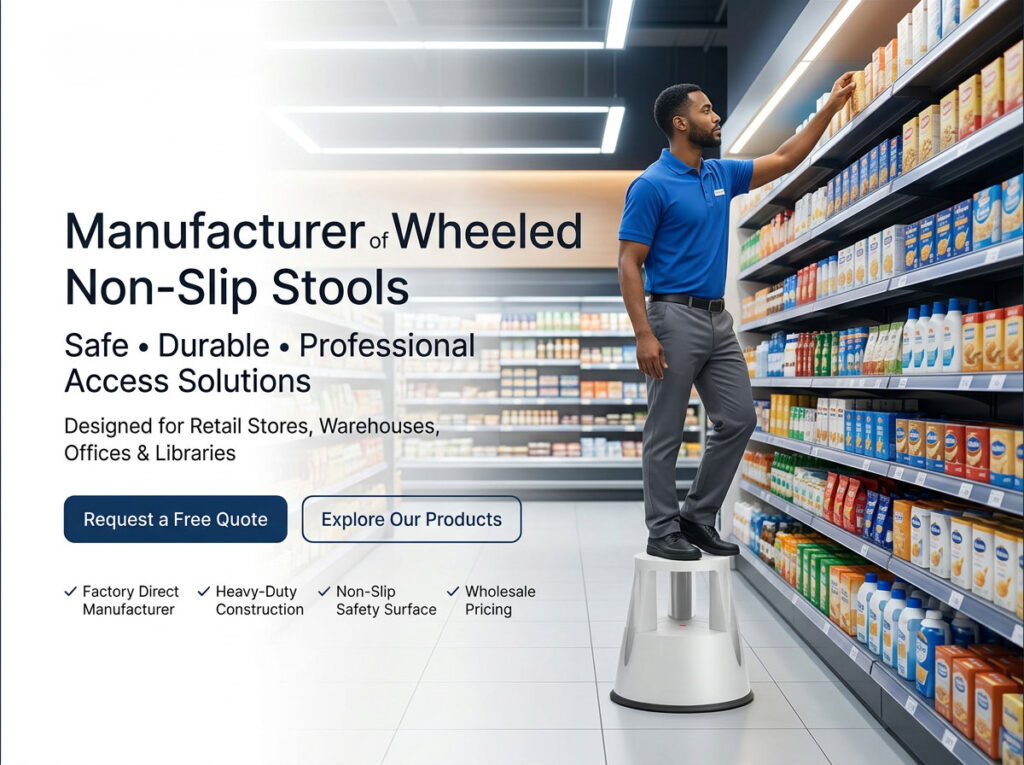


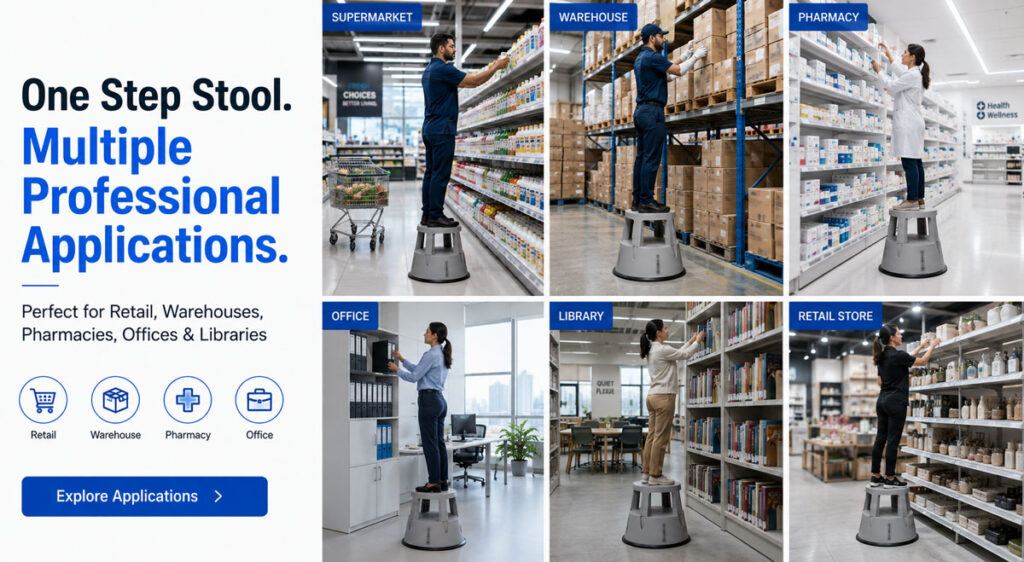
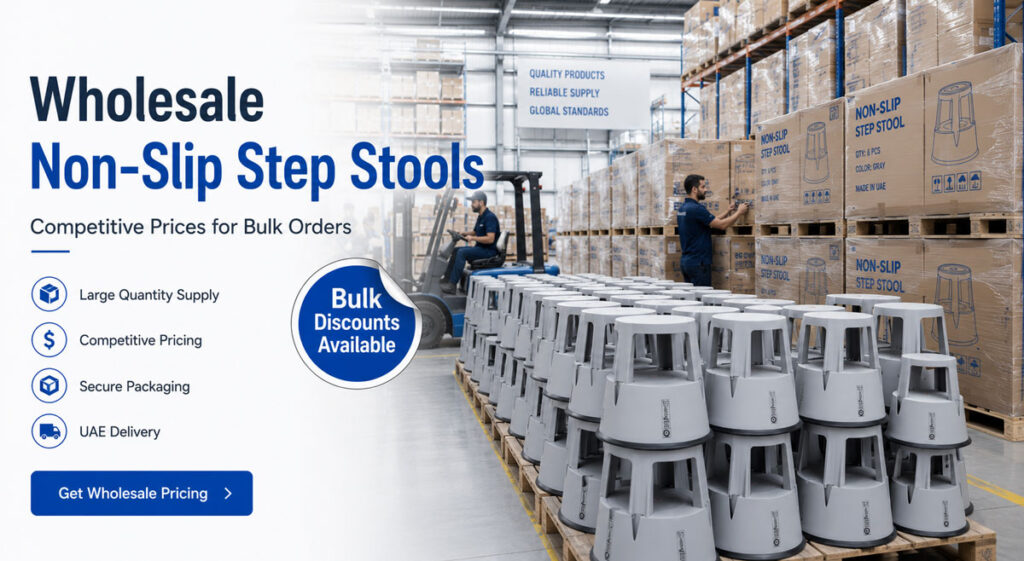

Firmalazım manufactures industrial-grade non-slip wheeled step stools and supports bulk orders, OEM configurations, and supply through wholesale and distributor channels. This guide examines the subject from a floor-performance and operational-continuity perspective, giving purchasing and operations managers a practical framework for selection, deployment, and sustained reliability across supermarket sites in Jordan.
Why Floor Conditions Dictate Elevated-Access Performance in Jordanian Supermarkets
Supermarket backrooms and warehouse retail zones in Jordan present a wider range of floor surfaces and environmental conditions than many operators initially expect. Polished ceramic or porcelain tiles in newer stores create low-friction surfaces when dust or minor moisture is present. Older concrete floors in distribution areas accumulate fine dust that reduces tread grip and caster reliability. Temperature swings between air-conditioned sales floors and warmer receiving zones affect both material behaviour and operator comfort. Non-slip wheeled step stools succeed only when their tread design, caster compound, and locking mechanisms have been matched to these realities.
In Amman, the concentration of large-format supermarkets and central distribution points generates continuous high-reach cycles on mixed floor types. A platform that locks securely on tile yet still rolls smoothly across adjacent concrete sections becomes a measurable time saver. The same requirement appears in Zarqa, where industrial adjacency and higher dust loads place extra demand on non-slip tread performance and caster seals. Irbid hosts both modern supermarket formats and denser urban stores; aisle widths and floor finishes vary enough that a single well-chosen model must perform across the range.
Coastal conditions in Aqaba introduce higher humidity and occasional salt-laden air that can accelerate surface wear on lower-grade finishes. Inland centres such as Salt and Madaba experience more pronounced temperature differences between seasons, making consistent powder-coat protection and stable rubber compounds important. Jerash and Mafraq combine newer retail openings with existing warehouse retail facilities; units that have already proven reliable in higher-intensity sites transfer more easily. Further south, Karak, Tafilah, and Ma’an operate under lower volume but still require the same safety and mobility standards if staff are to work without improvisation.
Northern and satellite locations follow the same logic. Ajloun and Ramtha serve regional demand with compact backrooms where footprint and turning radius matter. Sahab, Wadi Al-Seer, Sweileh, Marka, and Al-Jubeiha function as important nodes within the greater Amman commercial orbit; equipment standardised for these sites supports staff mobility and shared spare-part inventories. Even smaller or secondary facilities benefit when the same non-slip wheeled step stool specification is applied, keeping residual risk and training requirements uniform.
Core Performance Requirements for Non-Slip Wheeled Platforms
Three technical elements determine whether a wheeled step stool remains reliable under daily supermarket conditions:
- Tread surface that maintains grip on both dusty concrete and smooth tile
- Casters that roll freely yet lock (or retract) positively under load
- Frame and finish that resist abrasion and environmental stress over commercial cycles
A manufacturer that designs specifically for commercial use typically combines ribbed or textured steel or composite treads with bonded non-slip material, polyurethane or high-quality rubber casters, and a powder-coated steel frame. Load ratings in the 150–300 kg range cover a worker plus typical case weights with practical margin. Spring-loaded casters offer automatic stabilisation; manual locks provide confirmatory feedback. Both approaches work when the chosen method is consistent across the network and covered in a short familiarisation brief.
Common Specification Mismatches Observed in Practice
Purchasing teams sometimes select domestic or light-commercial stools because the unit price appears lower. These models frequently lack the tread durability, caster quality, and frame reinforcement required for repeated daily cycles in supermarket and warehouse retail environments. Another mismatch occurs when casters are chosen for appearance rather than for the actual floor surfaces present on site. A third error is ordering mixed models across locations, which fragments training, spare parts, and safety expectations as the network grows.
Practical Selection Checklist for Purchasing Managers
- Confirm minimum load rating against actual worker-plus-case weights
- Require non-slip tread performance data or on-site trial results for both tile and concrete
- Verify caster compound and locking/spring behaviour on representative floors
- Specify powder-coated or equivalent finish suited to local temperature and dust conditions
- Check overall footprint against the narrowest working aisle
- Confirm availability of bulk-order pricing and consistent batch specification
- Request OEM identification options for multi-site asset tracking
- Ensure spare casters, feet, and tread components are available through a distributor or wholesale channel
- Obtain commercial-use documentation from the manufacturer
- Plan a short practical familiarisation for all relevant staff
Deployment Patterns That Protect Daily Continuity
High-intensity stores benefit from locating units near the zones that generate the majority of high-reach tasks rather than in a distant equipment room. Clear return zones and simple colour or number coding encourage consistent placement after use. Embedding a rapid visual inspection of treads, casters, and locks into the existing shift-start routine catches wear before it affects safety or speed. In multi-site networks the same model, the same briefing language, and the same inspection points keep residual risk measurable and low.
When a new supermarket opens, including the approved non-slip wheeled step stools in the fit-out package establishes correct methods from the first restocking cycle. Retrofitting later is more expensive in both capital and disruption.
Maintenance Discipline Under Jordanian Conditions
Dust is the most common environmental factor that degrades non-slip performance over time. Open or ribbed tread designs that shed fine particles retain grip longer than tightly perforated surfaces that trap debris. Periodic cleaning of treads and caster mechanisms restores both safety and rolling ease. Genuine wear items supplied by the original manufacturer preserve dimensional and material compatibility; generic substitutes often introduce new variables.
A monthly structural review examining fastener condition, frame rigidity, and caster swivel freedom complements the daily visual check. Keeping a simple log creates an auditable record without administrative burden.
Cost Behaviour Over a Multi-Year Horizon
Acquisition price is visible; the cost of intermittent instability, slower restocking, and premature replacement is not. A durable non-slip wheeled step stool ordered in bulk and maintained under basic discipline typically remains in reliable commercial service for years. When OEM identification supports asset tracking and a distributor relationship shortens spare-part lead times, total cost of ownership falls further. Light-duty alternatives that appear cheaper at purchase usually generate higher cumulative expense through earlier failure and higher residual risk.
Scenario: Morning Restock Cycle on Mixed Floors
An operator selects a unit that has already passed the morning visual check, rolls it from a tiled sales-floor interface onto adjacent concrete storage, positions it squarely, engages the lock or confirms spring stabilisation, climbs while maintaining three points of contact, completes the pick without overreaching, descends, unlocks, and returns the platform to its designated zone. The sequence remains rapid because the tread grips on both surfaces and the casters behave predictably. Across a full shift the cumulative time difference versus an unstable or poorly gripping alternative becomes significant.
Scenario: Multi-Site Standardisation After Local Variation
A chain that previously allowed local purchasing finds itself with three different stool models across its stores. Training materials diverge, spare-part kits cannot be shared, and safety audits produce inconsistent findings. By locking a single industrial non-slip specification, converting existing sites on a planned schedule, and routing all future requirements through bulk orders and a single distributor relationship, the network recovers consistency. Staff mobility improves and residual elevated-access risk declines.
Expert Note on Environmental Matching
The decisive factor is rarely the highest load rating or the most elaborate feature set. It is the match between tread and caster behaviour and the actual floors and dust levels present in the facilities. A short on-site trial under real conditions almost always reveals more than catalogue claims alone.
Comparison: Non-Slip Commercial Units versus Light-Duty Alternatives
| Factor | Non-Slip Commercial Wheeled Step Stool | Light-Duty or Domestic Alternative |
|---|---|---|
| Tread grip on dusty concrete | Designed to maintain | Often degrades quickly |
| Tread grip on smooth tile | Reliable when correctly specified | Variable, especially with dust or moisture |
| Caster locking consistency | Engineered for repeated commercial cycles | Frequently less positive |
| Frame durability | Reinforced for daily supermarket use | Lighter construction, earlier fatigue |
| Spare-part availability | Supported through distributor channels | Often fragmented or unavailable |
| Total cost over 3–5 years | Lower when ordered in bulk | Higher due to replacements and friction |
| Multi-site standardisation | Straightforward | Difficult |
Implementation Sequence for a Jordanian Supermarket Operator
- Map the range of floor surfaces, dust levels, and high-reach task frequencies at representative sites.
- Draft a short internal specification focused on non-slip performance, caster behaviour, load, and footprint.
- Request samples and commercial-use documentation from a manufacturer able to fulfil bulk orders and OEM requests.
- Conduct controlled trials on both tile and concrete under actual operating conditions.
- Approve the standard and convert existing non-compliant units on a planned schedule.
- Embed a one-page familiarisation brief and daily visual check into induction and shift routines.
- Establish small kits of genuine wear items at site or regional level through the chosen distributor.
- Include the approved model in every new-store fit-out package.
- Review performance and any residual incidents at planned intervals.
Closing Perspective
Non-slip wheeled step stools deliver their contribution to supermarket safety and operational continuity only when their design has been matched to the real floor surfaces and environmental conditions found across Jordanian facilities. Specification discipline, practical introduction, routine inspection, and supply continuity through bulk orders, OEM options, and wholesale or distributor channels convert a simple platform into a reliable commercial asset. When these elements are aligned, elevated-access tasks remain fast, predictable, and low-risk from the densest urban stores to secondary locations throughout the country.
Frequently Asked Questions
What makes a wheeled step stool genuinely non-slip under supermarket conditions in Jordan? A combination of textured or ribbed tread geometry and bonded non-slip material that retains grip on both dusty concrete and smooth tile, verified by on-site trial rather than catalogue claim alone.
Why do light-duty stools often lose grip faster in daily commercial use? Their tread compounds and surface designs are typically optimised for occasional domestic or light office use, not for continuous supermarket and warehouse retail cycles in dusty environments.
How important is caster compound for mixed tile and concrete floors? Critical. The wrong compound can either mark polished tile or fail to roll smoothly on dusty concrete. Trial on actual surfaces is the only reliable confirmation.
What load rating covers typical supermarket restocking tasks? A rating that comfortably includes a worker plus the heaviest regularly handled case, commonly in the 150–300 kg range, provides practical margin.
Can one model serve both air-conditioned sales-floor interfaces and warmer receiving zones? Yes, when the frame finish and rubber compounds are specified for the temperature range encountered in commercial facilities.
How does dust specifically degrade non-slip performance over time? Fine particles reduce the effective contact between tread and floor and can increase caster rolling resistance or locking unreliability if not cleaned periodically.
What is the practical advantage of bulk orders for a multi-site operator? Identical specification across all locations, stronger volume pricing, simpler forecasting, and easier spare-part standardisation.
How does OEM identification improve daily operations? It enables rapid visual tracking, clearer ownership by department or site, and simpler audit trails without complex software.
Should a daily visual inspection be formal or informal? A rapid, consistent check of treads, casters, and locks at shift start is sufficient when any failed unit is immediately tagged out of service.
What wear items should be held locally? Genuine caster wheels, rubber feet or base pads, and any manufacturer-recommended tread components, replenished through the distributor relationship.
Is spring-loaded stabilisation or manual locking preferable for high-frequency supermarket work? Both can perform well; the decisive factor is consistency across the network and clear coverage in the familiarisation brief.
How should new supermarket openings treat non-slip wheeled step stools? Include the approved model and calculated quantity in the fit-out package so correct equipment and methods are present from day one.
What is the most common operator error after correct equipment has been introduced? Leaving the unit in a walkway after use instead of returning it to a designated zone, creating secondary obstruction risk.
How can time savings from reliable elevated access be demonstrated? Compare average duration of high-reach restocking tasks before and after introduction of the standardised non-slip units across representative shifts.
Does working through a wholesale or distributor channel improve long-term reliability? Yes. It shortens lead times for both complete units and genuine wear items and provides a practical local contact for technical clarification.
What documentation should procurement retain? Load rating, material and finish specifications, commercial-use statement, and records of any trials or inspections.
How often should a deeper structural review be performed? Monthly under normal commercial intensity is a practical baseline; higher-volume sites may choose a shorter interval.
Can secondary lower-volume locations operate under the same standard? Yes. The same model is used; quantities are simply adjusted to actual demand and may be supported by a nearby hub pool.
What single change most reduces residual elevated-access risk across a network? Replacing mixed light-duty stools with a single approved non-slip commercial model ordered in bulk and covered by consistent inspection and familiarisation routines.
How does powder-coat finish contribute to service life in Jordanian conditions? It provides a durable barrier against abrasion, dust, and the temperature variations common between different zones of a supermarket facility.
Is it acceptable to use the step stool as a temporary surface for open cartons or tools? No. This practice can overload individual steps, damage non-slip surfaces, and create secondary hazards.
What role does the manufacturer play beyond initial supply? Consistent production of the approved model, genuine wear-part availability, OEM flexibility, and the capacity to support recurring bulk orders as the store network evolves.
How should a unit that fails a daily check be managed? Remove it from service at once, tag it clearly, and either repair with genuine parts or replace it. Never return a compromised unit to the working pool.
What is the recommended trial scope before locking a network standard? At least two or three sites that together represent the range of floor surfaces, dust levels, and intensity the operator will encounter.
Why is three-point contact still required on a stable non-slip platform? It remains a fundamental control against loss of balance during ascent and descent, independent of tread or caster quality.
This floor-performance and continuity-focused examination treats non-slip wheeled step stools as commercial tools whose value appears only when design, specification, and daily discipline are matched to the real conditions inside Jordanian supermarket facilities. When a manufacturer supplies durable units and supports bulk orders, OEM needs, and wholesale or distributor fulfilment, elevated-access tasks remain fast, stable, and low-risk from the largest urban stores to secondary locations across the country.
Non-Slip Wheeled Step Stools for Supermarkets in Jordan
Non-slip wheeled step stools influence more than immediate restocking speed inside Jordanian supermarkets. When selected and deployed with attention to human factors, they reduce cumulative physical strain, support consistent end-of-shift performance, and lower the probability of overexertion or slip-related incidents that erode workforce availability. Firmalazım manufactures industrial non-slip wheeled step stools engineered for commercial use and enables bulk orders, OEM identification, and supply through wholesale and distributor channels. This guide approaches the subject from an ergonomics and shift-productivity perspective, giving purchasing and operations managers a practical method for matching equipment to real working postures, reach requirements, and daily fatigue patterns across supermarket facilities in Jordan.
The Hidden Cost of Elevated Access Without Ergonomic Support
Supermarket restocking and high-shelf retrieval require repeated climbing, reaching, and controlled descent. When the platform is unstable, poorly gripped, or incorrectly dimensioned, operators compensate with awkward postures, extended reach, or extra caution that slows the cycle. Over a full shift these micro-adjustments accumulate into measurable fatigue. Over weeks and months they contribute to soft-tissue strain, reduced pace in later hours, and higher residual risk of slip or overbalance incidents.
In Amman, large-format stores and central distribution nodes generate the highest cycle intensity. Platforms that allow a neutral standing posture and secure footing on both tile and concrete sections keep later-shift performance closer to early-shift levels. The same dynamic appears in Zarqa, where dust loads and mixed industrial-adjacent floors increase the chance that inadequate tread grip forces compensatory movements. Irbid combines modern supermarket layouts with denser urban constraints; aisle geometry and shelf heights vary enough that a single well-matched non-slip wheeled model must accommodate the range without forcing operators into side-reaching or over-extension.
Coastal humidity and temperature variation in Aqaba affect both material behaviour and operator comfort during prolonged standing on the platform. Inland centres such as Salt and Madaba experience clearer seasonal temperature swings; consistent frame stability and non-slip performance become more noticeable across full shifts. Jerash and Mafraq are adding retail capacity; introducing ergonomically appropriate elevated-access equipment at the outset establishes working habits that protect both safety and sustained productivity. Southern locations including Karak, Tafilah, and Ma’an operate at lower absolute volume yet still require the same postural support if staff are to complete high-reach tasks without progressive discomfort.
Northern and satellite sites follow identical principles. Ajloun and Ramtha serve regional demand with compact backrooms where correct platform height and footprint directly influence reach zones. Sahab, Wadi Al-Seer, Sweileh, Marka, and Al-Jubeiha function as important nodes within the greater commercial orbit of the capital; standardised ergonomic equipment supports staff who move between these locations and keeps residual strain risk uniform. When the same non-slip wheeled step stool specification is applied network-wide, training, inspection, and fatigue-related observations remain comparable across every site.
Human-Factors Elements That Determine Daily Comfort and Safety
Four elements dominate the ergonomic contribution of a non-slip wheeled step stool:
- Platform height that places the majority of high-shelf work within a comfortable reach envelope
- Tread surface that remains secure under the dynamic loading of ascent, standing, and descent
- Overall stability that eliminates the need for continuous micro-balancing
- Handrail or support geometry (on higher models) that allows three-point contact without forcing shoulder elevation
A manufacturer designing for commercial use typically addresses these points through measured step spacing, high-friction tread compounds, positive locking or spring-loaded casters, and frame rigidity that resists flex under load. Load ratings in the practical commercial range provide margin without adding unnecessary weight that itself increases handling strain when the unit is repositioned.
Observable Signs That Current Equipment Is Creating Strain
Supervisors can detect ergonomic mismatch without formal measurement. Operators who repeatedly side-reach instead of repositioning the platform, who descend more slowly in the final hours of a shift, or who report mid-back or knee discomfort after high-reach intensive days are signalling that the elevated-access tool is not supporting neutral posture. Units that require exaggerated caution because of uncertain grip or residual movement under load further increase cognitive and physical load. These patterns are correctable by matching the platform more precisely to the work.
Selection Criteria from an Ergonomics and Productivity Standpoint
- Platform height and step geometry matched to the dominant shelf levels in the facility
- Non-slip tread verified on both the smoothest tile and the dustiest concrete present
- Caster behaviour that allows easy repositioning yet absolute stability once the operator is on the platform
- Frame rigidity that prevents noticeable flex under commercial load
- Footprint that permits placement close enough to the target bay to avoid over-reaching
- Availability of bulk-order consistency so every site uses the same postural support
- OEM identification that allows tracking of units and correlation with any strain reports
- Spare-part continuity through a distributor or wholesale channel so worn treads or casters are replaced before they degrade grip or stability
- Commercial-use documentation confirming design intent for repeated daily cycles
- Planned short familiarisation that includes correct positioning relative to the body, not only relative to the shelf
Shift-Level Productivity Impact
Early-shift performance is often similar regardless of equipment quality. The divergence appears later. When operators work on a stable, high-grip platform that keeps reaches inside a comfortable envelope, pace decline is slower and residual incident risk remains lower. Across a full week the difference compounds into measurable additional cases handled or reduced overtime. When the same model is used network-wide, these gains become comparable and auditable rather than anecdotal.
Integration into Existing Supervisor Routines
The daily visual check of tread condition, caster function, and frame integrity can be added to existing shift-start observations without new bureaucracy. Any unit showing reduced grip or uncertain locking is tagged out immediately. Periodic informal observation of working posture during high-reach tasks gives supervisors early warning of mismatch. When strain or near-miss reports are reviewed, the elevated-access equipment is already visible as a controlled variable rather than an invisible background factor.
Common Errors That Undermine Ergonomic Benefit
Ordering by price alone frequently produces platforms whose height or stability forces compensatory movement. Allowing mixed models across sites prevents consistent postural training. Neglecting tread and caster maintenance allows progressive loss of grip that operators then accommodate with slower, more cautious technique. Using the platform as a temporary work surface for cartons or tools both damages the non-slip surface and encourages awkward loading postures.
Practical Deployment Sequence Focused on Human Factors
- Observe actual high-reach postures and reach distances at representative sites during both early and late shift periods.
- Translate observations into a short specification that prioritises platform height, tread security, and stability under dynamic load.
- Obtain samples from a manufacturer able to support bulk orders and OEM identification.
- Trial the preferred model under real floor and task conditions, paying attention to later-shift operator feedback.
- Approve the standard and convert existing units on a controlled schedule.
- Deliver a brief practical familiarisation that emphasises body positioning relative to the platform and the target shelf.
- Embed the visual inspection into shift-start routines and link any strain reports to equipment condition logs.
- Maintain genuine wear items so non-slip performance never degrades unnoticed.
- Include the approved model in all new-store fit-out packages so ergonomic support is present from the first day.
Scenario: Late-Shift Performance on a Matched Platform
An operator working the final hours of a high-volume restock day continues to reposition the non-slip wheeled step stool rather than over-reaching, maintains three-point contact without shoulder elevation, and completes the remaining bays at a pace only modestly slower than the morning. Grip remains secure on both remaining tile sections and dusty concrete. The cumulative physical load is lower than on an unstable or poorly gripping alternative, and residual incident probability stays low.
Scenario: Network-Wide Correlation of Strain Reports
After standardising on a single industrial non-slip model, a chain notices that soft-tissue strain reports linked to elevated access decline and become more evenly distributed across sites. Because every location uses identical equipment and the same inspection points, any remaining reports can be investigated against specific unit condition or task design rather than against uncontrolled equipment variation.
Expert Observation on Long-Term Workforce Availability
The return on ergonomically appropriate elevated-access equipment appears not only in daily case counts but in sustained workforce availability. Lower cumulative strain reduces both formal absence and the informal slowdown that occurs when operators protect discomfort. Over a multi-year horizon this contribution often exceeds the difference in initial equipment cost, especially when bulk-order pricing and distributor support keep total ownership cost controlled.
Comparison: Ergonomically Matched versus Generic Platforms
| Factor | Ergonomically Matched Non-Slip Wheeled Stool | Generic or Light-Duty Alternative |
|---|---|---|
| Neutral standing posture | Supported by design | Frequently requires compensation |
| Reach envelope | Matched to dominant shelf heights | Often forces side-reach or extension |
| Late-shift pace retention | Higher | More pronounced decline |
| Residual slip/overbalance risk | Lower when tread and stability are correct | Higher under fatigue or dust |
| Consistency across sites | Achievable through bulk standardisation | Difficult |
| Correlation with strain data | Possible | Obscured by equipment variation |
| Total cost including workforce impact | Lower over multi-year horizon | Higher when strain and slowdown are included |
Closing Perspective
Non-slip wheeled step stools become a genuine contributor to supermarket productivity and workforce sustainability only when their design and deployment address the human factors of repeated elevated access. Platform height, tread security, dynamic stability, and network consistency determine whether operators finish shifts with residual capacity or with accumulated strain. When a manufacturer supplies industrial units designed for commercial use and supports bulk orders, OEM tracking, and wholesale or distributor fulfilment, the equipment can be standardised, maintained, and observed as a controlled variable. The result is more predictable late-shift performance, lower residual elevated-access risk, and clearer long-term workforce availability across supermarket facilities throughout Jordan.
Frequently Asked Questions
How does an unstable or poorly gripping step stool increase cumulative physical strain? Operators compensate with altered posture, extended reach, slower controlled movements, and higher continuous attention to balance. These micro-adjustments accumulate across repeated cycles and become noticeable by the later hours of a shift.
What platform height range best supports neutral posture for typical supermarket shelf work? Height should place the majority of retrieval and placement tasks within a comfortable vertical envelope so that shoulder elevation and excessive lumbar flexion are minimised. On-site observation of actual shelf levels is required for precise matching.
Why is non-slip performance still critical even when the operator is standing still on the platform? Dynamic loading during small weight shifts, reaching, and the start of descent can overcome marginal grip, especially on dusty or polished surfaces. Secure footing removes the need for continuous balance correction.
Can the same non-slip wheeled model reduce both early-shift caution time and late-shift fatigue? Yes. Immediate confidence in grip and stability shortens the cautious phase of each cycle, while sustained security prevents the progressive compensatory effort that drives fatigue.
How should supervisors detect ergonomic mismatch without formal measurement tools? Watch for repeated side-reaching instead of repositioning, slower descent in later hours, verbal reports of mid-back or knee discomfort after intensive high-reach periods, and any increase in near-miss balance events.
What is the value of OEM identification in an ergonomics-focused programme? It allows correlation of any strain or near-miss reports with specific units and their maintenance history, turning equipment condition into a visible and manageable variable.
How do bulk orders support consistent ergonomic outcomes across a network? Identical platform geometry, tread specification, and stabilisation method mean every operator experiences the same postural support and every supervisor applies the same observation points.
Should familiarisation training emphasise body position relative to the platform or only platform position relative to the shelf? Both. Correct placement of the platform is necessary, yet operators also need clear guidance on maintaining neutral posture and three-point contact once they are on the unit.
What maintenance failure most quickly degrades the ergonomic benefit? Loss of tread grip or caster stability through wear or dust accumulation. Operators then reintroduce compensatory movements that the original specification was intended to eliminate.
How can late-shift productivity differences be quantified? Compare cases handled or bays completed in the final two hours of shifts before and after introduction of the matched non-slip platforms, controlling for overall volume.
Is handrail geometry relevant on lower step stools? On models above two or three steps, appropriate handrail height and continuity support three-point contact without forcing elevated shoulder posture.
What role does a distributor play in preserving long-term ergonomic performance? Rapid supply of genuine tread components, casters, and feet ensures that grip and stability never degrade to the point where operators begin compensating.
How should new stores be treated in an ergonomics-driven programme? The approved non-slip wheeled step stool and the associated familiarisation brief should form part of the opening package so that correct postural support exists from the first restocking cycle.
Can secondary lower-volume sites justify the same ergonomic specification? Yes. Absolute cycle counts may be lower, yet the individual operator still experiences the same per-cycle postural load. Consistency also supports staff who move between high- and low-volume locations.
What single change most reliably improves late-shift elevated-access performance? Replacing mixed or marginal platforms with a single non-slip commercial model whose height, grip, and stability have been validated against actual working postures and floor conditions.
How does frame flex under load affect perceived and actual safety? Even small flex introduces continuous micro-balancing demands that increase both physical effort and residual overbalance risk, particularly under fatigue.
Should strain reports be reviewed against equipment condition logs? Yes. When units are uniquely identified and inspection records are kept, patterns linked to specific platforms or maintenance gaps become visible and actionable.
What is the practical length of an effective ergonomics-focused familiarisation? Ten to fifteen minutes of hands-on demonstration covering platform placement, body positioning, stabilisation method, three-point contact, and prohibited compensatory behaviours is usually sufficient when reinforced periodically.
How do temperature and humidity variations in different Jordanian locations affect material choices? Consistent non-slip compounds and powder-coat protection that retain performance across the range of conditions encountered between coastal and inland sites prevent progressive degradation of grip or frame integrity.
Why is three-point contact emphasised even on a highly stable non-slip platform? It remains a fundamental control during the dynamic phases of ascent and descent, independent of static standing security.
What is the recommended frequency for reviewing the ergonomic match of the approved model? Annually, or whenever significant changes occur in dominant shelf heights, case weights, or floor finishes across the network.
How does commercial-use design intent differ from light-duty design in human-factors terms? Commercial designs assume repeated daily dynamic loading, continuous grip requirements under real floor conditions, and the need for consistent postural support across full shifts rather than occasional short-duration use.
Can supervisor observations of posture replace formal ergonomic assessment? They provide valuable early warning and continuous monitoring. Formal assessment remains useful when designing or significantly revising the network specification, but daily observation keeps the system responsive.
What is the most cost-effective way to maintain non-slip performance over years of commercial use? Routine cleaning of treads and casters combined with timely replacement of genuine wear items before grip or stability falls below the original design level.
How should a chain correlate reduced strain reports with equipment standardisation? Track both the absolute number and the site distribution of elevated-access-related strain or near-miss reports before and after conversion to the single approved non-slip model, alongside inspection-pass rates and late-shift productivity samples.
This human-factors and shift-productivity examination positions non-slip wheeled step stools as tools that protect both immediate safety and longer-term workforce capacity. When platform geometry, tread security, and dynamic stability are matched to real working postures, and when the same specification is deployed consistently through bulk orders, OEM tracking, and reliable wholesale or distributor support, operators sustain higher performance across full shifts while residual elevated-access risk remains controlled. The approach turns a simple commercial platform into a measurable contributor to operational continuity and workforce sustainability across supermarket facilities in Jordan.
Non-Slip Wheeled Step Stools for Supermarkets Jordan
Non-slip wheeled step stools only deliver consistent value inside Jordanian supermarket operations when their availability, condition, and correct use are made visible and managed at shift level. Without simple visual controls and clear ownership, units disappear into corners, grip degrades unnoticed, and elevated-access risk becomes invisible until an incident or delay occurs. Firmalazım manufactures industrial non-slip wheeled step stools designed for commercial use and supports bulk orders, OEM identification, and supply through wholesale and distributor channels. This guide examines the subject from a visual-management and shift-accountability perspective, showing purchasing and operations managers how to turn a basic platform into a controlled, observable asset that protects both safety and restocking continuity across supermarket sites in Jordan.
Why Elevated-Access Equipment Becomes Invisible Without Deliberate Controls
In busy supermarket backrooms the tools that are not actively managed tend to drift. A wheeled step stool used for a high-reach task is left in an aisle, later moved by someone else, and eventually settles in a low-visibility storage area. Tread grip declines gradually under dust. Casters lose free movement. Operators begin compensating with slower technique or improvised alternatives. Supervisors notice the resulting delays or near-misses only after the fact. The root cause is rarely the original equipment quality; it is the absence of simple, daily visibility and ownership.
In Amman, high-volume stores and distribution interfaces generate continuous elevated-access demand. When units are given clear home positions and daily condition checks, they remain available at the moment they are needed. The same requirement appears in Zarqa, where dust and mixed traffic make progressive grip loss more likely if inspection is left to chance. Irbid operates a mix of modern and denser urban formats; without visual standards the same model can be present yet effectively unavailable because it is not where the work is happening.
Coastal conditions in Aqaba accelerate surface and caster wear if cleaning and inspection are irregular. Inland centres such as Salt and Madaba experience clearer seasonal variation; consistent visual routines keep performance stable across temperature changes. Jerash and Mafraq are expanding retail capacity; establishing ownership and visibility rules at the moment of opening prevents the later drift that follows informal local practice. Southern sites including Karak, Tafilah, and Ma’an may operate at lower absolute volume, yet the individual impact of a missing or degraded platform remains the same for the staff who need it.
Northern and satellite locations follow the identical logic. Ajloun and Ramtha serve regional demand with compact footprints where a missing unit forces immediate improvisation. Sahab, Wadi Al-Seer, Sweileh, Marka, and Al-Jubeiha form part of the greater commercial network around the capital; standardised visual controls allow staff who move between these sites to find and use equipment under the same rules. When every location applies the same home-position standard, the same daily check, and the same tagging discipline, residual elevated-access risk becomes measurable rather than diffuse.
Core Elements of a Visual Management System for Wheeled Step Stools
Four practical elements convert the platform from an informal tool into a managed asset:
- Designated home positions marked on the floor or by simple signage
- OEM or colour identification that makes ownership and unit identity obvious
- A rapid daily condition check linked to shift start
- Clear tagging and removal rules for any unit that fails the check
These elements require almost no additional labour when embedded into routines that already exist. Their power lies in making the normal state visible and the abnormal state impossible to ignore.
Designing Home Positions That Survive Real Operations
Home positions should be located close to the zones that generate the majority of high-reach tasks yet outside main traffic flows. Floor marking or a simple wall board with outlines works. The test of a good home position is whether a supervisor can see in three seconds whether the unit is present and correctly stored. In multi-aisle backrooms more than one home position may be required; the principle remains the same. When units are consistently returned, the next operator never wastes time searching.
Identification That Supports Accountability
OEM identification plates or durable colour coding allow each unit to be linked to a department, zone, or site. When a unit is found out of place or in degraded condition, the identity is immediate. This supports both daily ownership and longer-term tracking of wear patterns or repeated misuse. Bulk orders that include consistent identification from the manufacturer make the system scalable without later field marking.
Daily Condition Check as a Visual Standard
At shift start a designated person confirms three points: tread surface clean and intact, casters free and locking (or retracting) correctly, frame free of obvious damage. The check takes less than thirty seconds per unit. Any failure results in immediate tagging and removal from the working pool. The tagged unit is either repaired with genuine parts or replaced. Because the check is visual and binary, it requires no forms beyond a simple pass/fail mark if records are desired.
Tagging and Removal Discipline
A red or highly visible tag stating “Do Not Use – Awaiting Attention” removes ambiguity. Units that remain tagged beyond a defined short interval escalate to the supervisor or maintenance contact. This closes the loop between detection and restoration. When genuine wear items are held locally through a distributor relationship, most tagged units return to service quickly.
Integration with Existing Short-Interval Management
Many supermarket operations already use short-interval checks for cleanliness, temperature, or stock gaps. Adding the elevated-access equipment status to the same board or verbal round requires almost no extra time. The question becomes simply: “Are all designated step stools present, in home position, and showing a current pass mark?” Abnormal answers trigger immediate action rather than later investigation.
Common Failures of Informal Systems
Units left in aisles create secondary trip hazards and force other staff to move equipment that is not theirs. Progressive dust accumulation on treads is noticed only when grip has already declined. Casters that no longer lock freely are tolerated until an operator experiences residual movement under load. Mixed or unidentified units make it impossible to know whether the network still matches the original commercial specification. Each of these failures is preventable by the four visual elements described above.
Practical Implementation Sequence
- Map the actual high-reach demand zones and current resting places of existing stools.
- Define and mark clear home positions that balance proximity to work with traffic safety.
- Standardise on a single non-slip commercial model ordered in bulk with OEM identification.
- Convert existing units on a planned schedule, retiring non-compliant stools.
- Write a one-page standard covering home position, daily check points, and tagging rules.
- Train shift leaders and relevant staff in the visual standard during a short practical session.
- Embed the check into the existing shift-start routine and add equipment status to any short-interval board already in use.
- Establish a small local kit of genuine casters, feet, and tread components via the distributor.
- Review compliance and any residual incidents at regular intervals; adjust home positions only if data show they are not serving the work.
- Include the full visual standard and approved model in every new-store opening package.
Scenario: Shift Start Under Visual Control
The designated checker walks the marked home positions, confirms each unit is present, inspects tread and casters, and places or confirms the daily pass mark. Any unit that fails is tagged and moved to the attention point. The rest of the shift proceeds with known-good equipment in known locations. Searching time is eliminated and residual grip or stability risk is controlled before the first high-reach task begins.
Scenario: Mid-Shift Recovery of a Displaced Unit
An operator finishes a task and leaves the stool in an aisle. A supervisor or colleague returning it to the marked home position is now the expected and visible behaviour rather than an exception. Because identity is clear, repeated displacement by the same zone can be addressed directly. The system makes the preferred behaviour the path of least resistance.
Expert Observation on Accountability
Visual management does not require complex software or additional headcount. It requires that the normal state of the elevated-access equipment is defined, made obvious, and checked at a frequency that matches the speed at which the abnormal state can develop. When those conditions are met, supervisors manage by exception and residual risk remains low even under volume pressure.
Comparison: Visual Management versus Informal Availability
| Aspect | Visual Management System | Informal Availability |
|---|---|---|
| Location of units | Known home positions, visible at a glance | Variable, often requires searching |
| Condition awareness | Daily binary check before work begins | Reactive, after grip or stability has declined |
| Ownership | Clear through OEM or colour identification | Diffuse |
| Response to failure | Immediate tagging and removal | Tolerance until incident or complaint |
| Training and consistency | Single standard across all sites | Local variation |
| Residual elevated-access risk | Controlled and measurable | Hidden until expressed as delay or incident |
| Scalability across network | High | Declines as store count grows |
Closing Perspective
Non-slip wheeled step stools protect supermarket safety and restocking continuity only when their presence, condition, and correct use remain visible at the shift level. Designated home positions, clear identification, a rapid daily check, and disciplined tagging convert the platform from an informal tool into a managed commercial asset. When the underlying equipment is supplied by a manufacturer that supports bulk orders, OEM identification, and reliable wholesale or distributor fulfilment, the visual system can be standardised and sustained across every location. The result is higher equipment availability, lower residual risk, and clearer accountability from the largest urban stores to secondary sites throughout Jordan.
Frequently Asked Questions
What is the simplest effective home-position standard for wheeled step stools? A marked floor location or wall outline close to high-reach demand zones yet outside main traffic flows, visible enough that a supervisor can confirm presence in seconds.
Why does progressive dust accumulation often go unnoticed without a daily check? Grip loss is gradual. Operators adapt their technique incrementally until the cumulative effect appears as slower cycles or a near-miss, at which point the degradation is already advanced.
How does OEM identification strengthen shift-level accountability? It makes each unit uniquely or zonally recognisable, so displacement, repeated misuse, or maintenance history can be linked to a specific platform rather than to an anonymous tool.
Can the daily condition check be completed in under a minute per unit? Yes. A focused visual confirmation of tread integrity, caster freedom and locking function, and absence of obvious frame damage requires only seconds when the points are predefined.
What should happen the moment a unit fails the daily check? It is tagged with a highly visible “Do Not Use” marker and removed from the working pool until repaired with genuine parts or replaced.
How are home positions protected from being blocked by other materials? By treating the marked area as a controlled zone in the same way that fire exits or emergency equipment locations are protected, and by including the status in short-interval reviews.
Is colour coding alone sufficient for multi-site networks? Colour coding helps for zone or department ownership; combining it with unique OEM numbering or labelling improves long-term tracking and correlation with any incident or wear data.
What is the most common reason visual standards fail after initial introduction? Home positions are chosen for convenience of installation rather than for proximity to actual high-reach work, so operators stop returning units because the marked location is inconvenient.
How does a distributor relationship support the visual system? It ensures rapid replenishment of genuine wear items so that tagged units return to service quickly and the working pool remains complete.
Should short-interval management boards include elevated-access equipment status? Yes. A simple present/pass or missing/fail indicator keeps the status visible to the entire shift without additional paperwork.
How are new supermarket openings treated under a visual management approach? The approved non-slip model, marked home positions, daily check standard, and tagging rules form part of the opening package so the system exists from the first day of operation.
Can secondary lower-volume sites operate the same visual standard without excess burden? Yes. The standard is identical; the number of units and home positions is simply scaled to actual demand.
What single visual element most reduces searching time? Consistently observed home positions that place the unit where the work actually occurs.
How should repeated displacement of a unit be addressed? Because identity is clear, the zone or individuals involved can be coached directly; the visual system makes the pattern obvious rather than anecdotal.
Is a written log required for every daily check? A simple pass mark or board indicator is sufficient for most commercial environments; more detailed logging can be added if audit requirements demand it.
What maintenance failure most quickly undermines the entire visual system? Allowing tagged units to remain out of service for extended periods, which teaches staff that the standard is not enforced and that improvisation is acceptable.
How does bulk ordering with consistent identification support network-wide visual management? Every site receives identical units with identical markings, so the same home-position rules, check points, and tagging language apply without local variation.
What is the recommended response if a home position repeatedly becomes blocked? Review the location against actual traffic and work flow; move the home position if data show it is not serving the operators, rather than abandoning the standard.
Can the visual system detect early signs of misuse as well as wear? Yes. Units repeatedly found out of position, with damaged treads from improper loading, or with casters showing impact damage provide early signals that coaching or process adjustment is required.
How does commercial-use design intent interact with visual management? Equipment built for repeated daily cycles maintains its non-slip and locking performance longer under the inspection regime, so the visual system spends more time confirming the normal state and less time managing failures.
What is the practical length of training required to introduce the visual standard? A short practical walk-through of home positions, the three check points, and the tagging rule is usually sufficient when reinforced by daily practice and supervisor example.
Should the same visual standard apply to both full-size stores and smaller format locations? Yes. Consistency of expectation and language across the network is more valuable than local customisation of the control system itself.
How are residual elevated-access incidents investigated under a visual management regime? Equipment identity, last inspection status, and home-position compliance become immediate data points rather than unknowns, shortening root-cause analysis.
What role does the manufacturer play in sustaining the system over years? Consistent production of the approved model, genuine wear-part availability, and OEM identification continuity allow the visual standard to remain stable as the store network evolves.
How can compliance with home-position and daily-check standards be sampled without creating bureaucracy? Periodic supervisor walks that simply count units in correct position with current pass marks provide a rapid, low-overhead measure of system health.
This visual-management and accountability examination treats non-slip wheeled step stools as shift-level controlled assets rather than background tools. When home positions, identification, daily condition checks, and tagging discipline are made visible and routine, availability rises, residual risk falls, and supervisors manage by exception. Supported by a manufacturer that enables bulk orders, OEM identification, and reliable wholesale or distributor fulfilment, the approach scales cleanly across supermarket facilities throughout Jordan and keeps elevated-access performance both safe and predictable.

Bir yanıt yazın