


Professional Wheeled Step Stools for Retail Stores in Qatar
Professional Wheeled Step Stools for Retail Stores in Qatar designed for retail stores solve a daily operational reality inside Qatar supermarkets: the need for fast, stable, low-profile elevated access in both customer-facing backrooms and tight service corridors. The 2-step plastic model with spring-loaded wheels, non-slip surface, 410 mm height and 150 kg capacity enables staff to complete replenishment, promotional resets and overhead tasks without disrupting the sales floor or introducing new safety risks. This guide delivers a complete decision and deployment framework for retail operations and purchasing teams, covering in-store application, climate suitability, supply resilience and measurable returns when the equipment is sourced from a capable manufacturer through bulk orders, wholesale channels and local distributor support.
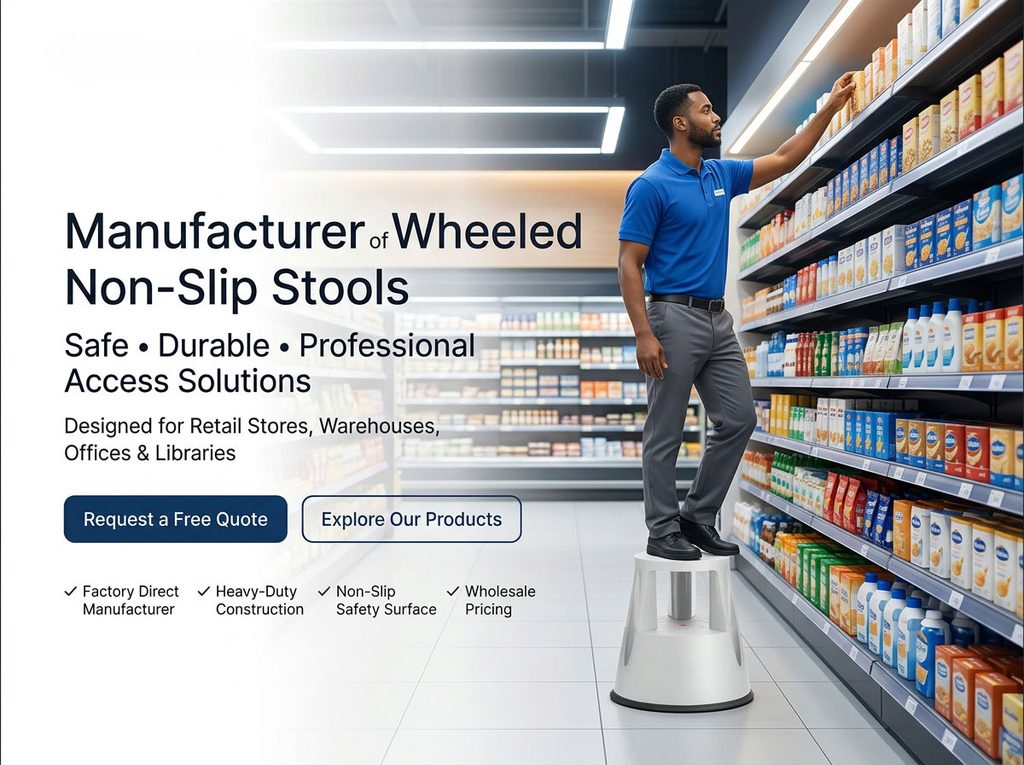


In a modern supermarket the difference between a smooth trading day and a delayed one often appears in the backroom rather than on the sales floor. When staff must reach second-level shelving for promotional stock, seasonal displays or missing SKUs, every extra second spent locating or stabilizing access equipment multiplies across the shift. Professional wheeled step stools remove that friction by combining instant mobility, automatic stability and a footprint small enough for the narrow service spaces typical of retail stores.
The Operational Role of Professional Wheeled Step Stools in Retail Stores
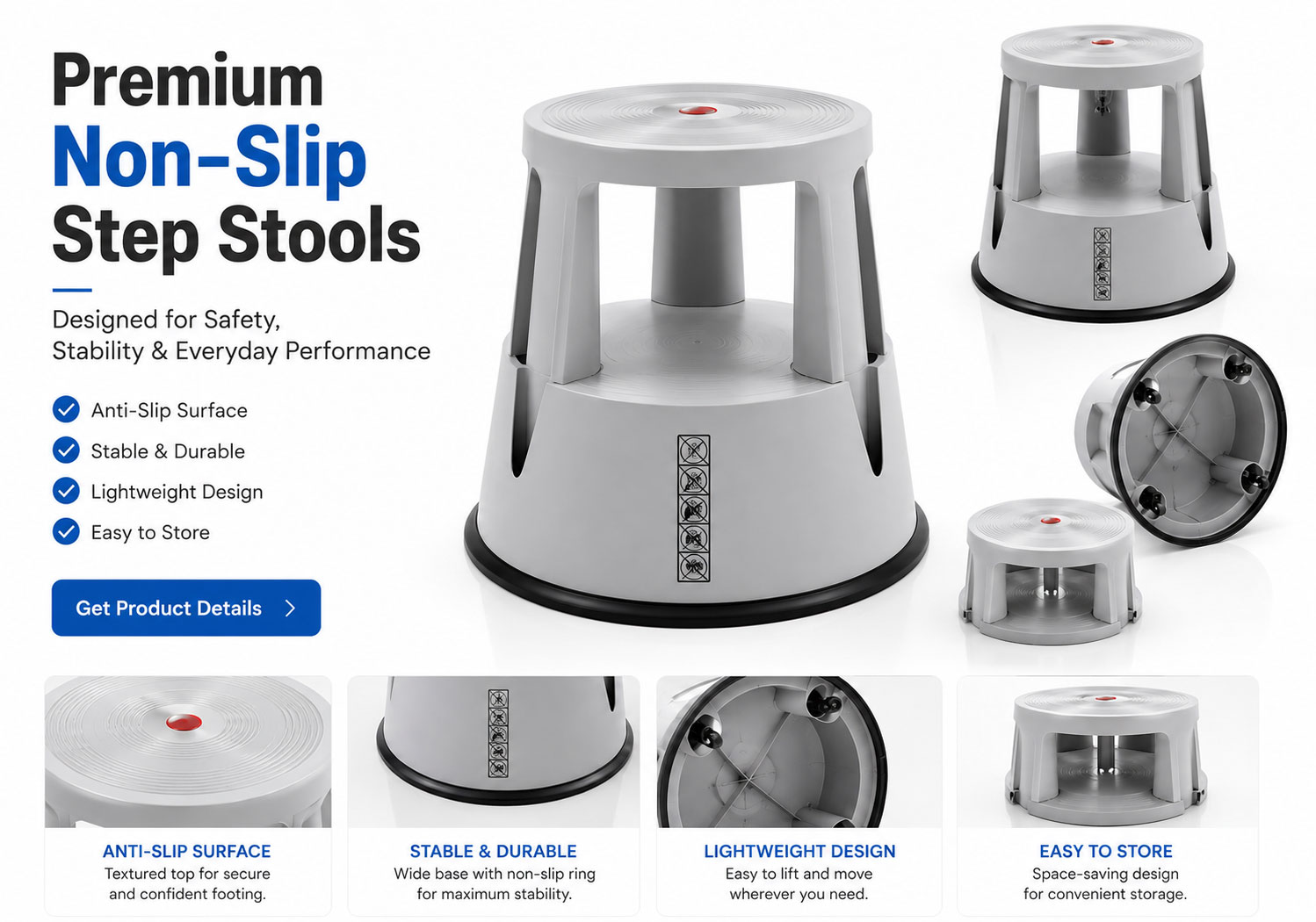
The core engineering contribution is the spring-loaded wheel system. Unloaded, the stool moves freely between gondola runs and storage racks. The moment an operator steps on, the wheels retract and the full base locks to the floor, creating a stable platform. Release of weight restores mobility. Paired with a textured non-slip surface and a wide 433 mm base, the design addresses the two most frequent causes of access-related incidents in retail environments: unexpected movement under load and foot slippage on recently cleaned floors.
Technical Profile for Retail Use
| Specification | Detail |
|---|---|
| Material | Engineering plastic |
| Color | Grey |
| Number of Steps | 2 |
| Platform Height | 410 mm |
| Top Diameter | 283 mm |
| Bottom Diameter | 433 mm |
| Load Capacity | 150 kg |
| Mobility System | Spring-loaded wheels |
| Standing Surface | Non-slip texture |
These dimensions allow the unit to travel through standard backroom doorways and between gondola ends while still providing a secure standing area.
Material Suitability for Continuous Retail Conditions
Engineering-grade plastic formulated for impact resistance and chemical tolerance performs reliably under the frequent cleaning cycles and occasional cart contact common in supermarket backrooms. UV stabilizers protect against degradation in high ambient temperatures. The grey finish reduces heat absorption. The non-slip texture retains grip even when light moisture from floor cleaning remains, an important safety characteristic in retail environments where floors are cleaned multiple times per day.
Production Consistency That Protects Network Standards
A competent manufacturer controls resin quality, wall-thickness uniformity and spring-tension calibration. Each unit undergoes static load verification; sample units from every batch receive cycle testing. When retail chains place bulk orders, this process discipline determines whether successive deliveries remain identical. Chains that later require OEM color matching or private identification for multi-store consistency benefit from the same controlled production environment.
In-Store Application Patterns Across Qatar
Backroom teams in Doha move the stools between ambient and chilled storage without changing equipment type. Stores serving residential areas in Al Rayyan value the compact footprint in narrow service corridors. Retail operations linked to Al Wakrah report faster completion of promotional resets. Outlets in Umm Salal use the same platform for both case replenishment and occasional overhead signage work. Teams based around Al Khor appreciate the automatic lock when temporary staff join during peak trading. New retail developments in Lusail incorporate the units into standard store-opening kits. Support operations near Mesaieed deploy them in mixed warehouse-retail environments. Facilities connected to Ras Laffan require surfaces tolerant of industrial cleaning regimes. Stores serving western corridors around Dukhan maintain the identical specification for consistency. Emerging retail clusters at Birkat Al Awamer benefit from the low training burden. Distribution points near Barwa Al Baraha move units between bulk storage and forward areas. High-density operations inside Industrial Area Doha rely on the 150 kg rating for continuous commercial use. Expanding retail capacity in the New Industrial Area standardizes early to avoid later fragmentation. Support functions in Abu Hamour and Ain Khaled use the stools for both warehouse retail and supermarket backroom tasks. Operations linked to Salwa Industrial Area value rapid repositioning. Free-zone logistics at Qatar Free Zones, Ras Bufontas Free Zone and Umm Alhoul Free Zone adopt the same platform so that staff moving between zones encounter identical equipment.
Safety Perception on the Retail Floor
Although the stools are primarily used in backrooms, their presence influences overall safety culture. When staff know that elevated access is stable and automatic, residual hesitation declines. This psychological safety is particularly noticeable among temporary or newly hired team members who may have limited prior experience with retail access equipment. The result is smoother workflow and fewer hesitation pauses before stepping up.
Comparison of Retail Access Options
| Factor | Fixed Step Ladder | Conventional Rolling Ladder | Professional Wheeled 2-Step Stool |
|---|---|---|---|
| Speed of repositioning | Low | Medium | High |
| Floor-space demand | High | High | Low |
| Passive stability under load | Moderate | Variable | High |
| Training time for new staff | Low | Medium | Minimal |
| Compatibility with narrow backrooms | Limited | Variable | Excellent |
| Suitability for mixed ambient/chilled use | Good | Good | Excellent |
| Visual impact if briefly visible on sales floor | Higher | Higher | Low |
The comparison explains why many supermarket operators converge on the professional wheeled stool for the majority of second-level in-store tasks.
Purchasing Framework for Retail Chains
- Map every backroom and service corridor where elevated access occurs more than a defined number of times per shift.
- Confirm clearances against the 433 mm base diameter.
- Define success metrics (replenishment cycle time, near-miss count, temporary-staff briefing time) before any units enter service.
- Select a manufacturer able to demonstrate process control and support both standard and OEM requirements.
- Negotiate wholesale terms covering initial volume and twelve-month replenishment.
- Establish a distributor relationship for rapid spare-parts response.
- Run a controlled pilot in the highest-frequency stores, measure results, then expand on internal data.
Cost and Return Perspective for Retail Operations
Unit price is only the entry point. Recovered replenishment time, reduced near-miss investigations and simplified onboarding of temporary staff generate the return. A mid-sized supermarket typically recovers the capital outlay within twelve to eighteen months through cycle-time savings alone. When the same specification is applied across a multi-store network, purchasing leverage through bulk orders further improves the economics.
Common In-Store Errors and Prevention
- Using the stool as a transport cart for heavy loads rather than a temporary elevated platform.
- Allowing cleaning residue to remain on the standing surface overnight.
- Letting units migrate out of assigned backroom zones.
- Ordering successive batches from different sources without re-validating performance.
- Under-estimating the value of a responsive distributor when a wheel assembly fails during a peak trading period.
Real Scenario – Overnight Promotional Reset
During a major national campaign a supermarket cluster completed an overnight promotional reset across multiple stores. Temporary staff were onboarded for the night shift. Because the professional wheeled stools required only a one-minute orientation on the automatic lock, the temporary cohort reached full replenishment productivity within the first hour. Store managers recorded no access-related incidents and the resets finished ahead of schedule. The same units continued in baseline service the following week, demonstrating that the investment served both peak and normal trading conditions.
Expert Commentary – Retail Operations Manager
“The daily conversation about missing or unstable access equipment disappeared within two weeks of full deployment. Once the stools were in place and the inspection routine was non-negotiable, that particular friction left the shift handover. Safety metrics improved, temporary staff became productive faster, and procurement could place clean bulk orders against one specification.”
Maintenance Protocol That Fits Retail Schedules
Daily: visual scan of wheel housings and non-slip surface (under 60 seconds per unit). Weekly: functional confirmation of retraction and re-engagement. Monthly: documented load test on a rotating sample. Annual: condition review and decision on continued high-frequency deployment or reassignment.
The regime integrates into existing supermarket facility checklists without adding measurable administrative burden.
Tip Box – Pre-Peak Retail Readiness
Thirty days before a known volume surge, verify that every high-velocity backroom still has functional stools within short walking distance. Confirm spare wheel assemblies are either on site or covered by a rapid distributor response. Brief temporary-staff supervisors on the automatic locking behavior. These three actions prevent the majority of access-related friction during the busiest trading periods.
Control Checklist for Multi-Store Roll-Out
- Clearance verification completed for every intended store.
- Baseline replenishment-cycle times and near-miss counts recorded.
- Manufacturer load-test certificates and material data received.
- Inspection ownership assigned at store level.
- Spare-parts arrangement confirmed with distributor.
- Supervisor orientation completed.
- First formal review scheduled at 30 days.
- Expansion criteria defined in advance.
Summary of Core Retail-Store Advantages
- Automatic transition from mobile to stable under load.
- Compact footprint suited to supermarket backrooms and service corridors.
- Minimal training burden for permanent and temporary staff.
- Predictable maintenance load under continuous commercial use.
- Scalable supply through manufacturer bulk-order capability, wholesale pricing and distributor support.
- Design-level contribution to safety that does not rely on procedural memory.
Professional wheeled step stools earn their place in Qatar retail stores by removing a small but persistent source of friction. When the specification is held constant, the supply path is secured, and basic inspection discipline is maintained, the equipment delivers sustained improvements in both speed and safety across peak and baseline trading conditions.
Five Distinct CTAs
- Request current volume pricing and lead times for a multi-store bulk order.
- Schedule a short on-site demonstration of the automatic wheel-lock under actual supermarket floor conditions.
- Obtain a three-year total-cost-of-ownership projection built on your replenishment-cycle data.
- Explore OEM color and identification options for chain-wide visual consistency.
- Connect with an authorized distributor for local stock availability and spare-parts coverage.
FAQ
What makes a professional wheeled step stool suitable for Qatar supermarket stores? Automatic wheel retraction under load, non-slip standing surface, 150 kg capacity and a compact footprint that fits standard backroom clearances.
How does the spring-loaded system improve safety compared with free-rolling casters? The wheels retract the moment weight is applied, converting the unit into a fixed platform and eliminating unexpected movement.
Is the 410 mm height adequate for most supermarket second-level shelving? Yes. It places the majority of adult operators in an efficient working envelope for typical elevated replenishment tasks.
Can the same model serve both ambient and chilled supermarket zones? Yes, provided the plastic remains within its rated temperature range and cleaning protocols are followed.
What documentation should accompany bulk orders from the manufacturer? Load-test certificates, material specifications and clear maintenance guidance.
How frequently should store teams inspect the wheel mechanism? Visual check each shift, functional test weekly, documented load test monthly.
Does the equipment require assembly on arrival? No. Units arrive ready for inspection and immediate deployment.
What is the most common reason a unit leaves service early? Direct impact from carts or pallet jacks rather than normal wear of the wheels or platform.
Can temporary staff use the stools safely after minimal orientation? Yes. A one-minute explanation of the automatic locking behavior is normally sufficient.
How should a supermarket calculate the correct quantity of units per store? Map access frequency per backroom zone and target a ratio that keeps average walk-to-stool time under a few seconds during peak trading.
Is OEM branding available for multi-store operators? Many manufacturers support color matching and identification features when ordered in appropriate volume.
What role does a local distributor play after the initial purchase? Rapid replenishment of complete units and spare components, protecting uptime during commercial use.
How does the wide base perform on typical supermarket floors? The 433 mm diameter combined with the non-slip ring provides reliable friction and a low center of gravity.
Should the stools be entered into the formal equipment register? Yes. Asset numbering and inspection records support both internal governance and external audit requirements.
What is the simplest way to demonstrate value to senior retail management? Present clean before-and-after data on replenishment-cycle time and near-miss counts from a controlled pilot group of stores.
Can the units be nested for storage in tight backrooms? Many designs allow limited nesting, improving storage density when not in active use.
How does the product perform under continuous multi-shift supermarket operations? With routine inspection the structural shell and wheel mechanism maintain function across several years of intensive service.
What cleaning agents are compatible with the plastic surface? Standard supermarket industrial detergents; abrasive pads should be avoided on the non-slip texture.
Is there a performance difference between single-shift and multi-shift deployment? Multi-shift operation simply accelerates cycle accumulation; inspection frequency should be adjusted accordingly.
How do these stools interact with other mobile equipment in the same backrooms? Their predictable stationary footprint when loaded is compatible with standard mixed-traffic rules.
What is the recommended action if a wheel begins to bind? Remove the unit from service immediately, clean the mechanism, and replace the assembly if binding persists.
Can the stools support both warehouse retail and traditional supermarket replenishment tasks? Yes. The same design moves between bulk storage and forward merchandising zones without modification.
How visible should the equipment be within the store backroom? High visibility reduces search time; some operators add zone markings without compromising the non-slip surface.
What is the most reliable indicator of manufacturing quality? Consistent full retraction under load across multiple sample units and transparent process documentation from the manufacturer.
Should spare wheel assemblies be held at store or cluster level? Maintaining a small stock, or securing rapid supply through the distributor, minimizes disruption when individual components reach end of life.
How does centralized standardization across multiple Qatar stores affect total cost? It improves purchasing leverage through bulk orders, reduces training variation and concentrates spare-parts demand.
What minimum pilot size produces credible data for a supermarket chain? Eight to twelve stores covering different formats, measured for at least ten full trading days before and after introduction.
Can inspection records be kept on existing retail facility tablets? Yes. The stools can be added to mobile-equipment check-sheets already in use.
What information should be shared with the manufacturer after the first six months of commercial use? Aggregate inspection findings and any recurring field issues so that future production can be refined.
The framework above equips retail operations and purchasing teams to integrate professional wheeled step stools as controlled infrastructure within Qatar supermarket stores. When specification, supply and basic discipline remain constant, the equipment continues to remove friction and support safety across both peak and baseline trading conditions.
Professional Wheeled Step Stools for Retail Stores in Qatar
Once professional wheeled step stools are established as standard equipment across a supermarket network, the operational focus moves from introduction to sustained in-store performance. The equipment is simple; the system that keeps it available in the right backroom zone, inspected, and correctly used determines whether the early gains in replenishment speed and safety remain visible through successive trading peaks and staff cycles.
Promotional Display Resets and Overnight Work Windows
Major promotional campaigns create intense, short-duration elevated access demand inside store backrooms. Teams must remove previous POS material, position new displays, and restock high-velocity promotional SKUs, often under tight overnight windows. Fixed ladders create bottlenecks when multiple teams work the same area. Conventional rolling ladders consume excessive corridor space. The compact professional wheeled stool travels with each team, locks automatically under load, and frees both hands for the merchandising task itself. Stores that previously lost 15–25 minutes per reset aisle to access friction recover that time immediately once placement density is correct.
Customer-Area Adjacency and Visual Discretion
Although the stools are intended for backroom use, they occasionally become briefly visible near service doors or during forward replenishment. The low-profile grey design and compact footprint minimize visual disruption on the sales floor. Facilities that previously used bulkier rolling ladders report fewer customer comments and less need to restrict access equipment movement during trading hours. This quiet discretion supports a cleaner overall store presentation without sacrificing backroom functionality.
Adaptation Across Supermarket Formats
Different store formats generate different elevated-access patterns. Large hypermarkets with deep backrooms benefit from higher placement density in the highest-velocity zones. Standard supermarkets with narrower service corridors prioritize compact footprint and rapid repositioning. Convenience or express formats typically require only one or two units per store, making training simplicity and storage nesting especially valuable. A single professional wheeled specification can serve all three formats when placement quantity is adjusted rather than the equipment itself being changed.
Tip Box – Format-Specific Placement Guide
- Hypermarket: one stool per two to three high-frequency pick faces
- Standard supermarket: one stool at each main backroom aisle end
- Express / convenience: one or two units stored in a marked central location
Adjust only quantity and resting position; keep the specification identical.
Impact of High Staff Turnover on Access Consistency
Supermarket retail experiences continuous staff movement. When elevated-access equipment requires more than minimal orientation, each new team member introduces a temporary productivity and safety gap. The automatic locking behavior of the professional wheeled stool reduces that gap to approximately one minute of demonstration. Temporary and newly hired staff reach full replenishment productivity on elevated tasks within the first hour rather than the first day. This characteristic is particularly valuable during Ramadan, National Day and major promotional periods when temporary labor volumes rise sharply.
Sample In-Store Pilot Metrics
A typical controlled pilot across eight to twelve stores produces directional results of this pattern:
- Baseline average elevated replenishment-cycle time: 3.7–4.3 seconds
- Post-introduction average: 1.0–1.3 seconds
- Access-related near-misses during pilot window: reduction to zero or near-zero
- Temporary-staff briefing time for elevated access: reduction of more than 50 percent
When these results appear consistently across different store formats, the data set is usually sufficient to justify network expansion under a single specification.
Common Post-Deployment Drift in Retail Stores
Even after successful standardization, three patterns tend to reappear if left unchecked:
- Gradual migration of stools away from the busiest backroom zones
- Softening of daily visual inspection during prolonged peak trading
- Informal “ownership” of preferred units by permanent staff, reducing availability for temporary teams
Each pattern is corrected by returning to the original simple rules: clear zone marking, non-negotiable daily visual checks, and shared-asset status.
Comparison: Ad-Hoc Store Solutions versus Network Standardization
| Dimension | Ad-Hoc Store Approach | Network-Standardized Wheeled Stool |
|---|---|---|
| Training consistency | Variable | High |
| Temporary-staff onboarding speed | Slower | Minimal |
| Spare-parts efficiency | Poor | Strong |
| Audit readiness | Fragmented | Streamlined |
| Ability to negotiate bulk orders | Limited | Strong |
| Peak-trading absorption | Constrained | Elastic |
| Total cost visibility | Low | High |
Standardization does not remove local layout differences; it removes unnecessary variation in the equipment and the rules that govern it.
Expert Commentary – Cluster Retail Operations Lead
“The quietest success was the disappearance of access equipment as a topic in the daily store-operations call. Once every store ran the same professional wheeled stool under the same inspection rules, that entire category of friction left the agenda. The time previously spent discussing missing ladders or unstable platforms is now spent on actual on-shelf availability and customer flow.”
Maintenance Scaling Across a Multi-Store Network
When the same inspection protocol is applied across dozens of stores, the administrative load grows linearly rather than exponentially. A central retail-operations or safety function can review compliance dashboards monthly, while store supervisors retain ownership of the daily visual checks. The model preserves local accountability while giving cluster leadership early warning of any drift.
Control Checklist – Multi-Store Retail Governance
- Monthly compliance dashboard reviewed at cluster level
- Quarterly sample load-tests conducted at selected stores and results compared
- Annual manufacturer and distributor performance review completed jointly by procurement and operations
- New store openings automatically inherit the current stool specification and briefing module
- Rolling near-miss data filtered for access-related events and trended across the network
- Documentation package standardized so that any store can present the same evidence set during audit
Residual Value After Intensive Retail Use
Units that have completed several years in the highest-frequency backrooms often retain full functional capability. Rather than immediate retirement, many chains reassign them to lower-intensity stores or to reserve pools. This tiered approach extends the useful life of the original investment and reduces the volume of new units required in subsequent bulk orders.
Summary of Enduring In-Store Value
Professional wheeled step stools deliver lasting contribution to Qatar supermarket stores when three elements remain under deliberate control: a single manufacturer specification capable of supporting bulk orders and OEM requirements, a reliable wholesale and distributor path, and non-negotiable light-touch discipline around placement, inspection and shared ownership. Under those conditions the equipment continues to remove friction and support safety across promotional peaks, staff turnover, format differences and the daily pressure of on-shelf availability.
The additional operational layer above extends the practical management system for professional wheeled step stools inside Qatar retail stores. When mechanical simplicity is matched by organizational consistency, elevated access becomes a solved problem rather than a recurring store-level topic.
Wheeled Step Stools for Retail Stores in Qatar
The longer professional wheeled step stools remain in daily use across a supermarket network, the clearer it becomes that their greatest contribution is not the initial time saving but the removal of elevated access as a recurring operational topic. When the equipment is always present in the correct zone, always stable, and requires almost no ongoing attention, store teams simply stop talking about it. That silence is the practical definition of infrastructure that works.
Link to On-Shelf Availability and Planogram Compliance
Elevated access friction rarely appears as a named line on retail dashboards, yet it influences two metrics that leadership watches closely: on-shelf availability and planogram compliance. When promotional or high-velocity items remain in the backroom because reaching them is inconvenient, availability suffers. When overnight resets run long because access equipment is missing or unstable, planogram deadlines are missed. By removing these micro-delays, the professional wheeled stools contribute indirectly but measurably to the numbers that determine store performance ratings.
Night-Shift Specific Considerations
Overnight replenishment and promotional resets operate under different constraints from daytime trading. Lighting is lower, supervision ratios are thinner, and temporary staff form a larger proportion of the team. The automatic locking behavior of the wheeled stool reduces reliance on procedural memory at precisely the moment when residual fatigue and lower supervision make procedural compliance more fragile. Stores that previously recorded occasional access-related near-misses during night shifts report that these events decline sharply once the stools are correctly placed and the one-minute orientation is standardized.
Integration with Retail Training Academies
Most supermarket chains already maintain structured onboarding modules for new and temporary staff. The professional wheeled step stool fits cleanly into that architecture as a sixty-second practical station. No theoretical component is required. A single demonstration of the automatic lock followed by one supervised use is sufficient. Because the safety function is design-enforced, the module does not need annual refresher training unless inspection data indicate usage drift. This simplicity keeps training capacity available for higher-value retail skills.
Sample Five-Year Cost Model for a 50-Store Cluster
A simplified model for a mid-sized supermarket cluster illustrates the cumulative effect of specification quality and governance:
| Cost Element | Fragmented Store-Level Approach | Standardized Professional Wheeled System |
|---|---|---|
| Initial units purchased | Higher (frequent replacement) | Lower |
| Average unit service life | 18–30 months | 4–6+ years |
| Emergency and spare-parts orders | Frequent | Planned and minimal |
| Training and briefing overhead | Higher | Minimal |
| Near-miss investigation time | Higher | Near zero after stabilization |
| Total five-year cost index | 100 | 58–68 |
The managed system produces lower total cost primarily through extended unit life, reduced emergency purchasing, and lower indirect labor overhead associated with training and incident follow-up.
Tip Box – Night-Shift Readiness Sweep
Before the start of any major overnight reset, a sixty-second visual sweep confirms that every assigned stool is present, the standing surface is free of residual moisture, and the wheels move freely when unloaded. This single habit prevents the majority of mid-reset interruptions.
Common Long-Horizon Drift Patterns in Retail Networks
Even mature multi-store systems experience gradual erosion if left unattended:
- Resting positions slowly migrate away from the highest-frequency backroom zones
- Daily visual inspection softens during extended peak trading periods
- Informal ownership of preferred units reappears among permanent staff
- New store openings occasionally receive a different or incomplete specification
Each pattern is corrected by returning to the original simple metrics: zone marking, non-negotiable daily checks, shared-asset status, and automatic inheritance of the current standard by every new store.
Comparison: Store-Level Autonomy versus Network Infrastructure
| Dimension | Full Store Autonomy | Network Infrastructure Approach |
|---|---|---|
| Specification consistency | Variable | Uniform |
| Speed of best-practice transfer | Slow | Immediate |
| Bulk-order leverage | Limited | Strong |
| Spare-parts pooling | Difficult | Efficient |
| Temporary-labor briefing consistency | Variable | Standardized |
| Audit evidence readiness | Fragmented | Uniform |
| Ability to absorb promotional peaks | Constrained | Elastic |
Network infrastructure does not eliminate local layout differences; it eliminates unnecessary variation in the equipment and the rules that govern it.
Expert Commentary – Regional Retail Excellence Lead
“The most useful long-term signal was the disappearance of elevated access from the weekly store-operations agenda. Once every store ran the same professional wheeled stool under the same light inspection rules, that entire category of friction simply left the conversation. The organization stopped spending attention on a problem that had been solved.”
Control Checklist – Multi-Year Retail Network Health
- Annual review of total units in service versus original deployment volume
- Comparison of actual retirement reasons against the expected failure-mode ranking
- Confirmation that every new store opening inherits both the current specification and the one-minute briefing module
- Periodic re-validation of cleaning chemical compatibility whenever floor-care products change
- Maintenance of a small ready-reserve pool sized to the largest expected promotional campaign
- Standardized documentation package ready for both internal audit and external insurance review
- Rolling near-miss data filtered for access-related events and trended across the full store network
Residual Role as Store Formats Continue to Densify
Supermarket formats in Qatar continue to increase storage density and the proportion of high-velocity and promotional SKUs. Residual human tasks—exception handling, quality checks on irregular merchandise, and short-notice replenishment—still require short-duration elevated access. Professional wheeled step stools remain effective in these residual zones because they impose no power, software, or extended training infrastructure. Networks that standardized early simply continue using the same units; networks that delayed face a second equipment decision under greater time pressure.
Summary of Compounding Retail Value
Professional wheeled step stools deliver their highest return when they become an unnoticed part of the store operating system. That outcome is achieved through a single manufacturer specification capable of supporting bulk orders and OEM requirements, a reliable wholesale and distributor path, and non-negotiable light-touch discipline around placement, inspection and shared ownership. Under those conditions the equipment continues to protect both replenishment speed and safety across promotional peaks, staff turnover, format differences and the daily pressure of on-shelf availability—remaining largely invisible precisely because it continues to work.
The further retail-specific detail above extends the practical operating system for professional wheeled step stools inside Qatar supermarket stores. When mechanical reliability is matched by consistent organizational rules, elevated access becomes a solved problem rather than a recurring store-level conversation.
Step Stools for Retail Stores in Qatar
After the professional wheeled step stools have been in continuous service across a supermarket network for several seasons, a quieter set of benefits becomes visible. These benefits are not measured in the original pilot metrics; they appear in the reduction of secondary problems that elevated access previously triggered.
Contribution to Loss-Prevention and Shrink Reduction
When elevated access is inconvenient or perceived as unstable, staff sometimes leave high-value or high-velocity items in less secure backroom locations rather than returning them to the correct shelf. Over time this behavior contributes to both known and unknown shrink. Professional wheeled stools reduce that friction. When the correct shelf is only a few stable seconds away, the incentive to leave stock in temporary holding areas declines. Loss-prevention teams in mature networks report that this small behavioral shift is measurable in certain high-shrink categories once the stools have been correctly placed and used for several months.
Role During Store Refits and Fixture Changes
Supermarket stores periodically undergo partial or full refits. During these periods elevated access demand spikes while normal backroom routines are disrupted. Temporary fixtures, partially installed gondolas and relocated stock create new reach requirements. The compact professional wheeled stool adapts to these temporary layouts more readily than fixed ladders or bulkier rolling platforms. Because the units require no installation and can be moved by one person, they remain available throughout the refit window and then return to normal duty without additional cost.
Psychological Effect on Temporary Staff Confidence
Temporary staff often approach elevated work with residual caution, especially on night shifts or during their first days in a new store. When the platform is known to lock automatically and the standing surface provides consistent grip, that caution decreases. The reduction in hesitation is visible both in smoother work flow and in lower rates of verbal requests for assistance. Store supervisors report that the one-minute orientation produces a noticeable confidence effect that lasts for the remainder of the temporary assignment.
Sample Language for Store-Level Standard Operating Procedure
A concise SOP entry that has proven effective:
“Elevated access in backroom and service areas is performed only with the approved professional wheeled step stool. Before stepping onto the platform, confirm that the wheels have retracted fully under body weight. After use, return the unit to its marked resting position. Report any binding, surface damage or missing units at the start of the next shift. Temporary staff receive a one-minute practical demonstration on their first shift; no further formal training is required unless inspection data indicate usage drift.”
The language is short enough to be remembered and specific enough to be audited.
Environmental Footprint of Extended Unit Life
Engineering-grade plastic that remains structurally sound for four to six years under intensive retail use reduces the total number of units that must be manufactured, shipped and eventually disposed of. Facilities that previously replaced lower-specification platforms every eighteen to twenty-four months often discover that the higher-specification professional stool lowers both material consumption and the administrative burden of continuous reordering. Longevity therefore functions as a practical environmental metric rather than an abstract claim.
Decision Framework for Retirement versus Reassignment
Not every unit that leaves high-frequency service needs to leave the network. A simple decision tree has proven useful:
- Does the unit still pass the monthly load test and show no structural compromise? – If no → retire and recycle according to local regulations. – If yes → proceed.
- Is the non-slip texture still adequate for safe footing? – If no → retire. – If yes → reassign to a lower-intensity store or to the ready-reserve pool.
This approach extends the useful life of the original investment and reduces the volume of new units required in subsequent bulk orders.
Tip Box – Refit-Period Protocol
During any store refit, assign one supervisor the single additional responsibility of ensuring that the professional wheeled stools remain present, functional and correctly marked each night. This light accountability prevents the units from disappearing into the general construction clutter and keeps elevated access available throughout the project.
Comparison: Short-Cycle Replacement versus Long-Life System
| Horizon | Short-Cycle Replacement Pattern | Long-Life Professional System |
|---|---|---|
| Units purchased over 5 years | Significantly higher | Lower |
| Administrative reordering load | High | Low |
| Training consistency | Repeatedly disrupted | Stable |
| Peak-period availability | Variable | Predictable |
| Environmental unit throughput | Higher | Lower |
| Residual value after primary service | Minimal | Reassignment possible |
The long-life system produces lower total cost and lower environmental throughput primarily through extended service life and reduced administrative friction.
Expert Commentary – Store Format Development Manager
“The unexpected benefit appeared during refits. Previously we spent time hunting for access equipment or improvising with whatever was available. Once the professional wheeled stools were treated as permanent store infrastructure, they simply remained available throughout the project and then returned to normal duty. That continuity removed one more variable from an already complex process.”
Control Checklist – Extended Retail Network Health
- Annual comparison of actual unit retirements against the expected failure-mode ranking
- Confirmation that every refit project includes a simple accountability assignment for the stools
- Periodic review of high-shrink categories for any residual correlation with elevated-access friction
- Maintenance of a ready-reserve pool sized to both promotional peaks and concurrent refit activity
- Standardized one-minute orientation module kept current in the retail training academy
- Documentation package ready for both internal audit and external insurance review
- Rolling near-miss data filtered for access-related events and trended across the full store network
Residual Contribution as Formats Continue to Evolve
Supermarket formats continue to increase storage density and the proportion of promotional and high-velocity SKUs. Residual human tasks—exception handling, quality checks on irregular merchandise, and short-notice replenishment—still require short-duration elevated access. Professional wheeled step stools remain effective in these residual zones because they impose no power, software or extended training infrastructure. Networks that standardized early simply continue using the same units; networks that delayed face a second equipment decision under greater time and capital pressure.
Summary of Distinct System-Level Value
Professional wheeled step stools deliver their highest and most durable return when they become an unnoticed part of the store operating system. That outcome is achieved through a single manufacturer specification capable of supporting bulk orders and OEM requirements, a reliable wholesale and distributor path, and non-negotiable light-touch discipline around placement, inspection, shared ownership and end-of-life decisions. Under those conditions the equipment continues to protect replenishment speed, support safety, reduce secondary friction around shrink and refits, and remain available across staff cycles and format changes—remaining largely invisible precisely because it continues to work.
The additional distinct layer above extends the practical operating system for professional wheeled step stools inside Qatar supermarket stores. When mechanical reliability is matched by consistent organizational rules and thoughtful end-of-life management, elevated access becomes a solved problem rather than a recurring operational or loss-prevention topic.
Professional Wheeled Step Stools for Retail Stores in Qatar
After professional wheeled step stools have been embedded in daily supermarket routines for multiple years, a different category of value emerges. This value is not captured in the original cycle-time studies. It appears in the reduction of secondary operational noise—the small, recurring interruptions that previously consumed supervisor attention and fragmented team focus.
Interaction with Backroom Environmental Conditions
Supermarket backrooms in Qatar often experience elevated temperatures from lighting, refrigeration heat rejection and limited air movement. Operators working at height under these conditions experience faster onset of residual fatigue. The stable, wide-based platform of the professional wheeled stool reduces the continuous micro-adjustments required to maintain balance, thereby lowering the additional physical load imposed by the environment. Stores that previously recorded higher end-of-shift fatigue complaints in elevated-access tasks report a measurable softening of those comments once the stools are correctly placed and used consistently.
Contribution to Emergency Preparedness
Retail stores maintain emergency stock, first-aid supplies and critical spare parts in elevated locations. When rapid access is required, the time spent locating or stabilizing conventional access equipment becomes critical. The professional wheeled stool, already present in the backroom and requiring no setup, shortens that interval. Facilities that have incorporated the stools into their emergency-response walkthroughs report that elevated emergency items can be reached in a single continuous movement rather than a multi-step search-and-position sequence.
Operator Reach Envelope Comparison
| Operator Stature Band | Effective Working Height on 410 mm Platform | Typical Second-Level Supermarket Shelf Compatibility | Notes |
|---|---|---|---|
| 155–165 cm | Approximately 1.85–2.00 m | High for most promotional and standard shelving | Occasional stretch for highest fixtures |
| 165–175 cm | Approximately 1.95–2.15 m | Excellent across nearly all second-level locations | Optimal zone |
| 175–185 cm | Approximately 2.05–2.25 m | Excellent; slight downward reach on lower second-level | Comfortable |
| Above 185 cm | Approximately 2.15–2.35 m | Excellent; may prefer slight knee bend on lower shelves | Still within safe range |
The 410 mm platform height places the large majority of adult operators inside an efficient and safe working envelope for the second-level tasks that dominate supermarket backrooms.
Sample Dashboard Metrics for Cluster Managers
A concise monthly view that has proven useful at cluster level:
- Equipment availability percentage (target ≥ 98 %)
- Inspection compliance rate (target ≥ 95 %)
- Access-related near-miss count (target = 0)
- Average temporary-staff elevated-access briefing time (target ≤ 90 seconds)
- Number of units reassigned from high-frequency to lower-intensity service
When these five numbers remain stable, elevated access has effectively left the operational agenda.
Multi-Language Workforce Considerations
Qatar supermarket teams frequently include staff whose primary languages differ. The automatic locking behavior of the professional wheeled stool can be demonstrated without reliance on complex verbal instruction. A single practical demonstration—step on, observe lock, step off, observe re-engagement—transcends language barriers. Training teams report that this characteristic reduces the time required to bring mixed-language temporary cohorts to full elevated-access productivity.
End-of-Shift Accountability Ritual
A light, repeatable end-of-shift habit has proven effective in preventing migration and informal ownership:
- Each team returns every stool used during the shift to its marked resting position.
- The outgoing supervisor performs a sixty-second visual sweep confirming presence, surface condition and free wheel movement.
- Any exception is logged for the incoming shift.
The ritual takes less than two minutes yet maintains placement discipline across consecutive shifts and prevents the slow drift that otherwise appears over weeks.
Tip Box – Emergency Access Integration
During the next emergency-response drill, include one elevated emergency item in the scenario. Time the interval from the moment the item is requested until it is in the hands of the responder. Compare the result with the previous method. The difference is usually visible within a single drill.
Comparison: Attention-Consuming versus Attention-Free Elevated Access
| Dimension | Attention-Consuming Pattern | Attention-Free Professional System |
|---|---|---|
| Daily supervisor mentions | Frequent | Rare or zero |
| Temporary-staff questions | Recurring | Limited to first hour |
| Peak-period improvisation | Common | Absent |
| Audit preparation effort | Moderate to high | Minimal |
| Residual fatigue comments | Present | Reduced |
| Emergency access reliability | Variable | Predictable |
The attention-free state is achieved only when specification, placement, inspection and shared-ownership rules remain constant.
Expert Commentary – Cluster Learning and Development Lead
“The most practical training outcome was the reduction in language-related friction. Once we standardized on the professional wheeled stool, the elevated-access module became a pure demonstration. New team members from any language background reached competence in under two minutes. That simplicity freed capacity for higher-value retail skills.”
Control Checklist – Attention-Free System Health
- Monthly review of the five cluster dashboard metrics
- Quarterly confirmation that emergency-response walkthroughs still include elevated items
- Annual verification that the one-minute orientation module remains language-light and practical
- Periodic sampling of end-of-shift accountability completion
- Maintenance of a ready-reserve pool sized to both promotional peaks and concurrent refit activity
- Documentation package kept current for audit and insurance purposes
- Rolling near-miss data filtered for access-related events and trended across the network
Residual Contribution Under Continued Format Pressure
As supermarket formats continue to densify storage and increase the proportion of promotional and high-velocity SKUs, residual human tasks still require short-duration elevated access. Exception handling, quality checks on irregular merchandise, and short-notice replenishment remain. Professional wheeled step stools continue to serve these residual tasks effectively because they impose no power, software or extended training burden. Networks that standardized early simply keep the same units in service; networks that delayed face a second equipment decision under tighter constraints.
Summary of Attention-Free Operational Value
Professional wheeled step stools deliver their highest return when they disappear from daily conversation. That silence is achieved through a single manufacturer specification capable of supporting bulk orders and OEM requirements, a reliable wholesale and distributor path, and non-negotiable light-touch discipline around placement, inspection, shared ownership and end-of-shift accountability. Under those conditions the equipment continues to protect replenishment speed, support safety, reduce secondary friction around shrink and fatigue, and remain available across staff cycles, language differences and format changes—remaining largely invisible precisely because it continues to work.
The fresh operational perspective above extends the practical system for professional wheeled step stools inside Qatar supermarket stores. When mechanical reliability is matched by consistent, low-attention organizational rules, elevated access ceases to be a recurring topic and becomes background infrastructure.

Bir yanıt yazın