


Professional Wheeled Step Stools for Retail Stores in Kenya
Professional Wheeled Step Stools for Retail Stores in Kenya enable supermarket staff in Kenya to reach high shelves, build displays, and handle backroom stock with speed and stability. Spring-loaded or auto-locking casters allow free movement when unloaded and secure positioning under load, while non-slip treads and robust frames support continuous commercial use. In retail environments that also manage warehouse retail functions, these units reduce strain, cut task time, and reinforce safety standards. Firmalazım provides solutions suited to Kenyan supermarket operations, available through bulk orders, OEM options, and wholesale distribution via local partners.
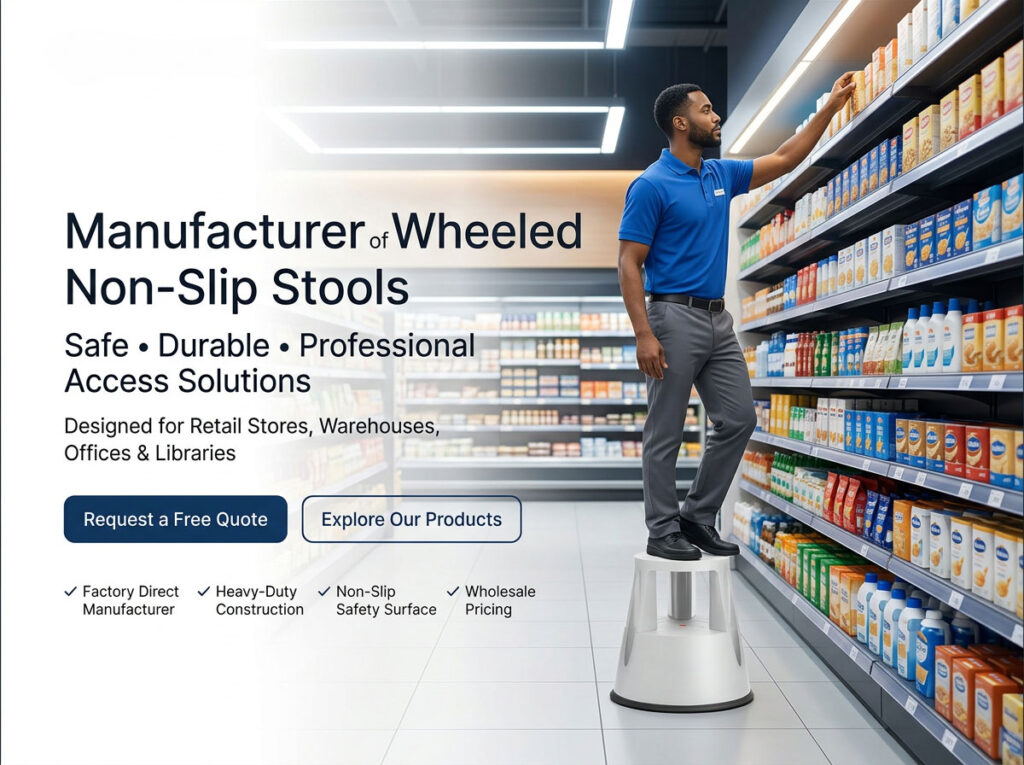


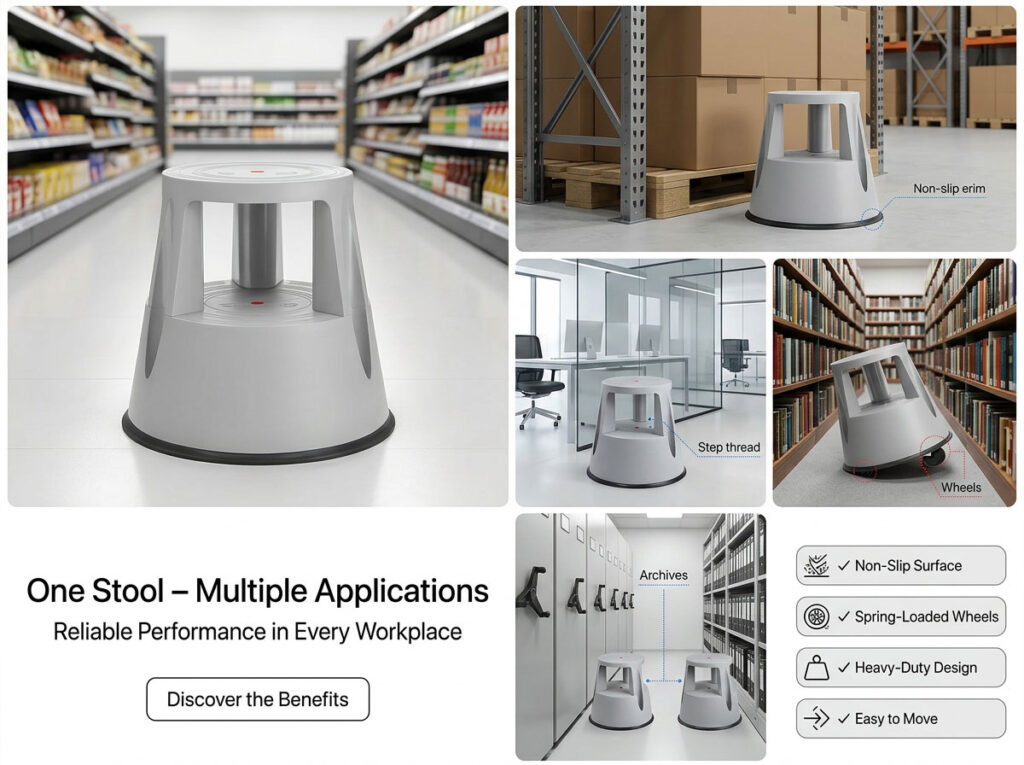



Kenyan supermarket floors combine high customer density, frequent cleaning, and constant restocking pressure. Staff must move quickly between aisles, promotional zones, and backroom areas while maintaining both speed and safety. Professional wheeled step stools address this exact combination of demands. They travel with the worker, lock the moment weight is applied, and provide a stable platform even on floors that have recently been mopped or carry light dust from receiving.
The core purpose is to remove the need for stretching, climbing on lower shelves, or improvising with crates and pallets. When a suitable wheeled stool is within easy reach and can be positioned in seconds, unsafe alternatives lose their appeal. In stores that also operate warehouse retail zones for bulk or online fulfilment, the same units frequently move between the sales floor and the storage area, requiring durability across both settings.
Design Features That Match Kenyan Retail Conditions
Professional models centre on three performance pillars. First, the mobility system—most commonly spring-loaded casters—retracts under body weight so the unit becomes fixed without any manual action. Second, the tread surface maintains grip on damp or lightly soiled floors typical after routine cleaning. Third, the frame is built for continuous commercial use, usually in all-welded steel with a finish that resists frequent cleaning chemicals.
Load ratings commonly start at 150 kg and rise higher for units expected to support both the worker and a carried case. Handrails appear on taller models to give additional security during ascent and while working. Non-marking feet and casters protect the polished or coated floors found in modern supermarket formats.
Material and Construction Choices for Longevity
Steel remains the preferred frame material for professional wheeled step stools intended for supermarket duty. Continuous welds eliminate the loosening that occurs with bolted joints under repeated loading. Powder-coated or industrial finishes protect against moisture and cleaning agents. Tread options include perforated steel for drainage, textured patterns for mechanical grip, or replaceable high-friction overlays that can be renewed without discarding the entire unit.
A manufacturer focused on commercial use subjects complete assemblies to cyclic testing that simulates years of daily supermarket traffic. The resulting durability directly influences whole-life cost and the frequency of replacement cycles across a multi-store network.
Supply Options for Growing Retail Chains
Many professional units originate from manufacturers that also support OEM programmes. Colour coding to match store branding, adjusted platform heights, or additional handrail configurations become practical once volumes reach bulk-order levels. Wholesale channels then distribute the standardised units to individual stores or central hubs, while a regional distributor maintains stocks of wear components such as casters, treads, and feet. This structure keeps specification consistent as chains expand and simplifies long-term maintenance.
High-Impact Usage Moments in Supermarket Operations
Three situations account for most elevated access needs:
- Top-shelf restocking of high-turnover categories before and during peak trading
- Rapid assembly or dismantling of promotional displays that exceed normal reach
- Handling of bulk cases in the warehouse retail or backroom zone
In each case the ability to roll the stool into position, step on with confidence, complete the task, and clear the aisle quickly determines whether the equipment is used consistently or bypassed under time pressure.
Comparison of Access Options for Retail Floors
| Feature | Professional Wheeled Step Stool | Standard Mobile Stool | Fixed Platform | Lightweight Consumer Stool |
|---|---|---|---|---|
| Automatic locking under load | Yes | Variable | N/A | Rarely |
| Grip on recently cleaned floors | High | Moderate | High | Low to moderate |
| Speed of repositioning | Very high | High | None | High |
| Suitability for customer aisles | Excellent | Moderate | Poor | Moderate |
| Durability under continuous commercial use | High | Variable | High | Low |
| Floor protection | Non-marking options | Variable | Good | Variable |
The comparison shows why many supermarket operators standardise on professional wheeled models rather than lighter or less specialised alternatives.
Cost Perspective for Multi-Store Procurement
Acquisition cost is only the starting point. Units ordered through bulk channels and supported by a local distributor typically deliver lower whole-life cost because they require less frequent replacement and generate fewer risk-related expenses. OEM customisation can eliminate later adaptation work when branding or dimensional needs exist. A practical internal model used by retail chains includes purchase price, expected consumable replacement, inspection labour, and a risk adjustment based on historical elevated-access incidents. When professional wheeled stools replace mixed or inadequate equipment, the risk component usually declines enough to produce a clear net positive within the first year.
Expert Guidance on Specification Priorities
Procurement and operations leads who have standardised elevated access across Kenyan supermarket networks consistently place three criteria above unit price. The mobility system must lock automatically under load. The tread must retain grip after exposure to cleaning agents and light soiling. Genuine spare parts must be available through a regional distributor on short lead times. Applying these filters early removes most unsuitable products from consideration.
Common Errors and Practical Prevention
Recurring mistakes include selecting stools rated only for dry floors, underestimating the combined weight of worker plus product, allowing different models across stores, neglecting marked parking positions, and treating inspection as optional. Each is preventable with a short written specification and clear ownership of daily and weekly checks.
Operating Conditions Across Key Kenyan Locations
Retail environments differ across the country. In the high-density trading zones of Nairobi the priority is rapid movement through crowded aisles and reliable performance after frequent cleaning. Coastal stores and supporting facilities in Mombasa face higher humidity and require robust finishes.
Western and Rift Valley centres such as Kisumu, Nakuru, and Eldoret combine growing modern retail formats with variable dust and temperature conditions. Peri-urban and industrial corridors including Kiambu, Thika, and Machakos often blend supermarket trading with significant warehouse retail activity.
Further locations such as Meru, Kakamega, Naivasha, Kitale, Nyeri, Nanyuki, Kisii, Kericho, Kilifi, Ongata Rongai, and Dianibu each present distinct combinations of climate, customer density, and operational tempo. Across all of them the core requirements remain the same: free movement when unloaded, absolute stability when loaded, and construction rated for continuous commercial use.
Practical Maintenance Rhythm
Daily (any user) Visual check of tread condition and confirmation that casters roll when unloaded.
Weekly (supervisor) Body-weight test of locking function, cleaning of tread and wheels, inspection of feet.
Monthly (facilities or safety lead) Frame integrity review, label condition check, and coordination of parts replacement through the distributor.
Units that fail any stage are tagged and removed until restored with genuine components.
Deployment Checklist for New or Upgraded Fleets
- Identify the most frequent elevated tasks and floor conditions
- Select tread and locking systems matched to those conditions
- Standardise on one or two models across the network
- Mark clear parking positions that protect customer flow
- Assign inspection ownership
- Conduct short hands-on familiarisation for all relevant staff
- Schedule the first monthly performance review
Stores that complete this sequence before the stools enter service achieve faster adoption and fewer early issues.
Looking Ahead for Kenyan Retail Operations
Supermarket formats in Kenya continue to densify promotional space and expand into new catchments. Short-duration elevated work will remain frequent. Professional wheeled step stools that can be deployed in seconds, maintain stability on real floors, and survive continuous commercial use will stay relevant. Operators who work with a manufacturer capable of OEM support and a distributor that maintains local parts availability will be positioned to absorb incremental improvements without disrupting established fleets.
Firmalazım focuses on professional wheeled step stools engineered for the daily realities of Kenyan supermarket and warehouse retail environments. Through bulk orders, OEM collaboration, wholesale distribution, and sustained local support, the objective is equipment that performs reliably under continuous commercial use while contributing to the safety standards expected in modern retail operations.
Five Distinct Calls to Action
- Request performance data on locking systems and tread grip under typical supermarket cleaning conditions.
- Arrange a short in-store trial with sample professional wheeled units during a live restocking period.
- Submit current store count and elevated-access challenges for a volume pricing proposal under bulk orders.
- Explore OEM colour or branding options that align the stools with existing store standards.
- Contact the regional distributor network to confirm spare-parts availability and technical support coverage.
FAQ – Professional Wheeled Step Stools for Kenyan Retail Stores
What makes a wheeled step stool “professional” for supermarket use? Automatic locking under load, tread performance on cleaned floors, and construction rated for continuous commercial use rather than occasional light duty.
How do spring-loaded casters improve daily safety? They eliminate the risk that wheels are left unlocked under time pressure—the most common human-error pathway in busy aisles.
What load rating should be specified when staff carry product cases? A rating that covers the heaviest expected combination of worker plus case. Many professional units start at 150–200 kg and go higher.
Can the same stools serve both the sales floor and warehouse retail areas? Yes, provided the load rating and durability match the more demanding of the two environments.
How often should locking function be tested? A weekly body-weight test by a supervisor, plus a quick daily visual check by users, forms a practical minimum.
Is OEM colour coding useful for multi-store chains? Yes. It improves visual management and makes incorrect placement immediately obvious.
What is the most common reason these stools leave service early? Loss of tread grip or damaged feet—both largely preventable with disciplined inspection and timely parts replacement through a distributor.
How does ordering in bulk affect total cost? Unit price declines and logistics become more efficient when coordinated through wholesale channels.
Should parking positions be marked on the sales floor? Yes. Clear markings keep units accessible while protecting customer flow.
What training produces the fastest safe adoption? A short hands-on demonstration on the actual floor covering positioning, locking behaviour, and correct technique.
Can professional wheeled stools reduce reliance on larger ladders? For the majority of routine supermarket elevated tasks they can, improving both speed and safety.
How do frequent cleaning chemicals affect long-term performance? Quality finishes and tread compounds are selected for resistance to common retail cleaning agents; regular cleaning of the tread itself still matters.
What documentation should accompany a multi-store purchase? Load-test evidence, material specifications, inspection guidance, and confirmation of spare-parts availability through a designated distributor.
Is it acceptable to add aftermarket non-slip mats to lighter stools? No. Purpose-designed industrial treads provide mechanical security that ad-hoc additions rarely match.
How should a near-miss involving a step stool be handled? Immediate removal of the unit, documentation, inspection, and a brief team review focused on learning.
Do these stools require special floor protection? Professional models are available with non-marking feet and casters specifically for supermarket flooring.
What early sign indicates that a tread system is losing effectiveness? Operators reporting reduced confidence underfoot or visible polishing of the friction surface.
Can the same specification be used for both new stores and existing upgrades? Yes. One approved specification simplifies procurement, training, and parts management across the network.
How does climate variation across Kenya affect equipment choice? Quality commercial designs remain functional across typical ranges, but elastomeric components should be inspected after extreme conditions.
What role does the distributor play after delivery? Ongoing supply of genuine wear components, technical advice for local conditions, and coordination of replacements.
Should contractors working in-store use the site’s approved stools? Yes, to maintain specification control and consistent safety standards.
How can leadership prevent the stools from becoming optional during peak periods? By referencing them in standard operating procedures and treating missing or defective units with the same seriousness as other process tools.
Is a small buffer stock useful? Yes. It allows rapid replacement of units removed for repair and supports temporary volume spikes.
What is the recommended policy for stools involved in an impact? Immediate removal, structural inspection, and either certified repair with genuine parts or permanent retirement.
How does Firmalazım support retail operators seeking both standard and customised solutions? By supplying professional wheeled step stools engineered for continuous commercial use in Kenyan supermarket and warehouse retail environments, available through bulk orders, OEM collaboration, wholesale channels, and local distributor support.
These elements form a coherent operating system. Professional wheeled step stools deliver lasting reductions in both risk and task friction only when technical suitability, disciplined procurement, procedural integration, and daily ownership work together. When that system is in place, the equipment becomes a quiet but effective contributor to safer, faster elevated access across supermarket and warehouse retail operations in Kenya.
Professional Wheeled Step Stools for Retail Stores in Kenya
The real test of professional wheeled step stools begins after the units arrive on site. Technical performance opens the door; consistent daily use determines whether the investment delivers lasting value.
Adoption Sequence Observed in Kenyan Supermarket Environments
Stores that achieve rapid, durable uptake follow a recognisable pattern. In the first week staff test the automatic locking action and comment on the stability the non-slip tread provides after floor cleaning. By the end of the second week the stools begin to move without prompting during restock windows. By the close of the third week most relevant team members treat the correct unit as the default tool for any elevated task. Sites that omit the short hands-on familiarisation or leave parking positions unmarked experience slower progress and a higher residual rate of stretching or climbing on fixtures. The equipment itself does not create the habit; the surrounding process of positioning, coaching, and visible ownership does.
Practical Measurement Framework for Store and Area Managers
Three indicators are sufficient for most supermarket operations:
- Monthly count of elevated-access near-miss reports
- Sampled average time for a standard top-shelf restock task
- Percentage of scheduled stool inspections completed on time
A simple tally maintained by the shift supervisor captures the data. When near-misses decline and task times stabilise at the lower figure, the operational benefit becomes visible without complex analysis. Adding informal operator comments on grip confidence after wet cleaning often supplies the earliest qualitative confirmation that the tread system is performing as intended.
Structured Familiarisation That Survives Shift Patterns
A concise module lasting roughly twenty-five minutes has proven effective:
- Short explanation of why automatic locking and non-slip performance matter on frequently cleaned floors (4 minutes)
- Live demonstration of the full sequence: roll, position, step on, work, step off, return to marked position (6 minutes)
- Hands-on practice by each participant with immediate coaching (10 minutes)
- Review of the daily visual check and the rule for removing a defective unit (5 minutes)
New starters receive the module during induction. Existing teams receive a short refresher at six- to twelve-month intervals or after major layout changes. Using the same content across every store ensures that staff transferring between locations encounter identical expectations.
Deeper Cost and Risk Perspective
A complete whole-life view includes acquisition cost under bulk orders or OEM arrangements, logistics through wholesale and distributor channels, expected consumable replacement, familiarisation labour, and a risk adjustment based on historical elevated-access incidents. Chains that have replaced mixed or light-duty equipment with standardised professional wheeled stools typically observe a clear reduction in the risk layer. When this reduction is combined with modest daily time recovery across restock and display tasks, the model returns a net positive inside the first twelve to eighteen months. The advantage grows when the same specification is applied across the network because training materials, spare-parts inventories, and audit processes scale efficiently.
Regional Operating Realities Across Listed Locations
Conditions vary meaningfully. In the high-density trading environment of Nairobi the combination of heavy customer flow and frequent floor cleaning places maximum demand on rapid repositioning and reliable grip after mopping. Coastal operations in Mombasa introduce higher humidity, making coating quality and sealed caster mechanisms more significant.
Western and lakeside centres such as Kisumu balance growing modern retail formats with variable dust and moisture. Rift Valley hubs including Nakuru and Eldoret experience wider temperature ranges that affect both staff comfort and equipment performance over time. Peri-urban and industrial corridors around Kiambu, Thika, and Machakos frequently combine supermarket trading with substantial warehouse retail activity, rewarding units that move comfortably between the two environments.
Further locations such as Meru, Kakamega, Naivasha, Kitale, Nyeri, Nanyuki, Kisii, Kericho, Kilifi, Ongata Rongai, and Dianibu each present distinct profiles of climate, customer density, and operational tempo. Across all of them the fundamental requirements remain identical: free movement when unloaded, absolute stability when loaded, and construction rated for continuous commercial use.
Preventing Process Drift After Initial Success
The most common long-term risk is gradual erosion of the supporting disciplines. Parking markings fade, inspection ownership becomes unclear during staff changes, and new team members receive only brief verbal instruction. Effective counter-measures include:
- Quarterly five-minute refresher demonstrations built into existing team meetings
- Inclusion of stool condition and positioning in routine leadership walks
- Simple trend visibility of near-miss rates in staff areas
- Explicit handover of inspection ownership whenever supervisors change roles
These actions require little time yet protect the performance gains already achieved.
Realistic Recovery Illustration
A multi-store cluster introduced professional wheeled stools successfully but allowed inspection discipline to slip during a period of high turnover. Within three months several units showed polished treads and incomplete locking. Near-miss reports began to reappear. Recovery required immediate removal of sub-standard units, re-assignment of named ownership on every shift, and a short refresher for all relevant teams. Within four weeks the near-miss rate returned to the improved baseline. The episode confirmed that technical capability and process ownership are equally necessary.
Maintaining Specification Integrity During Expansion
Organisations that open new stores or upgrade existing ones while preserving elevated-access standards share three practical disciplines. They keep a single short performance specification visible and frozen. They route volume requirements through established bulk-order and wholesale channels that feed a capable distributor network. And they include the approved professional wheeled stools in every store-opening and refurbishment checklist so that the same standard appears from the first day of trading.
Closing System Perspective
Professional wheeled step stools deliver lasting value inside Kenyan supermarket and warehouse retail environments only when four elements function together:
- Technical suitability for real floor conditions and continuous commercial use
- Procurement that leverages bulk orders, OEM flexibility where needed, and reliable wholesale-to-distributor supply
- Procedural integration that makes correct use the easiest path
- Sustained ownership of inspection, positioning, and familiarisation over time
When these elements are present, the stools become an unremarkable yet highly effective part of normal store operations—quietly reducing risk, recovering small increments of time that compound across shifts, and supporting the consistent safety standards expected in modern retail environments.
Firmalazım remains focused on professional wheeled step stools engineered for these exact conditions. Support covers specification guidance, volume supply under bulk orders, OEM collaboration, and ongoing local availability through distributor channels, enabling the equipment to perform reliably under continuous commercial use.
Additional FAQ – Adoption, Measurement and Expansion
How long does it typically take for staff to treat the stools as the default tool? In stores that combine correct equipment with hands-on familiarisation and marked parking positions, the transition usually occurs within two to three weeks.
What is the most useful single metric for a busy store manager? Monthly count of elevated-access near-miss reports. A sustained decline confirms that both equipment and process are working.
Should the same stools be used by night-fill and day teams? Yes. A single specification simplifies training, inspection, and parts management across all shifts.
How can a store prevent stools from migrating to inconvenient locations? Durable floor markings plus a quick visual check of positioning included in the supervisor’s weekly routine.
Is it worth tracking operator comments on grip confidence? Yes. Qualitative feedback after wet cleaning often provides the earliest signal that the tread system is performing or beginning to degrade.
What is the recommended response when a new staff member is observed improvising? Immediate coaching, verification that the nearest correct unit is serviceable, and inclusion of the correct method in the next short refresher.
Can the stools be referenced in formal restock procedures? Yes. Explicitly requiring the approved professional wheeled stool for any work above a defined height reinforces both safety and consistency.
How should layout changes or seasonal display resets be handled? Re-mark parking positions as part of the change and conduct a brief re-familiarisation for affected teams.
What early cultural signal shows that adoption is succeeding? Staff begin moving a stool into position automatically and express mild frustration if the nearest unit is missing or defective.
Does Firmalazım assist with the non-product elements of a successful rollout? Support typically includes guidance on specification, volume pricing under bulk orders, OEM coordination where required, and introduction to the relevant distributor for ongoing parts and technical coverage.
These additional layers complete the operational picture. Professional wheeled step stools become a durable source of both productivity and safety advantage only when technical performance, disciplined supply, procedural reinforcement, and sustained ownership are treated as interdependent. When that integrated system is in place, the equipment performs quietly and reliably across supermarket and warehouse retail environments in Kenya.
Professional Wheeled Step Stools for Retail Stores Kenya
After the initial adoption phase, the focus shifts from introduction to long-term resilience. Professional wheeled step stools that remain serviceable, correctly positioned, and routinely used over multiple years deliver compounding returns in both safety and productivity. Achieving that longevity requires deliberate attention to fleet management, cultural reinforcement, and strategic alignment with store growth.
Synthesising Staff Feedback from Live Kenyan Deployments
Across multiple supermarket environments, operator comments converge on a consistent set of observations. The most frequent positive remarks concern the automatic locking action: staff state that they no longer need to remember an extra step during busy restock windows. A second recurring theme is grip confidence on floors that have just been cleaned; once users experience the difference between a lightly textured surface and a genuine professional non-slip tread, they become reluctant to accept anything less. When negative feedback appears, it almost always traces to secondary process issues—units left in inconvenient locations, delayed replacement of worn components, or insufficient initial familiarisation—rather than to the core design of the stools themselves.
These patterns confirm that technical performance is necessary but not sufficient. The surrounding system of positioning, inspection ownership, and early coaching determines whether the technical advantages are captured day after day.
Sample Implementation Timeline for a Single Store or Pilot Cluster
A realistic sequence that has worked across different formats runs as follows:
Weeks 1–2 Finalise the performance specification, confirm volumes, and place the order through the chosen wholesale or distributor channel.
Weeks 3–4 Receive units, mark parking positions on the sales floor and in warehouse retail zones, and conduct hands-on familiarisation for all relevant shifts.
Weeks 5–8 Daily coaching by supervisors, activation of a simple inspection board, and collection of the first near-miss and task-time data.
Month 3 Structured review of metrics, adjustment of parking locations if needed, and decision on any OEM refinements for subsequent orders.
Month 6 Full evaluation against the original business case and decision on wider network rollout.
Stores that compress the familiarisation and early-coaching phase almost always experience slower adoption and a higher residual rate of unsafe alternatives.
Advanced Integration with Store Operating Systems
Professional wheeled step stools contribute most when they are referenced inside existing routines rather than treated as a parallel initiative. Effective linkage points include:
- Opening and closing checklists that verify the nearest units are present and serviceable
- Restock standard operating procedures that specify use of the approved wheeled stool for any work above shoulder height
- Near-miss and incident investigation templates that explicitly ask whether correct access equipment was available and used
- Contractor induction materials that show the approved stools and the rule against improvisation
- Leadership walk templates that include a glance at stool condition and positioning
When these connections exist, the stools reinforce the wider operational and safety system and are in turn protected by it.
Sustainability Through Durability and Local Serviceability
A stool that remains in service for many years under continuous commercial use generates less waste than lighter units that require frequent replacement. Replaceable tread systems and modular caster assemblies allow high-wear components to be renewed while the structural frame continues in service. Local availability of genuine parts through a distributor shortens transport distances for maintenance items and reduces the likelihood that entire units will be discarded because a single component has failed. Some operators also record a secondary benefit: fewer damaged products or packaging materials when staff can reach elevated points securely and without haste. That reduction appears both in waste metrics and in the presentation quality of goods on supermarket shelves.
Regional Nuances – Sustained Performance Across Locations
Long-term performance continues to reflect local conditions. In the high-intensity trading environment of Nairobi the combination of dense customer flow and frequent cleaning keeps the demand for rapid repositioning and reliable wet-grip performance consistently high. Coastal operations in Mombasa maintain the need for robust coatings and sealed mechanisms in response to humidity.
Western and Rift Valley centres such as Kisumu, Nakuru, and Eldoret require equipment that tolerates temperature variation and seasonal dust without loss of locking reliability or tread effectiveness. Peri-urban and industrial corridors around Kiambu, Thika, and Machakos continue to reward units that transition smoothly between sales floor and warehouse retail zones.
Further locations including Meru, Kakamega, Naivasha, Kitale, Nyeri, Nanyuki, Kisii, Kericho, Kilifi, Ongata Rongai, and Dianibu each sustain their own balance of climate, trading density, and operational tempo. Across the full network the non-negotiable requirements remain unchanged: free movement when unloaded, absolute stability when loaded, and construction rated for continuous commercial use.
Maintaining Momentum During Network Growth and Staff Change
The greatest risk after successful introduction is gradual erosion of the supporting disciplines during periods of expansion or high turnover. Counter-measures that have proven effective include:
- Quarterly short refresher demonstrations built into existing team meetings
- Explicit inclusion of access-equipment condition in routine leadership walks
- Simple trend charts of near-miss rates posted in staff areas
- Formal handover of inspection ownership whenever supervisors or safety champions change roles
- Inclusion of the approved stool specification in every new-store opening and refurbishment checklist
These actions are low-cost yet highly effective at preventing regression.
Strategic Continuity for Multi-Store Operators
Organisations that preserve elevated-access standards across years of growth share three enduring practices. They keep a single, short performance specification frozen and visible to both procurement and operations. They route all volume requirements through established bulk-order and wholesale channels that feed a capable distributor network. And they treat the professional wheeled stools as formal process equipment whose presence, condition, and correct use are subject to the same scrutiny as other critical tools.
Closing Perspective
Professional wheeled step stools deliver compounding value inside Kenyan supermarket and warehouse retail environments only when four elements operate as a single system:
- Technical suitability for real floor conditions and continuous commercial use
- Procurement that leverages bulk orders, OEM flexibility where needed, and reliable wholesale-to-distributor supply
- Procedural integration that makes correct use the path of least resistance
- Sustained ownership of inspection, positioning, and familiarisation across time and organisational change
When these elements are present, the stools become an unremarkable yet highly effective part of normal store operations—quietly reducing risk, recovering small increments of time that accumulate across shifts and stores, and supporting the consistent safety standards expected in modern retail environments.
Firmalazım continues to focus on professional wheeled step stools engineered for these exact conditions. Support extends from initial specification guidance through volume supply under bulk orders, OEM collaboration, and ongoing local availability via distributor channels, so that the equipment can perform reliably under continuous commercial use across Kenya’s diverse retail landscape.
Further FAQ – Longevity, Culture and Strategic Fit
How can a multi-store organisation ensure that new stores open with the same elevated-access standard? Include the approved professional wheeled stool specification and the standard familiarisation module in every store-opening checklist, and supply units through the established distributor channel.
What is the most effective way to protect inspection discipline during high staff turnover? Named ownership on every shift, a simple visible log, and explicit handover whenever the responsible person changes role.
Is it useful to involve experienced operators when evaluating a potential new model? Yes. A short practical trial with shortlisted units often surfaces usability details that pure technical data miss.
How should seasonal promotional peaks be managed without permanently enlarging the fleet? Maintain a modest central buffer of additional units that can be deployed to high-activity stores, or establish temporary reallocation protocols between nearby locations.
What early warning signs indicate that cultural adoption is weakening? An increase in units found outside marked parking positions, incomplete inspection logs, or a rise in operator comments about reduced grip confidence.
Can the same performance specification serve both small-format and large-format stores? Yes, provided the load rating and tread system meet the more demanding environment. Standardisation simplifies training, parts, and audits.
How does Firmalazım support organisations moving from a successful pilot to full network standardisation? By maintaining consistent specification support, offering volume pricing under bulk orders, coordinating OEM details where required, and ensuring the distributor network can provide parts and technical coverage at every site.
What is the recommended action when a stool is involved in any impact or tip event? Immediate removal from service, thorough structural inspection, and either certified repair with genuine parts or permanent retirement.
Should contractors working inside the store be required to use the site’s approved stools? Yes. This maintains specification control and ensures consistent safety standards for all elevated work.
How can leadership demonstrate that the stools are considered process equipment rather than optional safety gear? By referencing them in standard operating procedures, including them in routine audits and leadership walks, and treating missing or defective units with the same seriousness as other critical tools.
These final elements close the loop. Professional wheeled step stools become a durable source of both productivity and safety advantage only when technical performance, disciplined supply, procedural reinforcement, and sustained ownership are treated as interdependent. When that integrated system is in place, the equipment performs quietly and reliably across supermarket and warehouse retail environments throughout Kenya.
Continuation – Failure Prevention, Cultural Reinforcement, and Future Readiness
Even well-chosen professional wheeled step stools can under-perform if the surrounding system weakens over time. The difference between a fleet that continues to deliver value for years and one that gradually loses effectiveness usually lies in how failure modes are anticipated and how cultural expectations are kept alive.
Detailed Failure Mode Analysis and Prevention
Several recurring issues appear in supermarket environments when process discipline slips:
Incomplete caster locking Usually caused by accumulated debris or gradual spring wear. Prevention centres on the weekly body-weight test and prompt cleaning of wheel mechanisms. Units that fail the test are removed immediately.
Loss of tread grip Results from polishing under repeated use or residue build-up from cleaning chemicals. Scheduled tread inspection and timely renewal of replaceable surfaces keep friction levels reliable.
Damaged or flattened feet Reduces stability and can mark floors. Weekly visual checks and rapid replacement through the distributor prevent progressive deterioration.
Units left in high-traffic positions A procedural rather than mechanical failure. Durable floor markings combined with supervisor visibility during routine walks correct the pattern before it becomes habitual.
Mixed or unauthorised equipment appearing on site Occurs when specification control weakens during expansion or contractor activity. Clear visual identification (including OEM colour options where used) and explicit rules in contractor inductions maintain consistency.
Each of these modes is predictable. When the corresponding preventive control is owned and visible, the fleet retains its original performance characteristics far longer.
Embedding the Equipment in Retail Safety Culture
Professional wheeled step stools contribute most when they are treated as normal process tools rather than occasional safety devices. Practical cultural signals include:
- Supervisors who routinely move a stool into position themselves when they see an elevated task beginning
- Team discussions that treat the absence of a serviceable unit as a process failure equal to a missing scanner or pricing gun
- Recognition of shifts that maintain perfect inspection completion and zero elevated-access near-misses
- Inclusion of correct access equipment use in internal audits with the same weighting as other operational standards
When these signals are consistent, new staff absorb the expectation quickly and experienced staff maintain it under pressure.
Quantitative Illustration from Multi-Store Experience
A regional supermarket group operating across several counties tracked elevated-access task times and near-miss reports before and after full standardisation on professional wheeled stools. Average time for a typical top-shelf restock sequence fell by approximately 20 seconds once stools were correctly positioned and staff were familiar with the automatic locking action. At an average of 80–100 such tasks per store per trading day, the cumulative daily recovery exceeded half an hour per location. Across a network the aggregate figure became substantial. At the same time, elevated-access near-miss reports declined by more than 50 % within the first quarter. The combined productivity and risk-reduction effect more than offset the annualised cost of the fleet, including expected consumable replacement supplied through the distributor.
Future-Proofing for Evolving Retail Formats
Kenyan supermarket formats continue to change. Higher promotional density, tighter labour models, growth of click-and-collect zones, and the expansion of warehouse retail functions inside or adjacent to stores all increase the frequency of short-duration elevated work. Professional wheeled step stools that can be deployed and cleared in seconds remain well matched to these trends.
Operators who select a manufacturer capable of supporting OEM evolution and a distributor that maintains reliable local parts availability will be able to absorb incremental improvements—more durable friction compounds, lighter high-strength frames, modular accessory options—without replacing entire fleets. Keeping the core performance specification stable while allowing controlled evolution of secondary features provides both continuity and adaptability.
Location-Specific Performance Notes – Extended View
Long-term fleet behaviour continues to reflect local operating realities. In the intensive urban environment of Nairobi the combination of high task frequency and frequent floor cleaning keeps pressure on both repositioning speed and wet-grip reliability. Coastal stores in Mombasa sustain the need for corrosion-resistant finishes and sealed mechanisms.
Western and Rift Valley locations such as Kisumu, Nakuru, and Eldoret require consistent locking performance across temperature variation and seasonal dust loads. Peri-urban corridors including Kiambu, Thika, and Machakos continue to benefit from units that move easily between sales floor and warehouse retail zones.
Additional centres such as Meru, Kakamega, Naivasha, Kitale, Nyeri, Nanyuki, Kisii, Kericho, Kilifi, Ongata Rongai, and Dianibu each maintain their own profile of climate, customer density, and operational intensity. Across the entire set the same core requirements apply: free movement when unloaded, absolute stability when loaded, and construction rated for continuous commercial use.
Strategic Recommendations for Sustained Network Performance
Multi-store operators that keep elevated-access standards intact over years of growth typically follow four practices:
- Maintain a single, short, visible performance specification that covers automatic locking, tread performance, load rating, and spare-parts availability
- Route all volume requirements through established bulk-order and wholesale channels that feed a capable distributor network
- Treat inspection ownership, parking discipline, and familiarisation as formal process elements subject to the same scrutiny as other operational standards
- Review fleet condition and near-miss trends at regular intervals and act promptly on early warning signs
These practices convert a one-time equipment decision into a durable operational advantage.
Closing Synthesis
Professional wheeled step stools deliver compounding returns inside Kenyan supermarket and warehouse retail environments only when technical suitability, disciplined procurement, procedural integration, and sustained cultural ownership function as one system. When that system is in place, the stools become an ordinary yet highly effective part of daily work—reducing risk, recovering small amounts of time that accumulate across shifts and stores, and supporting the consistent safety standards expected in modern retail operations.
Firmalazım remains focused on professional wheeled step stools engineered for these exact conditions. Support spans specification guidance, volume supply under bulk orders, OEM collaboration where required, and ongoing local availability through distributor channels, enabling the equipment to perform reliably under continuous commercial use across Kenya’s diverse retail landscape.
Additional FAQ – Failure Prevention, Culture and Future Fit
What is the single most effective control for preventing incomplete caster locking? A weekly body-weight functional test combined with prompt cleaning of wheel mechanisms and immediate removal of any unit that fails.
How can leadership make correct stool use feel like normal work rather than an extra safety rule? By using the stools themselves when demonstrating tasks, referencing them in ordinary operating procedures, and treating their absence as a process issue equal to other missing tools.
Is it worth tracking the percentage of inspections completed on time? Yes. Inspection completion is a leading indicator. A sustained drop usually precedes a rise in near-miss reports or equipment complaints.
How should a network handle the introduction of a new store format with different aisle widths or display heights? Revisit the performance specification only if the new format genuinely exceeds the capability of the existing units. Otherwise maintain the standard and adjust parking positions and familiarisation content as needed.
What early sign indicates that cultural expectations around the stools are weakening? An increase in units found outside marked positions, incomplete inspection logs, or staff reverting to stretching or climbing on fixtures.
Can OEM colour coding help maintain specification control as the network grows? Yes. Distinct visual identification makes unauthorised or incorrect units immediately obvious during leadership walks and audits.
How does Firmalazım support long-term fleet performance beyond the initial supply? By enabling consistent specification, offering volume pricing under bulk orders, supporting OEM refinements where useful, and ensuring the distributor network can supply genuine parts and technical advice across locations.
What is the recommended response to any impact or tip event involving a stool? Immediate removal from service, thorough inspection, and either certified repair with genuine components or permanent retirement. Never return a potentially compromised unit to the floor.
Should the same performance standard apply to both corporate stores and franchise or partner-operated locations? Yes, if the brand and safety expectations are shared. Consistent equipment and familiarisation content protect both operational performance and brand reputation.
How can a network prepare for future increases in elevated-task frequency? Keep the core performance specification stable, maintain a modest buffer stock for rapid deployment, and work with a manufacturer and distributor partnership capable of supporting controlled evolution of secondary features without disrupting the existing fleet.
These elements complete a full operational cycle—from initial selection through sustained multi-year performance. Professional wheeled step stools become a reliable source of both safety and productivity advantage only when technical capability, supply discipline, process ownership, and cultural reinforcement are maintained together. When that integrated approach is applied, the equipment serves Kenyan supermarket and warehouse retail operations quietly, consistently, and effectively over the long term.

Bir yanıt yazın