


Professional Step Stools for Retail Stores in South Africa
Professional Step Stools for Retail Stores in South Africa give South African retail and supermarket teams safe, presentable access to high shelves and display areas without compromising customer floors or store appearance. Designed for commercial use, these platforms combine stability, non-marking mobility and a clean professional profile that fits trading-floor environments. From high-traffic stores in Johannesburg to coastal outlets in Cape Town and inland locations in Pretoria, the right specification supports faster merchandising, protects Safety standards and meets the practical needs of modern retail operations nationwide.
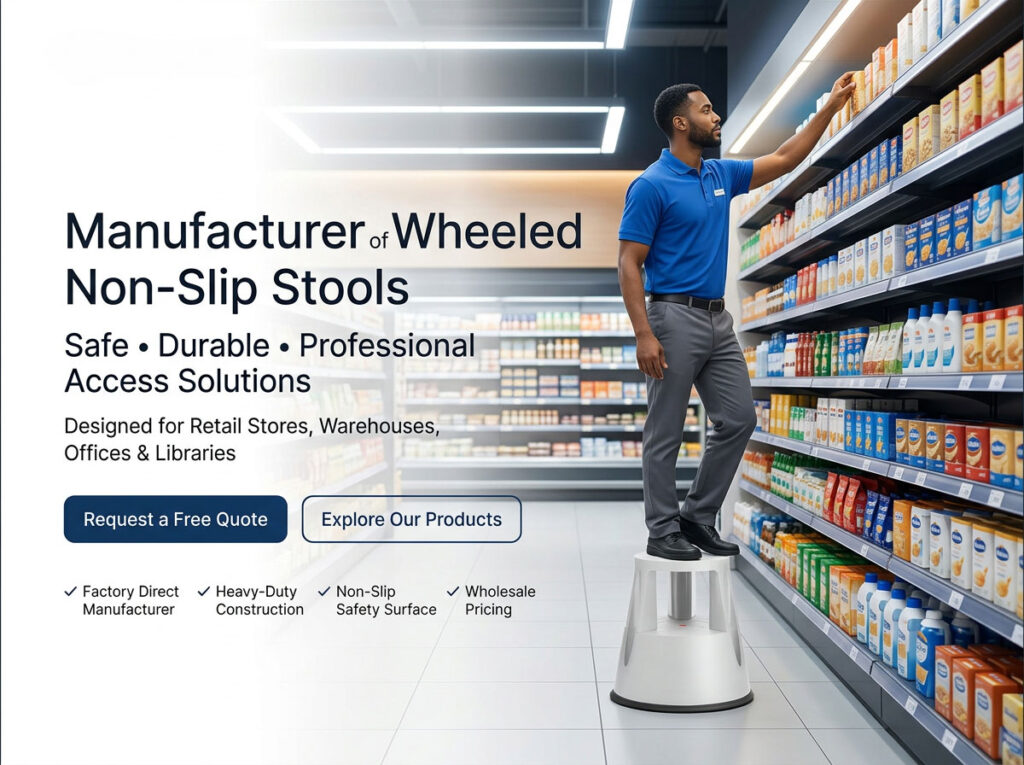


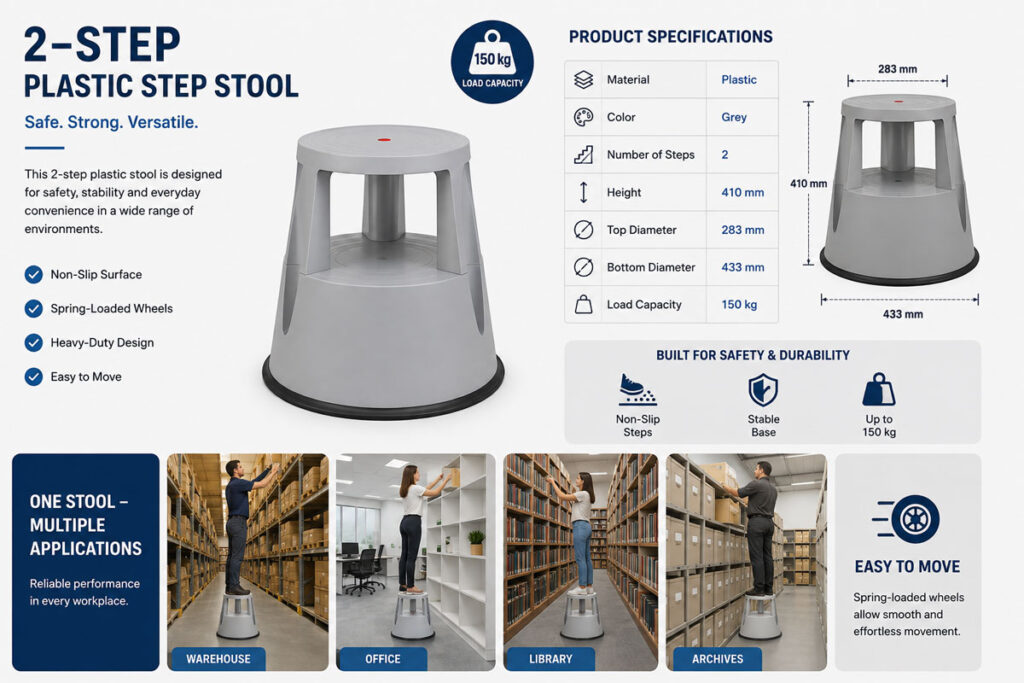


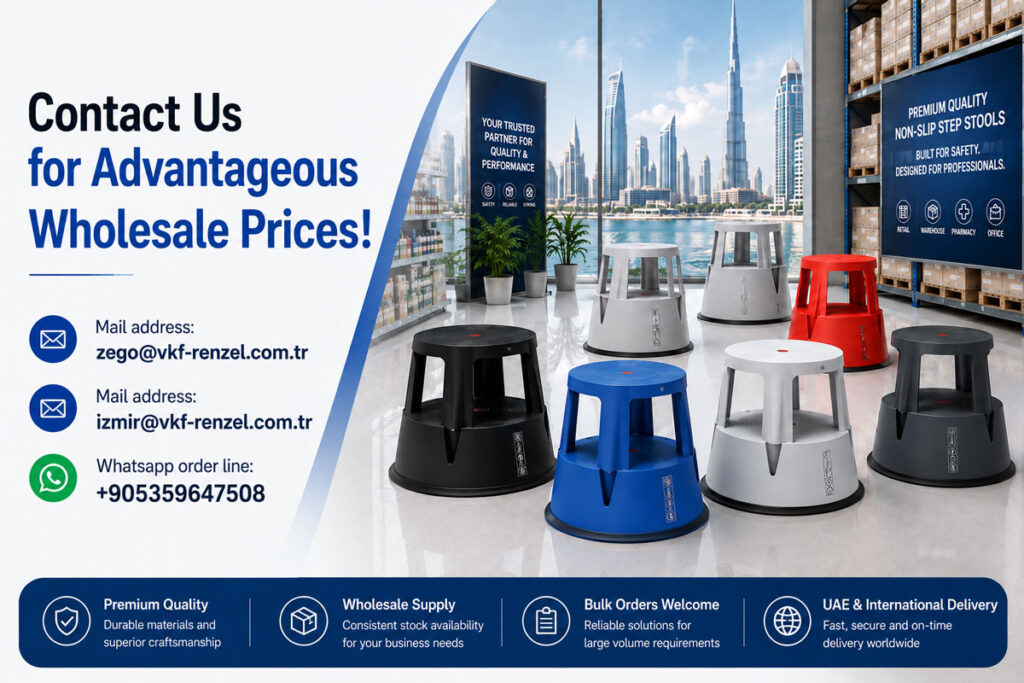
The Invisible Tool That Keeps Retail Floors Looking Professional
Retail success depends on what customers see and what they never notice. High shelves must stay fully stocked and perfectly faced. Promotional displays must change quickly. Ceiling fixtures and signage must remain clean and functional. Yet the tools used to reach those heights often remain an afterthought—until they leave marks, create noise, or cause a near-miss in front of shoppers.
Professional step stools engineered for retail environments solve the problem quietly. They provide stable, non-slip access, move smoothly on finished floors, lock securely under load, and present a clean, intentional appearance that matches the standard of the store itself. In supermarket and broader retail settings the difference is both operational and visual.
Why Retail Floors Demand a Different Class of Access Equipment
Warehouse platforms prioritise raw load capacity and durability under industrial conditions. Retail floors add three further requirements: absolute floor protection, low visual and acoustic impact, and the ability to be used briefly during trading hours without disrupting customers.
A professional step stool meets all three. Non-marking wheels protect polished, tiled and epoxy surfaces. Compact geometry and quiet operation allow short tasks to be completed without drawing attention. A stable non-slip surface and reliable lock keep the operator safe even when the surrounding environment is busy.
Regional Retail Realities Across South Africa
High-footfall urban stores face continuous customer traffic and frequent cleaning cycles. Coastal locations add humidity. Inland sites introduce dust and temperature variation. In Durban the combination of heat, moisture and high customer density places extra demand on both surface grip and wheel compounds. Gqeberha (Port Elizabeth) shares similar coastal conditions. Bloemfontein and Kimberley require platforms that tolerate dry, dusty intervals between cleaning. East London and Pietermaritzburg sit between these climate profiles.
Further variation appears across the map. Polokwane and Nelspruit (Mbombela) experience seasonal extremes that test surface coatings. George, Stellenbosch, Paarl and Worcester often feature design-led stores with premium floor finishes where non-marking performance is non-negotiable. The dense Gauteng retail network—Midrand, Sandton, Centurion, Roodepoort, Germiston, Benoni, Boksburg and the East Rand—records the highest frequency of merchandising resets and therefore the strongest case for standardisation. Vereeniging, Welkom, Rustenburg, Klerksdorp and Witbank (Emalahleni) extend the same requirement into regional retail centres. Richards Bay and Newcastle complete the national picture with their own mix of humidity, footfall and floor types.
In every location the core need remains consistent: a stable, presentable, non-marking platform that can be deployed quickly and removed cleanly.
Design Attributes That Belong on the Sales Floor
Professional retail step stools typically feature:
- Compact footprint that fits narrow gondola aisles
- Non-marking wheels selected for polished and tiled surfaces
- Quiet rolling and locking action
- High-friction non-slip standing surface that remains effective after floor cleaning
- Clean lines and finishes that do not look out of place in customer areas
- Reliable lock that engages under operator weight
These attributes separate tools suitable for commercial use in supermarket and retail environments from both domestic steps and heavy industrial platforms designed only for back-of-house warehouse retail zones.
Daily Merchandising and Maintenance Sequences
Morning facing and gap-filling often require brief access to upper shelves. A professional stool allows the task to be completed in seconds without dragging a ladder through customer traffic. Promotional changeovers benefit even more: teams can move rapidly along an aisle, adjust high-level graphics or product, and clear the floor again before peak trading. Maintenance tasks—cleaning high mirrors, adjusting signage, replacing light fittings—follow the same pattern.
In stores that also operate small warehouse retail or stockroom areas, the same platforms frequently serve both front-of-house and back-of-house needs, reducing equipment variety.
Safety on the Trading Floor
Customer-facing areas raise the stakes. An incident that might remain internal in a closed warehouse becomes visible and potentially damaging to brand perception. A non-slip surface and positive lock directly reduce the probability of a slip or unexpected movement. When staff are trained to use the platform only for short, controlled tasks and to return it immediately to a designated location, residual risk stays low.
Tip Box – Trading-Hour Discipline Complete the task, step down, and return the stool to its home position before moving to the next location. Never leave a platform unattended in a customer aisle. These two habits protect both Safety and store presentation.
Retail Operations Insight “The best retail access tools are the ones customers never notice. They appear only for the seconds they are needed, leave no marks, and disappear again. That standard is achievable with the right professional specification.” — Multi-site retail operations manager, South African supermarket group
Procurement Logic for Retail Networks
Larger supermarket and retail groups standardise equipment to simplify training, spare parts and visual consistency. A manufacturer relationship supports consistent quality, volume pricing and optional OEM branding or colour matching. Wholesale channels become the commercial route once annual volumes are clear. Local distributor networks supply faster replacement and regional support for individual stores.
Bulk orders improve unit economics and reduce administrative overhead. OEM options allow discreet branding or finish adjustments that keep the platforms aligned with store design standards. Independent retailers and smaller regional chains typically work through a distributor who understands local floor types and can provide rapid service.
Cost Perspective Beyond the Unit Price
The relevant comparison is not against the cheapest domestic step but against the full cost of current methods: extra labour time, occasional floor repairs, near-miss investigations, and the subtle drag on merchandising speed. When these elements are quantified, a professional commercial platform usually recovers its cost inside a single high-activity season. Maintenance remains light—surface cleaning and periodic lock and wheel checks.
Comparison of Access Options for Retail Floors
| Option | Floor Protection | Visual Impact | Speed of Use | Customer-Area Suitability | Typical Retail Fit |
|---|---|---|---|---|---|
| Domestic step | Often poor | Low | Fast | Limited | Occasional only |
| Conventional ladder | N/A | High | Medium | Poor | Back-of-house |
| Industrial warehouse platform | Variable | High | Medium | Limited | Stockroom only |
| Professional retail step stool | Excellent | Low | Very fast | Strong | Trading floor + stockroom |
The professional retail step stool occupies the practical middle ground required by supermarket and specialty retail environments.
Selection Checklist for Retail Buyers
- Confirm non-marking performance on the actual floor finishes in use
- Verify lock reliability under realistic operator weight
- Check non-slip surface behaviour after exposure to common floor cleaners
- Assess visual and acoustic profile for trading-hour use
- Clarify commercial-use warranty terms
- Explore bulk-order pricing and OEM finish options
- Confirm local distributor capacity for rapid replacement
- Evaluate compact footprint against the narrowest aisles in the estate
Deployment and Habit Formation
- Inspect units on arrival.
- Test locks and wheels.
- Clean standing surfaces.
- Brief merchandising and maintenance teams on short-task discipline and immediate return to home position.
- Mark clear home locations that keep platforms accessible yet out of customer sightlines.
These steps convert a purchase into a reliable operating habit.
Maintenance That Preserves Both Function and Appearance
Daily surface wipe-down. Weekly lock and wheel function check. Monthly visual inspection of frame and finish. Prompt replacement of any worn non-marking wheels to protect floors.
Appearance matters as much as function on the sales floor. A scuffed or dirty platform undermines the professional standard the store is trying to maintain.
Observed Results in Operating Retail Stores
Stores that introduced professional step stools report:
- Faster high-level merchandising and promotional resets
- Fewer floor-marking complaints
- Reduced height-related near-miss reports on the trading floor
- Greater staff willingness to complete brief elevated tasks during open hours
Standardisation across multiple sites further simplifies training and visual consistency. Some groups later extend the same specification into warehouse retail stockrooms, creating a single equipment family for both environments.
Common Mistakes That Undermine Retail Standards
- Using industrial platforms that look out of place or mark floors
- Selecting domestic steps that lack lock reliability or commercial durability
- Leaving platforms unattended in customer aisles
- Neglecting surface cleaning until grip or appearance deteriorates
- Ordering without confirming non-marking performance on actual store floors
- Failing to establish and enforce home positions
All are avoidable with clear specification and simple process rules.
Building a Consistent Retail Access Standard
As South African supermarket and retail networks continue to raise presentation and Safety expectations, professional step stools move from ad-hoc purchases to planned equipment. The priority is selection of platforms that combine commercial durability, non-marking mobility and a presentable profile, secured on favourable terms through bulk orders or wholesale channels, and supported by daily habits that keep both operators and floors protected.
The requirement is consistent from Cape Town to Johannesburg, from Durban to Pretoria, and across every regional centre. Only local floor finishes and footfall intensity differ. One well-chosen professional commercial specification meets the need nationwide.
FAQ – Retail Store Specific Questions
1. Why do retail floors need a different step stool from warehouses? Retail environments add floor protection, low visual impact and the ability to work briefly during trading hours without disrupting customers.
2. Can professional step stools be used safely while the store is open? Yes, when tasks are kept short, the platform is never left unattended, and it is returned immediately to a designated home position.
3. How important are non-marking wheels in supermarket environments? Critical. Marked floors generate customer complaints and additional cleaning or repair costs.
4. Are bulk orders practical for multi-store retail groups? Yes. Standardising on one or two models simplifies training, spare parts and visual consistency while improving unit pricing.
5. What OEM options are useful for retail chains? Discrete branding, colour matching to store design, and minor footprint adjustments for narrow aisles.
6. Does a local distributor add value for retail networks? Yes—rapid replacement and regional knowledge of floor types and store formats.
7. How often should the standing surface be cleaned? Daily as part of normal store cleaning; immediately if any residue is visible.
8. Can the same stool serve both trading floor and stockroom? Yes. Many professional models are suitable for both commercial use environments.
9. What is the most common cause of floor damage? Use of incorrect wheel compounds or continued operation with damaged wheels.
10. How do these platforms affect customer perception? When used correctly they are almost invisible; when left out or poorly specified they become noticeable distractions.
11. Are quiet operation and smooth rolling important? Yes. Noise and rough movement draw unwanted attention during trading hours.
12. Should independent retailers specify the same models as large chains? Core non-marking, lock and non-slip requirements are the same; footprint can be adjusted to local aisle widths.
13. What documentation should accompany a wholesale purchase? Commercial warranty terms, non-marking and load statements, and maintenance guidance.
14. Can staff carry small items while using the stool? Only within rated load and with both feet fully on the platform. Training must state the limit.
15. How does Safety performance hold up after floor cleaning? A true commercial non-slip surface retains grip; domestic steps often do not.
16. Is there any risk of marking high-gloss or tiled floors? Not when non-marking compounds are correctly specified and maintained.
17. What height range suits most supermarket and retail shelving? Platforms that allow comfortable reach to typical upper gondola and wall-shelf levels.
18. How quickly can new units be introduced? Within one shift after inspection, cleaning and a short team briefing.
19. Do manufacturers supply simple visual guides for retail teams? Many provide concise illustrated instructions focused on trading-floor discipline.
20. Can a distributor support stores across multiple provinces? Established networks cover major urban, coastal and regional centres.
21. What immediate action is required if a lock becomes unreliable? Remove the unit from service and process repair or replacement through authorised channels.
22. Are these stools suitable near refrigerated cases where condensation occurs? Select models whose non-slip surface is rated for moisture; confirm lock function before each use.
23. How does coastal humidity affect long-term appearance and function? Quality coatings and compounds resist corrosion and staining when basic cleaning is maintained.
24. Should spare non-marking wheels be held in stock? Yes. Prompt replacement protects floors and keeps units in service.
25. Can units be moved between stores if needed? Yes, but asset tracking and home-position discipline remain essential.
26. What is the advantage of standardising on one manufacturer? Consistent appearance, interchangeable parts, and simplified bulk-order negotiations.
27. How do these platforms support warehouse retail stockrooms attached to stores? The same commercial-grade units can serve both environments, reducing equipment variety.
28. Is high-level merchandising common in South African supermarket formats? Yes. Vertical space is routinely used for both regular stock and promotional displays.
29. What training focus is most important for retail teams? Short-task discipline, immediate return to home position, and mandatory lock confirmation.
30. Can OEM finishes match specific store design palettes? Many manufacturers accommodate discrete colour or finish requests.
31. How should units be stored during trading hours? In designated home positions that keep them accessible to staff yet out of customer sightlines.
32. What single daily habit most protects both Safety and floors? Returning the platform to its home position immediately after each use and keeping the standing surface clean.
33. Do professional stools reduce the need for two-person tasks on the sales floor? Yes for short, controlled high-reach work that previously required a second person to stabilise a ladder.
34. How does a procurement manager verify suitability for retail floors? Request non-marking test statements, commercial-use warranty language, and, ideally, on-site evaluation on actual store floors.
35. What is the practical first step for a retail group? Place sample units in representative stores for two to four weeks, collect feedback from merchandising teams, and inspect floor condition before committing to bulk orders.
36. Does factory-direct purchasing help with long-term consistency? Yes. It supports uniform specification, volume pricing and easier OEM coordination.
37. Why is commercial-grade construction still necessary in retail? Even brief daily use accumulates; light domestic frames loosen or lose lock reliability over time.
38. Can one non-slip surface perform in both dry aisles and recently cleaned zones? Yes when formulated for commercial rather than domestic conditions.
39. What role does wholesale pricing play for multi-store retailers? It turns fragmented small purchases into a predictable capital programme with better unit economics.
40. Should both store operations and facilities teams participate in selection? Yes. Together they define real aisle constraints, floor types and merchandising reach requirements.
Five Distinct Calls to Action
- Ready to keep high shelves perfect without compromising floors or Safety? Request specifications and bulk-order options for professional retail step stools.
- Evaluate real performance on your own aisles and floor finishes. Ask for sample units and OEM finish possibilities.
- Standardise presentable, non-marking access across every store. Speak with the wholesale team about volume programmes and distributor coverage.
- Work with a manufacturer that understands retail trading-floor requirements. Request technical data, commercial warranty terms and lead times.
- Protect your floors, protect your teams and keep merchandising fast. Begin the conversation about the right professional step stool solution for your stores today.
Professional Step Stools for Retail Stores in South Africa
Professional Step Stools for Retail Stores in South Africa give South African retail and supermarket teams safe, presentable access to high shelves and display areas without compromising customer floors or store appearance. Designed for commercial use, these platforms combine stability, non-marking mobility and a clean professional profile that fits trading-floor environments. From high-traffic stores in Johannesburg to coastal outlets in Cape Town and inland locations in Pretoria, the right specification supports faster merchandising, protects Safety standards and meets the practical needs of modern retail operations nationwide.
The Quiet Standard Behind Every Perfectly Faced Aisle
Retail presentation is a continuous performance. Upper shelves must remain full, faced and aligned. Promotional headers and high-level graphics must change on schedule. Lighting and signage must stay clean. The tools that make these tasks possible are rarely discussed—until they leave black marks on a newly polished floor, create noise during peak trading, or contribute to a visible near-miss.
Professional step stools built for retail environments remove those risks. They deliver stable, non-slip access, roll quietly on finished surfaces, lock under operator weight, and present a clean, intentional appearance that belongs on the sales floor. In supermarket and broader retail settings the operational and visual gains appear together.
The Three Retail-Specific Requirements That Industrial Platforms Miss
Warehouse platforms prioritise load capacity and durability under industrial conditions. Retail floors add three further, non-negotiable demands:
- Absolute floor protection on polished, tiled and epoxy surfaces
- Low visual and acoustic impact so short tasks can be completed during trading hours
- A professional profile that does not look out of place among gondolas and customer traffic
A professional retail step stool is engineered to satisfy all three simultaneously. Non-marking wheels, compact geometry, quiet operation and a high-friction standing surface create a tool that can appear for the seconds it is needed and disappear again without residual damage or distraction.
National Footprint and Local Conditions
High-footfall urban stores experience continuous customer movement and frequent cleaning cycles. Coastal sites add humidity. Inland locations introduce dust and temperature variation. In Durban the combination of heat, moisture and dense customer traffic places continuous demand on both surface grip and wheel compounds. Gqeberha (Port Elizabeth) shares similar coastal pressures. Bloemfontein and Kimberley require platforms that tolerate dry, dusty intervals between cleaning. East London and Pietermaritzburg sit between these climate profiles.
Additional variation appears across the country. Polokwane and Nelspruit (Mbombela) experience seasonal extremes that test surface coatings. George, Stellenbosch, Paarl and Worcester frequently operate design-led stores with premium floor finishes where non-marking performance is essential. The dense Gauteng retail network—Midrand, Sandton, Centurion, Roodepoort, Germiston, Benoni, Boksburg and the East Rand—records the highest frequency of merchandising resets and therefore the strongest commercial case for standardisation. Vereeniging, Welkom, Rustenburg, Klerksdorp and Witbank (Emalahleni) extend the same requirement into regional retail centres. Richards Bay and Newcastle complete the national map with their own mix of humidity, footfall and floor types.
The core specification does not change from one city to another. Only the intensity of particular environmental and operational stressors varies.
Design Elements That Belong on the Sales Floor
Professional retail platforms typically incorporate:
- Compact footprint compatible with narrow gondola aisles
- Non-marking wheel compounds selected for polished, tiled and epoxy surfaces
- Quiet rolling and positive locking action
- High-friction non-slip standing surface that retains grip after floor cleaning
- Clean visual lines and finishes that do not disrupt store presentation
- Reliable weight-activated or mechanical lock
These attributes distinguish tools suitable for commercial use in supermarket and retail environments from both domestic steps and heavy industrial platforms intended only for closed warehouse retail zones.
Merchandising and Maintenance Workflows
Morning facing and gap-filling frequently require brief access to upper shelves. A professional stool allows the task to be completed in seconds without drawing a ladder through customer traffic. Promotional changeovers benefit still more: teams can move rapidly along an aisle, adjust high-level product or graphics, and clear the floor again before peak trading. Maintenance sequences—cleaning high mirrors, adjusting signage, replacing light fittings—follow the identical pattern of rapid deployment and immediate removal.
In stores that also operate stockrooms or small warehouse retail areas, the same platforms often serve both front-of-house and back-of-house needs, reducing equipment variety and training complexity.
Safety on the Trading Floor
Customer-facing areas raise the consequences of any incident. A near-miss that might remain internal in a closed warehouse becomes visible and potentially damaging to brand perception. A non-slip surface combined with a positive lock directly reduces the probability of slip or unexpected movement. When staff are trained to limit use to short, controlled tasks and to return the platform immediately to a designated home position, residual risk remains low.
Tip Box – Non-Negotiable Trading-Hour Rule Complete the task, step down, and return the stool to its home position before moving to the next location. Never leave a platform unattended in a customer aisle. These two habits protect both Safety and store presentation simultaneously.
Retail Operations Perspective “The best retail access tools are the ones customers never notice. They appear only for the seconds they are needed, leave no marks, make no noise, and disappear again. That standard is achievable with the correct professional specification and simple daily discipline.” — Multi-site retail operations manager, South African supermarket group
Procurement Pathways for Retail Networks
Larger supermarket and retail groups standardise equipment to simplify training, spare parts and visual consistency across the estate. A manufacturer relationship supports consistent quality, volume pricing and optional OEM branding or finish matching. Wholesale channels become the commercial mechanism once annual volumes are forecast. Local distributor networks supply faster replacement units and regional technical support for individual stores.
Bulk orders improve unit economics and reduce administrative overhead. OEM options allow discrete branding or finish adjustments that keep the platforms aligned with store design standards. Independent retailers and smaller regional chains typically work through a distributor who understands local floor types and can provide responsive service.
Total Cost Perspective for Retail Operators
The relevant comparison is not against the cheapest domestic step but against the full cost of current methods: extra labour minutes during merchandising resets, occasional floor repairs or polishing, near-miss investigations, and the subtle drag on presentation standards. When these elements are quantified, a professional commercial platform usually recovers its cost inside a single high-activity season. Ongoing maintenance remains light—surface cleaning and periodic lock and wheel checks.
Comparative Matrix for Retail Floors
| Access Option | Floor Protection | Visual & Acoustic Impact | Speed of Deployment | Customer-Area Suitability | Typical Fit |
|---|---|---|---|---|---|
| Domestic step | Often poor | Low | Fast | Limited | Occasional light use only |
| Conventional A-frame ladder | N/A | High | Medium | Poor | Back-of-house only |
| Industrial warehouse platform | Variable | High | Medium | Limited | Stockroom / closed areas |
| Professional retail step stool | Excellent | Low | Very fast | Strong | Trading floor + stockroom |
The professional retail step stool occupies the practical middle ground required by supermarket and specialty retail environments.
Selection Framework for Retail Buyers
- Verify non-marking performance on the actual floor finishes present in the estate
- Confirm lock reliability under realistic operator weight
- Test non-slip surface behaviour after exposure to common floor cleaners
- Assess visual profile and noise level for trading-hour use
- Clarify commercial-use warranty language
- Explore bulk-order pricing tiers and OEM finish options
- Confirm local distributor capacity for rapid replacement
- Evaluate compact footprint against the narrowest aisles in the network
Controlled Introduction and Habit Formation
- Full incoming inspection for transit damage.
- Function test of locks and wheels.
- Thorough cleaning of standing surfaces.
- Structured briefing of merchandising and maintenance teams focused on short-task discipline and immediate return to home position.
- Clear, signed home locations that keep platforms accessible to staff yet outside primary customer sightlines.
These steps convert a capital purchase into a reliable operating habit.
Maintenance That Protects Both Function and Presentation
Daily surface wipe-down as part of normal store cleaning. Weekly lock and wheel function check. Monthly visual inspection of frame, finish and wheel condition. Prompt replacement of any worn non-marking wheels to protect floors.
On the sales floor appearance is inseparable from function. A scuffed, dirty or noisy platform undermines the professional standard the store works to maintain.
Field Results Observed in Operating Stores
Retail sites that introduced professional step stools consistently report:
- Faster high-level merchandising and promotional resets
- Elimination or sharp reduction of floor-marking complaints
- Lower frequency of height-related near-miss reports on the trading floor
- Greater staff willingness to complete brief elevated tasks during open hours
Network-wide standardisation further simplifies training and visual consistency. Some groups later extend the same specification into warehouse retail stockrooms, creating a single equipment family for both environments.
Mistakes That Erode Retail Standards
- Deploying industrial platforms that look out of place or mark floors
- Selecting domestic steps that lack lock reliability or commercial durability
- Leaving platforms unattended in customer aisles
- Neglecting surface cleaning until grip or appearance deteriorates
- Ordering without confirming non-marking performance on actual store floors
- Failing to establish and enforce clear home positions
Every one of these errors is preventable through clear specification and simple process rules.
Establishing a Permanent Retail Access Standard
As South African supermarket and retail networks continue to raise both presentation and Safety expectations, professional step stools shift from ad-hoc purchases to planned equipment. The priority is selection of platforms that combine commercial durability, non-marking mobility and a presentable profile, secured on favourable terms through bulk orders or wholesale channels, and supported by daily habits that keep operators, customers and floors protected.
The operational requirement remains consistent from Cape Town to Johannesburg, from Durban to Pretoria, and across every regional centre. Only local floor finishes and footfall intensity differ. One correctly specified professional commercial platform meets the need across the national estate.
FAQ – Extended Retail-Focused Set
1. Why do retail floors require a different step stool from pure warehouse environments? Retail adds the requirements of absolute floor protection, low visual and acoustic impact, and the ability to perform short tasks during trading hours without disrupting customers.
2. Can professional step stools be used safely while the store is open to customers? Yes, provided tasks remain short, the platform is never left unattended, and it is returned immediately to a designated home position.
3. How critical are non-marking wheels in supermarket and retail environments? Essential. Marked floors generate customer complaints and additional cleaning or repair costs.
4. Are bulk orders realistic for multi-store retail and supermarket groups? Yes. Standardising on one or two models simplifies training, spare parts and visual consistency while improving unit economics.
5. Which OEM options prove most useful for retail chains? Discrete branding, colour or finish matching to store design, and minor footprint adjustments for narrow aisles.
6. What ongoing value does a local distributor provide to retail networks? Rapid replacement and regional knowledge of floor types and store formats.
7. How frequently should the standing surface be cleaned? Daily as part of normal store cleaning routines; immediately whenever any residue is visible.
8. Can the same stool serve both the trading floor and the stockroom? Yes. Many professional models are suitable for both commercial use environments.
9. What is the most common cause of floor damage linked to access equipment? Use of incorrect wheel compounds or continued operation with already damaged wheels.
10. How do these platforms influence customer perception when used correctly? They remain almost invisible—appearing only for the seconds required and leaving no residual marks or noise.
11. Are quiet operation and smooth rolling genuinely important? Yes. Noise and rough movement draw unwanted attention during trading hours.
12. Should independent retailers adopt the same core specification as large chains? Core non-marking, lock and non-slip requirements are identical; footprint can be adjusted to local aisle widths.
13. What documentation should accompany a wholesale or bulk purchase? Commercial warranty terms, non-marking and load statements, and clear maintenance guidance.
14. May staff carry small items while standing on the platform? Only within the rated load and with both feet fully planted. Training must state the limit explicitly.
15. How does Safety performance hold after routine floor cleaning? A true commercial non-slip surface retains grip; domestic steps frequently do not.
16. Is there realistic risk of marking high-gloss or tiled floors? Not when non-marking compounds are correctly specified and maintained.
17. What height range suits most supermarket and retail shelving? Platforms that allow comfortable reach to typical upper gondola and wall-shelf levels.
18. How quickly can new units be placed into service? Within one shift after inspection, cleaning and a short team briefing.
19. Do manufacturers supply simple visual guides for retail teams? Many provide concise illustrated instructions focused on trading-floor discipline.
20. Can a distributor support stores across multiple provinces? Established networks cover major urban, coastal and regional centres.
21. What immediate action is required if a lock becomes unreliable? Remove the unit from service and process repair or replacement through authorised channels.
22. Are these stools suitable near refrigerated cases where condensation forms? Select models whose non-slip surface is rated for moisture and confirm lock function before each use.
23. How does coastal humidity affect long-term appearance and function? Quality coatings and compounds resist corrosion and staining when basic cleaning discipline is observed.
24. Should spare non-marking wheels be held in local stock? Yes. Prompt replacement protects floors and keeps units available.
25. Can units be transferred between stores if required? Yes, provided asset tracking and home-position discipline are maintained.
26. What is the principal advantage of standardising on one manufacturer? Consistent appearance, interchangeable parts and simplified bulk-order negotiations.
27. How do these platforms support warehouse retail stockrooms attached to stores? The same commercial-grade units can serve both environments, reducing equipment variety.
28. Is high-level merchandising common in South African supermarket formats? Yes. Vertical space is routinely used for both regular stock and promotional displays.
29. What training emphasis is most important for retail teams? Short-task discipline, immediate return to home position, and mandatory lock confirmation.
30. Can OEM finishes be matched to specific store design palettes? Many manufacturers accommodate discrete colour or finish requests.
31. How should units be stored during trading hours? In designated home positions that remain accessible to staff yet outside primary customer sightlines.
32. What single daily habit most effectively protects both Safety and floors? Returning the platform to its home position immediately after each use and keeping the standing surface clean.
33. Do professional stools reduce the need for two-person tasks on the sales floor? Yes for short, controlled high-reach work that previously required a second person to stabilise a ladder.
34. How does a procurement manager verify suitability for retail floors? Request non-marking test statements, commercial-use warranty language, and ideally conduct on-site evaluation on actual store floors.
35. What is the practical first step for a retail group considering adoption? Place sample units in representative stores for two to four weeks, collect structured feedback from merchandising teams, and inspect floor condition before committing to bulk orders.
36. Does factory-direct purchasing support long-term consistency? Yes. It enables uniform specification, volume pricing and easier OEM coordination.
37. Why is commercial-grade construction still necessary in retail environments? Even brief daily use accumulates; light domestic frames loosen or lose lock reliability over time.
38. Can one non-slip surface perform reliably in both dry aisles and recently cleaned zones? Yes when formulated for commercial rather than domestic conditions.
39. What commercial role does wholesale pricing play for multi-store retailers? It converts fragmented small purchases into a predictable capital programme with improved unit economics.
40. Should both store operations and facilities teams participate in the selection process? Yes. Together they define real aisle constraints, floor types and merchandising reach requirements.
41. How should progressive loss of surface grip be handled? Remove the unit from service, deep-clean the platform, and replace the surface component if grip does not fully recover.
42. Can bulk orders be structured across more than one financial year? Yes. Multi-year agreements with the manufacturer or wholesale partner are commonly used.
43. What practical method prevents units migrating between stores? Asset numbering combined with a simple regional register.
44. Are special storage conditions required beyond a designated home position? No. A dry, signed home location is sufficient.
45. How do external Safety or brand-standard auditors typically view these platforms? As a positive control when they are present, maintained and demonstrably used according to clear rules.
46. What measurable impact do the platforms have on merchandising speed? Reduction in time required for high-level facing, gap-filling and promotional resets.
47. How should pilot success be quantified in a retail context? Before-and-after timing of representative high-level tasks plus tracking of floor-marking incidents and near-miss reports.
48. Is zone or department colour-coding practical? Yes and is frequently requested as an OEM option for larger estates.
49. What service life can be expected under typical retail multi-shift use? Several years when surface cleaning and lock/wheel inspection discipline are maintained.
50. How does the presence of professional stools influence overall store presentation standards? It removes a common source of floor damage and visual clutter while enabling faster maintenance of high-level presentation.
Five Distinct Calls to Action
- Ready to keep every high shelf perfect without compromising floors or Safety? Request specifications and bulk-order options for professional retail step stools.
- Validate real performance on your own aisles and floor finishes. Ask for sample units and available OEM finish possibilities.
- Standardise presentable, non-marking access across your entire retail network. Speak with the wholesale team about volume programmes and distributor coverage.
- Partner with a manufacturer that understands trading-floor requirements. Request full technical data, commercial warranty terms and realistic lead times.
- Protect your floors, protect your teams and keep merchandising fast and invisible to customers. Begin the conversation about the right professional step stool solution for your stores today.
Professional Step Stools for Retail Stores South Africa
Professional step stools give South African retail and supermarket teams safe, presentable access to high shelves and display areas without compromising customer floors or store appearance. Designed for commercial use, these platforms combine stability, non-marking mobility and a clean professional profile that fits trading-floor environments. From high-traffic stores in Johannesburg to coastal outlets in Cape Town and inland locations in Pretoria, the right specification supports faster merchandising, protects Safety standards and meets the practical needs of modern retail operations nationwide.
Peak Trading Periods and the Cost of Slow High-Level Access
Month-end, holiday campaigns and major promotional resets place maximum pressure on merchandising speed. Upper shelves and high-level graphics must change while customers are still in the store. Any tool that is slow to deploy, noisy, or likely to mark floors becomes a bottleneck exactly when speed and presentation matter most.
Professional step stools remove that bottleneck. Their compact size, quiet non-marking wheels and reliable lock allow brief elevated tasks to be completed and cleared within seconds. Stores that already have the platforms in place absorb peak-period volume with less overtime and fewer presentation compromises. Sites still relying on ladders or domestic steps experience longer reset times and higher residual risk during the busiest trading windows.
The same dynamic appears in Durban during summer tourism peaks, in Sandton and Centurion during major campaign periods, and in regional centres when local promotional calendars intensify. Having the correct commercial equipment already deployed and staff already trained converts a potential stress point into a controlled process.
Floor-Type Compatibility Across the Retail Estate
South African retail floors vary widely: high-gloss polished concrete, large-format porcelain tile, epoxy coatings, and occasional vinyl or composite surfaces. Each finish reacts differently to wheel compounds and cleaning regimes.
Non-marking polyurethane or equivalent compounds are the baseline requirement. On high-gloss surfaces even minor marking becomes immediately visible to customers. On textured tile the primary risk is reduced grip if the standing surface is contaminated. Professional platforms are selected and tested against the actual floor finishes present in the estate rather than against generic claims. In Cape Town and Stellenbosch design-led stores the visual standard is particularly exacting. In high-traffic Gauteng locations such as Midrand, Roodepoort, Germiston, Benoni and Boksburg the combination of footfall and frequent cleaning places continuous demand on both wheels and standing surface.
A short on-site evaluation with sample units remains the most reliable method of confirming compatibility before a bulk order is placed.
Change Management and Staff Adoption
New equipment succeeds only when staff adopt it consistently. Resistance usually stems from familiarity with previous methods or uncertainty about lock function. The most effective introduction sequence is:
- Brief hands-on demonstration on the actual sales floor
- Clear statement of the two non-negotiable rules (lock confirmation and immediate return to home position)
- Visible endorsement from store management
- Simple visual reminder at each home position
When these steps are followed, adoption is rapid. Merchandising teams quickly recognise the time saving and the reduced physical strain. Stores that skip the structured introduction experience slower uptake and higher rates of incorrect use.
Tip Box – Home Position Discipline A platform that is always in its signed home location is a platform that is used. A platform left in a random aisle is both a trip hazard and a presentation failure. Enforce the home position as strictly as any other store standard.
Brand Presentation and the Customer Journey
Customers form impressions in seconds. A scuffed floor, a noisy ladder being dragged through an aisle, or a platform left unattended near a gondola all register as small failures of care. Professional step stools eliminate those signals. When high-level work is completed quickly, quietly and without residual marks, the customer journey remains uninterrupted and the store’s presentation standard stays intact.
This effect is cumulative. Over weeks and months the absence of floor damage and visual clutter contributes to a consistently higher perceived standard. In premium locations such as Sandton and Stellenbosch the contribution is especially noticeable. In high-volume supermarket formats the same principle protects the everyday shopping experience.
Integration with Existing Visual Merchandising Standards
Many retail groups already operate detailed visual merchandising manuals. Professional step stools fit naturally into those standards when three elements are added:
- Approved equipment list that names the specific platform model
- Clear home-position diagrams for each store format
- Short illustrated sequence showing correct use during trading hours
Once these elements are present, the platforms become part of the official method rather than an optional extra. Audits then reinforce correct use in the same way they reinforce facing and pricing standards.
Extended Cost and Return Narrative
Beyond simple labour minutes, the full return includes:
- Avoided floor polishing or repair costs
- Reduced near-miss investigation time
- Faster promotional reset completion (protecting planned sales uplift)
- Lower residual risk of a customer-visible incident
- Longer equipment service life under commercial use
When these factors are modelled across a multi-store network, the commercial case for standardisation becomes clear. Bulk orders and wholesale pricing further improve the unit economics, while OEM options allow the platforms to remain visually aligned with store design standards.
Comparative Performance in Retail Conditions
| Requirement | Domestic Step | Industrial Platform | Professional Retail Stool |
|---|---|---|---|
| Non-marking on polished floors | Often fails | Variable | Designed for it |
| Quiet operation during trading | Acceptable | Often noisy | Quiet |
| Compact footprint for gondola aisles | Good | Frequently too large | Optimised |
| Lock reliability under daily use | Low–Medium | High | High |
| Visual suitability for sales floor | Low | Poor | High |
| Suitability for brief trading-hour tasks | Limited | Limited | Strong |
The professional retail stool is the only option that satisfies the full set of trading-floor requirements.
Practical Rollout Sequence for Multi-Store Groups
- Select three to five representative stores covering different floor types and footfall levels.
- Deploy sample units and capture feedback plus floor-condition observations over three to four weeks.
- Finalise specification, negotiate bulk-order and wholesale terms with the manufacturer, and confirm distributor coverage.
- Prepare short training materials and home-position standards.
- Roll out by region, beginning with highest-volume or highest-visibility stores.
- Conduct a 90-day review focused on floor condition, near-miss trends and merchandising speed.
This sequence minimises risk and allows early learning to shape later phases.
Long-Term Asset and Presentation Management
Once the platforms are deployed, ongoing management is straightforward:
- Asset numbering for tracking
- Scheduled wheel and lock inspection
- Immediate replacement of any worn non-marking wheels
- Periodic refresh of the short training message
These routines keep both Safety performance and visual standards intact over multiple years of commercial use.
Across the full national estate—from Cape Town and Stellenbosch through George, Gqeberha (Port Elizabeth), East London, Durban, Pietermaritzburg, Bloemfontein, Kimberley, Polokwane, Nelspruit (Mbombela), Johannesburg, Pretoria, Midrand, Sandton, Centurion, Roodepoort, Germiston, Benoni, Boksburg, the East Rand, Vereeniging, Welkom, Rustenburg, Klerksdorp, Witbank (Emalahleni), Richards Bay, Newcastle, Paarl and Worcester—the operational logic remains identical. Only local floor finishes and trading intensity differ. One well-specified professional commercial platform meets the need everywhere.
FAQ – Further Retail Questions
51. How should peak promotional periods influence the number of platforms per store? Higher activity stores benefit from one additional unit in the main promotional zone to avoid waiting during intensive reset windows.
52. What is the most effective way to confirm non-marking performance before a large order? Conduct a controlled on-site trial on the actual floor finishes present in the estate and inspect for any residual marks after repeated passes.
53. Can the platforms be integrated into existing visual merchandising audit checklists? Yes. Adding a single line for “approved access equipment in correct home position” reinforces both Safety and presentation standards.
54. How does staff turnover affect the need for refresher training? Brief refreshers at the start of each peak season and for every new team member keep the two core rules alive.
55. Is there value in colour-coding platforms by department or zone? Yes. OEM colour options improve ownership and make missing units immediately visible.
56. What is the recommended response if a customer comments on a platform left in an aisle? Treat it as a presentation failure, return the unit immediately, and use the incident as a real-time coaching moment.
57. How do these stools interact with automated or semi-automated cleaning equipment? Home positions should be located outside primary cleaning paths so the platforms do not become obstacles or suffer repeated impact.
58. Can the same specification serve both large hypermarkets and smaller convenience formats? Core non-marking, lock and non-slip requirements are identical; footprint can be adjusted for narrower aisles in smaller formats.
59. What commercial advantage does a multi-year supply agreement provide? Price stability, priority production slots for bulk orders, and easier coordination of OEM finishes across successive waves.
60. How should a retailer measure the contribution to overall store presentation scores? Track floor-marking incidents, customer complaints related to access equipment, and internal audit scores for high-level presentation before and after deployment.
Five Distinct Calls to Action
- Ready to protect both presentation standards and Safety during every merchandising reset? Request specifications and bulk-order options for professional retail step stools.
- Confirm non-marking performance and trading-hour usability on your own floors. Ask for sample units and OEM finish options.
- Standardise quiet, presentable access across your full retail network. Speak with the wholesale team about volume programmes and distributor coverage.
- Work with a manufacturer that designs for customer-facing retail environments. Request technical data, commercial warranty terms and lead times.
- Keep high shelves perfect, floors unmarked and customers uninterrupted. Start the conversation about the right professional step stool solution for your stores today.

Bir yanıt yazın