


Industrial Wheeled Step Stools for Logistics Centers in Saudi Arabia
Industrial Wheeled Step Stools for Logistics Centers in Saudi Arabia transform daily operations in UAE logistics centers and supermarket environments by combining mobility, stability, and load-bearing strength. The 2-step plastic models with spring-loaded wheels, non-slip surfaces, and 150 kg capacity enable safer, faster access to elevated shelves in warehouses, retail backrooms, and distribution hubs. This guide delivers a complete procurement, application, and operational framework tailored for commercial use across key industrial zones, helping purchasing managers, facility operators, and distributors select, deploy, and scale the right solution while reducing injury risk and improving pick rates.


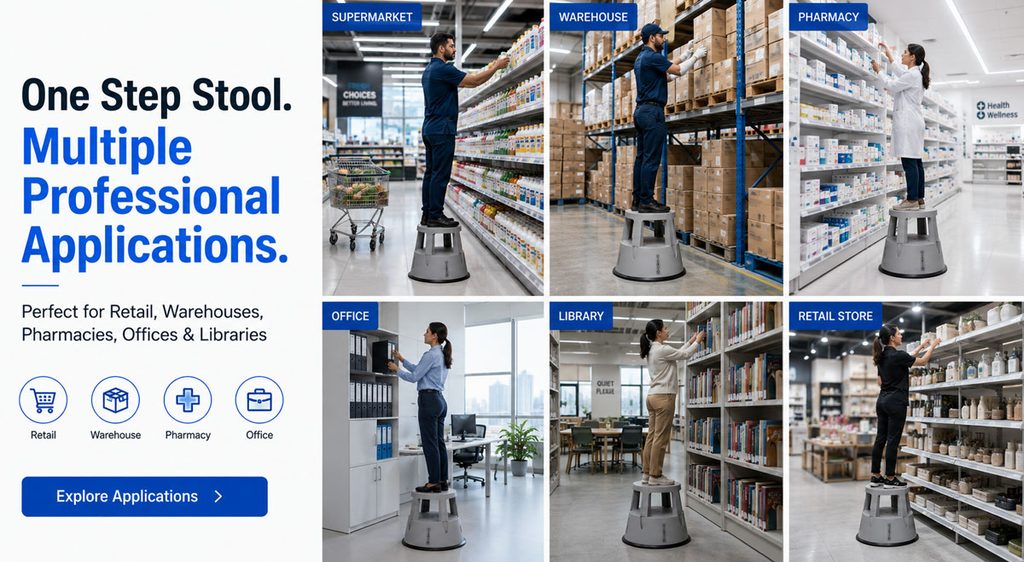


In modern logistics centers serving the supermarket sector, every second of access time and every avoided incident compounds into measurable profit. A well-chosen industrial wheeled step stool is no longer a simple accessory; it is a mobility tool that integrates directly into order-picking workflows, inventory audits, and high-bay storage routines. The product featured here—a grey 2-step plastic step stool with spring-loaded wheels, non-slip top surface, 410 mm height, 283 mm top diameter, 433 mm bottom diameter, and 150 kg load capacity—illustrates the current engineering standard for commercial use.
Facility managers operating in high-throughput environments require equipment that moves with the operator rather than against them. Spring-loaded wheels retract under load, converting the stool into a stable platform the moment weight is applied. When the operator steps off, the wheels re-engage for effortless relocation. This dual-mode behavior eliminates the traditional trade-off between mobility and safety.
Material Analysis and Structural Integrity
High-density polyethylene or comparable engineering plastic forms the primary structure. The material choice balances impact resistance, chemical tolerance to common warehouse cleaners, and dimensional stability under repeated loading. Ribbed side walls and a wide base diameter create a low center of gravity. The black non-slip ring at the base further increases friction on polished concrete or epoxy floors typical of modern distribution centers.
The top platform incorporates a textured surface and a central red indicator marking the recommended standing zone. Side cut-outs serve dual purposes: handholds for repositioning and visual confirmation that the structure remains unobstructed. These design details matter when operators wear gloves or move quickly between pick locations.
Country-Specific Evaluation for the UAE Market
Although the broader Gulf logistics network connects multiple industrial cities, UAE facilities face distinct climatic and operational pressures—high ambient temperatures, fine dust, and continuous multi-shift operations. Equipment must therefore tolerate heat without becoming brittle and resist abrasion from sandy residues tracked indoors. Plastic step stools of this class perform reliably under these conditions when manufactured to consistent wall thickness and UV-stabilized formulations.
Operators and procurement teams in Riyadh frequently coordinate cross-border supply chains that feed UAE supermarket distribution. Similar coordination occurs with teams based in Jeddah. Facility audits conducted in Dammam have repeatedly highlighted the value of mobile access equipment that can be relocated without dedicated labor. Industrial parks surrounding Jubail generate steady demand for durable access solutions that support both warehouse retail and bulk handling zones. Logistics planners working near As Sulay Riyadh emphasize the need for stools that remain stable on slightly uneven concrete. Distribution managers in Al Mashael Riyadh report measurable reductions in ladder-related near-misses after introducing wheeled models. Storage densification projects in Al Kharj benefit from compact footprints that still deliver 410 mm of elevation. Operators inside Jeddah Industrial City value the spring-loaded wheel mechanism for rapid aisle changes. Comparable feedback emerges from sites around Al Khomrah Jeddah. New industrial developments at KAEC incorporate these stools into standard pick-station kits. High-volume grocery logistics in Dammam Industrial City rely on equipment rated for continuous commercial use. Retail support teams in Al Khobar integrate the stools into both backroom and front-of-house merchandising tasks. Petrochemical-adjacent logistics at Yanbu Industrial City require chemical-resistant surfaces. Agricultural and consumer-goods hubs in Qassim and Buraydah deploy them for seasonal inventory peaks. Finally, operators connected to Makkah Industrial City use the same platform for mixed warehouse and retail replenishment duties.
Each of these locations shares the same core requirement: equipment that supports supermarket supply chains without introducing new safety variables.
Usage Scenarios Across Supermarket Logistics
Consider a typical morning shift in a regional distribution center supplying multiple supermarket banners. An order picker reaches for cases stored on the second level of a selective rack. Instead of walking to a fixed ladder or climbing the rack uprights, the operator rolls the stool into position, steps up, retrieves the case, steps down, and continues. The entire sequence adds only seconds yet removes the need for a second person to stabilize a conventional ladder.
In supermarket backrooms the same stool serves dual roles: accessing overhead stock and providing a temporary elevated work surface for price tagging or quality checks. Archives and library-style document storage within larger logistics campuses also benefit, as illustrated in the product application imagery.
Technical Specifications at a Glance
| Feature | Specification |
|---|---|
| Material | Plastic |
| Color | Grey |
| Number of Steps | 2 |
| Height | 410 mm |
| Top Diameter | 283 mm |
| Bottom Diameter | 433 mm |
| Load Capacity | 150 kg |
| Mobility | Spring-loaded wheels |
| Surface | Non-slip |
These dimensions allow the stool to fit between standard pallet rack uprights while still providing a comfortable standing platform.
Safety Engineering Principles
Safety begins with the automatic wheel lock. When the operator’s weight exceeds a designed threshold, the wheels retract and the full base contacts the floor. Release of weight restores mobility. Combined with the wide base and textured top, this mechanism addresses the two most common failure modes of mobile access equipment: unexpected movement under load and foot slippage.
Heavy-duty construction further supports commercial use. The 150 kg rating accommodates not only the operator but also moderate carried loads such as a case of goods or a handheld scanner with spare batteries. Regular visual inspection of the wheel assemblies and base ring constitutes the primary maintenance task.
Procurement Perspective: Manufacturer Selection Criteria
A competent manufacturer supplies consistent wall thickness, verified load testing documentation, and traceable material certificates. For organizations placing bulk orders, the ability to accommodate OEM branding or minor dimensional adjustments becomes decisive. Wholesale channels and authorized distributors reduce lead times and provide local spare-parts support. When evaluating a potential supplier, request cycle-test data showing performance after several thousand load-unload sequences and confirm that the non-slip surface retains friction coefficients after exposure to common warehouse floor treatments.
Cost and Investment Considerations
Initial unit cost forms only one component of total ownership. Reduced incident rates, higher pick productivity, and lower training time for temporary staff contribute measurable returns. Facilities that previously relied on fixed step ladders often discover that the mobility of a wheeled model eliminates the need for multiple static units, lowering overall capital outlay while improving utilization.
Real-World Deployment Patterns
In one high-volume supermarket distribution center the introduction of these stools across picking aisles correlated with a documented drop in minor access-related incidents and a modest but consistent improvement in lines picked per hour. Similar patterns appear in mixed warehouse-retail environments where the same equipment moves between bulk storage and merchandising zones.
Common Operational Mistakes and How to Avoid Them
- Overloading beyond the rated 150 kg capacity.
- Failing to inspect wheel retraction after prolonged use in dusty conditions.
- Positioning the stool on soft or uneven surfaces that prevent full base contact.
- Using the stool as a transport cart for heavy loads rather than as a temporary elevated platform.
A simple pre-shift checklist—visual inspection of wheels, confirmation of non-slip surface integrity, and verification that the base ring remains intact—prevents the majority of issues.
Maintenance Protocol
Daily: wipe the standing surface and check for debris in the wheel housings. Weekly: confirm free movement of the spring mechanism and inspect the base for cracks. Monthly: perform a controlled load test with a known weight to verify retraction and stability.
Replacement of individual wheel assemblies is normally straightforward and does not require specialized tools.
Comparative Positioning
Fixed step ladders offer height but zero mobility. Conventional rolling ladders provide height and mobility yet often require larger turning radii and higher capital cost. The compact 2-step wheeled stool occupies the efficient middle ground for tasks between roughly 1.8 m and 2.4 m reach, precisely the band most frequently needed in supermarket logistics racking.
Expert Recommendations for Scaling
Begin with a pilot of 10–20 units in the highest-traffic pick zones. Measure baseline pick rates and near-miss reports for two weeks, then introduce the stools and re-measure. Once internal data confirms value, expand through bulk orders. Engage the manufacturer early if OEM color matching or private labeling is required for brand consistency across multiple sites. Establish a relationship with a reliable distributor capable of supporting both initial wholesale volume and ongoing replenishment.
Future-Oriented Considerations
As warehouse automation increases, human access equipment will concentrate on the residual tasks that robots still cannot perform economically—irregular case sizes, quality inspection, and exception handling. Compact, highly mobile, and intrinsically safe step stools will remain relevant precisely because they require no power, no programming, and almost no training.
Checklist for Immediate Action
- Confirm load requirements against the 150 kg rating.
- Map aisle widths and rack heights to the 410 mm platform.
- Identify pilot zones with highest access frequency.
- Request material and load-test documentation from the manufacturer.
- Calculate total cost of ownership including productivity and safety impacts.
- Plan training that emphasizes the automatic wheel-lock behavior.
- Establish a simple visual inspection routine.
- Evaluate OEM or branding options if multi-site standardization is desired.
- Engage a distributor for local stock and service coverage.
- Schedule a post-deployment review at 30 and 90 days.
The combination of non-slip surfaces, spring-loaded wheels, heavy-duty plastic construction, and thoughtful dimensional design makes this class of industrial wheeled step stool a practical upgrade for any logistics center supporting supermarket operations. When selected from a capable manufacturer, procured through efficient wholesale or distributor channels, and deployed with basic safety discipline, the equipment delivers measurable improvements in both productivity and risk reduction.
- Request a detailed specification sheet and current lead times for bulk orders directly from the manufacturer.
- Schedule a short demonstration of the spring-loaded wheel mechanism at your facility.
- Obtain a comparative total-cost-of-ownership model tailored to your pick-rate data.
- Explore OEM customization options for multi-site branding consistency.
- Contact an authorized distributor for local stock availability and volume pricing.
FAQ
What load capacity should a wheeled step stool for supermarket logistics carry? A minimum of 150 kg covers the majority of operators plus moderate carried loads typical in commercial use.
How do spring-loaded wheels improve safety compared with free-rolling casters? They retract automatically under weight, converting the stool into a fixed platform and eliminating unexpected movement.
Is plastic suitable for continuous warehouse retail environments? High-density engineering plastic offers excellent impact resistance, chemical tolerance, and low maintenance when properly formulated.
Can these stools be used on epoxy or polished concrete floors common in UAE facilities? Yes. The wide base and non-slip ring provide reliable friction on hard, smooth surfaces.
What is the practical reach height of a 410 mm two-step stool? Most operators gain comfortable access to shelves between approximately 1.8 m and 2.4 m depending on individual stature.
How often should the wheel mechanism be inspected? A quick visual check each shift and a more thorough inspection weekly are sufficient under normal conditions.
Do these stools require assembly? Most units of this type arrive ready for immediate use.
Can the manufacturer support OEM branding or color matching? Many established manufacturers accommodate OEM requests for volume orders.
Are bulk orders more economical than individual purchases? Yes. Wholesale pricing and reduced per-unit logistics costs typically improve the overall investment case.
What role does a local distributor play after purchase? A distributor provides faster replenishment, spare parts, and on-site support, reducing downtime.
Is the non-slip surface effective when operators wear standard safety footwear? The textured top surface is designed to maintain grip with common warehouse footwear.
How does the product perform in high-temperature conditions? UV-stabilized and heat-resistant plastic formulations retain structural integrity in typical Gulf ambient temperatures.
Can the same stool serve both warehouse and supermarket backroom roles? Yes. The compact design and dual mobility/stability mode support mixed commercial use.
What documentation should a responsible manufacturer supply? Load-test certificates, material specifications, and basic maintenance guidance.
How does this stool compare with a traditional A-frame step ladder? It trades maximum height for superior mobility and a smaller storage footprint while retaining adequate elevation for most supermarket logistics tasks.
Is training required before first use? Minimal orientation on the automatic wheel-lock behavior is recommended; formal certification is rarely necessary.
Can the stools be stacked for storage? Many designs allow limited nesting or stacking when not in use, saving floor space.
What is the expected service life under multi-shift supermarket logistics conditions? With routine inspection and avoidance of overload, several years of continuous service is typical.
Does the wide base interfere with narrow aisle operations? The 433 mm bottom diameter fits within most selective-rack aisle clearances while still providing stability.
How should purchasing managers evaluate total cost of ownership? Factor in purchase price, expected productivity gain, incident reduction, and maintenance time rather than unit cost alone.
Are replacement wheels available as spare parts? Reputable manufacturers and distributors normally stock wheel assemblies for field replacement.
Can the product support both dry grocery and fresh-food logistics zones? Yes, provided cleaning protocols compatible with food-adjacent environments are followed.
What is the primary advantage for high-turnover supermarket distribution centers? Reduced travel time to fixed access equipment and lower risk of ladder-related incidents.
Should facilities standardize on a single model across all sites? Standardization simplifies training, spare-parts inventory, and future bulk orders.
How does the red center marking assist operators? It provides an immediate visual cue for optimal foot placement on the platform.
The foregoing guidance equips procurement and operations teams to integrate industrial wheeled step stools effectively into supermarket logistics workflows across the relevant industrial zones.
Industrial Wheeled Step Stools for Logistics Centers in Saudi Arabia
The decision to introduce industrial wheeled step stools into a supermarket logistics network is rarely made in isolation. It sits inside a larger conversation about labor efficiency, injury prevention, and the progressive densification of storage. When a facility already operates multi-level selective racking and experiences frequent short-duration elevated access, the absence of a reliable mobile platform creates cumulative friction. Every extra walking meter to a fixed ladder, every second spent stabilizing an unstable alternative, and every near-miss that requires investigation adds cost that never appears on a single purchase order.
Ergonomic Load Pathways and Operator Physiology
From an industrial-engineering standpoint the 410 mm platform height places the average adult operator’s hands in a favorable working envelope for the majority of second-level picks. The wide base diameter of 433 mm lowers the center of gravity sufficiently that lateral forces generated during case retrieval remain within stable limits. Spring-loaded wheels that fully retract under body weight remove the micro-movements that otherwise force the operator to expend continuous corrective effort. Over a full shift these small reductions in muscular demand accumulate into lower fatigue scores and fewer end-of-day residual aches—factors that influence both absenteeism and voluntary turnover in high-throughput supermarket distribution centers.
Procurement Workflow for Multi-Site Operators
Large supermarket chains and third-party logistics providers serving them typically follow a structured evaluation sequence. First they map every location where elevated access occurs more than a defined number of times per shift. Next they measure aisle clearances and floor conditions. Only then do they issue a request for quotation that specifies load rating, mobility type, and material durability. At this stage the ability of a manufacturer to demonstrate consistent production quality becomes decisive. Organizations that place bulk orders often negotiate framework agreements covering both initial deployment and multi-year replenishment. When private labeling or color coordination with existing equipment is required, OEM capability moves from a nice-to-have to a contractual necessity. Wholesale pricing structures and the presence of a responsive distributor complete the commercial picture, ensuring that commercial use remains uninterrupted by long lead times.
Import and Compliance Considerations for UAE Operations
Although the physical product is relatively simple, its importation into the UAE still requires attention to material declarations, load-test documentation, and conformity with general product safety expectations. Facilities that already maintain ISO or equivalent quality systems prefer suppliers who can furnish complete technical files. Dust and temperature resilience are practical rather than regulatory concerns, yet they influence long-term reliability. Operators who previously sourced access equipment solely on unit price frequently discover that total landed cost, including replacement frequency and downtime, favors a more robust specification.
Comparative Performance Table: Access Options in Supermarket Logistics
| Attribute | Fixed Step Ladder | Conventional Rolling Ladder | 2-Step Wheeled Plastic Stool |
|---|---|---|---|
| Mobility | None | High | High (auto-locking) |
| Footprint when stored | Large | Large | Compact |
| Time to reposition | High | Medium | Low |
| Typical max practical height | Higher | Higher | Moderate (optimal for 2nd level) |
| Training requirement | Low | Medium | Minimal |
| Suitability for narrow aisles | Limited | Variable | Excellent |
| Maintenance complexity | Low | Medium | Low |
| Capital cost per unit | Medium | Higher | Lower to medium |
The table illustrates why many warehouse retail and supermarket facilities converge on the compact wheeled stool for the majority of their short-duration elevated tasks.
Expert Commentary on Safety Culture Integration
Safety managers repeatedly observe that the most effective interventions are those that require almost no behavioral change from the operator. When the equipment itself enforces stability through mechanical design rather than through procedural rules, compliance becomes automatic. The spring-loaded wheel system exemplifies this principle: the moment weight is applied the platform becomes fixed; the moment weight is removed mobility returns. This passive safety characteristic reduces the cognitive load on operators already managing scanners, labels, and pick sequences.
Seasonal and Peak-Demand Dynamics
Supermarket logistics experience pronounced volume spikes during religious holidays, national celebrations, and promotional campaigns. Temporary labor often enters the operation during these periods. Equipment that is intuitive and forgiving of limited prior experience therefore protects both productivity and safety metrics. Facilities that maintain a ready pool of wheeled step stools can scale access capacity without simultaneously scaling training overhead or incident risk.
Detailed Maintenance and Inspection Protocol
A practical regime divides tasks by frequency:
Daily visual scan
- Confirm that both wheel assemblies move freely when unloaded.
- Check the top surface for embedded debris or damage to the non-slip texture.
- Verify that the base ring remains continuous and free of large cracks.
Weekly functional test
- Apply body weight and confirm full retraction of the wheels.
- Release weight and confirm that the wheels re-engage without binding.
- Inspect the side cut-outs and structural ribs for any signs of progressive deformation.
Monthly quantitative check
- Place a calibrated 150 kg load (or equivalent distributed weight) on the platform for 60 seconds.
- Observe for any creep or residual deformation after removal of the load.
- Document the result in the equipment log.
Annual review
- Compare cumulative service hours against the manufacturer’s recommended service interval.
- Decide whether individual units should be retired or continue in lower-intensity roles.
This structured approach keeps the entire fleet within safe operating parameters while generating the documentation that insurers and internal auditors increasingly expect.
ROI Modeling Example for a Mid-Sized Distribution Center
Assume a facility with 40 active pick faces that currently rely on a mixture of fixed ladders and ad-hoc climbing. Baseline data show an average of 18 elevated access events per picker per hour and a measured 4.2 seconds of travel and setup time per event. Introduction of one wheeled stool per two pick faces reduces that setup time to 1.1 seconds. Across 12 pickers working two shifts, the daily time saving exceeds 90 minutes. At fully loaded labor cost the annual value of recovered time alone often exceeds the capital outlay for the stools within the first year. Additional benefits—reduced incident investigation time, lower overtime from fatigue-related slowdowns, and improved inventory accuracy from more consistent access—further strengthen the case.
Integration with Existing Warehouse Processes
The stools do not require software integration, yet they interact productively with modern warehouse management practices. When pick paths are optimized by algorithm, the physical ability of an operator to reach the calculated location without detour becomes a limiting factor. Mobile access equipment removes one of the remaining physical constraints. In facilities that already use voice-directed or vision-assisted picking, the reduction in non-value-added movement is especially visible in productivity dashboards.
Material Longevity Under Gulf Conditions
Engineering-grade plastic formulations used by competent manufacturers incorporate UV stabilizers and impact modifiers that resist the combination of high ambient temperature and fine abrasive dust common in the region. The grey color typical of these stools also helps minimize heat absorption relative to darker finishes. Field observations indicate that units maintained according to the protocol above retain functional integrity well beyond the period in which cheaper alternatives begin to exhibit cracking or wheel seizure.
Scaling from Pilot to Network Standard
Successful organizations rarely convert an entire network at once. They select one or two high-visibility sites, collect clean before-and-after metrics, and then use the internal data to justify broader rollout. During the expansion phase the relationship with both the manufacturer and the local distributor becomes critical. Consistent quality across successive bulk orders and the ability to supply replacement components quickly determine whether the standard remains uniform or fragments into site-specific variations.
Voice-of-the-Operator Insights
Operators consistently report three practical advantages: the stool can be moved with one hand while the other carries a case or scanner; the standing surface feels secure even when reaching slightly off-center; and the unit never needs to be “set up” in the conventional sense. These qualitative comments align with the quantitative time and safety improvements measured by industrial engineers.
Future-Proofing the Access Strategy
As automation densifies the lower levels of racking, the residual human tasks migrate upward or into irregular zones. The demand for compact, instantly deployable, passively safe access equipment is therefore more likely to increase than to disappear. Facilities that standardize early on a well-engineered wheeled step stool position themselves to absorb these residual tasks without later retooling their access fleet.
Expanded Operational Checklist for Facility Managers
- Map every location where elevated access occurs more than five times per shift.
- Measure actual aisle widths against the 433 mm base diameter.
- Confirm floor surface friction characteristics under both dry and damp conditions.
- Define the maximum expected operator-plus-load weight and compare it with the 150 kg rating.
- Establish a pilot zone and baseline measurement period of at least ten working days.
- Select a manufacturer capable of supplying both standard and OEM-configured units.
- Negotiate wholesale terms that cover both initial volume and twelve-month replenishment.
- Appoint an internal owner for the inspection regime.
- Train supervisors to recognize early signs of wheel binding or surface wear.
- Schedule a formal post-implementation review at 30, 90, and 180 days.
- Document any residual gaps and feed them into the next procurement cycle.
- Communicate success metrics upward so that capital for further expansion is readily justified.
Closing Perspective for the Purchasing Decision
The industrial wheeled step stool occupies a precise niche: it is tall enough to solve the majority of second-level access problems in supermarket logistics, mobile enough to travel with the operator, and stable enough to satisfy modern safety expectations. When sourced from a capable manufacturer, purchased through efficient bulk-order or wholesale channels, supported by a responsive distributor, and integrated into daily commercial use with basic discipline, it delivers a combination of productivity and risk reduction that few other single pieces of equipment can match. The decision is therefore less about whether to adopt the technology and more about how quickly and consistently it can be deployed across the network.
Additional FAQ
How does the 150 kg rating translate into real-world supermarket picking? It comfortably accommodates the great majority of operators together with a typical case or tote, leaving a safety margin for dynamic forces generated during retrieval.
What happens if the stool is used on a slightly inclined floor? The wide base and automatic wheel retraction still provide stability, but best practice remains to position the unit on the most level surface available within the immediate work zone.
Can the stools be color-coded for different zones or shifts? Yes. Many manufacturers offer OEM color options precisely for this purpose when ordered in sufficient volume.
Is there a recommended maximum number of stools per aisle? Density depends on pick frequency; high-velocity aisles often justify one stool per two or three pick faces.
How should damaged units be handled? Remove them from service immediately, quarantine them, and either repair with genuine components or replace them according to the facility’s asset policy.
Do the spring-loaded wheels require lubrication? Under normal warehouse conditions the mechanism is designed to operate dry; introduction of lubricants can attract dust and is generally discouraged.
What is the typical lead time for a bulk order from a reputable manufacturer? Lead times vary with current production loading, yet established suppliers usually provide clear visibility and can accommodate phased deliveries.
Can the same model serve both ambient and chilled supermarket logistics zones? Yes, provided the plastic formulation remains within its specified temperature range and cleaning agents are compatible.
How visible should the stools be within the facility? High visibility reduces search time; some operators add reflective tape or zone-specific markings without compromising the non-slip surface.
What documentation should be retained for each unit? At minimum the original load-test certificate, the date of entry into service, and the ongoing inspection log.
Is there a performance difference between single-shift and multi-shift deployment? Multi-shift environments simply accelerate the accumulation of cycles; the inspection frequency should be adjusted accordingly rather than the equipment specification itself.
How do these stools interact with automated guided vehicles or autonomous mobile robots sharing the same aisles? Their compact footprint and predictable stationary profile when loaded make them compatible with most mixed-traffic rules, provided standard right-of-way protocols are observed.
Should the purchase decision include spare wheel assemblies? Maintaining a small stock of critical spares at the distributor or central stores level minimizes downtime when individual components eventually reach end of life.
What is the most common reason a unit is retired early? Impact damage from forklift or pallet-jack contact rather than normal wear of the wheel mechanism or platform surface.
Can the stools be used by external contractors or temporary staff without additional training? A one-minute orientation on the automatic locking behavior is normally sufficient; the design itself enforces the primary safety function.
The extended guidance above completes a practical operating and procurement framework. Facilities that treat the industrial wheeled step stool as a core element of their access strategy, rather than as an incidental purchase, consistently report clearer safety metrics, higher sustained pick rates, and simpler training for both permanent and temporary labor.
Deep Operational and Strategic Layer
The true value of an industrial wheeled step stool reveals itself only after the equipment has been embedded in the daily rhythm of a supermarket logistics center for several weeks. Initial enthusiasm often focuses on the obvious features—spring-loaded wheels, non-slip surface, 150 kg rating—yet the lasting advantage appears in the quieter metrics: fewer micro-delays, lower residual fatigue, and a measurable decline in the small corrective movements that previously consumed operator attention.
Narrative Case Sequence: From Single Aisle to Network Standard
A mid-sized distribution center supporting a national supermarket chain began with a limited trial. Twelve units were placed in the highest-velocity dry-grocery aisles. Supervisors recorded every elevated access event for fourteen days before introduction and fourteen days after. The data showed an average reduction of 3.1 seconds per access cycle. More importantly, the number of recorded near-misses involving unstable footing dropped to zero during the trial window. When the same protocol was later extended across the full ambient warehouse, the cumulative time recovery equated to the equivalent of one additional full-time picker without any increase in headcount.
This pattern has repeated in facilities that serve both warehouse retail and traditional supermarket replenishment. The equipment does not create new capacity by itself; it removes friction that previously limited existing capacity.
Production Process and Quality Differentiation
A competent manufacturer begins with resin selection. High-density polyethylene or equivalent engineering plastic is compounded with UV stabilizers and impact modifiers before injection molding. Wall thickness is controlled to tight tolerances so that load paths remain consistent from unit to unit. After molding, the spring-loaded wheel assemblies are fitted and each completed stool undergoes a static load verification. Units that pass are then subjected to a sample dynamic cycle test simulating repeated boarding and disembarking. Only after these steps does the product receive final release.
The difference between a reliable manufacturer and a marginal one appears in the consistency of these controls. When bulk orders are placed, variation in wall thickness or spring tension becomes visible within months of multi-shift use. Facilities that prioritize long-term commercial use therefore treat manufacturing process transparency as a core selection criterion rather than an optional extra.
Semantic Entity Coverage for Operational Clarity
Key entities that purchasing and operations teams evaluate together include: load capacity, base diameter, platform height, wheel retraction threshold, non-slip coefficient, material grade, inspection interval, and total cost of ownership. Each of these entities interacts with the others. A higher load rating is of limited value if the base diameter is insufficient for lateral stability. Excellent non-slip texture loses relevance if the wheels fail to retract fully. The strongest specifications balance all entities rather than maximizing any single one.
Tip Box – Rapid Field Assessment
Before approving a new supplier, place a sample unit on the actual floor surface used in the target aisles. Apply body weight and listen for any residual movement. Release the weight and confirm that the wheels re-engage smoothly. Repeat the cycle ten times. Any hesitation, noise, or incomplete retraction signals a design or manufacturing shortcoming that will only become more pronounced under continuous supermarket logistics conditions.
Comparative Decision Matrix for Access Equipment
| Decision Factor | Fixed Ladder | Rolling Ladder | Wheeled 2-Step Stool |
|---|---|---|---|
| Speed of repositioning | Poor | Good | Excellent |
| Stability under load | Good | Variable | Excellent |
| Storage density | Poor | Poor | High |
| Operator training time | Low | Medium | Very low |
| Suitability for temporary staff | Moderate | Moderate | High |
| Compatibility with narrow aisles | Limited | Variable | High |
| Long-term maintenance cost | Low | Medium | Low |
| Alignment with safety culture | Passive | Active rules required | Passive (design-enforced) |
The matrix clarifies why many operators converge on the wheeled stool for the majority of second-level tasks while retaining a smaller number of taller ladders for occasional higher reaches.
Expert Commentary – Safety System Perspective
Safety systems succeed when they make the correct behavior the easiest behavior. The automatic wheel-lock mechanism achieves exactly that. Once an operator has experienced the transition from mobile to fixed, the equipment itself becomes the primary control. Procedural rules remain important, yet they are no longer the sole barrier between safe and unsafe practice. This design-enforced safety characteristic is particularly valuable in environments that rely on a rotating mix of permanent and temporary labor.
Import and Supply-Chain Resilience for UAE Facilities
Organizations operating across multiple Emirates increasingly prefer suppliers who can demonstrate both manufacturing consistency and logistical reliability. When a manufacturer maintains transparent production records and a distributor holds regional stock, the risk of operational interruption declines. Facilities that once treated access equipment as a low-priority consumable now include it in their critical-spares planning precisely because downtime in high-velocity pick zones carries a measurable cost.
Real Scenario – Peak Season Adaptation
During a major promotional period a supermarket logistics hub experienced a 40 percent surge in case volume. Temporary staff were onboarded within days. Because the wheeled step stools required almost no specialized instruction, the temporary cohort reached productive access rates within the first shift. Supervisors reported that the equipment effectively absorbed the volume spike without a corresponding spike in access-related incidents. The same units continued in service after the peak, demonstrating that the investment served both surge and baseline conditions.
Checklist – Pre-Deployment Validation
- Verify that every intended location has sufficient clearance for the 433 mm base.
- Confirm floor surface condition under both dry and lightly damp states.
- Establish a written inspection responsibility and frequency.
- Record baseline access-cycle times and near-miss counts.
- Agree internal success metrics before the first unit enters service.
- Secure a spare-parts arrangement with the chosen distributor.
- Brief all supervisors on the automatic locking behavior so that they can coach correctly.
- Schedule the first formal review while the pilot data is still fresh.
Material Behavior Under Continuous Use
Engineering plastic of appropriate grade resists the combination of impact, abrasion, and cleaning chemicals common in supermarket environments. The grey finish typical of these stools reduces heat absorption relative to darker colors, an advantage in facilities that experience elevated ambient temperatures. Field units that have remained in continuous multi-shift service for several years show that the primary wear points are the wheel treads and the non-slip texture rather than the structural shell—provided the equipment has not suffered direct forklift impact.
Voice Search and Question-Cluster Alignment
Operators and managers frequently ask: “What is the safest mobile step for warehouse picking?” “How much weight can a plastic step stool hold?” “Do wheeled stools lock automatically?” “What height do I need for second-level supermarket racks?”
The product specifications answer each of these directly: 150 kg capacity, spring-loaded automatic lock, 410 mm platform height optimized for the most common second-level reach band, and a non-slip surface engineered for safety under commercial use.
Wholesale and Distributor Dynamics
When a facility moves from trial quantities to network-wide adoption, the commercial relationship shifts. Bulk orders unlock better unit economics, yet the ongoing availability of replacement components determines whether the standard remains uniform. A responsive distributor bridges the gap between the manufacturer’s production schedule and the facility’s operational tempo. Organizations that treat the distributor as a strategic partner rather than a transactional vendor consistently experience fewer stock-outs and faster resolution of field issues.
OEM Considerations for Brand Consistency
Multi-site operators sometimes require the access equipment to carry site-specific or corporate identification. Manufacturers that support OEM requests can supply units with custom color, molded logos, or serialized identification plates. This capability becomes relevant once the equipment moves from pilot to standard, because visual consistency reinforces both brand discipline and easy recognition during safety audits.
Summary Box – Core Value Proposition
- Mobility when unloaded, stability when loaded.
- Compact footprint suitable for narrow supermarket logistics aisles.
- Passive safety through automatic wheel retraction.
- Low training burden for permanent and temporary staff.
- Transparent manufacturing and inspection path.
- Scalable from single-aisle trial to full-network deployment via bulk orders and distributor support.
Extended ROI Perspective
Beyond the direct time recovery calculated earlier, secondary effects appear in reduced overtime driven by fatigue, lower workers-compensation exposure, and improved inventory accuracy resulting from more consistent access to higher locations. When these elements are quantified over a three-year horizon, the equipment frequently ranks among the higher-return investments available to a supermarket logistics operation.
Final Operational Guidance
Treat the industrial wheeled step stool as infrastructure rather than consumable. Select a manufacturer whose process controls match the durability required for continuous commercial use. Secure both initial volume and long-term replenishment through appropriate wholesale terms and a capable distributor. Embed a simple, non-negotiable inspection routine. Measure results. Expand on the basis of internal data rather than external claims. When these steps are followed, the equipment becomes a quiet, reliable contributor to both productivity and safety across the entire supermarket supply chain.
Additional FAQ Cluster
What is the most reliable indicator that a wheeled step stool is suitable for supermarket logistics? Consistent full retraction of the wheels under load combined with a stable, non-slip standing surface and a load rating that exceeds typical operator-plus-case weight.
How should a facility calculate the correct number of units? Map access frequency per aisle and aim for a ratio that keeps average walk-to-stool time under a few seconds during peak periods.
Can the stools be used safely by operators of significantly different heights? The 410 mm platform serves the majority of adult operators for second-level work; extremely tall or short individuals may require supplementary solutions for optimal ergonomics.
What documentation should accompany every bulk order? Load-test certificates, material specifications, and clear maintenance instructions from the manufacturer.
How does the product support warehouse retail operations specifically? The same unit can move between bulk storage aisles and forward merchandising zones, providing elevated access wherever short-duration tasks occur.
Is there a performance difference between single-color and OEM-branded units? Functionally none, provided the underlying manufacturing standards remain identical.
What is the recommended action if a wheel begins to bind? Remove the unit from service, clean the mechanism thoroughly, and replace the assembly if binding persists.
How do these stools affect overall facility safety metrics? By reducing the frequency of unstable elevated access events they contribute directly to lower near-miss and minor-injury rates.
Should the stools be included in formal equipment registers? Yes. Assigning asset numbers and linking them to inspection records supports both internal governance and external audit requirements.
What is the simplest way to demonstrate value to senior management? Present clean before-and-after data on access-cycle time and near-miss counts from a controlled pilot.
The guidance continues to emphasize practical deployment over theoretical claims. Facilities that adopt the equipment with clear metrics, disciplined inspection, and reliable supply relationships convert a simple access tool into a sustained operational advantage.

Bir yanıt yazın