


Heavy-Duty Step Stools for Supermarkets in Saudi Arabia
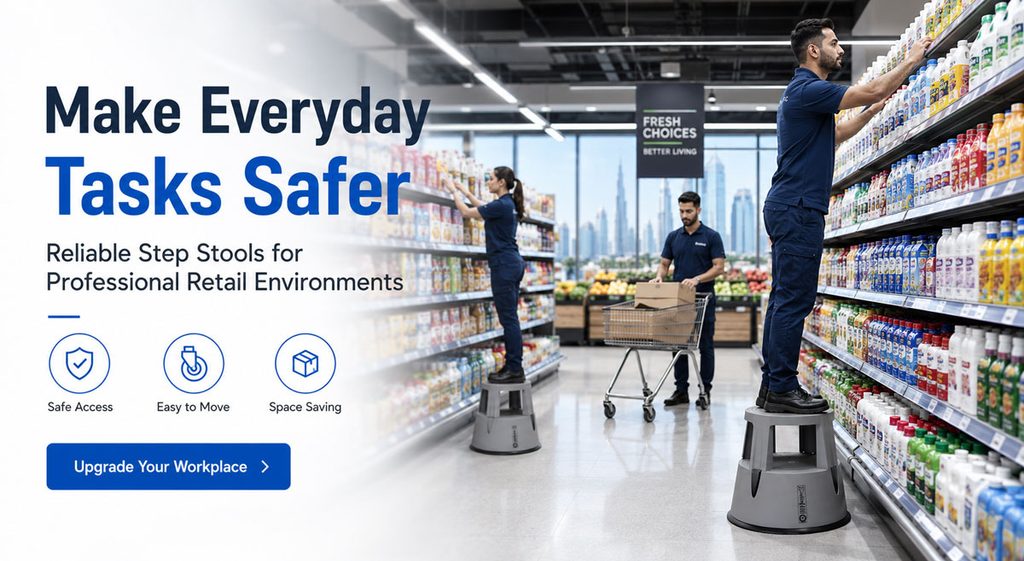
Heavy-Duty Step Stools for Supermarkets in Saudi Arabia are a practical safety and efficiency tool for supermarket operations across Saudi Arabia. A 2-step plastic design with non-slip surface, spring-loaded wheels, 150 kg load capacity and wide stable base allows staff to reach upper shelves, restock displays and perform routine maintenance without relying on ladders or improvised platforms.






This guide is written for purchasing managers, facility directors and safety officers responsible for multi-store networks. It examines real operating conditions in major Saudi cities and industrial zones, common specification mistakes, total cost of ownership, supplier evaluation for manufacturer and wholesale supply, OEM options, and practical deployment steps that protect both people and budgets.
The Quiet Cost of Height Access in Saudi Supermarkets
In a busy Saudi supermarket the upper shelves never stay full for long. Staff must restock, rotate stock, clean signage and adjust planograms while customers continue to move through the aisles. Every time a team member climbs on a chair, a lower shelf or an unstable platform, the store accepts an unnecessary risk. Heavy-duty step stools with non-slip surfaces and spring-loaded wheels remove that risk while keeping the work fast and mobile.
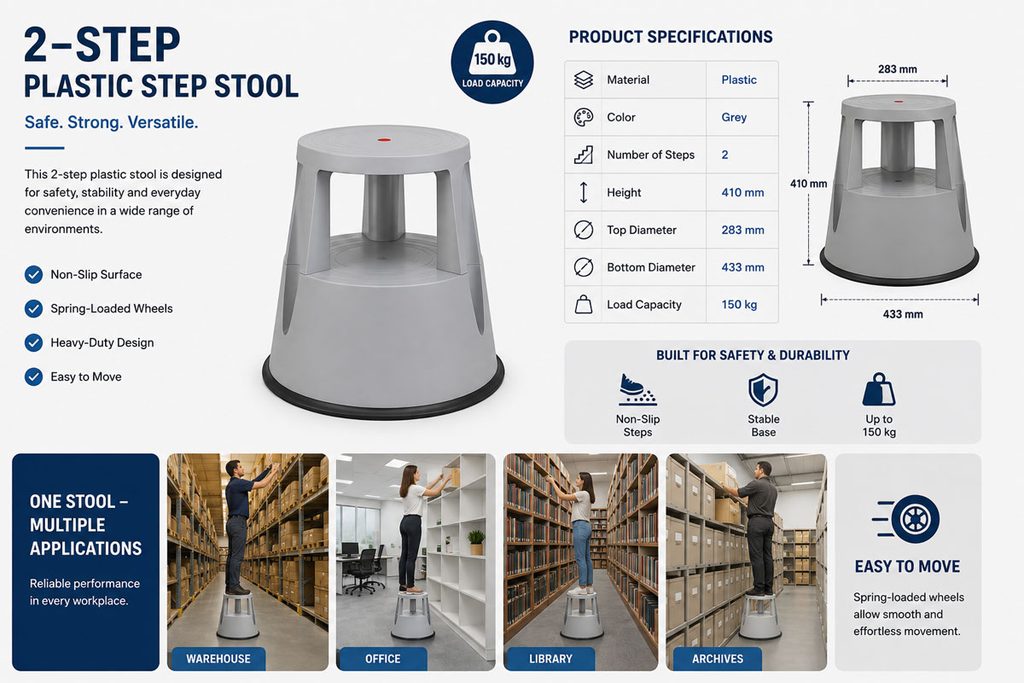
The reference product is a grey 2-step plastic stool approximately 410 mm high. The top platform measures 283 mm in diameter, the base widens to 433 mm, and the load rating is 150 kg. Spring-loaded wheels retract under body weight so the stool becomes a fixed platform the moment someone stands on it. When the user steps off, the wheels re-engage for easy movement to the next bay. This simple mechanical behaviour is the difference between a tool that staff trust and one they avoid.
Why Saudi Operating Conditions Demand Robust Specification
Saudi Arabia’s climate, store formats and labour patterns create specific demands. Air-conditioned interiors contrast with hot loading docks. Floor surfaces range from polished tiles in modern hypermarkets to epoxy or concrete in back-of-house areas. High ambient temperatures outside and frequent cleaning cycles inside place continuous stress on materials and mechanisms.
A stool that performs well under these conditions must combine a non-slip standing surface, reliable wheel retraction, impact-resistant plastic and a wide base that resists tipping when a worker reaches sideways with a carton. Units that lack any of these features tend to fail earlier or create new hazards.
Real Usage Patterns Across Key Locations
Operational intensity varies by city and zone, yet the core need remains consistent.
In Riyadh, large hypermarkets and supermarket chains experience continuous restocking pressure; mobile heavy-duty stools reduce the time staff spend searching for or carrying ladders between aisles.
As Sulay Riyadh contains mixed commercial and residential retail formats where compact, easily moved stools prove practical in tighter spaces.
Al Mashael Riyadh hosts growing retail developments that benefit from standardised safety equipment from the fit-out stage.
Al Kharj supports both local supermarket operations and nearby logistics activity; durable stools with non-slip surfaces handle varied floor conditions.
Jeddah’s high-traffic stores and coastal humidity require equipment that maintains grip and structural integrity under frequent cleaning.
Jeddah Industrial City supplies many retail networks; warehouse retail teams use the same heavy-duty stools for racking access and order preparation.
Al Khomrah Jeddah sees intensive distribution-linked supermarket activity where rapid movement between receiving and sales floor is essential.
KAEC (King Abdullah Economic City) is developing new commercial and logistics infrastructure; early adoption of standardised non-slip step stools supports consistent safety practice from the first stores.
Dammam’s industrial and retail mix generates steady demand for equipment that survives both sales-floor and back-room use.
Dammam Industrial City hosts manufacturing and logistics operations that feed supermarket supply chains; spring-loaded stools support temporary elevated access during packing and quality checks.
Al Khobar’s retail and commercial zones value stools that move quietly and lock securely in busy customer environments.
Yanbu Industrial City combines industrial activity with supporting retail; heavy-duty construction is required for the more demanding floor and temperature conditions.
Qassim region stores serve both urban and surrounding communities; reliable, low-maintenance stools reduce the logistical burden of frequent replacements.
Buraydah, as a key commercial centre in Qassim, sees regular use of mobile step stools for daily merchandising and upper-shelf work.
Makkah Industrial City supports retail and logistics linked to the broader western region; equipment that can be ordered in bulk and maintained simply fits the operational scale.
Across every location the purchasing priority is the same: specify once for safety and durability, then supply consistently.
Technical Attributes That Drive Performance
| Feature | Typical Specification | Operational Benefit |
|---|---|---|
| Height | 410 mm | Practical reach for standard supermarket shelving |
| Top diameter | 283 mm | Stable standing area |
| Base diameter | 433 mm | Lower centre of gravity, tip resistance |
| Load capacity | 150 kg | Covers staff plus normal product load |
| Material | Heavy-duty plastic | Impact resistance, cleanability, no corrosion |
| Surface | Textured non-slip | Grip on tile and epoxy floors |
| Wheel system | Spring-loaded | Locks under weight, rolls when unloaded |
| Colour | Grey | Practical for retail environments |
These dimensions and ratings should be verified against actual production samples before any large commitment.
Material Behaviour Under Saudi Conditions
Plastic construction offers clear advantages in supermarket environments: it is lighter than metal, does not rust, and can be moulded with permanent non-slip texture. In Saudi Arabia the same material must also resist temperature cycling between cold interiors and hot external areas, plus repeated exposure to cleaning chemicals.
Higher-grade formulations maintain dimensional stability and surface grip. Lower-grade plastics often develop stress cracks around the step junctions or wheel housings after months of daily loading. The black non-slip ring at the base improves friction on smooth floors and protects the plastic edge from abrasion—an inexpensive detail that extends service life.
Common Purchasing and Specification Mistakes
Procurement teams frequently encounter the same avoidable errors:
- Choosing the lowest unit price without testing wheel-lock reliability
- Accepting free-rolling designs that continue to move while the user is climbing
- Ordering without confirming dimensional consistency across bulk quantities
- Omitting spare-parts availability from the supply agreement
- Failing to match the stool to the store’s existing safety-audit language
- Treating the purchase as a one-time expense rather than a multi-year programme
Each mistake converts a modest acquisition cost into recurring operational and safety friction.
Quick Control List for Buyers
- Verify spring-loaded retraction under realistic body weight
- Measure actual top and base diameters on sample units
- Request material data and any cycle-test information
- Confirm OEM or private-label capability if branding is required
- Establish clear lead times for both initial bulk orders and later top-ups
- Nominate an internal owner for ongoing inspection standards
Supplier Evaluation: Manufacturer, Wholesale and Distributor Routes
A capable manufacturer supplies consistent quality, transparent technical data and the ability to scale. Many supermarket groups also require OEM options so that equipment can carry the retailer’s identity.
Wholesale channels and appointed distributors add practical value by holding regional stock and simplifying smaller replenishment orders. The strongest arrangements often combine direct manufacturer engagement for large programmes with distributor support for ongoing maintenance quantities.
Evaluation points that matter in daily practice include documented load performance, evidence of supply to other commercial or warehouse retail clients, clarity of warranty and parts supply, and proven logistics into Saudi industrial and commercial zones. Firmalazım operates as a manufacturer oriented toward these commercial requirements.
Total Cost of Ownership Perspective
A realistic multi-year model includes:
- Acquisition cost (influenced by volume and any OEM work)
- Inbound logistics
- Expected service life under daily supermarket intensity
- Spare-parts consumption
- Inspection and cleaning labour
- Cost of early replacement
- Value of reduced near-misses and faster upper-shelf restocking
When these elements are examined together, the higher-specification unit with reliable locking wheels and durable construction frequently delivers the lower net cost. Safety performance is the primary justification; operational efficiency and longer service life provide the secondary return.
Maintenance That Protects the Investment
Daily visual confirmation that wheels roll freely when unloaded and retract under light pressure takes only seconds. Weekly cleaning with standard floor detergents removes residues that would otherwise reduce grip. Monthly inspection of springs and wheel condition prevents progressive failure.
Because the design is mechanical and the structure is plastic, most potential problems are visible before they become safety issues. Keeping a small number of spare units at high-volume stores eliminates downtime at modest cost.
Comparison Snapshot
| Factor | Basic Free-Rolling Stool | Heavy-Duty Spring-Loaded Non-Slip | Fixed Platform |
|---|---|---|---|
| Mobility | High | High when unloaded | None |
| Stability under load | Variable / rolling risk | High | High |
| Suitability for open sales floor | Limited | Strong | Poor |
| Typical service life | 12–24 months | 36–60 months | Long but inflexible |
| Cleaning effort | Moderate | Low to moderate | Higher |
| Total cost over 3–5 years | Often higher | Usually lower | High opportunity cost |
The spring-loaded non-slip design occupies the practical middle ground required by supermarket operations.
Implementation Sequence for Multi-Store Networks
- Select pilot stores with contrasting formats and traffic levels.
- Deploy a controlled quantity of the candidate specification for 30–60 days.
- Collect usage data, staff feedback and any change in height-related near-miss reports.
- Finalise technical specification and commercial terms, including bulk pricing and parts supply.
- Align delivery with store maintenance windows.
- Conduct brief practical training focused on the locking behaviour.
- Establish designated storage points and a simple inspection routine.
- Review results at six months and adjust quantities.
This sequence keeps both financial and operational risk low while generating internal evidence for wider adoption.
Expert Note on Risk Transfer
Every time staff rely on chairs or lower shelves for height access, the organisation transfers risk from controlled equipment to people. A correctly specified heavy-duty step stool reverses that transfer. Clear load ratings and a defined mechanical locking system can be referenced directly in risk assessments and safe-work procedures, giving safety officers auditable controls and facility managers equipment that staff actually prefer to use.
Closing View for Purchasing Decision Makers
A heavy-duty 2-step plastic step stool with non-slip surface and spring-loaded wheels is a modest line item on any supermarket budget. Its influence on daily safety performance, restocking labour and multi-year replacement cost is disproportionate. Purchasing managers who evaluate the product through total cost of ownership, specification discipline and supplier reliability—rather than unit price alone—consistently select designs that lock under weight, maintain grip and survive commercial use across Saudi Arabia’s varied retail environments.
Firmalazım, as a manufacturer serving commercial channels, focuses on consistent quality for bulk orders, OEM flexibility and products engineered for the safety and durability demands of supermarket and warehouse retail operations.
FAQ
1. What makes a step stool “heavy-duty” for Saudi supermarket conditions? Reliable spring-loaded wheel lock, non-slip surface, wide stable base, 150 kg load rating and plastic formulation that tolerates temperature cycling and frequent cleaning.
2. How does the spring-loaded system improve safety compared with ordinary wheeled stools? Wheels retract under body weight so the stool cannot roll while the user is climbing or standing.
3. Is 150 kg capacity sufficient for typical supermarket tasks? Yes. It covers a staff member plus normal product or tool loads under commercial use.
4. How should total cost of ownership be calculated across multiple stores? Include acquisition, logistics, expected service life, spare parts, inspection labour and the value of reduced incidents and faster restocking.
5. What are the most common specification mistakes? Buying on price alone, accepting free-rolling designs, ignoring batch consistency, and omitting spare-parts terms.
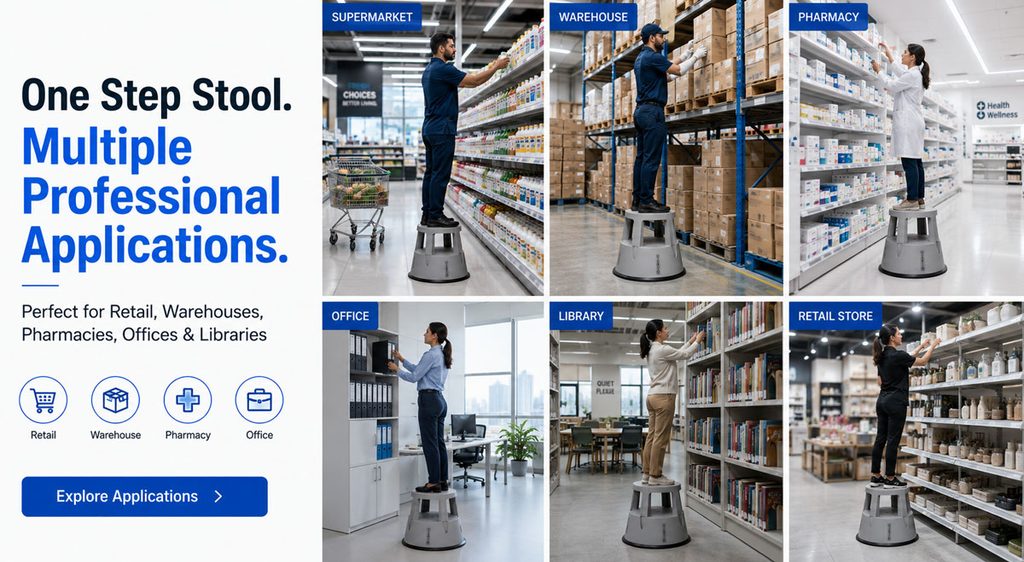
6. Can these stools be used on both sales-floor tiles and warehouse concrete? Yes, provided the base has adequate non-slip contact. The locked wide base performs on both surfaces.
7. How important is OEM capability for large supermarket groups? It allows private labelling or colour matching so equipment aligns with the retailer’s brand standards.
8. What maintenance routine is most cost-effective? Daily visual checks, weekly cleaning with standard detergents, and monthly inspection of springs and wheels.
9. How long should a quality unit last under daily use? Typically three to five years when basic inspection and cleaning are followed.
10. Should step stools be included in new-store fit-out schedules? Yes. Including them from the opening phase ensures correct quantities are available and avoids later emergency purchases.
11. What documentation should be required from a manufacturer before a bulk order? Dimensional drawings, load-capacity confirmation, material data, warranty terms and spare-parts availability.
12. How do wholesale and distributor channels add value? They provide regional stock, faster small-quantity fulfilment and local logistics support between major deliveries.
13. Can the same specification serve both front-of-house and back-of-house warehouse retail areas? Yes. The non-slip surface and locking wheels work in both environments.
14. What training do staff actually need? A short practical demonstration that the wheels retract under weight is normally sufficient.
15. How can near-miss data support the investment case? Track height-access near-misses before and after deployment. A measurable reduction provides internal evidence for wider roll-out.
16. Are there special considerations for industrial cities such as Jubail or Yanbu? Higher temperature exposure and more industrial floor conditions make durable construction and reliable wheel mechanisms especially important.
17. How should spare units be managed? Keep a small pool at high-volume stores so individual stools can be rotated out for inspection or repair without operational gaps.
18. What is the practical advantage of a wider base? It lowers the centre of gravity and increases resistance to tipping when the user reaches sideways.
19. Can colour be customised? Often yes under an OEM programme, subject to minimum order quantities.
20. How does plastic compare with metal for this application? Plastic is lighter, non-corrosive, easier to clean and capable of integral non-slip texture—advantages in most supermarket settings.
21. What is the risk of relying on chairs or lower shelves? It transfers height-access risk from controlled equipment to people and creates inconsistent, unauditable practice.
22. How should pilot programmes be structured? Choose contrasting store formats, define clear metrics in advance, and run for 30–60 days before full commitment.
23. What logistics factors matter for delivery into Saudi industrial zones? Suppliers experienced with industrial-city procedures can often provide more predictable lead times and clearer documentation.
24. Should replacement frequency be tracked as a KPI? Yes. Unexpected early replacements signal specification or maintenance issues that need review.
25. How does Firmalazım support commercial buyers in Saudi Arabia? As a manufacturer focused on commercial use, it supports bulk orders, OEM requirements and distributor channels for supermarket and warehouse retail safety equipment.
26. What is the main operational difference between a spring-loaded stool and a fixed platform? The spring-loaded unit moves freely when unloaded, allowing rapid relocation; a fixed platform cannot.
27. How important is non-slip texture in a supermarket environment? Critical. Dust, residual detergent and occasional food particles reduce friction on smooth surfaces.
28. Can the stools be cleaned with standard supermarket detergents? Yes. Avoid aggressive solvents that could degrade the plastic or texture over time.
29. What final question should a purchasing manager ask before signing an agreement? Does this specification, at this total cost of ownership, measurably reduce height-access risk while surviving daily commercial use across our network?
30. How can procurement protect against future supply disruption? Establish dual channels where possible, maintain modest safety stock, and include clear lead-time commitments in the commercial agreement.
Request a practical total-cost comparison and sample units so your team can evaluate spring-loaded performance under real supermarket conditions in Saudi Arabia.Speak with the commercial team about volume pricing, OEM options and structured supply for multi-store networks.Obtain current technical data, load documentation and logistics parameters for bulk orders into major Saudi cities and industrial zones.Schedule a focused discussion on standardising heavy-duty non-slip step stools and converting height-access risk into a controlled process.Contact us to explore manufacturer-direct or distributor-supported supply of durable, spring-loaded stools engineered for the safety and operational demands of supermarket and warehouse retail environments across Saudi Arabia.
Heavy-Duty Step Stools for Supermarkets in Saudi Arabia
Heavy-duty step stools are a core safety and productivity tool for supermarket operations throughout Saudi Arabia. A well-engineered 2-step plastic model with non-slip surface, spring-loaded wheels, 150 kg capacity and wide stable base allows staff to reach high shelves, restock displays and carry out routine maintenance without ladders or improvised platforms.
This extended guide is written strictly from the purchasing manager’s perspective. It focuses on total cost of ownership, specification discipline, common purchasing errors, supplier evaluation for manufacturer and wholesale channels, OEM flexibility, real operating conditions across major Saudi cities and industrial zones, and practical deployment steps that protect both people and long-term budgets.
The Hidden Line Item That Affects Safety Scores and Labour Cost
In Saudi supermarket networks the cost of height access rarely appears as a single budget line. It surfaces instead as near-miss reports, slower upper-shelf restocking, premature equipment replacement, and occasional injury claims. A heavy-duty 2-step stool with spring-loaded wheels and non-slip surface converts that diffuse cost into a controllable one.
The reference design stands approximately 410 mm high. The top platform is 283 mm in diameter, the base widens to 433 mm, and the rated load is 150 kg. Spring-loaded wheels retract the moment body weight is applied, turning a mobile unit into a fixed platform. When the user steps off, the wheels re-engage for effortless movement to the next location. This mechanical behaviour is the primary reason staff actually use the tool instead of climbing on chairs or lower shelves.
Why Saudi Conditions Raise the Specification Bar
Temperature swings between cold sales floors and hot loading docks, frequent cleaning cycles, varied floor surfaces, and high daily usage intensity all place continuous stress on materials and mechanisms. A stool that performs reliably under these conditions must combine four attributes: a textured non-slip standing surface, dependable wheel retraction, impact-resistant plastic, and a base wide enough to resist tipping when a worker reaches sideways with a carton. Units that omit any of these features tend to generate higher long-term cost through earlier failure or reduced staff confidence.
Operational Reality Across Key Saudi Locations
Although the core task is identical, logistics density, store format and climate exposure differ by city and zone. Procurement planning must reflect those differences.
In Riyadh, large hypermarkets and multi-store chains face continuous restocking pressure; mobile heavy-duty stools reduce the time staff spend locating or carrying ladders between long aisles.
As Sulay Riyadh contains mixed commercial and residential retail formats where compact, easily moved stools prove practical in more constrained floor plans.
Al Mashael Riyadh is seeing rapid retail development; standardising non-slip step stools from the fit-out stage supports consistent safety practice across new stores.
Al Kharj combines local supermarket operations with nearby logistics activity; durable construction and reliable grip handle the mixed floor conditions common in the area.
Jeddah’s high-traffic coastal stores and higher humidity require equipment that maintains surface traction and structural integrity under frequent wet cleaning.
Jeddah Industrial City supplies many retail networks; warehouse retail teams use the same heavy-duty stools for racking access and order preparation before goods move to the sales floor.
Al Khomrah Jeddah experiences intensive distribution-linked supermarket activity where rapid, safe movement between receiving docks and sales areas is essential.
KAEC continues to expand commercial and logistics infrastructure; early adoption of standardised spring-loaded stools helps establish uniform safety equipment from the first stores.
Dammam’s industrial and retail mix generates steady demand for units that survive both customer-facing and back-of-house use.
Dammam Industrial City hosts manufacturing and logistics operations that feed supermarket supply chains; temporary elevated access during packing and quality checks is a daily requirement.
Al Khobar’s retail and commercial zones value stools that move quietly and lock securely in busy customer environments.
Yanbu Industrial City combines industrial activity with supporting retail; higher temperature exposure and more industrial floor surfaces make robust construction particularly important.
Qassim region stores serve both urban centres and surrounding communities; low-maintenance, long-life stools reduce the logistical burden of frequent replacements.
Buraydah, as a major commercial hub in Qassim, sees regular daily use of mobile step stools for merchandising and upper-shelf work.
Makkah Industrial City supports retail and logistics linked to the western region; equipment that can be ordered in bulk and maintained simply matches the operational scale of the area.
Across all these locations the purchasing priority remains constant: specify a stable, non-slip, spring-loaded design once, then supply it consistently through reliable manufacturer or wholesale channels.
Technical Attributes That Determine Real-World Performance
| Attribute | Typical Value | Why It Matters in Saudi Supermarkets |
|---|---|---|
| Overall height | 410 mm | Practical reach for standard shelving without excess climb |
| Top diameter | 283 mm | Stable standing surface |
| Base diameter | 433 mm | Lower centre of gravity and tip resistance |
| Load capacity | 150 kg | Covers staff plus normal product or tool load |
| Material | Heavy-duty plastic | Impact resistance, cleanability, no corrosion |
| Surface finish | Textured non-slip | Maintains grip on tile and epoxy floors |
| Wheel system | Spring-loaded | Locks under weight, rolls when unloaded |
| Colour | Grey | Practical and dirt-hiding in retail environments |
These figures should be verified on actual production samples before any large commitment. Batch-to-batch consistency is especially important for multi-store roll-outs.
Material Performance and Longevity
Plastic remains the preferred material for this category because it is lighter than metal, does not rust, and can be moulded with permanent non-slip texture. In Saudi Arabia the same material must also tolerate rapid temperature changes and repeated contact with cleaning chemicals.
Higher-grade formulations retain dimensional stability and surface grip over years of daily use. Lower-grade plastics frequently develop stress cracks around step junctions or wheel housings after months of intensive loading. The black non-slip base ring is a small but useful detail: it improves friction on smooth floors and protects the plastic edge from abrasion, extending service life at negligible extra cost.
Purchasing Errors That Quietly Inflate Cost
The same mistakes appear repeatedly across supermarket procurement teams:
- Selecting solely on unit price without verifying dynamic stability under load
- Accepting free-rolling designs that can still move while the user is climbing
- Ordering without confirming dimensional and performance consistency across bulk quantities
- Omitting spare-parts availability and clear warranty terms from the agreement
- Failing to align the product with the company’s existing safety-audit language
- Treating the purchase as a one-time expense rather than a multi-year programme
Each of these errors converts a modest acquisition cost into recurring operational friction and higher total cost of ownership.
Procurement Control Checklist
- Confirm spring-loaded retraction under realistic body weight on sample units
- Measure actual top and base diameters against stated specifications
- Request material data and any available cycle-test information
- Verify OEM or private-label capability if branding is required
- Establish clear lead times for both initial bulk orders and later top-ups
- Nominate a single internal owner for ongoing inspection standards
Supplier Evaluation: Manufacturer, Wholesale and Distributor Options
A capable manufacturer delivers consistent quality, transparent technical documentation and the ability to scale with the retailer’s growth. Many supermarket groups also require OEM flexibility so that equipment can carry the retailer’s identity.
Wholesale channels and appointed distributors add practical value by holding regional stock and simplifying smaller replenishment orders between major deliveries. The strongest commercial arrangements frequently combine direct manufacturer engagement for large programmes with distributor support for ongoing maintenance quantities.
Key evaluation criteria include documented load and stability performance, evidence of supply to other commercial or warehouse retail clients, clarity of warranty and parts supply, and proven logistics capability into Saudi industrial and commercial zones. Firmalazım operates as a manufacturer focused on these commercial requirements.
Total Cost of Ownership in Practice
A realistic three-to-five-year model for a multi-store operator includes:
- Unit acquisition cost (volume- and OEM-dependent)
- Inbound logistics
- Expected service life under daily supermarket intensity
- Spare-parts consumption (primarily wheels and springs)
- Inspection and cleaning labour
- Cost of premature replacement
- Monetised value of reduced near-misses and faster upper-shelf restocking
When these elements are examined together, the higher-specification unit with reliable locking wheels and durable construction almost always shows the lower net cost. Safety performance provides the primary justification; operational efficiency and longer service life deliver the secondary return.
Maintenance Regime That Protects the Asset
Daily visual confirmation that wheels roll freely when unloaded and retract under light pressure takes only seconds per unit. Weekly cleaning with standard supermarket floor detergents removes residues that would otherwise reduce grip. Monthly inspection of spring tension and wheel condition prevents progressive failure.
Because the mechanism is purely mechanical and the structure is plastic, most potential problems are visible before they become safety issues. Maintaining a small pool of spare units at high-volume stores eliminates downtime at very modest cost.
Side-by-Side Comparison for Decision Support
| Decision Factor | Basic Free-Rolling Stool | Heavy-Duty Spring-Loaded Non-Slip | Fixed Platform |
|---|---|---|---|
| Mobility when unloaded | High | High | None |
| Stability under load | Variable / rolling risk | High (wheels retract) | High |
| Suitability for open sales floor | Limited | Strong | Poor |
| Typical commercial service life | 12–24 months | 36–60 months | Long but inflexible |
| Cleaning and hygiene effort | Moderate | Low to moderate | Higher |
| Spare-parts practicality | Often limited | Generally available | Minimal |
| Total cost over 3–5 years | Frequently higher | Usually lower | High opportunity cost |
The spring-loaded non-slip design occupies the practical centre that supermarket operations require.
Recommended Implementation Sequence
- Select two or three pilot stores with contrasting formats and traffic levels.
- Deploy a controlled quantity of the candidate specification for 30–60 days.
- Collect usage frequency, staff feedback and any change in height-related near-miss reports.
- Finalise the technical specification and commercial terms, including bulk pricing, OEM options and parts supply.
- Align delivery schedules with store maintenance windows.
- Conduct brief practical training focused solely on the locking behaviour.
- Establish designated storage points and a simple inspection standard.
- Review quantitative and qualitative results at six months and adjust quantities as needed.
This sequence keeps both financial and operational risk low while generating the internal evidence required for wider network adoption.
Expert Perspective on Risk and Control
Every time supermarket staff rely on chairs, lower shelves or cardboard boxes for height access, the organisation transfers risk from controlled equipment to people. A correctly specified heavy-duty step stool reverses that transfer. Clear load ratings and a defined mechanical locking system can be referenced directly in risk assessments and safe-work procedures. Safety officers gain auditable controls; facility managers gain equipment that staff actually prefer to use because it moves easily and locks securely. When both groups are satisfied, compliance scores and daily productivity improve together.
Closing View for the Purchasing Decision
A heavy-duty 2-step plastic step stool with non-slip surface and spring-loaded wheels is a modest line item. Its influence on daily safety performance, restocking labour and multi-year replacement cost is outsized. Purchasing managers who evaluate the product through total cost of ownership, specification discipline and supplier reliability—rather than unit price alone—consistently select designs that lock under weight, maintain grip and survive commercial use across Saudi Arabia’s diverse retail environments.
Firmalazım, operating as a manufacturer serving commercial channels, focuses on consistent quality for bulk orders, OEM flexibility and products engineered for the safety and durability demands of supermarket and warehouse retail operations throughout the Kingdom.
FAQ
1. What defines a heavy-duty step stool suitable for Saudi supermarket conditions? Reliable spring-loaded wheel lock under body weight, textured non-slip surface, wide stable base, 150 kg load rating, and plastic formulation that tolerates temperature cycling and frequent cleaning.
2. How does the spring-loaded mechanism improve safety compared with ordinary wheeled stools? The wheels retract the moment weight is applied, so the stool cannot roll while the user is climbing or standing.
3. Is 150 kg capacity adequate for normal supermarket tasks? Yes. It comfortably covers a staff member plus typical product or tool loads under commercial use.
4. How should total cost of ownership be modelled across a multi-store network? Include acquisition cost, logistics, expected service life, spare parts, inspection labour, early-replacement cost, and the value of reduced near-misses plus faster upper-shelf work.
5. What are the most frequent purchasing mistakes? Buying on price alone, accepting free-rolling designs, ignoring batch consistency, and omitting spare-parts and warranty terms.
6. Can the same stool be used on both sales-floor tiles and warehouse concrete? Yes. The non-slip base and locked wide footprint perform on both surfaces.
7. How important is OEM capability for large supermarket groups? It enables private labelling or colour matching so equipment aligns with the retailer’s brand and safety standards.
8. What maintenance routine delivers the best cost-to-benefit ratio? Daily visual checks, weekly cleaning with standard detergents, and monthly inspection of springs and wheels.
9. What typical service life can be expected under intensive daily use? Three to five years when basic inspection and cleaning routines are followed.
10. Should step stools be included in new-store capital and fit-out schedules? Yes. Including them from the opening phase ensures correct quantities are present and avoids later emergency purchases.
11. What documentation should be mandatory before placing a bulk order? Dimensional drawings, load-capacity confirmation, material data, warranty terms, and spare-parts availability.
12. How do wholesale and distributor channels complement direct manufacturer supply? They provide regional stock, faster small-quantity fulfilment, and local logistics support between major deliveries.
13. Can one specification serve both front-of-house merchandising and back-of-house warehouse retail tasks? Yes. The non-slip surface and locking wheels function effectively in both environments.
14. What training content is actually required for staff? A short practical demonstration that the wheels retract under weight is normally sufficient.
15. How can near-miss data strengthen the investment case? Track height-access near-misses before and after deployment. A measurable reduction supplies internal evidence for wider roll-out and supports safety-audit discussions.
16. Are there additional considerations for industrial cities such as Jubail, Yanbu or Dammam Industrial City? Higher temperature exposure and more industrial floor conditions make robust construction and reliable wheel mechanisms especially important.
17. How should spare units be managed at store level? Maintain a small pool at high-volume sites so individual stools can be rotated out for inspection or repair without creating operational gaps.
18. What is the practical benefit of a significantly wider base? It lowers the centre of gravity and increases resistance to tipping when the user reaches sideways with a load.
19. Can colour or branding be customised? Often yes under an OEM programme, subject to minimum order quantities and lead-time implications.
20. Why is plastic generally preferred over metal for this application? It is lighter, non-corrosive, easier to clean, and capable of integral non-slip texture—advantages in most supermarket settings.
21. What risk does reliance on chairs or lower shelves create? It transfers height-access risk from controlled equipment to people and produces inconsistent, unauditable practice.
22. How should pilot programmes be structured to generate usable data? Select contrasting store formats, define clear metrics in advance, and run for at least 30–60 days before full commitment.
23. What logistics factors matter most for delivery into Saudi industrial zones? Suppliers experienced with industrial-city procedures can often provide more predictable lead times and clearer documentation for commercial volumes.
24. Should replacement frequency be tracked as a key performance indicator? Yes. Unexpected early replacements signal either specification problems or inadequate maintenance and should trigger review.
25. How does Firmalazım support commercial buyers across Saudi Arabia? As a manufacturer focused on commercial use, it supports bulk orders, OEM requirements, and distributor channels for supermarket and warehouse retail safety equipment.
26. What is the main operational difference between a spring-loaded stool and a fixed platform? The spring-loaded unit moves freely when unloaded, allowing rapid relocation between tasks; a fixed platform cannot.
27. How critical is non-slip surface texture in a supermarket environment? Very. Dust, residual detergent and occasional food particles reduce friction on smooth surfaces; texture maintains usable grip.
28. Can these stools be cleaned with ordinary supermarket detergents? Yes. Avoid aggressive solvents that could degrade the plastic or the non-slip texture over time.
29. What final question should a purchasing manager ask before signing? Does this specification, at this total cost of ownership, measurably reduce height-access risk while surviving daily commercial use across our store network?
30. How can procurement reduce the risk of future supply disruption? Establish dual channels where practical, maintain modest safety stock, and include clear lead-time commitments in the commercial agreement.
Five Distinct Calls to Action
- Request a practical total-cost-of-ownership model and sample units so your procurement and safety teams can evaluate spring-loaded performance under real Saudi supermarket conditions.
- Speak directly with the commercial team about volume pricing, OEM options, and structured supply programmes for multi-store networks.
- Obtain current technical data sheets, load documentation, and logistics parameters for bulk orders into major Saudi cities and industrial zones.
- Schedule a focused consultation on standardising heavy-duty non-slip step stools and converting height-access risk into a controlled, auditable process.
- Contact us to explore manufacturer-direct or distributor-supported supply of durable, spring-loaded stools engineered for the safety and operational demands of supermarket and warehouse retail environments across Saudi Arabia.
Heavy-Duty Step Stools for Supermarkets in Saudi Arabia
Heavy-duty step stools are one of the simplest yet highest-impact safety tools a Saudi supermarket can standardise. A 2-step plastic model with non-slip surface, spring-loaded wheels, 150 kg capacity and wide base geometry lets staff reach upper shelves, restock displays and perform routine tasks without ladders or improvised platforms.
This version is written as a practical error-prevention and multi-site standardisation guide for purchasing and facility managers. It focuses on the mistakes that quietly increase cost and risk, the climate and floor-surface realities of Saudi stores, real operating scenarios across major cities and industrial zones, and the commercial decisions that determine whether the equipment delivers lasting value.
The Expensive Habit Most Stores Still Tolerate
Walk through almost any supermarket after the morning delivery wave and you will still see staff climbing on chairs, lower shelves or stacked cartons to reach the top level. Each of those moments is a small, accepted risk. Over hundreds of stores and thousands of shifts the cumulative cost appears as near-miss reports, slower planogram execution, occasional injuries and premature equipment replacement.
A correctly specified heavy-duty 2-step stool removes that habit. The design in question stands roughly 410 mm high, offers a 283 mm top platform, a 433 mm base, a textured non-slip surface and spring-loaded wheels that retract under body weight. Rated at 150 kg, it is built for commercial use. When unloaded it rolls freely; the moment someone stands on it the wheels disappear and the stool becomes a fixed, stable platform. That single behaviour is what makes staff willing to use it instead of improvising.
Climate, Floors and Daily Intensity – The Saudi Reality
Saudi supermarket environments combine three stresses that cheaper stools rarely survive for long: rapid temperature change between cold sales floors and hot receiving docks, frequent wet cleaning, and high daily cycle counts. Plastic must remain dimensionally stable and retain surface grip. Wheel springs must continue to retract cleanly after thousands of cycles. The base must stay wide enough to resist tipping when a worker reaches sideways with a carton.
Units that look identical on a specification sheet often diverge sharply after six to twelve months of real use. The difference is almost always in wall thickness, internal ribbing, spring quality and the presence of a proper non-slip base ring.
Where the Equipment Is Actually Used
Operational pressure varies by location, yet the core need is consistent.
In Riyadh the largest hypermarkets run continuous restocking cycles; mobile stools that lock securely reduce the time staff spend hunting for ladders across long aisles.
As Sulay Riyadh contains smaller and mid-sized formats where space is tighter and a compact rolling design is especially practical.
Al Mashael Riyadh is adding new retail space at speed; introducing a single standardised stool from the first fit-out prevents later fragmentation of equipment.
Al Kharj mixes local supermarket trading with nearby logistics activity; floor surfaces and temperature exposure both demand durable construction.
Jeddah’s coastal stores face higher humidity and more frequent wet cleaning; surface grip and corrosion-free materials become critical.
Jeddah Industrial City feeds many retail networks; warehouse retail teams use the same heavy-duty stools for racking access before goods move to the sales floor.
Al Khomrah Jeddah handles intensive distribution-to-store flows; rapid, safe movement between dock and aisle is a daily requirement.
KAEC continues to build new commercial capacity; early standardisation of non-slip step stools supports consistent safety practice from the opening of each new store.
Dammam combines industrial and retail activity; equipment must survive both customer-facing and back-of-house conditions.
Dammam Industrial City supports manufacturing and logistics that supply supermarket chains; temporary elevated access during packing and quality checks is routine.
Al Khobar’s busy retail zones reward stools that move quietly and lock firmly in front of customers.
Yanbu Industrial City adds higher ambient temperatures and more industrial floor surfaces; robust plastic and reliable wheel mechanisms are non-negotiable.
Qassim region stores serve both city centres and surrounding communities; low-maintenance, long-life units reduce the logistical cost of frequent replacements.
Buraydah, the commercial heart of Qassim, sees steady daily use of mobile stools for merchandising and upper-shelf work.
Makkah Industrial City supports retail and logistics across the western region; equipment that can be ordered in bulk and maintained simply matches the scale of operations there.
In every one of these locations the purchasing decision is the same: choose a design that locks under weight, grips reliably and lasts, then supply it consistently.
The Specification Mistakes That Cost Money
Most of the long-term cost of step stools comes from decisions made at the buying stage. The most common errors are:
- Selecting on unit price alone without testing wheel-lock behaviour under real body weight
- Accepting free-rolling designs that can still move while the user is climbing
- Ordering large quantities without checking dimensional consistency across the batch
- Ignoring spare-parts availability and clear warranty language
- Failing to write the product into the company’s existing safety-audit framework
- Treating the purchase as a one-off expense instead of a multi-year programme
Each of these mistakes turns a modest acquisition cost into repeated operational friction.
Error-Prevention Checklist for Buyers
- Test spring-loaded retraction on actual sample units with a realistic load
- Measure top and base diameters yourself
- Request material data and any cycle-test information the manufacturer can provide
- Confirm OEM or private-label options if branding is required
- Lock in lead times for both the initial bulk order and later top-ups
- Assign one internal owner for ongoing inspection standards
Commercial Supply Routes That Work
A manufacturer that understands commercial use can deliver consistent quality, transparent technical data and the volume capacity supermarket groups need. Many chains also require OEM capability so the stools can carry the retailer’s identity.
Wholesale and distributor partners add value by holding regional stock and simplifying smaller replenishment orders. The most resilient arrangements usually combine direct manufacturer supply for large programmes with distributor support for ongoing maintenance quantities. Firmalazım operates in this commercial space, supporting both bulk orders and structured distributor relationships.
Total Cost View Over Three to Five Years
A useful model includes:
- Acquisition cost (volume and any OEM work)
- Inbound logistics
- Expected service life under daily intensity
- Spare-parts consumption
- Inspection and cleaning labour
- Cost of early replacement
- Value of fewer near-misses and faster upper-shelf work
When these factors are examined together, the higher-specification unit with reliable locking wheels and durable construction almost always shows the lower net cost. Safety is the primary justification; durability and staff acceptance deliver the secondary return.
Maintenance That Actually Gets Done
Daily visual checks take seconds. Weekly cleaning with ordinary floor detergent removes the residues that reduce grip. Monthly inspection of springs and wheels catches progressive wear before it becomes a safety issue.
Because the design is mechanical and the structure is plastic, most problems are visible. Keeping a small number of spare units at high-volume stores eliminates downtime at very low cost.
Quick Comparison for Internal Discussions
| Factor | Cheap Free-Rolling Stool | Heavy-Duty Spring-Loaded Non-Slip | Fixed Platform |
|---|---|---|---|
| Moves easily when empty | Yes | Yes | No |
| Stays locked under weight | No | Yes | Yes |
| Suitable for open sales floor | Limited | Strong | Poor |
| Typical life in daily use | 12–24 months | 36–60 months | Long but inflexible |
| Cleaning effort | Moderate | Low–moderate | Higher |
| 3–5 year total cost | Often higher | Usually lower | High opportunity cost |
The spring-loaded non-slip design sits in the practical middle that supermarket operations need.
How to Roll Out Without Creating New Problems
- Choose two or three pilot stores with different formats and traffic levels.
- Place a controlled quantity of the candidate stool for 30–60 days.
- Collect simple data: how often it is used, staff comments, any change in height-related near-misses.
- Finalise the specification and commercial terms, including bulk pricing and parts supply.
- Align delivery with existing maintenance windows.
- Give staff a short practical demonstration of the locking behaviour.
- Fix clear storage points so the stools do not become new obstacles.
- Review results at six months and adjust quantities.
This sequence keeps risk low and produces the internal evidence needed for wider adoption.
A Note on Risk Ownership
When staff climb on chairs or shelves, the organisation has effectively decided that height-access risk belongs to people rather than to controlled equipment. A properly specified heavy-duty step stool reverses that decision. Clear load ratings and a defined locking mechanism can be written directly into risk assessments. Safety teams gain something auditable; facility teams gain something staff will actually use. Both outcomes improve the numbers that purchasing managers are measured on.
Final Perspective for the Buyer
A heavy-duty 2-step plastic step stool with non-slip surface and spring-loaded wheels will never be the most glamorous item on a supermarket capital list. It will, however, influence daily safety scores, restocking speed and multi-year replacement cost more than many higher-priced assets. Buyers who judge it by total cost of ownership, specification discipline and supplier reliability—rather than by unit price alone—end up with equipment that locks under weight, keeps its grip and lasts across the varied conditions of Saudi supermarket operations.
Firmalazım works as a manufacturer focused on exactly these commercial requirements: consistent quality for bulk orders, OEM flexibility, and products engineered for supermarket and warehouse retail environments throughout Saudi Arabia.
FAQ
1. What makes a step stool genuinely heavy-duty for Saudi supermarket use? Reliable spring-loaded lock under body weight, durable non-slip surface, wide base, 150 kg rating, and plastic that tolerates temperature swings and frequent cleaning.
2. Why do ordinary wheeled stools create more risk than they solve? They can still roll while the user is climbing or standing. The spring-loaded design removes that failure mode.
3. Is 150 kg enough for normal supermarket work? Yes. It covers a staff member plus typical product or tool loads under commercial use.
4. How should a buyer calculate real cost over several years? Add acquisition, logistics, expected life, spare parts, inspection labour, early replacement cost, and the value of fewer near-misses plus faster restocking.
5. Which purchasing mistakes create the most long-term cost? Buying on price alone, accepting free-rolling designs, ignoring batch consistency, and leaving spare-parts terms out of the agreement.
6. Can one model serve both sales floor and warehouse retail areas? Yes. The non-slip surface and locking wheels work in both environments.
7. How useful is OEM capability for large chains? It allows private labelling or colour matching so the equipment fits the retailer’s brand and safety standards.
8. What maintenance actually gets performed in busy stores? Daily visual checks, weekly cleaning with standard detergents, and monthly spring/wheel inspection.
9. What service life is realistic under intensive daily use? Three to five years when the simple inspection routine is followed.
10. Should these stools be part of new-store fit-out packages? Yes. Including them from day one prevents later fragmented purchasing and missing equipment.
11. What documents should be required before a bulk order? Dimensional drawings, load confirmation, material data, warranty terms and spare-parts availability.
12. How do wholesale and distributor channels help? They hold regional stock and make small top-up orders faster and simpler between major deliveries.
13. What training do staff really need? A short demonstration that the wheels retract under weight is normally enough.
14. How can near-miss numbers support the business case? Compare height-access near-misses before and after introduction. A clear reduction strengthens the case for wider roll-out.
15. Do industrial cities such as Jubail, Yanbu or Dammam Industrial City need different specifications? They need the same core features, but with particular attention to temperature resistance and industrial floor durability.
16. How should spare units be handled? Keep a small number at high-volume stores so individual stools can be taken out of service without creating gaps.
17. Why does base diameter matter so much? A wider base lowers the centre of gravity and reduces tipping risk when the user reaches sideways.
18. Can colour or branding be changed? Often yes under an OEM programme, depending on minimum quantities.
19. Why is plastic usually better than metal here? Lighter, non-corrosive, easier to clean, and able to carry integral non-slip texture.
20. What risk does continued use of chairs and lower shelves create? It leaves height-access risk with people instead of controlled equipment and produces inconsistent practice that is hard to audit.
21. How should a pilot be structured? Pick contrasting stores, define simple metrics in advance, and run for 30–60 days before deciding on full commitment.
22. What logistics points matter for industrial-zone deliveries? Suppliers familiar with industrial-city procedures usually deliver more predictable lead times and clearer documentation.
23. Should replacement rate be watched as a KPI? Yes. Unexpected early failures point to either specification problems or maintenance gaps.
24. How does Firmalazım work with commercial buyers in Saudi Arabia? As a manufacturer focused on commercial use, it supports bulk orders, OEM needs and distributor channels for supermarket and warehouse retail safety equipment.
25. What is the biggest operational difference between a spring-loaded stool and a fixed platform? The spring-loaded unit can be moved quickly between tasks; a fixed platform cannot.
26. How important is the non-slip texture in practice? Critical. Dust, detergent residue and occasional food particles reduce grip on smooth surfaces.
27. Can ordinary supermarket detergents be used for cleaning? Yes. Avoid aggressive solvents that can damage the plastic or the texture over time.
28. What is the single most useful question a buyer can ask before signing? Does this specification, at this total cost of ownership, reduce height-access risk and survive daily commercial use across our network?
29. How can supply risk be reduced? Use dual channels where practical, keep modest safety stock, and lock clear lead times into the agreement.
30. What is the simplest way to start improving height-access safety? Replace improvised climbing with a single, well-specified heavy-duty stool that staff will actually use, then standardise it.
Ask for a side-by-side total-cost comparison and sample units so your team can test spring-loaded performance in real Saudi store conditions.
Talk to the commercial team about volume pricing, OEM options and a structured supply plan for your multi-store network.
Request current technical data, load documentation and logistics details for bulk orders into the main Saudi cities and industrial zones.
Book a short working session focused on eliminating the most common specification errors and standardising heavy-duty non-slip stools across your sites.
Contact us to discuss manufacturer-direct or distributor-supported supply of durable, spring-loaded stools built for the daily safety and operational demands of supermarket and warehouse retail environments in Saudi Arabia.

Bir yanıt yazın