


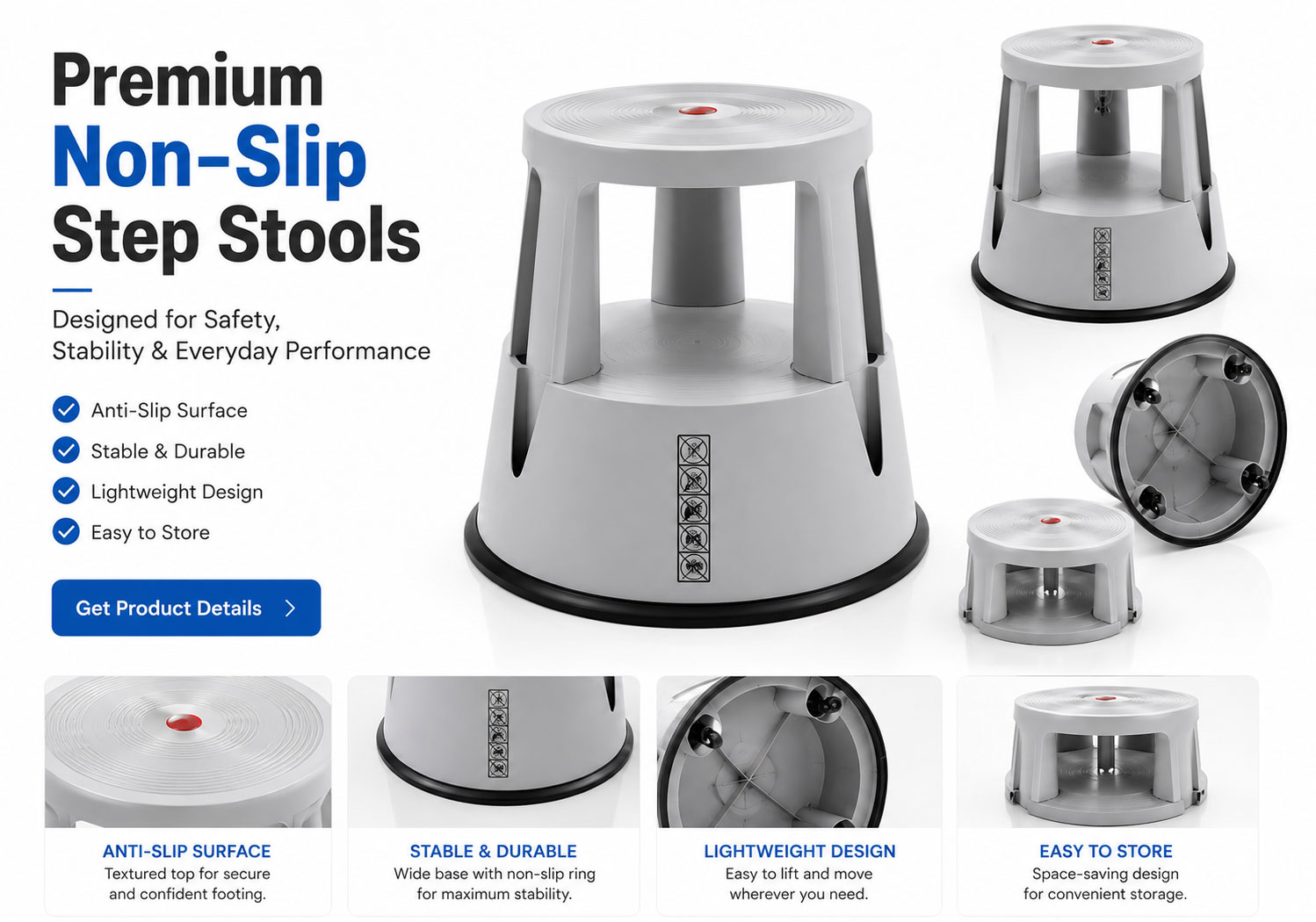
Commercial Step Stool Solutions for Facility Management in Saudi Arabia
Commercial Step Stool Solutions for Facility Management in Saudi Arabia reshape facility management inside supermarket logistics networks by delivering stable, mobile elevation exactly where short-duration access is required. The 2-step plastic model with spring-loaded wheels, non-slip surface, 410 mm height and 150 kg capacity removes friction from daily routines in warehouses, backrooms and distribution hubs. This guide examines the equipment through the lens of facility managers responsible for safety, uptime and cost control across UAE operations that interface with key industrial zones, providing a complete framework for selection, deployment and long-term performance.

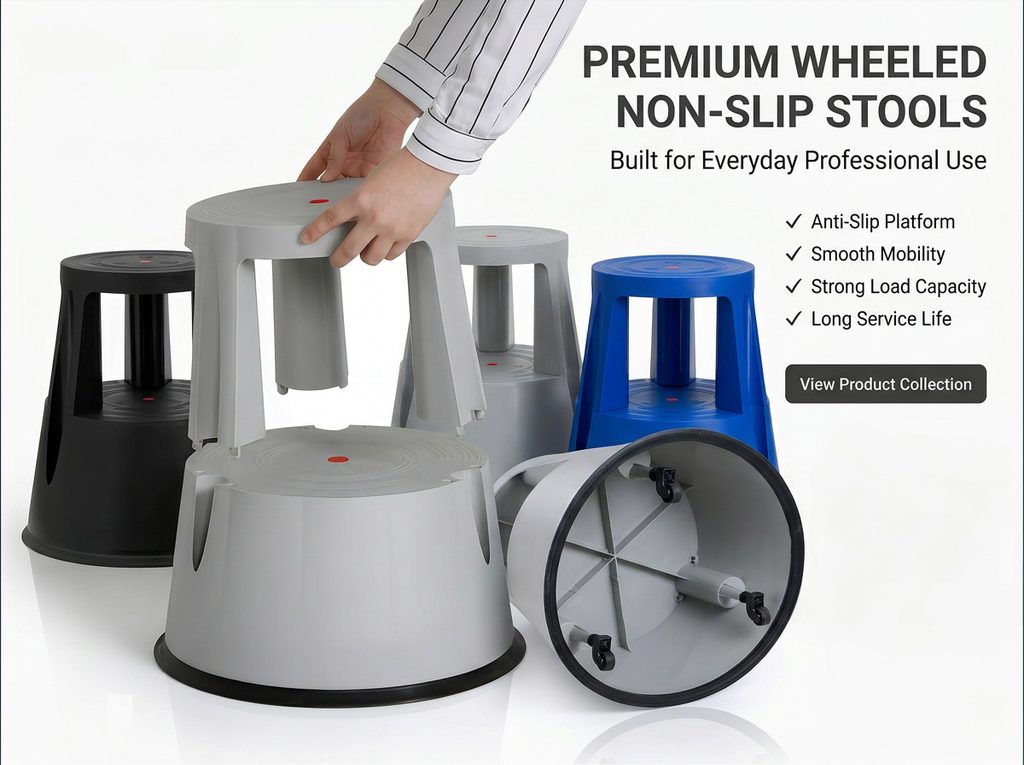


Facility managers overseeing supermarket supply chains confront a recurring operational tension: the need for rapid elevated access without introducing new hazards or consuming scarce floor space. Fixed ladders solve height but create bottlenecks. Conventional rolling ladders solve mobility yet demand larger turning radii and higher capital outlay. The compact commercial step stool occupies the precise middle ground required by modern facility management.
Product Purpose in Facility Context
The unit exists to convert a short reach task into a controlled, repeatable motion. An operator rolls the stool into position, steps onto the non-slip platform, completes the retrieval or inspection, steps down and continues. Spring-loaded wheels retract the moment weight is applied, locking the base firmly to the floor. The same wheels re-engage the moment weight is removed. This automatic transition is the core engineering contribution to safety and efficiency.
Technical Foundation
| Specification | Value |
|---|---|
| Material | Plastic |
| Color | Grey |
| Steps | 2 |
| Platform Height | 410 mm |
| Top Diameter | 283 mm |
| Bottom Diameter | 433 mm |
| Load Capacity | 150 kg |
| Mobility System | Spring-loaded wheels |
| Standing Surface | Non-slip |
These dimensions allow the stool to travel between standard pallet-rack uprights while still presenting a stable standing area large enough for confident footing.
Material Analysis for Facility Longevity
Engineering-grade plastic is selected for its combination of impact resistance, chemical tolerance and dimensional stability. In supermarket environments the material must withstand repeated cleaning with industrial detergents, occasional impact from carts or pallet jacks, and the abrasive effect of fine dust. UV stabilizers protect against degradation under high ambient temperatures. The grey finish further reduces heat absorption compared with darker colors, an advantage in facilities that experience elevated indoor temperatures during peak summer months.
Production Process Transparency
A reliable manufacturer controls resin compounding, injection-molding parameters and post-mold assembly with documented tolerances. Wheel mechanisms are fitted and each finished unit undergoes static load verification. Sample units from every production batch are subjected to cycle testing that simulates thousands of boarding and disembarking sequences. Facilities that place bulk orders benefit when the manufacturer can demonstrate this level of process control, because consistency across successive deliveries determines whether the equipment remains uniform network-wide.
Facility Management Scenarios in Supermarket Operations
In high-velocity dry-grocery aisles the stool travels with the picker. In chilled zones it provides the same elevation for case retrieval without requiring a separate access solution. In back-of-house merchandising areas it supports both stock replenishment and quality checks. Archives and document storage rooms within larger logistics campuses use the identical platform for occasional high-shelf access. The single design therefore serves multiple facility functions without proliferating equipment types.
Country and Zone Evaluation
Facility teams coordinating supply into the UAE frequently align practices with counterpart operations in Riyadh. Similar alignment occurs with teams based in Jeddah. Distribution managers responsible for sites near Dammam report that mobile access equipment reduces the need for dedicated ladder stations. Industrial parks surrounding Jubail generate continuous demand for durable platforms that support both warehouse retail and bulk-handling tasks. Planners working in the vicinity of As Sulay Riyadh emphasize stability on concrete floors that may show minor surface variation. Operators in Al Mashael Riyadh have recorded fewer access-related near-misses after introducing wheeled models. Storage densification projects around Al Kharj benefit from the compact footprint. Teams inside Jeddah Industrial City value the automatic wheel-lock for rapid aisle changes. Comparable feedback is received from facilities near Al Khomrah Jeddah. New developments at KAEC incorporate the stools into standard pick-station kits. High-volume grocery logistics in Dammam Industrial City rely on equipment rated for continuous commercial use. Retail support functions in Al Khobar move the same units between backroom and forward zones. Logistics linked to Yanbu Industrial City require surfaces tolerant of industrial cleaning regimes. Agricultural and consumer-goods hubs in Qassim and Buraydah deploy them during seasonal peaks. Finally, operators connected to Makkah Industrial City use the platform for mixed warehouse and retail replenishment duties.
Each location shares the same core facility-management requirement: access equipment that improves throughput without increasing risk.
Installation and First-Use Protocol
No assembly is required. Upon receipt the facility team performs a visual inspection of the base ring, wheel housings and standing surface. A controlled load test with a known weight confirms full wheel retraction. Once verified, the units are released into designated zones. A brief orientation for supervisors and operators focuses solely on the automatic locking behavior so that the safety function is understood from the first shift.
Maintenance as a Facility Process
Daily: quick visual scan for debris in wheel housings and integrity of the non-slip surface. Weekly: functional check of retraction and re-engagement. Monthly: documented load test and inspection of structural ribs. Annual: review of cumulative service hours against expected life and decision on continued deployment or reassignment to lower-intensity roles.
This regime integrates cleanly into existing facility maintenance schedules and generates the records required by internal audit and insurance reviews.
Comparison of Access Options
| Factor | Fixed Ladder | Conventional Rolling Ladder | Commercial 2-Step Wheeled Stool |
|---|---|---|---|
| Repositioning speed | Low | Medium | High |
| Floor-space demand | High | High | Low |
| Passive safety | Moderate | Requires active rules | High (design-enforced) |
| Training burden | Low | Medium | Minimal |
| Suitability for temporary labor | Moderate | Moderate | High |
| Narrow-aisle compatibility | Limited | Variable | Excellent |
| Long-term cost predictability | Good | Medium | High |
The comparison explains why facility managers responsible for supermarket logistics increasingly standardize on the wheeled stool for the majority of second-level tasks.
Investment and Cost Analysis
Unit purchase price is only the starting point. Recovered pick time, reduced near-miss investigations, lower fatigue-related slowdowns and simplified training for temporary staff all contribute to the return. A typical mid-sized distribution center that previously relied on a mixture of fixed ladders and ad-hoc climbing recovers the capital outlay within the first twelve to eighteen months through time savings alone. Secondary benefits—improved inventory accuracy from more consistent access and reduced overtime driven by residual fatigue—further strengthen the case.
Common Errors and Prevention
- Treating the stool as a transport cart for heavy loads rather than a temporary elevated platform.
- Skipping the daily visual inspection in dusty conditions.
- Positioning the unit on soft or heavily contaminated surfaces that prevent full base contact.
- Failing to remove a unit from service at the first sign of wheel binding.
- Ordering successive batches from different sources without verifying process consistency.
Each of these errors is preventable through clear facility standards and a single accountable owner for the equipment fleet.
Real Scenario – Peak Volume Absorption
During a major promotional campaign a supermarket logistics facility experienced a sharp rise in case throughput. Temporary staff were onboarded within 48 hours. Because the wheeled stools required only a one-minute orientation, the temporary cohort reached full access productivity on the first shift. Supervisors recorded no increase in access-related incidents despite the volume surge. The same units continued in baseline service after the campaign, demonstrating that the investment served both peak and normal conditions.
Expert Perspective on Safety Integration
Facility safety systems succeed when the correct action is also the easiest action. The spring-loaded wheel mechanism enforces stability without relying on procedural memory. Once an operator has experienced the transition from mobile to locked, the equipment itself becomes the primary control. This design-level safety characteristic is especially valuable in environments that mix permanent and temporary labor under continuous commercial use.
Purchasing Framework for Facility Managers
- Map every location where elevated access occurs more than a defined threshold per shift.
- Measure aisle clearances and floor conditions against the 433 mm base diameter.
- Define success metrics before any units enter service.
- Select a manufacturer able to demonstrate process control and supply both standard and OEM-configured units.
- Secure wholesale terms that cover initial volume and twelve-month replenishment.
- Appoint an internal owner for inspection and record-keeping.
- Establish a relationship with a distributor capable of rapid spare-parts response.
- Run a controlled pilot, measure results, then expand on internal data.
Tip Box – Field Verification
Place a sample unit on the actual floor surface of the target aisle. Apply body weight and confirm complete wheel retraction with no residual movement. Release the weight and verify smooth re-engagement. Repeat ten times. Any hesitation or incomplete lock indicates a design or manufacturing shortcoming that will surface under continuous supermarket conditions.
Control Checklist for Network Roll-Out
- Clearance verification completed for every intended zone.
- Baseline access-cycle times and near-miss counts recorded.
- Manufacturer load-test certificates and material specifications received.
- Inspection responsibility assigned and documented.
- Spare wheel assemblies stocked or covered by distributor agreement.
- Supervisor orientation completed.
- First formal review scheduled at 30 days.
- Expansion criteria defined in advance.
Summary of Core Facility Advantages
- Automatic transition from mobile to stable under load.
- Compact footprint compatible with narrow supermarket aisles.
- Minimal training burden for both permanent and temporary staff.
- Predictable maintenance integrated into existing facility routines.
- Scalable from single-zone pilot to full-network standard through bulk orders and distributor support.
- Transparent manufacturing path that supports long-term commercial use.
The commercial step stool is not an accessory; it is infrastructure. When selected from a capable manufacturer, procured under clear wholesale terms, supported by a responsive distributor and embedded in disciplined facility processes, it delivers measurable improvements in both safety and throughput across supermarket logistics operations.
Five Distinct CTAs
- Request current lead times and volume pricing for a network-wide bulk order.
- Arrange an on-site demonstration of the automatic wheel-lock mechanism under actual floor conditions.
- Obtain a three-year total-cost-of-ownership model built on your facility’s pick-rate data.
- Explore OEM color and identification options for multi-site standardization.
- Connect with an authorized distributor for local stock availability and spare-parts coverage.
FAQ
What makes a commercial step stool suitable for supermarket facility management? Automatic wheel retraction under load, a non-slip standing surface, a load rating of 150 kg and a compact footprint that fits standard aisle clearances.
How does the spring-loaded system improve safety compared with free-rolling casters? The wheels retract the moment weight is applied, converting the unit into a fixed platform and eliminating unexpected movement.
Is the 410 mm height adequate for most second-level supermarket racking? Yes. It places the majority of adult operators in an efficient working envelope for the most common elevated retrieval tasks.
Can the same model serve both ambient and temperature-controlled zones? Yes, provided the plastic formulation remains within its specified temperature range and cleaning protocols are followed.
What documentation should a manufacturer supply with bulk orders? Load-test certificates, material specifications and clear maintenance instructions.
How frequently should facility teams inspect the wheel mechanism? Visual check each shift, functional test weekly, documented load test monthly.
Does the equipment require assembly on arrival? No. Units are ready for immediate inspection and deployment.
What is the primary cause of early retirement? Direct impact from forklifts or pallet jacks rather than normal wear of the wheels or platform.
Can temporary staff use the stools safely with minimal orientation? Yes. A one-minute explanation of the automatic locking behavior is normally sufficient.
How should a facility calculate the correct quantity? Map access frequency per aisle and target a ratio that keeps average walk-to-stool time under a few seconds during peak periods.
Is OEM branding available for multi-site operators? Many manufacturers support color matching and identification options when ordered in appropriate volume.
What role does a local distributor play after the initial purchase? Rapid replenishment of complete units and spare components, reducing downtime.
How does the wide base affect stability on polished concrete? The 433 mm diameter combined with the non-slip ring provides reliable friction and a low center of gravity.
Should the stools be entered into the formal equipment register? Yes. Asset numbering and inspection records support both internal governance and external audits.
What is the simplest way to prove value to senior management? Present clean before-and-after data on access-cycle time and near-miss counts from a controlled pilot zone.
Can the units be nested or stacked when not in use? Many designs allow limited nesting, improving storage density inside the facility.
How does the product perform under continuous multi-shift commercial use? With routine inspection the structural shell and wheel mechanism maintain function for several years of intensive service.
What cleaning agents are compatible with the plastic surface? Standard industrial detergents used in supermarket environments; abrasive pads should be avoided on the non-slip texture.
Is there a performance difference between single-shift and multi-shift deployment? Multi-shift operation simply accelerates cycle accumulation; inspection frequency should be adjusted accordingly.
How do these stools interact with other mobile equipment in the same aisles? Their compact stationary profile when loaded is compatible with standard mixed-traffic rules.
What is the recommended action if a wheel begins to bind? Remove the unit from service immediately, clean the mechanism, and replace the assembly if binding persists.
Can the stools support both warehouse retail and traditional supermarket replenishment tasks? Yes. The same design moves between bulk storage and forward merchandising zones without modification.
How visible should the equipment be within the facility? High visibility reduces search time; some operators add zone markings without compromising the non-slip surface.
What is the most reliable indicator of manufacturing quality? Consistent full retraction under load across multiple sample units and transparent process documentation from the manufacturer.
Should spare wheel assemblies be held in facility stores? Maintaining a small stock, or securing rapid supply through the distributor, minimizes disruption when individual components reach end of life.
The framework above equips facility managers to integrate commercial step stool solutions as a controlled, measurable element of supermarket operations. When the equipment is selected, deployed and maintained with the same discipline applied to other critical infrastructure, it delivers sustained gains in both safety and productivity.
Commercial Step Stool Solutions for Facility Management in Saudi Arabia
Facility managers who treat commercial step stools as infrastructure rather than disposable tools unlock a quieter but more durable form of operational control. Once the equipment is embedded in daily routines, the absence of friction becomes noticeable only when it is removed. The goal is therefore not dramatic transformation but the steady elimination of small, repeated inefficiencies that compound across shifts, sites and seasons.
Ergonomic Integration into Facility Workflows
The 410 mm platform height places the average operator’s hands within a favorable reach zone for the majority of second-level supermarket picks. Lateral stability provided by the 433 mm base reduces the corrective muscle activity required to maintain balance while retrieving cases. Over a full shift these micro-reductions in effort translate into lower residual fatigue scores—an outcome that facility managers track through both absenteeism data and voluntary feedback. When temporary labor enters the operation during promotional peaks, the same ergonomic profile allows rapid productive contribution without extended familiarization periods.
Cross-Functional Ownership Model
Successful deployment rarely remains the sole responsibility of the operations team. Safety contributes the inspection protocol and near-miss tracking. Procurement secures consistent supply through bulk orders and maintains the relationship with both the manufacturer and the distributor. Maintenance owns the scheduled checks and spare-parts inventory. When these three functions share a single set of metrics—access-cycle time, inspection compliance and equipment availability—the stools remain a controlled asset rather than an unmanaged collection of plastic platforms.
Seasonal Facility Planning
Supermarket logistics experience predictable volume surges linked to religious holidays, national events and retailer promotions. Facility managers who maintain a ready pool of wheeled step stools absorb these surges without simultaneously expanding fixed ladder stations or accelerating training cycles. Units that serve baseline demand simply increase utilization during peaks and return to normal rotation afterward. This elasticity is one of the less obvious advantages of a mobile, low-training-burden solution.
Tip Box – Rapid Peak-Readiness Check
Thirty days before a known volume surge, verify that every high-velocity aisle still has functional stools within a short walk distance. Confirm that spare wheel assemblies are either on site or covered by a 24-hour distributor response. Brief temporary-staff supervisors on the automatic locking behavior. These three actions prevent the majority of access-related friction during the busiest periods.
Predictive Rather Than Reactive Maintenance Thinking
Although the stools are mechanically simple, facility teams that record inspection results over time can detect patterns. A gradual increase in the number of units showing early wheel binding, for example, may indicate rising floor contamination or a change in cleaning chemical. Addressing the root cause protects the entire fleet. This light-touch predictive approach fits naturally inside existing facility management systems without requiring specialized software.
Sustainability Angle Within Facility Constraints
Engineering-grade plastic that retains structural integrity across multiple years of commercial use reduces the frequency of replacement and the associated logistics burden. Facilities that previously rotated through lower-grade alternatives every twelve to eighteen months often discover that a higher-specification unit lowers both material consumption and the administrative load of continuous reordering. Longevity therefore becomes a practical sustainability metric rather than an abstract claim.
Real Scenario – Multi-Site Standardization
A regional supermarket operator managing several distribution nodes faced inconsistent access equipment across locations. Some sites used fixed ladders, others a mixture of rolling ladders and ad-hoc solutions. After a controlled pilot at one node demonstrated clear reductions in access time and near-misses, the facility management team standardized on the 2-step wheeled stool. Bulk orders secured volume pricing, OEM color matching created visual consistency, and a single distributor agreement covered spare parts for the entire network. Within nine months every site operated under the same access standard, simplifying both training and audit preparation.
Comparison: Centralized versus Decentralized Equipment Control
| Aspect | Decentralized (Site-by-Site) | Centralized Facility Standard |
|---|---|---|
| Purchase consistency | Variable | High |
| Training uniformity | Low | High |
| Spare-parts efficiency | Poor | Strong |
| Audit readiness | Fragmented | Streamlined |
| Ability to negotiate bulk orders | Limited | Strong |
| Speed of best-practice transfer | Slow | Rapid |
| Total cost visibility | Opaque | Clear |
Centralized control does not eliminate local flexibility; it simply removes unnecessary variation in a category where variation adds cost without adding value.
Expert Commentary – The Hidden Cost of Inconsistency
When every site solves the same elevated-access problem differently, the organization pays repeatedly for the same lesson. Facility managers who have standardized on a single, well-specified commercial step stool report that the administrative burden of managing access equipment drops sharply once the initial transition is complete. The equipment itself becomes almost invisible—precisely the outcome desired from any piece of facility infrastructure.
Voice-of-the-Facility-Manager Narrative
“We stopped counting the number of times someone walked past a fixed ladder because it was in the wrong aisle. Once the wheeled stools were in place, that particular friction disappeared. The safety team liked the automatic lock. The temporary staff liked that they did not need a long briefing. Procurement liked the ability to place bulk orders against a single specification. It is one of the few pieces of equipment that satisfied every stakeholder at the same time.”
Expanded Control Checklist for Ongoing Facility Governance
- Inspection compliance rate reviewed monthly.
- Equipment availability percentage tracked against a defined target.
- Near-miss data filtered for access-related events and trended.
- Spare-parts stock level verified against distributor lead times.
- Operator feedback collected at regular toolbox talks.
- Annual review of manufacturer performance on quality and delivery.
- Decision gate for expansion or replacement based on internal data rather than external promotion.
- Documentation package ready for both internal audit and external insurance review.
Investment Re-Framing for Capital Approval
Presenting the stools as a pure cost item invites delay. Presenting them as a controlled reduction in access-cycle time, a measurable contributor to safety metrics and a simplifier of temporary-labor onboarding changes the conversation. When the facility manager can show a pilot result expressed in minutes recovered per shift and near-misses avoided, capital approval typically follows without extended debate.
Integration with Broader Facility Digital Tools
Although the stools themselves are purely mechanical, their performance data can feed existing facility dashboards. Access-cycle time samples, inspection completion rates and equipment downtime can be logged in the same systems used for other mobile assets. The result is a more complete picture of operational friction without requiring the stools to carry sensors or connectivity.
Common Facility-Level Pitfalls and Countermeasures
- Allowing informal “ownership” of individual stools by specific operators, which reduces overall availability. Countermeasure: treat the units as shared facility assets with clear zone assignment.
- Letting inspection records become sporadic during peak periods. Countermeasure: keep the daily visual check under sixty seconds so it survives volume spikes.
- Ordering replacement units from a different source without re-validating performance. Countermeasure: maintain a single approved manufacturer specification for all bulk orders.
- Under-estimating the value of a responsive distributor when a wheel assembly fails on a Friday afternoon. Countermeasure: include response-time expectations in the distributor agreement.
Summary Box – Facility Management Outcomes
- Reduced non-value-added walking and setup time.
- Design-enforced stability that supports safety culture.
- Minimal training overhead for permanent and temporary staff.
- Predictable maintenance load that fits existing schedules.
- Scalable supply model through manufacturer bulk-order capability and distributor support.
- Clean data trail for both operational improvement and formal audit.
The commercial step stool earns its place in facility management not through complexity but through reliable simplicity. When the specification is held constant, the supply chain is secured, and the inspection routine is non-negotiable, the equipment disappears into the background of a well-run supermarket logistics operation—exactly where infrastructure belongs.
Additional FAQ
How does centralized facility standardization affect total cost of ownership? It improves purchasing leverage through bulk orders, reduces training variation and concentrates spare-parts demand, all of which lower long-term cost.
What is the minimum viable pilot size for a credible facility trial? Ten to fifteen units in the highest-frequency access zones, measured for at least ten full working days before and after introduction.
Can inspection records be kept digitally? Yes. Many facilities simply add the stools to existing mobile-equipment check-sheets already running on tablets or phones.
How should a facility respond if near-miss data does not improve after deployment? Re-examine placement density, floor conditions and whether operators are actually using the units rather than reverting to previous habits.
Is there a recommended retirement criterion based on age alone? Age is secondary to condition. Units that continue to pass monthly load tests and show no structural compromise remain in service regardless of calendar age.
What information should be shared with the manufacturer after the first six months? Aggregate inspection findings and any recurring field issues. Responsible manufacturers use this feedback to refine future production.
How do these stools affect facility insurance discussions? Documented reduction in access-related near-misses and a formal inspection regime strengthen the risk-management narrative.
Should facility managers involve the safety committee in the initial specification? Yes. Early involvement accelerates acceptance and ensures the chosen design satisfies both operational and safety criteria.
What is the practical limit on the number of stools a single supervisor can effectively oversee? There is no fixed number; the limit is determined by inspection compliance and availability metrics rather than headcount.
Can the same facility standard be applied to both large distribution centers and smaller satellite warehouses? Yes. The core specification remains identical; only the quantity and placement density change.
How frequently should the approved manufacturer list be reviewed? Annually, or immediately if quality or delivery performance declines.
What role does OEM capability play in long-term facility branding? It allows visual consistency across sites and can incorporate asset-identification features that simplify audits.
Is it necessary to re-train permanent staff after the initial orientation? Only if inspection findings or near-miss data indicate drift in correct usage.
How can facility managers quantify the reduction in temporary-staff onboarding time? Compare the duration of access-related briefing before and after introduction of the automatic-lock design.
What is the most effective way to keep the equipment from migrating out of assigned zones? Clear zone marking on the stools themselves and inclusion of location checks in the daily visual inspection.
The extended guidance reinforces a single principle: commercial step stool solutions deliver their greatest value when managed with the same rigor applied to any other piece of facility infrastructure. Selection, supply, inspection and measurement form a closed loop. When that loop is closed, the equipment supports supermarket operations quietly, consistently and at a predictable cost.
Advanced Facility Governance Layer
Once the commercial step stools have moved from pilot to network standard, the facility manager’s attention shifts from introduction to sustained governance. The equipment itself is simple; the system that keeps it available, inspected and correctly used is not. This layer of management determines whether the initial gains in access speed and safety remain visible three years later or slowly erode under the pressure of daily operations.
Risk-Mapping Exercise for Elevated Access
A practical facility exercise begins with a floor-plan overlay. Every location where an operator must leave floor level is marked. Frequency of access, typical load carried, floor condition and proximity to other traffic are scored. The resulting heat map almost always concentrates the highest risk in a relatively small number of aisles. Placing the wheeled stools first in these zones produces the fastest measurable return and the clearest safety improvement. Lower-frequency zones can be covered later or left with existing fixed solutions.
Interaction with Other Mobile Assets
Supermarket logistics floors are shared by pallet jacks, order pickers, cleaning machines and occasional forklifts. The compact stationary profile of the loaded step stool reduces conflict. When the wheels are retracted the unit occupies a predictable footprint and does not roll into traffic paths. Facility traffic rules that already govern other mobile equipment therefore require only minor extension rather than wholesale rewriting.
Training Modularization for Diverse Workforces
Many UAE facilities employ teams whose first languages differ. The automatic wheel-lock behavior can be demonstrated in under sixty seconds and requires no technical vocabulary. A short video loop playing in the break room, combined with a single practical demonstration at the start of each new temporary intake, has proven sufficient. Facility managers report that access-related briefing time for temporary staff drops by more than half once the stools replace less intuitive alternatives.
Budget-Cycle Alignment
Capital requests for access equipment compete with many other facility needs. Presenting the stools as a multi-year reduction in access-cycle time and a contributor to safety-key-performance-indicator improvement changes the framing. When the request is accompanied by pilot data expressed in minutes recovered per shift and near-misses avoided, it aligns more easily with annual budget cycles. Facilities that have already standardized also gain leverage when placing subsequent bulk orders, because the specification is already approved and the supplier relationship is established.
Supplier Performance Scorecard
A lightweight scorecard keeps the relationship with the manufacturer and the distributor under objective review. Typical criteria include:
- On-time delivery percentage for bulk orders
- Consistency of load-test documentation
- Response time for spare-parts requests
- Incidence of quality deviations in successive deliveries
- Willingness to support OEM identification requirements
Reviewing the scorecard annually prevents gradual drift in supply quality and gives procurement a clear basis for negotiation or, if necessary, re-sourcing.
Post-Implementation Audit Preparation
Internal and external auditors increasingly examine not only the presence of access equipment but the system that governs it. A ready package containing the original specification, load-test certificates, inspection records, training attendance logs and near-miss trend data satisfies most formal reviews. Facilities that treat the stools as managed assets rather than free-floating tools find audit preparation straightforward.
Long-Term Fleet Management Strategy
Over a five-year horizon the fleet will experience a mixture of normal wear, occasional impact damage and gradual technological or process change. A simple tiered approach works well:
- Tier 1: units in highest-frequency zones, inspected most rigorously and replaced first when condition declines
- Tier 2: units in medium-frequency zones, subject to standard inspection
- Tier 3: units held as ready reserve or assigned to low-frequency areas
This structure concentrates maintenance attention where it yields the greatest operational return and extends the useful life of the overall investment.
Expert Panel Insight – Three Facility Managers
“The biggest surprise was how quickly the temporary staff stopped asking for help with elevated picks. Once they trusted the automatic lock, they simply used the stools.”
“We used to lose time every time a fixed ladder was in the wrong place. That particular conversation has disappeared from the daily shift handover.”
“Procurement was skeptical until we showed the pilot numbers. After that the bulk-order process became routine.”
Tip Box – Quarterly Fleet Health Check
Once per quarter, pull a random sample of ten stools from different zones. Perform the full monthly load test on each, photograph any surface wear, and log the results. Compare the sample against the previous quarter. Rising incidence of wheel binding or base-ring damage signals either a floor-condition issue or a need to adjust cleaning protocols.
Comparison: Reactive versus Managed Fleet Approach
| Dimension | Reactive Approach | Managed Fleet Approach |
|---|---|---|
| Replacement trigger | Visible failure | Condition and utilization data |
| Spare-parts availability | Ad-hoc | Planned minimum stock or distributor SLA |
| Training consistency | Variable | Standardized module |
| Audit readiness | Scramble | Continuous |
| Total cost visibility | Low | High |
| Ability to absorb volume peaks | Limited | Built-in elasticity |
| Continuous improvement | Rare | Embedded in quarterly review |
The managed approach converts a simple piece of equipment into a controlled facility system.
Common Late-Stage Drift and Correction
Even well-implemented systems experience gradual drift. Inspection compliance softens during prolonged peak periods. Units migrate out of assigned zones. Informal ownership develops. The corrective mechanism is the same in each case: return to the original metrics. When availability percentage or inspection completion rate declines, the facility manager re-asserts zone assignment and inspection ownership before the operational gains begin to reverse.
Sustainability and Replacement Planning
Because the engineering-grade plastic retains integrity across years of commercial use, replacement is driven more by impact damage or evolving facility layout than by material fatigue. Facilities that track the reason for each retirement build a clearer picture of true consumption and can adjust both purchasing volume and protective measures (for example, better segregation from forklift traffic).
Final Facility-Level Synthesis
Commercial step stool solutions succeed in supermarket facility management when three conditions are held constant: a single clear specification from a capable manufacturer, a reliable supply path through wholesale terms and a responsive distributor, and a non-negotiable inspection and measurement routine. Under those conditions the equipment delivers persistent reductions in access friction and measurable support for safety objectives. When any of the three conditions weakens, the gains become temporary. The facility manager’s ongoing task is therefore to protect the system that protects the performance of the stools.
Additional FAQ
How often should the risk-map of elevated access points be refreshed? Annually, or whenever a significant layout change or volume shift occurs.
What is the most effective way to prevent stools from migrating between zones? Combine physical zone marking on the units with inclusion of location verification in the daily visual check.
Can the same inspection protocol serve both large distribution centers and smaller satellite sites? Yes. Only the number of units and the sampling frequency change; the checks themselves remain identical.
How should facility managers handle a sudden increase in wheel-binding reports? Treat it as a systemic signal. Inspect floor cleanliness and cleaning-chemical residue before assuming isolated equipment failure.
Is it useful to involve temporary-staff supervisors in the quarterly fleet health check? Yes. Their front-line observations often surface usage patterns that formal records miss.
What minimum data set satisfies most external auditors? Specification sheet, load-test certificates, twelve months of inspection records, training attendance and near-miss trend for access events.
How does OEM identification help with long-term fleet control? Serialized or color-coded identification makes zone assignment and audit tracing faster and reduces informal removal of units from the facility.
Should replacement decisions be centralized or left to individual sites? Centralized approval against a shared condition standard prevents premature or inconsistent retirement.
What is the practical benefit of maintaining a small ready-reserve pool? It absorbs both unexpected damage and temporary volume spikes without forcing immediate emergency orders.
How can facility managers quantify the reduction in briefing time for temporary labor? Compare average minutes spent on elevated-access instruction before and after introduction of the automatic-lock design.
Does the managed-fleet approach require additional headcount? No. It redistributes existing supervisory attention toward higher-value control rather than adding new roles.
What is the recommended trigger for re-evaluating the approved manufacturer? Any sustained decline in the supplier scorecard, particularly in quality consistency or spare-parts response time.
How do these stools affect overall facility traffic-flow planning? Their predictable stationary footprint when loaded simplifies the definition of shared-aisle rules.
Can inspection completion itself become a leading indicator of broader facility discipline? Yes. Sites that maintain high compliance on simple equipment checks often display stronger performance on other operational standards.
What final metric best summarizes long-term success? Sustained reduction in access-cycle time combined with flat or declining access-related near-miss rates across multiple peak seasons.
The governance layer described above converts a straightforward commercial step stool into a durable element of supermarket facility management. When specification, supply and measurement remain under deliberate control, the equipment continues to remove friction and support safety long after the initial deployment excitement has faded. That quiet persistence is the hallmark of infrastructure that works.
Facility managers who have already standardized on commercial step stools eventually confront a quieter but more strategic question: how does this simple piece of equipment continue to deliver value as the broader warehouse environment evolves. Automation density increases, pick profiles shift, and labor models change. The stools that solved yesterday’s access friction must still fit tomorrow’s layout without forcing a complete re-investment.
Cross-Border Facility Coordination
Many UAE-based supermarket logistics operations maintain close operational alignment with counterpart facilities in neighboring industrial zones. Teams responsible for sites linked to Riyadh often share access-equipment standards so that temporary staff moving between locations encounter identical platforms. The same logic applies to coordination with facilities near Jeddah. When distribution nodes connected to Dammam adopt the identical 2-step wheeled specification, training modules and inspection checklists transfer without translation. Industrial parks around Jubail benefit from the same uniformity. Planners working with operations in As Sulay Riyadh report that consistent equipment reduces the learning curve for shared seasonal labor. Comparable advantages appear when sites near Al Mashael Riyadh and Al Kharj operate under one access standard. Facilities inside Jeddah Industrial City and those around Al Khomrah Jeddah gain similar transferability. New developments at KAEC inherit the standard from established nodes. High-volume operations in Dammam Industrial City and support functions in Al Khobar likewise reduce friction by maintaining the same platform. Logistics linked to Yanbu Industrial City, agricultural hubs in Qassim and Buraydah, and mixed operations connected to Makkah Industrial City all experience the same benefit: one specification, one training approach, one inspection routine.
Detailed Cost-Modeling Example
Consider a distribution center running two shifts with 18 active pick faces that previously relied on a mixture of fixed ladders and informal climbing. Baseline measurement shows 16 elevated access events per picker per hour and an average 3.8 seconds of travel-plus-setup time per event. After introduction of one wheeled stool per two pick faces, setup time falls to 1.0 second. Across 14 pickers the daily recovery exceeds 75 minutes. At fully loaded labor cost the annual value of recovered time alone surpasses the capital outlay for the stools within the first year. Adding the reduction in near-miss investigation time and the lower briefing overhead for temporary staff extends the payback further. When the same model is applied across multiple sites, the cumulative return becomes a material line item in the facility budget rather than a marginal efficiency.
Operator Feedback Synthesis
Front-line comments collected over successive quarters converge on three practical points. First, the stools can be moved with one hand while the other carries a case or scanner. Second, the standing surface feels secure even during a slight off-center reach. Third, the unit never needs to be “set up” in the conventional sense; the automatic lock removes a decision step. These qualitative observations align with the quantitative reductions in cycle time and residual fatigue that facility managers track through formal metrics.
Tip Box – Quarterly Value Confirmation
Every ninety days, re-measure access-cycle time in the original pilot zones and compare the result with the baseline established at introduction. Simultaneously review the rolling near-miss count for access-related events. If both indicators remain favorable, the equipment continues to justify its place. If either indicator softens, investigate placement density, floor condition or usage compliance before assuming the specification itself has failed.
Future-Proofing Against Rising Automation
As lower-level racking increasingly falls under automated storage and retrieval systems, residual human tasks concentrate on irregular case sizes, quality inspection and exception handling—precisely the activities that still require short-duration elevated access. Compact, passively safe, zero-training wheeled stools remain relevant because they require no power, no programming and almost no supervision. Facilities that standardize early avoid later fragmentation when the residual human work zones shift.
Decision Tree for Facility Managers
- Does elevated access occur more than five times per hour in any aisle? – If no, retain existing solutions. – If yes, proceed.
- Is the required reach band primarily second-level? – If no, evaluate taller rolling ladders. – If yes, proceed.
- Can a 433 mm base diameter fit the aisle clearances? – If no, re-examine layout or select an alternative. – If yes, proceed to pilot.
- After a controlled pilot, do access-cycle time and near-miss data improve? – If no, diagnose placement or usage issues. – If yes, expand under a single specification, secure bulk-order terms with the manufacturer, and establish distributor support for spares.
Maintenance Load in Real Numbers
A facility operating 60 stools under multi-shift conditions typically allocates less than four supervisor hours per week to the entire inspection regime when the daily visual check is kept under one minute per unit. Monthly load testing of a rotating sample adds another two hours. The administrative burden remains low precisely because the equipment is mechanically simple and the failure modes are few and visible.
Common Late-Stage Questions from Facility Teams
- “We have had the stools for two years; when should we start planning replacement?” Condition, not calendar age, drives retirement. Units that continue to pass monthly load tests remain in service.
- “Can we move units between ambient and chilled zones?” Yes, provided the plastic remains within its rated temperature range and cleaning protocols are observed.
- “How do we stop informal ownership of individual stools?” Treat them as shared facility assets, mark zones clearly, and include location checks in the daily inspection.
Closing Perspective for the Next Planning Cycle
Commercial step stool solutions earn continued investment when they remain invisible in the best sense: always available, always stable, never the subject of daily complaint. Facility managers protect that invisibility by holding three elements constant—a single manufacturer specification capable of supporting bulk orders and OEM requirements, a reliable wholesale and distributor path, and a non-negotiable inspection routine. Under those conditions the equipment continues to remove friction from supermarket logistics operations long after the original pilot data have been filed away. That quiet persistence is the practical definition of infrastructure that works.

Bir yanıt yazın