


Heavy Duty Step Stool Supplier in Nigeria
Heavy-duty step stools are critical supermarket equipment in Nigeria, where tall shelving, intensive restocking, and difficult operating conditions demand tools that survive far beyond ordinary domestic products. As a Heavy Duty Step Stool Supplier in Nigeria, Firmalazım focuses on industrial-grade units built for high load capacity, repeated daily cycles, dusty floors, heat, and the practical realities of Nigerian retail logistics. These are not lightweight folding stools; they are robust platforms engineered to reduce staff risk, maintain productivity during night restocking, and deliver long service life in an environment where replacement parts and new imports can be slow and costly. This guide examines the product through the lens of operational durability, import and supply-chain resilience, material performance under local conditions, and the total cost of keeping elevation equipment functional across a Nigerian store network.
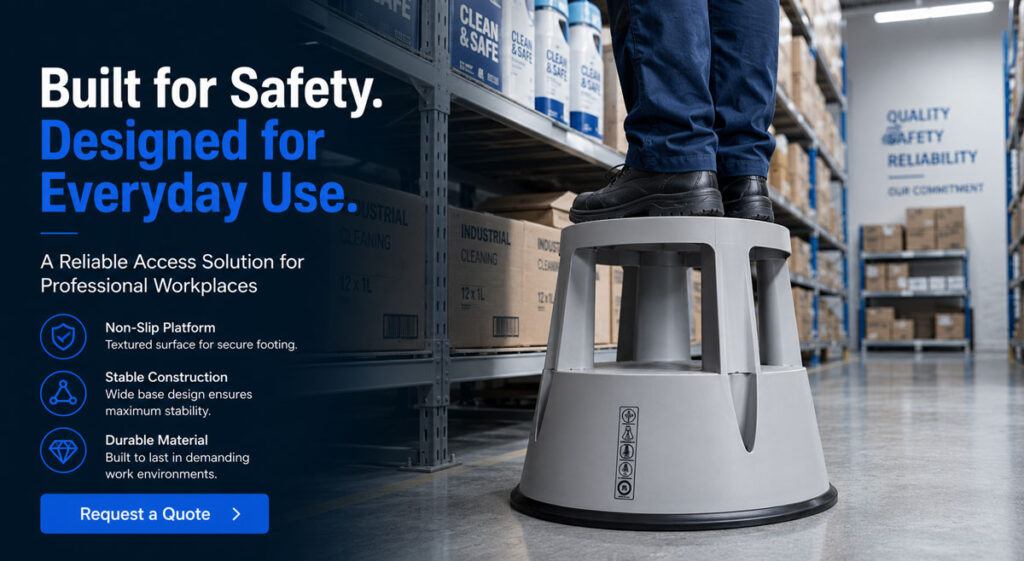
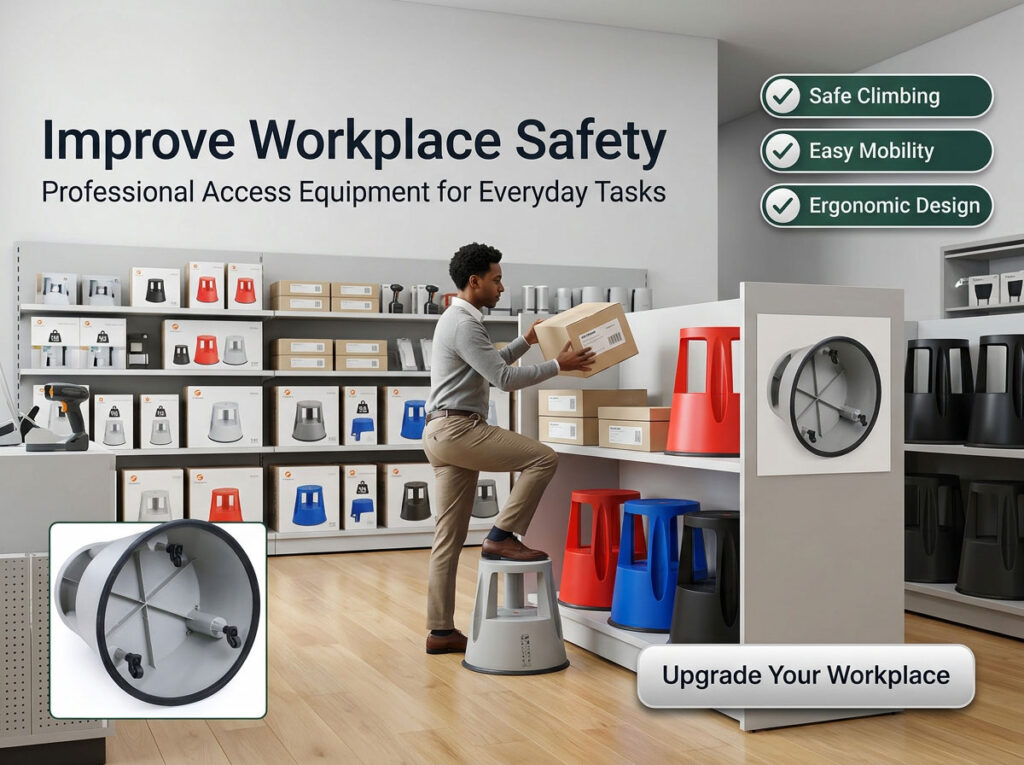
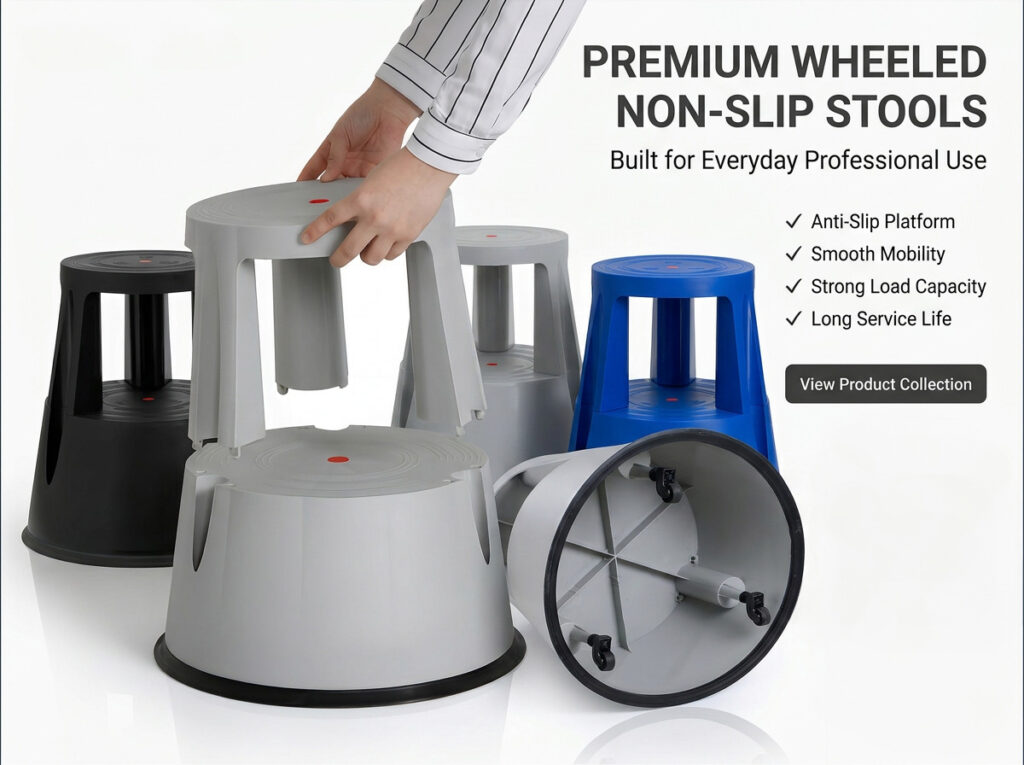
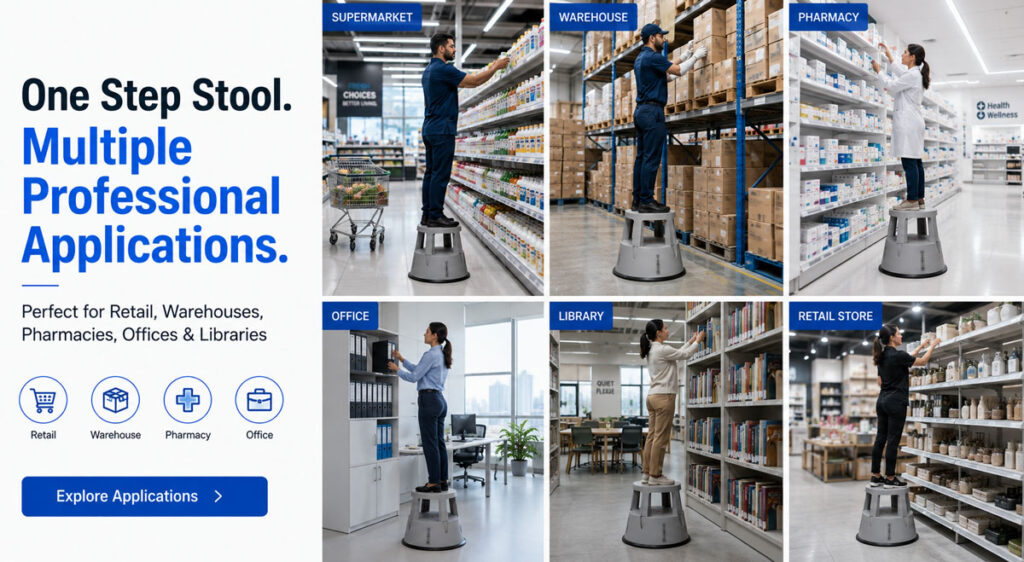
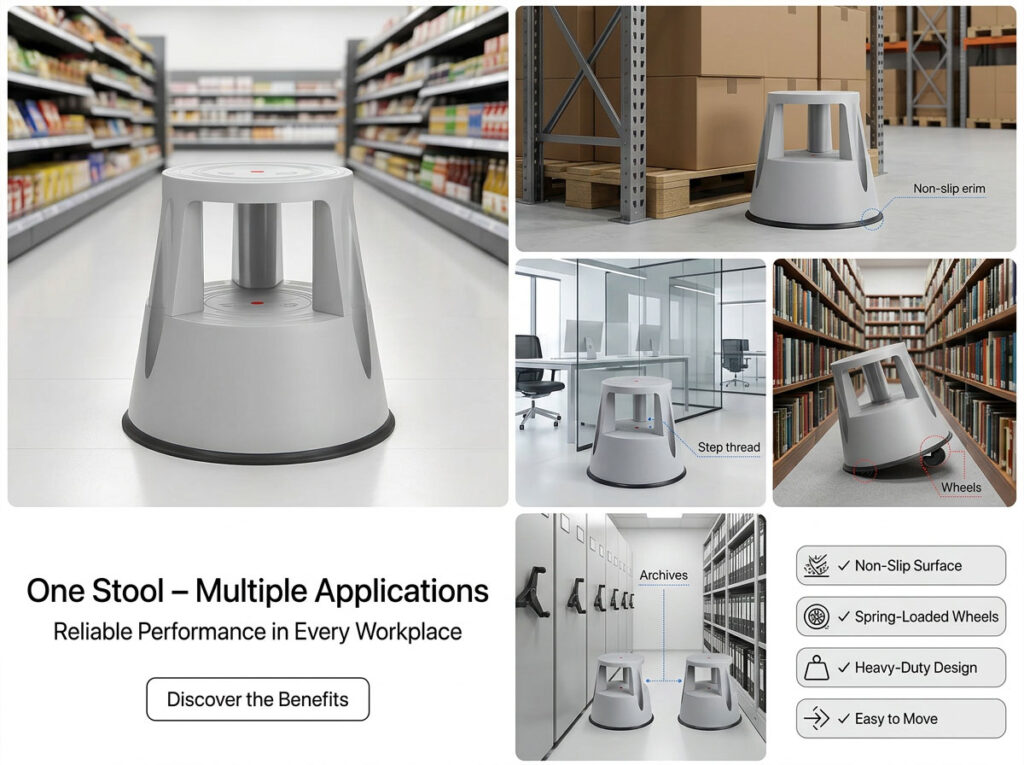
Why “Heavy Duty” Matters More in Nigeria Than Almost Anywhere Else
Nigerian supermarkets and modern retail outlets operate under a unique combination of pressures: high product density on tall gondolas, frequent power interruptions that force manual work, dusty or uneven floors in many locations, intense night and early-morning restocking windows, and a supply chain where importing replacements is neither fast nor cheap. In this setting a standard household step stool fails quickly. Frames bend, plastic cracks, anti-slip surfaces wear smooth, and casters (if present) seize or mark floors.
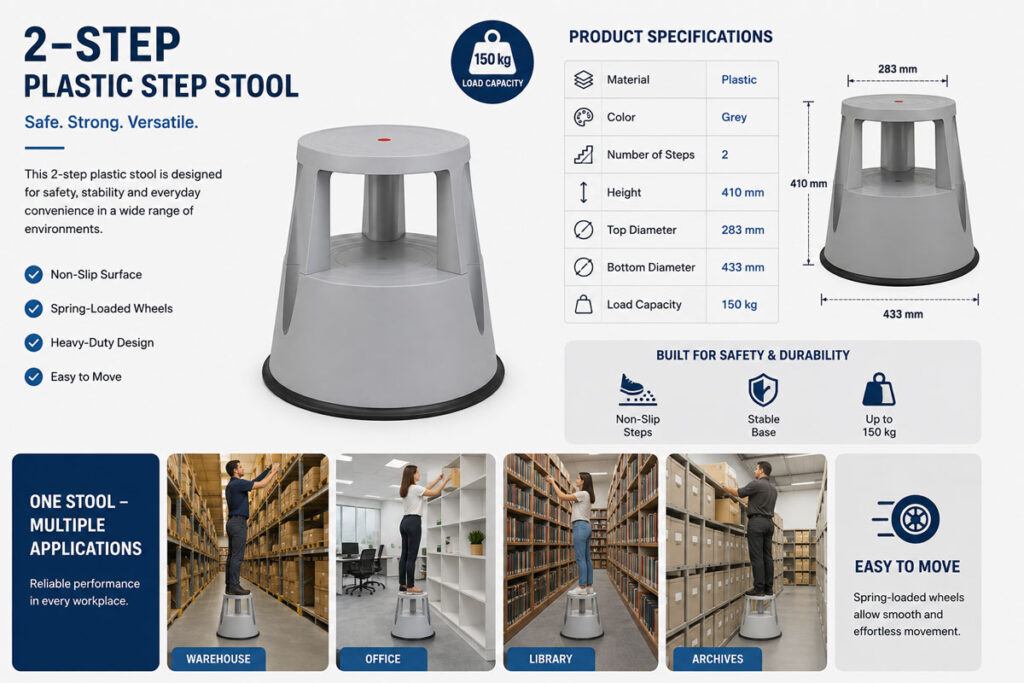
A true heavy-duty step stool is defined by structural over-engineering: higher load ratings (commonly 150 kg or more), thicker tube or plate construction, quality powder coating or galvanizing, deep non-slip treads, and, where mobility is required, industrial casters designed for continuous use. The goal is not elegance; it is survival and reliability under conditions that punish weaker equipment.
Heavy Duty Step Stool Supplier in Nigeria
Core Purpose in the Nigerian Retail Environment
The primary job is safe, repeatable access to upper shelves for restocking, facing, price changes, and promotional setup. Secondary uses include temporary access for maintenance of lighting or signage and support work in stockrooms. Because many stores run lean staffing and face high customer traffic, any tool that slows work or creates injury risk carries a high operational cost.
Heavy-duty units allow staff to work at height with confidence, reduce the temptation to use chairs or boxes, and keep the restocking rhythm intact even when generators are the only power source and time pressure is intense.
Typical Usage Scenarios Across Nigerian Stores
- Night restocking of grocery and non-food aisles in large-format outlets in Lagos, Abuja, Port Harcourt and other urban centres
- Daytime facing and promotional display work under customer traffic
- Access to overhead storage in back-of-house areas where space is limited
- Support for merchandising teams installing seasonal or brand-specific displays
- Occasional maintenance tasks above refrigeration units or lighting
- Multi-store chains standardising on one or two robust models to simplify training and parts
Technical Characteristics That Separate Heavy-Duty from Ordinary
- Load capacity: Minimum 150 kg working load; preferred 200–350 kg or higher for commercial margin
- Frame: Heavy-gauge steel (powder-coated or galvanised) or industrial aluminium with reinforced joints
- Treads: Deep, serrated, rubber-coated or high-friction surfaces that remain effective when dusty
- Base geometry: Wide stance and low centre of gravity to resist tipping when users lean or carry product
- Mobility options: Fixed feet for pure stability or industrial locking/spring-loaded casters for rolling models
- Finish: Coatings that resist corrosion, cleaning chemicals and the abrasive dust common in many locations
- Design life: Engineered for thousands of daily load cycles rather than occasional home use
Material Performance Under Nigerian Conditions
Steel remains the dominant choice for maximum strength and impact resistance. Quality powder coating or hot-dip galvanising is essential because humidity in coastal cities and aggressive cleaning agents accelerate corrosion on inferior finishes. Aluminium offers weight reduction that helps staff move units frequently, but the alloy and section must be industrial grade; domestic aluminium flexes and fatigues under commercial loads. Plastic or polymer components appear only in non-structural roles (treads, feet, grips) and must be UV- and heat-stable.
Rubber and elastomer elements (feet, tread covers, caster tyres) face a dual challenge: high ambient temperatures that can soften compounds and fine abrasive dust that accelerates wear. Specifying heat-resistant, abrasion-resistant compounds is non-negotiable for longevity.
Nigeria-Specific Supply and Import Realities
Importing industrial equipment into Nigeria involves Form M, Pre-Arrival Assessment Report (PAAR), possible SONCAP requirements depending on classification, customs duties calculated on CIF value, VAT (7.5 %), ECOWAS levy, CISS charges and other levies. Port congestion, documentation scrutiny and foreign-exchange availability can extend lead times significantly. Once goods clear, inland transport across variable road conditions adds further risk of damage.
These realities change the procurement calculus. A unit that lasts five to eight years under daily use is far more valuable than a cheaper alternative that requires replacement every 12–18 months. Local or regionally stocked spare parts (casters, treads, locking mechanisms) become a decisive advantage. A supplier that understands the full landed-cost and downtime picture can help operators avoid the false economy of the lowest unit price.
Comparison: Heavy-Duty Commercial vs Common Alternatives
| Feature | Heavy-Duty Industrial Step Stool | Domestic Folding Stool | Improvised (chair/box) | Light Commercial Ladder |
|---|---|---|---|---|
| Load capacity | 150–350+ kg | 100–150 kg | Unrated / unsafe | 100–150 kg |
| Durability under daily use | High | Low | Very low | Moderate |
| Resistance to dust & heat | Designed for it | Poor | N/A | Variable |
| Long-term cost | Lower | High (frequent replacement) | Highest (injury risk) | Moderate |
| Staff confidence | High | Low | Very low | Moderate |
| Suitability for Nigerian supermarket floor | Excellent | Poor | Unacceptable | Limited |
Deployment and Density Logic
Rather than buying a fixed number per store, calculate maximum acceptable walking distance to a functional unit during peak restocking. In dense grocery aisles a practical target is one reliable unit within 15–25 metres of high-frequency reach points, plus a buffer for maintenance. Under-deployment forces improvisation; over-deployment wastes scarce capital. Standardising on one or two models across a chain simplifies training, inspection and parts inventory.
Maintenance as a Survival Strategy
Because importing replacements is slow and expensive, maintenance becomes the primary defence of the investment:
- Daily visual and functional check (stability, tread condition, lock/caster function if mobile)
- Immediate quarantine of any compromised unit
- Weekly cleaning of treads and frames with appropriate agents
- Scheduled replacement of high-wear components before failure
- Simple asset log recording location, condition and actions taken
Units that receive this basic discipline routinely outlast those treated as disposable.
Common Procurement and Operational Mistakes
- Selecting on unit price alone without calculating landed cost and expected life
- Ignoring caster or foot quality for the actual floor surface
- Ordering without confirmed spare-parts availability
- Failing to position units in the natural work path, so staff revert to unsafe alternatives
- Neglecting short practical training on correct use and inspection
- Mixing domestic and industrial units, creating inconsistent expectations
Total Cost Perspective for Nigerian Operators
The relevant comparison is not the purchase price of one stool versus another. It is the cost of maintaining a reliable elevation layer across the store (or chain) versus the ongoing cost of friction, delays, injury exposure and repeated replacement caused by inadequate equipment. When import delays, foreign-exchange risk and downtime are factored in, robust heavy-duty units consistently deliver lower total cost over a multi-year horizon.
Practical Evaluation Checklist for Purchasing Managers
- Confirmed working load and test basis
- Frame and joint construction suitable for daily commercial impact
- Tread and foot materials proven under dusty, high-temperature conditions
- Coating quality that resists local cleaning regimes and humidity
- Mobility system (if required) with reliable locking and non-marking performance
- Spare-parts lead time measured in days or weeks, not months
- Willingness of supplier to support pilot placement and after-sales questions
- Clear marking of load rating and basic use instructions
Expert View on Long-Term Value
In an environment where capital is constrained and logistics are unpredictable, the equipment that stays functional longest creates the greatest operational advantage. Heavy-duty step stools that survive the combination of intensive use, difficult floors, heat and delayed replacements protect both staff and productivity. Firmalazım approaches the category from this resilience perspective—supplying units engineered for Nigerian supermarket realities rather than generic catalogue specifications.
Operators who treat elevation equipment as a durable operating asset rather than a consumable reduce both risk and recurring cost. The right heavy-duty step stool does not merely provide height; it removes a recurring point of friction and exposure from daily retail operations.
Frequently Asked Questions
What load capacity is realistic for Nigerian supermarket staff? 150–250 kg covers most staff-plus-product situations with margin. Higher ratings (300 kg+) provide additional durability under intensive use.
Why do ordinary stools fail quickly in Nigerian stores? Lower-grade materials, thinner sections, inferior coatings and tread compounds cannot withstand daily multi-shift loads, abrasive dust and temperature cycles.
How important is local spare-parts availability? Critical. Import lead times and foreign-exchange constraints make rapid local replacement of casters, treads or locking parts a major differentiator.
Are aluminium heavy-duty stools suitable? Yes, when the alloy and design are industrial grade. They reduce handling fatigue but must not sacrifice rigidity or joint strength.
What floor conditions affect performance most? Dusty tile or epoxy, occasional moisture from cleaning, and minor unevenness. Non-marking, abrasion-resistant feet or casters are essential.
Should every store use the same model? Standardisation simplifies training, inspection and parts. One or two proven models covering the majority of reach heights is usually optimal.
How does the Nigerian import process affect purchasing decisions? Longer lead times and higher landed costs reward units with longer service life and local support over the cheapest initial price.
What is the single most effective way to increase correct usage? Position functional units in the natural work path and give every staff member a short practical demonstration of safe use and inspection.
Can heavy-duty stools be used in wet or produce areas? Stainless or highly cleanable finishes are preferable. Standard coated steel requires more frequent inspection for corrosion.
How often should units be inspected? Visual and functional check at the start of each major shift; deeper inspection weekly under intensive use.
What is the biggest hidden cost of under-specified equipment? Repeated replacement combined with residual injury risk and the productivity loss from improvisation when units fail.
Do rolling (mobile) versions make sense in Nigerian supermarkets? Yes for high-frequency floor work, provided the casters and locking system are industrial grade and non-marking.
How should a multi-store chain approach standardisation? Select one or two models after a controlled pilot, then roll out with consistent positioning rules, training and inspection protocols.
What documentation should accompany each unit? Clear load rating, basic use instructions and, ideally, evidence of structural capacity. Asset tagging supports maintenance tracking.
Is training really necessary for a simple step stool? Yes. Correct loading, both feet on the platform and never overreaching significantly reduce incidents even with good equipment.
How does power unreliability affect the need for these tools? When generators or manual processes dominate, physical restocking intensity often increases, making reliable elevation equipment more important.
What is a practical pilot approach? Deploy a small number of units in one high-intensity zone, measure usage, residual improvisation and any near-misses over 4–6 weeks, then expand.
Can local fabricators produce equivalent heavy-duty units? Some can for basic designs, but consistency of materials, coatings, load testing and spare-parts systems usually favours specialised industrial suppliers.
What is the most expensive mistake in this category? Buying a large quantity of under-specified units that fail early, forcing repeated imports under difficult conditions while safety exposure continues.
How does Firmalazım differentiate as a supplier for the Nigerian market? By prioritising structural durability, material suitability for local conditions, and practical support that recognises the realities of import lead times and store-level operations.
Firmalazım supplies heavy-duty step stools built for the intensity, logistics constraints and operating conditions of Nigerian supermarket environments. When elevation equipment is chosen for longevity and reliability rather than lowest initial price, both safety and daily productivity improve.
Heavy Duty Step Stool Supplier Nigeria
In Nigerian supermarkets, the most dangerous moment is not when staff climb high — it is the moment they decide the proper step stool is too far away, too heavy, or already broken and reach for a chair, a carton, or a domestic stool instead. Heavy-duty step stools exist to make the correct choice the easiest choice. Firmalazım supplies Heavy Duty Step Stool solutions engineered specifically for the intensity, dust, heat, and high staff turnover of Nigerian retail floors. This article examines the product as a safety-control system: how design features prevent the most common error modes, how to build an environment where improvisation becomes rare, and what purchasing managers must demand if they want equipment that actually changes behaviour rather than simply sitting in a store room.
The Real Problem Is Not Height — It Is Decision Making Under Pressure
Every restocking shift in a busy Nigerian supermarket contains dozens of micro-decisions: “Is the proper stool close enough? Does it look stable? Will it take longer to fetch than to use this chair?” When the answer leans toward the unsafe option, risk accumulates. Falls, sprains, and near-misses are rarely caused by a single dramatic failure. They are the result of repeated small compromises.
A heavy-duty step stool only delivers value when it is present, trusted, and easier to use than the alternatives. Everything else — load rating, material, coating — exists to support that behavioural outcome.
Error Modes That Design Must Defeat
- Distance error — The correct unit is more than a few metres away, so staff improvise.
- Trust error — Previous units flexed, wobbled or collapsed, so staff no longer believe the equipment.
- Effort error — The stool is heavy, awkward to move, or difficult to lock, so the path of least resistance wins.
- Visibility error — Units blend into the background or are stored out of sight.
- Condition error — Damaged treads, seized casters or bent frames remain in circulation.
Heavy-duty design attacks each of these directly.
Engineering Responses to Each Error Mode
Against distance error Units must be light enough for frequent repositioning yet rigid enough not to flex. Wide bases that still fit narrow aisles, and optional mobility systems that roll smoothly on dusty tile, keep the tool inside the natural work path.
Against trust error Over-specified load capacity (200–350 kg+), reinforced joints, and visible structural robustness create immediate confidence. Staff feel the difference the first time they step on a properly engineered platform.
Against effort error Thoughtful weight distribution, comfortable grab points, and locking mechanisms that engage automatically or with minimal action remove friction. If using the correct tool feels harder than improvising, the design has failed.
Against visibility error High-visibility colours or clear zone marking make the safe option obvious. Equipment that disappears visually will be ignored.
Against condition error Materials and coatings that resist abrasive dust, heat cycling and aggressive cleaning keep the unit looking and performing like new for years. Easy-to-replace wear parts (treads, feet, casters) allow rapid restoration instead of permanent degradation.
Material and Construction Priorities for Nigerian Conditions
- Frame: Heavy-gauge steel with quality powder coating or galvanising remains the most forgiving choice under impact and heat. Industrial aluminium is viable when weight reduction is critical, provided section thickness and joint design are commercial grade.
- Treads: Deep serrated or rubber-coated surfaces that maintain grip when fine dust is present. Smooth domestic treads become slippery quickly.
- Feet / casters: Non-marking, heat-resistant compounds. Soft materials that mark floors or harden in heat create secondary problems.
- Finish: Coatings that survive frequent wet cleaning and coastal humidity without rapid corrosion or peeling.
Building a Zero-Improvisation Culture
Equipment alone is insufficient. The following operational layer turns hardware into behaviour change:
- Position units according to a maximum walking-distance rule (typically 15–25 metres in dense grocery).
- Mark permanent “home” locations so every unit has a known place.
- Conduct a two-minute practical demonstration for every new staff member focused on the feel of a stable platform versus an unstable one.
- Make damaged units immediately visible and removed (tagged quarantine area).
- Include a simple count and condition check in opening and closing routines.
- Celebrate near-miss reporting rather than punishing it.
When these practices sit on top of genuinely robust equipment, improvisation rates fall sharply.
Comparison of Approaches
| Approach | Typical Outcome in Nigerian Stores | Residual Risk |
|---|---|---|
| Cheapest available stools | Rapid failure, high improvisation, repeated spend | High |
| Mid-range “commercial” units | Moderate life, partial trust, mixed usage | Medium |
| True heavy-duty + positioning + training | Long life, high voluntary usage, low improvisation | Low |
| Heavy-duty without operational system | Good equipment under-used or poorly maintained | Medium-High |
The combination of engineered product and simple operating system produces the lowest total risk and cost.
Nigeria-Specific Constraints That Shape Design Choices
Import lead times, foreign-exchange pressure and inland transport risk make early failure expensive. Units that last five to eight years under daily multi-shift use therefore carry a structural advantage over those that require replacement every 12–24 months. Local or regionally available wear parts further protect uptime. Climate (heat, humidity in coastal cities, abrasive dust inland) demands materials and coatings specified for those conditions rather than temperate-market defaults.
Practical Deployment Sequence for a Store or Chain
- Map the highest-frequency reach zones and measure current walking distances to existing equipment.
- Select one or two heavy-duty models that cover 90 % of tasks.
- Pilot in a single high-intensity area with correct positioning and short training.
- Measure improvisation rate and any near-misses before and after.
- Refine quantity and placement, then standardise.
- Embed daily visual checks and monthly deeper inspection into existing routines.
- Maintain a small buffer stock of critical wear parts.
Maintenance as Error Prevention
A unit that looks neglected invites distrust. Simple discipline prevents that:
- Shift-start visual check for stability, tread condition and lock/caster function.
- Immediate removal of any unit that fails the check.
- Weekly cleaning focused on tread surfaces and moving parts.
- Scheduled replacement of feet, treads or casters before they reach failure.
- Asset log that records condition and actions.
This level of care is inexpensive and dramatically extends both physical life and staff confidence.
Expert Perspective
The safest supermarket floor is not the one with the most safety posters. It is the one where the correct tool is the path of least resistance. Heavy-duty step stools succeed when their design, placement and condition make improvisation feel unnecessary. Purchasing managers who evaluate suppliers only on unit price miss the larger system. Those who evaluate on the ability to reduce error modes — distance, trust, effort, visibility and condition — buy equipment that actually changes outcomes.
Firmalazım designs and supplies heavy-duty step stools for exactly this purpose: robust enough to earn trust, practical enough to stay in the work path, and supported in a way that recognises the realities of Nigerian retail operations.
Frequently Asked Questions
What is the most common reason staff still improvise even when stools are available? The unit is too far away, feels unstable from previous experience, or requires more effort to use than a nearby chair or carton.
How does heavy-duty construction specifically increase voluntary usage? Visible rigidity and a solid feel underfoot rebuild trust that lighter units have often destroyed.
What walking distance should be the maximum to a functional stool during peak restocking? 15–25 metres in dense grocery aisles is a practical target for most Nigerian large-format stores.
Are mobile (rolling) heavy-duty stools better than fixed ones? For high-frequency floor work, yes — provided the locking system is reliable and the casters suit dusty local floors. Fixed units remain useful in stockrooms.
How important is colour? High-visibility colours reduce the “I didn’t see it” excuse and support a culture where the safe option is obvious.
What load rating actually changes behaviour? Ratings of 200 kg and above create a clear perception of strength. Lower ratings often feel marginal to staff who have seen lighter stools fail.
Can local fabrication match industrial heavy-duty performance? Some fabricators produce strong basic frames, but consistency of materials, coatings, tread quality and spare-parts systems usually favours specialised suppliers.
How quickly should a damaged unit be removed from the floor? Immediately. Leaving compromised equipment in circulation destroys trust faster than almost any other factor.
What is the shortest effective training method? A two-minute hands-on demonstration of the difference between a stable heavy-duty platform and an unstable alternative, repeated for every new team member.
Does power instability affect the need for these stools? Yes. When generators or manual processes dominate, physical restocking intensity often rises, increasing both frequency of use and the cost of any delay or injury.
How do dusty floors change material requirements? Treads and feet must maintain grip and resist abrasive wear. Smooth or soft compounds degrade quickly and become slippery.
Should every store in a chain use identical models? Yes for the core fleet. Standardisation simplifies training, inspection, parts and behavioural expectations.
What is the biggest hidden cost of under-specified stools? The combination of repeated replacement under difficult import conditions plus the ongoing residual risk from continued improvisation.
How can near-miss reporting be encouraged? Treat it as useful operational data rather than a source of blame. Simple recognition systems work better than punishment.
Is a higher price always better? No. The correct price is the one that buys genuine structural durability, suitable materials for local conditions, and practical support — not the highest number on the quotation.
What single operational change produces the fastest reduction in improvisation? Correct physical positioning of robust units inside the natural work path, combined with immediate removal of any damaged equipment.
How should wear parts be managed? Keep a small buffer stock of feet, treads and (if mobile) casters so restoration takes hours rather than weeks.
Can heavy-duty stools be used safely while carrying product? Only within the rated capacity, with both feet on the platform and no overreaching. Design and training must reinforce this limit.
What documentation is useful at store level? Simple asset tags and a one-page inspection log. Complex paperwork is ignored; basic accountability is not.
How does Firmalazım approach the safety-control role of these products? By treating the step stool as a behavioural and risk-control tool rather than a piece of generic hardware, and by prioritising the features and support that make the correct choice the easiest choice on a Nigerian supermarket floor.
Firmalazım supplies heavy-duty step stools designed to close the gap between “we have equipment” and “staff actually use the safe option every time.” When design, placement and condition align, both injury exposure and operational friction decline together.
Industrial Step Stool Supplier Nigeria
Industrial step stools are essential supermarket equipment in Nigeria for safe shelf stocking, high-reach merchandising, maintenance, and inventory work. Generic domestic stools fail under commercial loads, humidity, frequent use, and Nigerian retail conditions. Firmalazım supplies purpose-built industrial step stools engineered for supermarket environments—higher load ratings, non-slip surfaces, corrosion resistance suited to coastal and inland climates, foldable or fixed designs, and compliance with practical safety expectations. Selecting the right supplier reduces workplace incidents, improves staff efficiency, lowers long-term replacement costs, and supports consistent store operations across Lagos, Abuja, Port Harcourt, and nationwide networks. This guide gives purchasing managers a practical decision framework covering materials, load capacity, real Nigerian operating conditions, total cost of ownership, common procurement mistakes, and supplier evaluation criteria.
Detailed Article
Why Step Stools Are Not Optional Equipment in Nigerian Supermarkets
In a busy Nigerian supermarket, vertical space is money. Gondola shelves, wall units, and high storage often push product beyond comfortable reach. Staff repeatedly need safe elevation for facing, restocking, price tagging, cleaning, and minor maintenance. Without reliable industrial step stools, operations slow, products stay out of reach, and injury risk rises—especially during peak hours or when floors are wet from cleaning or humidity.
Domestic folding stools sold in general markets are not designed for this duty cycle. They buckle under repeated commercial loading, lack adequate anti-slip performance on tiled or slightly damp floors, and degrade quickly in Nigeria’s climate. Purchasing managers who treat step stools as low-cost consumables often discover higher costs in downtime, replacements, and potential liability.
Firmalazım approaches industrial step stools as core supermarket equipment—alongside gondolas, chillers, and checkout counters—rather than an afterthought.
Core Functional Requirements for Supermarket Use
An industrial step stool for Nigerian retail must deliver:
- Stable elevation for adults of varying heights reaching upper shelves or lighting.
- Load capacity that safely exceeds typical staff-plus-product weight (commonly targeted at 150–350 kg or higher depending on model).
- Non-slip steps and feet that perform on ceramic tiles, concrete, or slightly wet surfaces common in stores.
- Compact storage or easy mobility so units do not obstruct aisles when not in use.
- Durability against frequent folding/unfolding, impact, and environmental exposure.
- Easy cleaning to meet hygiene expectations in food retail.
Models range from compact 2–3 step units for everyday merchandising to taller platform-style stools for higher reaches or maintenance tasks.
Material Analysis: What Holds Up in Nigerian Conditions
Steel (powder-coated or painted) Offers high strength and good load ratings at moderate cost. Powder coating improves corrosion resistance. Suitable for most inland stores. In coastal or high-humidity zones (Lagos, Port Harcourt), inspect coatings regularly and prefer thicker or better-protected finishes.
Aluminium Lightweight, naturally corrosion-resistant, and easier for staff to move frequently. Ideal where units are carried between aisles or stores. Load capacity must still meet industrial ratings; pure domestic aluminium stools often fall short.
Stainless steel Premium choice for wet areas, cold rooms, or stores with rigorous cleaning regimes. Higher initial cost but excellent longevity and hygiene. Common in hospital or food-processing adjacent applications and increasingly relevant for high-end or large-format supermarkets.
Hybrid constructions Steel frames with plastic or composite steps, or aluminium with reinforced platforms, balance weight, cost, and grip. Look for reinforced joints and quality welding or fastening.
Avoid thin-gauge domestic steel or plastic-dominant designs marketed for home use. They rarely survive intensive supermarket duty cycles.
Performance Specifications That Matter
Key measurable attributes purchasing managers should demand:
| Attribute | Typical Industrial Target | Why It Matters in Nigeria Supermarkets |
|---|---|---|
| Load capacity | 150–350+ kg | Staff + cartons/products; safety margin |
| Step height / total reach | 2–6 steps common; platform options | Matches gondola and wall shelf heights |
| Platform / step size | Wide enough for secure footing | Reduces fatigue and slip risk |
| Anti-slip features | Rubber treads, textured surfaces, non-marring feet | Wet floors, cleaning residue |
| Foldability / storage | Folds flat or stacks | Limited backroom space |
| Weight of unit | Manageable for staff (aluminium advantage) | Frequent repositioning |
| Finish | Powder coat, anodised, or stainless | Humidity and cleaning chemicals |
Standards references such as OSHA-related dimensional guidance, EN 14183 concepts for step stools, or ANSI A14.11 principles provide useful benchmarks even when local enforcement varies. Prioritise documented load testing and stable geometry over pure marketing claims.
Nigerian Operating Realities
- Climate: High humidity and coastal salt air accelerate corrosion on poorly finished steel. Aluminium or properly coated units perform better in Lagos and Port Harcourt.
- Flooring: Smooth tiles or polished concrete are common. Non-slip feet and treads are non-negotiable.
- Usage intensity: Multiple staff, multiple shifts, frequent moves. Units that feel solid underfoot and lock securely reduce hesitation and accidents.
- Power and space constraints: No reliance on powered lifts for routine tasks. Compact, non-powered stools fit existing store layouts.
- Supply chain: Reliable local stock or fast replenishment matters more than the lowest unit price when a store needs replacements quickly.
Common Failure Modes and How to Avoid Them
Purchasing managers repeatedly encounter the same issues:
- Insufficient load rating → bent frames or collapsed steps.
- Poor anti-slip → slips during wet cleaning or on polished floors.
- Weak hinges or locks → units that fold unexpectedly or will not stay open.
- Corrosion at joints → structural weakening within 12–24 months in humid zones.
- Overly heavy designs → staff avoid using them, defeating the purpose.
- No spare-parts pathway → entire unit discarded when one component fails.
Firmalazım focuses on designs that address these failure points through material selection, joint reinforcement, and practical testing under retail-like conditions.
Total Cost of Ownership Perspective
A cheap domestic stool may cost a fraction of an industrial unit upfront. Over two to three years the industrial unit usually wins:
- Fewer replacements
- Lower injury and downtime risk
- Higher staff willingness to use the equipment correctly
- Better appearance and professionalism on the sales floor
Calculate cost per year of reliable service rather than purchase price alone. Factor in potential claims, lost merchandising time, and management attention spent on equipment failures.
Procurement Checklist for Nigerian Buyers
- Define primary use (daily merchandising vs occasional maintenance) and maximum required reach.
- Specify minimum load capacity with safety margin.
- Require clear material and finish description suited to your climate zone.
- Demand evidence of stability testing or equivalent.
- Confirm fold dimensions and ease of handling by typical staff.
- Evaluate supplier stock levels, delivery lead times across Nigeria, and after-sales support.
- Inspect sample units under load and on representative flooring if possible.
- Clarify warranty terms covering structural failure versus normal wear.
- Consider standardising on one or two models across the chain for training and parts simplicity.
Integration with Broader Supermarket Equipment Strategy
Industrial step stools sit alongside gondola systems, refrigeration, POS furniture, and trolleys. A coherent equipment partner understands how these elements interact in layout, workflow, and maintenance. Choosing a supplier experienced in supermarket fit-outs reduces coordination friction and supports consistent standards across multiple branches.
Expert Operational Insight
From a purchasing and operations viewpoint, the quietest stores with the fewest access-related incidents are those that treat elevation equipment as infrastructure rather than disposable tools. Staff who trust the stool work faster and more carefully. Managers who standardise quality units spend less time chasing replacements and more time on merchandising and customer experience.
Firmalazım positions industrial step stools within this infrastructure mindset—durable, fit-for-purpose solutions for Nigerian supermarket environments rather than generic imports or local market finds.
Call to Action Options (varied tone)
- Request a specification sheet and current stock availability for industrial step stools matched to your store format.
- Speak with a Firmalazım specialist about load ratings, materials, and delivery options for your locations.
- Share your typical shelf heights and daily usage patterns for a tailored recommendation.
- Evaluate sample units against your existing stools and measure the difference in stability and confidence.
- Contact Firmalazım to align step-stool standards with your broader supermarket equipment programme.
Frequently Asked Questions (FAQ)
1. What distinguishes an industrial step stool from a domestic one for supermarket use? Industrial models are built for higher duty cycles, greater load ratings, better stability under commercial use, and materials that tolerate frequent handling and environmental exposure. Domestic stools prioritise low cost and light occasional home use.
2. What load capacity should Nigerian supermarkets specify? Target at least 150 kg with a clear safety margin; many industrial units offer 200–350 kg or higher. Account for staff weight plus products or tools being carried.
3. Are aluminium step stools better than steel in Nigeria? Aluminium offers lower weight and inherent corrosion resistance, advantageous in humid or coastal areas and for frequent movement. Steel provides excellent strength at potentially lower cost if properly coated. Choice depends on priorities of mobility versus pure durability and budget.
4. How important is anti-slip performance on Nigerian supermarket floors? Critical. Tiled and polished floors become slippery when wet from cleaning or humidity. Quality rubber treads, textured steps, and non-marring feet significantly reduce risk.
5. Can the same step stool serve both merchandising and maintenance tasks? Often yes for moderate heights. Taller platform-style units or multi-step designs expand versatility. Match the model to the highest regular reach required.
6. What fold dimensions matter for backroom storage? Units that fold flat or very compactly free valuable space. Confirm folded size against your storage constraints.
7. How does humidity affect longevity? Poorly finished steel corrodes at joints and fasteners. Prefer aluminium, stainless, or high-quality powder-coated steel with attention to weld and coating integrity.
8. Should we standardise one model across multiple stores? Yes for training consistency, parts commonality, and simplified purchasing. Allow limited variation only for distinctly different store formats or height needs.
9. What documentation should a supplier provide? Clear specifications (load, dimensions, materials), any available test references, warranty terms, and realistic delivery information for Nigerian locations.
10. How do we evaluate stability before bulk purchase? Inspect and test sample units: stand on them, shift weight, check for flex or wobble, test locking mechanisms, and assess grip on representative flooring.
11. Are there height recommendations relative to typical gondola systems? Match step count and platform height to the upper shelves staff regularly access. Measure actual reaches in your stores rather than relying on generic assumptions.
12. What maintenance do industrial step stools require? Regular visual inspection of steps, frames, locks, and feet; cleaning of treads; prompt replacement of damaged rubber components; and checking for corrosion or loose fasteners.
13. Can these stools be used in cold rooms or wet areas? Stainless steel or specially finished models perform better. Confirm suitability for temperature and wash-down conditions.
14. How does total cost of ownership compare to buying cheap replacements? Industrial units usually cost less over 2–3 years when factoring replacements, downtime, and risk. Track actual replacement frequency of current stools for a clear comparison.
15. What are common procurement mistakes? Focusing solely on lowest unit price, ignoring load ratings, accepting domestic-grade products for commercial duty, failing to test samples, and neglecting after-sales support and stock availability.
16. How quickly can replacements be obtained in Nigeria? Depends on the supplier’s local inventory and logistics network. Prioritise partners with established presence and realistic lead times for Lagos, Abuja, and other major centres.
17. Do step stools need certification for use in Nigerian retail? While specific local mandatory certification varies, specifying models that meet recognised dimensional and load principles (drawing from international step-stool guidance) supports safer procurement and reduces risk.
18. Can staff of different heights use the same stool effectively? Wider platforms and appropriate step spacing help. Some operations keep both lower and higher units available.
19. How do industrial step stools integrate with overall store safety programmes? They form part of working-at-height controls for low elevations. Combine with training on proper use, inspection routines, and clear policies against using unstable alternatives (chairs, boxes, etc.).
20. What role does Firmalazım play beyond supplying the product? Firmalazım focuses on matching industrial step stools to supermarket operational realities in Nigeria, providing specification guidance, availability information, and alignment with broader retail equipment needs.
21. Are mobile or wheeled variants useful? For larger formats or frequent long-distance moves within a store, spring-loaded or lockable castor options can help, provided stability when in use is not compromised.
22. How should we train staff on correct use? Emphasise full opening and locking, three points of contact where practical, never overreaching, inspecting before use, and storing units properly after use.
23. What happens if a stool fails under normal use within warranty? A reputable supplier addresses structural failures according to stated terms. Clarify coverage for frames, steps, and critical components at purchase.
24. Is custom branding or colour possible? For larger orders some suppliers accommodate colour or identification marking to support store standards or asset tracking.
25. How do we calculate the right quantity per store? Base on number of aisles, peak staffing, and observed concurrent need. Having units readily available in key zones prevents staff from improvising with unsafe alternatives.
26. Do these stools work on slightly uneven floors? Designs with good foot geometry and non-slip tips perform better. Severely uneven surfaces may still require caution or alternative access methods.
27. What is the typical service life under supermarket conditions? Well-specified industrial units lasting several years with proper care; domestic units often require much more frequent replacement.
28. Should purchasing be handled centrally or by individual stores? Central standardisation improves consistency and leverage; allow limited local flexibility only where justified by unique conditions.
29. How does Firmalazım support multi-branch supermarket groups? By offering consistent product standards, coordinated supply information, and recommendations that scale across locations.
30. What is the first practical step for a purchasing manager evaluating options? Define required reach, load, and environmental conditions; request specifications and samples from a specialist supplier such as Firmalazım; then compare against current equipment performance and failure history.
This content is structured for a high-converting landing page: clear value for the purchasing decision-maker, practical Nigerian context, decision tools, and multiple natural paths to contact Firmalazım.

Bir yanıt yazın