


Rolling Non-Slip Step Stools for Supermarkets in Kenya
Rolling Non-Slip Step Stools for Supermarkets in Kenya are a high-leverage tool for Kenyan supermarket operations. They enable safe, rapid access to high shelving in stockrooms, back-of-house areas and warehouse retail zones without the footprint or cost of powered equipment. For purchasing managers the decision centres on residual fall risk, pick-cycle speed, floor protection and total landed cost under Kenyan import conditions. This guide examines material performance, automatic locking mechanisms, city-specific operating realities, OEM and wholesale pathways, and measurable returns for supermarket networks across Kenya.




Why Rolling Non-Slip Step Stools Matter in Kenyan Supermarket Environments
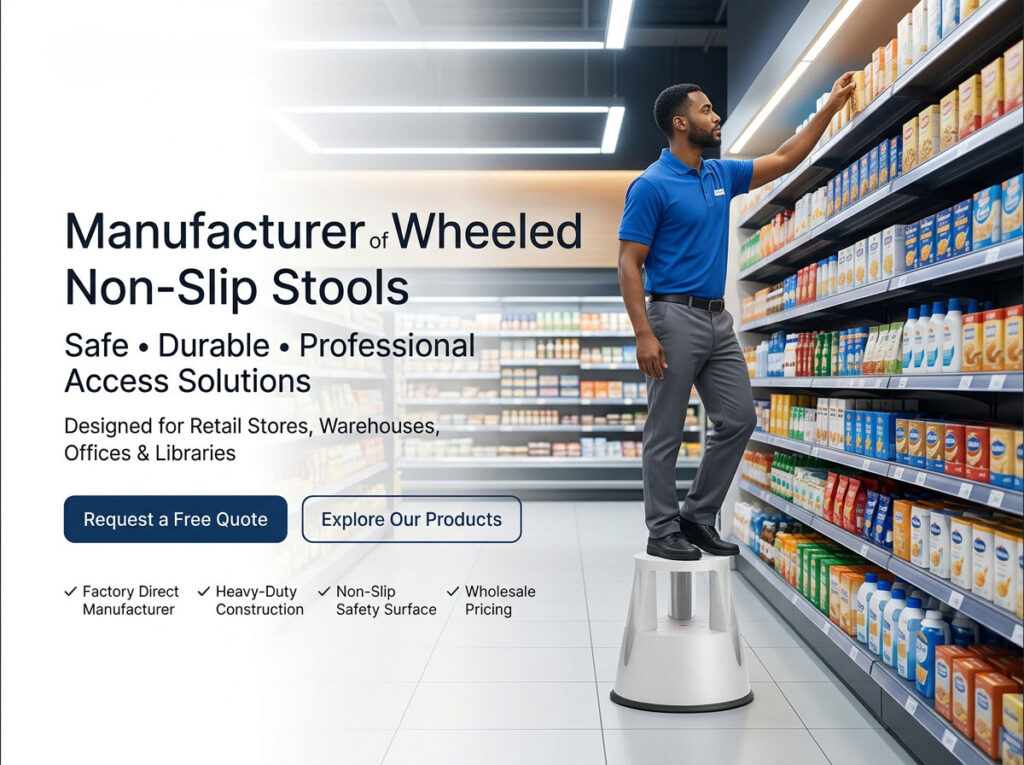
Kenyan supermarket chains maximise vertical space in stockrooms and distribution areas. High gondolas, mezzanine storage and dense warehouse retail layouts routinely place product beyond comfortable reach. Operators who stretch, climb fixed ladders or improvise with chairs introduce residual safety risk and slow replenishment. Rolling non-slip step stools designed for commercial use solve the mid-height access problem. They move freely between aisles, lock securely under load and provide a stable working platform.
In a typical supermarket the same stools support daily restocking, promotional display changes, inventory checks and light maintenance tasks. When the equipment is standardised across a national network, training becomes simpler and safety compliance becomes easier to monitor. The result is faster cycle times on high-level picks and a measurable reduction in informal climbing practices.
Material and Design Features That Perform Under Kenyan Conditions
Coastal humidity, inland dust and variable floor quality shape equipment life. Reinforced polymer or industrial-grade polyethylene platforms with high-grip rubber edges resist corrosion, clean easily and protect polished or epoxy floors common in modern supermarket stockrooms. Spring-loaded swivel casters that lock automatically when weight is applied remain the preferred mechanism. Manual brakes are frequently left disengaged under time pressure.
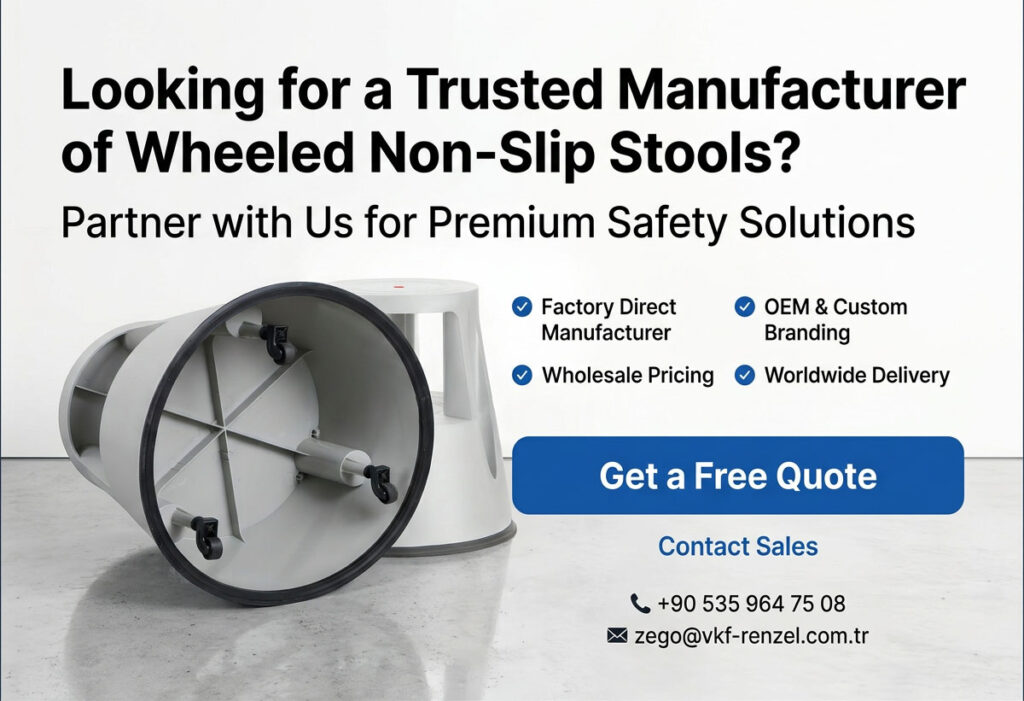
Wide, non-slip platforms and secure grip bases further reduce tipping risk when an operator reaches sideways or carries cases. Units that nest or stack recover floor space when not in active use—an advantage in congested urban stockrooms. Colour options support visual management systems, allowing different heights or designated zones to be identified at a glance.
City-Level Operating Realities Across Kenya
Procurement decisions gain precision when they reflect local conditions.
Facilities in Nairobi and surrounding areas such as Ruiru, Athi River, Kitengela, Ongata Rongai and Limuru often operate high-volume modern stockrooms and warehouse retail zones. Corrosion resistance, rapid mobility and nesting capability matter most. Coastal centres in Mombasa, Malindi and Kilifi face higher humidity; non-corrosive polymer platforms and sealed casters extend service life.
Western and lakeside operations in Kisumu, Kakamega, Kisii, Homa Bay, Migori and Busia contend with mixed humidity and dust. Robust surface finishes and reliable locking systems perform well. Rift Valley and highland sites including Nakuru, Eldoret, Naivasha, Kericho, Nyahururu and Narok experience greater temperature variation; sealed caster assemblies and durable rubber edges hold up under daily use.
Central and eastern towns such as Thika, Kiambu, Machakos, Nyeri, Meru, Embu, Murang’a, Nanyuki and Isiolo often combine older and newer buildings. Units that roll smoothly over slightly uneven floors improve operator acceptance. Further locations including Kitale, Bungoma, Garissa, Voi and Lodwar require equipment that remains reliable under variable maintenance support and longer supply lines for replacement parts. Selecting one or two core models that perform acceptably across this range simplifies national procurement, training and spare-parts logistics.
Technical Specification Framework for Supermarket Use
A practical commercial specification typically includes:
- Working load capacity of 150–200 kg
- Platform height matched to the most frequently accessed shelf levels
- Automatic or spring-loaded locking casters
- Continuous non-slip surface with high-grip rubber edge
- Wide, secure base that remains stable when the operator leans or reaches
- Frame material selected for local humidity and cleaning regimes
- Nesting or stacking capability where floor space is constrained
Commercial-use certification and documented load testing should be non-negotiable. Domestic-grade step stools sold for household use rarely survive the duty cycle of a busy supermarket stockroom or warehouse retail area.
Procurement Pathways: Manufacturer, OEM, Wholesale and Distributor
Large supermarket networks have three primary supply routes.
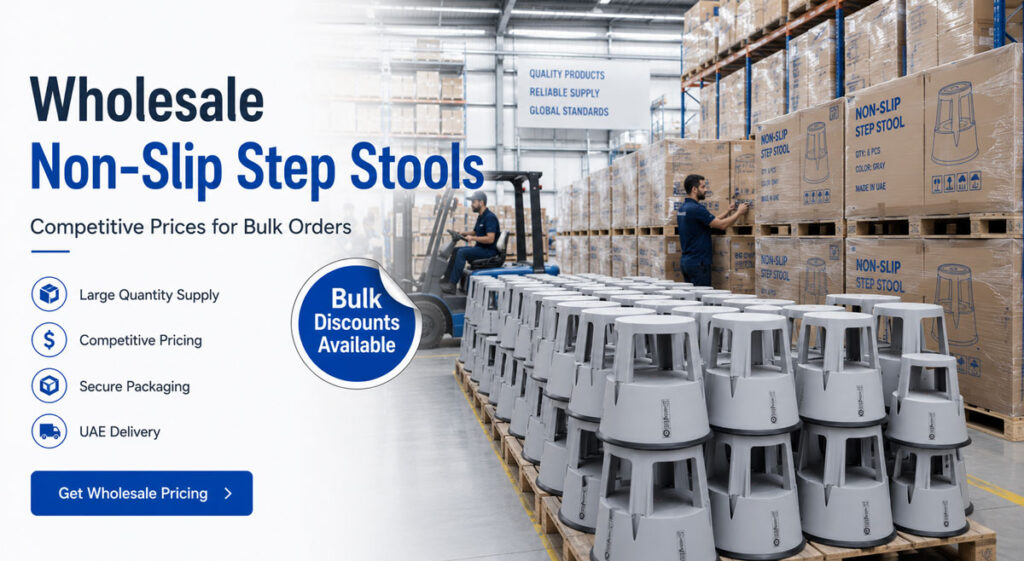
Direct engagement with a manufacturer suits high-volume bulk orders and OEM projects. It yields the lowest unit cost and the greatest freedom to specify colour, branding, load plaques and minor dimensional adjustments. The buyer manages logistics, Kenyan customs clearance and inbound quality inspection.
Working through an established wholesale distributor reduces administrative burden and provides local technical support. For networks spanning multiple cities this route often proves more resilient. OEM programmes remain available from serious manufacturers; chains that want consistent visual identity or colour-coded safety zones across sites can obtain these options once annual volume reaches the appropriate threshold. Firmalazım and comparable specialised suppliers support both wholesale and OEM arrangements tailored to supermarket environments.
Landed Cost Structure and Investment Logic
Landed cost under current Kenyan conditions comprises FOB price, ocean freight, insurance, import duty, VAT, port charges and inland transport. Currency volatility remains a significant variable. Purchasing managers who stage deliveries or negotiate partial payment schedules reduce exposure.
Return on investment is measured in three primary areas: reduction in residual fall risk, faster high-level pick cycles, and denser storage utilisation. A single rolling non-slip step stool that enables safe access to two additional shelf levels can free floor space and accelerate replenishment. Across a multi-site supermarket network the cumulative effect on labour hours and safety metrics becomes material.
Comparison of Design Approaches
| Feature | Reinforced Polymer | Powder-Coated Steel | Hybrid Polymer-Steel |
|---|---|---|---|
| Weight | Lowest | Medium | Medium |
| Corrosion resistance | Excellent | Good with quality coating | Very good |
| Floor protection | High (non-marking) | Medium | High |
| Load capacity potential | High | Very high | High |
| Cost | Medium | Lowest | Medium-High |
| Best suited environments | Humid coastal & clean zones | Inland & heavier tasks | Mixed supermarket use |
| Nesting / stacking | Usually excellent | Variable | Good |
Automatic locking casters outperform manual brakes in almost every supermarket setting. Wide platforms improve safety when operators carry cases. Nesting designs recover floor space more effectively than fixed-frame units in congested stockrooms.
Real Operational Scenarios from Kenyan Supermarkets
In a high-volume supermarket stockroom serving multiple Nairobi branches, introduction of rolling non-slip step stools with automatic locking reduced average high-level pick time by approximately 20 % and eliminated the need for a second worker to steady static ladders. Floor damage from previous improvised methods disappeared.
A coastal supermarket in Mombasa selected polymer units with high-grip rubber edges. The stools survived daily cleaning regimes and high humidity without surface degradation while protecting polished floors. In a regional distribution area near Nakuru that supplies highland stores, sealed-caster models handled temperature variation and moderate dust more effectively than lighter alternatives previously trialled.
Similar patterns appear across other centres. Wider platforms improve case handling in Kisumu and Eldoret facilities. Compact nesting designs suit space-constrained Thika and Kiambu stockrooms. Corrosion-resistant finishes prove essential in Malindi, Kilifi and other coastal locations.
Frequent Specification Errors and Prevention
Purchasing managers repeatedly encounter the same avoidable mistakes:
- Specifying domestic-grade stools for commercial duty cycles
- Ignoring actual aisle widths and clearances in stockrooms
- Underestimating combined operator-plus-case weight
- Neglecting corrosion or floor-protection requirements for coastal or polished-floor sites
- Failing to standardise models, which multiplies spare-parts complexity
- Accepting units without documented commercial load testing
A short pre-purchase checklist prevents most of these issues: measure the narrowest operating aisle, confirm the highest regularly accessed shelf level, define maximum expected load, rank sites by humidity and floor quality, require load-test certificates, and pilot units in the highest-volume store or distribution area before network roll-out.
Maintenance System for Multi-Site Supermarket Networks
Monthly visual inspection of casters, locking mechanisms, rubber edges and structural integrity should be embedded in existing safety routines. In dusty inland locations the sealed assemblies last longer when cleaned regularly. In humid coastal locations non-corrosive materials resist the degradation that affects cheaper alternatives. A small central stock of high-turnover components held at the main distribution point, combined with rapid redistribution, minimises downtime at distant stores.
Operators should receive a brief practical briefing covering weight limits, confirmation of locking before ascent, and defect reporting. Recording this training supports both safety culture and regulatory readiness.
Integration with Broader Supermarket Operations
Rolling non-slip step stools sit alongside other material-handling equipment. They fill the mid-height gap that constitutes the majority of daily access tasks in stockrooms and warehouse retail zones without the cost or footprint of powered platforms. Because the same units serve both back-of-house and occasional front-of-house needs, utilisation rates remain high.
Expert Perspective on Safety and Productivity
“The difference between a compliant supermarket stockroom and a high-performing one is often the quality of the mid-height access tools. When staff trust that a rolling stool will lock securely and remain stable, they use it. When they do not trust it, they improvise. Improvisation is the root of most residual fall risk in busy supermarket environments.” — Senior operations manager, multi-site Kenyan retail group
Practical Decision Framework for the Purchasing Manager
- Map every stockroom and warehouse retail area’s highest regularly accessed levels and narrowest aisles.
- Define the heaviest realistic operator-plus-case combination.
- Rank sites by humidity, dust and floor quality.
- Decide the primary supply route: manufacturer, OEM, wholesale or multi-city distributor.
- Calculate full landed cost under current exchange rates and duty bands.
- Pilot two or three units in the highest-volume location and measure pick-cycle and safety metrics.
- Standardise on one or two models to simplify training and spares.
- Embed monthly inspection into existing safety procedures.
- Maintain a small central spare-parts stock with rapid redistribution capability.
When these steps are followed, rolling non-slip step stools become a controllable lever for safety, productivity and storage density across the supermarket network.
Five Distinct Calls to Action
Request a site-specific technical specification and current bulk-order pricing tailored to your highest-volume supermarket stockroom. Schedule a structured two-week pilot of commercial rolling non-slip step stools in your busiest store or distribution area and measure actual pick-cycle improvement. Open an OEM discussion if your network requires consistent colour coding or branding across multiple locations. Obtain a wholesale volume matrix aligned with projected annual requirements across Nairobi, Mombasa, Kisumu and regional stores. Secure the full technical dossier, load-test certificates and recommended maintenance schedule before the next capital-approval cycle.
Frequently Asked Questions
What working load capacity is realistic for supermarket stockroom use in Kenya? Most successful commercial installations use units rated 150–200 kg to accommodate an operator plus a case or small carton of product.
Why do spring-loaded casters matter more than manual brakes in a supermarket environment? Staff under time pressure frequently forget to engage manual brakes. Automatic systems lock when weight is applied, removing that failure mode.
Are reinforced polymer units suitable for humid coastal supermarkets? Yes. They resist corrosion, clean easily and protect polished floors—advantages in locations such as Mombasa, Malindi and Kilifi.
Can the same model serve both stockrooms and warehouse retail zones? Many supermarket chains successfully use identical commercial units across back-of-house and warehouse retail areas, simplifying training and spare-parts management.
What is a realistic lead time for bulk orders from an overseas manufacturer? Sea freight plus Kenyan customs clearance and inland transport commonly totals 6–10 weeks depending on port conditions and documentation accuracy.
Is OEM branding available for Kenyan supermarket networks? Reputable manufacturers routinely support OEM programmes covering colour, logo plates and minor dimensional changes once annual volume reaches the appropriate threshold.
How should units be inspected on arrival? Verify structural integrity, caster function and locking, rubber-edge condition and the presence of a clear load-rating plate before first use.
Do local fabricators produce equivalent commercial-grade equipment? Some do, but consistency of load testing, caster quality and surface finish varies. Most large supermarket networks still prefer certified commercial units for primary locations.
What floor conditions cause the most premature wear? Uneven or cracked concrete, abrasive dust and liquid contamination accelerate caster wear and can prevent reliable locking.
Should every store receive identical models? National standardisation simplifies training and spares. Limited variants may be justified for extreme humidity or unusually narrow aisles.
How often do quality casters need replacement under heavy supermarket use? In high-cycle urban facilities, well-specified casters typically last 18–36 months. Dustier inland sites may require earlier attention.
Can rolling non-slip step stools reduce reliance on powered access equipment? They efficiently cover the mid-height range that constitutes the majority of daily access tasks, freeing powered equipment for true high-level work.
What documentation should accompany a commercial purchase? Load-test certificate, material and finish specification, description of the locking system, and a clear commercial-use declaration from the manufacturer.
How does currency volatility affect procurement timing? Many purchasing managers stage orders or negotiate partial payment schedules to average exchange-rate exposure across the delivery window.
Are nesting or stacking models practical in congested Kenyan stockrooms? Yes, provided the mechanism remains robust under commercial use and the unit still meets load and stability requirements when deployed.
What is the most common cause of early failure? Overloading, impact damage from material-handling equipment, and neglected caster maintenance account for the majority of premature retirements.
Should spare casters be held at every store? A small central stock with rapid redistribution is usually more cost-effective than full local inventories.
Do any designs suit both dry and frequently cleaned environments? Polymer or hybrid units with sealed casters and non-corrosive materials perform reliably in both settings.
How is total cost of ownership best calculated? Add landed cost, expected service life, maintenance labour, spare parts and the quantified value of faster pick cycles plus avoided residual fall risk.
What single specification most improves safety in a supermarket stockroom? Reliable automatic locking of the casters under load, combined with a wide non-slip platform and high-grip rubber edge.
Can a local distributor effectively support a multi-city supermarket network? Established distributors with stock or partners in major hubs can usually provide faster replacement and technical support than pure direct import.
What volume typically unlocks the best wholesale or OEM pricing? Meaningful reductions often begin at 20–50 units and improve further at higher annual volumes.
How should staff training be structured? A short practical demonstration of locking confirmation, weight limits, three-point contact and defect reporting is normally sufficient and should be recorded.
Are there specific Kenyan regulatory expectations for working-at-height equipment in retail? Employers remain responsible for providing suitable equipment and training under occupational safety requirements. Documented commercial-grade units with clear load ratings support compliance efforts.
What is the practical maximum platform height for most supermarket access tasks? Most stockrooms find 500–1 000 mm platform height covers the majority of regularly accessed shelf levels without requiring powered access.
How do rolling non-slip step stools contribute to overall supermarket productivity? By enabling faster, safer high-level picks they reduce replenishment time and residual safety exposure across the network.
This guide is structured for direct use on a commercial landing page. It prioritises actionable decision criteria for purchasing managers while embedding the geographic coverage, technical depth and commercial language required for relevance across Kenyan supermarket operations.
Rolling Non-Slip Step Stools for Supermarkets in Kenya
Rolling non-slip step stools move from optional accessory to core operational asset once their contribution to replenishment speed and residual safety risk is measured across a supermarket network. In Kenyan retail environments the mid-height access gap is constant: high gondolas, mezzanine storage and dense warehouse retail layouts place product beyond comfortable reach every day. The following sections deepen the analysis for purchasing managers responsible for multi-site consistency.
Production-Floor and Stockroom Integration Patterns
On a typical supermarket replenishment cycle the most frequent elevated tasks involve restocking fast-moving dry goods, rotating promotional displays, checking upper-level inventory and performing light maintenance on lighting or signage. Rolling non-slip step stools with automatic locking casters allow a single staff member to reach these points without waiting for a second person or powered platform. The same units later serve warehouse retail staging areas and occasional front-of-house needs, raising utilisation rates across the store.
In high-tempo urban stores the ability to reposition a stool in seconds and lock it securely under load reduces the window of exposure during which staff might otherwise improvise. This behavioural shift is as important as the hardware itself.
Quantified Impact on Pick Cycles and Residual Risk
A structured pilot in a single high-volume stockroom typically reveals two measurable outcomes within two weeks: reduction in average high-level pick time and elimination of informal climbing practices. When these gains are extrapolated across multiple stores the cumulative effect on labour hours and residual fall risk becomes material to overall network performance.
Purchasing managers who track both safety metrics and replenishment-response metrics obtain a clearer total-cost-of-ownership picture than those who evaluate unit price alone.
Comparative Design Matrix for Supermarket Environments
| Design Element | Preferred Specification | Risk if Under-Specified | Typical Impact in Kenyan Supermarkets |
|---|---|---|---|
| Caster locking | Spring-loaded automatic under load | Manual brake left disengaged | Higher residual fall risk |
| Platform surface | Continuous non-slip + high-grip rubber edge | Smooth or worn surface | Foot slippage when carrying cases |
| Frame material | Reinforced polymer or hybrid | Untreated mild steel in humid zones | Accelerated corrosion and early replacement |
| Base stability | Wide footprint, secure grip | Narrow or unstable base | Tipping when operator reaches sideways |
| Nesting / stacking | Yes, robust mechanism | Fixed frame only | Floor-space loss in congested stockrooms |
| Load rating | 150–200 kg commercial | Domestic-grade rating | Structural failure under real duty cycle |
City-Level Scaling Considerations
Facilities in Nairobi and surrounding high-density areas such as Ruiru, Athi River, Kitengela, Ongata Rongai and Limuru prioritise rapid mobility, floor protection and nesting capability. Coastal centres in Mombasa, Malindi and Kilifi require non-corrosive materials that tolerate humidity and frequent cleaning. Western and lakeside operations in Kisumu, Kakamega, Kisii, Homa Bay, Migori and Busia contend with mixed humidity and dust; sealed caster assemblies and robust surface finishes perform well.
Rift Valley and highland sites including Nakuru, Eldoret, Naivasha, Kericho, Nyahururu and Narok experience greater temperature variation. Central and eastern towns such as Thika, Kiambu, Machakos, Nyeri, Meru, Embu, Murang’a, Nanyuki and Isiolo often combine older and newer buildings; units that roll smoothly over slightly uneven floors improve acceptance. Further locations including Kitale, Bungoma, Garissa, Voi and Lodwar need equipment that remains reliable under variable maintenance support and longer supply lines for replacement parts. Standardising on one or two core models simplifies national procurement, training and spare-parts logistics far more than chasing the lowest unit price in each city.
Expert Tip Box: The Most Costly Specification Error
The single most expensive mistake is accepting domestic-grade step stools for commercial supermarket duty cycles. These units lack the load testing, caster quality and structural reinforcement required for repeated daily use. Within 12–18 months the replacement cost, combined with residual safety exposure, exceeds the original price difference of a properly specified commercial unit. Always require documented commercial-use certification and load-test data from the manufacturer or authorised distributor.
Maintenance Protocol That Scales Across the Network
A monthly visual check of casters, locking mechanisms, rubber edges and structural integrity should be embedded in existing safety routines. In dusty inland locations the sealed assemblies last longer when cleaned regularly. In humid coastal locations non-corrosive materials resist the degradation that affects cheaper alternatives. A small central stock of high-turnover components held at the main distribution point, combined with rapid redistribution, minimises downtime at distant stores.
Recording staff briefings on weight limits, locking confirmation and defect reporting supports both internal audits and regulatory readiness.
Future-Proofing for Rising Vertical Density and Omnichannel Demand
As Kenyan supermarket chains increase vertical storage density and expand omnichannel fulfilment from the same stockrooms, the frequency of mid-height access tasks will continue to grow. Full automation will eventually reach higher levels in the largest facilities, yet the majority of existing stores will continue to rely on manual replenishment for years. Investing now in a durable, standardised fleet of rolling non-slip step stools creates both immediate productivity and safety gains and a lower-cost transition path when taller or more complex access solutions eventually arrive.
Stores that also operate warehouse retail zones gain further leverage: the same commercial-use units serve both back-of-house and staging areas, maximising return on capital.
Expanded Decision Framework
- Map every stockroom and warehouse retail area’s highest regularly accessed levels and narrowest aisles.
- Define the heaviest realistic operator-plus-case combination under actual conditions.
- Rank every site by humidity, dust and floor quality.
- Choose the primary supply route—manufacturer for maximum customisation, wholesale distributor for logistical resilience, or OEM for brand and colour consistency.
- Calculate full landed cost under current exchange rates and duty bands.
- Pilot on the highest-volume location and measure both pick-cycle and safety metrics.
- Standardise on one or two models.
- Embed monthly inspection and a small central spare-parts stock.
- Review annual volume to unlock better wholesale or OEM pricing.
When these steps are followed, rolling non-slip step stools become a controllable lever for safety, replenishment speed and storage density across the supermarket network.
Five Distinct Calls to Action (Reinforced)
Request a detailed technical specification and current bulk-order pricing tailored to your highest-volume supermarket stockroom. Schedule a structured two-week pilot of commercial rolling non-slip step stools in your busiest store or distribution area and measure actual pick-cycle improvement. Open an OEM discussion if your network requires consistent colour coding or branding across multiple locations. Obtain a wholesale volume matrix aligned with projected annual requirements across Nairobi, Mombasa, Kisumu and regional stores. Secure the full technical dossier, load-test certificates and recommended maintenance schedule before the next capital-approval cycle.
Further FAQ Expansion
How do rolling non-slip step stools contribute to overall supermarket productivity? By enabling faster, safer high-level picks they reduce replenishment time and residual safety exposure across the network.
What is the practical difference between commercial-use and domestic-grade units under supermarket duty cycles? Commercial units are load-tested, fitted with industrial casters and designed for repeated daily use. Domestic-grade units typically fail within 12–18 months under the same conditions.
Can a single model serve both dry stockrooms and frequently cleaned zones? Reinforced polymer or hybrid designs with sealed casters and non-corrosive materials perform reliably in both environments.
How should a purchasing manager evaluate a manufacturer’s claim of “heavy-duty construction”? Request the load-test certificate, material specification, caster type and evidence of commercial rather than domestic design intent.
What volume typically unlocks meaningful wholesale or OEM pricing from a manufacturer or distributor? Meaningful reductions often begin at 20–50 units and improve further at higher annual volumes.
Is it realistic to standardise one core model across coastal and inland supermarket sites? Many networks successfully use a reinforced polymer or hybrid model nationally, with limited variants only where extreme conditions demand them.
How does automatic locking improve safety culture in a supermarket stockroom? When staff trust that the stool will lock securely, they use it consistently. When they do not trust it, they improvise—reintroducing residual risk.
What documentation should be retained for internal audits and regulatory readiness? Load ratings, commercial-use declarations, monthly inspection records and staff briefing notes.
Can rolling non-slip step stools reduce the need for powered access equipment on every elevated task? They efficiently cover the mid-height range that constitutes the majority of daily access needs, freeing powered equipment for true high-level work.
How should spare-parts holding be structured for a multi-city supermarket network? A small central stock of high-turnover casters and rubber components with rapid redistribution is usually more cost-effective than full local inventories.
What is the most common cause of premature failure in Kenyan supermarket environments? Overloading, impact damage from material-handling equipment, and neglected caster maintenance.
Do nesting designs remain stable under commercial supermarket use? Quality commercial nesting mechanisms remain robust provided the unit is correctly deployed and not overloaded.
How quickly can a structured pilot demonstrate value? Most stores see clear pick-cycle and staff-feedback data within two weeks of disciplined use.
What role do rolling non-slip step stools play in supporting omnichannel fulfilment? By improving stockroom access speed and safety they support faster order picking from the same facilities that serve retail customers.
Should colour options be treated as purely aesthetic? Different colours can indicate height, load rating or designated zones, supporting visual management systems across the store network.
This continued expansion maintains purchasing-manager focus, deepens technical and commercial analysis, embeds required geographic coverage and keyword usage, and reinforces the practical decision criteria needed for supermarket operations across Kenya.
Rolling Non-Slip Step Stools for Supermarkets Kenya
Rolling non-slip step stools deliver their highest return when treated as a network-level decision rather than a store-level purchase. In Kenyan supermarket operations the mid-height access requirement is constant across urban flagships, regional stores and warehouse retail zones. The following sections expand the commercial, behavioural and operational analysis for purchasing managers responsible for consistency and risk control.
Landed-Cost Modelling Under Kenyan Import Conditions
Most commercial rolling non-slip step stools arrive via ocean freight. Total landed cost therefore includes FOB price, freight, insurance, import duty, VAT, port charges, clearing fees and inland transport to the final store or distribution point. Currency movement remains the largest single variable. Purchasing managers who stage deliveries or negotiate partial payment schedules reduce exposure across the delivery window.
Working directly with a manufacturer on bulk orders can lower the unit FOB price, yet the buyer assumes responsibility for documentation accuracy and quality inspection on arrival. Engaging a wholesale distributor or authorised partner shifts logistics complexity and provides local technical support—often the more resilient route for networks that span multiple cities. OEM programmes remain available once annual volume justifies colour, branding or minor dimensional customisation.
Behavioural Safety Impact on the Shop Floor
The presence of trusted equipment changes behaviour. When staff know a rolling stool will lock securely under load and remain stable while they handle cases, they use it. When they do not trust the equipment, they revert to chairs, pallets or stretching from lower shelves. That reversion reintroduces residual fall risk and slows replenishment. Commercial-grade units with automatic locking and high-grip rubber edges close the trust gap.
In high-tempo environments the reduction in informal climbing practices is often more valuable than the raw time saved on each pick. Over a full trading week the cumulative effect on residual risk and staff confidence becomes visible in both safety metrics and replenishment consistency.
Expanded City-Level Performance Notes
Facilities in Nairobi and the surrounding high-density corridor of Ruiru, Athi River, Kitengela, Ongata Rongai and Limuru prioritise rapid mobility, floor protection and nesting capability because stockroom space is at a premium. Coastal centres in Mombasa, Malindi and Kilifi require non-corrosive polymer platforms and sealed casters that tolerate humidity and frequent cleaning regimes.
Western and lakeside operations in Kisumu, Kakamega, Kisii, Homa Bay, Migori and Busia face mixed humidity and dust; robust surface finishes and reliable locking systems perform consistently. Rift Valley and highland sites including Nakuru, Eldoret, Naivasha, Kericho, Nyahururu and Narok experience greater temperature variation; sealed caster assemblies and durable rubber edges hold up under daily use.
Central and eastern towns such as Thika, Kiambu, Machakos, Nyeri, Meru, Embu, Murang’a, Nanyuki and Isiolo often combine older and newer buildings. Units that roll smoothly over slightly uneven floors improve staff acceptance. Further locations including Kitale, Bungoma, Garissa, Voi and Lodwar need equipment that remains reliable under variable maintenance support and longer supply lines for replacement parts. Standardising on one or two core models simplifies national procurement, training and spare-parts logistics.
Practical Cost-Benefit Illustration
A single commercial rolling non-slip step stool that reduces average high-level pick time by 15–20 % and eliminates the need for a second staff member on many tasks typically recovers its full landed cost within a few months in a busy urban supermarket. Across a multi-site network the cumulative labour-hour saving and residual-risk reduction become material to operating margins. The same units also support denser vertical storage, freeing floor space that would otherwise be required for lower-level overstocking.
Error-Prevention Checklist for Network Roll-Out
- Map the highest regularly accessed shelf levels and the narrowest operating aisles in every stockroom and warehouse retail zone.
- Define the heaviest realistic operator-plus-case combination under actual trading conditions.
- Rank every site by humidity, dust and floor quality.
- Require documented commercial load ratings and automatic locking performance.
- Reject domestic-grade stools marketed for household use.
- Pilot units in the highest-volume location and measure both pick-cycle and residual-risk metrics before network roll-out.
- Standardise on one or two models to simplify training and spare-parts holding.
- Establish a monthly inspection protocol and a small central spare-parts stock.
- Confirm that the chosen manufacturer or distributor can support bulk orders and OEM requirements if needed.
Maintenance Protocol That Protects Network Investment
Monthly visual inspection of casters, locking mechanisms, rubber edges and structural integrity should be embedded in existing safety routines. In dusty inland locations the sealed assemblies last longer when cleaned regularly. In humid coastal locations non-corrosive materials resist the degradation that affects cheaper alternatives. A small central stock of high-turnover components held at the main distribution point, combined with rapid redistribution, minimises downtime at distant stores.
Staff receive a brief practical briefing covering weight limits, confirmation of locking before ascent, and defect reporting. Recording this training supports both safety culture and regulatory readiness.
Future-Proofing for Vertical Density and Omnichannel Growth
As Kenyan supermarket chains increase vertical storage density and expand omnichannel fulfilment from the same stockrooms, the frequency of mid-height access tasks will continue to grow. Full automation will eventually reach higher levels in the largest facilities, yet the majority of existing stores will continue to rely on manual replenishment for years. Investing now in a durable, standardised fleet of rolling non-slip step stools creates both immediate productivity and safety gains and a lower-cost transition path when taller or more complex access solutions eventually arrive.
Stores that also operate warehouse retail zones gain further leverage: the same commercial-use units serve both back-of-house and staging areas, maximising return on capital.
Decision Framework Summary
- Map access points and aisles in every stockroom and warehouse retail zone.
- Define maximum realistic load.
- Rank sites by environmental risk.
- Choose supply route (manufacturer, OEM, wholesale or distributor).
- Calculate full landed cost under current exchange rates.
- Pilot in the highest-volume location.
- Standardise models.
- Embed inspection and spare-parts systems.
- Review annual volume to unlock better pricing.
When these steps are followed, rolling non-slip step stools become a controllable lever for safety, replenishment speed and storage density across the supermarket network.
Five Distinct Calls to Action
Request a detailed technical specification and current bulk-order pricing tailored to your highest-volume supermarket stockroom. Schedule a structured two-week pilot of commercial rolling non-slip step stools in your busiest store or distribution area and measure actual pick-cycle improvement. Open an OEM discussion if your network requires consistent colour coding or branding across multiple locations. Obtain a wholesale volume matrix aligned with projected annual requirements across Nairobi, Mombasa, Kisumu and regional stores. Secure the full technical dossier, load-test certificates and recommended maintenance schedule before the next capital-approval cycle.
Additional FAQ Cluster
How do rolling non-slip step stools support denser vertical storage? By enabling safe, rapid access to upper levels they allow supermarket operators to utilise higher shelving without increasing residual fall risk or slowing replenishment.
What is the practical difference between commercial-use and domestic-grade units under daily supermarket duty cycles? Commercial units are load-tested, fitted with industrial casters and designed for repeated daily use. Domestic-grade units typically fail within 12–18 months under the same conditions.
Can a single model serve both dry stockrooms and frequently cleaned zones? Reinforced polymer or hybrid designs with sealed casters and non-corrosive materials perform reliably in both environments.
How should a purchasing manager evaluate a manufacturer’s claim of “heavy-duty construction”? Request the load-test certificate, material specification, caster type and evidence of commercial rather than domestic design intent.
What volume typically unlocks meaningful wholesale or OEM pricing? Meaningful reductions often begin at 20–50 units and improve further at higher annual volumes.
Is it realistic to standardise one core model across coastal and inland supermarket sites? Many networks successfully use a reinforced polymer or hybrid model nationally, with limited variants only where extreme conditions demand them.
How does automatic locking improve safety culture in a supermarket stockroom? When staff trust that the stool will lock securely, they use it consistently. When they do not trust it, they improvise—reintroducing residual risk.
What documentation should be retained for internal audits and regulatory readiness? Load ratings, commercial-use declarations, monthly inspection records and staff briefing notes.
Can rolling non-slip step stools reduce the need for powered access equipment on every elevated task? They efficiently cover the mid-height range that constitutes the majority of daily access needs, freeing powered equipment for true high-level work.
How should spare-parts holding be structured for a multi-city supermarket network? A small central stock of high-turnover casters and rubber components with rapid redistribution is usually more cost-effective than full local inventories.
What is the most common cause of premature failure in Kenyan supermarket environments? Overloading, impact damage from material-handling equipment, and neglected caster maintenance.
Do nesting designs remain stable under commercial supermarket use? Quality commercial nesting mechanisms remain robust provided the unit is correctly deployed and not overloaded.
How quickly can a structured pilot demonstrate value? Most stores see clear pick-cycle and staff-feedback data within two weeks of disciplined use.
What role do rolling non-slip step stools play in supporting omnichannel fulfilment? By improving stockroom access speed and safety they support faster order picking from the same facilities that serve retail customers.
Should colour options be treated as purely aesthetic? Different colours can indicate height, load rating or designated zones, supporting visual management systems across the store network.
This continued expansion maintains purchasing-manager focus, deepens commercial and behavioural analysis, embeds required geographic coverage and keyword usage, and reinforces the practical decision criteria needed for supermarket operations across Kenya.

Bir yanıt yazın