


Wheeled Step Stools for Logistics Operations in Lebanon
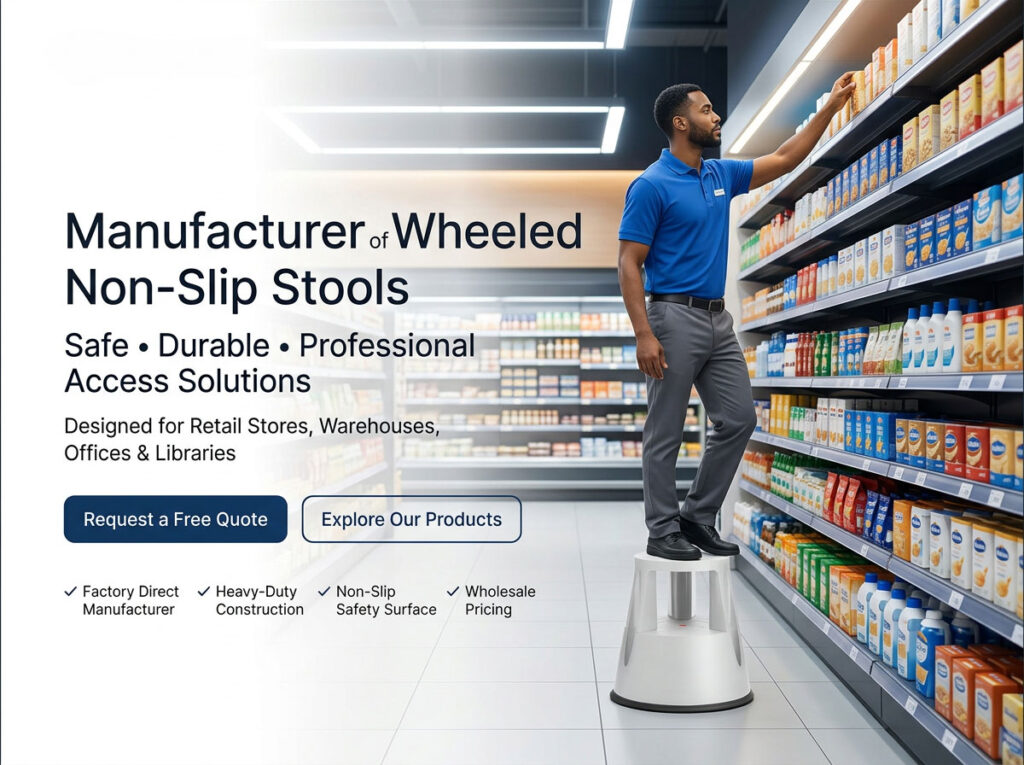
Wheeled Step Stools for Logistics Operations in Lebanon. In Lebanese logistics operations that feed supermarket networks, every extra second spent searching for access equipment or working from unstable positions multiplies across dozens of daily movements. Wheeled step stools designed for professional logistics use remove that friction. They roll into position instantly, lock securely under weight, and free both hands for accurate case or unit handling at height.
This page is written for logistics managers, warehouse supervisors, and purchasing leaders responsible for the flow of goods into and through supermarket supply chains. It examines real operational value rather than generic product features. Firmalazım supplies wheeled step stools engineered for Commercial Use in logistics and Warehouse Retail environments, available through Wholesale channels, Distributor networks, Bulk Orders, and OEM programs.


Why Compact Mobile Access Matters in Logistics Flow
Logistics environments supporting supermarket retail are characterized by frequent short-cycle elevated tasks: checking mixed pallets, building store orders, verifying high-level stock, and preparing last-mile loads. Traditional ladders are often too slow and obstructive. Fixed platforms lack mobility. Ordinary step stools without reliable wheels and locking systems create hesitation and risk.
Professional wheeled step stools occupy the practical middle ground. They move with the operator, lock automatically or positively under load, and maintain a small footprint that preserves aisle flow. In high-velocity settings this combination directly supports throughput and Safety at the same time.
The same requirements appear in facilities serving dense urban demand in Beirut and in regional distribution points linked to Tripoli and Sidon.
Core Design Attributes for Logistics Environments
Not every wheeled stool survives continuous logistics duty. The attributes that matter most include:
- Robust automatic or weight-activated locking
- Industrial-grade casters that roll smoothly on typical warehouse floors and resist debris
- Non-slip platforms that remain effective under dusty or occasionally damp conditions
- Load ratings appropriate for staff plus the occasional case or tool (commonly 150–250 kg+)
- Durable polymer or hybrid construction that withstands repeated impact
- Compact form that does not block material-handling equipment paths
These features support both pure logistics sites and hybrid Warehouse Retail operations that also serve supermarket backrooms.
Material and Durability Considerations
Logistics floors in Lebanon range from smooth sealed concrete to older surfaces with joints and occasional debris. Casters must handle this variety without rapid degradation. Sealed bearings and non-marking compounds reduce both maintenance frequency and floor damage.
Platform texture needs to retain grip after exposure to dust and standard cleaning regimes. Structural reinforcement at the platform-to-base junctions prevents the progressive looseness that appears in lighter consumer-grade units under daily Commercial Use.
Firmalazım, operating as a Manufacturer focused on professional access equipment, engineers units specifically for these conditions. OEM options allow color coding by zone or function and private labeling when networks standardize through Bulk Orders.
Operational Scenarios Across the Supply Chain
Receiving and put-away Staff verify mixed loads and place product at multiple height levels. A wheeled stool that follows the operator reduces walking and carrying of access equipment.
Order assembly for supermarket stores High-frequency case picking at mid-heights benefits from instant positioning and secure footing so both hands remain free for accurate handling.
Cross-dock and rapid transfer When dwell time is short, any delay in elevated access becomes visible in overall cycle time. Mobile stools keep the process fluid.
Store-delivery preparation Final checks and load building often require quick access to upper levels of roll-cages or pallets. Compact wheeled units perform this role without the bulk of larger rolling ladders.
These patterns are visible in operations supporting stores in Zahle, Jounieh, Baalbek, Byblos, and Aley, as well as those linked to Nabatieh, Batroun, and Tyre.
Comparison with Alternative Access Methods
| Method | Mobility | Footprint | Speed of Use | Best Logistics Fit |
|---|---|---|---|---|
| Wheeled step stool | High | Very small | Excellent | High-frequency mid-height tasks |
| Rolling warehouse ladder | Moderate | Large | Moderate | Less frequent higher reaches |
| Fixed platform | None | Large | Immediate | Permanent high-volume zones |
| Order-picker truck | High (powered) | Large | High | Large-scale, wide-aisle operations |
| Basic non-wheeled stool | None | Small | Slow | Very low-frequency use |
Wheeled step stools win on the combination of speed, minimal obstruction, and suitability for the short-cycle elevated work that dominates supermarket logistics.
Safety Integration in Fast-Moving Environments
In logistics the Safety case is both acute and cumulative. Unstable footing or over-reaching produces immediate fall risk and longer-term strain. Professional wheeled stools with reliable locking and non-slip surfaces reduce both.
Clear load-rating visibility, consistent performance across the fleet, and prompt removal of any unit that develops problems further support a strong Safety culture. The approach is the same whether the facility serves Zgharta, Jal El Dib, Hazmieh, or Sin El Fil.
Total Cost Perspective for Logistics Buyers
Acquisition cost is only the starting point. Full evaluation includes:
- Time recovered per elevated task
- Reduction in minor strain and near-miss events
- Caster and minor-part replacement frequency
- Impact of equipment unavailability on flow during peak windows
- Training and standardization costs across multiple sites
When professional units are specified and basic ownership discipline is applied, the operating components of cost remain low for years. Under-specified units generate rising friction that quickly offsets any initial price difference.
Procurement Routes That Match Logistics Needs
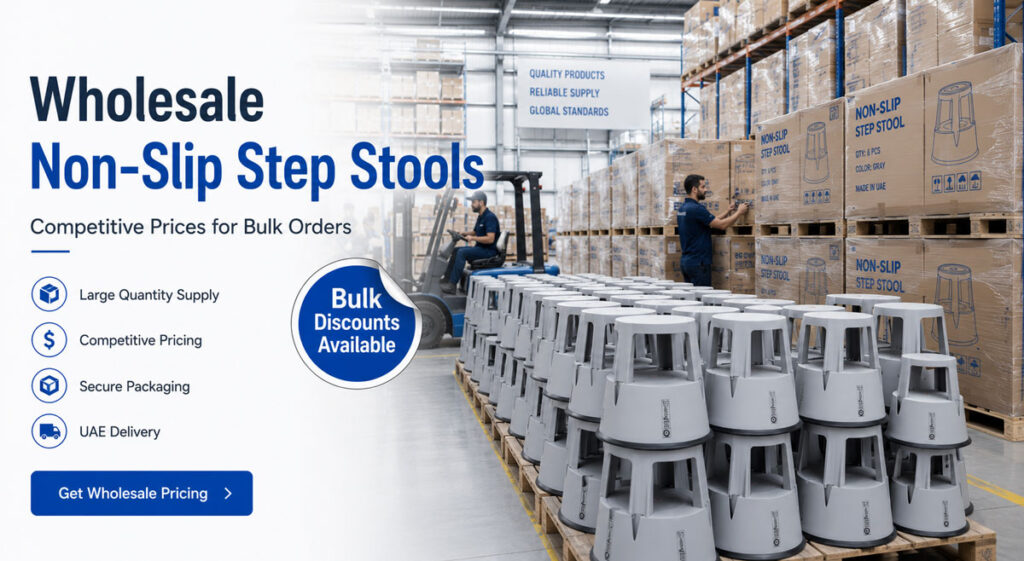
- Manufacturer-direct engagement suits networks seeking tight specification control, OEM color or labeling programs, and volume pricing on Bulk Orders.
- Wholesale channels deliver speed and competitive cost for standard professional models.
- Local Distributors provide faster last-mile delivery, domestic logistics familiarity, and responsive spare-parts support.
Many operators blend these routes to balance control, cost, and uptime across facilities linked to Dbayeh, Broummana, Kaslik, Choueifat, Baabda, Antelias, Bikfaya, Jezzine, and Bint Jbeil.
Implementation Sequence for Logistics Sites
- Map the highest-frequency elevated tasks and measure typical reach heights.
- Define the minimum professional specification (lock reliability, caster quality, platform grip, load rating).
- Pilot units in a live high-velocity zone.
- Finalize the standard and negotiate volume terms.
- Stage units at logical points along main flows rather than in distant storage.
- Deliver short practical training focused on positioning, lock verification, and centered stance.
- Assign clear ownership for daily checks and prompt removal of defective units.
- Review utilization and condition at 30 and 90 days.
Five Distinct Calls to Action
- Flow-focused: Share your highest-frequency elevated logistics tasks for a practical specification recommendation.
- Procurement-focused: Request current Wholesale pricing and lead times for professional wheeled models in the volumes you need.
- Standardization-focused: Explore OEM color-coding and labeling options for multi-site consistency.
- Pilot-focused: Arrange a short live-zone trial to evaluate mobility, locking, and staff response under real conditions.
- Network-focused: Discuss phased Bulk Orders and staging strategies across your logistics and supermarket support sites.
Frequently Asked Questions
What load rating is realistic for logistics staff use? A continuous rating of 150–250 kg covers most operators plus occasional additional weight. Higher ratings provide useful margin.
How important is automatic locking in fast-moving environments? Critical. Any hesitation or inconsistency in the lock reduces both speed and confidence.
Can the same wheeled step stools serve both pure logistics and supermarket backroom tasks? Yes. Many professional designs perform acceptably in both settings when durability and mobility are prioritized.
What caster features matter most on mixed warehouse floors? Sealed bearings, non-marking compounds, and resistance to debris accumulation.
How should units be staged in a logistics facility? At logical intervals along main picking, put-away, and order-assembly flows so retrieval time stays minimal.
Is color coding useful in logistics? Yes. Zone or function color coding improves correct selection and visual management, especially when supported by OEM programs.
What is the typical service life under daily Commercial Use? Quality professional units commonly deliver several years when basic caster maintenance and prompt defect removal are practiced.
How do these compare with rolling ladders for logistics work? Wheeled step stools are faster to deploy and far less obstructive for high-frequency mid-height tasks. Rolling ladders remain better for occasional higher reaches.
Do these stools require extensive training? No. A short practical demonstration focused on the lock mechanism and centered stance is normally sufficient.
What maintenance is actually required? Periodic cleaning of casters and platforms, visual lock checks, and timely replacement of wear items.
How does local climate affect material choice? Humidity and cleaning regimes favor durable polymer construction and corrosion-resistant components.
Are these tools relevant for smaller independent logistics operations? Yes. The speed and Safety benefits scale; smaller sites often feel the impact of poor access equipment more acutely.
What role does a Distributor play after the initial order? Faster replacement of units or parts and practical support for ongoing fleet availability.
Should every elevated logistics task use a wheeled step stool? No. Tasks requiring significant height or prolonged work at elevation may still need ladders or platforms. Wheeled stools cover the high-frequency middle range most efficiently.
What is the best first step for a purchasing or logistics manager? Document the most common elevated tasks, observe current work-arounds, and trial professional units in a live high-velocity zone.
Does Firmalazım support both standard models and customized requirements? As a Manufacturer, Firmalazım provides standard professional units, volume options through Wholesale and Bulk Orders, Distributor partnerships, and OEM flexibility for operators who need tailored solutions.
Wheeled step stools are simple tools, yet in the right specification and with basic operating discipline they remove measurable friction from the daily flow of supermarket logistics. When sourced for genuine Commercial Use and supported by clear ownership, they improve both speed and Safety across receiving, order assembly, and store-support activities.
Firmalazım stands ready to support Lebanese logistics and supermarket-supply operations with equipment designed for real working conditions, practical procurement pathways, and the flexibility required for multi-site environments. The most useful conversations begin with the specific elevated-task bottlenecks that currently slow flow or create unnecessary risk.
Wheeled Step Stools for Logistics Operations in Lebanon
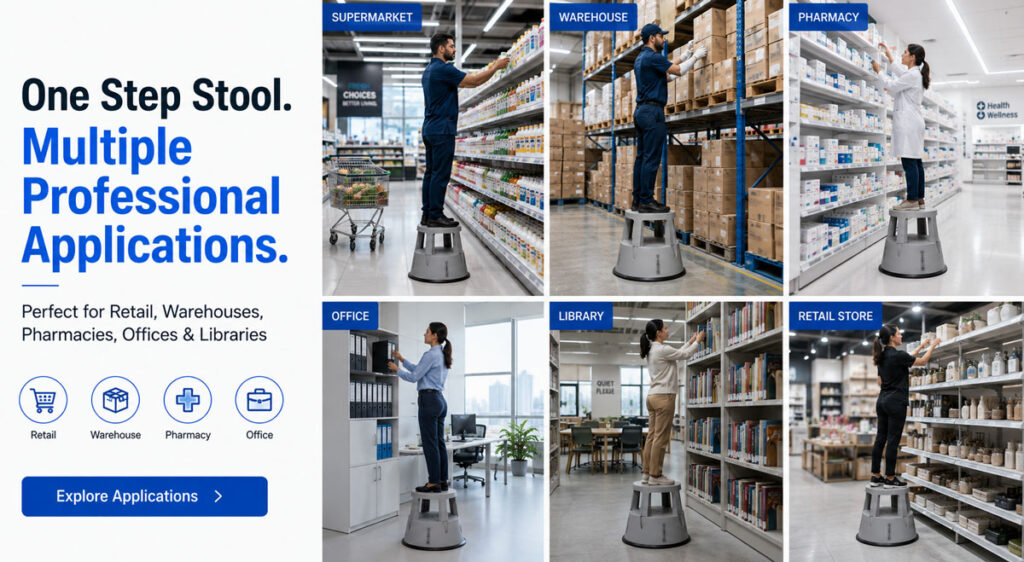
One Design, Multiple Logistics Roles: Why Versatile Wheeled Step Stools Outperform Specialized Alternatives
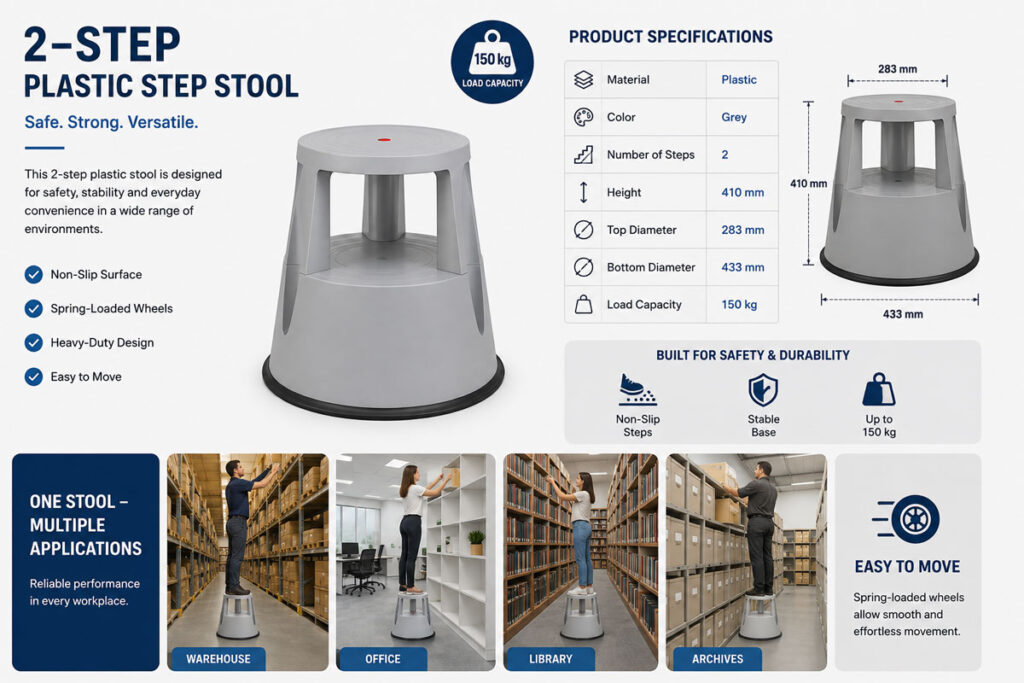
The image above illustrates a fundamental advantage of professional wheeled step stools: the same compact, spring-loaded, non-slip design performs reliably across supermarket aisles, warehouse racking, office support areas, libraries, and high-density archive storage. For logistics operations that feed Lebanese supermarket networks, this multi-environment capability is not a marketing claim—it is a practical lever for reducing equipment complexity, simplifying training, and protecting uptime.
This section examines how a single well-specified wheeled step stool family can serve the full spectrum of elevated access needs within supermarket logistics ecosystems in Lebanon.
The Cost of Equipment Proliferation
Many logistics and retail-support operations accumulate different access tools over time: one style for the main warehouse, another for supermarket backrooms, a third for administrative or archive areas. Each additional model multiplies spare-parts references, training variants, and inspection criteria. In lean teams the administrative burden eventually shows up as neglected units and inconsistent Safety practice.
A single professional wheeled step stool design that is acceptable in both pure logistics zones and adjacent supermarket or support spaces collapses that complexity. Staff moving between areas carry the same muscle memory. Spare casters and minor components remain common. Visual management and ownership rules stay consistent.
This simplification delivers measurable value in networks whose facilities support stores in Beirut, Tripoli, Sidon, and Zahle, and it scales equally well to operations linked to Jounieh, Baalbek, Byblos, and Aley.
Matching the Design to Real Logistics Tasks
Professional wheeled step stools with spring-loaded casters and non-slip platforms excel at high-frequency, mid-height work:
- Verifying mixed pallets during receiving
- Building store orders at case level
- Accessing upper levels of flow racks or shelving
- Final checks on roll-cages before dispatch
- Occasional administrative or archive retrieval in support areas
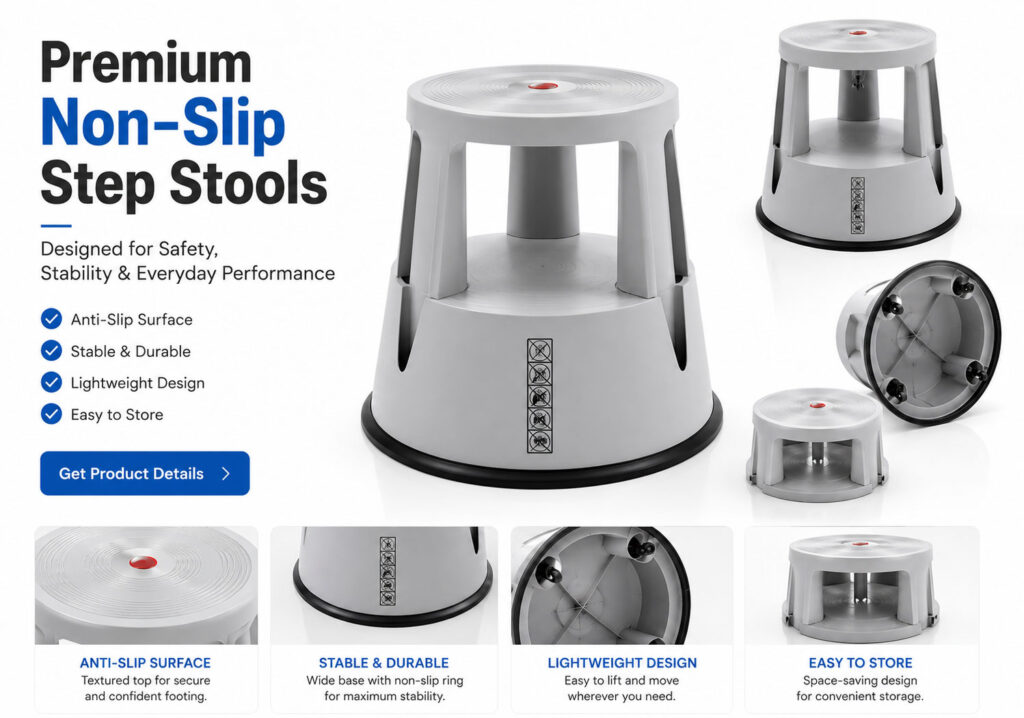
The spring-loaded mechanism allows the unit to roll freely when unloaded and to sit stably the moment weight is applied. The non-slip rim and platform texture provide confidence on the varied floor surfaces found in Lebanese logistics and retail environments. Heavy-duty construction ensures the unit survives the impacts and continuous movement typical of Commercial Use.
Cross-Functional Value Across the Supply Chain
Pure logistics / distribution centers Speed of repositioning and minimal aisle obstruction keep order-assembly and put-away cycles tight.
Hybrid Warehouse Retail zones The same units move between bulk storage and supermarket backroom tasks without requiring a change of equipment or mindset.
Store-support and last-mile preparation Compact size and quiet operation allow use in areas that may be closer to customer-facing zones.
Administrative and archive support spaces The clean aesthetic and reliable function make the stools acceptable in office-adjacent or document-storage areas that many logistics operations also manage.
This breadth reduces the total number of access-tool categories a logistics organization must manage. The benefit compounds across sites serving Nabatieh, Batroun, Tyre, Zgharta, and Jal El Dib.
Specification Priorities for Multi-Environment Use
When the same stool family must perform in warehouse, supermarket backroom, and lighter support spaces, certain attributes become non-negotiable:
- Consistent, positive spring-loaded locking under typical staff weight
- Casters that remain smooth and quiet on both sealed concrete and common retail tile
- Non-slip surfaces that retain effectiveness after cleaning and light moisture exposure
- Structural durability rated for genuine Commercial Use rather than occasional domestic duty
- Visual appearance that does not look out of place in cleaner or customer-adjacent areas
- Easy cleaning to meet basic hygiene expectations in food-related logistics
Units that meet these combined criteria can be standardized with confidence. Those that optimize only for pure industrial settings often feel too rough or noisy when moved into supermarket or office-support zones.
Staging and Flow Considerations
In multi-environment operations the staging logic must respect both logistics flow and occasional use in cleaner areas. Practical approaches include:
- Primary staging along main warehouse picking and put-away routes
- Secondary smaller clusters in supermarket backrooms or order-preparation zones
- Modest reserve in a central location for peak surges or temporary reallocation
- Clear visual management (color or labeling) so units intended for different zones remain distinguishable if needed
When staging is deliberate, the stools stay in circulation rather than migrating permanently to the most convenient corner. Facilities linked to Hazmieh, Sin El Fil, Dbayeh, and Broummana have demonstrated that thoughtful placement directly influences utilization rates.
Training That Travels Across Environments
Because the core interaction (roll, step, lock, work, step down, roll) remains identical, a single short training sequence serves warehouse staff, backroom teams, and occasional administrative users. This portability is especially valuable in organizations that rotate personnel or operate shared support functions.
Reinforcement stays light: the same micro-phrase, the same pre-use visual check, the same expectation that defective units are tagged and removed immediately. Consistency across environments strengthens the habit rather than diluting it.
Spare-Parts and Maintenance Simplification
Standardizing on one professional wheeled step stool family shrinks the spare-parts catalogue to a manageable set—primarily casters and occasional platform or body components. A local Distributor or Manufacturer relationship can then hold buffer stock efficiently, protecting uptime across multiple sites without excessive inventory.
Monthly caster cleaning and prompt attention to any lock or rolling issues keep the fleet reliable. Because the design is simple, most problems are diagnosed and resolved quickly when ownership is clear.
Risk of Over-Specialization
Organizations sometimes specify highly specialized access equipment for each distinct zone. While this can optimize individual tasks, it frequently creates secondary costs in training, parts, and under-utilized assets. In practice, a robust, well-designed wheeled step stool covers the large majority of elevated access needs in supermarket logistics ecosystems. Residual tasks that genuinely require greater height or capacity can still be served by a smaller number of rolling ladders or platforms.
The resulting hybrid fleet—standardized wheeled stools for high-frequency work plus limited specialized units—is usually leaner and more resilient than a fully fragmented approach.
Peak-Period and Disruption Resilience
During seasonal peaks or temporary labor constraints, the ability to reallocate wheeled step stools between warehouse and supermarket support areas becomes valuable. Units that are acceptable in both environments can be shifted without retraining or appearance concerns. This flexibility is harder to achieve when each zone uses a distinctly different tool.
The same logic applies during periods of supply-chain variability: a standardized fleet with common spares is easier to keep functional than a collection of unique models.
Practical Multi-Site Standardization Framework
- Define the core professional specification that satisfies both logistics and supermarket backroom conditions.
- Limit approved variants (height, color) to a small pre-agreed set.
- Establish a single short training and ownership model used everywhere.
- Negotiate Bulk Orders or Wholesale agreements that include spare-parts provisions.
- Allow local staging decisions within network principles.
- Review utilization and condition on a common cadence across all sites.
This framework delivers purchasing leverage and operational consistency while still respecting local layout differences. It has been applied by operators whose networks reach Kaslik, Choueifat, Baabda, Antelias, Bikfaya, Jezzine, and Bint Jbeil.
Measuring the Versatility Dividend
Useful indicators that the multi-environment approach is working include:
- Reduction in total access-equipment SKUs
- Higher average utilization per unit
- Lower spare-parts complexity and stock value
- Consistent Safety and usage standards across warehouse and support areas
- Ability to reallocate units during peaks without friction
When these indicators move in the right direction, the original decision to standardize on a versatile professional wheeled step stool is validated.
Closing Perspective: Simplicity as a Strategic Advantage
In supermarket logistics the most elegant solutions are often the ones that remove complexity rather than add it. A single, well-engineered wheeled step stool design that performs reliably in warehouse racking, supermarket backrooms, and related support spaces delivers exactly that form of elegance.
It reduces the number of tools staff must master, shrinks the spare-parts burden, simplifies training and ownership, and still provides the speed and Safety required for high-frequency elevated work. When sourced at genuine Commercial Use quality and supported by clear management discipline, the design becomes quiet infrastructure that supports flow across the entire supply chain.
Firmalazım supplies professional wheeled step stools engineered for this multi-environment reality, offering Manufacturer-level durability, practical Bulk Orders, OEM options for visual management, and dependable pathways through Wholesale and Distributor channels. The most productive conversations begin with a clear map of current elevated-access points across logistics and supermarket support areas and an honest assessment of how much equipment complexity the organization is currently carrying.
One capable design, thoughtfully deployed, frequently outperforms a collection of specialized alternatives. That is the practical lesson of the multi-application stool shown in the image—and it is a lesson that continues to deliver returns in Lebanese logistics operations every day.
Wheeled Step Stools for Logistics Operations Lebanon
Ergonomics, Fatigue, and Continuous Improvement: Extracting Full Value from Wheeled Step Stools in Lebanese Logistics
High-cycle logistics work is repetitive by nature. When elevated access is frequent, the cumulative physical load on staff becomes a hidden constraint on both productivity and Safety. Professional wheeled step stools with reliable spring-loaded locking and non-slip platforms reduce that cumulative load. This section examines the ergonomic mechanisms, practical tracking methods, and supplier collaboration approaches that turn a simple tool into a sustained performance asset for supermarket logistics operations in Lebanon.
The Ergonomics of Repeated Elevated Access
Every time a worker stretches from floor level or climbs an unstable surface, the body absorbs extra stress in the lower back, shoulders, and knees. Over a full shift these micro-loads accumulate. The result is earlier onset of fatigue, slower movement in the later hours of the day, and elevated risk of strain-related absence.
A wheeled step stool that is quick to position and secure underfoot changes the movement pattern. The operator steps onto a stable platform, works with a more neutral spine and shoulder position, and steps down without the deceleration impact of jumping or dropping from an unstable height. Across dozens of cycles the difference in cumulative load is significant.
This effect is observable in high-velocity order-assembly areas supporting stores in Beirut and Tripoli, and it appears equally in regional facilities linked to Sidon, Zahle, and Jounieh.
Design Features That Directly Influence Fatigue
Not every wheeled stool delivers the same ergonomic benefit. The features that matter most under repeated use are:
- Immediate, positive lock engagement so the user does not hesitate or brace
- Platform height that brings the most common work zone into a comfortable reach band
- Sufficient platform area for a natural, centered stance
- Non-slip texture that remains trustworthy even when the floor or shoes carry light dust or moisture
- Smooth rolling resistance that does not require extra force to reposition
When these elements are present, staff continue to use the stools late in the shift rather than reverting to stretching as fatigue sets in. That behavioral persistence is the real ergonomic dividend.
Simple, Data-Light Performance Tracking
Complex digital systems are unnecessary for most Lebanese logistics operations. A lightweight tracking approach that still yields useful insight includes:
- Periodic observation samples during peak and off-peak windows (does the correct tool get used?)
- A simple tally of units tagged out of service and average time to return
- Short pulse questions to users every 60–90 days on perceived ease and confidence
- Comparison of average task cycle times for high-frequency elevated activities before and after introduction
- Trend monitoring of minor strain reports linked to reaching or climbing
These measures require minimal administrative effort yet reveal whether the equipment is truly embedded or merely present. Facilities supporting Baalbek, Byblos, Aley, and Nabatieh have used variations of this approach to keep attention on real utilization rather than assumed benefit.
Fatigue-Related Risk Patterns and Countermeasures
Common patterns that increase fatigue and residual risk include:
- Units staged too far from the work face, so retrieval effort exceeds the perceived benefit of using the stool
- Casters that have stiffened, making repositioning feel like extra work
- Inconsistent lock feel that causes users to test stability on every ascent
- Mixed equipment standards that force staff to re-learn interaction patterns when moving between zones
Countermeasures are correspondingly practical: deliberate staging, scheduled caster attention, strict removal of units with compromised locks, and deliberate standardization on one professional design family. The same logic applies in operations linked to Batroun, Tyre, Zgharta, and Jal El Dib.
Supplier Collaboration for Continuous Fleet Improvement
Transactional purchasing ends at delivery. Collaborative relationships continue into the life of the fleet. Useful collaboration elements with a Manufacturer, Wholesale partner, or Distributor include:
- Structured feedback loops on caster life, lock consistency, and platform durability under actual Lebanese logistics conditions
- Advance visibility of volume needs so that Bulk Orders and spare-parts buffers can be planned
- Joint review of any recurring field issues and agreement on design or component adjustments for future deliveries
- Clear escalation paths when a batch or component under-performs
When the supplier treats field performance data as valuable input rather than complaint, the quality of subsequent units and the responsiveness of spare-parts support both improve. This is especially valuable for networks whose sites span Hazmieh, Sin El Fil, Dbayeh, Broummana, and Kaslik.
OEM and Visual Management as Fatigue-Reduction Tools
Color coding and simple labeling are often viewed as organizational niceties. In practice they reduce cognitive load and decision time. When staff can identify the correct unit at a glance, retrieval is faster and the probability of using an inappropriate or poorly maintained stool declines.
OEM programs make consistent color or labeling schemes feasible even for mid-sized groups. The result is lower friction at the moment of need—an indirect but real contribution to keeping fatigue-reducing behavior intact across the full shift. Operations connected to Choueifat, Baabda, Antelias, Bikfaya, Jezzine, and Bint Jbeil have applied such visual systems with measurable effect on correct-tool usage rates.
Integrating Ergonomic Goals into Existing Safety Conversations
Fatigue and strain are Safety issues. When wheeled step stools are discussed only as productivity tools, their contribution to long-term musculoskeletal health is under-weighted. Integrating the equipment into existing Safety talks and near-miss reviews keeps both dimensions visible:
- Include correct use in routine Safety observations
- Treat repeated non-use of available stools as a potential precursor to strain events
- Celebrate reductions in reaching-related discomfort reports with the same attention given to other Safety improvements
This framing helps maintain supervisory attention after the novelty of new equipment has faded.
Practical Shift-Level Habits That Protect the Ergonomic Benefit
- Start-of-shift visual confirmation that staged units roll and lock normally
- Immediate tagging and removal of any unit that feels different underfoot
- End-of-shift return of units to agreed staging points so the next shift inherits a usable fleet
- Weekly supervisor review of tagged units and spare-parts status
These habits require seconds per interaction yet compound into sustained availability of trustworthy equipment. When they are absent, the ergonomic advantage erodes quietly.
Linking Ergonomics to Broader Logistics KPIs
The strongest internal cases connect reduced fatigue to metrics the business already values:
- Sustained picking or put-away rates across the full shift rather than only the first hours
- Lower absenteeism or restricted-duty days linked to musculoskeletal issues
- Fewer micro-stoppages caused by hesitation or re-positioning
- Higher willingness of staff to perform elevated tasks correctly late in the shift
When these linkages are visible, investment in professional wheeled step stools and the simple systems that keep them functional becomes easier to defend and maintain.
Building a Resilient Improvement Cycle
- Specify units for genuine Commercial Use conditions (lock reliability, caster quality, platform grip).
- Stage them so that correct use is the path of least resistance.
- Train briefly and reinforce lightly but consistently.
- Track a small set of leading indicators (utilization samples, tagged-unit cycle time, user confidence).
- Feed field observations back to the Manufacturer or Distributor.
- Adjust staging, spare-parts buffers, or future specifications on the basis of real data.
- Repeat the cycle at planned intervals.
This loop turns a one-time equipment purchase into an evolving operational capability. It works across both large distribution centers and smaller hybrid facilities that support supermarket networks throughout Lebanon.
Closing Perspective: Small Tool, Compounding Effect
Wheeled step stools are modest pieces of equipment. Their contribution to logistics performance becomes substantial only when ergonomic reality, daily habit, and continuous improvement discipline are treated as seriously as the initial specification.
Organizations that manage all three layers keep staff fresher, maintain higher correct-use rates across full shifts, and extract years of reliable service from the fleet. Those that focus solely on unit price or initial deployment often watch the expected benefits fade as fatigue, friction, and neglected maintenance reassert themselves.
Firmalazım supports Lebanese logistics and supermarket-supply operations with Manufacturer-grade wheeled step stools designed for repeated Commercial Use, practical pathways for Bulk Orders and OEM visual management, and dependable supply through Wholesale and Distributor channels. The highest-leverage conversations begin with current elevated-task frequency, observed late-shift behavior, and the simple tracking and ownership habits the team is prepared to sustain.
When the tool, the body, and the management system are aligned, the result is quieter, safer, and more sustainable flow. That alignment is available to any operation willing to manage the details deliberately.
Wheeled step stools deliver safe, mobile height access for supermarket logistics across Lebanon. Designed for heavy-duty commercial use in warehouse retail environments, these non-slip units with non-marking wheels let staff reach upper shelves quickly while protecting floors and reducing fall risk. From dense urban stores in Beirut to coastal operations in Tripoli and inland hubs in Zahle, the right stool raises productivity, supports bulk orders, and meets the practical demands of modern supermarket supply chains.
Unlocking Vertical Efficiency: Why Lebanese Supermarkets Are Turning to Mobile Step Platforms
Supermarket operations in Lebanon face a constant height problem. High-bay shelving, bulk cartons, and tight replenishment windows mean staff regularly climb. Traditional ladders create bottlenecks and safety exposure. A well-engineered wheeled step stool changes that equation by combining mobility, stability, and industrial durability in one compact unit.
These platforms are not simple household steps. They are purpose-built tools for commercial use, engineered so a single operator can roll the unit into position, lock it securely, and access inventory without a second person or a fixed scaffold. In a sector where minutes lost on the floor translate directly into out-of-stocks and labor overtime, the difference is measurable.
The Core Problem Lebanese Supermarket Logistics Must Solve
Lebanese supermarket chains and independent stores operate under pressure: limited floor space, high vertical density, frequent deliveries, and a workforce that must move fast. In Sidon coastal warehouses and Jounieh retail backrooms alike, the same pattern appears—staff stretching, climbing makeshift platforms, or waiting for a ladder that is already in use elsewhere.
Falls from height remain one of the most common workplace incidents in retail logistics. Non-slip surfaces, wide stable bases, and lockable wheels address the root causes. When the platform itself can travel with the operator between aisles, the time previously spent fetching and returning fixed steps disappears.
What Makes a Wheeled Step Stool Suitable for Supermarket Environments
A supermarket-grade unit must survive daily abuse: heavy foot traffic, occasional impact from trolleys, cleaning chemicals, and temperature swings between cold rooms and ambient floors. Key attributes include:
- Reinforced steel or aluminum frame with high load capacity
- Wide, textured non-slip platform
- Spring-loaded or foot-activated locking casters that engage the moment weight is applied
- Non-marking wheels that protect polished or epoxy floors
- Compact footprint that still offers a secure stance
These features separate industrial tools from light-duty domestic stools. A manufacturer focused on warehouse retail applications designs for repeated commercial use rather than occasional home tasks.
Material and Construction Reality Check
Most premium units rely on powder-coated steel for the base and uprights because it resists corrosion in humid Lebanese coastal climates and tolerates the occasional impact. The platform surface is typically a high-friction polymer or textured metal plate. Wheels are usually polyurethane or rubber compounds chosen specifically to leave no marks on tile or concrete.
OEM partners can specify different load ratings, platform diameters, and height ranges. For supermarket back-of-house work, a working height that allows comfortable reach to 2.5–3.5 meters of shelving is usually sufficient. Higher units exist but become less practical in narrow aisles.
Operational Scenarios Across Lebanese Cities
In Baalbek distribution points serving surrounding villages, staff use wheeled stools to pick mixed SKUs from upper levels during night replenishment. In Byblos tourist-area stores, the same tool appears during daytime merchandising when displays must be restocked without closing the aisle. Aley hillside outlets with multi-level storage rooms rely on the mobility of the stool to move between rooms without carrying a heavy ladder.
Further north, Batroun and Zgharta facilities benefit from the non-marking wheels on newly renovated floors. In Tyre and Nabatieh southern operations, durability under high dust and temperature variation matters. Urban clusters such as Jal El Dib, Hazmieh, Sin El Fil, Dbayeh, and Antelias see the highest intensity of use because of dense store networks and frequent deliveries. Mountain and mid-range locations including Broummana, Bikfaya, Kaslik, Choueifat, Baabda, Jezzine, and Bint Jbeil use the platforms both for warehouse picking and for in-store high-shelf maintenance.
Each location shares the same core need: safe, rapid vertical access that does not damage floors or slow the rest of the team.
Safety Features That Actually Matter on the Floor
Safety is not a marketing checkbox. It is the difference between a routine task and an incident report. The most effective designs incorporate:
- Automatic wheel lock under load so the unit cannot roll while occupied
- Wide base geometry that resists tipping even when the operator leans slightly
- High-visibility platform edges
- Optional handrails or grab points on taller models
Training remains essential. Operators must step fully onto the platform, keep both feet planted, and avoid overreaching. When these habits combine with a properly engineered stool, fall risk drops sharply.
Procurement Perspective: Manufacturer, Wholesale, and Distributor Channels
Lebanese supermarket groups and independent operators typically source through three routes. Direct engagement with a manufacturer allows customization of height, load rating, and branding. Wholesale channels suit multi-store rollouts where consistent specification and volume pricing matter. Local distributor networks provide faster delivery, spare parts, and on-site support.
Bulk orders become attractive once a chain standardizes on one model. A single specification simplifies training, maintenance, and replacement planning. OEM arrangements let larger operators request private-label versions or modifications such as company-colored frames or integrated tool holders.
For smaller independent stores in Tripoli or Zahle, a local distributor often provides the most practical entry point—stock availability, warranty handling, and advice on the right height for their particular shelving.
Cost Structure and Total Ownership View
Purchase price is only the starting point. A quality wheeled step stool typically costs more than a basic domestic ladder, yet the lifetime cost is lower when measured against:
- Reduced labor time per replenishment cycle
- Lower incident-related downtime and insurance impact
- Longer service life under daily commercial use
- Floor protection that avoids costly repairs
A simple calculation used by many operations managers compares the hourly cost of two workers (one holding a ladder) against one worker using a mobile stool. The payback period is often measured in weeks rather than months once volume is high.
Maintenance is minimal: periodic inspection of wheel locks, cleaning of the non-slip surface, and occasional replacement of casters after years of heavy service. Spare parts availability through the original manufacturer or authorized distributor keeps units in circulation instead of being discarded.
Comparison Against Alternatives
| Solution | Mobility | Stability under load | Floor protection | Speed of deployment | Typical supermarket fit |
|---|---|---|---|---|---|
| Fixed ladder | None | High | N/A | Slow | Permanent access points |
| Domestic step stool | Limited | Moderate | Often marks | Fast | Light occasional use |
| Rolling warehouse ladder | High | High | Variable | Medium | Wide aisles only |
| Wheeled non-slip stool | High | High (with lock) | Excellent | Very fast | Most supermarket aisles |
The wheeled non-slip stool wins in environments where aisles are narrow, floors are finished, and tasks move frequently from one bay to another.
Practical Selection Checklist for Lebanese Buyers
- Confirm maximum working height required for your tallest regular shelves
- Verify load rating exceeds the heaviest expected operator plus carried items
- Test the locking mechanism under real weight
- Check wheel compound for non-marking performance on your floor type
- Request documentation on commercial-use certification or testing
- Clarify warranty terms and spare-parts lead times
- Ask about bulk-order pricing tiers and OEM customization options
- Evaluate whether a local distributor can provide after-sales support in your region
Installation and First-Use Protocol
No complex installation is required. Upon receipt:
- Inspect for shipping damage.
- Confirm all wheel locks engage and release correctly.
- Clean the platform surface.
- Brief staff on correct stance, weight distribution, and prohibition of overreaching.
- Place the unit in a visible, accessible location near high-activity zones.
Some operators mark a “home” parking position so the stool is always returned after use, preventing it from becoming an obstacle in an aisle.
Maintenance Routine That Prevents Premature Failure
Weekly: visual check of wheels and locks, wipe-down of platform. Monthly: test lock engagement under load, inspect frame for cracks or deformation. Annually: deeper inspection or professional service if the unit sees continuous multi-shift use.
Keeping the non-slip surface free of oil, dust, or product residue is the single most effective daily habit.
Real-World Impact Observed in Retail Settings
Operations managers report three consistent outcomes after introducing quality wheeled stools:
- Faster cycle times for upper-shelf replenishment
- Noticeable reduction in near-miss reports related to height work
- Greater willingness of staff to complete high-level tasks without waiting for assistance
In multi-site supermarket groups, standardizing on one model also simplifies internal training and spare-parts inventory.
Common Mistakes That Undermine the Investment
- Buying the cheapest unit without verifying commercial load rating
- Ignoring wheel type and later discovering floor marks
- Failing to train staff on lock engagement
- Using the stool as a mobile seat or for two people simultaneously
- Neglecting periodic inspection until a component fails under load
Avoiding these errors protects both the equipment investment and the safety record.
Forward-Looking Considerations
As Lebanese supermarket formats evolve toward higher vertical density and tighter labor models, mobile access platforms become infrastructure rather than optional tools. Integration with lean replenishment processes, clearer visual management of equipment locations, and possible future addition of simple sensors (usage counters or lock-status indicators) are logical next steps for larger operators.
For the moment, the priority remains selecting robust, non-slip, non-marking units from a reliable manufacturer, securing favorable terms on bulk orders through wholesale or distributor channels, and embedding correct use into daily routines.
FAQ – Frequently Asked Questions
1. What is the primary advantage of a wheeled step stool over a traditional ladder in supermarket logistics? Mobility. The unit travels with the operator between locations, eliminating repeated trips to fetch and return a fixed ladder.
2. Are these stools suitable for commercial use in high-traffic supermarket warehouses? Yes. Models designed for warehouse retail environments carry commercial load ratings and are built for repeated daily service.
3. How do non-marking wheels protect supermarket floors? They use compounds that roll without leaving black streaks or scuffs on tile, epoxy, or polished concrete.
4. Can a manufacturer supply customized versions for Lebanese supermarket chains? Many manufacturers offer OEM options including height adjustments, load ratings, color branding, and private labeling.
5. What load capacity should a supermarket specify? Choose a rating that comfortably exceeds the heaviest expected operator plus any items carried while standing on the platform.
6. Do the wheels lock automatically? Quality designs feature spring-loaded or weight-activated locks that engage as soon as an operator steps on.
7. Is bulk ordering cost-effective for multi-store supermarket groups? Yes. Volume pricing, standardized specification, and simplified spare-parts management usually outweigh the higher unit cost of premium models.
8. How does a local distributor add value compared with direct import? Faster delivery, local warranty support, spare parts availability, and advice tailored to regional floor types and shelving heights.
9. What maintenance is required to keep the non-slip surface effective? Regular cleaning to remove dust, oil, or product residue is the most important daily action.
10. Can these stools be used safely in narrow supermarket aisles? Yes, provided the footprint is compact and the operator is trained not to overreach.
11. Are there models suitable for both warehouse and front-of-store retail use? Many units are designed for exactly that dual environment—durable enough for warehouse conditions yet clean enough for customer-facing areas.
12. What safety training should accompany the introduction of wheeled stools? Correct stance, full engagement of locks, prohibition of two-person use, and awareness of maximum reach limits.
13. How long is the typical service life under daily supermarket conditions? With proper maintenance, several years of multi-shift use is common for industrial-grade units.
14. Can wholesale suppliers provide mixed heights in a single bulk order? Most can accommodate mixed configurations when the total volume justifies it.
15. What happens if a wheel lock fails? Remove the unit from service immediately and replace the affected components through the manufacturer or authorized distributor.
16. Are these tools appropriate for cold-room environments found in many Lebanese supermarkets? Select models with materials and lubricants rated for low temperatures; standard units may stiffen in extreme cold.
17. How do I verify that a stool is genuinely designed for commercial rather than domestic use? Request load-test documentation, commercial warranty terms, and evidence of industrial-grade materials.
18. Is it possible to obtain private-label versions for a supermarket brand? Yes, through OEM arrangements with the manufacturer.
19. What is the fastest way to evaluate a sample unit on site? Place it in a real aisle, have experienced staff perform typical tasks, and check lock engagement, stability, and floor marking under actual conditions.
20. Do these stools reduce the need for additional staff during peak replenishment? In many operations they allow one person to complete tasks that previously required two (one climbing, one stabilizing).
21. How should units be stored when not in use? In a designated visible location so they remain accessible yet out of main traffic paths.
22. Can a distributor arrange after-sales service across multiple Lebanese cities? Established distributors typically cover major urban and regional centers.
23. What is the most common reason a wheeled stool is retired early? Neglected maintenance of the locking mechanism or continued use after wheel damage.
24. Are there height recommendations for typical supermarket shelving in Lebanon? Most operators find platforms that enable comfortable reach to 2.5–3.5 m sufficient; taller units exist for specialized high-bay needs.
25. How does Safety performance compare with fixed platforms? When correctly used, a locked wheeled stool offers equivalent stability with far greater flexibility of location.
26. Should independent stores in smaller towns consider the same models as large chains? Yes, provided the specification matches their actual shelf heights and floor types; volume pricing may differ.
27. What documentation should accompany a bulk order? Load certificates, material specifications, warranty terms, and recommended maintenance schedule.
28. Can the stools be moved easily between floors in multi-level stores? Most compact models fit standard elevators or can be carried short distances when empty.
29. Is there a risk of tipping if the operator leans too far? Wide-base designs resist tipping under normal use; training against extreme overreach remains essential.
30. How quickly can a new unit be placed into service after delivery? Usually within minutes after visual inspection and a brief staff briefing.
31. Do manufacturers offer training materials for supermarket teams? Many supply simple illustrated guides or short videos covering correct use and daily checks.
32. What is the advantage of purchasing through a wholesale channel versus retail outlets? Consistent commercial specification, volume pricing, and access to genuine spare parts.
33. Can these platforms be used for occasional merchandising work in customer areas? Yes, provided the wheels are non-marking and the unit is removed promptly after use.
34. How does humidity in coastal Lebanese cities affect the equipment? Powder-coated steel frames and appropriate wheel materials resist corrosion when basic cleaning is maintained.
35. What should be checked before approving a large bulk order? Sample testing under real conditions, clarification of warranty scope, and confirmation of spare-parts lead times.
Call-to-Action Options (choose the tone that fits your landing page)
- Ready to standardize safe height access across your supermarket network? Request a detailed bulk-order quotation today.
- See the difference a true commercial-grade wheeled stool makes on your floor. Contact us for model options and OEM possibilities.
- Protect your team and your floors while accelerating replenishment cycles. Speak with our wholesale team about volume pricing.
- Looking for a reliable manufacturer and distributor partner for Lebanon? Reach out for specifications, samples, and delivery timelines.
- Upgrade your warehouse retail operations with proven non-slip mobile platforms. Start the conversation now.

Bir yanıt yazın