


Professional Heavy-Duty Step Stools for Warehouses in Jordan
Professional Heavy-Duty Step Stools for Warehouses in Jordan influence capital efficiency inside Jordanian supermarket warehouse operations far more than their purchase price suggests. When specified for genuine commercial durability, they extend replacement cycles, stabilise annual equipment budgets, and reduce the hidden costs of premature failure, emergency purchasing, and residual safety exposure.

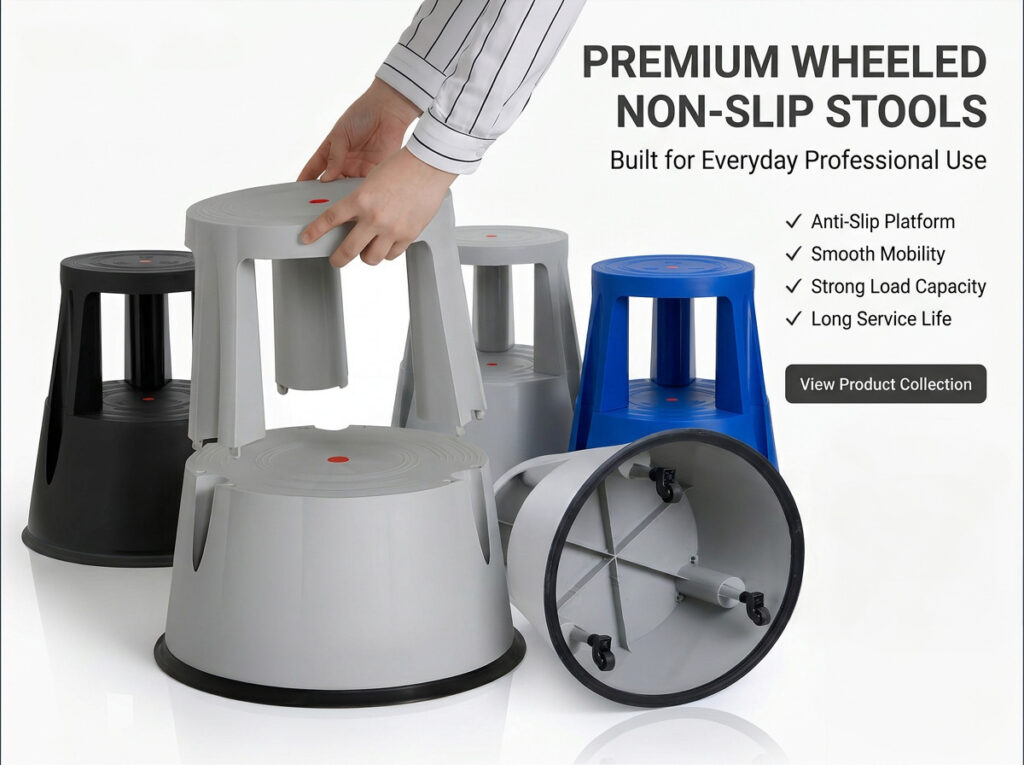

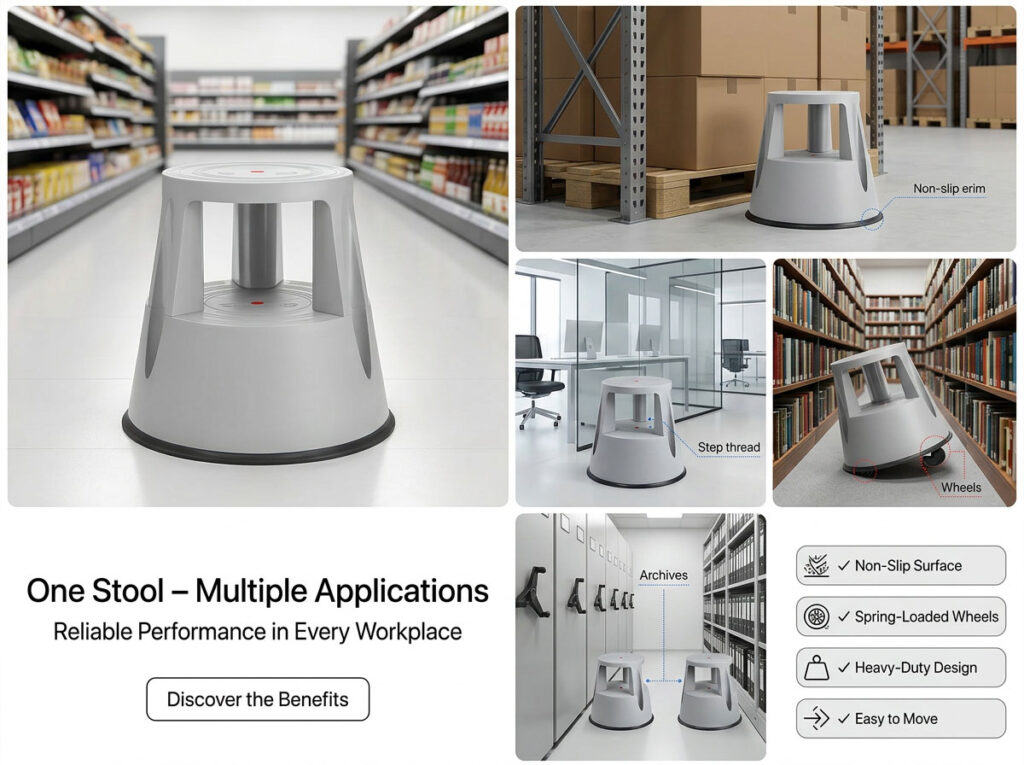


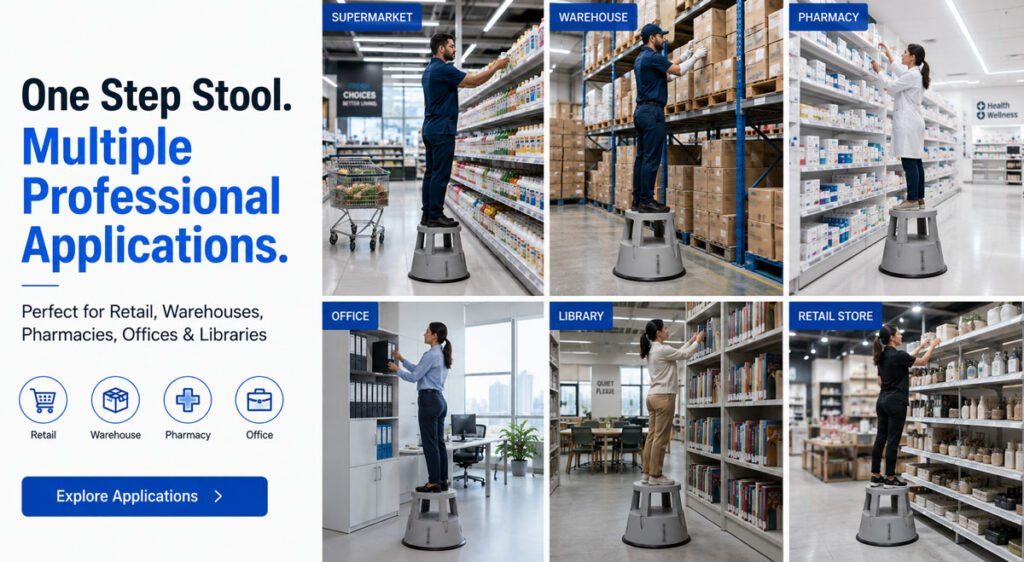

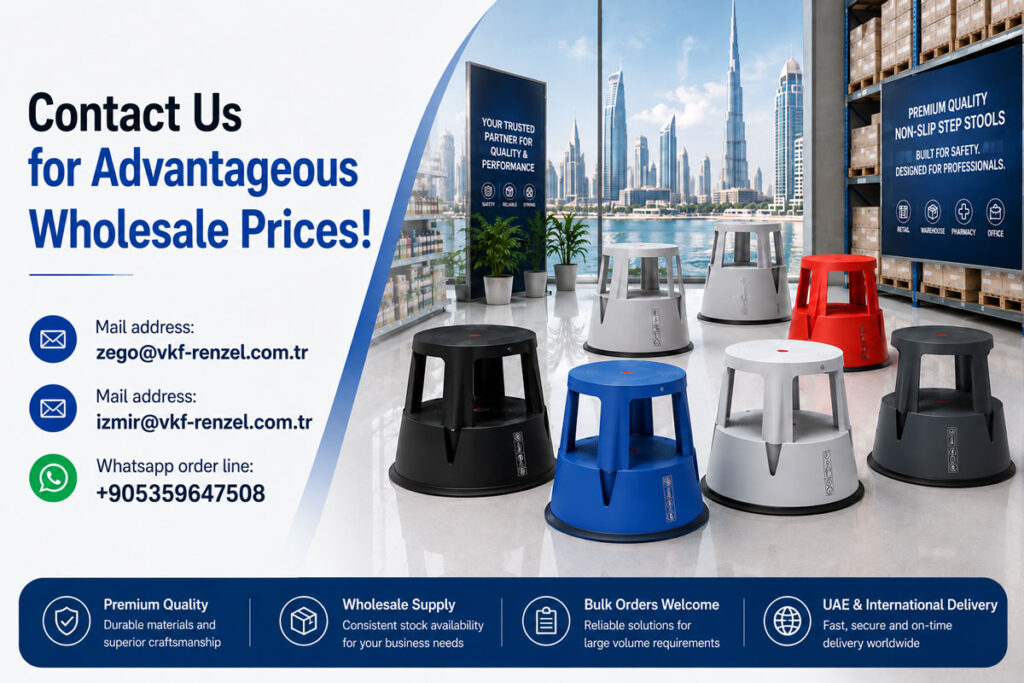
Firmalazım manufactures heavy-duty industrial step stools engineered for commercial use and supports bulk orders, OEM identification, and supply through wholesale and distributor channels. This guide examines the subject from a capital-allocation and replacement-cycle perspective, giving purchasing managers a practical method for treating elevated-access equipment as a controlled long-term asset rather than a recurring consumable across supermarket and warehouse retail facilities in Jordan.
The Capital Problem Created by Under-Specified Elevated Access
Many supermarket warehouse operations treat step stools as low-value items ordered reactively when something fails or a new site opens. The immediate invoice looks small. The longer-term pattern is expensive: mixed models accumulate, service lives prove shorter than expected, emergency replacements disrupt budgets, and residual safety risk remains unquantified. Over a three-to-five-year horizon the cumulative cost of under-specified equipment often exceeds the cost of having chosen professional heavy-duty units from the start and managed them as a deliberate capital item.
In Amman, the density of large supermarket warehouses and distribution interfaces produces the highest cycle intensity. Units that survive only one or two seasons create repeated capital calls precisely when management attention is focused on volume and margin. The same pattern appears in Zarqa, where dust and heavier industrial adjacency accelerate wear on lighter frames and casters. Irbid operates both modern warehouse retail facilities and denser urban stores; inconsistent equipment quality across sites makes network-level budgeting unpredictable.
Coastal exposure in Aqaba adds humidity and temperature cycling that shorten the life of inadequate finishes and rubber compounds. Inland centres such as Salt and Madaba experience clearer seasonal swings; heavy-duty construction that maintains structural integrity and non-slip performance across those swings protects both safety and capital predictability. Jerash and Mafraq continue to add capacity; locking a professional heavy-duty specification at the moment of expansion prevents later waves of premature replacement. Southern locations including Karak, Tafilah, and Ma’an may generate lower absolute volume, yet each premature failure still forces an unplanned purchase and temporary operational gap.
Northern and satellite sites follow the same capital logic. Ajloun and Ramtha serve regional demand; a single durable model simplifies both initial outlay and long-term replacement forecasting. Sahab, Wadi Al-Seer, Sweileh, Marka, and Al-Jubeiha form part of the greater commercial network; when every location operates the same heavy-duty standard, central purchasing can forecast volume, negotiate bulk terms, and avoid the premium of emergency orders. The result is smoother capital allocation across the entire supermarket warehouse footprint.
What “Heavy-Duty” Must Mean for Capital Efficiency
A professional heavy-duty step stool intended for commercial warehouse use is defined by measurable durability under repeated dynamic loading, not by marketing language. Key attributes include:
- Frame and weld integrity that resists progressive flex or cracking under daily commercial cycles
- Tread and non-slip surfaces that retain grip after extended exposure to dust and cleaning regimes
- Caster or foot systems rated for the actual floor surfaces and load frequencies present
- Finish systems that protect against abrasion and environmental stress without rapid degradation
- Documented load ratings that include realistic margins for worker-plus-product combinations
A manufacturer that designs explicitly for commercial use and supplies supporting documentation gives purchasing teams a clearer basis for calculating expected service life and therefore for capital planning.
Replacement-Cycle Modelling for the Purchasing Manager
Begin with observed or estimated daily cycle counts at representative sites. Apply a conservative service-life assumption based on the construction class of the equipment. Factor in the cost of inspection labour, genuine wear items, and the probability of premature failure under local conditions. Compare the resulting annualised cost of a professional heavy-duty model ordered in bulk against the annualised cost of lighter units purchased reactively. In most supermarket warehouse environments the heavy-duty route produces both lower annualised cost and far lower variance in annual spend.
Common Capital-Allocation Errors
Ordering the lowest immediate unit price almost always increases long-term capital demand. Allowing each site to purchase independently produces a mixed fleet whose replacement dates cannot be forecast. Neglecting OEM identification makes it impossible to track which units are approaching end of life. Failing to secure a distributor or wholesale channel for genuine wear items turns minor component failure into full-unit replacement. Each of these errors is avoidable with a single controlled specification and a deliberate purchasing relationship.
Capital-Focused Selection Checklist
- Require documented commercial-use design intent and load-test information from the manufacturer
- Confirm expected service life under conditions comparable to local supermarket warehouse intensity
- Verify availability of bulk-order pricing that locks specification and unit cost
- Include OEM identification to support age and condition tracking across the network
- Ensure genuine wear items are available through a reliable distributor or wholesale channel
- Calculate annualised cost over a three-to-five-year horizon rather than unit price alone
- Align the specification with existing safety and inspection regimes so residual risk remains controlled
- Plan conversion of any existing light-duty fleet on a scheduled basis to avoid overlapping capital spikes
- Embed the approved model in new-warehouse and new-store fit-out standards
- Review actual service life against the original assumption at planned intervals and adjust only if data justify change
Scenario: Multi-Year Capital Trajectory Under Two Approaches
A network that continues reactive purchasing of mixed light-duty stools experiences irregular replacement spikes, higher emergency premiums, and progressive accumulation of non-standard units. Budget variance remains high and residual safety exposure is difficult to quantify. A network that locks a professional heavy-duty specification, orders in bulk, tracks units through OEM identification, and maintains them with genuine parts experiences smoother annual capital demand, longer average service life, and clearer correlation between equipment condition and any residual incidents. The second trajectory is both lower in total cost and easier to defend in capital planning discussions.
Scenario: Expansion Without Capital Surprise
When a new supermarket warehouse opens in a secondary location, the fit-out list already contains the approved heavy-duty model at the calculated quantity. Because the specification is network-standard, no new evaluation cycle is required. Bulk pricing already negotiated applies. OEM identification is consistent with existing assets. The capital outlay is predictable and the operational standard is identical to every other site from day one.
Expert Observation on Budget Predictability
Purchasing managers are measured on both cost control and continuity. Equipment that appears cheap at purchase but generates repeated unplanned replacements undermines both metrics. Professional heavy-duty step stools, when correctly specified and supported by bulk purchasing and distributor continuity, convert an unpredictable expense into a manageable capital cycle.
Comparison: Heavy-Duty Controlled Fleet versus Reactive Mixed Fleet
| Dimension | Professional Heavy-Duty Controlled Fleet | Reactive Mixed Light-Duty Fleet |
|---|---|---|
| Average service life | Longer and more predictable | Shorter and highly variable |
| Annual capital variance | Low | High |
| Emergency purchase frequency | Rare | Common |
| Specification consistency | Network-wide | Site-by-site drift |
| Wear-item logistics | Standardised via distributor | Fragmented |
| Residual safety exposure | Measurable and lower | Diffuse and higher |
| Fit-out predictability for new sites | High | Requires repeated local decisions |
| Total cost over 3–5 years | Lower | Higher |
Implementation Roadmap for Capital Discipline
- Capture current replacement history and residual mixed-fleet composition across sites.
- Draft a concise heavy-duty specification focused on commercial durability, load margin, and environmental resilience.
- Engage a manufacturer able to support bulk orders, OEM identification, and long-term part continuity.
- Model annualised cost under realistic cycle and service-life assumptions.
- Approve the standard and negotiate volume terms.
- Convert existing non-compliant units on a phased schedule that smooths capital peaks.
- Implement simple age and condition tracking using the OEM identification.
- Establish local or regional kits of genuine wear items through the distributor relationship.
- Lock the approved model into all future warehouse and supermarket fit-out standards.
- Review actual versus modelled service life annually and refine assumptions only when data require it.
Closing Perspective
Professional heavy-duty step stools become a capital-efficient asset when their durability is matched to real supermarket warehouse cycles and when purchasing, identification, and part support are organised for the long term. Bulk orders lock both cost and specification. OEM identification enables tracking. Wholesale or distributor channels keep wear items available so minor issues never escalate into full replacements. Safety performance remains controlled because the equipment stays inside its design envelope for longer. When these elements are aligned, elevated-access equipment ceases to be a source of budget noise and becomes a predictable, low-variance component of supermarket warehouse operations across Jordan.
Frequently Asked Questions
Why do light-duty step stools often generate higher long-term capital cost despite lower unit price? Shorter service life, higher failure frequency, emergency purchase premiums, and the administrative cost of managing a mixed fleet typically outweigh the initial saving within two to three replacement cycles.
What service-life assumption is realistic for professional heavy-duty units in supermarket warehouse use? Under normal commercial intensity and basic inspection discipline, well-specified heavy-duty models commonly remain in reliable service for multiple years; exact figures should be validated against local cycle counts and environmental conditions.
How does OEM identification improve capital planning? It allows tracking of unit age, cumulative exposure, and condition so that replacement waves can be forecast and smoothed rather than discovered reactively.
What is the most effective way to avoid capital spikes when converting an existing mixed fleet? Phase the conversion by site or by zone according to a multi-quarter schedule that aligns with normal capital windows rather than attempting a single large replacement event.
Can bulk-order pricing remain available for ongoing replacements after the initial network conversion? Yes, when the relationship with the manufacturer and the distributor is structured for recurring volume rather than one-time projects.
How should wear-item cost be treated in the total-cost model? As a predictable annual operating element that protects the capital investment by preventing premature full-unit retirement.
What documentation from the manufacturer most strengthens the capital case? Commercial-use design statements, load-test summaries, and any available field-performance references under comparable intensity.
Is it justifiable to specify the same heavy-duty model for both high-volume and lower-volume sites? Yes. Consistency of specification simplifies purchasing, tracking, and part logistics; quantities are simply adjusted to demand.
How does residual safety exposure translate into capital or financial risk? Uncontrolled elevated-access equipment increases the probability of incidents that generate direct costs, investigation time, potential claims, and management distraction—all of which are forms of unplanned financial impact.
What single purchasing decision most improves long-term capital predictability? Locking a single professional heavy-duty specification and fulfilling all requirements through bulk-capable channels with OEM tracking.
How frequently should actual service life be compared against the original model? Annually, using the OEM identification records and any tagged-out or retired unit data.
Can a distributor relationship reduce the capital impact of component failure? Yes, by enabling rapid genuine-part replacement so that a caster or tread issue does not force retirement of an otherwise sound frame.
What is the recommended treatment of existing light-duty units still in service? Remove them from the working pool on the planned conversion schedule and do not allow them to remain as “backup” equipment that reintroduces mixed standards.
How should new warehouse or supermarket openings be capitalised under this approach? The approved heavy-duty model and calculated quantity form a standard line item in the fit-out budget, eliminating repeated evaluation cycles and price uncertainty.
Does heavier construction always increase the initial unit cost enough to offset durability gains? When volume pricing through bulk orders is applied, the incremental cost is frequently modest relative to the extension in service life and the reduction in replacement frequency.
What role does powder-coat or equivalent finish play in capital efficiency? It protects the structural investment against abrasion and environmental stress, directly supporting the longer service-life assumption used in the cost model.
How can purchasing teams defend a higher initial unit price to finance stakeholders? By presenting the annualised cost comparison, the reduction in budget variance, and the lower residual safety exposure over a multi-year horizon.
Is it necessary to hold buffer stock of complete units as well as wear items? A modest regional buffer of complete units protects continuity during conversion or unexpected volume spikes while the majority of capital remains in productive service rather than idle inventory.
What is the most common reason capital models underestimate light-duty costs? Failure to include the administrative burden of mixed fleets, the premium of emergency orders, and the operational cost of temporary work-arounds while waiting for replacements.
How does commercial-use design intent differ from general industrial claims in capital terms? Commercial-use design assumes the specific cycle frequencies, floor conditions, and handling patterns of supermarket warehouse environments, producing more reliable service-life expectations for that setting.
Should the capital model include inspection labour? Yes, at a realistic low level; the labour is modest when embedded in existing routines and is more than offset by the avoidance of unplanned failures.
What happens to residual risk when replacement cycles are extended through heavy-duty specification? When the equipment remains inside its design envelope and is supported by inspection and genuine parts, residual risk stays controlled or declines; extension of life does not automatically increase exposure.
How can multi-site networks avoid gradual re-introduction of non-standard units? By treating the approved heavy-duty specification as a controlled document and routing all future requirements through the same manufacturer and distributor relationship.
What is the practical first step for a purchasing manager inheriting a mixed elevated-access fleet? Map current models, approximate ages, and recent replacement spend; the resulting picture usually makes the case for standardisation self-evident.
How does Firmalazım’s capability set support the capital-efficiency approach? As a manufacturer oriented toward commercial use, it can supply consistent heavy-duty units in bulk quantities, apply OEM identification, and work with wholesale or distributor channels that keep parts and replacements available over the full service life of the fleet.
This capital-efficiency examination positions professional heavy-duty step stools as long-term assets whose value is realised through extended service life, lower budget variance, and controlled residual risk. When specification, volume purchasing, identification, and part support are aligned, elevated-access equipment ceases to generate unpredictable capital demands and becomes a stable, defensible component of supermarket warehouse operations throughout Jordan.
Professional Heavy-Duty Step Stools for Warehouses in Jordan
Professional heavy-duty step stools influence warehouse throughput by removing small but repeated non-value delays from picking and replenishment paths. When the platform is stable, correctly dimensioned, and immediately available, operators spend less time searching, repositioning, or compensating for uncertain grip or movement. Firmalazım manufactures heavy-duty industrial step stools designed for commercial use and supports bulk orders, OEM identification, and supply through wholesale and distributor channels. This guide examines the subject from a picking-path efficiency and non-value-time perspective, giving purchasing and operations managers a practical method for treating elevated-access equipment as a measurable contributor to supermarket warehouse flow across facilities in Jordan.
The Invisible Drag of Inadequate Elevated Access on Warehouse Paths
In supermarket warehouse and warehouse-retail environments the majority of operator time is spent moving, locating, retrieving, and placing product. Any tool that interrupts that sequence adds non-value time. A heavy-duty step stool that is missing, unstable, or poorly matched to shelf height forces the operator to search, to climb with exaggerated caution, to make multiple repositioning moves, or to stretch beyond a safe envelope. Each interruption is short. Across hundreds of picks per shift and across multiple sites the cumulative effect becomes visible in lower lines per hour, extended order-cycle times, and higher residual safety exposure.
In Amman, high-volume distribution warehouses serving supermarket networks generate the densest picking paths. Platforms that remain in known locations and provide immediate secure footing keep the sequence of travel-climb-retrieve-descend-travel intact. The same requirement appears in Zarqa, where dust and heavier traffic increase the chance that marginal equipment forces extra caution or corrective moves. Irbid combines modern warehouse layouts with denser urban constraints; path efficiency depends on equipment that does not itself become an obstacle or a source of hesitation.
Coastal conditions in Aqaba affect both material behaviour and the need for reliable non-slip performance under humidity variation. Inland centres such as Salt and Madaba experience clearer seasonal temperature differences; consistent platform stability across those conditions protects both pace and safety. Jerash and Mafraq are expanding warehouse capacity; introducing path-efficient elevated-access equipment at the outset prevents later flow friction. Southern locations including Karak, Tafilah, and Ma’an operate at lower absolute volume, yet each interrupted pick still lengthens the overall cycle for the staff involved.
Northern and satellite sites follow identical flow logic. Ajloun and Ramtha serve regional supermarket demand with compact footprints where a missing or awkward platform immediately disrupts the short travel distances. Sahab, Wadi Al-Seer, Sweileh, Marka, and Al-Jubeiha form part of the greater commercial orbit; standardised heavy-duty equipment allows path designs and operator methods to remain consistent when staff move between locations. When every site uses the same professional specification, non-value time associated with elevated access becomes both measurable and controllable.
Where Non-Value Time Actually Accumulates
Four recurring interruptions dominate:
- Searching for a platform that is not in a predictable location
- Multiple repositioning moves because the unit is unstable or the footprint forces awkward placement
- Slowed ascent or descent caused by uncertain grip or residual movement under load
- Extra travel or stretching caused by a platform height or step geometry that does not match the dominant shelf levels
A professional heavy-duty step stool addresses each point when its design, placement rules, and condition are aligned with the actual picking paths.
Path-Efficiency Selection Criteria
- Platform height and step geometry matched to the most frequent retrieval levels so that the majority of picks occur from a stable standing position rather than from over-reach
- Non-slip tread and positive stabilisation that remove hesitation during ascent, standing, and descent
- Footprint that allows placement close to the rack face without blocking the main travel aisle
- Frame rigidity that eliminates flex under commercial load and the resulting micro-balancing
- Immediate availability through designated locations so that search time approaches zero
- Network consistency via bulk orders and OEM identification so that path methods remain identical across sites
- Genuine wear-item support through a distributor or wholesale channel so that grip and stabilisation never degrade into new sources of delay
- Commercial-use documentation confirming the design is intended for repeated daily warehouse cycles
Measuring the Contribution
Simple before-and-after sampling is sufficient. Time a representative set of high-reach picks under current equipment conditions, capturing search, positioning, climb, retrieve, descend, and return-to-path. Repeat the sample after introduction of the controlled heavy-duty standard and designated locations. The difference in average non-value seconds per pick, multiplied by daily pick volume and number of operating days, produces a clear throughput and labour-equivalent figure. Most supermarket warehouse operations discover that the cumulative saving exceeds the annualised equipment cost within the first year.
Layout Interactions That Amplify or Reduce the Benefit
Aisle width, rack depth, and the location of bulk-reserve versus pick faces all influence how a step stool is used. In narrow-aisle configurations the footprint and turning behaviour of the platform become critical; a unit that requires excessive manoeuvring re-introduces the non-value time it was meant to eliminate. In wider warehouse retail areas the priority shifts to rapid travel between distant high-reach locations. In both cases the same professional heavy-duty model can serve, provided its dimensions have been validated against the actual geometry.
Common Path-Efficiency Errors
Placing home positions far from the dominant high-reach zones recreates search time. Choosing a platform whose height forces frequent over-reaching reintroduces strain and caution. Allowing mixed models across the network prevents standard path methods and training. Neglecting tread and caster condition allows progressive hesitation to return. Each error is visible in the time samples and is correctable by specification discipline and simple location rules.
Implementation Sequence Focused on Flow
- Map the highest-frequency high-reach locations and the current travel paths that serve them.
- Time a baseline sample of elevated picks, separating value and non-value elements.
- Draft a heavy-duty specification that prioritises height match, stability under dynamic load, and footprint compatibility with existing aisles.
- Obtain samples from a manufacturer able to fulfil bulk orders and OEM identification.
- Trial the preferred model on the actual paths, measuring both time and operator feedback.
- Approve the standard, mark practical home positions, and convert existing equipment on a controlled schedule.
- Embed a rapid condition check into shift-start routines so that grip and stabilisation remain at design level.
- Re-sample pick times after stabilisation and quantify the reduction in non-value seconds.
- Lock the approved model and location rules into all future warehouse layout and fit-out standards.
- Review path performance periodically; adjust only when layout or product-profile changes require it.
Scenario: High-Reach Pick Under Controlled Conditions
The operator travels the defined path, finds the heavy-duty step stool in its marked location, positions it once against the rack face, locks or confirms stabilisation, climbs with secure footing, retrieves the required cases from a comfortable standing height, descends, returns the platform to the home position, and continues. Search time is zero, repositioning moves are minimal, and hesitation during climb or descent is absent. The sequence remains inside the designed path rather than generating side excursions or corrective actions.
Scenario: Network-Level Path Standardisation
After conversion to a single professional heavy-duty model, every supermarket warehouse in the network uses identical platform geometry and identical location rules. Operators who transfer between sites require no re-learning of elevated-access technique. Central teams can compare non-value time samples across locations and identify outliers that are now attributable to layout or process rather than to equipment variation.
Expert Observation on Throughput
The largest gains rarely come from spectacular features. They come from the elimination of hundreds of small interruptions that never appear on a conventional productivity dashboard until they are deliberately measured. Professional heavy-duty step stools, when placed and maintained as part of the path design, remove those interruptions at low capital cost and with high reliability.
Comparison: Path-Integrated Heavy-Duty Fleet versus Ad-Hoc Elevated Access
| Factor | Path-Integrated Heavy-Duty Approach | Ad-Hoc Elevated Access |
|---|---|---|
| Search time per elevated pick | Near zero | Variable and often significant |
| Repositioning moves | Minimal | Frequent |
| Hesitation during climb/descent | Low | Higher under dust or fatigue |
| Consistency of method across sites | High | Low |
| Ability to measure non-value time | Straightforward | Obscured by equipment variation |
| Contribution to lines-per-hour | Positive and quantifiable | Neutral or negative |
| Residual safety exposure | Controlled | Higher |
| Fit with future layout changes | Predictable | Requires repeated local adaptation |
Closing Perspective
Professional heavy-duty step stools contribute to supermarket warehouse throughput when they are specified, located, and maintained as integral elements of the picking path rather than as background tools. Height match, dynamic stability, immediate availability, and network consistency remove repeated non-value seconds from every elevated retrieval. When a manufacturer supplies units designed for commercial use and supports bulk orders, OEM identification, and wholesale or distributor fulfilment, the equipment can be standardised and sustained across the entire warehouse footprint. The result is measurable flow improvement, lower residual risk, and clearer operational control from the largest distribution centres to secondary sites throughout Jordan.
Frequently Asked Questions
What is the most common source of non-value time related to elevated access? Searching for a platform that is not in a predictable location, followed by multiple repositioning moves caused by instability or poor footprint match.
How can non-value seconds per pick be measured without complex systems? Time a representative sample of high-reach picks with a simple breakdown of travel, search, position, climb, retrieve, descend, and return; repeat after changes and compare averages.
Why does platform height matching matter more than maximum load rating for path efficiency? Correct height keeps the majority of retrievals inside a stable standing envelope, eliminating the extra time and caution associated with over-reaching or repeated climbing.
Can a single heavy-duty model serve both narrow-aisle and wide-bay warehouse areas? Yes, when its footprint and turning behaviour have been validated against the tightest aisles and its stability remains adequate for longer travel distances.
How do designated home positions reduce non-value time? They drive search time toward zero and make the correct return behaviour the path of least resistance for the operator.
What role does OEM identification play in path-efficiency programmes? It allows correlation of any residual delays or incidents with specific units and their condition, separating equipment issues from layout or process issues.
How quickly do tread or caster wear begin to re-introduce hesitation? Under dusty commercial conditions the effect can appear within weeks if cleaning and genuine-part replacement are neglected; daily visual checks catch the decline early.
Should path-efficiency sampling include both early-shift and late-shift periods? Yes. Fatigue amplifies the time cost of any instability or poor grip; measuring both periods reveals the full contribution of a stable platform.
What is the practical first step for a warehouse already experiencing flow friction? Map the highest-frequency high-reach locations and time a baseline sample of elevated picks; the data usually make the case for controlled equipment self-evident.
How does bulk ordering support path consistency across multiple warehouses? Identical platform geometry and stabilisation method allow the same path rules and operator technique to be used network-wide without local variation.
Can secondary lower-volume sites justify the same path-integrated standard? Yes. Absolute pick volume may be lower, yet each elevated retrieval still benefits from zero search time and secure footing; consistency also supports shared staff.
What layout change most frequently requires a review of the step-stool specification? Significant alteration of aisle width, rack height profile, or the balance between bulk-reserve and forward-pick faces.
How should new warehouse openings be treated under a path-efficiency approach? The approved heavy-duty model, calculated quantity, and marked home-position rules form part of the layout and fit-out package so that flow efficiency exists from the first operational day.
Is handrail provision relevant to path speed on lower platforms? On models above two or three steps, appropriate handrails support confident three-point contact and reduce the cautious phase of ascent and descent.
What maintenance failure most quickly erodes path-efficiency gains? Loss of non-slip performance or locking reliability, which re-introduces operator hesitation and extra positioning moves.
How can residual safety exposure be linked to path performance? The same factors that slow the pick (uncertain grip, residual movement, over-reaching) also elevate incident probability; improving one metric usually improves the other.
What is the recommended frequency for re-sampling elevated-pick times? After initial stabilisation of the new standard, and then annually or whenever major layout or product-profile changes occur.
Does commercial-use design intent affect path efficiency? Yes. Equipment engineered for repeated daily warehouse cycles maintains its stability and grip characteristics longer under real intensity, preserving the time gains.
How does a distributor relationship protect the efficiency investment? Rapid supply of genuine casters, feet, and tread components keeps every unit at design performance so that non-value time does not creep back through progressive wear.
What single change typically produces the largest reduction in elevated-access non-value time? Combining a correctly height-matched heavy-duty platform with designated home positions that eliminate search.
Should operators be involved in the trial of candidate platforms? Yes. Direct feedback on positioning effort, climb confidence, and reach comfort often reveals differences that pure time samples miss.
How are mixed fleets harmful to path standardisation? Different geometries and stabilisation methods force operators to adapt technique at each site or even within the same site, destroying the possibility of a single efficient method.
What documentation supports the path-efficiency case for capital approval? Baseline and post-implementation time samples, calculated labour-equivalent savings, and the commercial-use specification of the chosen heavy-duty model.
Can the same heavy-duty step stool support both order-picking and replenishment paths? Yes, provided its height and footprint have been validated against the shelf levels and aisle constraints present in both activities.
How does Firmalazım’s offering align with a path-efficiency programme? As a manufacturer focused on commercial use, it can supply consistent heavy-duty units in bulk quantities, apply OEM identification for tracking, and work with wholesale or distributor channels that maintain part availability over the full service life required to protect the flow investment.
This picking-path and non-value-time examination positions professional heavy-duty step stools as active elements of warehouse flow design rather than passive accessories. When height, stability, availability, and network consistency are deliberately matched to the actual travel and retrieval sequence, elevated-access interruptions shrink and overall throughput rises. Supported by bulk orders, OEM identification, and reliable wholesale or distributor fulfilment from a manufacturer oriented toward commercial use, the approach delivers measurable efficiency and controlled residual risk across supermarket warehouse operations throughout Jordan.
Professional Heavy-Duty Step Stools for Warehouses Jordan
Professional wheeled non-slip step stools enable supermarket staff to complete high-shelf restocking inside active sales floors without creating prolonged aisle blockages or residual trip hazards that disrupt shopper movement. When the platform is stable, compact, and immediately mobile, the restocking sequence remains short and the customer path stays clear. Firmalazım manufactures heavy-duty wheeled non-slip step stools engineered for commercial use and supports bulk orders, OEM identification, and supply through wholesale and distributor channels. This guide examines the subject from a customer-path continuity and in-aisle safety perspective, giving purchasing and operations managers a practical framework for protecting both restocking speed and shopper experience across supermarket facilities in Jordan.
The Dual Demand of In-Aisle Elevated Access
Supermarket sales floors require continuous high-shelf replenishment while remaining open to customers. Staff must reach upper facings, place product, and withdraw without turning the aisle into a temporary obstacle course. A wheeled non-slip step stool that rolls into position, locks securely, supports a confident standing posture, and rolls out again keeps the interruption measured in seconds rather than minutes. Platforms that are unstable, oversized, or slow to stabilise force longer dwell times, encourage staff to leave equipment in place, or push operators toward unsafe stretching from the floor.
In Amman, high-traffic supermarket aisles experience continuous shopper flow alongside frequent restocking. Equipment that allows a complete high-reach cycle in the shortest safe window protects both labour productivity and customer movement. The same dual demand appears in Zarqa, where denser urban stores and higher dust loads make reliable non-slip performance and rapid mobility essential. Irbid operates a mix of modern open layouts and tighter urban formats; the ability to enter, complete, and exit an aisle quickly becomes a measurable contributor to overall floor efficiency.
Coastal humidity and temperature variation in Aqaba affect both material behaviour and the need for consistent grip under changing conditions. Inland centres such as Salt and Madaba see clear seasonal differences; platforms that retain stability and non-slip security across those differences keep in-aisle cycles predictable. Jerash and Mafraq continue to expand modern retail capacity; introducing customer-path-friendly elevated-access equipment at opening prevents later compromises between speed and safety. Southern locations including Karak, Tafilah, and Ma’an may experience lower absolute traffic, yet each prolonged aisle occupation still affects the shoppers who are present.
Northern and satellite sites follow the same principle. Ajloun and Ramtha serve regional demand with compact footprints where a single blocked aisle has immediate impact. Sahab, Wadi Al-Seer, Sweileh, Marka, and Al-Jubeiha form part of the greater commercial network; standardised wheeled non-slip platforms allow staff who move between these stores to apply identical in-aisle methods. When every location uses the same professional specification, both restocking speed and customer-path continuity remain under control.
Design Attributes That Protect the Customer Path
Four attributes determine whether a wheeled step stool supports or disrupts in-aisle work:
- Compact footprint that occupies minimal aisle width once positioned
- Rapid, positive stabilisation (lock or spring-loaded) that removes hesitation
- Non-slip surface that remains secure under the dynamic loading of ascent, reach, and descent
- Smooth mobility that allows the unit to enter and leave the working zone without scraping or catching
A manufacturer designing for commercial use typically combines these attributes with heavy-duty frame construction and load ratings suited to worker-plus-product combinations. The result is a platform that can be treated as a short-duration tool rather than a semi-permanent fixture.
Observable Signs of Path Disruption
Supervisors can detect problems without formal timing. Aisles that remain partially occupied after the operator has finished, customers who visibly alter their path around residual equipment, or staff who stretch from the floor rather than fetch a platform are all signals that the elevated-access solution is not supporting clean in-aisle cycles. Units left in place “for the next task” convert a short interruption into a prolonged one.
Selection Criteria Focused on Customer-Path Continuity
- Footprint compatible with the narrowest active sales aisle while still providing a stable standing surface
- Non-slip performance verified on the actual floor finishes present in sales areas
- Stabilisation method that engages quickly and positively under commercial load
- Frame and caster design that allows smooth entry and exit without marking floors or catching on transitions
- Height match that places the majority of high facings within a comfortable reach envelope
- Network consistency through bulk orders so that every store applies the same in-aisle method
- OEM identification that supports accountability for return-to-storage after each use
- Genuine wear-item availability via distributor or wholesale channels so that grip and mobility never degrade into new sources of delay or residual hazard
- Commercial-use documentation confirming suitability for repeated daily sales-floor cycles
In-Aisle Cycle Discipline
The preferred sequence is short and closed: roll into position, stabilise, climb, complete the facing or placement, descend, unlock, roll to the designated storage point or next task, and leave the aisle clear. Any step that is slow or uncertain lengthens the occupation of customer space. Training that emphasises the complete cycle, rather than only the climbing phase, keeps the path impact minimal.
Common Errors That Extend Aisle Occupation
Choosing an oversized or slow-to-stabilise platform forces longer dwell times. Allowing units to remain in the aisle between tasks converts every restocking moment into a semi-permanent obstacle. Neglecting tread or caster condition re-introduces hesitation that extends the cycle. Mixed models across stores prevent a single, well-practised in-aisle method. Each error is visible to customers and is correctable by specification and simple return discipline.
Implementation Sequence for Sales-Floor Integration
- Map the highest-frequency high-shelf locations on the sales floor and the aisle widths that serve them.
- Observe current restocking cycles, noting dwell time and any residual equipment left in customer paths.
- Draft a wheeled non-slip specification prioritising compact footprint, rapid stabilisation, and verified grip on sales-floor surfaces.
- Obtain samples from a manufacturer able to support bulk orders and OEM identification.
- Trial the preferred model during live trading hours, measuring both cycle time and customer-path impact.
- Approve the standard, define clear return locations near but outside active aisles, and convert existing equipment on a controlled schedule.
- Deliver a short practical brief focused on the complete in-aisle cycle and immediate return.
- Embed a rapid condition check into shift routines so that non-slip and mobility performance remain at design level.
- Re-observe cycles after stabilisation and confirm that aisle occupation time has reduced.
- Lock the approved model and return rules into all future store fit-out and planogram standards.
Scenario: High-Shelf Restock During Trading Hours
The operator rolls the heavy-duty wheeled non-slip stool into the aisle, positions it once, stabilises, climbs with secure footing, completes the facing, descends, unlocks, and rolls the unit clear of the customer path to its designated point. The entire occupation of the aisle is brief. Shoppers continue without diversion or hesitation. The sequence is repeatable across the store and across the network.
Scenario: Network Standardisation of In-Aisle Method
After conversion to a single professional wheeled model, every supermarket applies the same compact platform, the same stabilisation method, and the same return discipline. Staff who transfer between sites require no re-learning. Central teams can compare aisle-occupation samples and treat any outliers as process or layout issues rather than equipment variation.
Expert Observation on Customer Experience
Shoppers rarely comment on efficient restocking; they notice prolonged blockages, residual obstacles, and staff who appear to be improvising. A wheeled non-slip step stool that supports a clean, short cycle protects the silent majority of customer journeys while still allowing the store to keep high shelves fully faced.
Comparison: Path-Protecting Wheeled Platform versus Prolonged-Occupation Alternatives
| Factor | Path-Protecting Wheeled Non-Slip Approach | Prolonged-Occupation Alternative |
|---|---|---|
| Aisle dwell time per high-reach task | Short and controlled | Extended by instability or search |
| Residual equipment left in path | Rare when return discipline is applied | Common |
| Customer path diversion | Minimal | Frequent during restocking windows |
| Operator hesitation | Low | Higher under uncertain grip or movement |
| Consistency across stores | High via bulk standardisation | Low |
| Visibility of residual risk | Controlled through daily checks | Hidden until expressed as near-miss or complaint |
| Fit with live trading conditions | Designed for it | Often requires work-arounds |
Closing Perspective
Professional wheeled non-slip step stools protect both restocking productivity and customer-path continuity when their design and deployment are matched to the realities of live supermarket sales floors. Compact footprint, rapid stabilisation, secure non-slip performance, and disciplined return rules keep high-shelf work short and the aisle clear. When a manufacturer supplies units built for commercial use and supports bulk orders, OEM identification, and wholesale or distributor fulfilment, the same clean method can be standardised across every location. The result is faster facing, lower residual hazard, and a quieter, more consistent shopper experience from the busiest urban stores to secondary sites throughout Jordan.
Frequently Asked Questions
What is the primary customer-path risk created by inadequate elevated-access equipment? Prolonged aisle occupation and residual equipment left in the shopping path, both of which force shoppers to divert and increase the chance of trip or collision events.
How does a compact footprint improve in-aisle performance? It allows the platform to be positioned close to the shelf face while still leaving usable width for customers to pass, reducing the pressure to rush or to leave the unit in place.
Why is rapid stabilisation critical during trading hours? Any delay between positioning and secure standing extends the time the aisle is partially blocked and increases the temptation to stretch from the floor instead.
Can the same wheeled non-slip model serve both sales-floor and backroom warehouse areas? Yes, when its footprint, height, and mobility have been validated against both environments; many supermarket operations prefer a single standard for simplicity.
How should return locations be chosen for sales-floor units? Close enough to high-reach zones to keep travel short, yet outside the main customer flow so that the stored platform itself never becomes an obstacle.
What role does OEM identification play in protecting customer paths? It makes ownership and accountability visible, so units left in aisles can be linked to specific teams or shifts and coached directly.
How quickly can non-slip performance degrade on sales-floor finishes? Under continuous dust and cleaning regimes the effect can appear within days if the surface is not cleaned and genuine components are not maintained; daily visual checks prevent the decline from affecting cycles.
Should in-aisle cycle training emphasise speed or completeness? Completeness first: a fully closed cycle that ends with the aisle clear is faster over the day than a rushed cycle that leaves residual equipment or requires later correction.
What is the practical way to measure aisle-occupation impact? Observe and time a sample of high-shelf restocking tasks during trading hours, noting total dwell time and whether the platform is fully cleared afterwards; repeat after changes.
How do bulk orders support consistent customer-path protection? Identical platform geometry and stabilisation method allow every store to apply the same short-cycle method without local variation.
Can secondary lower-traffic stores justify the same path-protecting standard? Yes. Absolute traffic volume may be lower, yet each shopper still experiences any blockage; consistency also supports shared staff and simplified purchasing.
What layout factor most influences the success of wheeled platforms on the sales floor? Aisle width relative to platform footprint and the location of high-frequency high facings.
How should new store openings treat in-aisle elevated access? The approved wheeled non-slip model, calculated quantity, marked return points, and short-cycle brief form part of the opening package so that path protection exists from the first trading day.
Is handrail provision useful on lower platforms used in aisles? On models above two or three steps, compact handrails support confident three-point contact without significantly increasing the occupied width.
What maintenance failure most quickly re-introduces path disruption? Loss of non-slip grip or locking reliability, which lengthens every cycle through added operator caution.
How can residual customer complaints be linked to elevated-access equipment? Patterns of “aisle blocked” or “staff equipment in the way” reports often correlate with missing return discipline or degraded platform performance; identification and daily checks make the link visible.
What is the recommended frequency for reviewing in-aisle cycle performance? After initial stabilisation of the new standard, and then whenever planogram or fixture changes alter high-shelf demand or aisle geometry.
Does commercial-use design intent matter on the sales floor? Yes. Equipment engineered for repeated daily commercial cycles maintains its mobility, grip, and stability longer under real trading conditions, preserving both speed and path protection.
How does a distributor relationship protect the customer-path investment? Rapid supply of genuine casters, feet, and tread components keeps every unit at design performance so that cycle times and residual hazard do not creep back through progressive wear.
What single change typically produces the largest reduction in aisle occupation time? Combining a correctly dimensioned wheeled non-slip platform with enforced return-to-clear discipline after every high-reach task.
Should operators be observed during live trading when trialling new platforms? Yes. Customer flow, pass-by behaviour, and real dwell times under trading pressure reveal differences that closed-store trials miss.
How are mixed fleets harmful to in-aisle standardisation? Different footprints and stabilisation methods force operators to adapt technique in every store, destroying the possibility of a single clean, short cycle.
What documentation supports the customer-path case for capital approval? Before-and-after dwell-time samples, observed residual-equipment frequency, and the commercial-use specification of the chosen wheeled non-slip model.
Can the same heavy-duty wheeled stool support both promotional high displays and routine facings? Yes, provided its height and stability have been validated against the full range of upper-shelf tasks present on the sales floor.
How does Firmalazım’s capability set align with a customer-path programme? As a manufacturer focused on commercial use, it can supply consistent heavy-duty wheeled non-slip units in bulk quantities, apply OEM identification for accountability, and work with wholesale or distributor channels that maintain part availability over the full service life required to keep in-aisle cycles short and safe.
This customer-path and in-aisle continuity examination positions professional wheeled non-slip step stools as tools that protect both operational speed and the silent flow of shoppers. When footprint, stabilisation, grip, and return discipline are matched to live supermarket conditions, high-shelf work remains brief and the aisle stays clear. Supported by bulk orders, OEM identification, and reliable wholesale or distributor fulfilment from a manufacturer oriented toward commercial use, the approach delivers measurable restocking efficiency and consistent customer experience across supermarket facilities throughout Jordan.

Bir yanıt yazın