


Heavy-Duty Step Stools for Warehouses in Iraq
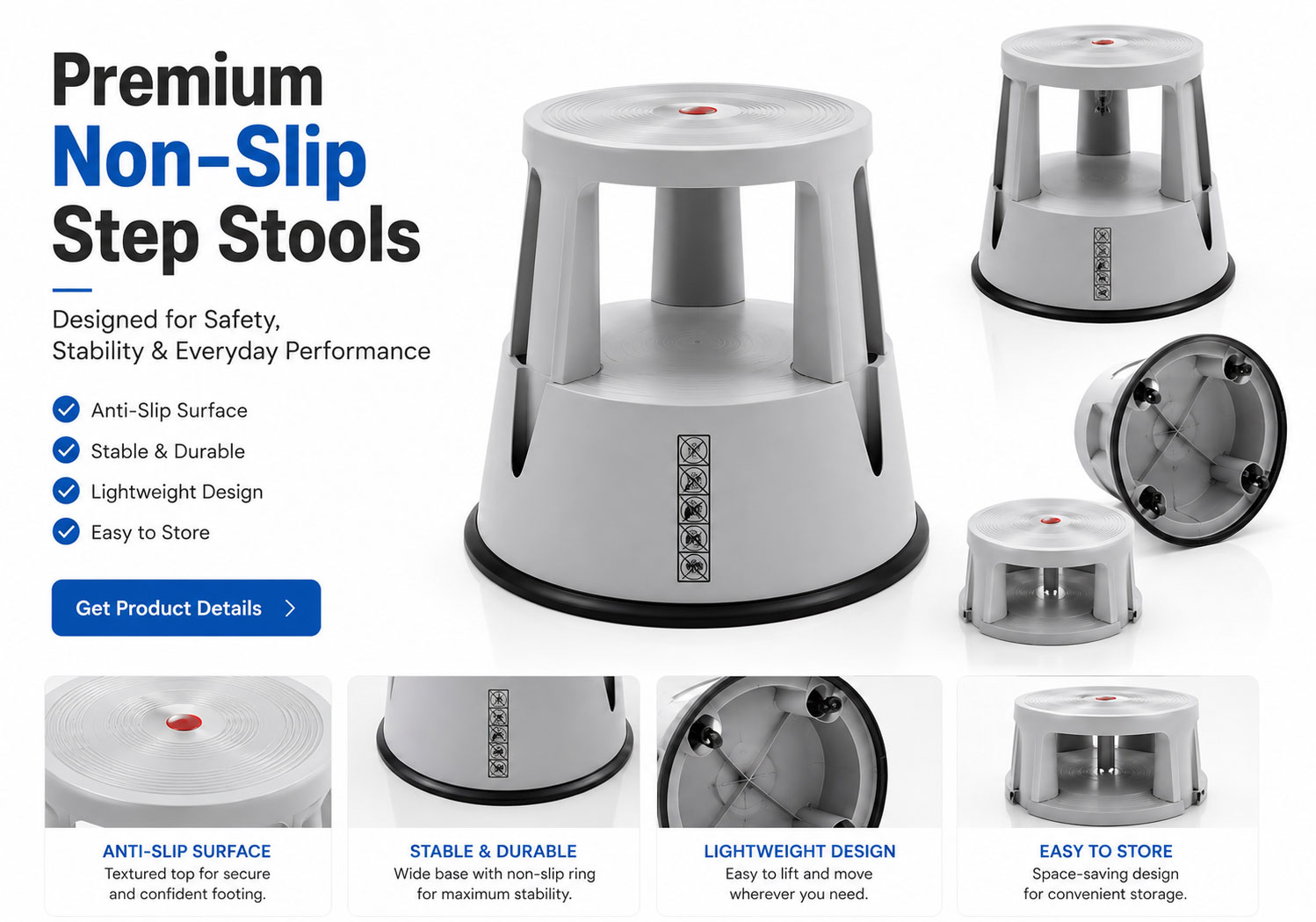
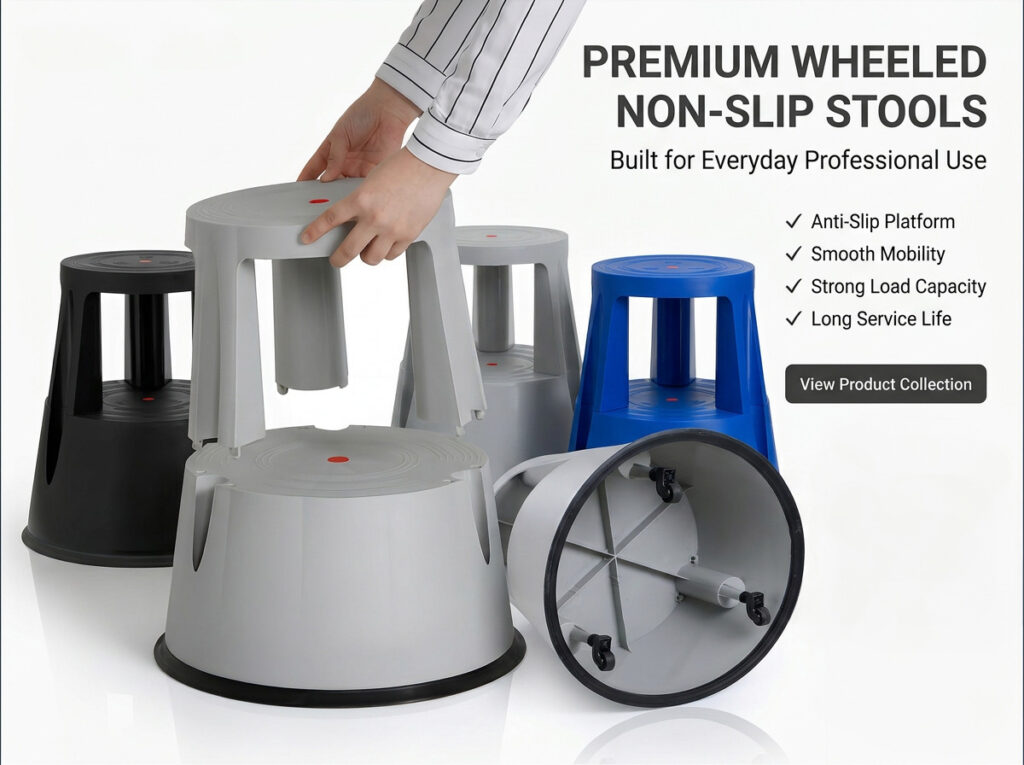
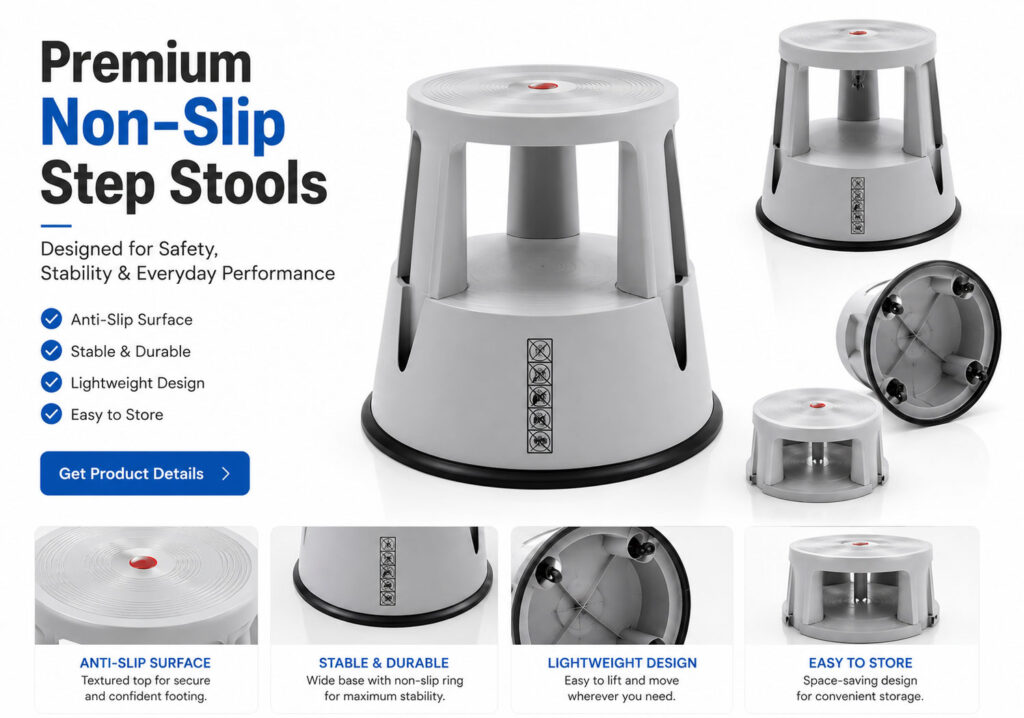
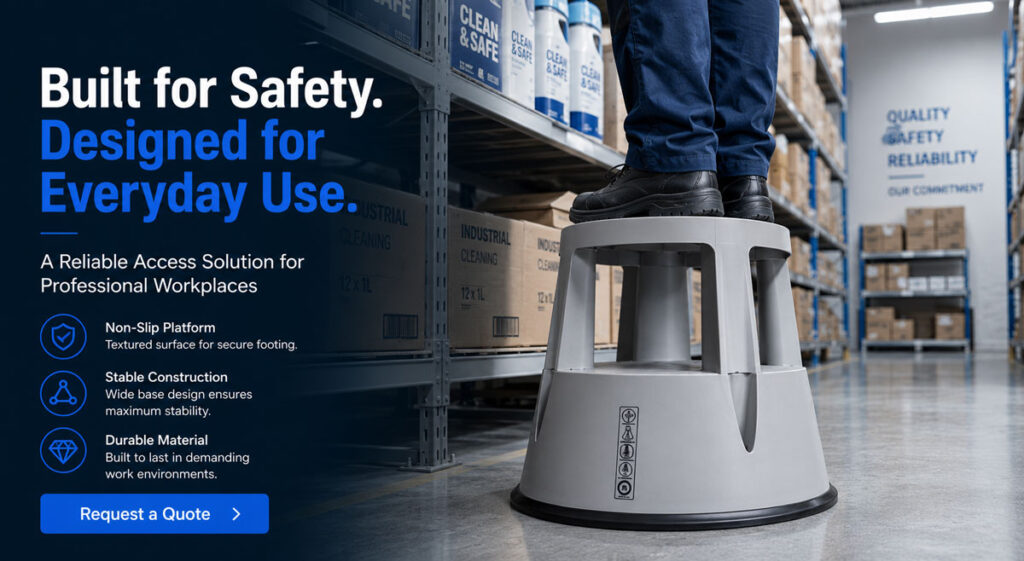
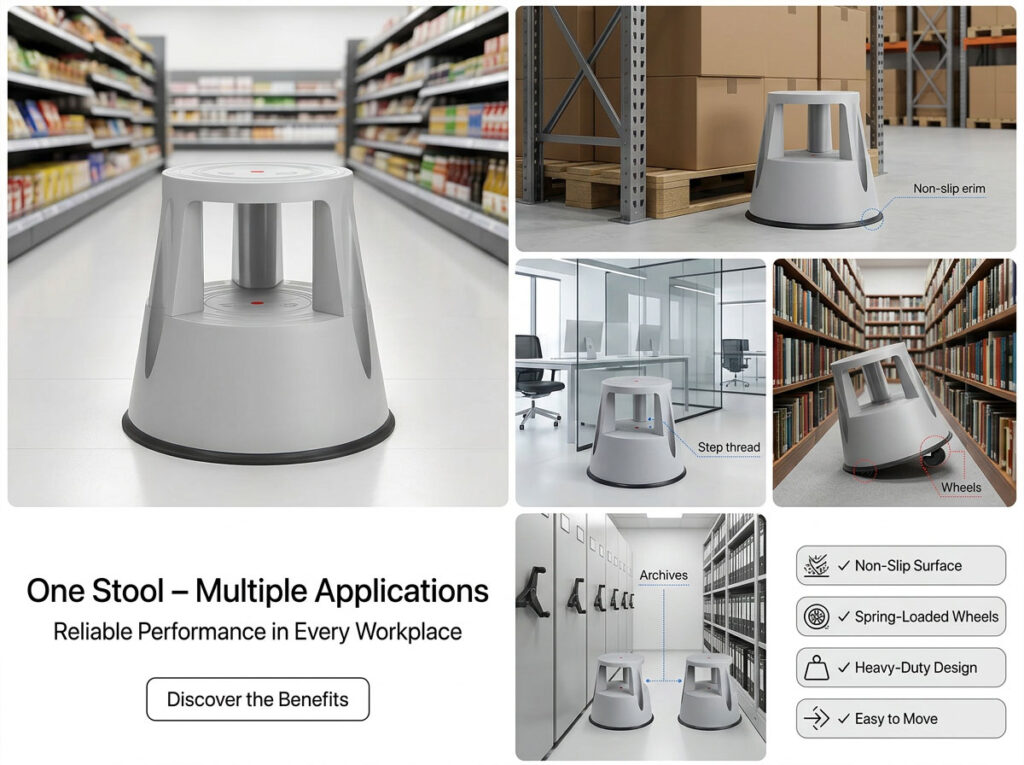
Heavy-Duty Step Stools for Warehouses in Iraq built for warehouse environments give Iraqi supermarket supply chains a reliable way to maintain speed and safety at height under dust, heat and high-cycle conditions. Firmalazım’s 2-step plastic model features spring-loaded automatic locking wheels, deep non-slip texturing, 150 kg capacity and a stable compact base. Designed for continuous commercial use, it supports order picking, put-away and inventory work inside warehouses that feed supermarket networks across Iraq.




Throughput Pressure Inside Iraqi Warehouse Operations
Warehouses that supply supermarket chains in Iraq operate under constant time pressure. Inbound trailers arrive on tight schedules. Order waves must be completed before store delivery windows close. Inventory accuracy checks cannot wait. In this environment any delay at the pick face or high-bay access point multiplies across the entire outbound flow.
A fixed ladder or an unstable platform introduces exactly that kind of delay. Workers lose seconds searching for a secure place to stand, hesitate when a surface feels uncertain under dust, or wait for a colleague to free a shared ladder. A heavy-duty step stool that rolls freely when unloaded and locks automatically under weight removes those seconds from every cycle. The result is higher pick rates, clearer travel paths and lower residual safety risk.
Firmalazım engineers the current 2-step unit for the physical realities of Iraqi warehouses linked to supermarket operations: concrete and epoxy floors, fine dust, temperature variation and high daily cycle counts.
Core Specifications Matched to Warehouse Demands
The stool stands 410 mm high, offers a 283 mm top platform and rests on a 433 mm base. Load capacity is rated at 150 kg. High-density plastic provides impact resistance and accepts deep non-slip texturing. Spring-loaded wheels retract under body weight so the platform becomes stationary without any lever. When the worker steps off, the wheels re-engage for immediate mobility.
These dimensions are chosen for logistics rather than light retail use. The height reaches the majority of frequently accessed mid-level racking. The base width fits typical aisle clearances while still resisting tip-over during sideways reach with a tote or case. The 150 kg rating covers a worker plus a full case under normal picking loads.
Material Selection for Dust, Heat and Continuous Cycles
Fine dust is a constant factor in many Iraqi locations. Surfaces that rely on thin coatings lose grip quickly. Deep moulded texture continues to provide contact points even when a light dust film is present. High-density plastic remains dimensionally stable across temperature differences between climate-controlled areas and warmer warehouse zones, resists impact and does not corrode.
The grey finish conceals the fine scuffs that accumulate during daily commercial use and continues to look serviceable under warehouse lighting. Compared with thinner domestic plastics, the commercial grade maintains structural integrity through thousands of loading cycles.
Automatic Locking as a Throughput Enabler
Manual brake systems introduce a decision that is easily skipped when wave pressure is high. Spring-loaded wheels remove that decision. The only required action is to step onto the platform. This simplicity improves compliance, shortens training time and reduces the chance that workers will improvise by climbing on lower pallets.
In high-volume warehouse environments the behavioural effect is measurable. Pickers move the stool with them, step up, complete the pick or put-away, step down and continue. No secondary action interrupts the flow.
Warehouse Scenarios Across Iraqi Logistics Networks
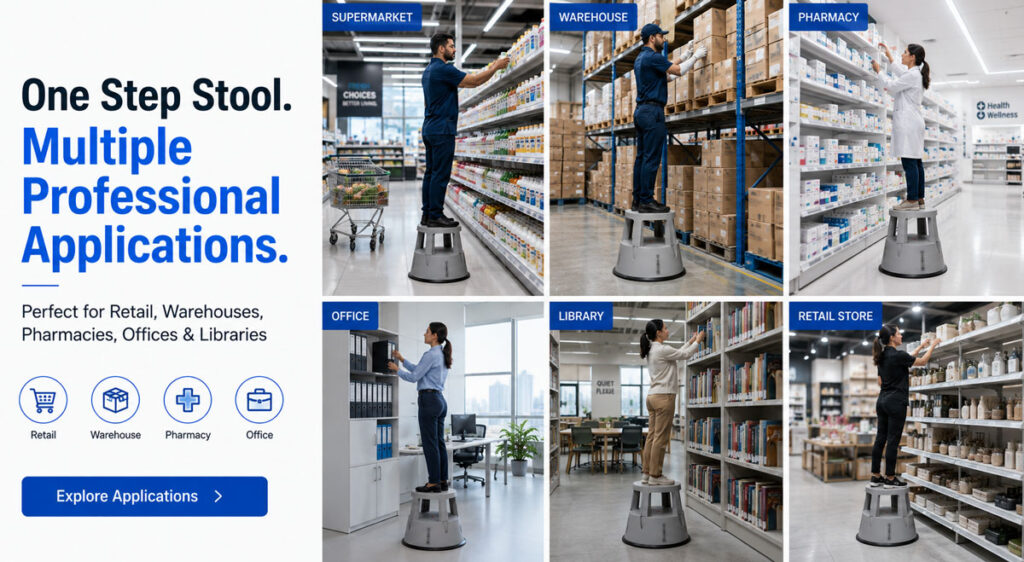
Order-picking teams travel continuously between racking aisles. A stool that can be rolled to the next bay and locked automatically keeps the picker in motion. Cross-dock teams use the same unit to access high temporary shelves after inbound trailers are unloaded. Inventory teams counting upper levels no longer improvise by standing on lower pallets. Receiving teams verify high-stacked pallets without waiting for a shared ladder.
These patterns appear across the country. Dense logistics hubs serving Baghdad recover measurable time during peak outbound waves. Southern facilities in Basrah benefit from non-slip performance under higher humidity and dust loads. Operations in Mosul and Karbala value the automatic lock for consistent safety behaviour across shifts.
Warehouses supporting stores in Kirkuk and Najaf report fewer near-miss incidents after replacing older smooth-step units. Large-format logistics sites in Erbil and Nasiriyah deploy the stools across both ambient and temperature-variable zones. Teams based in Al Diwaniyah and Kut value the light weight when stools must be moved between levels. Expanding industrial areas in Amarah, Hillah and Baqubah include the model in initial equipment lists because the specifications already satisfy throughput and safety requirements.
Coastal and southern sites in Ramadi, Kufa, Az Zubayr and Duhok place additional demand on non-slip surfaces. High-volume grocery logistics centers in Sulaymaniyah, Samawah, Abu Al-Khaseeb and Fallujah measure gains in completed lines per hour. Locations in Samarra, Zakho, Shatrah, Al Hartha, Al Qurnah, Mahmudiyah, Jisr Diyala, Taji, Nahrawan, Abu Ghraib, Musayib, Hindiyah, Al Hashimiyah, Miqdadiyah, Rifai, Suq Al-Shuyukh, Al-Suwaira, Al-Fallujah and Al Shirqat benefit from a single standardised design that simplifies multi-site training and spare-parts planning.
Procurement Logic for Warehouse and Supply-Chain Managers
Logistics procurement evaluates equipment on total cost of ownership and impact on flow. Replacement frequency under dust and heat exposure, residual risk, training overhead and the ability to standardise across multiple sites all influence the final calculation. A commercial-grade heavy-duty step stool that remains serviceable for several years under continuous warehouse cycles usually delivers lower long-term cost than lighter alternatives that require frequent replacement.
Wholesale pricing becomes relevant once volumes cover several logistics centers. OEM programmes allow private labelling or limited dimensional adjustments while the core mobility and safety features remain unchanged. Distributor partners can hold regional stock, shortening lead times for urgent replacements. Working with a specialised manufacturer improves the consistency of documentation available to safety and operations teams.
Side-by-Side Evaluation for Logistics Decision Makers
| Factor | Fixed Ladder or Light-Duty Stool | Heavy-Duty Wheeled Commercial Model | Warehouse Impact |
|---|---|---|---|
| Time to position at pick face | High | Low – rolls freely | Higher lines per hour |
| Stability under load | Variable | Automatic spring-loaded lock | Lower residual risk |
| Grip under dust | Declines rapidly | Retained by deep texture | Consistent safety |
| Training requirement | Multi-step or none | Single automatic action | Faster onboarding |
| Load capacity | Often lower | 150 kg verified | Covers worker + case |
| Service life under high cycles | Months | Multi-year commercial grade | Lower replacement cost |
Implementation Sequence for Iraqi Warehouses
- Map the highest-frequency pick and put-away zones and measure actual aisle clearances.
- Confirm that the 410 mm height and 433 mm base fit the physical layout.
- Trial a small number of units in one high-volume aisle for two to four weeks.
- Capture baseline data on pick time, near-miss frequency and worker feedback.
- Standardise on the successful model and proceed with bulk orders for remaining zones or sites.
- Embed the automatic locking behaviour in every new-hire induction.
- Add a brief visual check of wheels and textured surfaces to existing daily safety walks.
This sequence converts an equipment purchase into a controlled improvement in both throughput and safety.
Maintenance Protocol Suited to Dust and Continuous Operations Daily: Wipe textured steps during normal cleaning to remove dust films. Shift change: Quick visual confirmation that wheels retract under weight and roll freely when unloaded. Weekly: Supervisor inspection for cracks, worn texture or sticky movement. Any unit failing these checks is removed the same day and replaced from local or regional stock.
Because the design contains few moving parts, the protocol remains short enough to be sustained under high operational pressure.
Common Errors That Undermine Warehouse Performance
Selecting units with manual brakes that workers later ignore under wave pressure. Choosing bases too narrow for sideways reach with totes. Buying domestic-grade plastic that cracks under continuous commercial cycles and dust exposure. Allowing different models across different logistics centers, which multiplies training and spare-parts complexity. Overlooking the cumulative time cost of platforms that are difficult to move.
Avoiding these errors begins with a clear specification: automatic locking wheels, non-slip textured surfaces, 150 kg capacity, stable base geometry and commercial-grade construction supplied by a manufacturer experienced in warehouse retail environments.
Investment Horizon for Multi-Site Logistics Networks
A supermarket supply-chain organisation operating several warehouses and placing multiple stools in each faces a straightforward calculation. Continuous replacement of light-duty units generates ongoing purchasing cost and administrative load. A single investment in heavy-duty step stools that remain in service for several years under the same conditions reduces both. When higher pick rates and fewer safety interruptions are added, the return strengthens further.
Bulk order volumes improve unit economics. OEM options support brand and process consistency. Distributor networks provide local resilience. The combination turns a simple equipment line into a scalable operational asset that supports both current throughput and future network expansion.
Five Distinct Calls to Action
- Request sample units for a controlled trial in your highest-volume pick aisle and measure the change in lines completed per hour.
- Ask Firmalazım for a wholesale quotation structured around current warehouse count and planned capacity increases.
- Explore OEM branding if private-label consistency is required across the supply-chain network.
- Confirm regional distributor stock levels so that replacements can be supplied without interrupting flow.
- Schedule a short technical review to match the stool dimensions against specific racking heights and aisle profiles.
Closing Perspective for Logistics Decision Makers
Heavy-duty step stools remove recurring friction from the daily work of warehouse teams that serve supermarket networks in Iraq. Automatic locking, non-slip surfaces that perform under dust, adequate load capacity and compact mobility combine to support higher throughput, clearer travel paths and more consistent safety behaviour. Firmalazım supplies these solutions as a manufacturer focused on the commercial realities of Iraqi warehouses and warehouse retail environments. The ability to fulfil bulk orders, support OEM requirements and work through distributor networks allows the same reliable design to scale across an entire national supply chain.
Standardising on one purpose-built model simplifies training, inspection and replacement planning while delivering measurable gains in both productivity and residual risk reduction. The decision concerns the daily flow of every warehouse and the on-shelf availability of the supermarket network it supports.
Frequently Asked Questions
What distinguishes a heavy-duty warehouse step stool from a retail or domestic model? Higher cycle durability, automatic locking under load, verified capacity suited to worker-plus-case weights, and dimensions matched to logistics racking and aisle realities under dust and temperature variation.
How do spring-loaded wheels improve pick-face productivity? They lock automatically when weight is applied and re-engage when unloaded, removing a decision point that is easily skipped under wave pressure.
Is the 150 kg capacity realistic for warehouse tasks in Iraq? Yes. It covers the majority of workers plus typical full cases or totes under normal picking and put-away loads.
Can the same stool be used in ambient and temperature-variable warehouse zones? Yes. The construction and non-slip surfaces perform across the temperature ranges common in Iraqi logistics facilities.
Does Firmalazım support bulk orders for multi-center networks? Yes. Wholesale terms are available once volumes reach multi-site levels.
Are OEM customisation options available? Yes. Private labelling and limited adjustments can be discussed for larger programmes.
How should the non-slip surfaces be maintained in dusty warehouse environments? Wipe them during normal cleaning routines to remove dust films that can reduce grip.
What floor types are compatible? Concrete, epoxy, sealed and lightly textured surfaces commonly found in Iraqi warehouses.
Is the stool suitable when floors carry light residual moisture? The textured surfaces are designed to retain grip under the light moisture conditions typical after cleaning.
How does standardisation across warehouses improve operations? Identical equipment allows uniform training, identical inspection criteria and predictable replacement planning.
What service life can be expected under continuous commercial use? When basic cleaning and inspection are observed, commercial-grade units typically remain in service for multiple years.
Can smaller regional logistics operators obtain the product? Yes. Regional distributors stock the stools for lower-volume purchases.
What documentation is supplied with commercial orders? Load-capacity information, material details and care instructions suitable for internal safety and procurement files.
How does the design reduce improvised climbing on pallets? When a stable, easy-to-move platform is immediately available, workers have less reason to climb on product or lower levels.
Are colours other than grey available? Standard production is grey for practicality. OEM programmes can explore alternatives at sufficient volume.
What is the most common purchasing mistake in warehouse environments? Choosing units with manual brakes or inadequate non-slip surfaces that degrade under continuous high-cycle and dusty conditions.
How are urgent replacements handled? Through local distributor stock or direct from the manufacturer, depending on location and volume.
Is the stool intended for continuous all-day standing? It is designed for the repeated short-duration use typical of warehouse picking and put-away cycles.
What height is most useful for standard warehouse racking? A 410 mm platform brings the majority of frequently accessed mid-levels into comfortable reach.
How does working with a specialised manufacturer differ from generic imports? Consistent specifications, technical support, reliable bulk-order fulfilment and OEM capability reduce long-term risk and cost across a logistics network.
Firmalazım continues to supply heavy-duty step stools engineered for the daily realities of Iraqi warehouses that serve supermarket networks. Whether the need is a pilot trial, a full multi-center programme through bulk orders, or an OEM-branded solution, the focus remains safer, faster work at height that supports both throughput and safety across the supply chain.
Heavy-Duty Step Stools for Warehouses in Iraq
Residual Risk Control, Workforce Sustainability and Multi-Site Economics of Heavy-Duty Step Stools in Iraqi Warehouses
Warehouses that feed supermarket chains in Iraq operate under a combination of fine dust, temperature variation, high daily cycle counts and tight outbound windows. Access to mid-level racking and cross-dock shelves is a repeated physical task. When the platform used for that task is unstable, slow to position or loses grip, both residual risk and labour efficiency suffer.
Heavy-duty step stools engineered for continuous commercial use address these pressures directly. Firmalazım’s 2-step plastic model—with spring-loaded automatic locking wheels, deep non-slip texturing, 150 kg capacity and compact stable base—provides a practical platform matched to local warehouse conditions. The following sections examine residual risk under dust exposure, workforce sustainability across long shifts, multi-site economic modelling and the resulting impact on supermarket supply reliability.
Dust as a Persistent Residual-Risk Factor
Fine dust settles continuously in many Iraqi warehouse environments. Surfaces that rely on smooth finishes or thin coatings lose friction as the day progresses. A worker who steps onto a platform that has accumulated a light dust film faces an elevated residual slip risk. Deep moulded texture continues to present contact points even when a dust film is present. Routine cleaning restores full performance without special procedures.
This characteristic is especially important during peak outbound waves when staff move rapidly between bays and cannot pause to inspect every surface. The non-slip design keeps residual risk controlled from the first hour of the shift to the last.
Thermal and Material Stability Across Warehouse Zones
Climate-controlled areas and warmer open warehouse zones create temperature differences that affect some materials. High-density plastic remains dimensionally stable, retains its textured grip and continues to support the rated 150 kg load. It does not corrode and stays light enough for any trained worker to reposition without strain. The grey finish conceals the fine scuffs that accumulate during continuous commercial use and continues to look serviceable under warehouse lighting.
Technical Consistency That Enables Network Control
The Firmalazım unit delivers fixed specifications: overall height 410 mm, top platform diameter 283 mm, base diameter 433 mm, load capacity 150 kg, high-density plastic with deep non-slip texturing, and spring-loaded wheels that retract under load.
These characteristics remain identical in every unit, supporting uniform training, identical inspection criteria and predictable replacement planning across multiple warehouse sites. The automatic lock removes the most common residual risk associated with wheeled platforms—forgotten manual brakes—under the time pressure of outbound waves.
Workforce Sustainability Under High-Cycle Conditions
Repeated high-shelf access under residual risk and physical awkwardness increases cumulative fatigue. By the later hours of a shift, output declines and residual strain risk rises. A platform that locks automatically, offers secure non-slip footing and remains light enough for rapid repositioning reduces that cumulative load.
Staff maintain higher sustained pick rates across the full shift. Near-miss frequency linked to unstable platforms falls. Over weeks and months the reduction in residual strain supports better workforce sustainability in high-cycle warehouse environments.
Operational Patterns Across Iraqi Logistics Locations
Dense hubs serving Baghdad recover measurable time during peak outbound waves because platforms can be positioned and locked in one fluid motion. Southern facilities in Basrah contend with higher humidity and dust; textured surfaces continue to perform. Operations in Mosul and Karbala value the automatic lock for consistent behaviour across multiple shifts.
Warehouses supporting stores in Kirkuk and Najaf report fewer near-miss incidents after replacing older units. Large-format logistics sites in Erbil and Nasiriyah deploy the stools across ambient and temperature-variable zones. Teams based in Al Diwaniyah and Kut move the light units easily between levels. Expanding industrial areas in Amarah, Hillah and Baqubah include the model because the specifications already match local racking and aisle profiles.
Coastal and southern sites in Ramadi, Kufa, Az Zubayr and Duhok place additional demand on non-slip performance. High-volume grocery logistics centers in Sulaymaniyah, Samawah, Abu Al-Khaseeb and Fallujah measure gains in completed lines per hour. Locations in Samarra, Zakho, Shatrah, Al Hartha, Al Qurnah, Mahmudiyah, Jisr Diyala, Taji, Nahrawan, Abu Ghraib, Musayib, Hindiyah, Al Hashimiyah, Miqdadiyah, Rifai, Suq Al-Shuyukh, Al-Suwaira, Al-Fallujah and Al Shirqat benefit from one standardised design that simplifies multi-site training and spare-parts logistics.
Procurement and Multi-Site Economic Modelling
Logistics and procurement teams evaluate residual risk, process consistency and lifetime cost under local conditions. A commercial-grade heavy-duty step stool that remains serviceable for several years under continuous warehouse cycles and dust exposure usually delivers lower total cost than lighter units that require frequent replacement.
Wholesale pricing becomes relevant once volumes cover multiple sites. OEM programmes allow private labelling while the core locking and grip features remain unchanged. Distributor partners can hold regional stock, reducing lead times for urgent replacements. Engagement with a manufacturer experienced in commercial warehouse retail environments improves documentation quality for safety and operations files.
Comparative Decision Matrix
| Factor | Fixed or Light-Duty Option | Heavy-Duty Wheeled Commercial Model | Impact Under Iraqi Warehouse Conditions |
|---|---|---|---|
| Grip under progressive dust | Declines through the day | Retained by deep texture | Controlled residual slip risk |
| Locking reliability under pressure | Manual or none | Automatic under weight | Higher compliance |
| Cumulative fatigue per shift | Higher | Lower sustained effort | Improved end-of-shift output |
| Mobility between bays | Low | High when unloaded | Faster task cycles |
| Thermal stability | Variable | Stable high-density plastic | Reliable across zones |
| Service life under high cycles | Months | Multi-year commercial grade | Lower lifetime cost |
| Specification consistency | Variable | Uniform from manufacturer | Simplified multi-site management |
Structured Implementation for Multi-Site Networks
- Select one high-volume aisle or zone for a controlled pilot of four to six weeks.
- Capture baseline data on pick time, near-miss frequency, worker feedback on effort and any overtime linked to access delays.
- Introduce the heavy-duty step stools and repeat the same measurements.
- Document the observed differences and refine placement density.
- Scale through bulk orders to additional zones or sites, maintaining identical specifications.
- Embed the automatic locking behaviour in all national induction materials.
- Establish a simple weekly inspection protocol that travels with the equipment.
This sequence converts a product decision into a managed process improvement that strengthens both daily flow and long-term resilience.
Maintenance Discipline Under Dust and Continuous Operations Daily wiping of textured surfaces during normal cleaning prevents the accumulation of dust films. Shift-level visual checks confirm that wheels retract under weight and roll freely when unloaded. Weekly supervisor inspections identify cracks, worn texture or sticky mechanisms before they affect performance. Any unit that fails these checks is removed the same day and replaced from regional buffer stock.
Because the design contains few moving parts, the discipline remains light enough to be sustained under continuous wave pressure.
Error-Prevention Protocol for Warehouse and Network Managers
- Confirm that every active stool retains fully functional spring-loaded wheels.
- Verify that non-slip texturing has not been polished smooth by prolonged dust exposure and cleaning.
- Ensure base geometry continues to match the sideways reaches common in local racking layouts.
- Remove damaged units immediately and log the reason for pattern analysis.
- Keep induction content identical across all sites.
- Maintain a small regional buffer so that replacements occur without interrupting flow.
- Review near-miss, productivity and fatigue-related data quarterly to confirm sustained benefit.
Adherence to this protocol prevents the slow erosion of performance that can occur when equipment is treated as a one-time purchase rather than an ongoing operational asset.
Multi-Year Value for Expanding Supermarket Supply Chains A supermarket organisation that continues to expand its warehouse footprint benefits from equipment decisions that scale without reinvention. When every new site receives the same heavy-duty step stool, training, inspection and replacement systems transfer automatically. The manufacturer relationship deepens through repeated bulk orders and potential OEM collaboration. Distributor coverage expands in parallel with the network.
The cumulative effect is a quieter, more predictable operating environment in which teams can focus on flow accuracy and outbound reliability rather than on the mechanics of reaching height under residual risk.
Five Forward-Looking Actions
- Design a six-week pilot in one high-volume zone with clear before-and-after metrics on pick rate, residual risk and worker feedback.
- Request a multi-year wholesale framework quotation based on current warehouse count and planned capacity increases.
- Explore OEM branding options that align the equipment with internal process and audit standards.
- Map regional distributor coverage to ensure rapid replacement capability as the network grows.
- Commission a short technical alignment session to confirm that the 410 mm height and 433 mm base match the dominant racking and aisle profiles across the estate.
Strategic Synthesis for Supply-Chain Leadership Heavy-duty step stools function as residual-risk reducers and workforce sustainability tools under the specific dust, temperature and cycle conditions found in Iraqi warehouses. Automatic locking removes a decision point that is easily skipped under wave pressure. Deep textured surfaces maintain grip as dust accumulates. Adequate load capacity and stable geometry reduce tip risk. Compact mobility keeps travel paths clear and task cycles short.
Firmalazım supplies these capabilities as a manufacturer focused on the commercial realities of Iraqi warehouses that serve supermarket networks and warehouse retail zones. The ability to fulfil bulk orders, support OEM requirements and work through distributor networks allows the same reliable design to scale across an entire national supply chain. Standardising on one purpose-built model simplifies every supporting process—training, inspection, replacement and safety culture—while delivering measurable gains in throughput, residual-risk reduction and workforce sustainability.
The decision ultimately concerns the daily reliability of every warehouse and the on-shelf availability of the supermarket network it supports. Removing friction, residual risk and unnecessary physical load at the point of access to height is one of the more direct routes to both.
Extended Frequently Asked Questions
How does progressive dust accumulation specifically increase residual risk on ordinary platforms? Smooth or thinly coated surfaces lose friction as a dust film builds through the day. Deep moulded texture continues to provide contact points.
What is the most effective way to capture baseline residual-risk and productivity data before a pilot? Combine timed samples of mid-level picks with near-miss logs and structured worker feedback on perceived stability and effort across several shifts.
Can the stools support both steady-state picking and sudden promotional or seasonal surges? Yes. The same mobility and stability characteristics serve continuous daily tasks and higher-intensity peak periods.
How does temperature variation between zones affect material performance? High-density commercial plastic is selected for dimensional stability across the ranges common in Iraqi warehouse environments.
What buffer stock level is practical for a regional cluster of warehouses? A small number of spare units per cluster is usually sufficient to cover immediate replacements while new stock is ordered.
How are multi-year supply agreements typically structured? They combine volume commitments with scheduled delivery windows and the option to adjust quantities as network capacity evolves.
Does standardisation simplify both internal process audits and external safety reviews? Yes. Identical equipment and documented inspection routines produce clearer audit trails and more consistent findings.
What is the recommended response if a stool begins to show surface wear or reduced wheel response under dusty conditions? Remove it from service at the first sign of compromised performance and replace it from buffer stock.
Can the design support more reliable digital task-completion tracking? While the stool itself is mechanical, its consistent availability and predictable behaviour reduce the variability that often undermines digital task systems.
How does the automatic lock influence near-miss trends related to platform movement? Warehouses that standardise on automatic locking typically observe a clear reduction in reports linked to unexpected movement under load.
Is the product suitable for warehouses that operate mixed ambient and temperature-variable zones? Yes. The construction and non-slip surfaces perform across the temperature ranges common in these facilities.
What long-term partnership benefits arise from repeated bulk orders and potential OEM collaboration? Deeper technical alignment, priority production scheduling, refined specifications over successive programmes, and stronger continuity of supply as the warehouse network expands.
Firmalazım remains focused on supplying heavy-duty step stools that match the actual working conditions of Iraqi warehouses serving supermarket networks. Whether the requirement is a carefully measured pilot, a multi-year bulk supply programme, or an OEM-branded solution for network-wide consistency, the engineering priority stays the same: safer, faster, more sustainable work at height that supports both daily throughput and long-term supply-chain resilience across Iraq.
Heavy-Duty Step Stools for Warehouses Iraq
Outbound reliability in Iraqi supermarket supply chains starts at the warehouse pick face. Firmalazım’s heavy-duty step stool—with automatic spring-loaded locking, deep non-slip texture, 150 kg capacity and compact stable base—removes the access friction that delays waves and raises residual risk under dust and heat. Built for continuous commercial use, it keeps warehouse flow moving so supermarket shelves stay full across Iraq.
The Hidden Link Between Warehouse Access and Store Shelves
When a supermarket shelf stays empty, the root cause is often not a missing truck. It is the cumulative minutes lost inside the warehouse every time a picker hesitates on an unstable platform, searches for a ladder, or works around a surface that has lost grip under dust. Those minutes push outbound waves later. Stores receive incomplete orders. On-shelf availability drops.
A heavy-duty step stool that rolls into position and locks the instant weight is applied shortens every access cycle. The picker moves, steps up, completes the line, steps down and continues. No search, no extra locking action, no second person. The wave finishes closer to schedule. Stores receive fuller deliveries. Customers find the products they expect.
Firmalazım’s 2-step model is engineered for this exact cycle under Iraqi warehouse conditions: 410 mm height, 283 mm top platform, 433 mm base, 150 kg rating, high-density plastic with permanent non-slip texture, and spring-loaded wheels that retract under load.
Dust, Heat and the Daily Reality of Iraqi Warehouses
Fine dust settles throughout the shift. Cleaning leaves light residual moisture. Temperature differences between climate-controlled zones and open warehouse areas create further variables. Platforms that perform in clean, stable environments can lose grip or become awkward under these conditions.
Deep moulded texture continues to provide contact points even when a light dust film is present. High-density plastic stays dimensionally stable across temperature ranges, resists impact and does not corrode. The automatic lock removes the human-error variable that increases when wave pressure is high. Together these features keep the platform reliable from the opening of the shift to the final outbound cut-off.
How Access Speed Protects Outbound Windows
Every second saved on a mid-level pick is a second that keeps the wave on schedule. When the stool is light enough for one person to move, locks without a lever, and stays stable under a full case, the cumulative gain across hundreds of lines becomes measurable. Incomplete orders decline. Expedited transport costs fall. Supermarket stores receive the stock they need to maintain on-shelf availability.
The same unit works for put-away and inventory counts, so the entire warehouse flow remains consistent.
City-Level Operating Patterns Dense logistics hubs serving Baghdad recover time during peak outbound waves because platforms can be positioned and locked in one motion. Southern facilities in Basrah face higher humidity and dust; the textured surface continues to grip. Operations in Mosul and Karbala run multiple shifts; the automatic lock keeps behaviour consistent regardless of which team is working.
Warehouses supporting stores in Kirkuk and Najaf report fewer delayed lines after replacing older platforms. Large-format sites in Erbil and Nasiriyah use the same stools across ambient and temperature-variable zones, simplifying training. Teams in Al Diwaniyah and Kut move the light units between levels without fatigue. Expanding locations in Amarah, Hillah and Baqubah specify the model because the dimensions already match their racking and aisle profiles.
Southern and coastal sites in Ramadi, Kufa, Az Zubayr and Duhok place extra demand on grip under residual moisture. High-volume centers in Sulaymaniyah, Samawah, Abu Al-Khaseeb and Fallujah track measurable gains in wave completion. Locations in Samarra, Zakho, Shatrah, Al Hartha, Al Qurnah, Mahmudiyah, Jisr Diyala, Taji, Nahrawan, Abu Ghraib, Musayib, Hindiyah, Al Hashimiyah, Miqdadiyah, Rifai, Suq Al-Shuyukh, Al-Suwaira, Al-Fallujah and Al Shirqat all benefit from one standardised platform that removes the need for different training or spare parts in each city.
Procurement Reality for Multi-Site Supply Chains Unit price is only the starting figure. The real cost includes replacement frequency under dust and heat, time lost to unstable platforms, residual risk events, and the administrative burden of managing different models across sites. A commercial-grade heavy-duty stool that stays in service for years under local conditions usually costs less over the full life cycle.
Wholesale volumes reduce the unit cost further. OEM options allow private labelling while the core locking and grip features stay identical. Distributor partners hold stock in key regions so that a damaged unit can be replaced the same day. Working with a manufacturer that understands commercial warehouse retail use keeps specifications consistent and documentation ready for internal audits.
Side-by-Side Reality Check
| Situation | Older Fixed or Light Platform | Firmalazım Heavy-Duty Wheeled Stool | Result on Warehouse Flow |
|---|---|---|---|
| Dust film present | Grip falls | Texture still grips | Fewer slips |
| Light moisture after cleaning | Surface becomes risky | Texture holds | Continued confidence |
| Peak outbound wave | Ladder or unstable platform slows lines | Rolls in, locks, rolls out | Wave stays on schedule |
| End-of-shift fatigue | Heavy or awkward unit | Light, automatic lock | Higher remaining output |
| Multi-site training | Different models | One model everywhere | Uniform behaviour |
Practical Steps That Deliver Results Start with one high-volume aisle. Place several units in the zones that generate the most delayed lines. Time the mid-level picks for two weeks before and two weeks after. Record near-misses and staff comments on effort. Once the numbers confirm the gain, expand through bulk orders. Keep the induction message identical in every site: step on and it locks, step off and it rolls. Add a ten-second visual check of wheels and texture to the existing daily routine.
Maintenance That Survives Real Shifts Wipe the textured steps during normal cleaning to remove dust. At shift change confirm the wheels still retract under weight. Once a week a supervisor checks for cracks or sticky movement. Any unit that fails is removed the same day and replaced from the nearest buffer stock. The design has so few moving parts that the routine stays short.
Mistakes That Quietly Destroy the Benefit Buying units with manual brakes that staff later ignore. Choosing narrow bases that feel tippy when reaching sideways with a tote. Accepting domestic-grade plastic that cracks after a few months of dust and temperature cycles. Allowing each warehouse to select its own model. Ignoring the cumulative time cost of platforms that are slow to position.
Clear specification prevents all of them: automatic locking, deep non-slip texture, 150 kg capacity, stable 433 mm base, commercial-grade plastic, supplied by a manufacturer that supports bulk orders, OEM programmes and distributor networks.
Five Different Ways to Move Forward
- Run a controlled four-week test in one busy warehouse aisle and measure line completion speed plus near-miss count.
- Ask for a wholesale price structure based on the number of warehouses you plan to equip this year.
- Discuss OEM branding if you need the stools to match your internal visual or process standards.
- Confirm which regions already have distributor stock for same-day replacement.
- Match the 410 mm height and 433 mm base against the actual racking and aisle measurements in your current sites.
Closing View Delayed outbound waves are rarely a labour problem alone. They are often an access problem. A heavy-duty step stool that locks automatically, grips under dust and residual moisture, carries 150 kg and moves easily between bays removes that access problem. Firmalazım builds the unit for continuous commercial use in warehouse retail environments across Iraq. Standardising on one reliable model simplifies training, inspection and replacement while protecting outbound reliability and supermarket on-shelf availability in every city from Baghdad to Al Shirqat.
Frequently Asked Questions
How quickly does the stool improve wave completion times? Most warehouses see measurable gains in line completion speed within the first two weeks of consistent use.
Does fine dust really reduce grip on ordinary platforms? Yes. Smooth or thinly coated surfaces lose friction rapidly once a dust film forms. Deep moulded texture continues to grip.
Is the automatic lock reliable after months of dusty conditions? When the wheels are kept free of heavy build-up through normal cleaning, the spring mechanism continues to retract and re-engage consistently.
Can one model serve both climate-controlled and open warehouse zones? Yes. The same construction and non-slip surfaces perform across temperature and dust conditions.
What volume makes wholesale pricing available? Once the order covers multiple warehouses or a planned multi-site roll-out, wholesale terms become available.
Is OEM branding possible for a national supply-chain group? Yes. Private labelling and limited visual adjustments can be discussed for larger programmes.
How often should the textured surface be cleaned under dusty conditions? Wiping during the normal daily cleaning cycle is normally sufficient to maintain grip performance.
What happens if a wheel becomes sticky with dust? Remove the unit from service, clean the mechanism if possible, or replace it from buffer stock.
Does the 150 kg rating cover typical warehouse cases in Iraq? Yes. It provides a clear margin for worker weight plus full cases or totes of common supermarket products.
How does standardisation across warehouses reduce cost? One model means one training programme, one inspection checklist, one spare-parts plan and simpler bulk purchasing.
Can smaller regional operators buy through a distributor? Yes. Regional distributors stock units for lower-volume requirements.
What documentation is provided with commercial orders? Load-capacity statements, material information and basic care instructions suitable for internal records.
Is the stool suitable when floors are still slightly damp after cleaning? The deep texture is designed to retain grip under the light residual moisture typical after routine cleaning.
How long do commercial-grade units typically last under local warehouse conditions? With basic daily cleaning and weekly inspection, multiple years of service is realistic.
What is the single biggest residual risk the design removes? The forgotten manual brake that leaves a wheeled platform free to move under load.
Firmalazım continues to supply heavy-duty step stools built for the actual dust, temperature and cycle conditions of Iraqi warehouses that serve supermarket networks. Whether you need a single-aisle trial, a multi-site programme through bulk orders, or an OEM solution for network-wide consistency, the goal remains the same: keep outbound waves on schedule, residual risk low and supermarket shelves full across Iraq.
Step Stools for Warehouses Iraq
Heavy-duty step stools that lock automatically and maintain grip under dust give Iraqi warehouse teams a safer, faster way to work at the pick face. Firmalazım’s 2-step plastic model delivers spring-loaded wheels, deep non-slip texturing, 150 kg capacity and a stable 433 mm base. Built for continuous commercial use, it supports higher line rates and lower residual risk inside warehouses that supply supermarket networks across Iraq.
The Pick-Face Reality Most Equipment Ignores At the pick face a worker’s attention is split between the order, the location, the case weight and the next line. Any platform that requires a second thought about locking or that feels uncertain underfoot adds cognitive and physical load. Under the fine dust and temperature variation common in Iraqi warehouses, that extra load multiplies.
A heavy-duty step stool that rolls freely when unloaded and locks the moment weight is applied removes the extra thought. The worker positions the unit, steps up with certainty, completes the pick, steps down and moves to the next bay. The cycle stays fluid. Residual risk stays controlled. Line rates stay higher for longer.
Firmalazım’s current model is built around this exact sequence: 410 mm height, 283 mm top platform, 433 mm base, 150 kg rating, high-density plastic with permanent non-slip texture, and spring-loaded wheels that retract under load.
Dust Accumulation and the Gradual Loss of Grip Fine dust does not arrive all at once. It builds through the shift. Platforms with smooth surfaces or thin coatings lose friction progressively. By the middle of a long wave a worker may be standing on a surface that feels less secure than it did at the start of the day.
Deep moulded texture continues to present contact points even as a light dust film forms. Routine wiping during normal cleaning restores full performance. The result is consistent grip from the opening of the shift to the final outbound cut-off, without requiring special procedures or extra attention from the picker.
Heat, Weight and End-of-Shift Performance Temperature differences between climate-controlled zones and open warehouse areas affect both the worker and the equipment. Heavy or awkward platforms increase fatigue as the shift progresses. High-density plastic stays light, dimensionally stable and free from corrosion. The automatic lock removes an extra physical action. Together these features help maintain output and reduce residual strain in the later hours of the shift.
How the Design Supports Continuous Flow The 410 mm height places the majority of mid-level racking within comfortable reach. The 433 mm base resists tip-over when a worker reaches sideways with a tote. The 150 kg rating covers staff weight plus a full case. Spring-loaded wheels lock without a lever and re-engage the moment the worker steps off.
The combination keeps the picker in motion, reduces hesitation, and maintains travel-path clarity even during peak waves.
Warehouse Patterns Across Iraqi Locations Dense hubs serving Baghdad recover time during peak outbound periods because platforms can be positioned and locked in one continuous motion. Southern facilities in Basrah face higher dust and humidity loads; the textured surface continues to grip. Operations in Mosul and Karbala run multiple shifts; the automatic lock keeps behaviour consistent regardless of which team is on duty.
Warehouses supporting stores in Kirkuk and Najaf report fewer near-miss events after replacing older platforms. Large-format sites in Erbil and Nasiriyah use the same stools across ambient and temperature-variable zones. Teams in Al Diwaniyah and Kut move the light units between levels without accumulating extra fatigue. Expanding locations in Amarah, Hillah and Baqubah specify the model because the dimensions already match their racking and aisle profiles.
Southern and coastal sites in Ramadi, Kufa, Az Zubayr and Duhok place additional demand on grip under residual moisture. High-volume centers in Sulaymaniyah, Samawah, Abu Al-Khaseeb and Fallujah track measurable gains in line completion. Locations in Samarra, Zakho, Shatrah, Al Hartha, Al Qurnah, Mahmudiyah, Jisr Diyala, Taji, Nahrawan, Abu Ghraib, Musayib, Hindiyah, Al Hashimiyah, Miqdadiyah, Rifai, Suq Al-Shuyukh, Al-Suwaira, Al-Fallujah and Al Shirqat benefit from one standardised platform that removes the need for different training or spare parts in each city.
Procurement View: Residual Risk Versus Lifetime Cost The purchase price is only the entry point. The real cost includes replacement frequency under dust and heat, time lost to hesitation or unstable platforms, residual risk events, and the administrative load of managing different models across sites. A commercial-grade heavy-duty stool that remains serviceable for years under local conditions usually costs less over the full life cycle.
Wholesale volumes reduce the unit cost further. OEM options allow private labelling while the core locking and grip features stay identical. Distributor partners hold stock in key regions so that a damaged unit can be replaced the same day. Working with a manufacturer that understands commercial warehouse retail use keeps specifications consistent and documentation ready for internal audits.
Practical Comparison
| Condition | Older Fixed or Light Platform | Firmalazım Heavy-Duty Wheeled Stool | Effect on the Pick Face |
|---|---|---|---|
| Progressive dust film | Grip declines through the shift | Texture continues to grip | Consistent confidence |
| Light residual moisture | Surface becomes uncertain | Texture holds | No added hesitation |
| Peak wave pressure | Manual lock often skipped | Automatic under weight | Higher compliance |
| End-of-shift fatigue | Heavy or awkward unit | Light, single-action lock | Better sustained output |
| Multi-site training | Different models | One model everywhere | Uniform behaviour |
Implementation That Produces Measurable Change Choose one high-volume aisle. Place several units in the zones that generate the most delayed lines or near-miss reports. Time the mid-level picks for two weeks before and two weeks after. Capture near-miss counts and staff comments on effort and confidence. Once the numbers confirm the gain, expand through bulk orders. Keep the induction message identical in every site: step on and it locks, step off and it rolls. Add a short visual check of wheels and texture to the existing daily routine.
Maintenance That Fits Real Warehouse Shifts Wipe the textured steps during normal cleaning to remove dust. At shift change confirm the wheels still retract under weight. Once a week a supervisor checks for cracks or sticky movement. Any unit that fails is removed the same day and replaced from the nearest buffer stock. The design has few moving parts, so the routine stays short enough to survive continuous operations.
Errors That Quietly Cancel the Benefit Selecting units with manual brakes that staff later ignore under wave pressure. Choosing narrow bases that feel unstable when reaching sideways. Accepting domestic-grade plastic that cracks after months of dust and temperature cycles. Allowing each warehouse to select its own model. Ignoring the cumulative time and fatigue cost of platforms that are slow or awkward to use.
Clear specification prevents these problems: automatic locking, deep non-slip texture, 150 kg capacity, stable 433 mm base, commercial-grade plastic, supplied by a manufacturer that supports bulk orders, OEM programmes and distributor networks.
Five Distinct Routes Forward
- Run a four-week controlled test in one busy aisle and measure line speed plus near-miss frequency.
- Request a wholesale structure based on the number of warehouses you plan to equip this year.
- Discuss OEM branding if you need the stools to match internal visual or process standards.
- Confirm regional distributor stock for same-day replacement capability.
- Match the 410 mm height and 433 mm base against actual racking and aisle measurements in your current sites.
Closing Perspective The pick face is where warehouse performance is won or lost under the dust, heat and cycle pressure of Iraqi operations. A heavy-duty step stool that locks automatically, maintains grip as dust accumulates, carries 150 kg and moves easily between bays protects both line rates and residual risk. Firmalazım builds the unit for continuous commercial use in warehouse retail environments that serve supermarket networks. Standardising on one reliable model simplifies training, inspection and replacement while supporting outbound reliability and supermarket on-shelf availability from Baghdad to Al Shirqat.
Frequently Asked Questions
How does progressive dust specifically increase residual risk on ordinary platforms? Smooth or thinly coated surfaces lose friction as a dust film builds. Deep moulded texture continues to provide contact points throughout the shift.
What is the most practical way to measure improvement after introducing the stools? Time a representative sample of mid-level picks before and after, combined with near-miss logs and short staff feedback on confidence and effort.
Can the same stool serve both climate-controlled and open warehouse zones? Yes. The construction and non-slip surfaces perform across the temperature and dust conditions common in Iraqi warehouses.
Is the automatic lock reliable after prolonged dusty operation? When wheels are kept free of heavy build-up through normal cleaning, the spring mechanism continues to retract and re-engage consistently.
What volume triggers wholesale pricing? Once the order covers multiple warehouses or a planned multi-site programme, wholesale terms become available.
Is OEM branding possible? Yes. Private labelling and limited adjustments can be discussed for larger programmes.
How often should the textured surface be wiped under dusty conditions? During the normal daily cleaning cycle is normally sufficient to maintain grip performance.
What should be done if a wheel becomes sticky? Remove the unit from service immediately and replace it from buffer stock.
Does the 150 kg rating cover typical warehouse cases? Yes. It provides a clear margin for worker weight plus full cases or totes of common supermarket products.
How does standardisation across warehouses reduce cost and complexity? One model means one training programme, one inspection checklist, one spare-parts plan and simpler bulk purchasing.
Can smaller regional operators obtain the stools? Yes. Regional distributors stock units for lower-volume needs.
What documentation accompanies commercial orders? Load-capacity statements, material information and care instructions suitable for internal records.
Is the stool suitable when floors remain slightly damp after cleaning? The deep texture is designed to retain grip under the light residual moisture typical after routine cleaning.
How long do commercial-grade units typically last under local conditions? With basic daily cleaning and weekly inspection, multiple years of service is realistic.
What single residual risk does the design most effectively remove? The forgotten manual brake that leaves a wheeled platform free to move under load.
Firmalazım continues to supply heavy-duty step stools engineered for the actual dust, temperature and cycle conditions of Iraqi warehouses that serve supermarket networks. Whether the requirement is a single-aisle trial, a multi-site programme through bulk orders, or an OEM solution for network-wide consistency, the priority remains safer, faster, more sustainable work at the pick face so that outbound waves stay on schedule and supermarket shelves stay full across Iraq.

Bir yanıt yazın