


Professional Step Stools for Retail Stores in Saudi Arabia
Professional Step Stools for Retail Stores in Saudi Arabia are a quiet but critical tool for retail stores and supermarket operations across Saudi Arabia. A 2-step plastic design with non-slip surface, spring-loaded wheels, 150 kg capacity and wide stable base allows staff to merchandise upper shelves, adjust displays and maintain the sales floor without ladders or unsafe improvisation.




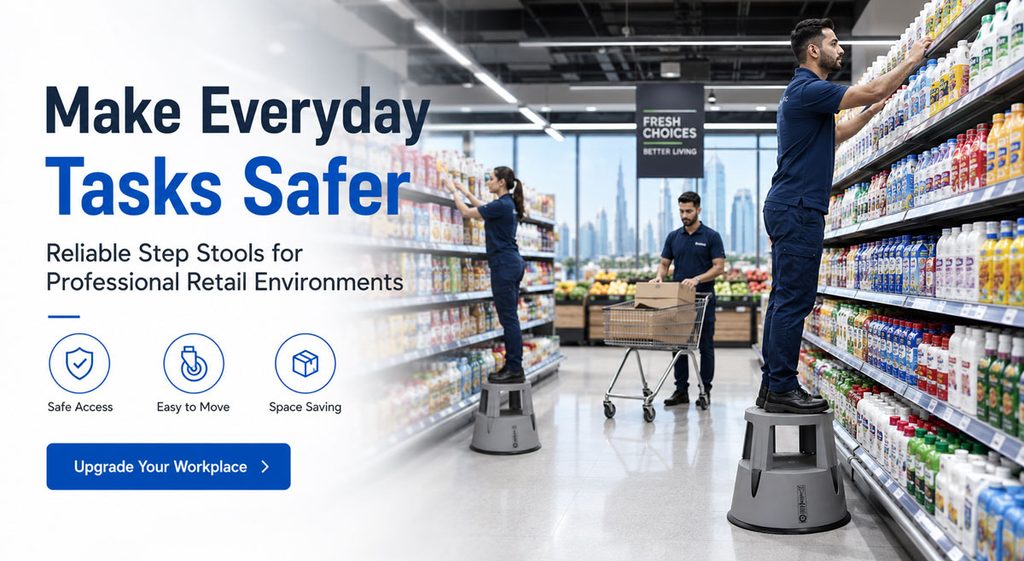


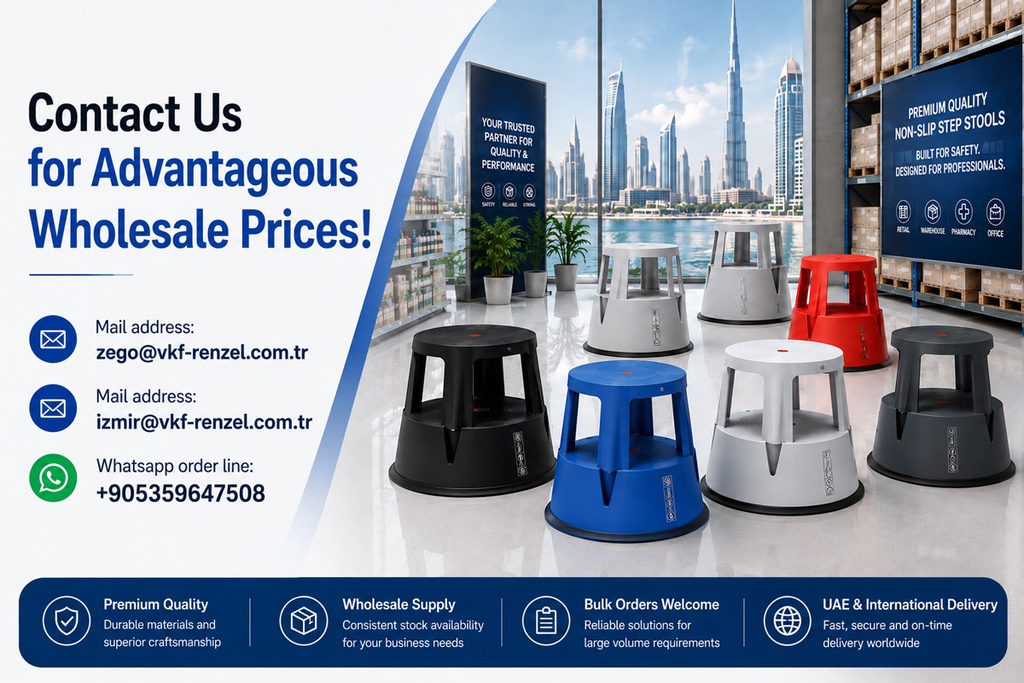
This guide is written for retail operations and purchasing managers. It examines how the right stool improves merchandising speed, protects customer-facing safety, reduces staff risk, and supports consistent standards across multi-store networks in major Saudi cities and industrial zones.
The Invisible Tool That Shapes the Sales Floor
In a busy Saudi retail store the upper shelves and promotional displays must stay full, clean and correctly priced while customers move freely through the aisles. Every time a team member climbs on a chair, a lower shelf or a stack of cartons, two things happen: a safety risk is created and the professional appearance of the store is compromised.
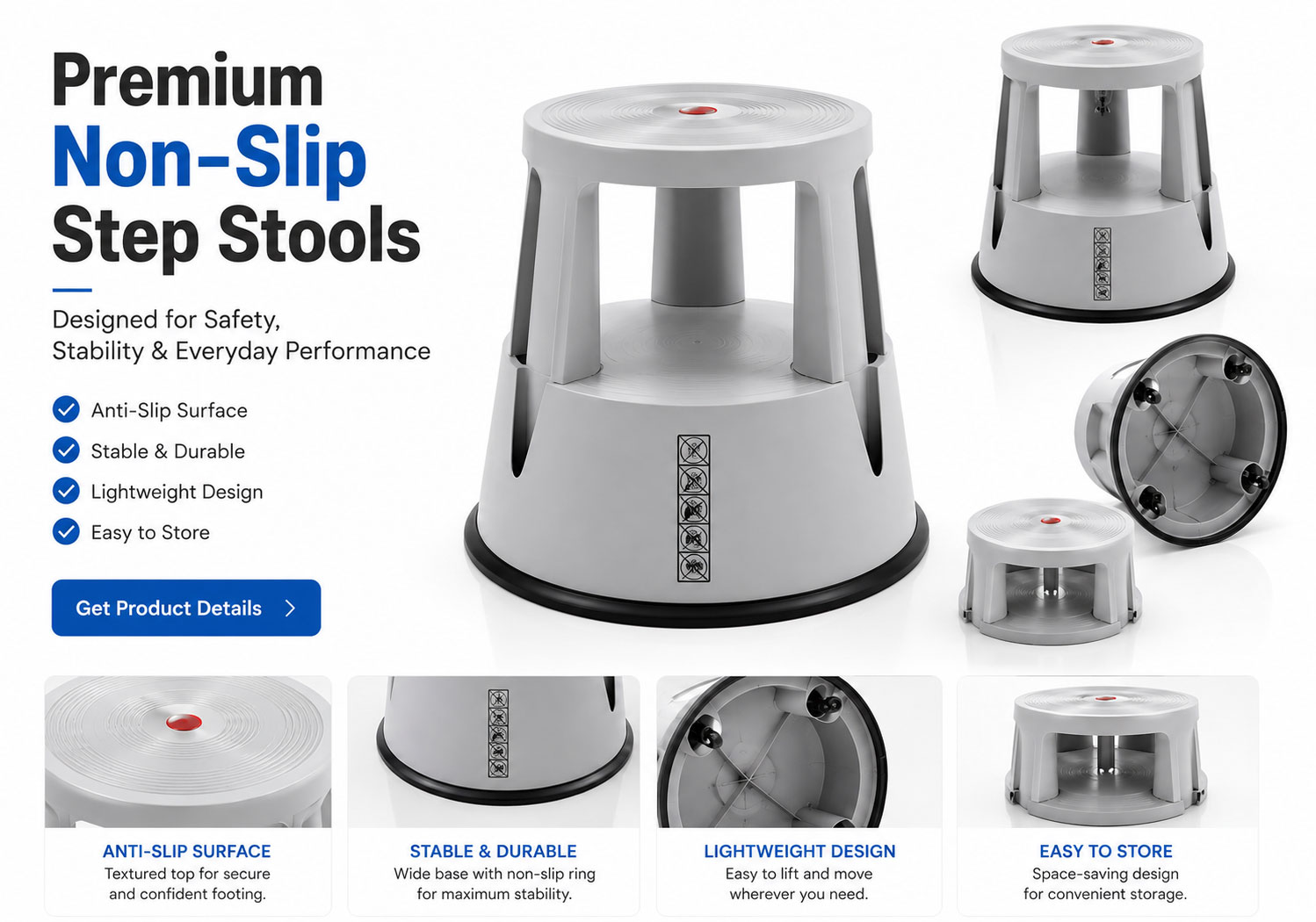
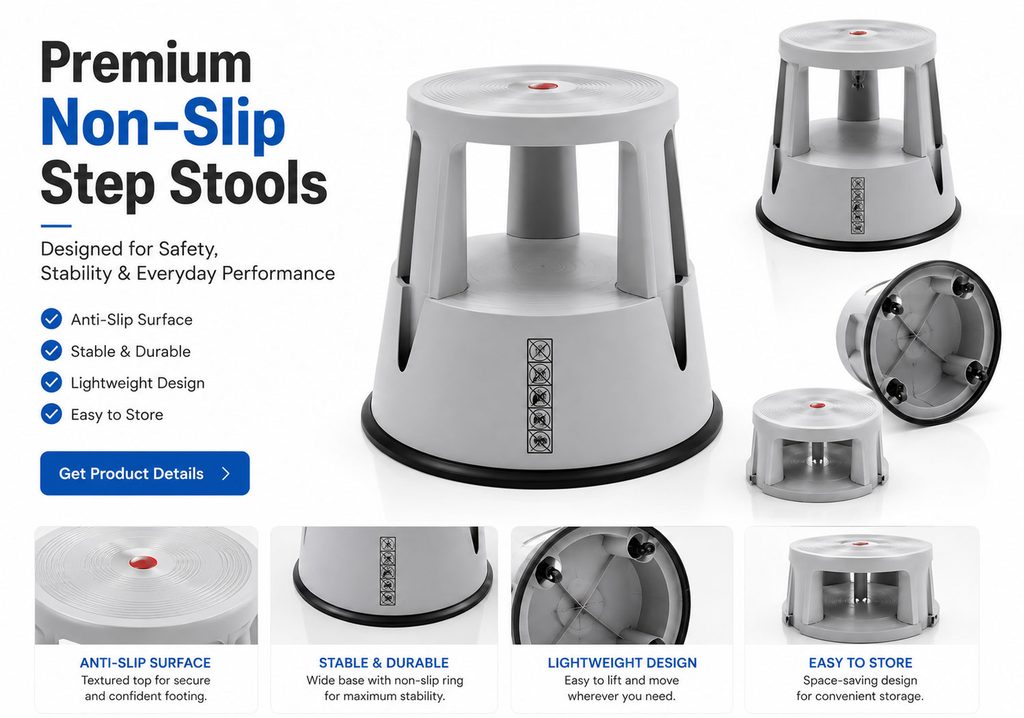
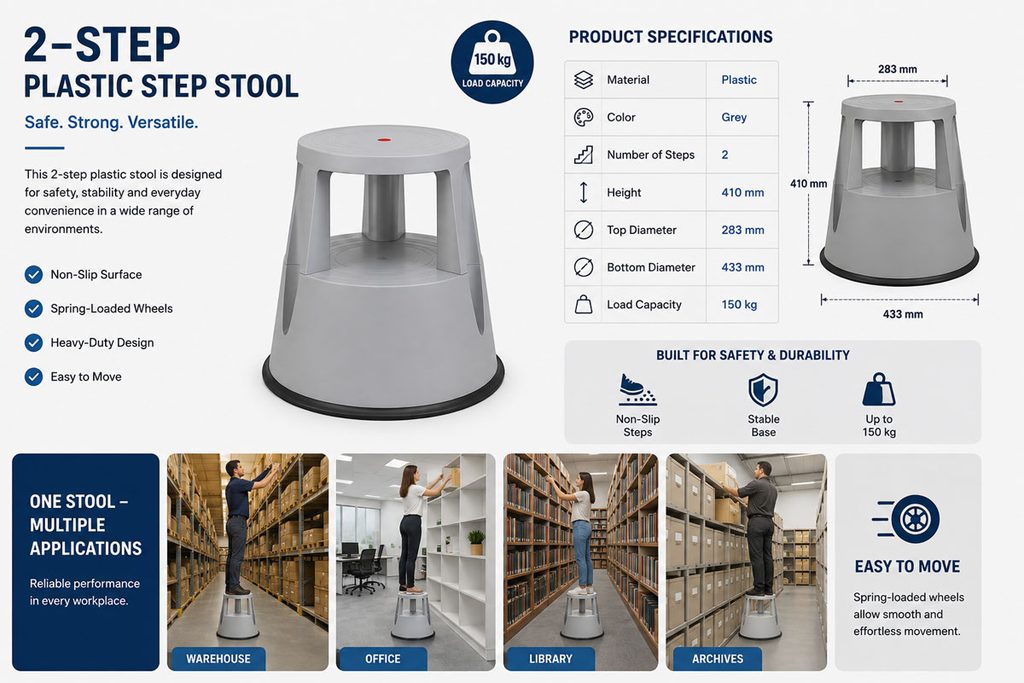
A professional 2-step plastic step stool with spring-loaded wheels removes both problems. The unit stands approximately 410 mm high, offers a 283 mm top platform, a 433 mm base and a 150 kg load rating. The surface is textured for grip. The wheels retract under body weight so the stool becomes a fixed platform the moment someone stands on it. When the user steps off, the wheels re-engage and the stool can be rolled to the next bay in seconds. This combination of mobility and locking stability is what makes the tool suitable for open sales-floor use in supermarket and retail environments.
Why Retail Conditions Demand a Different Standard
Retail floors are customer environments. Equipment must look clean, move quietly and never create a trip hazard. At the same time it must survive daily commercial use, frequent cleaning and the temperature differences between air-conditioned sales areas and warmer back rooms or loading zones.
A stool that fails any of these tests is quickly abandoned by staff, who then return to improvised climbing. The result is higher risk, slower merchandising and a less professional appearance. The spring-loaded non-slip design addresses the full set of requirements: it locks securely, grips reliably, cleans easily and presents a neat, low-profile shape that does not dominate the aisle.
How the Tool Is Used Across Saudi Retail Locations
Although the core task is the same, store formats and logistics intensity differ by city and zone.
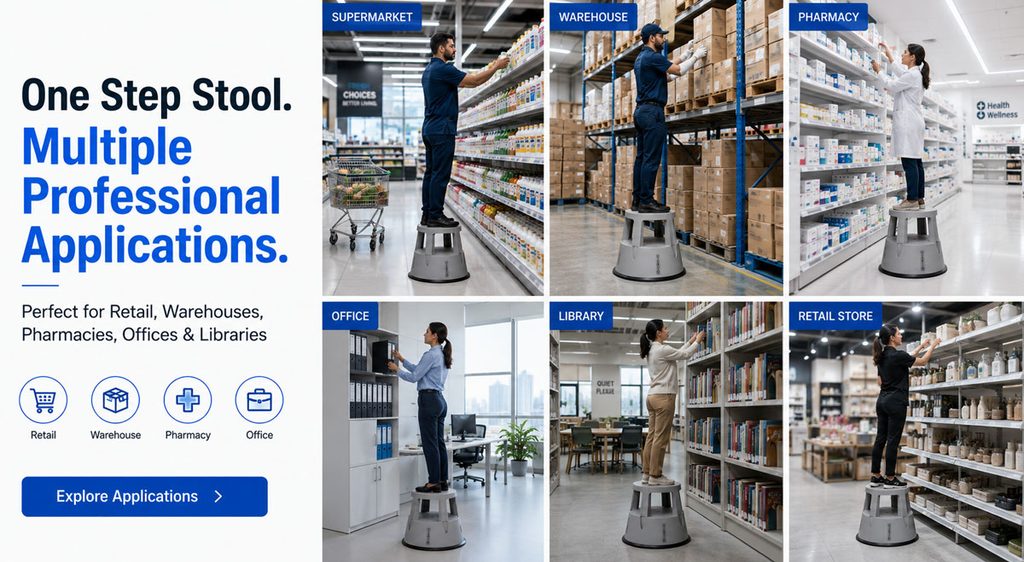
In Riyadh large supermarket and hypermarket formats run continuous merchandising cycles; mobile stools that lock under weight allow staff to keep upper shelves full without blocking customer flow.
As Sulay Riyadh contains a mix of mid-sized retail formats where compact, easily stored stools prove practical in tighter floor plans.
Al Mashael Riyadh is adding new retail space; introducing one standardised professional stool from the first stores supports consistent safety and appearance standards.
Al Kharj retail operations often sit alongside logistics activity; durable construction handles both sales-floor and light back-of-house use.
Jeddah coastal stores face higher humidity and more frequent wet cleaning; surface grip that remains effective under these conditions protects both safety and presentation.
Jeddah Industrial City supplies many retail networks; warehouse retail teams preparing goods for store delivery use the same heavy-duty stools for upper-level access.
Al Khomrah Jeddah handles intensive distribution-to-store flows; rapid, safe movement between back room and sales floor is essential.
KAEC continues to develop new commercial capacity; early adoption of standardised spring-loaded stools supports uniform practice across new retail sites.
Dammam combines retail and industrial activity; equipment must perform reliably in both customer-facing and support areas.
Dammam Industrial City supports manufacturing and logistics that feed supermarket shelves; temporary elevated access during preparation and quality checks is routine.
Al Khobar retail environments value quiet movement and secure locking in busy customer zones.
Yanbu Industrial City adds higher ambient temperatures; robust plastic and reliable wheel mechanisms remain important even for retail-support facilities.
Qassim region stores serve both urban and surrounding communities; long service life and simple maintenance reduce replacement logistics.
Buraydah, the commercial centre of Qassim, sees steady daily use of mobile stools for merchandising and upper-shelf work.
Makkah Industrial City supports western-region retail and logistics; equipment that can be ordered in bulk and maintained simply matches the scale of operations.
Jubail industrial and supporting retail facilities still require safe mobile access for higher fixtures where the 150 kg rating is appropriate.
Across every location the purchasing priority is the same: choose a design that locks under weight, presents a professional appearance, and survives daily commercial use, then supply it consistently.
Technical Profile for Retail Environments
| Attribute | Typical Value | Retail Benefit |
|---|---|---|
| Height | 410 mm | Useful reach for standard supermarket shelving |
| Top diameter | 283 mm | Stable standing surface for merchandising |
| Base diameter | 433 mm | Tip resistance and low visual profile |
| Load capacity | 150 kg | Covers staff plus normal product or tool load |
| Material | Heavy-duty plastic | Clean appearance, no corrosion, easy sanitation |
| Surface | Textured non-slip | Grip on tiled and polished floors |
| Wheel system | Spring-loaded | Locks under weight, rolls quietly when unloaded |
| Colour | Grey | Neutral and practical for most retail interiors |
These dimensions should be verified on actual samples. Consistency across bulk quantities is essential for multi-store networks that want uniform appearance and performance.
Material and Appearance Considerations
In a retail setting the stool is visible to customers. Grey plastic with a clean moulded surface and a neat black base ring presents a professional image. The same material must also resist cleaning chemicals and temperature changes without becoming brittle or losing grip. Higher-grade formulations maintain both appearance and structural integrity over years of daily use. Lower-grade plastics often show scuffs, stress marks or degraded texture that make the equipment look tired and reduce staff confidence.
Common Mistakes That Undermine Retail Standards
- Buying the cheapest available unit without testing locking behaviour or appearance
- Accepting free-rolling designs that can still move while staff are working at height
- Allowing different stores to purchase different models, creating inconsistent look and feel
- Ignoring spare-parts availability, so that damaged units stay in service or are simply discarded
- Failing to include the stools in formal safety procedures and staff training
Each of these errors increases risk and weakens the professional presentation of the store.
Retail Buyer Checklist
- Test spring-loaded retraction under realistic load on sample units
- Inspect surface finish and base ring for clean appearance
- Confirm dimensional consistency for bulk orders
- Verify OEM or private-label options if brand alignment is required
- Establish clear lead times for both initial and top-up supply
- Assign responsibility for ongoing inspection and storage standards
Commercial Supply Routes for Retail Networks
A manufacturer that understands commercial retail use can deliver consistent quality, clean appearance and the volume capacity multi-store groups need. Many retailers also require OEM capability so the stools can carry subtle branding or colour matching. Wholesale and distributor partners provide regional stock and flexible top-up orders. Firmalazım operates across these channels, supporting bulk orders and structured distributor relationships for supermarket and retail environments.
Total Cost in a Multi-Store Context
A useful three-to-five-year view includes acquisition cost, logistics, expected service life, spare parts, inspection labour, early replacement, and the value of faster merchandising plus fewer safety incidents. When these factors are examined together, a higher-specification unit with reliable locking and durable finish almost always delivers the lower net cost. Safety is the primary justification; merchandising speed and consistent store presentation provide additional return.
Maintenance That Protects Both Safety and Appearance
Daily visual checks confirm free rolling and clean retraction. Weekly cleaning with standard retail floor detergents keeps the surface and base looking professional. Monthly inspection of springs and wheels prevents progressive failure. Because the design is simple and mechanical, most issues are visible before they affect safety or appearance. Keeping a small number of spare units at higher-volume stores avoids gaps during peak trading.
Side-by-Side Comparison for Retail Decision Makers
| Factor | Basic Free-Rolling Stool | Professional Spring-Loaded Non-Slip | Fixed Platform |
|---|---|---|---|
| Speed of movement between bays | High | High | None |
| Stability while working | Variable | High | High |
| Appearance on open sales floor | Often poor | Clean and professional | Bulky |
| Customer trip-hazard risk | Moderate | Low | Higher |
| Typical service life | 12–24 months | 36–60 months | Long |
| Ease of multi-store consistency | Low | High | Moderate |
| 3–5 year total cost | Frequently higher | Usually lower | High opportunity cost |
The spring-loaded non-slip design sits in the practical centre that retail operations require.
Implementation Approach for Retail Chains
- Select pilot stores with different formats and traffic levels.
- Deploy a controlled quantity for 30–60 days and gather feedback on usability, appearance and any change in height-related incidents.
- Finalise one approved specification and the commercial terms, including bulk pricing and parts supply.
- Calculate network quantities from actual store layouts and merchandising intensity.
- Align deliveries with existing store maintenance windows.
- Provide a short practical demonstration of locking behaviour.
- Designate storage points that keep the stools available yet out of customer flow.
- Review performance and replacement rates at six months.
This sequence keeps risk low and produces clear internal evidence for wider adoption.
Expert Perspective on Customer-Facing Safety
When staff climb on chairs or shelves in view of customers, the store sends an unintended message about its safety culture. A professional step stool that locks securely and looks clean supports both actual safety and perceived standards. Safety teams gain an auditable control. Store managers gain a tool that staff will use because it is convenient and reliable. Purchasing teams gain a predictable, multi-year cost profile.
Closing View
A professional 2-step plastic step stool with non-slip surface and spring-loaded wheels is a modest item on any retail capital list. Its influence on daily merchandising speed, staff safety and store presentation is significant. Buyers who evaluate it through total cost of ownership, appearance standards and supplier reliability secure equipment that locks under weight, maintains a clean look and performs consistently across Saudi retail and supermarket environments.
Firmalazım operates as a manufacturer focused on commercial use, supporting bulk orders, OEM requirements and distributor channels for professional step stools engineered for supermarket and retail operations throughout Saudi Arabia.
FAQ
1. What makes a step stool “professional” for retail store use? Reliable spring-loaded locking, clean non-slip surface, wide stable base, 150 kg rating, and an appearance that suits open sales floors.
2. How does the spring-loaded system improve safety on the sales floor? Wheels retract under body weight so the stool cannot roll while staff are working at height in front of customers.
3. Is 150 kg capacity sufficient for normal retail merchandising tasks? Yes. It covers a staff member plus typical product or tool loads under commercial use.
4. How should total cost be calculated across a retail network? Include acquisition, logistics, expected life, spare parts, inspection labour, early replacement, and the value of faster merchandising plus fewer incidents.
5. What are the most common purchasing mistakes in retail? Buying on price alone, accepting free-rolling designs, allowing mixed models across stores, and ignoring spare-parts supply.
6. Can the same stool be used on the sales floor and in back-of-house warehouse retail areas? Yes. The non-slip surface and locking wheels perform in both environments.
7. How useful is OEM capability for retail chains? It allows subtle branding or colour matching so equipment aligns with store standards.
8. What maintenance keeps both safety and appearance intact? Daily visual checks, weekly cleaning with standard retail detergents, and monthly spring/wheel inspection.
9. What service life is realistic under daily retail use? Three to five years when the simple inspection routine is followed.
10. Should these stools be included in new-store fit-out packages? Yes. Including them from opening day prevents later inconsistent purchasing and missing equipment.
11. What documentation should be required before a bulk order? Dimensional drawings, load confirmation, material data, warranty terms and spare-parts availability.
12. How do wholesale and distributor channels help multi-store retailers? They provide regional stock and faster top-up orders between major deliveries.
13. What training do retail staff need? A short demonstration that the wheels retract under weight is normally sufficient.
14. How can incident data support the investment case? Compare height-related near-misses or improvised climbing before and after introduction. A clear reduction strengthens the case for wider roll-out.
15. Do industrial-support locations such as Jubail or Yanbu need different features? They need the same core features, with attention to temperature resistance and durability.
16. How should spare units be managed in a retail network? Keep a small number at higher-volume stores so individual stools can be rotated without creating gaps.
17. Why does base diameter matter on a sales floor? A wider base improves stability and reduces the visual bulk of the unit.
18. Can colour or finish be customised? Often yes under an OEM programme, subject to minimum quantities.
19. Why is plastic usually preferred for retail environments? It is light, non-corrosive, easy to clean, and presents a neat appearance.
20. What message does improvised climbing send to customers? It suggests that safety standards are secondary, which can undermine confidence in the store.
21. How should a pilot be structured in a retail chain? Select contrasting store formats, define simple metrics, and run for 30–60 days before full commitment.
22. What logistics factors matter for delivery into industrial and commercial zones? Suppliers familiar with local procedures usually provide more predictable lead times and clearer documentation.
23. Should replacement rates be tracked? Yes. Rising early failures indicate either specification or maintenance issues.
24. How does Firmalazım support retail buyers in Saudi Arabia? As a manufacturer focused on commercial use, it supports bulk orders, OEM requirements and distributor channels for supermarket and retail safety equipment.
25. What is the main operational difference between a spring-loaded stool and a fixed platform? The spring-loaded unit can be moved quickly between tasks without obstructing customers; a fixed platform cannot.
26. How important is non-slip texture on polished retail floors? Critical. Dust and cleaning residue reduce grip on smooth surfaces; texture maintains traction.
27. Can ordinary retail floor detergents be used? Yes. Avoid aggressive solvents that can damage the plastic or texture over time.
28. What is the most useful question a buyer can ask before signing? Does this specification, at this total cost of ownership, improve both safety and merchandising efficiency across our retail network?
29. How can supply risk be reduced? Use dual channels where practical, keep modest safety stock, and lock clear lead times into the agreement.
30. What is the simplest way to start improving height-access practice on the sales floor? Replace improvised climbing with a single, well-specified professional stool that staff will actually use, then standardise it across stores.
Request a practical total-cost comparison and sample units so your retail operations team can evaluate spring-loaded performance and appearance under real store conditions.Speak with the commercial team about volume pricing, OEM options and a structured supply plan for your multi-store network.Obtain current technical data, load documentation and logistics details for bulk orders into the main Saudi cities and industrial zones.Schedule a focused discussion on standardising professional non-slip step stools and eliminating improvised climbing on the sales floor.Contact us to explore manufacturer-direct or distributor-supported supply of durable, spring-loaded stools engineered for the safety, appearance and operational demands of supermarket and retail environments across Saudi Arabia.
Professional Step Stools for Retail Stores in Saudi Arabia
Professional step stools shape both safety and the visible quality of Saudi retail stores. A 2-step plastic model with non-slip surface, spring-loaded wheels, 150 kg capacity and wide base lets staff merchandise upper shelves and maintain displays without ladders or improvised climbing that customers can see.
This continuation focuses on customer perception, merchandising rhythm, brand consistency across multi-store networks, and the practical decisions that keep equipment looking professional and performing reliably in supermarket and retail environments throughout Saudi Arabia.
The Customer Sees Everything
In an open retail environment every action on the sales floor is visible. When a team member climbs on a chair or a lower shelf to adjust a price ticket or restock a high bay, customers notice. The moment registers as informal, slightly careless, and at odds with the polished image most Saudi supermarket and retail brands work hard to maintain.
A professional step stool changes the visual story. The unit is low-profile, grey, and purpose-built. Staff step on, the wheels lock, the work is done, and the stool is rolled away. The sequence looks controlled and intentional. That small difference supports both actual safety and the perception of operational discipline.
Merchandising Rhythm and Lost Minutes
Retail merchandising is a continuous rhythm of small tasks: facing up, rotating stock, changing promotional tickets, cleaning high signage, and adjusting planograms. Each task that requires height access consumes time. When the only available solution is a ladder that must be fetched, opened, and later put away, the minutes accumulate. When the solution is a wheeled stool that is already nearby and locks automatically, the same tasks shrink.
Over a full trading day and across dozens of stores the difference becomes measurable in labour efficiency and in the freshness of the upper shelves that customers actually see.
Brand Consistency Across a Network
Multi-store retailers face a quiet but persistent problem: different sites quietly buy different stools. One store ends up with a free-rolling model, another with a fixed platform, a third with a worn unit that no longer locks cleanly. The result is inconsistent appearance, inconsistent staff behaviour, and inconsistent safety practice.
Standardising on one professional spring-loaded design removes that drift. Every store presents the same clean equipment, the same locking behaviour, and the same expectation of safe height access. For brands that invest heavily in visual standards, this consistency is part of the overall store experience.
Location Notes Focused on Retail Presentation
Store formats and customer density vary, yet the need for a professional, mobile solution remains constant.
In Riyadh large-format supermarket and hypermarket sites run continuous merchandising; stools that lock securely and look tidy allow upper shelves to stay full without disrupting customer flow.
As Sulay Riyadh mid-sized stores often work with tighter aisle widths; a compact rolling profile that stores cleanly between tasks helps keep the floor uncluttered.
Al Mashael Riyadh is adding new retail space; locking in one approved model from the first stores prevents later visual and operational inconsistency.
Al Kharj retail sites frequently sit near logistics activity; durable construction supports both sales-floor presentation and light back-of-house use.
Jeddah coastal stores contend with higher humidity and more frequent wet cleaning; surface grip and a finish that stays clean protect both safety and appearance.
Jeddah Industrial City supplies many retail networks; warehouse retail teams preparing stock for store delivery use the same professional stools for upper-level access.
Al Khomrah Jeddah handles intensive distribution-to-store movement; equipment that can be moved quickly and locked securely supports smooth flow from back room to sales floor.
KAEC continues to open new commercial sites; early standardisation of spring-loaded stools supports uniform presentation and safety practice from day one.
Dammam retail environments combine high customer traffic with support logistics; the stools must look professional on the sales floor and remain reliable in back areas.
Dammam Industrial City supports manufacturing and logistics that feed supermarket shelves; temporary elevated access during preparation remains a daily need.
Al Khobar stores value quiet movement and a neat appearance in busy customer zones.
Yanbu Industrial City supporting facilities face higher ambient temperatures; robust plastic and consistent wheel performance remain important.
Qassim region stores serve both city and surrounding communities; long service life and simple maintenance keep equipment looking presentable with minimal effort.
Buraydah, the commercial centre of Qassim, sees steady daily use of mobile stools for merchandising and upper-shelf work.
Makkah Industrial City supports western-region retail and logistics; equipment that can be ordered in bulk and maintained simply matches the operational scale.
Jubail industrial and supporting retail sites still require safe mobile access for higher fixtures where the 150 kg rating is appropriate.
In every case the commercial requirement is identical: one clean, locking design supplied consistently through manufacturer or wholesale channels.
Appearance and Material Reality on the Sales Floor
Customers notice scuffs, cracks and dirty surfaces. A professional stool must therefore retain a clean appearance under daily commercial use and frequent cleaning. Higher-grade plastic with a smooth moulded finish and a neat base ring stays presentable longer. Lower-grade units quickly show wear that makes the equipment look neglected. For retailers who invest in store ambience, this difference is not cosmetic—it is part of the brand experience.
Hidden Costs of Inconsistency
When stores operate different models, several quiet costs appear:
- Staff training must be repeated or becomes informal
- Spare parts cannot be pooled efficiently
- Audit documentation becomes more complex
- Visual standards drift
- Some sites revert to improvised climbing when the preferred unit is unavailable
Standardising on a single professional design removes most of these costs at once.
Retail Consistency Checklist
- Approve one model for the entire network
- Include the approved stool in new-store fit-out packages
- Write clear storage and inspection expectations
- Track replacement rates by site as an early-warning indicator
- Use OEM options if subtle branding or colour coding supports zone identification
Commercial Levers for Retail Networks
A manufacturer that understands retail commercial use can deliver consistent quality, clean appearance and the volume capacity multi-store groups require. OEM capability allows discreet branding or colour matching where this supports brand standards. Wholesale and distributor partners provide the regional stock and flexible top-up orders that keep networks supplied without large central inventories. Firmalazım works across these routes, supporting bulk orders and structured distributor relationships for supermarket and retail environments.
Total Cost Through a Retail Lens
A three-to-five-year view should capture acquisition, logistics, service life, spare parts, inspection labour, early replacement, and the value of faster merchandising plus fewer visible safety lapses. When these elements are examined together, a higher-specification unit with reliable locking and durable finish almost always delivers the lower net cost. Safety remains the primary justification; merchandising efficiency and consistent store presentation supply the secondary return.
Maintenance That Protects Presentation
Daily visual checks confirm free rolling and clean retraction. Weekly cleaning with standard retail detergents keeps the surface and base looking professional. Monthly inspection of springs and wheels prevents progressive failure. Because wear is usually visible, this light routine protects both safety and appearance without adding significant labour.
Refined Comparison for Retail Decision Makers
| Factor | Basic Free-Rolling | Professional Spring-Loaded Non-Slip | Fixed Platform |
|---|---|---|---|
| Visual impact on sales floor | Often poor | Clean and low-profile | Bulky |
| Speed between merchandising tasks | High | High | None |
| Locking reliability | Low | High | High |
| Ease of network-wide consistency | Low | High | Moderate |
| Typical service life | 12–24 months | 36–60 months | Long |
| Customer trip-hazard risk | Moderate | Low | Higher |
| 3–5 year total cost (network) | Frequently higher | Usually lower | High opportunity cost |
The spring-loaded non-slip design continues to occupy the practical centre for retail operations.
Practical Network Roll-Out Sequence
- Select pilot stores with different formats and customer densities.
- Deploy a controlled quantity for 30–60 days and gather feedback on usability, appearance and any change in improvised climbing.
- Finalise one approved specification and the commercial terms, including bulk pricing and parts supply.
- Calculate network quantities from actual store layouts and merchandising intensity.
- Align deliveries with existing store maintenance windows.
- Provide a short practical demonstration of locking behaviour.
- Designate storage points that keep the stools available yet outside main customer flow.
- Review appearance, usage and replacement rates at six months.
This sequence keeps both safety and brand-presentation risk low while generating clear internal evidence.
Closing Perspective
A professional 2-step plastic step stool with non-slip surface and spring-loaded wheels will never be the most visible investment in a retail store. It will, however, influence daily merchandising speed, staff safety behaviour and the impression customers form when they look up at the higher shelves. Purchasing and operations managers who evaluate it through total cost of ownership, appearance standards and supplier reliability secure equipment that locks under weight, stays presentable and performs consistently across Saudi supermarket and retail environments.
Firmalazım continues to operate as a manufacturer focused on commercial use, supporting bulk orders, OEM requirements and distributor channels for professional step stools engineered for supermarket and retail operations throughout Saudi Arabia.
Further FAQ Entries
31. How does a professional stool affect customer perception? It replaces visible improvised climbing with a controlled, purpose-built action that supports the store’s overall image of care and organisation.
32. Why do mixed fleets across stores create hidden costs? They complicate training, spare-parts management, audit documentation and visual standards, and increase the chance that staff revert to unsafe improvisation.
33. Can subtle branding be added under an OEM programme? Yes, when minimum quantities are met. Discreet logos or colour accents can support brand consistency without dominating the equipment.
34. How should storage points be chosen on a busy sales floor? Select locations close to high-merchandising zones yet outside main customer pathways and emergency routes.
35. What is the clearest sign that current height-access practice is damaging store standards? Visible climbing on chairs or shelves during trading hours, or upper shelves that remain under-stocked because access is inconvenient.
36. How often should appearance and condition be reviewed network-wide? Quarterly reviews of replacement rates and sample-site condition catch rising wear or inconsistency early.
37. Is the same model suitable for both premium and high-volume supermarket formats? Yes. The clean appearance and reliable locking behaviour work across format types; only quantities and storage planning differ.
38. How does formal inclusion in store procedures help during brand or safety audits? It demonstrates that height-access risk is controlled by specified equipment rather than left to individual discretion.
39. What is the most cost-effective way to handle occasional higher-reach tasks? Keep the standard professional stools for daily merchandising and maintain a small number of taller platforms for the minority of tasks that exceed normal reach.
40. What final commercial question should a retail buyer ask? Can the manufacturer or distributor deliver consistent quality, clean appearance and reliable supply into the specific cities and industrial zones where our stores operate?
Request a network-level cost and consistency model plus sample units so your retail team can evaluate both performance and appearance under real store conditions.Discuss volume pricing, OEM branding options and a phased supply plan matched to your store network growth.Obtain full technical data, finish samples and logistics parameters for bulk delivery into the main Saudi retail and industrial zones.Arrange a practical working session focused on eliminating visible improvised climbing and standardising professional step stools across your stores.Contact us to explore manufacturer-direct or distributor-supported supply of durable, spring-loaded stools engineered for the safety, appearance and operational demands of supermarket and retail environments across Saudi Arabia.
Professional Step Stools for Retail Stores in Saudi Arabia
Professional Step Stools for Retail Stores in Saudi Arabia influence both the daily rhythm of Saudi retail stores and the long-term consistency of brand standards. A 2-step plastic design with non-slip surface, spring-loaded wheels, 150 kg capacity and wide base enables staff to execute upper-shelf merchandising quickly and safely while preserving a clean, controlled appearance on the sales floor.
This further continuation examines staff adoption, peak-trading pressure, planogram execution, seasonal demand spikes, and the commercial choices that protect brand equity across multi-store networks in Saudi Arabia.
Why Staff Either Adopt the Tool or Ignore It
Equipment succeeds on the sales floor only when staff prefer it to the alternatives. If a stool is difficult to find, awkward to move, or feels unstable, teams quietly return to chairs and lower shelves. The spring-loaded design succeeds because the behaviour is immediate and trustworthy: step on and it locks; step off and it rolls. No levers to remember, no sticky mechanisms, no surprising movement.
When that reliability is combined with convenient storage points, adoption becomes self-reinforcing. Staff use the stool because it is faster and safer than improvising. Managers see fewer height-related incidents and more consistent upper-shelf presentation. The cycle supports itself.
Peak Trading and the Cost of Delay
During peak periods—weekend trading, promotional launches, Ramadan, National Day, back-to-school—the volume of merchandising tasks rises sharply. Upper shelves must be replenished more frequently, promotional tickets changed faster, and displays adjusted under time pressure. Any solution that adds friction (fetching a ladder, waiting for a shared platform, or working from an unstable surface) multiplies across hundreds of small tasks.
A wheeled non-slip stool that is already on the floor and locks automatically shrinks those task times. The cumulative effect across a full peak day is measurable in both labour efficiency and the visual freshness of the store that customers experience.
Planogram Execution and Vertical Accuracy
Modern supermarket planograms treat the full height of the fixture as selling space. When upper levels are under-faced, incorrectly ticketed or left with gaps, the planogram integrity collapses and sales potential is lost. Professional step stools make vertical accuracy practical. Staff can reach the top shelf, adjust facing, and move to the next bay without the time penalty of traditional ladders. The result is tighter planogram compliance and better return on the space the retailer already pays for.
Seasonal and Promotional Intensity
Saudi retail calendars contain intense promotional windows. During these periods the same upper shelves that normally receive routine attention become high-priority zones. Temporary displays are built, removed and rebuilt. Price tickets change daily. The equipment that supports this intensity must be available in sufficient numbers, quick to reposition, and reliable under repeated use.
A standardised professional stool fleet that can be supplemented with bulk orders ahead of major seasons gives operations teams the capacity they need without last-minute improvisation.
Location Notes – Peak and Presentation Focus
Different cities experience peak pressure in slightly different ways, yet the equipment requirement remains consistent.
In Riyadh large-format stores face concentrated weekend and promotional peaks; stools that lock securely and stay presentable allow upper shelves to keep pace with demand.
As Sulay Riyadh mid-sized formats often operate with leaner staffing; a tool that is fast to use and easy to store multiplies the effectiveness of each team member.
Al Mashael Riyadh new stores benefit from receiving a full complement of professional stools at opening so peak-season readiness is built in from the start.
Al Kharj sites that combine retail with nearby logistics activity need equipment that performs on both the sales floor and in light support areas during intensive periods.
Jeddah coastal stores experience strong seasonal and weekend peaks alongside higher humidity; surface grip and clean appearance remain important under pressure.
Jeddah Industrial City preparation hubs that feed retail stores use the same professional stools for upper-level work when promotional volumes surge.
Al Khomrah Jeddah distribution-to-store flows intensify before major trading periods; rapid, locked access supports timely replenishment.
KAEC new commercial sites that open into peak seasons require standardised equipment from day one to avoid early inconsistency.
Dammam stores balance high customer traffic with promotional intensity; stools must look professional and remain reliable throughout.
Dammam Industrial City support facilities see corresponding peaks in preparation work; temporary elevated access becomes more frequent.
Al Khobar busy retail zones value quiet, controlled movement even when merchandising pressure is high.
Yanbu Industrial City supporting sites face temperature stress during summer peaks; durable construction protects performance.
Qassim region stores serve both urban and wider catchments; long-life equipment reduces the risk of shortages during intensive periods.
Buraydah commercial activity concentrates promotional and weekend demand; mobile stools that staff trust keep upper shelves current.
Makkah Industrial City western-region logistics and retail support experience corresponding seasonal volume spikes; bulk-capable supply is essential.
Jubail industrial and supporting retail locations still require safe mobile access for higher fixtures when promotional or maintenance work intensifies.
In every location the commercial logic is the same: one reliable, presentable design supplied consistently through manufacturer or wholesale channels, with the capacity for bulk orders ahead of peak seasons.
Protecting Brand Equity Through Equipment Standards
Brand equity in retail is built from thousands of small consistent details. Visible improvised climbing, worn or mismatched stools, and under-presented upper shelves all erode that equity over time. A single professional standard across the network protects the visual and operational consistency that customers associate with the brand. For purchasing managers this is not a soft benefit—it is a measurable contribution to the store experience the company is trying to sell.
Extended Commercial Considerations for Peak Readiness
A manufacturer able to deliver consistent quality and volume is the foundation. OEM options allow discreet branding or colour accents that support brand standards without dominating the equipment. Wholesale and distributor partners provide the regional stock and flexible top-up capacity needed before major seasons. Firmalazım operates across these commercial routes, supporting bulk orders and structured distributor relationships for supermarket and retail environments that must stay ready for peak demand.
Total Cost Including Peak-Season Dynamics
A realistic multi-year model should also capture the cost of being unprepared for peaks: overtime labour, lost sales from under-faced upper shelves, emergency equipment purchases, and the reputational effect of visible improvisation during high-traffic periods. When these factors are included, a standardised professional fleet that can be reinforced with planned bulk orders shows a clearer advantage.
Maintenance Under Peak Pressure
The lightest routines survive peak periods. A five-second visual check at the start of the shift remains feasible. Weekly cleaning continues with the same detergents already in use. Monthly spring and wheel inspection can be scheduled outside the most intensive trading windows. Because wear is progressive and visible, this approach keeps the fleet reliable without competing for labour during the busiest days.
Decision Table – Peak and Brand Focus
| Factor | Basic Free-Rolling | Professional Spring-Loaded Non-Slip | Fixed Platform |
|---|---|---|---|
| Usability under peak pressure | Limited | High | Low |
| Visual consistency across stores | Low | High | Moderate |
| Support for planogram accuracy | Moderate | High | Low |
| Ease of seasonal bulk reinforcement | Variable | High | Low |
| Typical service life | 12–24 months | 36–60 months | Long |
| Brand-presentation risk | Higher | Lower | Moderate |
| 3–5 year total cost including peaks | Frequently higher | Usually lower | High opportunity cost |
The spring-loaded non-slip design continues to deliver the best balance for retail operations that must protect both safety and brand presentation.
Network Roll-Out Sequence Tuned for Peak Readiness
- Map merchandising intensity and peak calendars at pilot stores.
- Deploy a controlled quantity and measure both daily usability and peak-period performance.
- Finalise one approved specification and commercial terms that include capacity for seasonal bulk orders.
- Calculate network quantities from real layouts and known peak multipliers.
- Schedule baseline deliveries and pre-peak top-ups.
- Deliver short practical demonstrations focused on locking reliability.
- Embed the approved stool in store procedures and designate storage points that remain accessible under peak traffic.
- Review usage, appearance and replacement rates after the first major peak.
This sequence builds both safety control and peak-season readiness while generating clear internal evidence.
Closing Perspective
A professional 2-step plastic step stool with non-slip surface and spring-loaded wheels is a small piece of equipment. Its influence on merchandising rhythm, staff behaviour during peak trading, planogram accuracy and long-term brand consistency is substantial. Purchasing and retail operations managers who evaluate it through total cost of ownership, peak readiness and supplier reliability secure a tool that locks under weight, stays presentable and supports the standards the brand works to maintain across Saudi supermarket and retail environments.
Firmalazım continues to operate as a manufacturer focused on commercial use, supporting bulk orders, OEM requirements and distributor channels for professional step stools engineered for the daily and peak-season demands of supermarket and retail operations throughout Saudi Arabia.
Additional FAQ Entries
41. How does a professional stool improve planogram compliance? It makes accurate upper-shelf facing and ticketing fast enough to be done consistently rather than deferred.
42. Why do peak trading periods expose weak height-access solutions? Task volume rises sharply; any friction in the access method multiplies across hundreds of small merchandising actions.
43. Can seasonal bulk orders be planned in advance with a manufacturer or distributor? Yes. Clear lead times and volume capacity allow pre-peak reinforcement of the fleet.
44. What is the most visible sign that height-access practice is damaging brand perception? Customers seeing staff climb on chairs or shelves during normal trading hours.
45. How should storage points be managed during peak periods? Keep them close to high-intensity merchandising zones yet outside the densest customer pathways so availability remains high without creating obstacles.
46. Does standardisation help during external brand or safety audits? Yes. One approved model with documented procedures demonstrates controlled practice across the network.
47. How can replacement rates be used as a peak-season readiness indicator? Rising early failures before or during peaks signal that the fleet is under stress and may need reinforcement or specification review.
48. Is colour coding useful for peak-season equipment management? Under an OEM programme, different colours can help teams identify stools assigned to specific zones or promotional areas.
49. What is the simplest way to protect upper-shelf presentation during intensive trading? Ensure every store has enough professional stools that staff actually prefer to use, positioned where the work happens.
50. What final question should a retail buyer ask before committing to a large programme? Can the manufacturer or distributor deliver consistent quality, clean appearance and reliable volume—including seasonal bulk capacity—into the cities and industrial zones where our stores operate?
Request a peak-season readiness model and sample units so your retail team can evaluate both daily performance and high-pressure usability.Discuss volume pricing, OEM options and a supply plan that includes pre-peak bulk capacity for your store network.Obtain technical data, finish samples and logistics parameters for delivery into the main Saudi retail and industrial zones.Arrange a working session focused on protecting upper-shelf presentation and eliminating visible improvised climbing during peak trading.Contact us to explore manufacturer-direct or distributor-supported supply of durable, spring-loaded stools engineered for the safety, appearance and peak-season demands of supermarket and retail environments across Saudi Arabia.

Bir yanıt yazın